
Reports
The Global Xenon Flash Lamp Market was valued at USD 170.4 Million in 2025 and is anticipated to reach a value of USD 306.2 Million by 2033 expanding at a CAGR of 7.6% between 2026 and 2033. Industrial sterilization and high-precision medical photonics are accelerating replacement demand for high-reliability pulsed xenon architectures.
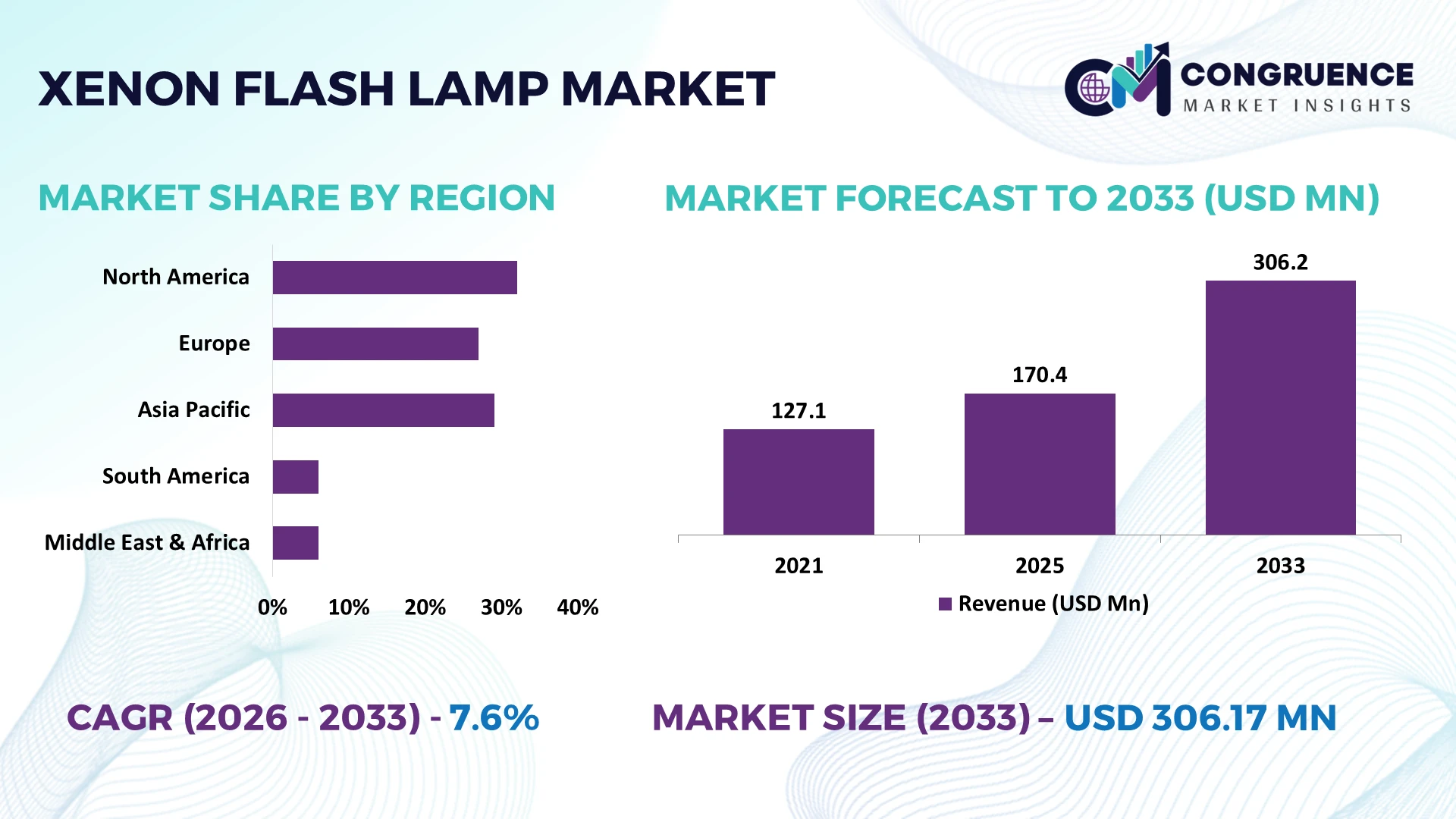
North America’s industrial segment commanded USD 16.8 million in 2025 with 31% share, anchored by advanced manufacturing and semiconductor inspection deployment; Germany followed at USD 13.4 million and 24.7% share, reflecting precision engineering adoption. Geopolitical concentration of xenon gas supply in Ukraine continues to pressure procurement strategies across European and Japanese OEMs.
The strategic implication is clear, supply-chain localization and application-specific lamp engineering now determine competitive positioning more than raw output capacity.
Market Size & Growth: Valued at USD 170.4 million in 2025, forecast to USD 306.2 million by 2033 at 7.6% CAGR, driven by mercury-free UV sterilization adoption in food and healthcare processing.
Top Growth Drivers: Aesthetic dermatology and IPL systems contribute 34% of incremental demand; industrial sterilization accounts for 28%; semiconductor wafer inspection adds 19%.
Short-Term Forecast: By 2027, trigger-circuitry innovations reduce discharge failure rates by 26.4%, improving operational reliability in laser pumping and analytical instrumentation.
Emerging Technologies: Deformed aspheric light guides cut computational modeling time by 80% for flash lamp annealing; AI-driven pulse control and compact reflector designs expand machine vision integration.
Regional Leaders: North America at 32% share prioritizes medical photonics; Asia-Pacific at 29% scales industrial automation; Europe at 27% leads precision optics and regulatory-driven sterilization.
Consumer/End-User Trends: 41% of new photography equipment designs now specify compact xenon modules over LED for high-intensity color rendering in professional imaging.
Pilot/Case Example: 2025 high-power pulsed lamp optimization at Chinese ICF facilities achieved 26.4% peak trigger voltage improvement without operating voltage changes.
Competitive Landscape: Heraeus, Hamamatsu, Ushio, and Excelitas hold 64% combined share, with Heraeus leading in medical and analytical OEM relationships.
Regulatory & ESG Impact: Mercury-free mandates across EU medical device directives drive 22% of replacement demand toward xenon alternatives in dermatology and disinfection.
Investment & Funding: Chinese manufacturers Nam Kwong, Qimei, and Yaming expand capacity at 15–20% lower unit costs, targeting Asia-Pacific industrial and signaling applications.
Innovation & Future Outlook: Long-life electrode designs and UV-C disinfection integration represent the next strategic shift, extending replacement cycles in critical healthcare infrastructure.
The Xenon Flash Lamp Market’s demand core concentrates in aesthetic dermatology, industrial UV sterilization, and semiconductor wafer inspection, where spectral intensity and pulse reliability outperform solid-state alternatives. Recent innovations in trigger circuitry and aspheric light-guide architectures improve discharge consistency and energy-deposition uniformity. Approximately 34% of incremental adoption traces to mercury-free regulatory transitions in European medical device manufacturing. Ukraine’s concentrated xenon gas supply introduces operational uncertainty for European and Japanese OEMs, reinforcing dual-sourcing imperatives. These dynamics frame the strategic pathways examined below.
Xenon flash lamps are transitioning from commodity components to strategic enablers of precision manufacturing and regulated medical workflows. Ukraine’s dominance in xenon gas supply—disrupted by ongoing geopolitical tensions—has forced Heraeus, Hamamatsu, and Excelitas to restructure procurement toward long-term contracts and non-Ukrainian refining partnerships. This supply-chain shift elevates lamp sourcing from purchasing tactic to board-level risk management.
Technologically, optimized trigger circuitry now delivers a 26.4% increase in peak trigger voltage without altering operating voltage, directly reducing discharge failure rates in laser fusion and analytical instrumentation. Regionally, China’s industrial segment reached USD 16.8 million at 31% share, driven by semiconductor inspection and advanced manufacturing, while the United States leads medical applications at USD 12.3 million with 29.3% share. Over the next 24–36 months, adoption indicators point to 15–20% replacement cycles shortening in dermatology and sterilization as mercury-free compliance deadlines tighten.
A practical deployment example: Chinese ICF facilities implemented parallel resistor-capacitor circuit modifications in 2025, achieving measurable discharge reliability gains without capital equipment replacement. Companies are responding by localizing assembly in Southeast Asia and investing in electrode longevity R&D. The strategic conclusion: competitive advantage now hinges on supply-chain resilience and application-specific reliability engineering, not scale alone.
Regulatory elimination of mercury-based UV sources across European medical and food-safety frameworks is redirecting demand toward pulsed xenon architectures, with 22% of dermatology device replacements now specifying xenon alternatives. Industrial sterilization adoption contributes 28% of incremental application demand, driven by food and beverage processing hygiene mandates. Chinese manufacturing hubs—particularly Shenzhen and Dongguan—are responding with cost-competitive lamp assemblies, capturing 31% of industrial segment value at USD 16.8 million. Companies are expanding capacity and forming OEM partnerships with sterilization equipment integrators, compressing lead times by 15–20%. The sharp strategic insight: regulatory compliance is functioning as a demand accelerant, not a cost burden, for suppliers positioned with pre-certified xenon modules.
Ukraine’s dominance in global xenon gas refining—disrupted by geopolitical conflict—creates acute supply vulnerability for European and Japanese lamp manufacturers, with procurement lead times extending and spot prices volatile. Simultaneously, LED alternatives capture 12–15% of photography and signaling applications annually, pressuring xenon’s share in lower-intensity use cases. High production complexity limits new entrant capacity, concentrating risk among Heraeus, Hamamatsu, Ushio, and Excelitas at 64% combined share. Companies are mitigating through dual-sourcing agreements with non-Ukrainian gas refiners, strategic inventory buffers, and application differentiation toward high-intensity niches where LED substitution remains technically unviable.
Flash lamp annealing for perovskite solar cell crystallization and semiconductor dopant activation presents an untapped precision-manufacturing opportunity, with processing windows under 20 milliseconds enabling 11.7% power conversion efficiency in flexible photovoltaic architectures. Deformed aspheric light-guide integration reduces modeling computational time by 80%, accelerating system design cycles for OEMs. China’s semiconductor equipment localization push—targeting wafer inspection and etching applications—creates a captive demand pool for domestic xenon lamp suppliers. Companies positioning R&D toward uniform energy-deposition optics and multi-lamp configurations will capture annealing demand before standardized solid-state alternatives mature. The non-obvious insight: photovoltaic and semiconductor thermal processing represent higher-margin pathways than conventional photography replacement.
High-power pulsed xenon lamps in laser fusion facilities require discharge reliability exceeding 99.9%, yet leading-cable length and circuit configuration variations still produce failure rates demanding continuous engineering intervention. Medical device integration faces additional regulatory scrutiny, with photobiological safety compliance adding 8–12% to development timelines for new dermatology and endoscopic systems. Workforce gaps in high-voltage pulse-power engineering constrain scale-up at Chinese and Southeast Asian manufacturing sites. Companies must invest in simulation-driven circuit optimization and standardized reliability testing protocols, or risk deployment delays in the highest-value application segments. The operational insight: reliability certification, not raw lumen output, constitutes the true barrier to entry in fusion and medical photonics.
Copper Ink Sintering Gains Traction Heraeus Noblelight's xenon flash systems now sinter copper nanoparticle inks in milliseconds, achieving conductivity of ~3 mΩ/□/mil while eliminating inert-gas oven requirements. This photonic processing protects paper and foil substrates from thermal damage, enabling roll-to-roll printed electronics at speeds conventional ovens cannot match. UK-based Promethean Particles and Dycotec Materials are scaling this workflow, with Heraeus integrating flash modules directly into high-volume production lines for RFID and smart packaging.
Mercury-Free Compliance Reshapes Medical OEM Design European medical device directives are accelerating xenon adoption in dermatology and endoscopy, with 22% of replacement demand now tied to mercury-free mandates. Heraeus introduced a high-efficiency medical flash lamp reducing energy consumption by nearly 18% while maintaining diagnostic brightness standards. German and Japanese OEMs are restructuring procurement toward pre-certified xenon modules, compressing regulatory approval cycles for phototherapy and diagnostic imaging systems.
Compact Reflector Engineering Expands Machine Vision Integration Deformed aspheric light-guide designs reduce modeling computational time by 80%, enabling faster OEM customization for high-speed imaging and semiconductor inspection. China's industrial segment, valued at USD 16.8 million at 31% share, is absorbing compact xenon modules for wafer and PCB inspection lines. Companies are responding by co-developing reflector geometries with automation integrators rather than selling standardized lamps.
Dual-Sourcing Becomes Procurement Standard Ukraine's concentrated xenon gas refining capacity has pushed European and Japanese manufacturers to establish non-Ukrainian supply contracts, with lead-time buffers now standard practice. Hamamatsu expanded production capacity by 22% to secure spectroscopy and industrial photonics demand across Asia-Pacific and North America. The non-obvious insight: supply resilience, not luminous output, now determines OEM qualification timelines for critical medical and defense applications.
Pulsed flash lamps command approximately 66% of total type share, driven by their irreplaceable role in spectroscopy, laser pumping, and high-speed imaging where precise microsecond bursts outperform continuous illumination. Scalability advantages in trigger circuitry standardization and reflector integration allow manufacturers to serve multiple OEM platforms from a single pulsed architecture, reducing design-cycle costs across medical and industrial applications. Round flash lamps retain relevance in endoscopic and compact diagnostic devices, while U-shaped and linear configurations serve niche aerospace and entertainment lighting requirements with lower volume but higher customization margins.
The fastest-growing type dynamic centers on application-specific geometries rather than standalone product categories. Chinese manufacturers are expanding linear flash lamp capacity for wafer inspection, with China's linear segment reaching USD 12.9 million in 2025 at 31% share. Companies are shifting R&D investment toward electrode longevity and pulse-shape programmability, prioritizing total cost of ownership over initial unit pricing for semiconductor and fusion research clients. The strategic implication: type differentiation increasingly hinges on system integration capability, not lamp specifications alone.
Industrial applications lead with approximately 30–32.7% share, anchored by material processing, semiconductor manufacturing, and UV curing where pulsed xenon delivers the intensity and spectral breadth solid-state alternatives cannot match. Medical applications follow at 25.3%, concentrated in phototherapy, endoscopy, and diagnostic imaging systems requiring stable wavelength output across device lifecycles. Science and research contributes 20.3%, with spectroscopy and fluorescence studies representing the most specification-sensitive buyer segment.
Photography retains 13% share but faces structural pressure from compact LED arrays in consumer segments, pushing xenon suppliers toward professional and high-speed imaging niches where color rendering and strobe intensity remain non-negotiable. The fastest-growing application shift is occurring in industrial photonic sintering, where millisecond processing windows enable copper ink adoption in printed electronics. Companies are adapting by bundling flash systems with process engineering services rather than selling discrete lamps, particularly for Chinese and German electronics manufacturing clients. Demand is strengthening where thermal budget constraints prohibit conventional oven processing.
Industrial end-users hold approximately 30% share, driven by semiconductor inspection, UV curing, and laser processing lines where xenon lamps function as consumable infrastructure with predictable replacement cycles. Healthcare follows closely at 25.3%, with diagnostic imaging and phototherapy devices creating recurring demand tied to hospital capital equipment refresh schedules and regulatory recertification timelines. Research and academia contribute 20.3%, representing lower volume but disproportionately high specification influence—university and national laboratory adoption often establishes performance benchmarks that industrial buyers later require.
The fastest-growing end-user expansion is occurring in Chinese industrial automation, where domestic equipment builders are specifying xenon modules for machine vision and wafer inspection at 31% of linear lamp segment value. Photography end-users retain 13% share but are consolidating toward professional studios and high-speed industrial imaging, abandoning consumer applications. Companies are targeting healthcare OEMs through long-term supply agreements with reliability guarantees, while industrial clients receive co-development partnerships for application-specific reflector and trigger configurations. Future demand shifts toward buyers who treat xenon as a process-critical component rather than a replaceable commodity.
North America accounted for the largest market share at 32% in 2025 however, Asia-Pacific is expected to register the fastest growth, expanding at a CAGR of 7.9% between 2026 and 2033.
North America holds 32% of global market share, concentrated in medical device OEMs and national laboratory laser fusion programs where pulsed xenon reliability is non-negotiable. The United States drives regional consumption through dermatology platform replacements and spectroscopy instrumentation upgrades, with procurement cycles tied to hospital capital budgets and DOE facility maintenance schedules. Canadian research institutions contribute steady demand for fluorescence and Raman spectroscopy applications, though at lower volume. Supply chain exposure to Ukrainian xenon gas refining remains a procurement concern, pushing U.S. manufacturers toward long-term contracts with domestic gas distributors. Companies are responding by prioritizing application engineering support for medical OEMs rather than expanding generic lamp inventories.
United States Market Outlook: The U.S. medical photonics sector represents the region's most concentrated demand pool, with dermatology and endoscopy device manufacturers specifying xenon modules at 29.3% of regional application value. National laboratory laser fusion programs at facilities including NIF sustain high-specification pulsed lamp demand, with reliability thresholds exceeding commercial-grade requirements. The FDA's medical device certification pathways favor suppliers with documented photobiological safety compliance, creating a qualification moat for established manufacturers.
Europe commands 27% of global share, anchored by German photonics engineering and EU-wide medical device directives mandating mercury-free light sources. Germany alone contributes USD 15.2 million at 33.9% of regional value, driven by spectroscopy and industrial laser applications. The UK and France follow with 25% and 21% of regional demand respectively, concentrated in healthcare infrastructure and research institutions. European manufacturers face the most acute xenon gas supply vulnerability given Ukraine's refining concentration, accelerating dual-sourcing strategies and inventory buffers. Companies are restructuring procurement toward non-Ukrainian gas contracts while maintaining German assembly operations for precision-critical medical modules.
Germany Market Outlook: Germany's photonics sector consumes xenon flash lamps across spectroscopy, industrial laser pumping, and medical diagnostics, with healthcare infrastructure representing 25.5% of national application demand at USD 10.7 million. The country's advanced industrial engineering base supports domestic OEM integration, while EU medical device regulations create a compliance-driven replacement market. German manufacturers prioritize long-life electrode designs and trigger circuitry reliability as differentiation against lower-cost Asian imports.
Asia-Pacific represents 29% of global share, with China's industrial segment valued at USD 16.8 million and 31% share of regional linear lamp demand. The region's manufacturing scale—semiconductor inspection, PCB verification, and high-speed imaging—creates volume demand that domestic suppliers Nam Kwong, Qimei, and Yaming serve at 15–20% lower unit costs than Western incumbents. Japan retains high-value spectroscopy and analytical instrumentation demand through Hamamatsu's domestic production, while India's professional photography and emerging industrial automation sectors show accelerating adoption. Companies are localizing assembly in Shenzhen and Dongguan to compress lead times for Chinese equipment builders, while Japanese suppliers focus on precision applications where reliability premiums justify pricing.
China Market Outlook: China's xenon flash lamp consumption is propelled by semiconductor wafer inspection and machine vision deployment across advanced manufacturing hubs, with the country's linear lamp segment reaching USD 12.9 million at 31% share. Domestic suppliers are scaling production capacity to serve equipment builders who prioritize cost competitiveness and supply responsiveness over imported brand prestige. Government-supported semiconductor localization policies create a captive demand pool for domestic photonics components, though high-end spectroscopy and medical applications still favor imported precision modules.
South America holds 6% of global share, with demand concentrated in Brazilian healthcare and research institutions where medical device imports supply the majority of phototherapy and diagnostic imaging equipment. Regional adoption remains constrained by hospital capital budget cycles and limited domestic photonics manufacturing capability, creating dependency on U.S. and European OEM supply chains. Brazil accounts for the largest share of regional consumption, primarily through dermatology device imports and university spectroscopy laboratory procurement. Infrastructure limitations in Andean markets limit deployment to essential medical and research applications, with industrial photonics adoption remaining nascent outside Brazilian manufacturing corridors.
Brazil Market Outlook: Brazil represents South America's most significant xenon flash lamp demand pool, driven by dermatology and aesthetic medicine device imports serving private clinic networks in São Paulo and Rio de Janeiro. The country's research institutions maintain spectroscopy and fluorescence instrumentation requiring stable pulsed light sources, though procurement cycles remain vulnerable to currency volatility and import tariff adjustments. Domestic assembly capability remains limited, positioning Brazil as a price-sensitive import market for OEM-completed modules.
Middle East & Africa accounts for 6% of global share, with demand concentrated in Gulf Cooperation Council states investing in healthcare infrastructure modernization and university research capacity. Saudi Arabia and the UAE lead regional adoption through hospital phototherapy equipment procurement and newly established photonics research programs, while South Africa represents the sub-Saharan region's most developed market for spectroscopy and medical diagnostics. The region's limited domestic manufacturing base creates import dependency, with European and Chinese suppliers competing on pricing and lead-time responsiveness. Companies are targeting government healthcare tenders and university equipment modernization programs as primary channels, often bundling lamp modules with service contracts to secure multi-year replacement cycles.
Saudi Arabia Market Outlook: Saudi Arabia's healthcare infrastructure expansion under Vision 2030 includes phototherapy and diagnostic imaging equipment procurement that specifies xenon flash modules for dermatology applications. The country's newly established research universities are investing in spectroscopy and materials characterization laboratories, creating incremental demand for stable pulsed light sources. Government procurement processes favor suppliers with local service presence and long-term maintenance commitments, creating barriers for transactional distributors.
The competitive structure pits global technology leaders—Heraeus (now operating as Excelitas Noblelight), Hamamatsu, Ushio, and Excelitas—against cost-advantaged Chinese suppliers Nam Kwong, Dongguan Qimei, and Yaming. The top five players collectively command approximately 64% of market value, with Heraeus and Hamamatsu alone accounting for roughly 38%. Competition hinges on application engineering depth rather than unit pricing: medical OEM qualification cycles create 22% switching-cost premiums, while Chinese suppliers offset 15–20% lower unit costs against limited high-reliability certification. Ushio’s €114 million acquisition of ams OSRAM’s entertainment and industrial lamps business, closing by March 2026, signals consolidation pressure in specialized segments. Supply chain control over xenon gas refining constitutes the decisive entry barrier, with Ukrainian concentration creating procurement leverage that favors incumbents with dual-sourcing contracts. Winning requires certified reliability engineering for medical and fusion applications, paired with regional assembly presence to compress lead times for industrial buyers.
Heraeus Holding GmbH (operating as Excelitas Noblelight)
Hamamatsu Photonics K.K.
Ushio Inc.
Excelitas Technologies Corp.
PerkinElmer Inc.
Amglo Kemlite Laboratories Inc.
Sugawara Laboratories Inc.
Nam Kwong Electric Co. Ltd.
Dongguan Qimei
Dongguan Yaming
Shenzhen Bohan
HOLOGENIX
SARSPEC LDA
Solar Light Company
Current pulsed xenon architectures dominate high-intensity applications through microsecond discharge precision, with Heraeus flash sintering systems achieving conductivity of ~3 mΩ/□/mil on copper ink—eliminating inert-gas ovens and reducing processing footprints by substantial margins. Hamamatsu’s improved electrode construction extends service life and output stability, targeting spectroscopy and in-vitro assay instruments where ±1% photometric consistency determines OEM qualification.
Emerging trigger circuitry innovations, exemplified by Excelitas HIT technology, compress ignition latency below 1ms while reducing power consumption by 30% and extending electrode longevity beyond 10,000 hours. This shifts total cost of ownership calculations for industrial laser pumping and dermatology platforms, where replacement frequency and downtime carry disproportionate operational penalties.
Disruptive integration of xenon flash into roll-to-roll printed electronics workflows positions photonic sintering as a viable alternative to thermal processing for temperature-sensitive substrates. Between 2026 and 2028, suppliers embedding process engineering services alongside lamp hardware will capture higher-margin industrial accounts, while component-only vendors face commoditization in cost-sensitive Asian markets.
July 2025 — Ushio Inc. signed an agreement to acquire ams OSRAM’s entertainment and industrial lamps business for €114 million, adding semiconductor wafer fabrication light sources and cinema lamp portfolios; the deal transfers approximately 500 employees and is scheduled to close by March 2026, expanding Ushio’s precision photonics footprint. Source: oaklins.com
October 2025 — Excelitas Noblelight presented infrared contour emitters and UV curing systems at K 2025 in Düsseldorf, demonstrating contact-free deburring and laminating processes that reduce scrap rates in injection-molded plastic production through precisely targeted energy delivery and robot-integrated control. Source: plasticker.de
2025 — Heraeus Noblelight (now Excelitas Noblelight) validated xenon flash sintering of copper nanoparticle inks with Promethean Particles and Dycotec Materials, achieving electrical conductivity of ~3 mΩ/□/mil on paper substrates within milliseconds, eliminating inert-gas oven requirements and enabling roll-to-roll printed electronics production. Source: noblelight.com
October 2025 — Lucideon and Excelitas Technologies completed a UK Research and Innovation-funded case study at the AMRICC Centre validating xenon flash lamp sintering for non-oxide ceramics, demonstrating broad-spectrum energy transfer across heated areas from 25 mm to over 300 mm for thermally sensitive layered structures. Source: amricc.com
This report delivers a comprehensive assessment of the global xenon flash lamp market across pulsed, round, U-shaped, and linear type configurations, mapping demand distribution across industrial, medical, scientific research, and photography applications. End-user coverage spans healthcare OEMs, semiconductor fabrication, analytical instrumentation, and professional imaging, with regional analysis addressing North America, Europe, Asia-Pacific, South America, and Middle East & Africa at country-level granularity where strategic concentration warrants.
Quantitative indicators include segment share distributions, adoption patterns across mercury-free replacement cycles, and deployment intensity in semiconductor inspection and photonic sintering workflows. Competitive intelligence profiles 14 active participants, with market concentration metrics and qualification barrier analysis supporting entry and expansion decisions. The report equips investment planning and competitive positioning through 2033, prioritizing application-specific reliability engineering and supply-chain resilience as strategic determinants in an environment shaped by xenon gas sourcing concentration and LED substitution pressure in lower-intensity segments.
| Report Attribute / Metric | Details |
|---|---|
| Market Revenue (2025) | USD 170.4 Million |
| Market Revenue (2033) | USD 306.2 Million |
| CAGR (2026–2033) | 7.6% |
| Base Year | 2025 |
| Forecast Period | 2026–2033 |
| Historic Period | 2021–2025 |
| Segments Covered |
By Type
By Application
By End-User
|
| Key Deliverables | Revenue Forecast; Market Trends; Growth Drivers & Restraints; Technology Insights; Segmentation Analysis; Regional Insights; Competitive Landscape; Regulatory & ESG Overview; Recent Developments |
| Regions Covered | North America; Europe; Asia-Pacific; South America; Middle East & Africa |
| Companies Profiled | Heraeus Holding GmbH (operating as Excelitas Noblelight); Hamamatsu Photonics K.K.; Ushio Inc.; Excelitas Technologies Corp.; PerkinElmer Inc.; Amglo Kemlite Laboratories Inc.; Sugawara Laboratories Inc.; Nam Kwong Electric Co. Ltd.; Dongguan Qimei; Dongguan Yaming; Shenzhen Bohan; HOLOGENIX; SARSPEC LDA; Solar Light Company |
| Customization & Pricing | Available on Request (10% Customization Free) |




