
Reports
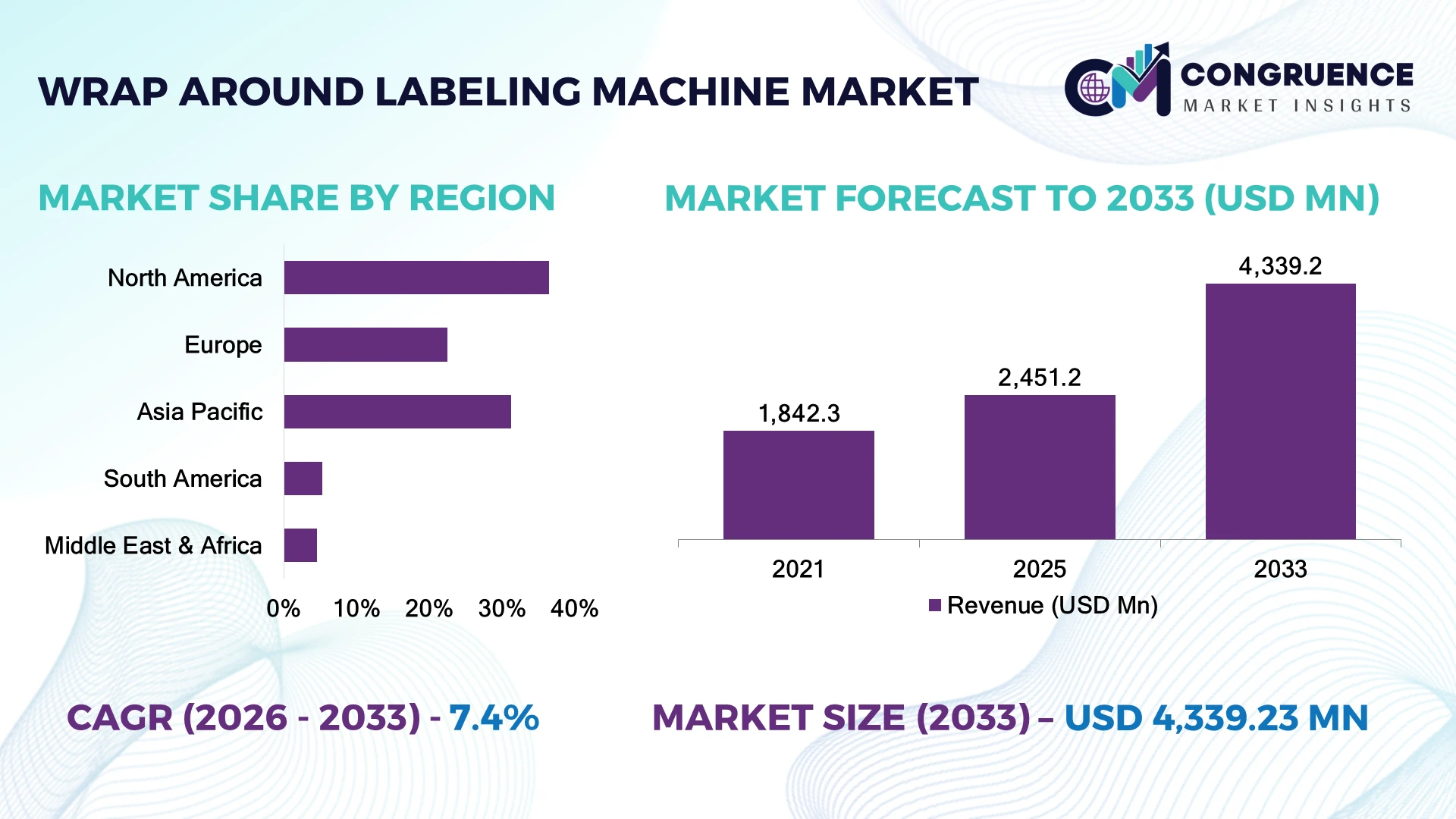
The Global Wrap Around Labeling Machine Market was valued at USD 2,451.2 Million in 2025 and is anticipated to reach a value of USD 4,339.2 Million by 2033 expanding at a CAGR of 7.4% between 2026 and 2033. Growth is driven by high-speed beverage packaging lines, pharmaceutical serialization compliance, and AI-enabled vision inspection integrated into advanced wrap around labeling systems.
Germany leads the market with approximately 18% of global labeling machinery production, supported by strong packaging automation, beverage processing, and pharmaceutical equipment manufacturing. More than 72% of newly installed premium labeling lines incorporate machine-vision inspection and servo-controlled labeling systems. Compared with Italy's highly export-oriented machinery sector, Germany invests more aggressively in Industry 4.0 integration amid European manufacturing resilience and supply-chain diversification following Red Sea logistics disruptions, strengthening precision engineering leadership.
Manufacturers prioritizing intelligent automation, modular machine architecture, and digital service capabilities will secure stronger positions in premium packaging investments.
Market Size & Growth: USD 2,451.2 Million in 2025, reaching USD 4,339.2 Million by 2033 at 7.4% CAGR, driven by packaging automation.
Top Growth Drivers: Vision inspection +31%, pharmaceutical automation +28%, beverage packaging modernization +26%.
Short-Term Forecast: By 2028, labeling accuracy improves 18% while changeover time declines 25%.
Emerging Technologies: AI inspection, digital twins, servo automation increase line productivity by nearly 20%.
Regional Leaders: Europe, Asia-Pacific, North America dominate through smart factory deployment and packaging upgrades.
Consumer/End-User Trends: Over 65% of beverage manufacturers prefer high-speed wrap around labeling platforms.
Pilot/Case Example: 2025 smart packaging line reduced unplanned downtime by 22% using predictive monitoring.
Competitive Landscape: Top suppliers control approximately 46% share through engineering, integration, and after-sales support.
Regulatory & ESG Impact: Sustainable labeling materials reduce packaging waste by nearly 15%.
Investment & Funding: More than USD 900 Million supports automation, regional expansion, and digital manufacturing.
Innovation & Future Outlook: Modular, AI-driven labeling platforms strengthen flexible, high-throughput packaging operations.
The Wrap Around Labeling Machine Market is expanding across beverages, pharmaceuticals, personal care, food, and industrial packaging as manufacturers adopt AI-enabled vision inspection, servo-driven motion control, and predictive maintenance. Nearly 68% of premium packaging lines now prioritize digital connectivity and rapid format changeovers. Ongoing supply-chain regionalization is accelerating localized machine production, setting the stage for deeper strategic market evaluation.
Wrap around labeling machines have become strategic manufacturing assets because packaging speed, traceability, and product differentiation increasingly determine operational competitiveness. Food, beverage, pharmaceutical, and personal care manufacturers are restructuring production around automated packaging cells while stricter labeling compliance and digital quality assurance accelerate equipment modernization. Investment increasingly favors flexible systems capable of handling multiple container formats with minimal operator intervention.
Modern servo-driven labeling machines deliver approximately 25% faster changeovers and nearly 18% higher labeling accuracy than conventional mechanically synchronized equipment. Germany and Italy continue leading premium packaging machinery innovation, while China rapidly expands large-scale manufacturing capacity through cost-efficient automation. Over 60% of newly commissioned high-speed packaging lines integrate machine vision, digital diagnostics, or Industrial IoT connectivity, improving uptime and reducing inspection-related waste.
A beverage producer deploying AI-assisted wrap around labeling with automated rejection systems can reduce labeling defects by approximately 30% while improving line availability through predictive maintenance. Manufacturers are expanding regional assembly operations, strengthening automation partnerships, and integrating software-driven lifecycle services to differentiate beyond hardware. Through 2028, companies combining intelligent automation, modular machine architecture, and digital support capabilities will establish stronger competitive positioning and deliver sustainable operational advantages across global packaging industries.
The strongest growth catalyst is the rapid automation of high-speed packaging operations across beverage, pharmaceutical, and personal care manufacturing. Nearly 68% of newly commissioned premium packaging lines now incorporate servo-driven labeling systems, while machine-vision inspection reduces labeling defects by approximately 30% and improves overall equipment effectiveness by nearly 18%. The implementation of pharmaceutical serialization regulations and digital packaging traceability in countries including the United States and Germany is accelerating replacement of legacy labeling equipment. This shift increases production consistency and lowers manual intervention. In response, manufacturers are expanding modular machine portfolios, investing in AI-enabled inspection technology, and forming automation partnerships to deliver integrated packaging solutions with faster commissioning and lifecycle support.
Advanced wrap around labeling machines depend on precision servo motors, industrial vision cameras, PLC controllers, and specialty sensors, making system costs sensitive to electronic component pricing. Imported automation components account for nearly 40% of equipment value in premium systems, while commissioning expenses can represent 15–20% of total installation costs. Continued semiconductor supply fluctuations and shipping disruptions through key Asian manufacturing hubs extend equipment lead times and pressure project schedules. These constraints reduce deployment flexibility for mid-sized packaging companies and affect investment decisions. Manufacturers are responding by localizing component sourcing, negotiating long-term supplier agreements, qualifying alternative automation platforms, and increasing standardized machine architectures that simplify integration while reducing maintenance complexity.
Future opportunities are emerging through intelligent labeling platforms capable of adapting automatically to diverse container formats and production environments. AI-assisted quality inspection improves label positioning accuracy by nearly 25%, while predictive maintenance lowers unexpected downtime by approximately 20%. Japan and South Korea are accelerating adoption of digital factory initiatives that encourage integrated packaging automation and data-driven maintenance strategies. Equipment suppliers are investing in digital twins, cloud-connected diagnostics, and collaborative robotics to support flexible manufacturing. A particularly valuable opportunity lies in subscription-based remote monitoring and predictive service models, enabling manufacturers to generate recurring revenue while improving customer uptime and strengthening long-term operational partnerships beyond traditional equipment sales.
Expanding intelligent labeling systems across multiple manufacturing sites remains operationally challenging because packaging equipment must communicate seamlessly with MES, ERP, warehouse automation, and vision inspection platforms. Approximately 45% of packaging modernization projects require customized software integration, while commissioning periods increase by nearly 20% when legacy production lines remain operational. Many factories also face shortages of automation engineers capable of maintaining interconnected packaging ecosystems. These challenges reduce deployment consistency and delay digital transformation initiatives. Equipment manufacturers must strengthen cybersecurity, invest in standardized communication protocols, expand technical training programs, and establish long-term technology partnerships that simplify enterprise-wide integration while maintaining production reliability.
AI Vision Quality Control AI-powered inspection systems are now deployed on approximately 62% of newly installed premium labeling lines, reducing label rejection rates by nearly 30% while increasing inspection speed by 20%. Rising pharmaceutical traceability requirements are accelerating adoption, prompting equipment suppliers to integrate advanced cameras, machine learning algorithms, and automated reject mechanisms into standard machine configurations.
Servo-Driven Modular Platforms Modular servo-controlled labeling machines reduce product changeover time by approximately 25% and improve positioning precision by nearly 18%. Beverage manufacturers in Germany increasingly replace fixed mechanical systems with configurable architectures supporting multiple container sizes, encouraging suppliers to expand modular product portfolios and standardized automation platforms for higher production flexibility.
Connected Predictive Maintenance Industrial IoT connectivity now supports predictive maintenance across roughly 55% of advanced packaging installations, lowering unplanned downtime by approximately 22%. Labor shortages and increasing maintenance costs are driving manufacturers toward cloud-enabled diagnostics, remote service capabilities, and digital lifecycle management that improve equipment utilization while reducing emergency maintenance interventions.
Sustainable Labeling Integration Lightweight label materials and adhesive optimization reduce packaging material consumption by approximately 12%, while automated dispensing improves label utilization by nearly 15%. Sustainability targets across European manufacturing are encouraging equipment suppliers to redesign applicators for recyclable materials, strengthen partnerships with packaging converters, and optimize machine settings for environmentally compliant production without sacrificing throughput.
Automatic wrap around labeling machines accounted for approximately 64% of the market in 2025, maintaining leadership through high-speed throughput, precise label placement, and seamless integration with automated filling and packaging lines. These systems are widely deployed by beverage, pharmaceutical, and food manufacturers where production speeds often exceed 300 containers per minute. Their compatibility with machine vision, servo motion control, and predictive maintenance platforms improves operational efficiency while minimizing labeling errors. Manufacturers continue expanding fully automatic product portfolios with modular configurations that simplify installation and support multi-format production environments.
Semi-automatic wrap around labeling machines represent the fastest-growing segment as small and mid-sized manufacturers modernize packaging operations without investing in complete production-line automation. Adoption is increasing across specialty food, cosmetics, and nutraceutical production where operational flexibility is prioritized over maximum throughput. Manual systems remain relevant for pilot production and low-volume operations, while customized hybrid solutions are gaining traction for contract packaging facilities. Equipment suppliers are strengthening product differentiation through compact machine designs, quick-change tooling, and digital operator interfaces, reflecting a clear investment shift toward scalable automation platforms.
Beverage packaging held the largest market share at approximately 38%, supported by continuous high-speed production requirements, standardized container formats, and strict labeling accuracy standards. Carbonated beverages, bottled water, dairy drinks, and alcoholic beverages rely extensively on wrap around labeling machines capable of maintaining consistent positioning at high production speeds. Equipment suppliers are integrating servo controls and AI-based inspection systems to improve uptime while reducing product rejection, enabling beverage manufacturers to achieve higher packaging efficiency with minimal manual intervention.
Pharmaceutical packaging is the fastest-growing application as serialization compliance, product traceability, and regulatory labeling requirements become increasingly stringent. Food packaging continues expanding through ready-to-eat meals, sauces, and packaged consumer goods, while personal care and household products increasingly require flexible labeling for multiple container shapes. Industrial chemical packaging maintains steady demand through durable label application under challenging operating conditions. Manufacturers are responding by developing adaptable labeling platforms supporting rapid format changes, integrated inspection systems, and digital production monitoring that strengthen operational performance across diverse packaging sectors.
Large manufacturing enterprises accounted for approximately 61% of market demand owing to their extensive production capacity, continuous packaging operations, and greater investment in automated manufacturing infrastructure. Multinational beverage, pharmaceutical, food, and personal care companies deploy integrated wrap around labeling systems across multiple production facilities to improve throughput, quality assurance, and regulatory compliance. Their purchasing decisions increasingly emphasize digital connectivity, predictive maintenance, and standardized automation platforms capable of supporting enterprise-wide operational consistency.
Contract packaging companies represent the fastest-growing end-user segment as global brands increasingly outsource packaging operations to improve flexibility and reduce capital expenditure. Small and medium-sized manufacturers continue adopting modular semi-automatic and automatic labeling systems that support gradual automation. Private-label producers are also increasing investment to manage higher production volumes and shorter product lifecycles. Equipment manufacturers are responding through customized machine configurations, flexible financing models, and long-term service agreements that strengthen customer retention while supporting scalable production expansion.
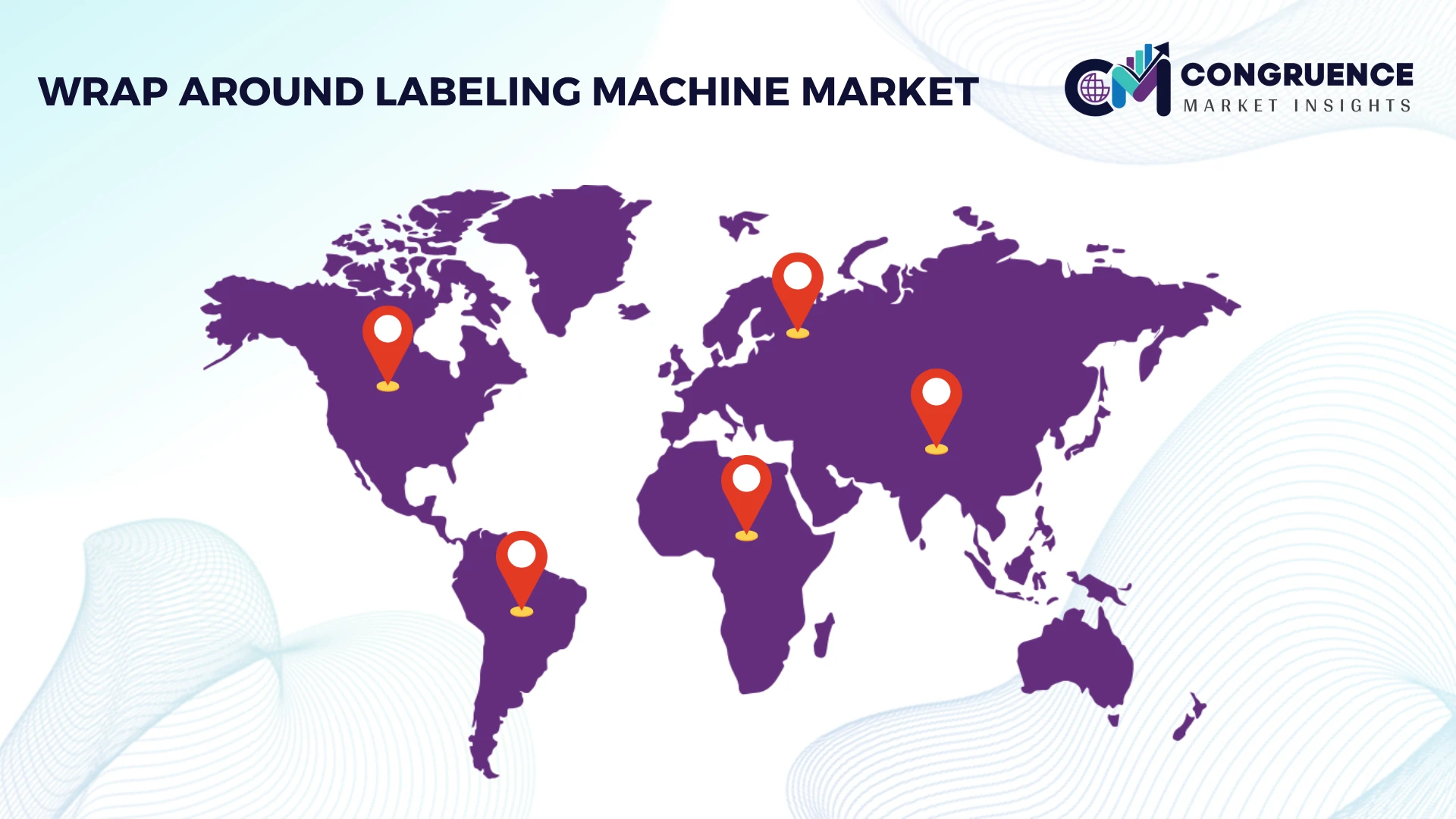
North America accounted for the largest market share at 36.4% in 2025 however, Asia-Pacific is expected to register the fastest growth, expanding at a CAGR of 8.3% between 2026 and 2033.
Automation-led packaging modernization strengthens high-speed labeling operations
North America maintains market leadership through extensive deployment of automated packaging lines across beverage, pharmaceutical, food, and personal care manufacturing. Large-scale production facilities increasingly integrate wrap around labeling machines with vision inspection systems, robotics, and centralized manufacturing execution platforms to improve traceability and reduce unplanned downtime. The region contributes a substantial share of premium labeling equipment demand, supported by continuous investment in factory modernization and labor optimization. In 2026, several beverage bottling facilities expanded production lines capable of exceeding 500 containers per minute, increasing demand for servo-driven wrap around labeling systems with rapid changeover capability. Equipment suppliers continue strengthening service networks and predictive maintenance offerings, enabling manufacturers to improve equipment availability while reducing maintenance costs across high-volume packaging operations.
U.S. Market Outlook: The United States dominates regional demand through its extensive food processing, pharmaceutical manufacturing, and beverage packaging industries. Advanced packaging facilities increasingly prioritize smart labeling systems equipped with machine vision, remote diagnostics, and digital quality monitoring. More than 70% of newly commissioned large-scale beverage packaging lines incorporate fully automated labeling solutions, while domestic equipment manufacturers continue expanding customized systems supporting flexible packaging formats and regulatory labeling compliance.
Precision engineering and sustainable packaging reshape equipment investment
Europe remains a major manufacturing hub for premium wrap around labeling machines, supported by advanced machinery engineering, stringent packaging regulations, and sustainability initiatives. Manufacturers increasingly develop energy-efficient systems with recyclable label compatibility and lower adhesive consumption while supporting rapid product changeovers for diverse consumer goods. Pharmaceutical and premium food manufacturers continue driving demand for highly accurate labeling equipment integrated with serialization and inspection technologies. During 2026, multiple packaging machinery suppliers introduced modular labeling platforms reducing format changeover time by nearly 30%, improving production flexibility for contract packaging operations. Equipment differentiation increasingly centers on precision, digital integration, and lifecycle operating efficiency.
Germany Market Outlook: Germany leads the regional market through its globally recognized packaging machinery manufacturing ecosystem and advanced industrial automation capabilities. Domestic engineering companies continue investing in servo-controlled labeling platforms compatible with Industry 4.0 manufacturing environments. More than 60% of newly installed high-performance labeling systems are integrated with digital production monitoring, reinforcing Germany's position as Europe's technology leader for precision packaging equipment.
Manufacturing expansion accelerates high-volume packaging automation
Asia-Pacific is emerging as the fastest-growing regional market as expanding manufacturing capacity, rising packaged food consumption, and pharmaceutical production stimulate investment in automated packaging equipment. China, Japan, India, and South Korea continue strengthening local machinery production while multinational companies establish regional manufacturing facilities to improve supply resilience. The region accounts for a significant share of global packaging equipment manufacturing, supported by cost-efficient production ecosystems and export-oriented industrial clusters. During 2026, several manufacturing parks expanded packaging equipment production capacity by over 20%, improving equipment availability for regional customers. Companies increasingly localize component sourcing to shorten lead times and enhance supply-chain stability.
China Market Outlook: China represents the largest regional market through its extensive food, beverage, cosmetics, and pharmaceutical manufacturing industries. Large packaging equipment manufacturers continue investing in intelligent production facilities capable of supplying advanced labeling systems for domestic and export markets. Automated packaging penetration continues rising, with high-speed labeling equipment increasingly deployed across large manufacturing enterprises seeking higher productivity and improved packaging consistency.
Food and beverage investments support packaging modernization
South America continues expanding demand for wrap around labeling machines through modernization of food processing, beverage bottling, and household products manufacturing. Manufacturers increasingly replace aging packaging equipment with automated labeling solutions that improve production consistency while reducing labor dependency. Investment remains concentrated in larger industrial economies where packaged consumer goods production continues expanding despite periodic economic volatility. During 2026, multiple beverage producers upgraded packaging facilities with integrated labeling and inspection systems, improving packaging throughput by approximately 18%. Infrastructure limitations and equipment import dependence continue influencing purchasing decisions, encouraging suppliers to strengthen regional technical support and localized service operations.
Brazil Market Outlook: Brazil leads regional demand through its extensive beverage, processed food, and personal care manufacturing sectors. Large domestic manufacturers increasingly adopt automated labeling equipment supporting higher production volumes and multiple packaging formats. Packaging modernization programs continue expanding across industrial corridors, while local distributors strengthen installation, maintenance, and spare-parts capabilities to improve equipment reliability and reduce operational interruptions.
Industrial diversification stimulates advanced packaging investment
The Middle East & Africa market is steadily expanding as governments promote industrial diversification, domestic food manufacturing, and pharmaceutical production. Modern packaging facilities increasingly require automated labeling solutions capable of meeting export-quality standards and improving production efficiency. Investment is concentrated within industrial free zones and manufacturing clusters where integrated packaging lines support regional consumer goods production. During 2026, several manufacturing facilities commissioned automated packaging systems incorporating digital inspection and wrap around labeling equipment, increasing production efficiency by approximately 15%. International machinery suppliers continue expanding regional partnerships to strengthen technical support, installation services, and operator training.
Saudi Arabia Market Outlook: Saudi Arabia represents the region's strongest market through sustained investment in food processing, pharmaceuticals, and industrial manufacturing aligned with national industrial diversification initiatives. Modern manufacturing plants increasingly integrate fully automated packaging systems supporting higher operational efficiency and export competitiveness. Expansion of industrial cities and localized manufacturing programs continues encouraging adoption of advanced labeling equipment while strengthening domestic packaging infrastructure and technical capabilities.
Global equipment leaders including Krones AG, SACMI, KHS, Sidel, and HERMA compete directly in premium, high-speed packaging lines, while regional machinery manufacturers challenge them through lower-cost, customized systems for local beverage and food processors. The top five suppliers collectively control approximately 52% of global market activity. Competition centers on labeling accuracy, line speeds exceeding 50,000 containers per hour, digital integration, and lifecycle service, with predictive maintenance reducing downtime by nearly 20% and servo-driven systems improving label placement accuracy above 99.5%. Companies increasingly compete through modular platform expansion, OEM partnerships, aftermarket service contracts, and vertical integration across filling, inspection, and labeling equipment. The competitive shift favors intelligent packaging ecosystems over standalone machines as manufacturers seek unified automation platforms. High engineering expertise, validation requirements, and global service capability remain significant entry barriers. Winning requires scalable automation, rapid customization, reliable global support, and continuous innovation that delivers measurable productivity gains while lowering total operating costs.
Krones AG
SACMI Imola S.C.
KHS GmbH
Sidel Group
HERMA GmbH
P.E. Labellers S.p.A.
Etipack S.p.A.
Pack Leader Machinery Inc.
Quadrel Labeling Systems
ProMach Inc.
Accutek Packaging Equipment Companies, Inc.
Marchesini Group S.p.A.
ALTECH S.r.l.
Novexx Solutions GmbH
Servo-driven motion control, machine vision inspection, and intelligent HMI platforms define current technology leadership in wrap around labeling machines. More than 68% of newly installed high-speed systems incorporate vision-guided label verification, improving placement precision by approximately 18% while reducing product rejection rates by nearly 15%. Remote diagnostics and predictive maintenance are now deployed in around 55% of premium installations, enabling faster troubleshooting and higher equipment utilization across continuous packaging operations.
AI-assisted setup optimization, digital twins, and Industrial Internet of Things connectivity are becoming mainstream differentiators. Compared with conventional mechanically synchronized systems, modern servo-controlled labeling platforms complete format changeovers about 35% faster while reducing adjustment-related downtime by roughly 25%. Global packaging OEMs benefit most because integrated filling, inspection, and labeling solutions deliver stronger operational consistency than standalone equipment. Automated quality analytics also improve traceability, supporting pharmaceutical and food compliance without reducing production throughput.
Between 2026 and 2028, cloud-connected production management, robotic container handling, and adaptive vision algorithms will accelerate adoption across flexible packaging lines. Digital integration will increasingly determine purchasing decisions as manufacturers prioritize higher throughput, faster product changeovers, and lower maintenance costs. Companies investing early in intelligent labeling ecosystems will secure stronger competitive positioning through superior operational efficiency and lifecycle performance.
April 2026 HERMA introduced the 152E HC wrap-around labeling machine at Interpack, engineered for evolving pharmaceutical traceability requirements and advanced wrap-around applications. The platform strengthens compliance readiness while supporting high-speed production environments. Source: HERMA
May 2026 HERMA and Schreiner MediPharm jointly launched an RFID wrap-around labeling solution for pharmaceutical vials, reducing RFID chip breakage risk to virtually 0% during high-cycle operation, significantly improving product traceability and manufacturing reliability. Source: Labels & Labeling
September 2025 Krones introduced the Flectra labeling platform, developed jointly with Gernep, delivering greater flexibility for low- and medium-output packaging applications while simplifying product changeovers across beverage, food, pharmaceutical, and personal care production. Source: Krones
April 2025 Krones announced production of its 1,000th Sleevematic system, integrated with Contiroll wrap-around labeling technology for a 36,000 bottles-per-hour aseptic beverage line, reinforcing advanced multi-format labeling capability and production flexibility. Source: Krones Press Release. (Krones)
The report delivers comprehensive analysis of the global wrap around labeling machine market across equipment types, automation levels, applications, end-user industries, and major geographic regions. It evaluates deployment trends across food and beverage, pharmaceuticals, cosmetics, chemicals, and industrial packaging while assessing adoption of servo-driven controls, machine vision inspection, Industrial Internet of Things connectivity, predictive maintenance, and intelligent production integration. More than 20 major equipment manufacturers and technology providers are assessed through competitive benchmarking, product positioning, and innovation strategies.
The study provides detailed regional comparisons, investment trends, supply-chain developments, technology adoption patterns, and operational performance indicators between 2026 and 2033. It highlights evolving customer purchasing priorities, automation penetration, production flexibility, and digital manufacturing integration, enabling stakeholders to strengthen expansion planning, competitive positioning, product development, partnership strategies, and long-term capital investment decisions across mature and emerging packaging automation markets.
| Report Attribute/Metric | Report Details |
|---|---|
|
Market Revenue in 2025 |
USD 2,451.2 Million |
|
Market Revenue in 2033 |
USD 4,339.2 Million |
|
CAGR (2026 - 2033) |
7.4% |
|
Base Year |
2025 |
|
Forecast Period |
2026 - 2033 |
|
Historic Period |
2021 - 2025 |
|
Segments Covered |
By Type
By Application
By End-User
|
|
Key Report Deliverable |
Revenue Forecast, Growth Trends, Market Dynamics, Segmental Overview, Regional and Country-wise Analysis, Competition Landscape |
|
Region Covered |
North America, Europe, Asia-Pacific, South America, Middle East, Africa |
|
Key Players Analyzed |
Krones AG, SACMI Imola S.C., KHS GmbH, Sidel Group, HERMA GmbH, P.E. Labellers S.p.A., Etipack S.p.A., Pack Leader Machinery Inc., Quadrel Labeling Systems, ProMach Inc., Accutek Packaging Equipment Companies, Inc., Marchesini Group S.p.A., ALTECH S.r.l., Novexx Solutions GmbH |
|
Customization & Pricing |
Available on Request (10% Customization is Free) |




