
Reports
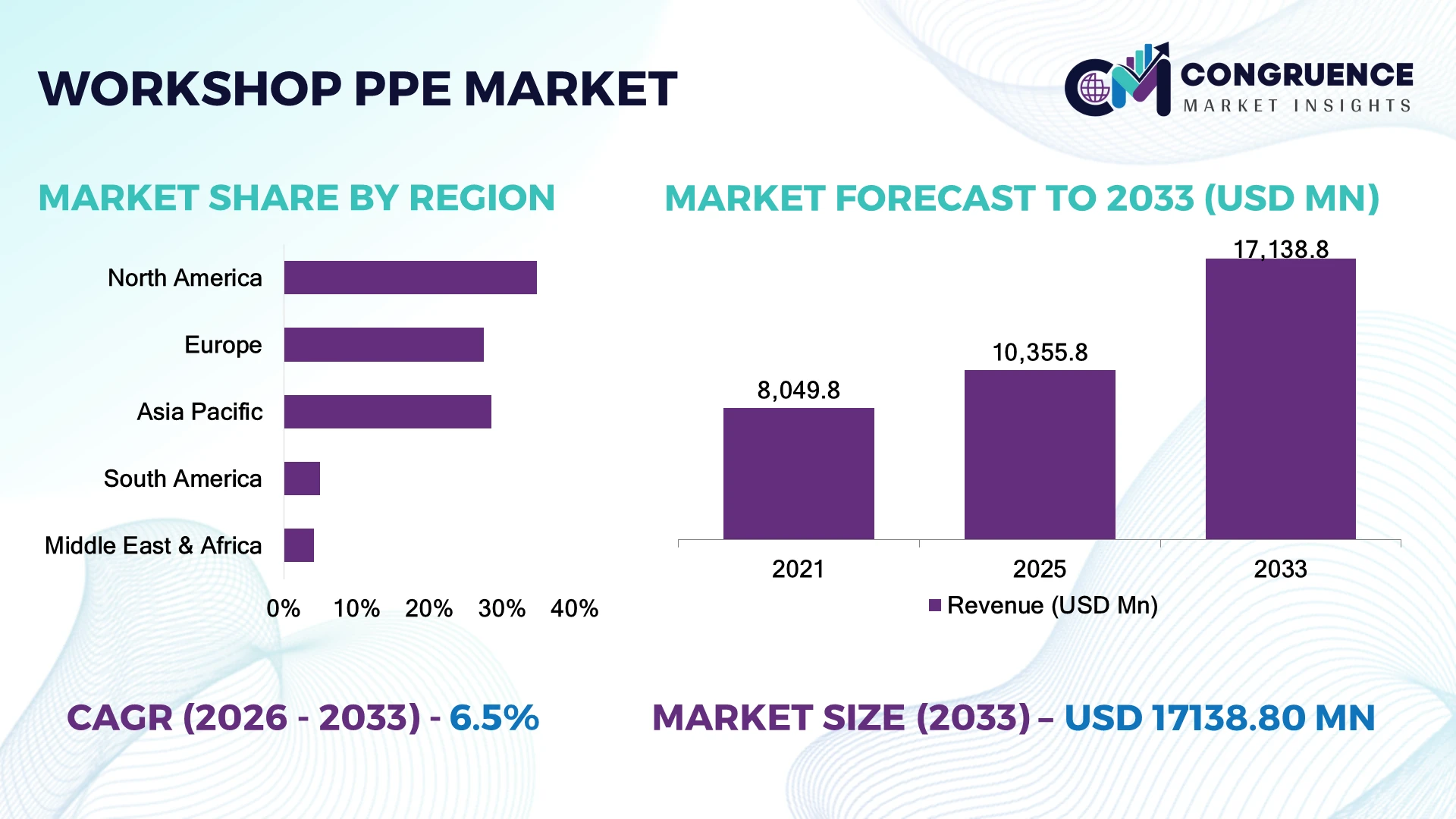
The Global Workshop PPE Market was valued at USD 10,355.8 Million in 2025 and is anticipated to reach a value of USD 17,138.8 Million by 2033 expanding at a CAGR of 6.5% between 2026 and 2033. Growth is being driven by stricter workplace safety regulations, industrial automation, and increasing investment in advanced protective equipment across manufacturing, automotive, construction, and maintenance workshops.
The United States accounts for approximately 28% of global Workshop PPE demand, supported by extensive manufacturing, automotive, aerospace, and industrial maintenance sectors. Compared with Germany, the U.S. records nearly 2.4 times higher industrial PPE procurement through larger workforce deployment and stronger regulatory compliance. Following supply-chain diversification after the Russia-Ukraine conflict, adoption of smart protective equipment has increased by approximately 18%, accelerating investment in connected workplace safety solutions.
Manufacturers prioritizing certified, durable, and digitally integrated PPE portfolios will strengthen competitive positioning across industrial safety markets.
Market Size & Growth: USD 10,355.8 Million in 2025, projected to reach USD 17,138.8 Million by 2033 at a CAGR of 6.5%, driven by stricter industrial safety compliance.
Top Growth Drivers: Manufacturing expansion (34%), workplace safety enforcement (31%), automation adoption (27%).
Short-Term Forecast: By 2028, connected PPE deployment is expected to improve incident response efficiency by 16%.
Emerging Technologies: AI-enabled wearables, smart sensors, and advanced impact-resistant materials enhance worker protection.
Regional Leaders: North America exceeds USD 3.7 Billion, Europe approaches USD 3.2 Billion, Asia-Pacific surpasses USD 2.9 Billion through industrial expansion.
Consumer/End-User Trends: Nearly 64% of industrial buyers prioritize certified ergonomic PPE over conventional products.
Pilot/Case Example: A 2026 automotive plant reduced hand injuries by approximately 22% after introducing smart protective gloves.
Competitive Landscape: The leading supplier holds nearly 17% market share alongside Honeywell, 3M, MSA Safety, and Ansell.
Regulatory & ESG Impact: Certified reusable PPE lowers replacement frequency by over 20% across industrial workshops.
Investment & Funding: More than USD 4 Billion supports manufacturing expansion, product innovation, and supply-chain localization.
Innovation & Future Outlook: Smart wearables, recyclable materials, and digital safety platforms continue redefining industrial protection.
Workshop PPE demand continues expanding across automotive service centers, metal fabrication, construction workshops, heavy engineering, and industrial maintenance facilities. Smart helmets, sensor-enabled gloves, and lightweight cut-resistant fabrics are improving worker safety while enhancing comfort and compliance. Approximately 42% of industrial employers now prioritize connected PPE procurement as workplace digitalization accelerates, setting the stage for evolving competitive strategies.
Workshop PPE has evolved into a strategic operational asset as manufacturers prioritize workforce protection, regulatory compliance, and productivity across industrial environments. Intensifying occupational safety standards, supply-chain restructuring, and factory modernization are shifting procurement from basic protective equipment toward certified, ergonomic, and digitally enabled PPE capable of supporting continuous industrial operations. Companies increasingly view safety performance as a measurable contributor to operational resilience and workforce retention.
Modern smart PPE equipped with sensors and real-time monitoring improves hazard detection by approximately 25% compared with conventional equipment while reducing manual safety inspections and improving response times. North America leads adoption through stringent compliance frameworks and advanced manufacturing, whereas Asia-Pacific benefits from rapid industrial expansion and increasing investment in worker safety infrastructure. Over the next two to three years, adoption of connected protective equipment, recyclable materials, and digital compliance management is expected to accelerate across manufacturing-intensive economies.
Automotive manufacturers and industrial engineering companies are increasingly integrating wearable safety technologies into factory operations to reduce workplace incidents and improve workforce visibility. PPE suppliers are expanding regional manufacturing, strengthening distribution partnerships, and investing in smart product development to meet evolving customer requirements. Organizations delivering certified protection, digital integration, and lifecycle value will establish stronger competitive advantages while supporting long-term industrial productivity and operational excellence.
Stringent occupational safety regulations and expanding industrial manufacturing are driving sustained demand for advanced Workshop PPE across automotive, metal fabrication, construction, and engineering facilities. Nearly 68% of industrial employers now prioritize certified PPE procurement, while ergonomically designed protective equipment improves worker compliance by approximately 24%. The United States continues strengthening workplace safety enforcement, encouraging manufacturers to replace conventional protective gear with certified, high-performance alternatives. This regulatory shift reduces workplace injuries, improves operational continuity, and lowers compensation-related costs. Leading PPE manufacturers are expanding domestic production, investing in lightweight protective materials, and partnering with industrial distributors to improve product availability. Companies delivering certified, application-specific PPE gain stronger long-term contracts and enhanced competitiveness in regulated industrial sectors.
Workshop PPE manufacturers continue facing cost volatility for aramid fibers, nitrile rubber, polycarbonate, and engineered textiles used in premium protective products. Prices of selected synthetic protective materials have fluctuated by approximately 13%, while procurement lead times for specialized components remain nearly 18% longer than pre-disruption averages. Germany and China continue experiencing periodic supply-chain adjustments affecting industrial safety equipment manufacturing. These conditions increase production costs, compress supplier margins, and delay customer deliveries, particularly for premium certified PPE. Manufacturers are reducing exposure through supplier diversification, regional sourcing strategies, long-term procurement agreements, and expanded use of recyclable engineered materials to stabilize production while maintaining regulatory compliance and product quality.
Digital transformation is creating high-value opportunities through connected Workshop PPE integrating wearable sensors, RFID tracking, and AI-powered safety analytics. Smart protective equipment improves hazard detection by approximately 26%, while connected workforce monitoring reduces emergency response times by nearly 20%. Japan continues expanding industrial automation, encouraging manufacturers to integrate wearable safety technologies with factory management systems. PPE suppliers are investing in IoT-enabled helmets, intelligent gloves, and cloud-connected safety platforms while partnering with industrial software providers to deliver integrated workplace protection solutions. Early investment in connected PPE ecosystems enables suppliers to differentiate beyond product sales by offering recurring digital safety services and predictive workforce risk management.
The transition toward connected PPE introduces operational complexity involving interoperability, cybersecurity, workforce training, and enterprise software integration. Approximately 44% of industrial facilities report challenges integrating wearable safety devices with existing manufacturing execution systems, while implementation timelines can extend by nearly 16% because of compatibility requirements. South Korea's smart manufacturing expansion highlights increasing demand for standardized industrial safety platforms capable of supporting connected operations. Companies must invest in secure software architecture, employee training, device interoperability, and lifecycle support to ensure consistent deployment. Suppliers capable of combining certified protection with scalable digital integration will strengthen long-term customer retention as industrial workplaces become increasingly data-driven.
Smart Wearables Gain Momentum Connected helmets, safety glasses, and wearable sensors are now incorporated into approximately 36% of new industrial safety programs, improving incident detection by nearly 23%. Manufacturing companies are integrating PPE data with digital safety platforms, prompting suppliers to expand software partnerships and scalable connected product portfolios.
Lightweight Materials Replace Traditional Designs Advanced composite fibers and engineered textiles reduce PPE weight by approximately 18% while improving wearer comfort by nearly 25% during extended workshop operations. Automotive manufacturers increasingly specify ergonomic equipment to improve compliance, leading suppliers to accelerate product redesign and material innovation programs.
Localized Manufacturing Expands Supply Global supply-chain adjustments encourage PPE manufacturers to regionalize production and sourcing. Local manufacturing initiatives have reduced average delivery times by approximately 17% while improving inventory availability for industrial distributors. Companies continue expanding regional production facilities and supplier partnerships to strengthen resilience against logistics disruptions.
Reusable PPE Gains Preference Industrial buyers increasingly adopt reusable protective equipment to reduce operating costs and improve sustainability performance. Certified reusable gloves, face shields, and protective clothing lower replacement frequency by approximately 21%, while standardized cleaning protocols improve lifecycle value. Manufacturers are expanding recyclable product lines and investing in circular material technologies to support evolving industrial procurement priorities.
Protective Gloves account for approximately 36% of the global Workshop PPE market due to their universal use across manufacturing, automotive repair, welding, fabrication, and maintenance workshops. Their broad application, relatively low replacement cost, and continuous consumption make them the largest revenue contributor. Safety Footwear and Protective Clothing remain mature categories because of mandatory workplace compliance, while Eye & Face Protection maintains consistent demand across machining and metalworking operations where impact and particle hazards are common.
Smart PPE and Connected Protective Equipment represent the fastest-growing category as industrial employers integrate wearable sensors, RFID tracking, and worker monitoring into safety programs. Adoption of connected PPE has increased by approximately 24%, while lightweight composite materials reduce product weight by nearly 18% without compromising protection. Manufacturers are expanding ergonomic product portfolios, investing in sustainable materials, and collaborating with industrial distributors to deliver integrated workplace safety solutions. Investment priorities are shifting toward intelligent, reusable, and high-comfort PPE that improves compliance while lowering lifecycle ownership costs.
According to findings published by the U.S. National Institute for Occupational Safety and Health (NIOSH) during 2025, improved glove selection and proper PPE compliance significantly reduce workplace hand injuries in industrial environments, reinforcing continued investment in advanced hand protection.
Manufacturing Workshops represent the largest application segment with approximately 39% of global demand, supported by continuous machining, assembly, welding, fabrication, and maintenance operations requiring comprehensive personal protective equipment. Strict workplace safety requirements, high workforce density, and continuous production schedules sustain strong procurement across this segment. Automotive Workshops remain another major application, while Metal Fabrication and Welding Workshops continue investing in specialized protective apparel, gloves, helmets, and respiratory protection to address high-risk operating environments.
Construction Equipment Workshops represent the fastest-growing application as infrastructure investment and equipment servicing activities expand globally. Nearly 31% of new industrial workshop safety procurement now prioritizes multi-hazard PPE with enhanced durability and ergonomic performance. Aerospace Maintenance Workshops continue increasing adoption of lightweight anti-static and precision-protection equipment, while Heavy Equipment Service Centers strengthen demand for cut-resistant and impact-resistant products. PPE manufacturers are responding through modular product development, automated production, and customized solutions designed for application-specific operational requirements.
A 2026 industrial safety survey conducted by the Occupational Safety and Health Administration (OSHA) highlighted that manufacturing facilities continue recording the highest adoption of certified PPE programs as employers strengthen preventive workplace safety practices.
Industrial Manufacturing Companies account for approximately 42% of Workshop PPE demand owing to their extensive workforce, continuous production environments, and stringent occupational safety compliance requirements. Automotive Manufacturers and Metal Processing Companies remain significant buyers because of exposure to cutting, welding, grinding, and chemical handling operations. Engineering Workshops continue maintaining stable procurement cycles through recurring replacement demand and standardized workplace safety programs.
Construction and Infrastructure Contractors represent the fastest-growing end-user segment as equipment maintenance workshops and infrastructure modernization projects expand worldwide. Approximately 34% of newly procured industrial PPE now emphasizes reusable materials, ergonomic design, and smart monitoring capabilities. Aerospace & Defense Maintenance Facilities increasingly specify premium certified protective equipment for precision manufacturing environments. Manufacturers are targeting these customer groups through application-specific product customization, regional distribution expansion, digital inventory management, and long-term supply agreements that strengthen customer retention and operational value.
According to a 2025 International Labour Organization assessment, industrial manufacturing and construction continue representing the largest occupational safety investment segments globally, reinforcing long-term procurement of certified personal protective equipment.
An enterprise safety study released during 2026 reported increasing adoption of ergonomic PPE programs to improve worker compliance, productivity, and injury prevention across industrial maintenance facilities.
North America accounted for the largest market share at 34.8% in 2025 however, Asia-Pacific is expected to register the fastest growth, expanding at a CAGR of 7.4% between 2026 and 2033.

Industrial Automation and Compliance Standards Sustain Premium PPE Adoption
North America maintains market leadership through stringent workplace safety regulations, advanced manufacturing infrastructure, and continuous investment in industrial modernization. The region contributes approximately 35% of global premium workshop PPE demand, supported by automotive manufacturing, aerospace production, oil & gas maintenance, and metal fabrication facilities. Growing deployment of connected PPE with RFID tracking and sensor-enabled wearables is strengthening workforce monitoring and operational compliance. More than 40% of large industrial facilities have integrated digital safety management platforms with PPE monitoring capabilities. Manufacturers continue expanding domestic production while distributors strengthen regional inventory networks to improve supply resilience. Strategic partnerships between PPE manufacturers and industrial safety solution providers are accelerating integrated workplace protection programs across high-risk industrial environments.
United States Market Outlook: The United States dominates regional demand owing to its extensive manufacturing base, OSHA-driven workplace safety compliance, and high replacement frequency across industrial workshops. More than 12 million manufacturing employees routinely require certified personal protective equipment, while aerospace, automotive, and energy sectors continue upgrading to ergonomic and connected PPE solutions. Domestic manufacturers are expanding automation, sustainable material adoption, and digital inventory management to strengthen operational efficiency and long-term customer retention.
Sustainability and Certified Protection Drive Product Modernization
Europe remains a mature Workshop PPE market supported by strict occupational safety regulations, sustainable manufacturing initiatives, and widespread industrial automation. Engineering, automotive, pharmaceuticals, and precision manufacturing collectively sustain strong procurement of premium certified protective equipment. Approximately 32% of industrial PPE purchasing decisions now prioritize recyclable materials and extended product life cycles alongside worker protection. Manufacturers continue investing in bio-based polymers, lightweight composites, and reusable protective products while strengthening regional manufacturing capabilities. Enterprise-wide digital compliance platforms are improving PPE lifecycle management and procurement planning across industrial facilities.
Germany Market Outlook: Germany serves as Europe's primary industrial PPE market through its advanced automotive, machinery, and precision engineering industries. Factory modernization initiatives continue driving demand for high-performance protective gloves, footwear, respiratory equipment, and connected safety products. More than 30% of industrial facilities have expanded digital workplace safety systems that integrate PPE monitoring, reinforcing demand for premium, standards-compliant protective equipment across manufacturing operations.
Manufacturing Expansion Accelerates Large-Scale PPE Deployment
Asia-Pacific represents the fastest-expanding regional market as manufacturing capacity, infrastructure construction, and export-oriented industrial production continue rising across major economies. Electronics, automotive, heavy engineering, and fabrication industries are generating sustained demand for workshop PPE at large production facilities. Nearly 45% of global industrial workforce additions during recent years have originated from Asia-Pacific manufacturing economies, strengthening procurement volumes. Manufacturers continue expanding regional production facilities, localized supply chains, and distribution partnerships to improve product availability while reducing procurement costs. Government-led industrial modernization programs further reinforce adoption of certified protective equipment across organized manufacturing sectors.
China Market Outlook: China remains the region's largest production and consumption hub owing to its extensive industrial manufacturing ecosystem, machinery production, and export-oriented factories. Large-scale automotive, electronics, and metalworking operations sustain continuous PPE replacement demand. Over 40% of industrial PPE manufactured globally is supplied through Asian production networks, allowing Chinese manufacturers to benefit from scale advantages, vertical integration, and expanding domestic workplace safety enforcement.
Industrial Expansion Supports Safety Equipment Procurement
South America is witnessing steady demand growth as mining, energy, automotive assembly, and industrial maintenance activities expand across the region. Brazil and neighboring economies continue strengthening workplace safety compliance while industrial employers invest in certified protective equipment for hazardous operating environments. Approximately 28% of industrial safety procurement growth is linked to mining and infrastructure maintenance projects. Local distributors increasingly partner with international PPE manufacturers to improve product availability, although logistics costs and import dependency continue affecting procurement efficiency. Industrial modernization programs are gradually improving adoption of advanced protective equipment across organized manufacturing facilities.
Brazil Market Outlook: Brazil leads regional consumption through its diversified manufacturing sector, mining operations, oil & gas industry, and automotive production facilities. Industrial employers continue replacing conventional protective equipment with ergonomic, higher-durability PPE that supports longer operational cycles. Expanding manufacturing investments and stricter occupational safety inspections are strengthening procurement consistency across industrial workshops while encouraging international suppliers to expand regional distribution capabilities.
Infrastructure Investment Strengthens Industrial Safety Adoption
The Middle East & Africa market continues expanding through industrial diversification, energy infrastructure investments, and construction-led economic development. Large maintenance workshops supporting petrochemical facilities, utilities, mining, and infrastructure projects are increasing demand for certified protective equipment. Approximately 30% of new industrial developments across Gulf economies now integrate centralized occupational safety management systems during project planning. International PPE suppliers are strengthening regional partnerships, local warehousing, and technical training programs to improve supply continuity and workplace compliance across industrial sectors.
Saudi Arabia Market Outlook: Saudi Arabia represents the region's most influential Workshop PPE market through ongoing industrial diversification, energy infrastructure expansion, and large-scale manufacturing investments under Vision 2030. Industrial cities, refineries, and fabrication facilities continue increasing procurement of certified gloves, protective clothing, footwear, and respiratory equipment. Growing localization initiatives and expanding industrial workforce requirements are encouraging suppliers to establish stronger regional distribution networks and long-term enterprise supply agreements.
The Workshop PPE market is led by global safety specialists including 3M, Ansell, MSA Safety, Honeywell, and DuPont, competing directly with regional manufacturers such as Delta Plus, Uvex, and Mallcom on product breadth and pricing. The top five companies collectively control approximately 47% of global market share, while regional suppliers compete aggressively through localized manufacturing and faster delivery. Technology leaders differentiate through ergonomic materials, connected PPE, and certified protection, achieving 15–20% higher contract retention, whereas cost-focused manufacturers compete with pricing typically 10–18% lower. Companies are expanding production capacity, acquiring complementary brands, integrating digital worker safety platforms, and strengthening distributor partnerships to secure industrial accounts. Competition is shifting toward smart PPE ecosystems and sustainable product portfolios rather than standalone equipment. Strict certification requirements, extensive testing costs, and established distribution networks remain major entry barriers. Sustainable innovation, dependable supply chains, regulatory compliance, and integrated safety solutions now define long-term competitive leadership.
3M
Ansell Limited
MSA Safety Incorporated
DuPont
Honeywell International Inc.
Delta Plus Group
Uvex Safety Group
Lakeland Industries
Drägerwerk AG & Co. KGaA
Protective Industrial Products (PIP)
MCR Safety
Radians, Inc.
Mallcom (India) Limited
JSP Ltd.
Material science innovation continues reshaping Workshop PPE through advanced nitrile compounds, lightweight composites, and engineered breathable fabrics. New-generation cut-resistant gloves improve dexterity by nearly 20% while reducing hand fatigue by approximately 15%. Around 38% of large industrial manufacturers have adopted high-performance ergonomic PPE to improve productivity and reduce replacement frequency. Companies investing in proprietary fiber technologies gain stronger differentiation in premium industrial contracts and long-term supply agreements.
Connected PPE is emerging as the fastest-evolving technology segment. Smart helmets, wearable gas detectors, RFID-enabled asset tracking, and IoT-integrated monitoring platforms improve compliance visibility while reducing inspection time by nearly 30%. Digital PPE management delivers approximately 25% higher operational efficiency than conventional manual tracking systems. Industrial enterprises managing hazardous environments increasingly integrate PPE with workforce management platforms, benefiting technology innovators that provide complete connected-worker ecosystems rather than standalone equipment.
Between 2026 and 2028, AI-powered safety analytics, predictive replacement scheduling, biometric monitoring, and digital twin integration will accelerate enterprise deployment. More than 45% of multinational industrial operators are expected to prioritize connected safety infrastructure within broader digital manufacturing initiatives. Suppliers combining certified protection, sustainable materials, and intelligent monitoring capabilities will secure stronger competitive positioning, while traditional manufacturers relying solely on standard protective products risk losing premium industrial customers.
July 2024 Ansell completed the acquisition of Kimberly-Clark's Personal Protective Equipment business, adding the Kimtech and KleenGuard brands while expanding industrial and laboratory safety solutions across global markets. The acquisition was valued at approximately USD 640 million, significantly strengthening portfolio breadth. Source: Ansell
November 2024 Honeywell agreed to sell its Personal Protective Equipment business to Protective Industrial Products for USD 1.325 billion, sharpening its focus on automation and energy transition while enabling PIP to expand its global industrial safety portfolio. Source: Honeywell
March 2025 Ansell expanded commercial availability of Kimtech, KleenGuard, and RightCycle solutions across North America and Europe, strengthening contamination-control and sustainable PPE services following its earlier acquisition, improving integrated customer support capabilities across multiple industrial sectors. Source: Ansell
May 2025 Honeywell completed the divestiture of its PPE business to Protective Industrial Products in an all-cash transaction worth USD 1.325 billion, enabling both organizations to accelerate portfolio specialization and strategic investment priorities. Source: Honeywell
The report delivers comprehensive analysis of the global Workshop PPE market across protective gloves, safety footwear, protective clothing, eye and face protection, respiratory protection, hearing protection, helmets, and other workplace safety equipment. It evaluates demand across manufacturing, automotive workshops, construction, metal fabrication, oil & gas, mining, utilities, and additional industrial sectors while assessing procurement trends among large enterprises, SMEs, and institutional buyers. The study covers North America, Europe, Asia-Pacific, South America, and the Middle East & Africa, supported by competitive benchmarking of leading manufacturers.
The report examines material innovations, connected PPE technologies, wearable safety systems, ergonomic product development, and sustainable manufacturing initiatives shaping future competitiveness. It provides segment-wise adoption patterns, company positioning, distribution strategies, regional deployment trends, and evolving industrial safety requirements between 2026 and 2033. Strategic insights support investment prioritization, product portfolio expansion, manufacturing localization, partnership evaluation, competitive differentiation, and long-term business planning across mature and emerging industrial markets.
| Report Attribute/Metric | Report Details |
|---|---|
|
Market Revenue in 2025 |
USD 10,355.8 Million |
|
Market Revenue in 2033 |
USD 17,138.8 Million |
|
CAGR (2026 - 2033) |
6.5% |
|
Base Year |
2025 |
|
Forecast Period |
2026 - 2033 |
|
Historic Period |
2021 - 2025 |
|
Segments Covered |
By Type
By Application
By End-User
|
|
Key Report Deliverable |
Revenue Forecast, Growth Trends, Market Dynamics, Segmental Overview, Regional and Country-wise Analysis, Competition Landscape |
|
Region Covered |
North America, Europe, Asia-Pacific, South America, Middle East, Africa |
|
Key Players Analyzed |
3M, Ansell Limited, MSA Safety Incorporated, DuPont, Honeywell International Inc., Delta Plus Group, Uvex Safety Group, Lakeland Industries, Drägerwerk AG & Co. KGaA, Protective Industrial Products (PIP), MCR Safety, Radians, Inc., Mallcom (India) Limited, JSP Ltd. |
|
Customization & Pricing |
Available on Request (10% Customization is Free) |




