
Reports
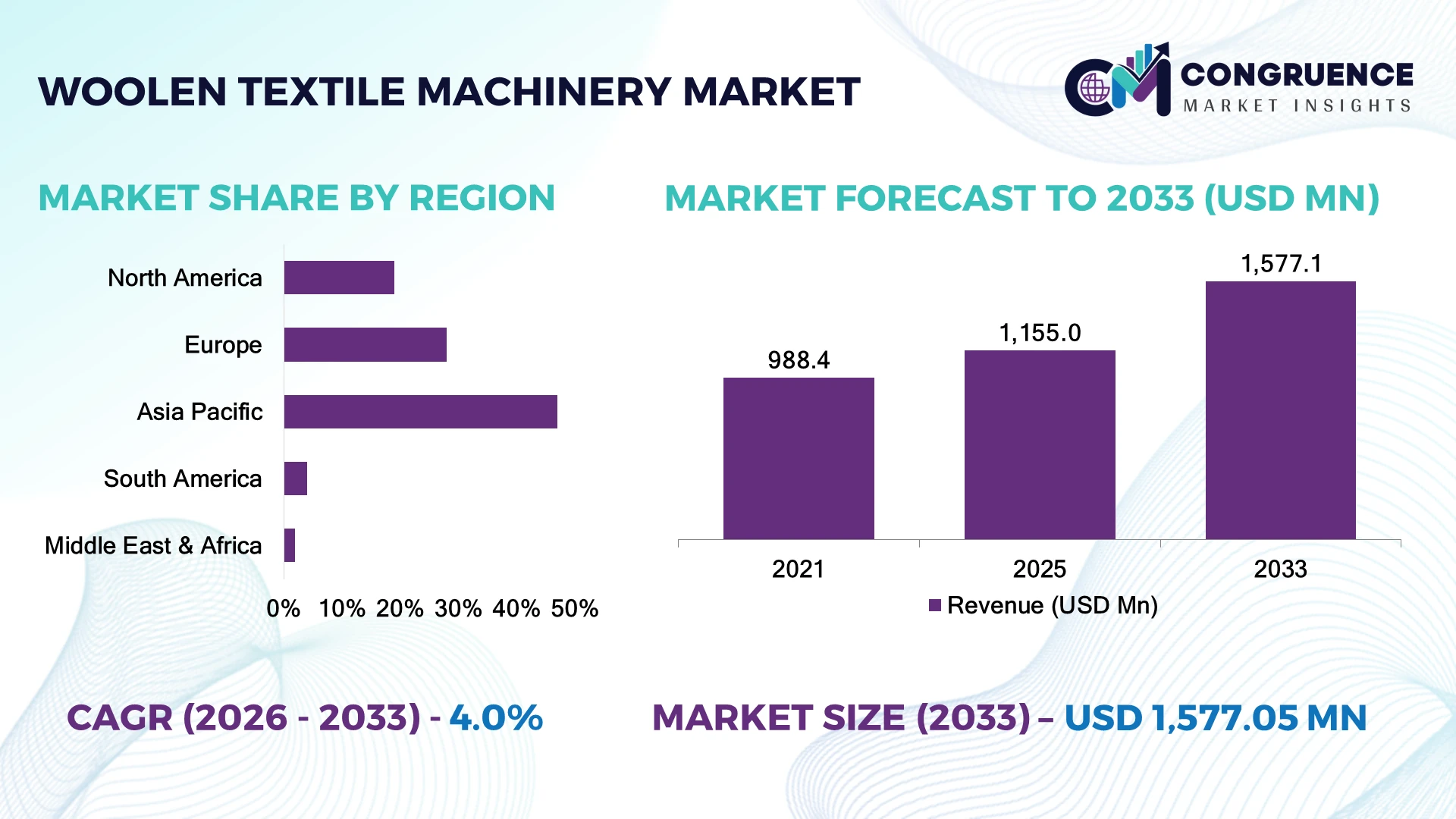
The Global Woolen Textile Machinery Market was valued at USD 1,155.0 Million in 2025 and is anticipated to reach a value of USD 1,577.1 Million by 2033 expanding at a CAGR of 3.97% between 2026 and 2033. Growth is driven by accelerating automation upgrades across wool processing facilities, expanding premium textile manufacturing, and increasing investment in energy-efficient spinning and weaving technologies.
China leads the global market with approximately 34% of installed wool textile machinery capacity, supported by large-scale textile clusters, strong equipment modernization programs, and advanced automated production lines. Italy follows with nearly 12% of high-value machinery production, specializing in premium textile engineering and precision manufacturing. Continued investment in smart factory deployment and export-oriented textile infrastructure strengthens China's competitive position while reinforcing Europe's technology leadership.
The competitive landscape increasingly favors manufacturers investing in intelligent automation, digital production monitoring, and sustainable processing capabilities.
Market Size & Growth: USD 1,155.0 Million in 2025, projected to reach USD 1,577.1 Million by 2033 at 3.97% CAGR, supported by automation upgrades and premium wool manufacturing.
Top Growth Drivers: Factory automation (+28%), energy-efficient equipment adoption (+24%), and premium wool textile production (+18%).
Short-Term Forecast: By 2028, automated production efficiency is expected to improve by approximately 20% while maintenance downtime declines by 15%.
Emerging Technologies: AI-driven machine monitoring, predictive maintenance, digital twin integration, and IoT-enabled production optimization are transforming operations.
Regional Leaders: Asia-Pacific (~USD 640 Million), Europe (~USD 410 Million), and North America (~USD 220 Million), driven by smart manufacturing and modernization initiatives.
Consumer/End-User Trends: More than 48% of premium textile manufacturers are integrating automated spinning and weaving systems.
Pilot/Case Example: In 2024, an automated Italian wool production facility improved production efficiency by 17% through intelligent machine monitoring.
Competitive Landscape: The top five manufacturers collectively account for approximately 42% of the global market, led by established European and Asian machinery suppliers.
Regulatory & ESG Impact: Advanced energy-efficient machinery lowers electricity consumption by nearly 18%, aligning with stricter industrial sustainability initiatives.
Investment & Funding: More than USD 850 Million has been invested globally in textile manufacturing modernization through factory expansion and strategic partnerships.
Innovation & Future Outlook: Digital manufacturing ecosystems, robotics integration, and intelligent process control are strengthening global competitiveness amid ongoing supply-chain diversification.
Demand remains strong across premium apparel, technical textiles, luxury fabrics, and export-oriented manufacturing facilities. Advanced automation, intelligent quality inspection, and predictive maintenance systems are improving operational consistency while reducing material waste by nearly 16%. Increasing supply-chain localization and stricter sustainability standards are encouraging manufacturers to modernize production assets, creating a stronger foundation for long-term strategic expansion.
The woolen textile machinery market has become strategically important as textile manufacturers prioritize production efficiency, digital transformation, and resilient supply chains. Industrial modernization programs, reshoring initiatives, and investments in advanced manufacturing equipment are accelerating replacement of aging machinery. Manufacturers increasingly compete through intelligent production systems that deliver consistent quality, lower operating costs, and improved resource utilization.
Modern automated spinning and weaving systems deliver approximately 22% higher production efficiency and reduce energy consumption by nearly 18% compared with conventional equipment. China continues expanding large-scale manufacturing capacity, while Italy remains a global technology leader for precision textile machinery and premium engineering solutions. Over the next two to three years, adoption of connected factory platforms is expected to exceed 45% among large textile producers, strengthening production visibility and maintenance planning.
Several machinery suppliers are expanding regional service centers, forming technology partnerships, and investing in AI-enabled production optimization to improve customer support and equipment performance. Companies implementing predictive maintenance and digital process monitoring achieve faster production scheduling and reduced unplanned downtime, reinforcing long-term competitive positioning through operational excellence and advanced manufacturing capabilities.
Growing investment in automated wool processing equipment is transforming manufacturing productivity across major textile-producing countries. More than 46% of newly installed machinery incorporates digital monitoring capabilities, while intelligent maintenance systems reduce unexpected downtime by approximately 21%. China's textile modernization initiatives continue supporting advanced equipment deployment, encouraging manufacturers to replace legacy production lines with energy-efficient systems. Leading machinery suppliers are expanding production capacity, strengthening local service networks, and collaborating with automation technology providers to improve operational performance. This structural modernization improves product consistency, lowers operating costs, and enables manufacturers to meet rising quality requirements in premium textile applications while strengthening long-term industrial competitiveness.
High capital investment requirements remain a significant barrier for small and medium-sized textile manufacturers. Advanced automated machinery typically increases initial equipment expenditure by nearly 30%, while imported precision components account for almost 40% of production costs for several manufacturers. Global logistics disruptions and electronic component shortages continue affecting equipment delivery schedules and maintenance planning. Manufacturers are responding by localizing component sourcing, negotiating long-term supplier agreements, and expanding regional manufacturing capabilities. These strategies improve procurement stability, reduce operational uncertainty, and strengthen production continuity despite persistent supply-chain volatility and pricing pressures.
Growing adoption of Industry 4.0 technologies creates substantial opportunities for machinery suppliers delivering connected production solutions. AI-based quality inspection improves defect detection by approximately 25%, while cloud-enabled machine analytics reduce maintenance planning time by nearly 20%. India is expanding textile manufacturing infrastructure through industrial modernization initiatives, increasing demand for digitally integrated machinery platforms. Companies are investing in research, software integration, and strategic partnerships to develop fully connected production ecosystems. Early investment in intelligent manufacturing capabilities enables suppliers to differentiate through productivity gains, operational transparency, and long-term customer value beyond traditional machinery sales.
Successful deployment of advanced textile machinery increasingly depends on digital expertise and seamless factory integration. Approximately 35% of manufacturers report shortages of automation technicians, while enterprise-wide machine integration projects often require implementation periods exceeding 12 months. Compatibility challenges between legacy production systems and modern digital platforms continue delaying modernization projects. Machinery suppliers are strengthening workforce training, expanding technical support services, and developing standardized software interfaces to simplify deployment. Companies that successfully combine advanced equipment with skilled technical capabilities will secure stronger operational resilience, higher production reliability, and sustainable competitive differentiation in increasingly digital textile manufacturing environments.
AI-Driven Process Optimization Intelligent machine monitoring is becoming standard across premium wool processing facilities, with AI-enabled quality inspection improving defect detection by nearly 24% and predictive maintenance reducing unexpected downtime by 21%. Textile manufacturers in Italy and China are integrating machine learning into spinning and weaving workflows to address labor shortages and improve production consistency. Machinery suppliers are expanding software partnerships and embedded analytics to deliver higher equipment utilization and lower maintenance costs.
Energy-Efficient Equipment Upgrades Sustainability regulations and rising industrial electricity costs are accelerating replacement of legacy machinery. Modern wool textile equipment reduces energy consumption by approximately 18% while cutting process waste by nearly 15%. German manufacturers are prioritizing high-efficiency motors and automated control systems to comply with stricter environmental standards. Companies are restructuring product portfolios toward low-energy machinery and expanding retrofit services to extend equipment life without full production shutdowns.
Localized Manufacturing Networks Supply-chain diversification is encouraging manufacturers to establish regional component sourcing and localized assembly operations. Average lead times have declined by almost 17%, while localized procurement has reduced logistics dependency by approximately 14%. Indian textile equipment suppliers are increasing domestic production capabilities to improve delivery reliability. Companies are strengthening supplier partnerships and inventory planning to reduce operational disruptions while improving responsiveness to customer demand.
Digital Service Business Expansion Equipment manufacturers are shifting from traditional machinery sales toward lifecycle service models supported by cloud-based diagnostics and remote technical support. Connected service platforms have increased maintenance response speed by nearly 27% and improved machine availability by approximately 19%. Japanese and European suppliers are expanding digital service centers and subscription-based monitoring solutions, creating recurring customer engagement while improving operational reliability through continuous performance optimization.
The market is segmented into spinning machinery, weaving machinery, knitting machinery, dyeing & finishing machinery, and others. Spinning machinery leads the market with an estimated 38% share because wool yarn quality, production consistency, and automation capabilities depend heavily on advanced spinning systems. Manufacturers continue upgrading ring spinning and compact spinning technologies to improve fiber utilization by nearly 16% while lowering material waste by approximately 12%. Weaving machinery remains a mature segment supporting high-volume fabric production, whereas knitting machinery continues expanding across technical and fashion textile applications.
Dyeing & finishing machinery represents the fastest-growing segment as textile producers prioritize sustainable processing and automated chemical management. Modern finishing technologies reduce water consumption by nearly 20% while improving production efficiency by approximately 15%. Machinery manufacturers are expanding intelligent finishing solutions, investing in digital process controls, and strengthening partnerships with textile mills to improve production flexibility. The remaining machinery categories continue supporting specialized wool processing operations where customization and precision remain critical investment priorities.
The market is segmented into apparel manufacturing, home textiles, technical textiles, industrial textiles, and others. Apparel manufacturing accounts for approximately 49% of machinery demand due to continuous production volumes, premium wool garment manufacturing, and frequent equipment modernization. Automated spinning, weaving, and finishing technologies improve production throughput by nearly 19% while reducing manual intervention by approximately 22%. Home textiles remain a stable segment driven by premium blankets, upholstery, and furnishing fabrics, while industrial textile applications continue serving specialized manufacturing requirements. Technical textiles represent the fastest-growing application as engineered wool materials gain acceptance in protective clothing, insulation products, and performance fabrics. Production automation within technical textile facilities has increased by nearly 24%, encouraging machinery suppliers to introduce flexible manufacturing platforms and digital quality assurance technologies. Companies are scaling application-specific machinery, integrating intelligent production software, and expanding engineering support to capture evolving customer requirements across multiple textile categories.
The market is segmented into integrated textile mills, textile manufacturers, contract textile processors, research institutes, and others. Integrated textile mills hold approximately 45% of total demand because they manage spinning, weaving, dyeing, and finishing operations within unified production facilities. Vertical integration enables equipment utilization rates exceeding 82% while reducing internal production handling by nearly 18%. Textile manufacturers remain major purchasers as they expand automated production capacity to strengthen quality consistency and operational efficiency. Contract textile processors represent the fastest-growing end-user segment as global apparel brands increasingly outsource specialized wool processing operations. Equipment investments among contract processors have increased by approximately 23%, supported by flexible manufacturing requirements and shorter production cycles. Machinery suppliers are responding through customized equipment packages, financing programs, long-term maintenance agreements, and digital monitoring platforms that improve customer retention. Research institutes and other specialized users continue supporting innovation, pilot-scale production, and advanced textile process development.
Asia-Pacific accounted for the largest market share at 47% in 2025 however, North America is expected to register the fastest growth, expanding at a CAGR of 4.32% between 2026 and 2033.
North America represents approximately 19% of the global woolen textile machinery market, supported by growing investment in automated textile production, digital manufacturing systems, and modernization of specialty wool processing facilities. Manufacturers are replacing conventional spinning and finishing equipment with intelligent production platforms that improve operational visibility and reduce maintenance interruptions. More than 42% of newly commissioned textile equipment installations incorporate predictive maintenance capabilities. Strategic collaborations between machinery suppliers and textile producers are accelerating deployment of connected manufacturing solutions, while investments in production efficiency continue strengthening domestic manufacturing competitiveness. Demand is particularly strong in premium apparel, industrial textiles, and technical wool applications where precision manufacturing and product consistency remain essential operational priorities.
United States Market Outlook: The United States leads the regional market through advanced manufacturing infrastructure, strong textile engineering capabilities, and continuous investment in smart factory technologies. Automated textile production systems have been adopted by approximately 46% of large manufacturing facilities, improving production consistency and operational flexibility. Domestic manufacturers continue expanding digital production management, AI-enabled quality inspection, and equipment modernization programs to strengthen competitiveness across premium textile manufacturing and export-oriented production.
Europe accounts for approximately 28% of the global market, benefiting from established textile machinery manufacturing expertise, premium engineering capabilities, and strong sustainability initiatives. Equipment suppliers continue introducing highly automated spinning, weaving, and finishing systems that improve production efficiency while reducing resource consumption. Nearly 44% of newly supplied machinery integrates digital process control and intelligent monitoring technologies. Industrial modernization programs and stricter environmental standards are encouraging textile manufacturers to replace aging production equipment with energy-efficient alternatives. Continuous investment in research, automation, and specialized machinery development reinforces Europe's position as a global innovation hub for advanced wool textile manufacturing technologies.
Italy Market Outlook: Italy remains the region's most influential market due to its globally recognized textile machinery manufacturers, premium wool processing expertise, and extensive export capabilities. More than 40% of domestic machinery production serves international textile manufacturers, supported by continuous investment in automation and precision engineering. Italian companies are expanding digital manufacturing capabilities while strengthening partnerships with luxury textile producers seeking high-performance production equipment.
Asia-Pacific contributes approximately 47% of global demand, supported by extensive textile manufacturing infrastructure, integrated supply chains, and large-scale industrial production. The region maintains the highest concentration of spinning, weaving, and finishing facilities, enabling continuous investment in automated machinery and intelligent manufacturing systems. More than 52% of new textile production capacity is commissioned within major manufacturing economies across the region. Export-oriented textile production, expanding industrial parks, and government-backed manufacturing initiatives continue encouraging machinery modernization. Equipment suppliers are increasing localized manufacturing, expanding technical service networks, and strengthening regional partnerships to improve production efficiency and customer responsiveness.
China Market Outlook: China dominates regional demand through its extensive textile manufacturing ecosystem, advanced industrial clusters, and strong machinery production capabilities. Approximately 34% of global installed wool textile machinery capacity is located in China, supported by continuous factory modernization and digital manufacturing initiatives. Domestic manufacturers are expanding automation, intelligent quality inspection, and localized equipment production to strengthen export competitiveness while improving operational efficiency across large-scale textile facilities.
South America represents approximately 4% of the global market, supported by gradual modernization of textile manufacturing facilities and increasing adoption of automated processing equipment. Textile producers are replacing aging machinery to improve production efficiency, reduce operating costs, and enhance product quality. Equipment modernization has improved manufacturing productivity by nearly 14% across several industrial facilities. Although investment levels remain below more mature markets, expanding regional textile production and targeted industrial development initiatives continue supporting machinery replacement. Manufacturers are responding through localized technical support, flexible financing solutions, and strategic partnerships that improve equipment accessibility for regional textile enterprises.
Brazil Market Outlook: Brazil leads the regional market through its diversified textile manufacturing base, established industrial infrastructure, and expanding investment in automated production technologies. More than 48% of regional textile machinery installations are concentrated within Brazil's manufacturing sector. Companies continue upgrading spinning and finishing operations while adopting intelligent production monitoring systems to improve productivity and strengthen domestic textile competitiveness.
The Middle East & Africa accounts for approximately 2% of the global market, supported by industrial diversification programs, textile manufacturing investments, and expanding production infrastructure. Governments are encouraging domestic textile manufacturing through industrial development initiatives that stimulate machinery deployment and factory modernization. Nearly 16% of newly established textile facilities incorporate automated production equipment from project inception. Machinery suppliers are expanding regional distribution partnerships and technical service capabilities to improve installation efficiency and long-term operational support. Modern manufacturing infrastructure and investment-focused industrial policies continue strengthening the foundation for future textile equipment deployment.
Türkiye Market Outlook: Türkiye serves as the region's leading market through its integrated textile manufacturing ecosystem, strategic export position, and advanced production capabilities. More than 45% of regional wool textile exports originate from Turkish manufacturers supported by modern spinning and weaving facilities. Companies continue investing in automated production equipment, digital manufacturing platforms, and sustainable textile processing technologies to reinforce operational efficiency and strengthen international market competitiveness.
The competitive landscape is led by Rieter AG, Trützschler Group, Saurer Group, Savio Macchine Tessili, and Itema, competing against regional machinery manufacturers in China, India, and Türkiye that emphasize cost-efficient production. Global technology leaders compete through automation, digital process control, and lifecycle services, while regional suppliers focus on pricing flexibility, shorter delivery cycles, and localized support. The top five companies collectively account for approximately 48% of the market. Competition increasingly centers on intelligent manufacturing, where automated systems improve production efficiency by nearly 20% and predictive maintenance lowers unexpected downtime by approximately 18%. Customized machinery now represents over 35% of new enterprise orders, reflecting demand for application-specific production lines. Leading manufacturers are expanding service networks, forming digital technology partnerships, and strengthening vertical integration across components and software. Rising investment in connected factories is accelerating technology-led consolidation, while high engineering expertise and after-sales capabilities remain significant entry barriers. Sustainable competitive advantage depends on automation leadership, responsive service, customized solutions, and resilient global supply chains.
Trützschler Group
Saurer Group
Savio Macchine Tessili S.p.A.
Itema S.p.A.
Toyota Industries Corporation
Karl Mayer Group
Murata Machinery, Ltd.
Lakshmi Machine Works Limited
Jingwei Textile Machinery Co., Ltd.
Picanol Group
Tsudakoma Corporation
Automation, artificial intelligence, and industrial IoT are redefining wool textile machinery performance. AI-enabled quality inspection improves defect identification by approximately 24%, while predictive maintenance lowers unexpected downtime by nearly 21%. Around 46% of newly installed premium textile machinery incorporates connected monitoring platforms, enabling continuous process visibility and remote diagnostics. These technologies allow manufacturers to improve yarn consistency, reduce waste, and optimize production scheduling while strengthening operational resilience.
Digital production platforms are replacing conventional standalone control systems across spinning, weaving, and finishing operations. Compared with legacy equipment, integrated smart machinery improves production efficiency by approximately 22% while reducing energy consumption by nearly 18%. Textile manufacturers investing in cloud-based manufacturing execution systems and digital twin technologies gain faster process optimization and more accurate production planning. Global technology suppliers benefit most by combining intelligent software, automation, and long-term service contracts into integrated manufacturing solutions.
Between 2026 and 2028, robotics-assisted material handling, AI-driven adaptive process control, and machine-to-machine connectivity will become standard across advanced textile facilities. Connected equipment deployment is expected to exceed 55% among large integrated textile manufacturers, creating stronger competitive differentiation through productivity, operational flexibility, lower lifecycle costs, and data-driven manufacturing decisions. Early technology adoption will define long-term industry leadership.
May 2025 Rieter AG announced the acquisition of OC Oerlikon's Barmag division, adding a business with approximately CHF 734 million in 2024 sales and significantly expanding its man-made fiber portfolio. The move strengthens technology breadth and global market positioning. Source: www.rieter.com
November 2024 Rieter AG, ARISE IIP, and Afreximbank signed a framework agreement supporting Africa's textile industrialization through integrated spinning projects and industrial park development. The initiative targets large-scale manufacturing expansion and regional value-chain growth. Source: www.rieter.com
April 2025 Rieter AG celebrated 230 years of textile engineering innovation while highlighting continued investment in automation, digitization, and sustainable spinning technologies across its global manufacturing network employing approximately 4,800 people. Source: www.rieter.com
March 2026 Rieter introduced its "Spinning Redefined with Automation and Intelligence" platform at ITM 2026, showcasing fully automated spinning solutions integrating digitalization across multiple production stages to improve operational efficiency and intelligent factory deployment.
This report provides comprehensive analysis of the global woolen textile machinery market across major equipment types, applications, end-user industries, and key geographic markets. The assessment covers spinning, weaving, knitting, dyeing and finishing equipment together with emerging intelligent manufacturing solutions. Regional evaluation spans North America, Europe, Asia-Pacific, South America, and the Middle East & Africa, while examining manufacturing concentration, deployment trends, technology adoption, and enterprise investment patterns. More than 45% of market activity is concentrated within integrated textile manufacturing environments, reflecting accelerating industrial modernization.
The report delivers strategic insights into automation, artificial intelligence, industrial IoT, predictive maintenance, sustainable manufacturing, and digital production management between 2026 and 2033. It evaluates competitive positioning, innovation strategies, supply-chain developments, partnership activity, and expansion priorities across leading equipment manufacturers. Business intelligence throughout the report supports investment planning, market entry evaluation, product development, capacity expansion, competitive benchmarking, and long-term operational decision-making across established and emerging textile manufacturing ecosystems.
| Report Attribute / Metric | Details |
|---|---|
| Market Revenue (2025) | USD 1,155.0 Million |
| Market Revenue (2033) | USD 1,577.1 Million |
| CAGR (2026–2033) | 3.97% |
| Base Year | 2025 |
| Forecast Period | 2026–2033 |
| Historic Period | 2021–2025 |
| Segments Covered |
By Type
By Application
By End-User
|
| Key Deliverables | Revenue Forecast; Market Trends; Growth Drivers & Restraints; Technology Insights; Segmentation Analysis; Regional Insights; Competitive Landscape; Regulatory & ESG Overview; Recent Developments |
| Regions Covered | North America; Europe; Asia-Pacific; South America; Middle East & Africa |
| Companies Profiled | Rieter AG; Trützschler Group; Saurer Group; Savio Macchine Tessili S.p.A.; Itema S.p.A.; Toyota Industries Corporation; Karl Mayer Group; Murata Machinery, Ltd.; Lakshmi Machine Works Limited; Jingwei Textile Machinery Co., Ltd.; Picanol Group; Tsudakoma Corporation |
| Customization & Pricing | Available on Request (10% Customization Free) |




