
Reports
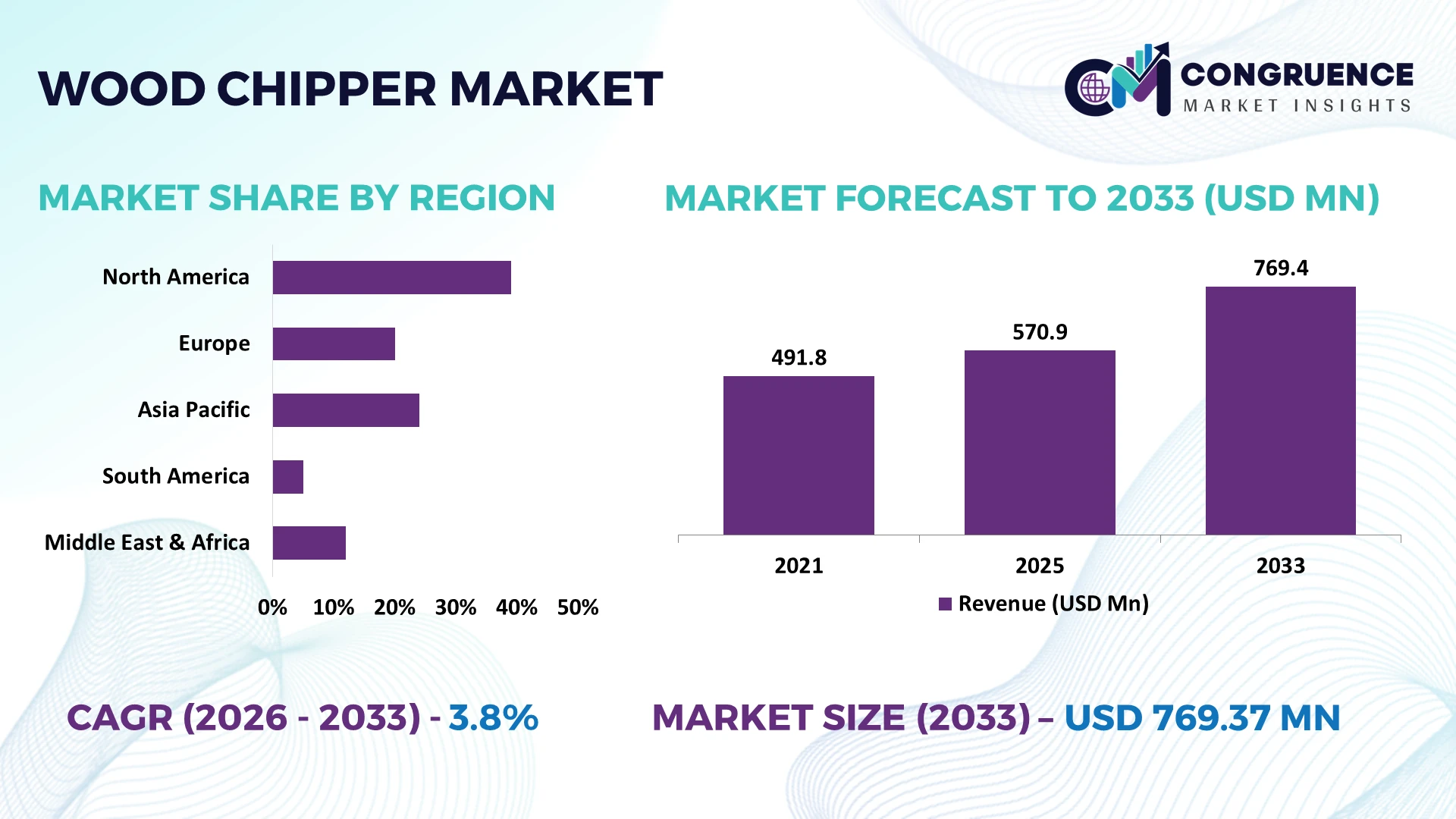
The Global Wood Chipper Market was valued at USD 570.9 Million in 2025 and is anticipated to reach a value of USD 769.37 Million by 2033 expanding at a CAGR of 3.8% between 2026 and 2033. Growth is driven by mechanized forestry operations, expanding biomass feedstock preparation, municipal vegetation management, and replacement of manual wood-processing equipment with high-throughput chipping systems.
The United States remains a dominant Wood Chipper Market, supported by approximately 765 million acres of forest land and an extensive commercial logging, arboriculture, landscaping, and utility vegetation-management ecosystem. Mechanized forestry operations increasingly deploy hydraulic-feed, tracked, and remote-controlled chippers to improve throughput and operator safety. Compared with India, where mechanization remains more fragmented across forestry and biomass collection, U.S. equipment penetration is substantially deeper. Federal wildfire-risk reduction across western states further strengthens utilization, while modern high-efficiency machines can reduce processing time by around 20% in intensive applications.
Strategically, manufacturers should prioritize high-capacity forestry models, safety automation, dealer coverage, and biomass-compatible equipment in markets where mechanization and wildfire-management spending are accelerating.
Market Size & Growth: USD 570.9 million in 2025 advances to USD 769.37 million by 2033 at 3.8% CAGR, supported by mechanized forestry and biomass-processing expansion.
Top Growth Drivers: Forestry mechanization, biomass utilization, and municipal vegetation management collectively underpin equipment demand, with advanced machines delivering approximately 15–25% productivity gains.
Short-Term Forecast: By 2027, optimized hydraulic feeding and electronic engine controls are positioned to improve operational fuel efficiency by approximately 8–12%.
Emerging Technologies: Telematics, automated feed control, and sensor-based overload protection are increasing uptime, with connected monitoring capable of reducing unplanned service interventions by roughly 10–15%.
Regional Leaders: North America, Europe, and Asia-Pacific collectively represent more than 80% of global equipment demand, driven respectively by arboriculture, biomass utilization, and forestry mechanization.
Consumer/End-User Trends: Professional contractors increasingly favor towable and tracked chippers, with productivity improvements of approximately 20% strengthening fleet-replacement economics.
Pilot/Case Example: In 2025, advanced remote-controlled chipping operations demonstrated approximately 15% lower operator exposure around hazardous feeding zones while maintaining commercial processing throughput.
Competitive Landscape: Vermeer, Bandit Industries, Morbark, GreenMech, and Timberwolf anchor competition; leading suppliers increasingly differentiate through 3-year warranties, dealer servicing, telematics, and feed-control technology.
Regulatory & ESG Impact: EU Stage V and comparable emissions requirements push manufacturers toward cleaner engines, with modern systems delivering particulate reductions exceeding 90% versus older uncontrolled diesel platforms.
Investment & Funding: Global forestry modernization and wildfire-management programs involve multi-billion-dollar public expenditure, directing equipment investment toward high-capacity chipping, vegetation clearance, and biomass recovery.
Innovation & Future Outlook: By 2028, electric-drive components, intelligent feed systems, and remote diagnostics will strengthen the advanced wood chipper segment, targeting 10%+ reductions in fuel and maintenance intensity.
Wood chippers are becoming increasingly important across commercial forestry, arboriculture, municipal landscaping, utility right-of-way maintenance, biomass processing, and wildfire fuel-reduction programs. Demand is shifting toward tracked mobility, automated feed control, remote operation, telematics, and low-emission powertrains that improve equipment utilization and operator safety. Modern feed-management technologies can raise processing productivity by approximately 15–20% compared with conventional manually optimized operation. Wildfire mitigation programs in North America and stricter European off-road engine standards are also influencing equipment specifications, creating a clearer strategic divide between basic chippers and technology-enabled professional platforms.
Wood chippers are becoming strategically important as forestry contractors, arborists, municipalities, and biomass operators shift from standalone mechanical equipment toward higher-throughput, digitally monitored fleets. Wildfire fuel-reduction programs in the United States and forest-management modernization in Europe are increasing requirements for mobile processing capacity. The underlying market shift is toward equipment that converts woody residues directly at harvesting or vegetation-management sites, reducing material handling, transport movements, and disposal requirements.
Modern hydraulic-feed chippers with electronic load sensing can deliver roughly 15–25% higher processing efficiency than legacy manually regulated systems while reducing engine overload and fuel consumption by approximately 8–12%. The United States leads deployment of high-horsepower towable and tracked machines across commercial arboriculture and wildfire mitigation, while Germany and the Nordic countries emphasize biomass integration and lower-emission equipment. Through 2026–2028, telematics penetration across professional fleets is expected to strengthen as contractors prioritize uptime, utilization tracking, and preventive maintenance.
A practical deployment involves utility contractors processing branches directly along transmission corridors instead of transporting bulky vegetation to centralized facilities, improving truck utilization and worksite productivity. Manufacturers are consequently investing in remote controls, automated feed systems, dealer service capacity, and low-emission powertrains. Competitive advantage will increasingly depend on processing efficiency, machine uptime, operator safety, and lifecycle operating cost.
Forestry mechanization and large-scale vegetation management are strengthening demand for high-throughput wood chippers as operators replace labor-intensive cutting, loading, and hauling processes. Mechanized chipping can improve woody-residue processing productivity by approximately 20–30%, while optimized hydraulic feeding can reduce fuel consumption per processed tonne by 8–12%. In the United States, wildfire fuel-reduction programs are increasing treatment of hazardous forest vegetation, creating sustained equipment requirements across western states. Utility companies are also intensifying right-of-way clearance around transmission infrastructure. This shift favors mobile chippers that process residues directly at worksites, reducing hauling volume by more than 60% after material size reduction. Manufacturers are responding with higher-capacity tracked platforms, intelligent feed controls, remote operation, and expanded dealer-service networks.
High acquisition costs, diesel exposure, and maintenance intensity constrain fleet replacement among smaller arborists and forestry contractors. Heavy-duty tracked chippers can consume 15–25% more fuel under poorly optimized loading cycles, while knives, anvils, bearings, and hydraulic components create recurring maintenance requirements that can represent 8–12% of annual equipment operating costs in intensive applications. Diesel-price volatility in the United States and Europe directly affects contractor margins because chipping frequently operates alongside loaders and transport vehicles. Smaller Indian forestry and landscaping operators face an additional barrier from fragmented service infrastructure and limited access to specialized replacement components. Manufacturers are countering these constraints through extended maintenance packages, equipment financing, modular wear components, localized parts inventories, and electronically controlled engines that optimize fuel use according to material load.
Connected equipment and decentralized biomass processing create a higher-value opportunity beyond conventional vegetation disposal. Telematics-enabled chippers can improve fleet utilization by approximately 10–15%, while predictive maintenance can reduce unexpected downtime by around 10% through engine, hydraulic, temperature, and operating-hour monitoring. Finland, Sweden, and Germany provide attractive deployment environments because established biomass supply chains can absorb chipped forestry residues as industrial and district-heating feedstock. Electrified auxiliary systems and intelligent feed algorithms are also emerging as practical routes toward lower fuel intensity. By 2028, professional fleets are positioned to increasingly specify remote diagnostics and automated load management as standard purchasing criteria. Manufacturers are investing in connected control platforms, biomass-compatible processing configurations, and partnerships with forestry contractors, creating recurring opportunities around software, maintenance, parts, and lifecycle fleet services.
Scaling advanced wood chipper deployment requires operators capable of managing high-powered machinery, electronic controls, maintenance diagnostics, and increasingly connected fleet systems. Skilled equipment shortages remain significant across forestry and arboriculture, while inadequate operating practices can reduce productive machine utilization by 15–20% through feeding interruptions, knife damage, blockages, and avoidable maintenance. In the United States, increasingly complex wildfire and utility-clearance projects also require equipment to operate across steep terrain, confined corridors, and variable woody material. Remote controls improve operator separation, but electronic and hydraulic sophistication increases technician requirements and diagnostic complexity. Manufacturers must therefore combine product innovation with operator training, standardized control architecture, remote troubleshooting, and stronger field-service coverage. Long-term differentiation will depend on converting advanced machine capability into consistently high utilization rather than simply adding technological features.
Electronics Are Reshaping Feed Control: Professional chippers increasingly combine electronic engine management with hydraulic feed rollers, automatic reversing, and load-sensing controls. These systems can improve material throughput by 15–20%, lower fuel consumption per processed tonne by 8–12%, and reduce engine-overload events by roughly 20%. Manufacturers are integrating programmable feed settings and diagnostic interfaces into premium towable and tracked platforms, shifting differentiation from horsepower alone toward controlled productivity and machine availability.
Compact Fleets Gain Greater Mobility: Arboriculture contractors are restructuring fleets around lighter towable and compact tracked machines suited to congested urban worksites. Compact configurations can reduce equipment repositioning time by 15–25% and require approximately 20% less transport footprint than larger forestry platforms. Labor constraints reinforce this shift because smaller crews need machines with simplified controls, hydraulic feeding, and rapid setup. Suppliers are expanding compact product families while standardizing controls across multiple horsepower classes.
Noise and Emissions Shape Procurement: European Stage V requirements and municipal noise restrictions are changing professional equipment specifications. Modern after-treatment systems can cut particulate emissions by more than 90%, while optimized engines and acoustic enclosures reduce operational noise by approximately 5–10%. Contractors working near schools, hospitals, residential areas, and regulated urban zones increasingly prioritize compliant equipment. Manufacturers are responding with cleaner diesel architectures, electric auxiliary functions, sound attenuation, and redesigned cooling systems.
Chip Quality Gains Commercial Importance: Buyers increasingly specify consistent chip dimensions rather than treating output solely as disposable residue. Optimized knife geometry, adjustable anvils, and controlled feeding can reduce oversize material by 15–20% and improve usable biomass recovery by approximately 10%. This shift links equipment performance directly with downstream handling, composting, mulch, and energy applications. Suppliers are refining cutting chambers and configurable discharge systems, enabling operators to monetize residues while reducing disposal movements and handling costs.
Towable chippers represent the leading type, accounting for approximately 35% of Wood Chipper Market demand, supported by favorable mobility, processing capacity, and acquisition economics for arborists and landscaping contractors. Their ability to move between jobs without dedicated heavy-equipment transport strengthens fleet utilization. Drum chippers remain important in high-volume forestry and biomass operations because continuous cutting configurations handle large woody material efficiently. Disc chippers retain relevance where uniform chip dimensions and controlled discharge are operational priorities.
Self-propelled chippers are the fastest-growing type as forestry contractors increasingly require off-road mobility and direct access to vegetation without separate towing equipment. Tracked configurations can reduce repositioning time by approximately 20% on difficult terrain and improve productive working access by 15–25% compared with road-dependent machines. Hand-fed chippers remain established among tree-care contractors handling smaller material. Manufacturers are concentrating investment on tracked undercarriages, remote controls, hydraulic feed optimization, and modular towable platforms, shifting product development toward mobility and utilization rather than maximum engine output alone.
Forestry operations lead the application mix with an estimated 38% share, reflecting sustained requirements for slash processing, harvesting-residue management, thinning, and roadside biomass preparation. High-capacity drum and self-propelled machines dominate intensive forestry workflows because contractors prioritize tonnes processed per operating hour. Landscaping remains a mature application centered on towable and hand-fed equipment, particularly for tree pruning, storm cleanup, and commercial property maintenance. Land clearing requires larger feed openings and rugged hydraulic systems for variable-diameter woody material.
Biomass production is the fastest-growing application as operators increasingly convert harvesting residues into standardized feedstock rather than treating them as disposal material. Global production of wood pellets, briquettes, and other agglomerates reached 52 million tonnes in 2024, up 2% year over year. Municipal green-waste processing is simultaneously expanding equipment utilization through centralized collection and organics-management programs. Manufacturers are adapting with adjustable chip sizing, higher-capacity discharge systems, contaminant-resistant components, and integrated material-handling configurations. Investment is consequently shifting toward machines capable of serving both residue-management and commercially usable biomass workflows.
Forestry contractors represent the dominant end-user group with approximately 36% market share because commercial harvesting, thinning, land management, and residue processing require high-capacity equipment operating across multiple sites. Machine utilization can exceed landscaping applications by 20–30% during intensive harvesting programs, making durability, feed capacity, and service availability central purchasing criteria. Landscaping contractors form another established buyer group, favoring maneuverable towable and hand-fed machines that support frequent urban deployments. Sawmills and wood processors primarily use chippers for converting slabs, offcuts, and residual material into usable fibre or fuel.
Biomass producers are emerging as the fastest-growing buyer group as woody residues gain value within pellet, industrial heating, and decentralized energy supply chains. FAO data show global wood pellet and agglomerate production reached 52 million tonnes in 2024, 10% above 2020 levels. Municipal authorities also increasingly integrate chippers into storm-response and green-waste workflows. Suppliers are targeting these buyer groups through application-specific cutting systems, fleet financing, service agreements, telematics, and partnerships connecting equipment performance with downstream biomass specifications.
North America accounted for the largest market share at 36% in 2025 however, Asia-Pacific is expected to register the fastest growth, expanding at a CAGR of 5.1% between 2026 and 2033.

Professional Forestry and Arboriculture Mechanization
North America accounts for approximately 36% of global Wood Chipper Market demand, supported by concentrated commercial forestry, professional tree care, utility vegetation management, and municipal debris-processing operations. The United States produces about 16% of global industrial roundwood, providing a substantial operating base for high-capacity drum, towable, and tracked chippers. Contractors increasingly specify hydraulic feed control, remote operation, and telematics as fleet utilization becomes more important than machine acquisition cost alone. Canada contributes additional demand through timber harvesting and biomass supply chains, accounting for roughly 6% of global industrial roundwood production. Wildfire mitigation across western U.S. states is also expanding vegetation-treatment workloads. Manufacturers are strengthening dealer networks, mobile servicing, and tracked product portfolios to capture recurring professional replacement demand and minimize contractor downtime.
United States Market Outlook: The United States combines large forestry output with mature arboriculture and utility-maintenance industries. It accounts for approximately 16% of worldwide industrial roundwood production and 19% of wood pellet production, strengthening equipment utilization across forestry and biomass workflows. Contractors increasingly prioritize high-capacity machines, rapid parts availability, operator-protection systems, and connected fleet diagnostics.
Biomass Integration Reshapes Equipment Specifications
Europe represents approximately 29% of global wood chipper demand, with Germany, the United Kingdom, Sweden, Finland, France, and Austria supporting concentrated professional deployment. Equipment selection increasingly reflects Stage V engine compliance, urban noise requirements, biomass feedstock specifications, and compact-machine mobility. Europe produces approximately 47% of global wood pellets, reinforcing demand for controlled chip dimensions and efficient forestry-residue processing. Sweden and Finland each contribute roughly 3% of global industrial roundwood production, sustaining intensive forestry-equipment utilization despite relatively small populations. Municipal contractors are simultaneously shifting toward lower-emission engines, sound attenuation, automated feed management, and maneuverable tracked platforms. European manufacturers are responding with compact chassis designs, electronically regulated feeding, remote controls, and application-specific cutting systems. The competitive emphasis is moving from basic material reduction toward lower operating intensity, regulatory compliance, and predictable output quality.
Germany Market Outlook: Germany combines advanced forestry machinery distribution with significant biomass utilization and equipment engineering capability. The country produces approximately 8% of global wood pellets and remains an important industrial-roundwood importer and processor. Strict Stage V compliance and municipal operating requirements favor technologically advanced chippers offering efficient combustion, reduced noise, precise feed control, and dependable dealer-supported maintenance.
Industrial Scale Accelerates Mechanized Processing
Asia-Pacific holds approximately 22% of global Wood Chipper Market demand and is transitioning from fragmented low-capacity processing toward mechanized forestry, biomass, landscaping, and wood-processing operations. China anchors manufacturing scale and produces around 10% of global industrial roundwood while accounting for approximately 45% of wood-based panel production, creating substantial downstream residue-processing requirements. Japan and South Korea provide another demand channel through biomass consumption; together they account for approximately 23% of global wood pellet consumption. Equipment deployment is increasingly divided between competitively priced Chinese machinery and higher-specification professional systems incorporating automated feeding, engine protection, and remote operation. Manufacturers are expanding domestic production, export-oriented product lines, and distributor partnerships across Southeast Asia. Rising mechanization in India and Indonesia additionally creates demand for smaller, serviceable machines capable of handling dispersed forestry and agricultural woody residues.
China Market Outlook: China combines large-scale machinery manufacturing with extensive wood-processing infrastructure, giving domestic suppliers a strong cost and production advantage. The country accounts for roughly 10% of global industrial roundwood production and 14% of global sawnwood production. Suppliers are increasingly upgrading basic chippers with hydraulic feeding, diesel optimization, mobile configurations, and export-oriented safety features to compete beyond price.
Plantation Forestry Strengthens Industrial Demand
South America accounts for approximately 8% of global wood chipper demand, led by Brazil and Chile, where plantation forestry, pulp production, sawmilling, and biomass recovery support industrial equipment deployment. Brazil produces about 10% of global industrial roundwood and 13% of global wood pulp, creating concentrated demand for heavy-duty residue processing around forestry and pulp clusters. Chile adds specialized demand from export-oriented plantation and pulp operations. Large eucalyptus and pine estates favor mobile, high-throughput machines capable of processing harvesting residues close to collection points, reducing bulky-material transport. However, long service distances, variable road infrastructure, and imported component dependency increase equipment-support requirements outside major forestry hubs. Suppliers are consequently emphasizing durable hydraulic systems, simplified maintenance, localized spare-parts inventories, and partnerships with forestry-equipment distributors rather than relying solely on centralized sales coverage.
Brazil Market Outlook: Brazil is the region's strategic center because its plantation forestry industry combines scale, mechanized harvesting, and vertically integrated pulp production. The country contributes approximately 10% of global industrial roundwood production and 28% of global pulp exports. Chipper suppliers benefit from concentrated eucalyptus operations where residue recovery, biomass preparation, and high machine utilization justify industrial-capacity equipment.
Waste Modernization Expands Specialized Deployment
Middle East & Africa represents approximately 5% of global wood chipper demand, with deployment concentrated in South Africa, Gulf landscaping operations, municipal green-waste programs, plantation forestry, and biomass-processing projects. Unlike timber-intensive markets, Gulf demand centers on urban landscaping, tree maintenance, construction-site vegetation clearance, and organic-waste diversion, favoring compact towable equipment rather than large forestry machines. Africa presents a different operating structure: Ethiopia and the Democratic Republic of Congo each contribute around 6% and 5% of global wood-fuel production respectively, although mechanized processing remains uneven. South Africa combines commercial forestry with established equipment distribution and service infrastructure. Suppliers are addressing the region through durable machines, rental channels, dealer partnerships, and simplified maintenance configurations. Expansion depends heavily on after-sales coverage because fragmented service infrastructure can materially reduce utilization outside major industrial and municipal centers.
South Africa Market Outlook: South Africa provides the strongest commercial platform through plantation forestry, arboriculture, municipal maintenance, and established machinery distribution. The country accounts for approximately 7% of global wood-fuel exports, highlighting active woody-material supply chains. Professional buyers increasingly require durable chippers supported by local parts inventories, field servicing, operator training, and configurations suited to plantation and municipal workloads.
Vermeer, Bandit Industries, Morbark, Timberwolf, GreenMech, and Heizohack compete across professional arboriculture, forestry, biomass, and municipal applications, with North American heavy-equipment specialists facing European mobility and low-emission specialists. The top five suppliers account for approximately 51% of global market value, leaving regional manufacturers strongest in price-sensitive and localized applications. Competition increasingly centers on throughput, dealer coverage, telematics, safety, and lifecycle cost; automated feed control can improve processing efficiency by 15–20%, while optimized engine management can reduce fuel intensity by 8–12%. Vermeer, Bandit, and Morbark emphasize broad dealer support and high-capacity platforms, while Timberwolf and GreenMech differentiate through compact configurations and urban usability. Product development is shifting toward connected diagnostics, remote controls, and cleaner powertrains rather than horsepower alone. Dealer density, replacement-parts availability, and certification create significant entry barriers. Winning requires dependable throughput, rapid service response, application-specific configurations, and measurable operating-cost advantages across demanding professional duty cycles for fleet-based commercial buyers.
Vermeer Corporation
Bandit Industries
Morbark
Timberwolf
GreenMech
Heizohack
J.P. Carlton
Schliesing Machinery
Först
Jensen Service GmbH
Pezzolato S.p.A.
Teknamotor
Negri Bio
Linddana A/S
Current wood chipper technology centers on managed hydraulic feeding, load sensing, telematics, and automated engine control. Smart feed systems regulate roller speed against engine load, improving processing efficiency by approximately 15–20% versus legacy fixed-feed machines. Telematics is concentrated in professional fleets, where connected diagnostics can reduce unplanned service interventions by roughly 10–15%. These technologies increase utilization while allowing dealers to diagnose faults remotely.
Emerging platforms combine remote controls, variable-speed tracking, Bluetooth diagnostics, hybrid powertrains, and configurable cutting systems. Hybrid chippers can deliver more than 7 tonnes-per-hour throughput while using smaller combustion engines supplemented by electrical peak power. Compared with conventional high-horsepower diesel architectures, intelligent power management can lower fuel and emissions intensity by around 10–20% under variable workloads. Arboriculture contractors and municipal fleets benefit because lower noise, simplified troubleshooting, and tracked mobility improve multi-site productivity.
Disruptive development is shifting toward battery-electric chippers and integrated fleet platforms. Limited-release electric machines are undergoing field validation, signaling early commercial adoption rather than laboratory development. Between 2026 and 2028, electric drivetrains, predictive maintenance, automated feed optimization, and digital fleet integration will move into professional deployment. Manufacturers acting now gain competitive advantage through lower costs, compliance readiness, data-enabled servicing, stronger fleet relationships and lifecycle support.
September 2025 Vermeer introduced limited-release BX1000XL and BC200 electric brush chippers within a four-model electric tree-care validation program. Select customers began real-world testing across North America and Europe, advancing zero-tailpipe-emission equipment validation and fleet electrification decisions worldwide. Source: Vermeer
February 2024 Morbark replaced its Eeger Beever range with five BVR brush chippers spanning 12–20-inch capacities. The modular platform and ZeroClutch drum-speed monitoring simplify maintenance and protect drivetrain components, strengthening equipment uptime and productivity for professional tree-care fleets. Source: EquipmentWorld
August 2025 Bandit Industries produced its 100,000th machine, a Model 12XC hand-fed chipper, after expanding manufacturing operations beyond 560,000 square feet. The milestone demonstrates production scale and supports dealer-led equipment availability across more than 56 countries worldwide. Source: Bandit
November 2025 Timberwolf acquired GreenMech’s brand and intellectual property plus GreenMech GmbH and SAS, adding sales and technical-support hubs in Germany and France. GreenMech manufacturing remained at Alcester, strengthening Timberwolf’s European forestry and tree-care distribution footprint significantly. Source: GreenMech
The Wood Chipper Market Report evaluates five equipment types: disc, drum, hand-fed, towable, and self-propelled chippers, alongside forestry operations, landscaping, land clearing, biomass production, and municipal green-waste processing. End-user coverage spans forestry contractors, landscaping contractors, municipal authorities, biomass producers, sawmills, and wood processors. The analysis assesses North America, Europe, Asia-Pacific, South America, and Middle East & Africa, including country-level deployment patterns and competitive positioning.
Technology coverage examines automated feed control, telematics, remote operation, tracked mobility, hybrid systems, electrification, and configurable chip production. With North America representing approximately 36% of 2025 demand and towable equipment accounting for about 35% of type-level deployment, the report identifies established and emerging investment priorities. The 2026–2033 framework supports capacity planning, geographic expansion, product development, partnership strategy, competitor benchmarking, and positioning around professional fleet modernization and biomass-processing applications.
| Report Attribute/Metric | Report Details |
|---|---|
Market Revenue in 2025 | USD 570.9 Million |
Market Revenue in 2033 | USD 769.37 Million |
CAGR (2026 - 2033) | 3.8% |
Base Year | 2025 |
Forecast Period | 2026 - 2033 |
Historic Period | 2021 - 2025 |
Segments Covered | By Type
By Application
By End-User
|
Key Report Deliverable | Revenue Forecast, Growth Trends, Market Dynamics, Segmental Overview, Regional and Country-wise Analysis, Competition Landscape |
Region Covered | North America, Europe, Asia-Pacific, South America, Middle East, Africa |
Key Players Analyzed | Vermeer Corporation, Bandit Industries, Morbark, Timberwolf, GreenMech, Heizohack, J.P. Carlton, Schliesing Machinery, Först, Jensen Service GmbH, Pezzolato S.p.A., Teknamotor, Negri Bio, Linddana A/S |
Customization & Pricing | Available on Request (10% Customization is Free) |




