
Reports
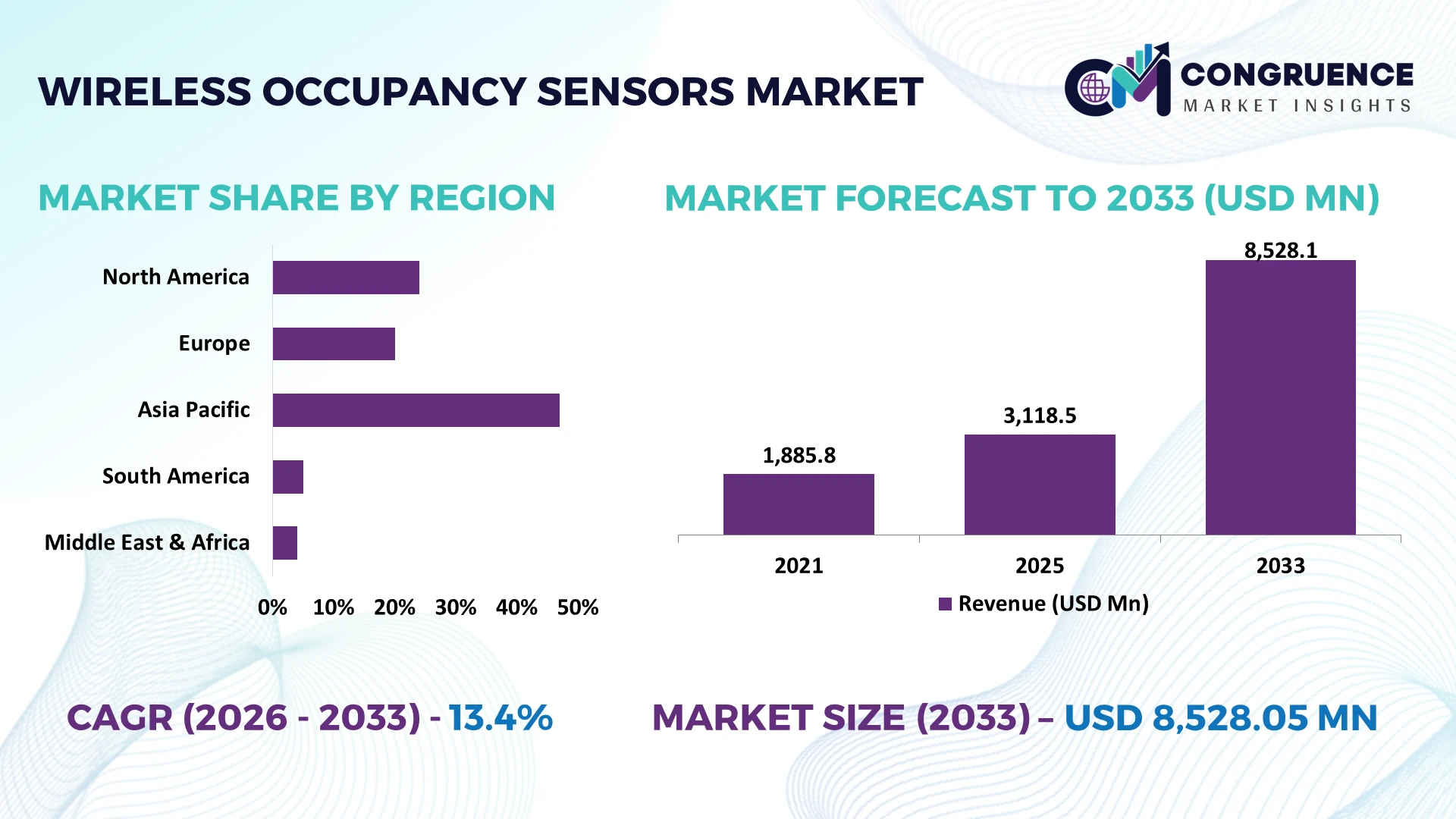
The Global Wireless Occupancy Sensors Market was valued at USD 3118.5 Million in 2025 and is anticipated to reach a value of USD 8528.05 Million by 2033 expanding at a CAGR of 13.4% between 2026 and 2033. Growth is being accelerated by intelligent building retrofits, stricter energy-efficiency regulations, expanding IoT-enabled facility management, and large-scale commercial automation deployments.
The United States remains the dominant market, accounting for approximately 34% of global deployments, supported by multi-billion-dollar smart building investments, widespread commercial retrofitting, and over 68% adoption of connected building management platforms across large enterprise facilities. Compared with Germany, where industrial occupancy sensing adoption is approaching 46%, the U.S. benefits from broader enterprise digitization and accelerated infrastructure modernization, reinforced by resilient North American manufacturing strategies amid evolving global supply-chain realignments in 2026.
Organizations prioritizing scalable wireless occupancy sensor ecosystems gain stronger energy optimization, compliance readiness, and long-term operational efficiency across commercial and industrial assets.
Market Size & Growth: USD 3118.5 million in 2025 to USD 8528.05 million by 2033 at 13.4% CAGR, driven by intelligent building automation and wireless retrofit projects.
Top Growth Drivers: Smart building adoption (+29%), commercial energy optimization (+24%), and IoT-enabled facility management expansion (+21%) continue accelerating global deployment.
Short-Term Forecast: By 2028, wireless installations reduce commissioning costs by nearly 30% while improving space-utilization efficiency by approximately 22%.
Emerging Technologies: AI occupancy analytics, edge computing, and Bluetooth Low Energy mesh networks improve detection accuracy by more than 25% in advanced commercial facilities.
Regional Leaders: North America exceeds USD 3.0 billion, Europe approaches USD 2.2 billion, and Asia-Pacific surpasses USD 2.5 billion, supported by regional smart infrastructure expansion.
Consumer/End-User Trends: More than 61% of enterprise facility managers prioritize wireless occupancy sensing for energy optimization and hybrid workplace management.
Pilot/Case Example: In 2026, a commercial office modernization project improved lighting efficiency by 34% through AI-enabled wireless occupancy sensor integration.
Competitive Landscape: Leading suppliers collectively control approximately 41% of the global market, with Schneider Electric, Honeywell, Signify, Legrand, and Siemens maintaining strong competitive positions.
Regulatory & ESG Impact: Building efficiency standards reduce lighting-related energy consumption by nearly 18%, strengthening sustainability compliance across commercial portfolios.
Investment & Funding: More than USD 1.4 billion supports strategic partnerships, manufacturing expansion, and smart building technology integration amid ongoing regional supply-chain diversification.
Innovation & Future Outlook: Battery-free sensors, digital twins, and predictive occupancy intelligence increase automation precision while enabling enterprise-wide connected building strategies.
Wireless occupancy sensors are experiencing strong adoption across commercial offices, healthcare facilities, educational campuses, logistics centers, and smart retail environments where real-time space intelligence improves operational performance. AI-enabled edge analytics, battery-free sensor designs, and interoperable wireless protocols are accelerating product innovation, while occupancy-based energy optimization delivers efficiency gains exceeding 20%. Continued regulatory emphasis on building efficiency and localized component sourcing is strengthening deployment resilience, setting the stage for broader strategic market evaluation.
Wireless occupancy sensors have become a strategic component of intelligent building ecosystems as organizations prioritize operational efficiency, regulatory compliance, and data-driven facility management. Infrastructure modernization across commercial buildings, healthcare facilities, educational campuses, and logistics centers is accelerating deployment, while supply-chain restructuring since 2025 has encouraged manufacturers to diversify component sourcing and expand localized production. Facility owners increasingly view occupancy intelligence as a long-term operational asset rather than a standalone lighting control solution.
Compared with conventional wired occupancy systems, advanced wireless platforms reduce installation time by nearly 45% and lower retrofit costs by approximately 30% while enabling centralized analytics through cloud-connected building management systems. The United States leads large-scale enterprise implementation with extensive digital workplace investments, whereas Japan emphasizes high-precision sensing for compact commercial infrastructure and aging-building modernization. During the next two to three years, wireless sensor integration with AI-enabled building platforms is expected to exceed 55% of new commercial automation projects, supported by expanding interoperability standards.
A recent office campus modernization project demonstrated a 27% reduction in energy consumption after deploying wireless occupancy sensing integrated with HVAC automation and lighting controls. Companies are strengthening partnerships with software providers, expanding edge-computing capabilities, and increasing investment in interoperable sensor ecosystems to improve deployment flexibility. Organizations establishing scalable wireless occupancy intelligence today will secure stronger competitive positioning through lower operating costs, improved asset utilization, and more resilient smart-building infrastructure.
Commercial building modernization and enterprise digitalization remain the strongest structural drivers for wireless occupancy sensor adoption. More than 64% of new intelligent office developments now incorporate wireless sensing platforms, while energy optimization initiatives typically reduce lighting consumption by 20–35%. In the United States, stricter building performance standards continue encouraging wireless retrofits over disruptive wired installations. This transition improves deployment speed, minimizes operational downtime, and strengthens lifecycle asset management. Leading companies are expanding manufacturing capacity, investing in AI-enabled sensing technologies, and forming software integration partnerships to deliver complete building intelligence solutions. The strategic advantage extends beyond energy savings by enabling continuous occupancy analytics that support workplace optimization and predictive facility management.
Interoperability limitations between proprietary communication protocols and legacy building management systems continue slowing enterprise-scale deployment. Nearly 38% of facility managers identify integration complexity as a primary implementation concern, while semiconductor and wireless module procurement costs remain around 12–15% above pre-disruption levels for selected components. Germany and other advanced manufacturing hubs continue addressing supply resilience through localized electronics production, yet compatibility issues still increase deployment timelines and engineering costs. Companies are responding by diversifying suppliers, adopting open communication standards, and negotiating long-term component contracts. Organizations that standardize interoperable architectures achieve faster commissioning and lower long-term maintenance costs than fragmented deployments.
The convergence of AI analytics, edge computing, and digital twin technologies is creating new value beyond conventional occupancy detection. Advanced occupancy intelligence improves space utilization by approximately 25% while reducing unnecessary HVAC operation by nearly 18%. Singapore continues promoting intelligent building initiatives that accelerate adoption of integrated sensor ecosystems across commercial developments. Companies are expanding R&D investments in self-learning algorithms, battery-free sensing technologies, and cloud-native analytics platforms to deliver predictive facility optimization. A growing opportunity also exists in subscription-based building intelligence services, enabling recurring revenue models while helping enterprises continuously optimize workplace performance through real-time occupancy insights.
Large multi-site deployments require seamless integration across lighting controls, HVAC systems, security platforms, and enterprise software, creating substantial execution complexity. Approximately 42% of large commercial projects require customized system integration, while cybersecurity compliance efforts increase implementation timelines by nearly 20%. The United Kingdom has strengthened connected-building cybersecurity expectations, requiring more rigorous validation of IoT infrastructure. Companies must expand cybersecurity investment, strengthen system integration expertise, and collaborate with automation platform providers to ensure consistent performance across diverse building portfolios. Organizations capable of delivering secure, scalable, and interoperable deployments will establish durable competitive differentiation in increasingly connected commercial environments.
AI-Driven Building Intelligence Advanced occupancy analytics are replacing basic motion detection as enterprises integrate AI with wireless sensing platforms. More than 57% of newly deployed enterprise systems now support predictive occupancy analysis, improving workspace utilization by nearly 24% and reducing unnecessary lighting cycles by approximately 28%. Driven by digital workplace transformation in the United States, manufacturers are expanding software partnerships and embedding edge intelligence to deliver continuous operational optimization instead of standalone sensing hardware.
Battery-Free Sensor Adoption Energy-harvesting wireless sensors are gaining traction as organizations seek lower maintenance requirements and longer deployment lifecycles. Maintenance interventions decline by roughly 35%, while battery replacement requirements fall by over 80% in suitable commercial installations. Tightened sustainability targets and stricter building efficiency standards are accelerating adoption, prompting companies to redesign product portfolios around maintenance-free architectures and scalable retrofit solutions that minimize operational disruption.
Open Protocol Integration Growth Enterprises increasingly prioritize interoperable wireless occupancy sensors supporting BACnet, Matter, and Bluetooth Mesh ecosystems. Around 52% of large commercial automation projects now specify multi-protocol compatibility, reducing system integration time by nearly 26%. Germany's emphasis on smart manufacturing interoperability has strengthened this transition, encouraging suppliers to standardize communication platforms and expand technology alliances that simplify enterprise-wide deployment across mixed building infrastructure.
Hybrid Workplace Optimization Flexible office utilization continues reshaping occupancy sensing strategies as organizations measure real-time space demand instead of fixed workstation capacity. Dynamic workspace management improves meeting room utilization by approximately 31% while reducing underused floor space by nearly 19%. Facility technology providers are restructuring service offerings toward cloud-managed occupancy intelligence, enabling enterprises to align facility operations with changing workforce patterns and optimize long-term infrastructure planning.
Passive Infrared (PIR) sensors remain the leading product category, accounting for approximately 43% of total market deployment due to their cost efficiency, reliable occupancy detection, and straightforward integration into commercial lighting systems. Their low power consumption and scalable installation make them the preferred solution for offices, educational institutions, and retail facilities. Microwave sensors continue serving specialized applications requiring wider detection coverage, while Ultrasonic technology remains valuable in enclosed environments where fine-motion detection is essential. Manufacturers are enhancing PIR platforms with AI-enabled analytics and wireless connectivity to strengthen competitive differentiation.
Dual Technology sensors represent the fastest-growing segment as organizations prioritize higher detection accuracy and reduced false activations across complex commercial environments. Combining PIR and Ultrasonic sensing improves detection reliability by nearly 30%, supporting deployment in healthcare facilities, logistics centers, and premium office buildings. Adoption of Dual Technology solutions has increased by approximately 22% in newly automated enterprise projects, while Microwave platforms continue expanding within industrial infrastructure. Companies are accelerating product innovation, investing in intelligent multi-sensor platforms, and expanding channel partnerships to address growing enterprise demand for precision occupancy intelligence.
Lighting Control remains the largest application segment, representing approximately 37% of deployments because occupancy sensing directly reduces unnecessary electricity consumption and simplifies retrofit implementation. Commercial facilities continue prioritizing automated lighting strategies that lower operating costs while supporting regulatory compliance. Energy Management and HVAC Control are increasingly integrated through centralized building platforms, allowing occupancy data to optimize ventilation and temperature settings simultaneously. Security & Surveillance applications continue expanding as occupancy analytics improve situational awareness across enterprise environments.
Smart Buildings represent the fastest-growing application segment as digital infrastructure investments reshape enterprise facility management. Deployment of integrated occupancy intelligence has increased by approximately 26%, while synchronized HVAC and lighting automation improves overall building efficiency by nearly 23%. Security platforms increasingly leverage occupancy information to automate access control and incident monitoring across large facilities. Companies are responding through cloud-based building management integration, AI-enabled automation, and ecosystem partnerships that unify multiple building functions into scalable intelligent infrastructure, strengthening operational resilience and long-term asset performance.
Commercial Buildings remain the dominant end-user segment, accounting for approximately 48% of market deployment due to extensive requirements for energy optimization, workplace analytics, and intelligent facility management. Large office campuses, retail centers, hospitality properties, and mixed-use developments continue investing in wireless occupancy sensing to reduce operational costs while improving occupant experience. Residential Buildings steadily expand through smart home adoption, while Educational Institutions increasingly modernize classrooms with automated occupancy-based lighting and environmental controls.
Healthcare Facilities represent the fastest-growing end-user segment as hospitals and medical campuses prioritize precise occupancy monitoring, infection-control workflows, and energy-efficient operations. Sensor deployment within healthcare environments has expanded by approximately 24%, while Industrial Facilities report productivity improvements exceeding 18% through occupancy-driven automation of warehouses and production support areas. Companies are strengthening healthcare-focused product portfolios, expanding enterprise partnerships, and developing specialized sensing platforms that satisfy demanding compliance, reliability, and operational continuity requirements across mission-critical facilities.
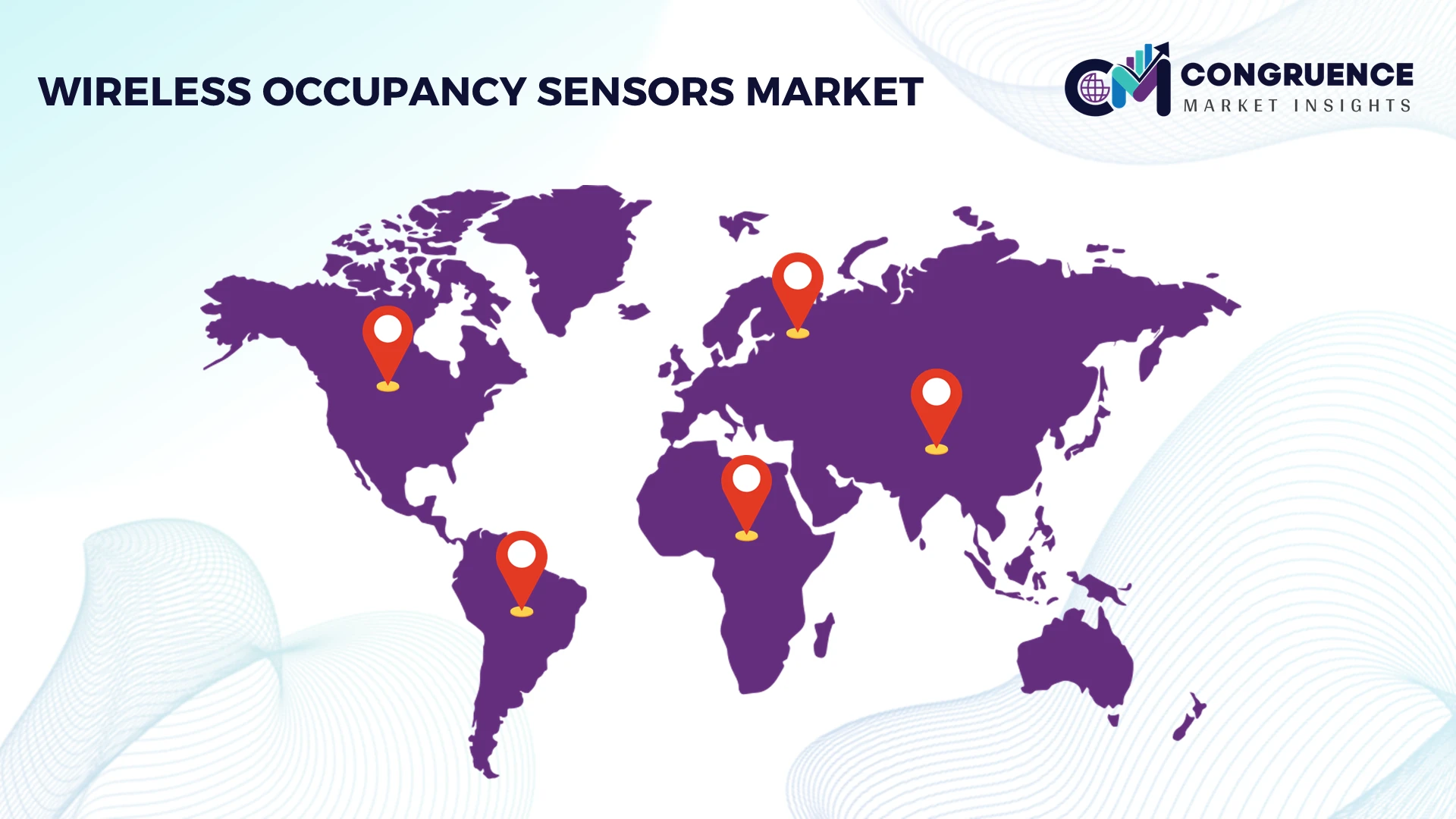
North America accounted for the largest market share at 36.8% in 2025 however, Asia-Pacific is expected to register the fastest growth, expanding at a 15.2% between 2026 and 2033.
Smart Building Retrofits Drive Enterprise Adoption
North America remains the largest regional market due to widespread deployment across commercial offices, healthcare campuses, educational institutions, and logistics facilities. Strong enterprise investment in intelligent building automation, combined with stringent energy-efficiency regulations, continues accelerating wireless occupancy sensor integration. The region contributes approximately 37% of global deployments, with connected building platforms increasingly incorporating occupancy analytics into HVAC, lighting, and security operations. More than 62% of newly modernized commercial buildings now deploy wireless sensing systems as part of digital facility management initiatives. Technology providers continue expanding cloud-based building platforms through strategic software partnerships, while large property owners prioritize scalable retrofits that minimize installation disruption and improve long-term operational performance.
United States Market Outlook: The United States leads the regional market through advanced commercial infrastructure, extensive smart office modernization, and strong enterprise adoption of IoT-enabled building management platforms. Approximately 68% of large commercial building automation projects integrate occupancy sensing within centralized facility management systems. Federal and state-level energy-efficiency initiatives continue encouraging intelligent retrofits, while technology providers strengthen AI software capabilities and ecosystem partnerships to deliver predictive occupancy intelligence across commercial portfolios.
Regulatory Modernization Strengthens Intelligent Buildings
Europe maintains a strong position through aggressive building modernization, sustainability mandates, and digital infrastructure upgrades. Approximately 29% of global wireless occupancy sensor deployments originate from the region, supported by increasing investments in energy-efficient commercial buildings and industrial automation. More than 54% of major office refurbishment projects now incorporate wireless occupancy sensing to comply with evolving efficiency standards while improving workplace flexibility. Manufacturers continue investing in interoperable wireless platforms and low-maintenance sensor technologies to support both retrofit and new-build applications. Growing collaboration between automation vendors and building management providers is improving deployment consistency across diverse property portfolios.
Germany Market Outlook: Germany remains the region's technology leader due to its advanced manufacturing ecosystem, intelligent commercial infrastructure, and emphasis on industrial automation. Around 46% of newly commissioned smart commercial facilities incorporate integrated occupancy sensing solutions linked with centralized energy management systems. Domestic engineering expertise and strong industrial digitization programs continue supporting innovation in wireless sensor technologies while strengthening export competitiveness across European building automation markets.
Manufacturing Scale Accelerates Smart Infrastructure
Asia-Pacific is the fastest-expanding regional market, supported by rapid urbanization, commercial construction, electronics manufacturing, and government-backed smart infrastructure initiatives. The region accounts for nearly 31% of global deployments and continues expanding through large-scale office developments, transport infrastructure, healthcare investments, and industrial automation projects. More than 58% of newly constructed premium commercial buildings across leading economies integrate intelligent wireless building technologies during initial development. Electronics manufacturers continue increasing production capacity while automation vendors expand regional partnerships to improve supply resilience and accelerate deployment across high-growth markets.
China Market Outlook: China dominates the regional landscape through its extensive electronics manufacturing capacity, smart city development programs, and expanding commercial infrastructure. More than 60% of domestic intelligent commercial construction projects include wireless occupancy sensing integrated with connected building platforms. Strong local manufacturing capabilities, continued investment in IoT technologies, and rapid enterprise digitalization enable suppliers to scale production efficiently while supporting growing domestic and export demand.
Commercial Modernization Supports Demand
South America is experiencing steady adoption as commercial property modernization, retail expansion, and healthcare infrastructure improvements increase demand for wireless occupancy sensing. Approximately 7% of global market deployment is concentrated within the region, with enterprise customers increasingly selecting wireless retrofits that reduce installation complexity. Nearly 32% of recently upgraded commercial facilities incorporate intelligent occupancy controls to improve energy performance and operational visibility. Investment remains focused on office buildings, shopping centers, and institutional infrastructure, although inconsistent modernization across smaller markets continues affecting deployment speed. Technology vendors are strengthening distributor partnerships and localized service capabilities to improve implementation efficiency.
Brazil Market Outlook: Brazil leads regional demand through its large commercial real estate sector, expanding logistics infrastructure, and increasing adoption of intelligent building technologies. Nearly 35% of premium office modernization projects now include wireless occupancy sensors integrated with lighting and HVAC automation. Local system integrators continue expanding partnerships with international technology providers, improving implementation quality while supporting enterprise digital transformation initiatives.
Infrastructure Investment Reshapes Building Automation
The Middle East & Africa market is advancing through large-scale infrastructure development, premium commercial construction, and smart city investments. The region contributes approximately 6% of global deployment, with demand concentrated in high-value commercial complexes, airports, healthcare facilities, and hospitality projects. Around 40% of newly developed flagship commercial properties now integrate intelligent wireless occupancy sensing within centralized building management systems. Governments continue prioritizing energy-efficient infrastructure, encouraging technology suppliers to establish regional partnerships and expand technical support capabilities for complex enterprise installations.
United Arab Emirates Market Outlook: The United Arab Emirates remains the leading regional market because of extensive smart building investments, premium commercial developments, and advanced digital infrastructure initiatives. More than 50% of newly completed Grade-A commercial developments incorporate integrated wireless occupancy sensing to optimize operational efficiency and sustainability performance. Strong public-private collaboration and continued investment in intelligent infrastructure position the country as a regional reference market for connected building technologies.
Global leaders including Schneider Electric, Honeywell, Siemens, Legrand, and Signify compete directly with technology-focused innovators and specialized building automation suppliers. The top five companies collectively account for approximately 44% of the market, while regional manufacturers challenge established brands through competitive pricing and localized engineering support. Competition centers on detection accuracy, wireless interoperability, installation speed, and lifecycle maintenance costs. AI-enabled occupancy analytics improve operational efficiency by nearly 25%, while standardized wireless protocols reduce deployment time by approximately 20%, creating measurable differentiation beyond hardware performance. Leading companies are expanding software ecosystems, strengthening strategic partnerships with building management platform providers, investing in edge intelligence, and increasing regional manufacturing to improve supply resilience. Vertical integration across sensing hardware and building software is becoming a defining competitive advantage as customers demand unified automation platforms. High certification requirements, enterprise integration expertise, and cybersecurity compliance create significant entry barriers. Sustainable success depends on delivering interoperable, intelligent, secure, and scalable occupancy sensing ecosystems with rapid deployment capability.
Schneider Electric
Honeywell International
Siemens AG
Legrand
Signify
Acuity Brands
Lutron Electronics
Hubbell Incorporated
Eaton Corporation
Johnson Controls
Leviton Manufacturing
ABB Ltd.
STEINEL
Distech Controls
Wireless occupancy sensors are rapidly evolving from standalone motion detectors into intelligent edge-connected devices integrated with building management systems. Passive Infrared (PIR), Ultrasonic, and Dual Technology sensors remain the most deployed platforms, with nearly 65% of new commercial installations supporting wireless connectivity and cloud-based monitoring. AI-assisted occupancy analytics improve detection accuracy by approximately 22%, while Bluetooth Mesh and Zigbee integration reduce installation complexity by nearly 28%. These technologies enable facility managers to optimize lighting, HVAC, and workspace utilization through centralized automation while lowering maintenance requirements across multi-site commercial portfolios.
Emerging technologies between 2026 and 2028 include battery-free energy-harvesting sensors, mmWave radar sensing, digital twins, and edge AI processing. Compared with conventional wired occupancy systems, next-generation wireless platforms shorten installation time by approximately 45% and reduce lifecycle maintenance costs by nearly 30%. More than 40% of enterprise smart-building deployments are expected to incorporate edge-based occupancy intelligence, enabling faster decision-making, predictive environmental control, and interoperability with advanced building automation platforms through standardized communication protocols.
Disruptive innovation is shifting competition from hardware performance toward intelligent software ecosystems. Global automation leaders benefit from AI-enabled analytics, while specialized sensor manufacturers compete through low-power architectures and precision detection algorithms. Companies investing in interoperable platforms, cybersecurity, and predictive occupancy intelligence are strengthening long-term competitive positioning. Through 2028, wider adoption of occupancy-driven digital building operations will improve operational efficiency by approximately 20%, making intelligent sensing a strategic differentiator rather than a standalone building control component.
January 2024 Honeywell launched Advance Control for Buildings, integrating occupancy sensing with AI-enabled building management for commercial retrofits, delivering up to 20% HVAC energy savings while operating on existing building wiring. Business impact: faster modernization of legacy facilities. Source: https://buildings.honeywell.com
February 2025 Schneider Electric introduced the SpaceLogic Touchscreen Room Controller with occupancy-aware HVAC and lighting optimization, delivering up to 35% energy savings and reducing HVAC comfort issues by 25%. Business impact: stronger intelligent building automation performance.
June 2025 Acuity Brands, through SensorSwitch, launched the TLS Twist-to-Lock industrial occupancy sensor supporting retrofit and factory-installed deployments for warehouses and manufacturing facilities. Business impact: expanded industrial automation with faster installation flexibility.
February 2025 ABB and Samsung Electronics announced integration of ABB InSite energy management with Samsung SmartThings, enabling occupancy-based energy optimization across residential and commercial buildings. Business impact: broader connected-building interoperability and intelligent energy management.
This report provides comprehensive analysis of the Wireless Occupancy Sensors market across Passive Infrared (PIR), Ultrasonic, Dual Technology, and Microwave technologies, covering key applications including Lighting Control, HVAC Control, Security & Surveillance, Energy Management, and Smart Buildings. It evaluates demand across Commercial Buildings, Residential Buildings, Industrial Facilities, Healthcare Facilities, and Educational Institutions while assessing deployment patterns, technology integration, and competitive positioning. Regional coverage spans North America, Europe, Asia-Pacific, South America, and the Middle East & Africa, representing the major deployment centers and emerging adoption markets.
The report examines AI-enabled sensing, edge computing, battery-free technologies, interoperable wireless communication, and intelligent building automation trends shaping market evolution between 2026 and 2033. It provides strategic assessment of technology adoption, enterprise deployment priorities, operational benchmarks, company positioning, regional expansion opportunities, and evolving customer requirements. The analysis supports investment planning, product development, partnership strategies, competitive benchmarking, and long-term market expansion by combining segmentation insights with operational, technological, and industry-specific intelligence relevant to decision-makers.
| Report Attribute/Metric | Report Details |
|---|---|
Market Revenue in 2025 | USD 3118.5 Million |
Market Revenue in 2033 | USD 8528.05 Million |
CAGR (2026 - 2033) | 13.4% |
Base Year | 2025 |
Forecast Period | 2026 - 2033 |
Historic Period | 2021 - 2025 |
Segments Covered | By Type
By Application
By End-User
|
Key Report Deliverable | Revenue Forecast, Growth Trends, Market Dynamics, Segmental Overview, Regional and Country-wise Analysis, Competition Landscape |
Region Covered | North America, Europe, Asia-Pacific, South America, Middle East, Africa |
Key Players Analyzed | Schneider Electric, Honeywell International, Siemens AG, Legrand, Signify, Acuity Brands, Lutron Electronics, Hubbell Incorporated, Eaton Corporation, Johnson Controls, Leviton Manufacturing, ABB Ltd., STEINEL, Distech Controls |
Customization & Pricing | Available on Request (10% Customization is Free) |




