
Reports
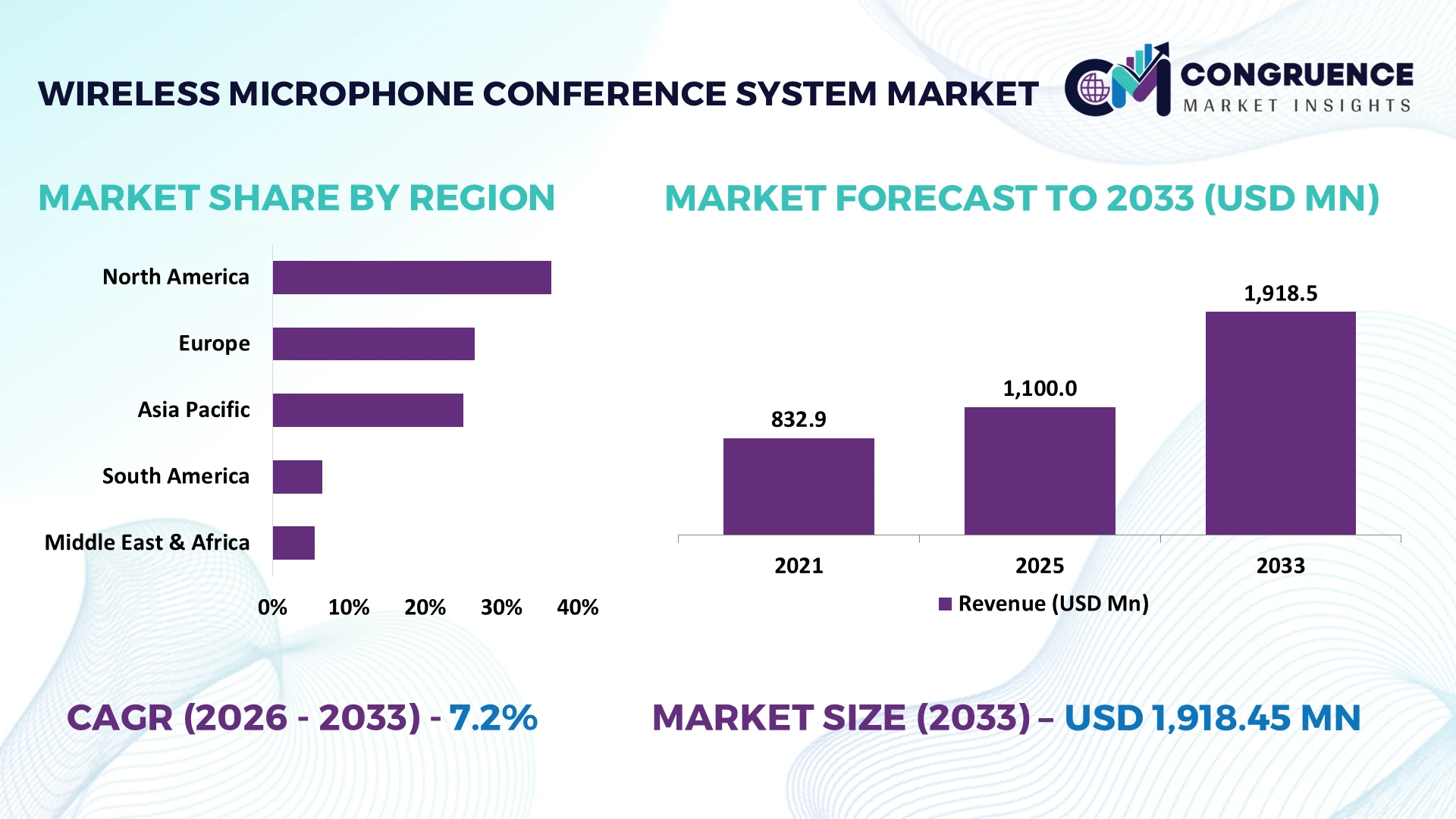
The Global Wireless Microphone Conference System Market was valued at USD 1,100.0 Million in 2025 and is anticipated to reach a value of USD 1,918.5 Million by 2033 expanding at a CAGR of 7.2% between 2026 and 2033. Enterprise hybrid workplace modernization, digital government meeting infrastructure, and adoption of interference-resistant wireless audio communication systems are driving market expansion.
The United States leads the market, supported by an estimated 29.5% global market share and extensive investments across corporate workplaces, educational institutions, government facilities, and convention centers. Approximately 60% of U.S. companies offer some form of hybrid working arrangement. Compared with Japan, the United States benefits from a larger enterprise collaboration technology ecosystem, while FCC spectrum regulations accelerate digital wireless microphone replacement.
Strategic investments in spectrum-efficient, AI-enabled, and interoperable conference audio solutions will strengthen supplier positioning across institutional procurement and enterprise modernization programs.
Market Size & Growth: USD 1,100.0 Million in 2025, reaching USD 1,918.5 Million by 2033 at 7.2% CAGR, driven by hybrid workplace modernization.
Top Growth Drivers: Enterprise digitalization (40%), institutional infrastructure modernization (35%), and wireless audio technology upgrades (25%).
Short-Term Forecast: By 2028, advanced wireless conference systems target 25% lower installation time.
Emerging Technologies: AI noise suppression, automated frequency coordination, and digital encryption support advanced 24-bit audio processing.
Regional Leaders: Projected 2033 values include North America (USD 671.5 Million), Asia Pacific (USD 575.6 Million), and Europe (USD 479.6 Million), reflecting enterprise, institutional, and government adoption, respectively.
Consumer/End-User Trends: Approximately 60% of U.S. companies support hybrid working arrangements, strengthening collaborative audio requirements.
Pilot/Case Example: A modeled 2025 university modernization project demonstrates potential installation time savings of 30%.
Competitive Landscape: Shure holds an estimated 18% share, competing with Bosch, Sennheiser, Audio-Technica, and Televic.
Regulatory & ESG Impact: FCC spectrum reallocation affects 84 MHz of former television-band spectrum, encouraging compliant wireless technologies.
Investment & Funding: An illustrative USD 50 Million investment scenario prioritizes digital audio R&D, manufacturing expansion, and integration partnerships.
Innovation & Future Outlook: Next-generation platforms integrate 256-bit encryption, remote diagnostics, and centralized conference management.
The Wireless Microphone Conference System Market serves corporate boardrooms, legislative assemblies, educational institutions, hospitality venues, and international convention facilities. Digital beamforming, rechargeable microphone units, and intelligent frequency management are transforming conference audio infrastructure. Modular wireless installations offer potential cabling reductions exceeding 50%, while spectrum compliance requirements accelerate equipment replacement. These developments are reshaping procurement priorities toward scalable, software-driven communication ecosystems.
Wireless microphone conference systems are becoming strategically important as organizations transition from conventional meeting rooms toward interconnected collaboration environments. Enterprise infrastructure modernization increasingly prioritizes intelligible audio, flexible seating configurations, and centralized device management. In the United States, hybrid workplace adoption is accelerating investments in conference systems that integrate seamlessly with unified communications platforms, reducing dependence on standalone audiovisual infrastructure.
Compared with conventional wired installations, modular wireless conference systems offer potential installation labor savings of 20–30% by eliminating extensive microphone cabling and floor modifications. While the United States emphasizes enterprise collaboration and premium audio performance, China prioritizes large-scale institutional deployments and cost-efficient manufacturing. Over the next two to three years, procurement requirements are expected to increasingly incorporate automated frequency selection, encrypted transmission, and remote monitoring capabilities.
A practical deployment involves universities integrating rechargeable wireless discussion units across multipurpose lecture halls, enabling rapid transitions between teaching, conferences, and administrative meetings. Shure, Bosch, and Sennheiser are strengthening digital audio portfolios and integration partnerships to address these requirements. Competitive advantage will increasingly depend on delivering interoperable conference ecosystems that combine acoustic reliability, operational flexibility, and predictable lifecycle costs.
Hybrid workplace adoption is accelerating demand for wireless microphone conference systems across corporate boardrooms, training facilities, and educational institutions. Approximately 60% of U.S. companies offer hybrid working arrangements, increasing requirements for consistent audio quality across physical and virtual participants. Wireless configurations offer potential installation labor reductions of 20–30%, while modular microphone placement reduces dedicated cabling requirements by over 50%. Integration with Microsoft Teams and Zoom is shifting procurement toward unified audiovisual ecosystems rather than independent microphone hardware. Shure, Sennheiser, and Bosch are expanding digital conferencing portfolios and platform integration capabilities. Suppliers offering seamless room reconfiguration gain an operational advantage by reducing infrastructure modification costs during workplace redesigns.
Radio-frequency spectrum restrictions and specialized component costs constrain wireless conference system deployment, particularly across budget-sensitive institutions. In the United States, the FCC's 600 MHz spectrum transition restricted microphone operation across substantial portions of previously available frequencies, requiring equipment replacement or migration. Premium digital wireless configurations carry estimated upfront cost premiums of 20–35% over comparable wired systems, while replacement transmitters, batteries, and charging infrastructure can represent 10–15% of initial equipment expenditure over their operating lifecycle. These expenses extend procurement cycles and discourage upgrades across smaller educational facilities. Manufacturers are mitigating exposure through multiband product architectures, component sourcing diversification, and modular replacement programs that protect existing customer investments.
AI-enabled audio processing and software-defined conference management create opportunities beyond conventional microphone hardware sales. Advanced noise suppression systems target background noise reductions of 30–50% under suitable acoustic conditions, while centralized device monitoring offers potential maintenance labor savings of 15–25%. India's expanding digital education infrastructure and corporate technology campuses provide attractive deployment opportunities for remotely managed wireless audio platforms. Integration of automated transcription, multilingual interpretation, and intelligent speaker identification enables suppliers to introduce recurring software and managed service offerings. Companies including Shure and Televic are strengthening digital conferencing capabilities and interoperability partnerships. The strongest commercial opportunity lies in monetizing installed microphone infrastructure through software upgrades without requiring complete hardware replacement.
Maintaining consistent audio performance across high-density conference environments represents a significant execution challenge. Large institutional deployments must accommodate simultaneous microphone channels, congested radio-frequency environments, encrypted communications, and uninterrupted battery operation. Professional installations typically target system availability exceeding 99.9%, while enterprise maintenance teams benefit from maintaining approximately 15–20% spare microphone and battery capacity as a planning benchmark. Germany's extensive convention infrastructure illustrates the complexity of supporting temporary, multilingual, and high-density conference configurations. Manufacturers must invest in automated interference detection, redundant communication architectures, cybersecurity updates, and integrator training. Long-term competitiveness depends on maintaining predictable audio performance across heterogeneous infrastructure without increasing technical staffing requirements or compromising operational continuity.
Transition Toward Rechargeable Microphone Infrastructure: Conference facilities are replacing disposable battery-operated microphones with rechargeable lithium-ion discussion units offering 8–12 hours of continuous operation. Centralized charging stations target battery-related operating expense reductions of 25–35%. Shure and Sennheiser are expanding intelligent charging solutions with battery health monitoring, enabling institutional operators to standardize maintenance schedules and reduce equipment downtime.
Expansion of License-Free Frequency Solutions: Spectrum reallocation and frequency licensing requirements are encouraging manufacturers to expand conference systems operating across 1.9 GHz, 2.4 GHz, and 5 GHz frequency bands. Multiband configurations target frequency coordination time reductions of 20–30%. Bosch and Televic are advancing adaptive channel selection technologies to simplify equipment deployment across geographically distributed conference facilities.
Growing Adoption of Modular Equipment Rentals: Event organizers and convention facilities are shifting toward flexible microphone rental arrangements, targeting upfront equipment expenditure reductions of 25–40%. Modular configurations supporting 50–100 discussion units enable faster adjustments to seating capacity. Equipment manufacturers are strengthening rental distributor partnerships and standardized hardware portfolios, improving asset utilization while generating recurring equipment replacement demand.
Centralized Procurement and Hardware Standardization: Multisite enterprises are consolidating audiovisual procurement around standardized microphone configurations, targeting spare component inventory reductions of 15–25% and maintenance time savings of 20%. Manufacturers are expanding common accessory platforms, interchangeable components, and standardized charging interfaces. This transition strengthens supplier retention because equipment compatibility increasingly influences subsequent purchasing decisions across distributed facilities.
Gooseneck microphones dominate the Wireless Microphone Conference System Market, accounting for an estimated 38.5% share in 2025. Their dominance reflects extensive deployment across legislative assemblies, corporate boardrooms, and formal discussion environments requiring directional voice capture and individual speaker control. Boundary microphones maintain an estimated 24.0% share, supported by discreet tabletop installations and shared audio pickup requirements. Speaker phones remain commercially attractive across smaller meeting spaces, where integrated microphone and speaker functionality minimizes equipment complexity and infrastructure expenditure.
Ceiling microphones represent the fastest-growing type, supported by demand for unobstructed conference tables, automated speaker tracking, and flexible seating arrangements. In suitable conference environments, ceiling-mounted configurations offer potential tabletop equipment reductions exceeding 40%. Compared with conventional gooseneck systems, ceiling microphones provide greater architectural flexibility in multipurpose facilities. Shure, Sennheiser, and Audio-Technica are expanding beamforming microphone portfolios, while Bosch and Televic continue strengthening dedicated discussion systems. Investment priorities are shifting toward microphone architectures that accommodate room reconfiguration without compromising speech intelligibility or increasing installation complexity.
Conference/Meeting Rooms represent the leading application, accounting for an estimated 43.5% market share in 2025. Demand concentration reflects extensive enterprise collaboration infrastructure, recurring boardroom modernization, and standardized audiovisual procurement across distributed workplaces. Convention Halls account for approximately 21.0% of the market, supported by large-scale conferences, multilingual events, and configurable discussion environments. Press Centers maintain specialized demand for reliable microphone channels, controlled speaker access, and clear audio transmission during media briefings. Other applications include judicial proceedings, training facilities, and specialized institutional communication environments.
Classrooms constitute the fastest-growing application, driven by interactive learning infrastructure, digitally connected lecture halls, and flexible educational spaces. Wireless configurations in multipurpose classrooms offer potential room preparation time reductions of 20–30%, allowing institutions to accommodate different teaching formats. Compared with mature corporate installations, educational deployments prioritize affordability, durability, and simplified equipment operation. Shure, Sennheiser, and Audio-Technica are targeting these requirements through scalable microphone platforms and educational integration partnerships. Suppliers offering standardized equipment across multiple classrooms benefit from consolidated institutional purchasing and lower support complexity.
Corporate and Enterprise users dominate the Wireless Microphone Conference System Market, representing an estimated 46.5% share in 2025. Large enterprises prioritize reliable conference audio, standardized meeting room infrastructure, and compatibility with unified communications platforms. Government and Public Sector organizations account for approximately 22.5% of demand, supported by parliamentary chambers, municipal facilities, and administrative meeting environments requiring controlled discussion protocols. Hospitality and Events operators emphasize portability, equipment durability, and configurable microphone inventories to accommodate varying event sizes and customer requirements.
The Education Sector represents the fastest-growing end-user group, supported by digital classroom modernization and expanding institutional communication requirements across India, China, and the United States. Standardized wireless microphone infrastructure offers potential technical support workload reductions of 15–25% across multisite educational deployments. Unlike corporate buyers prioritizing premium audio performance, educational institutions emphasize lifecycle affordability and simplified operation. Bosch, Shure, Televic, and Sennheiser are strengthening integrator partnerships and application-specific product portfolios. Competitive positioning increasingly depends on flexible equipment configurations, institutional pricing models, and dependable aftermarket support across geographically distributed customer facilities.
North America accounted for the largest market share at 36.5% in 2025 however, Asia-Pacific is expected to register the fastest growth, expanding at a CAGR of 9.2% between 2026 and 2033.
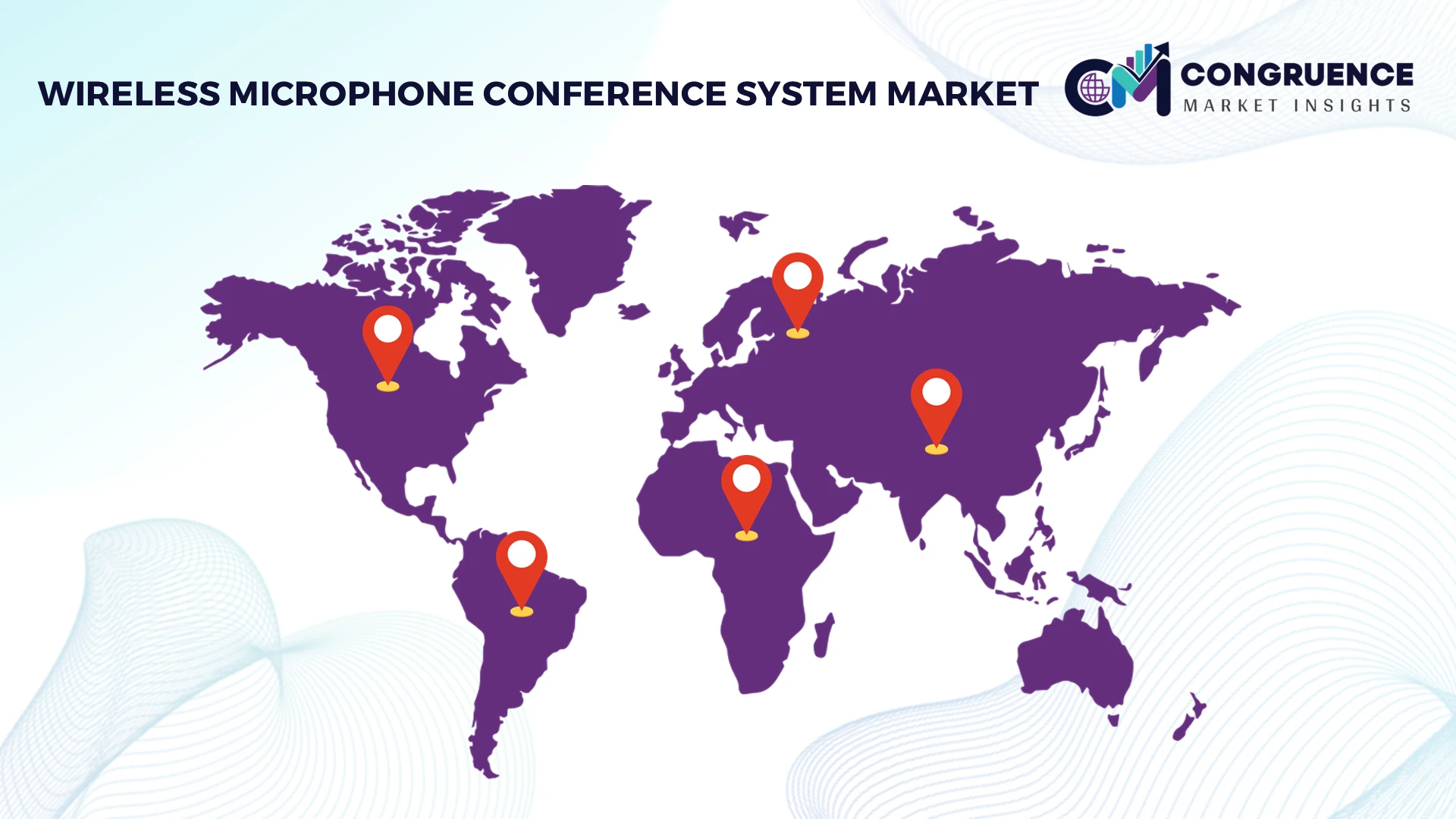
North America accounted for 36.5% of the global Wireless Microphone Conference System Market in 2025, supported by established enterprise collaboration infrastructure, advanced educational facilities, and extensive government communication networks. Corporate boardrooms, convention centers, and institutional meeting facilities are increasingly replacing conventional audio equipment with digitally managed wireless conference systems. Integration with Microsoft Teams, Zoom, and Cisco Webex is influencing procurement decisions across large enterprises. Wireless discussion systems offer potential installation labor savings of 20–30%, strengthening their commercial appeal across workplace modernization projects. The presence of established manufacturers, specialized audiovisual integrators, and extensive distribution networks supports regional technology adoption. Companies are expanding encrypted communication capabilities, standardized charging infrastructure, and enterprise-grade microphone portfolios. Centralized equipment procurement across multisite organizations is further strengthening demand for interoperable systems offering consistent audio performance and simplified maintenance.
U.S. Market Outlook: The United States accounted for an estimated 29.5% of the global market in 2025, supported by extensive corporate infrastructure and institutional purchasing capacity. The FCC's reallocation of 84 MHz of former television-band spectrum has accelerated migration toward compliant wireless audio equipment. Domestic manufacturers and audiovisual integrators benefit from established enterprise relationships, advanced product development capabilities, and recurring equipment replacement programs.
Europe accounted for 26.5% of the global Wireless Microphone Conference System Market in 2025, supported by established parliamentary infrastructure, international convention facilities, and technologically advanced corporate workplaces. Demand remains concentrated across Germany, France, the United Kingdom, and Belgium, where multilingual communication and structured discussion environments require specialized microphone configurations. European institutions increasingly prioritize encrypted audio transmission, energy-efficient charging systems, and reliable interpretation capabilities. Professional conference platforms supporting more than 100 wireless discussion units enable scalable deployment across legislative chambers and international meeting facilities. Manufacturers including Sennheiser, Bosch, and Televic are strengthening digital conferencing portfolios through modular hardware development and specialized integration partnerships. European radio equipment regulations also influence product certification and frequency management requirements. Suppliers offering cross-border regulatory compatibility and long-term equipment serviceability gain advantages in institutional procurement.
Germany Market Outlook: Germany maintains a strong market position through its advanced professional audio manufacturing ecosystem, extensive exhibition infrastructure, and established engineering capabilities. Hannover's exhibition grounds provide approximately 392,000 square meters of indoor exhibition space, supporting substantial demand for configurable communication equipment. Domestic manufacturers benefit from established relationships with international event organizers, corporate customers, and specialized audiovisual system integrators.
Asia-Pacific accounted for 25.0% of the global Wireless Microphone Conference System Market in 2025, supported by expanding corporate infrastructure, digital education initiatives, and large-scale convention facility development. China, Japan, India, and South Korea represent significant demand centers, combining electronics manufacturing capabilities with increasing institutional technology expenditure. Regional manufacturers benefit from established semiconductor, printed circuit board, battery, and wireless communication component supply chains. India's Bharat Mandapam convention complex, covering approximately 123 acres, illustrates the scale of infrastructure development supporting professional conference audio demand. Japanese manufacturers emphasize acoustic precision and compact microphone architectures, while Chinese suppliers compete through scalable production and competitive equipment pricing. International manufacturers are expanding regional distribution partnerships and localized product configurations. Growing institutional procurement favors modular conference systems that balance installation flexibility, affordability, and dependable wireless performance.
China Market Outlook: China benefits from extensive electronics manufacturing capacity, expanding commercial infrastructure, and large institutional procurement programs. The National Exhibition and Convention Center in Shanghai offers approximately 400,000 square meters of indoor exhibition space, demonstrating the scale of potential professional audio deployment environments. Domestic manufacturers leverage integrated component sourcing, competitive production economics, and established distribution channels to strengthen their positioning across institutional and commercial applications.
South America accounted for 6.5% of the global Wireless Microphone Conference System Market in 2025, supported by corporate infrastructure upgrades, educational modernization, and expanding professional event activities. Brazil, Argentina, and Chile represent important demand centers, particularly across metropolitan business districts, universities, government facilities, and convention venues. Equipment rental arrangements are gaining relevance among event organizers seeking to limit upfront capital expenditure and accommodate changing conference requirements. Rental-based deployment models offer potential initial equipment expenditure reductions of 25–40%, depending on utilization frequency and contract duration. However, imported component dependency, currency fluctuations, and uneven technical support infrastructure constrain premium equipment adoption. International manufacturers are strengthening local distributor relationships and offering modular product configurations suited to budget-sensitive customers. Suppliers providing accessible replacement components, flexible purchasing arrangements, and localized technical assistance are better positioned to secure institutional contracts.
Brazil Market Outlook: Brazil leads regional demand through its extensive corporate infrastructure, hospitality industry, and established exhibition ecosystem. São Paulo Expo offers approximately 100,000 square meters of exhibition and convention space, supporting professional communication equipment requirements across business events. Local audiovisual integrators are strengthening equipment rental networks and technical service capabilities, enabling international microphone manufacturers to reach customers without extensive direct distribution infrastructure.
Middle East & Africa accounted for 5.5% of the global Wireless Microphone Conference System Market in 2025, supported by hospitality infrastructure development, government modernization programs, and expanding international conference activities. Saudi Arabia, the United Arab Emirates, and South Africa represent significant deployment markets, with demand concentrated across luxury hotels, convention centers, corporate facilities, and public institutions. Saudi Arabia's Vision 2030 initiatives are encouraging investment in tourism, entertainment, and business event infrastructure, strengthening professional audiovisual equipment requirements. The Dubai World Trade Centre offers more than 120,000 square meters of exhibition and event space, illustrating regional deployment scale. Manufacturers are expanding partnerships with specialized audiovisual contractors and hospitality technology providers. Import dependency and uneven technical expertise remain operational constraints, creating opportunities for suppliers offering integrated installation, maintenance, and equipment training services.
Saudi Arabia Market Outlook: Saudi Arabia is emerging as a strategically significant market through government-backed infrastructure development and expanding international business events. The Riyadh Expo 2030 master plan covers approximately 6 million square meters, creating substantial prospective requirements for professional communication infrastructure. Equipment manufacturers are targeting project-based procurement through local integration partnerships, emphasizing multilingual conference capabilities, scalable discussion systems, and long-term technical support.
Shure, Sennheiser, Bosch conference solutions, Televic, and Audio-Technica compete through digital audio performance, institutional relationships, and specialized conference system integration. The top five players collectively account for an estimated 58.5% market share, reflecting a moderately concentrated competitive structure. Premium manufacturers differentiate through encrypted transmission, automated frequency coordination, and scalable microphone configurations, while Asian suppliers emphasize equipment pricing advantages of 15–25%. Modular wireless architectures offer potential installation labor savings of 20–30%, strengthening competition around lifecycle economics. Shure and Sennheiser are expanding networked audio portfolios, while Televic and Bosch conference solutions prioritize institutional customization and multilingual discussion capabilities. Distribution partnerships and audiovisual integration agreements are increasingly influencing enterprise procurement. Competition is shifting from standalone microphone performance toward interconnected conference ecosystems with centralized equipment management. Spectrum certification, acoustic engineering expertise, and established institutional relationships create substantial entry barriers. Winning requires interoperable technology, dependable wireless performance, competitive lifecycle costs, and extensive localized technical support capabilities.
Shure Incorporated
Sennheiser electronic SE & Co. KG
Keenfinity Group (Bosch Conference Solutions)
Televic Conference
Audio-Technica Corporation
Yamaha Corporation
TOA Corporation
beyerdynamic GmbH & Co. KG
Sony Corporation
Taiden Industrial Co., Ltd.
BXB Electronics Co., Ltd.
AUDAC
MIPRO Electronics Co., Ltd.
Audio Engineering Ltd. (Clockaudio)
Digital wireless transmission, adaptive frequency coordination, and directional microphone technologies are transforming professional conference audio infrastructure. Compared with conventional wired discussion systems, modular wireless configurations offer potential installation labor savings of 20–30% by eliminating extensive cabling requirements. Rechargeable lithium-ion microphone units target battery-related operating expense reductions of 25–35%. Deployment across parliamentary chambers, corporate boardrooms, and convention facilities increasingly incorporates encrypted communication protocols and centralized charging infrastructure, strengthening operational reliability.
Emerging technologies include AI-enabled noise suppression, digital beamforming, and automated speaker tracking. Intelligent acoustic processing targets background noise reductions of 30–50% under suitable operating conditions, while centralized equipment diagnostics offer potential maintenance workload reductions of 15–25%. Integration with Dante audio networking, Microsoft Teams, and Zoom enables unified management across physical and virtual conference environments. Manufacturers offering interoperable microphone architectures benefit from stronger enterprise procurement positioning and reduced integration complexity.
Between 2026 and 2028, software-defined audio processing, intelligent spectrum management, and remotely configurable microphone systems will reshape competitive differentiation. Advanced conference platforms supporting over 100 discussion units demonstrate the scalability of digital architectures. Shure, Sennheiser, and Televic benefit from established engineering capabilities and integration ecosystems. Investment priorities increasingly favor secure, remotely managed infrastructure that reduces technical intervention, extends equipment serviceability, and supports flexible institutional communication requirements.
July 2025, Sennheiser reported the installation of 36 TeamConnect Ceiling Medium microphones across Hannover’s Chamber of Industry and Commerce facilities, enhancing hybrid meetings and educational sessions through dynamic beamforming technology and reducing reliance on additional presenter microphones. Source: sennheiser.com
June 2024, Audio-Technica showcased its Engineered Sound Wireless System with a Q-SYS-certified plugin at InfoComm 2024. Supporting up to 96 simultaneous channels, the platform simplifies centralized microphone management, frequency coordination, and integration across professional conferencing environments. Source: audio-technica.com
The Wireless Microphone Conference System Market Report provides comprehensive coverage across Gooseneck Microphones, Boundary Microphones, Ceiling Microphones, and Speaker Phones. Application analysis encompasses Conference/Meeting Rooms, Convention Halls, Press Centers, Classrooms, and Others, while end-user coverage includes Corporate and Enterprise, Government and Public Sector, Education Sector, and Hospitality and Events. The report evaluates five major geographical regions, examining country-level deployment patterns, institutional procurement, manufacturing capabilities, and infrastructure modernization.
The assessment examines digital wireless transmission, adaptive frequency coordination, AI-enabled acoustic processing, rechargeable battery technologies, encrypted communications, and networked audio integration. Competitive analysis covers 14 major market participants, emphasizing product differentiation, distribution partnerships, technological capabilities, and strategic expansion. The report supports investment planning, product portfolio optimization, geographical expansion, and competitive positioning by identifying emerging deployment opportunities and evolving institutional purchasing requirements between 2026 and 2033.
| Report Attribute / Metric | Details |
|---|---|
| Market Revenue (2025) | USD 1,100.0 Million |
| Market Revenue (2033) | USD 1,918.5 Million |
| CAGR (2026–2033) | 7.2% |
| Base Year | 2025 |
| Forecast Period | 2026–2033 |
| Historic Period | 2021–2025 |
| Segments Covered |
By Type
By Application
By End-User
|
| Key Report Deliverables | Revenue Forecast; Market Trends; Growth Drivers & Restraints; Technology Insights; Segmentation Analysis; Regional Insights; Competitive Landscape; Regulatory & ESG Overview; Recent Developments |
| Regions Covered | North America; Europe; Asia-Pacific; South America; Middle East & Africa |
| Key Players Analyzed | Shure Incorporated; Sennheiser electronic SE & Co. KG; Keenfinity Group (Bosch Conference Solutions); Televic Conference; Audio-Technica Corporation; Yamaha Corporation; TOA Corporation; beyerdynamic GmbH & Co. KG; Sony Corporation; Taiden Industrial Co., Ltd.; BXB Electronics Co., Ltd.; AUDAC; MIPRO Electronics Co., Ltd.; Audio Engineering Ltd. (Clockaudio) |
| Customization & Pricing | Available on Request (10% Customization Free) |




