
Reports
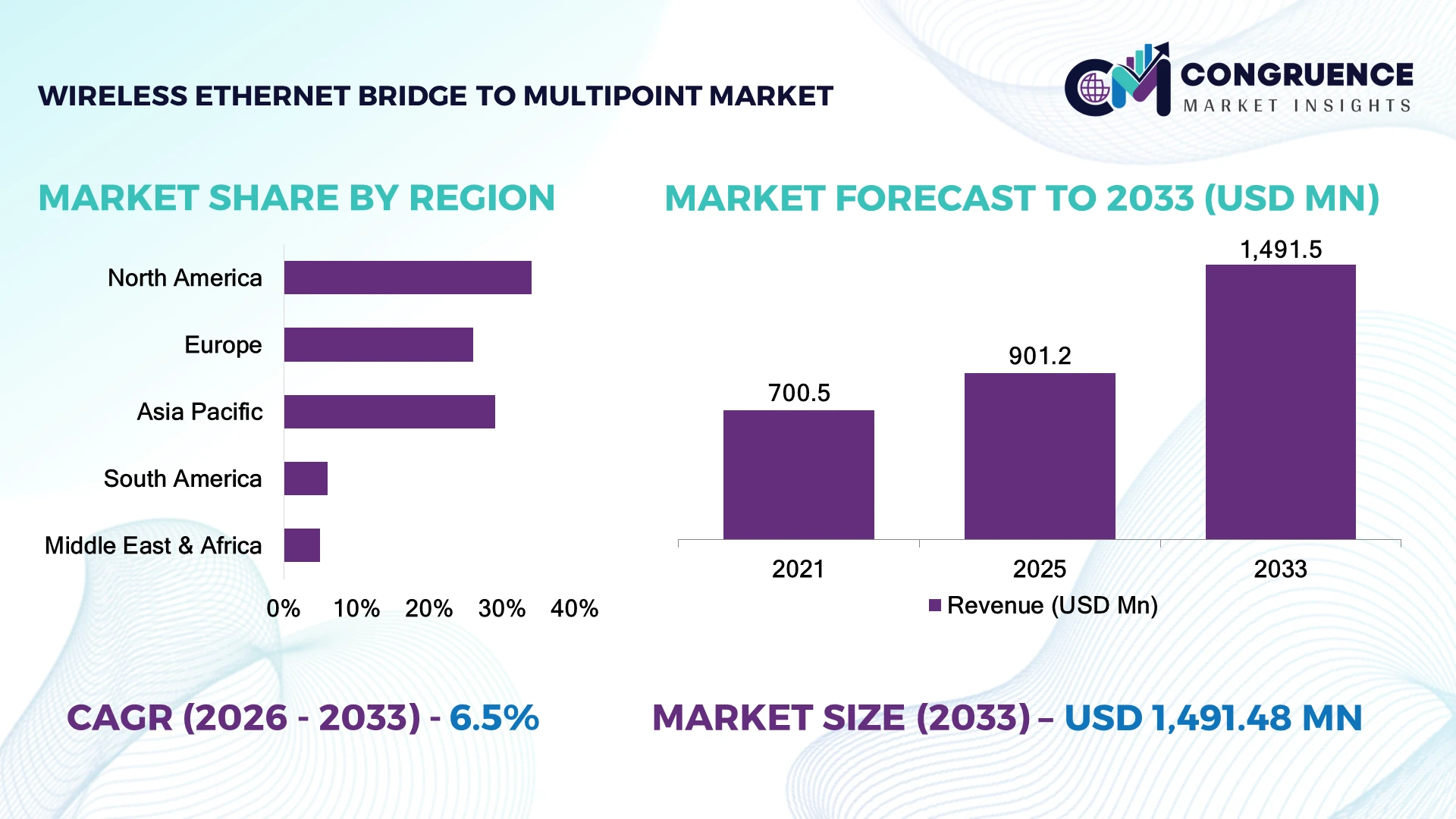
The Global Wireless Ethernet Bridge to Multipoint Market was valued at USD 901.2 Million in 2025 and is anticipated to reach a value of USD 1,491.5 Million by 2033 expanding at a CAGR of 6.5% between 2026 and 2033. Growth is driven by enterprise campus connectivity, industrial video surveillance, rural broadband expansion, and the need to connect distributed facilities without extending fiber infrastructure.
The United States holds a strategically influential position through advanced wireless networking, enterprise infrastructure spending, and broadband modernization programs. Its USD 42.45 billion Broadband Equity, Access, and Deployment allocation supports connectivity expansion, including eligible alternative technologies, although it is not dedicated to wireless bridges. Meanwhile, India is scaling fixed wireless access rapidly: Reliance Jio reported 5.6 million FWA connections in March 2025, eight times its March 2024 level. This contrast highlights the difference between mature enterprise-network demand and rapid connectivity expansion.
Strategic implication: suppliers should prioritize high-capacity, interference-resilient platforms and deployment economics, while targeting infrastructure gaps that make fiber installation expensive or impractical.
The wireless Ethernet bridge-to-multipoint market serves organizations connecting buildings, industrial equipment, surveillance networks, and remote sites where trenching fiber is costly or disruptive. Wi-Fi 6-based radios, multi-user MIMO, and millimeter-wave links are expanding the design options for both short-range campus connectivity and higher-capacity fixed wireless access. With 71% of fixed wireless access providers surveyed by Ericsson offering 5G-based services in 2026, the wider connectivity ecosystem is shifting toward wireless alternatives, although that figure does not represent bridge-equipment adoption. Network planners increasingly assess wireless links as part of a resilient, hybrid connectivity architecture.
Wireless Ethernet bridge-to-multipoint technology is becoming strategically important because enterprises need to connect distributed assets without the construction delays, civil works, and recurring access constraints associated with fiber deployment. Logistics yards, manufacturing sites, utility facilities, campuses, and rural service areas benefit when one access point can distribute Ethernet connectivity to multiple endpoints. The commercial advantage is not simply avoiding cable installation; it is enabling faster network changes as sites and operational requirements evolve.
Technology selection is becoming more differentiated. Wi-Fi 6-based multipoint platforms support scalable access and interference management, while 60 GHz systems offer high-capacity links over suitable short-range line-of-sight paths. Cambium’s ePMP 4600 platform supports up to 4 Gbps in 6 GHz, while Ubiquiti’s Building Bridge XG specifies up to 5.8 Gbps. These are product specifications, not guarantees of real-world throughput. North American deployments emphasize enterprise reliability and spectrum planning, while India’s expanding FWA ecosystem illustrates demand for rapid wireless coverage.
During 2026–2028, buyers will increasingly compare equipment through delivered throughput, installation time, remote troubleshooting, and lifecycle cost. For example, connecting a warehouse annex or surveillance cluster wirelessly can avoid trenching while preserving a wired Ethernet interface at the endpoint. Vendors are responding with cloud-managed systems, multi-band portfolios, and simpler installation workflows. Competitive advantage will favor suppliers that combine dependable performance with security, predictable support, and straightforward integration into existing networks.
The central growth driver is the need to connect buildings, industrial assets, and remote facilities without extending physical cable infrastructure. Wireless bridges can bypass trenching, right-of-way coordination, and site disruption, making them useful for warehouses, utilities, ports, and multi-building campuses. The wider fixed wireless access market reinforces this demand: Ericsson reported that 83% of surveyed service providers offered FWA in 2026, with 71% offering it over 5G. These figures describe service-provider adoption, not bridge-device penetration. The US BEAD program’s USD 42.45 billion allocation also reinforces the policy focus on reaching unserved locations. Manufacturers are responding with multipoint platforms, cloud management, and high-capacity radios that simplify deployment and remote operations.
Wireless bridge performance depends on spectrum availability, interference, line of sight, weather exposure, and the density of nearby transmitters. Unlicensed 5 GHz equipment can be economical but may encounter congestion in industrial estates or dense urban areas. Millimeter-wave systems provide higher capacity but generally require more careful alignment and suitable propagation conditions. Regulatory differences also affect channel width, transmit power, and permitted outdoor operation. These factors complicate standardized deployment and can increase engineering and support costs. Network operators mitigate the exposure through spectrum surveys, channel planning, directional antennas, redundant paths, and equipment supporting multiple bands. Suppliers that provide reliable site-planning tools and clear interference diagnostics can reduce failed installations and avoid costly post-deployment redesign.
A significant opportunity lies in managed wireless connectivity for distributed facilities that need Ethernet access without dedicated fiber construction. Industrial campuses can use multipoint radios to connect surveillance cameras, access-control systems, sensors, and remote buildings under a centrally monitored architecture. Product capabilities are advancing: Cambium’s ePMP 4600 supports up to 4 Gbps in 6 GHz, while its ePMP 4500 platform supports up to 4 Gbps in 5 GHz under specified configurations. These are advertised capabilities rather than typical field results. Vendors can develop recurring service opportunities through remote monitoring, configuration support, and managed network contracts. Partnerships with system integrators, telecom operators, and industrial automation providers can extend distribution while reducing the burden of direct technical support.
Scaling multipoint bridges across large networks requires consistent configuration, secure administration, reliable firmware maintenance, and compatibility with customer Ethernet and routing environments. A radio link that performs well in a controlled test can underdeliver when antenna alignment, interference, physical obstructions, or traffic contention differ from the original design. Multi-vendor estates add management complexity, while exposed outdoor devices require appropriate authentication, encryption, access controls, and timely patching. Operators must also plan capacity for peak traffic instead of relying exclusively on advertised maximum throughput. Suppliers are investing in centralized monitoring, configuration templates, secure management interfaces, and automated diagnostics. The strategic challenge is to deliver repeatable performance across varied sites while controlling support costs and preserving network resilience.
Point-to-multipoint wireless bridge systems are estimated to represent approximately 38% of the market by type, supported by their ability to connect multiple remote endpoints through a shared access point. Compared with point-to-point bridges, which provide dedicated links between two locations, multipoint architectures can reduce equipment duplication across campuses, industrial facilities, and surveillance networks. Indoor wireless bridges address shorter-range enterprise connectivity, while Wi-Fi 7-enabled and software-defined platforms are emerging as performance-oriented options. These advanced systems are gaining relevance as customers prioritize throughput, centralized management, and flexible network configuration over basic connectivity alone.
Wi-Fi 7 and software-defined wireless bridge devices are expected to be among the fastest-developing type categories as organizations modernize high-density networks. The Wireless Broadband Alliance reported in its 2026 industry survey that 38% of respondents planned Wi-Fi 7 deployments during 2025–2026, while 65% considered 6 GHz availability important or critical to their Wi-Fi business. These figures reflect broader Wi-Fi investment plans, not bridge-specific adoption. Vendors are responding with higher-capacity radios, improved spectrum management, and cloud-based controls. Investment priorities are shifting toward scalable multipoint equipment that supports future upgrades without requiring a complete network redesign.
Enterprise networking is estimated to account for approximately 34% of application demand, reflecting the need to connect office buildings, warehouses, campuses, and remote facilities without extending fiber to every endpoint. Video surveillance is another substantial application because distributed cameras require reliable Ethernet connectivity across large sites, including locations where trenching is disruptive or uneconomic. Broadband access remains strategically important for service providers connecting underserved communities and business premises, while industrial automation requires stable links for monitoring, control, and operational data. Enterprise networking leads through its broad use across industries, whereas surveillance and broadband applications often generate concentrated deployments with clearly defined connectivity requirements.
Video surveillance and broadband access are among the fastest-developing application areas as security systems, remote facilities, and fixed wireless services expand. In a 2025 survey of 1,000 US technology decision-makers, Ericsson reported that 41% of businesses planned to implement video surveillance devices over the following 12 months. This signals broader connectivity demand rather than wireless bridge adoption specifically. Suppliers are responding with sector-based multipoint radios, remote monitoring, and simplified installation tools. For buyers, the key implication is to assess total network coverage, reliability, and endpoint density rather than selecting equipment on advertised peak throughput alone.
Telecom operators are estimated to represent approximately 32% of end-user demand, reflecting their use of point-to-multipoint infrastructure for broadband distribution, remote-site connectivity, and last-mile extensions. Large enterprises also deploy wireless bridges across campuses and geographically separated facilities, while government agencies use them for public infrastructure, municipal surveillance, and remote service locations. Industrial manufacturers require dependable links for production monitoring, yard connectivity, and facility-to-facility communication. Telecom operators benefit from repeatable network architectures and centralized management, whereas enterprise and industrial customers place greater emphasis on application reliability, security, and integration with existing Ethernet infrastructure.
Industrial manufacturers and large enterprises are positioned for faster adoption as connected equipment, video workloads, and multi-site operations increase connectivity requirements. Ericsson’s 2025 survey found that 58% of US businesses already used IoT devices across their operations, while another 34% planned to invest in IoT. These findings indicate broader enterprise connectivity demand rather than bridge-specific deployment. Vendors are targeting industrial buyers with ruggedized outdoor hardware, service-level support, and integration partnerships, while telecom suppliers prioritize capacity and manageable cost per connected endpoint. Future demand will favor providers that can deliver dependable performance across varied environments without adding disproportionate installation or maintenance complexity.
North America accounted for the largest market share at approximately 34% in 2025 however, Asia-Pacific is expected to register the fastest growth, expanding at a CAGR of 8.1% between 2026 and 2033.
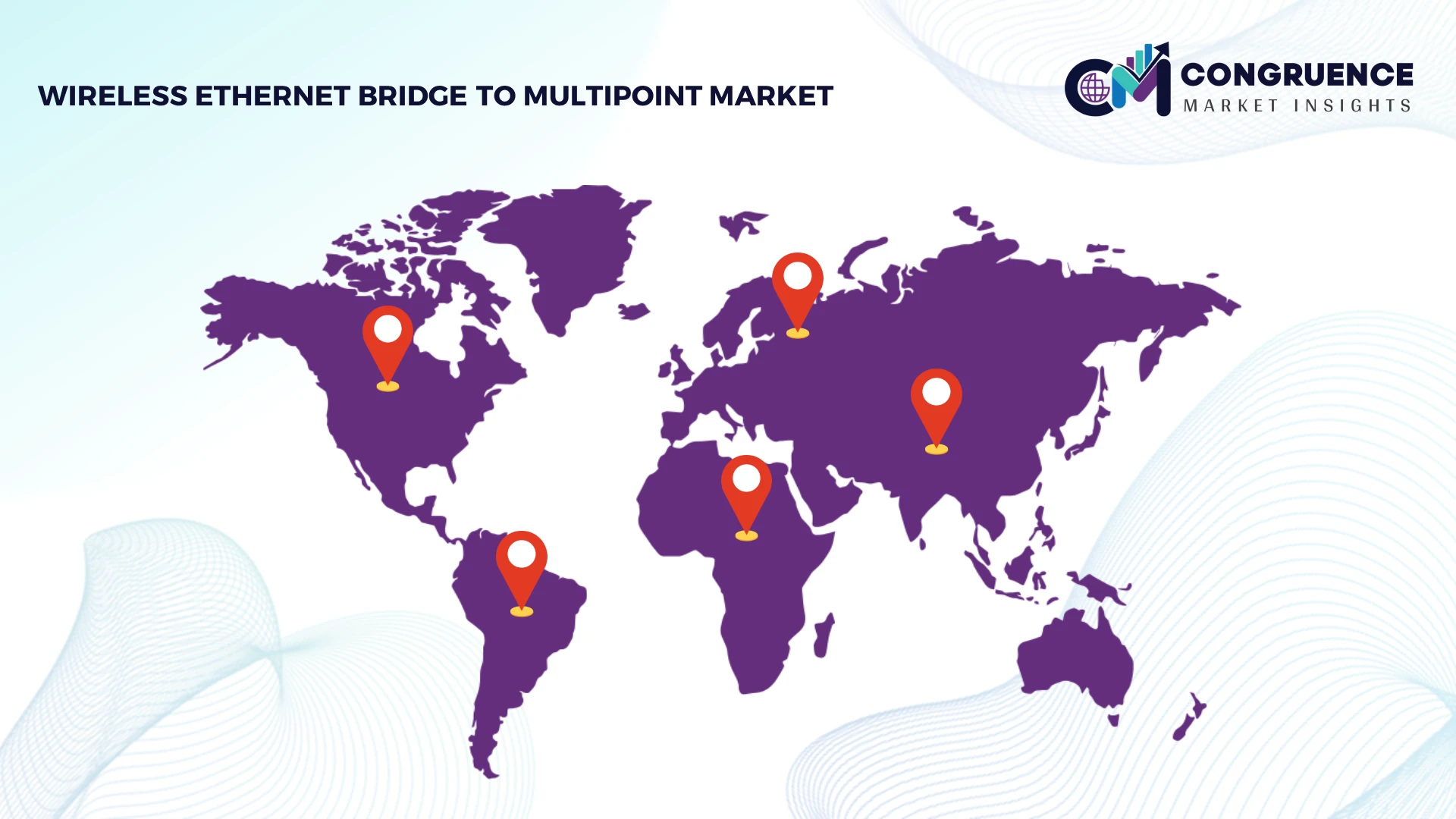
Enterprise modernization and broadband infrastructure funding reinforce wireless deployment.
North America is estimated to hold approximately 34% of the market, supported by enterprise networking, industrial surveillance, utilities, and telecommunications infrastructure. The United States anchors demand through technology-intensive businesses and investment in connectivity for underserved locations. Wireless bridges are particularly relevant for connecting warehouses, campuses, construction sites, and remote infrastructure where fiber installation requires substantial civil work. The federal Broadband Equity, Access, and Deployment program provides USD 42.45 billion for broadband infrastructure, creating opportunities for multiple eligible technologies, although funding is not specifically allocated to wireless bridges. Vendors are competing through multipoint capacity, interference management, centralized monitoring, and installation simplicity. Buyers increasingly evaluate total deployment cost and operational reliability rather than headline throughput alone.
United States Market Outlook: The United States benefits from established wireless networking vendors, extensive enterprise infrastructure, and a mature system-integration ecosystem. The USD 42.45 billion BEAD program supports broadband expansion across states and territories, including eligible infrastructure alternatives where appropriate. Industrial facilities, utilities, and municipal networks provide additional opportunities for wireless Ethernet links. Suppliers can strengthen market position through partnerships with broadband providers and system integrators, particularly when solutions reduce deployment complexity while maintaining network security and predictable service performance.
Industrial digitization and rural connectivity shape purchasing priorities.
Europe is estimated to represent approximately 26% of the market, supported by industrial automation, enterprise campuses, logistics infrastructure, and connectivity modernization. Germany, the United Kingdom, and France provide important demand centers, while rural and geographically challenging locations sustain interest in alternatives to fiber extensions. The European Commission's 2025 Digital Decade assessment identified connectivity gaps and continuing investment needs across member states. Wireless bridge suppliers can address these requirements with managed multipoint systems, secure administration, and spectrum-efficient equipment. However, national spectrum rules, procurement differences, and strong fiber competition require vendors to demonstrate clear deployment advantages rather than relying solely on wireless installation flexibility.
Germany Market Outlook: Germany offers an attractive environment through its manufacturing base, industrial campuses, logistics facilities, and automation-intensive production sites. Wireless bridges can connect separate buildings, production support areas, and temporary operational facilities without extensive cable installation. Suppliers should prioritize reliable industrial performance, interference planning, and integration with existing Ethernet networks. Partnerships with automation specialists and industrial system integrators can help manufacturers address specific operational requirements while differentiating their products from lower-cost equipment designed primarily for residential or basic broadband applications.
Connectivity expansion and cost-sensitive deployments accelerate adoption potential.
Asia-Pacific is estimated to account for approximately 29% of the market and offers the strongest prospective expansion as enterprises, telecom operators, and public agencies extend connectivity across dispersed locations. China, India, Japan, and South Korea present distinct opportunities spanning industrial networking, broadband access, and enterprise infrastructure. India's extensive digital connectivity requirements create demand for cost-effective wireless links, while Japan and South Korea emphasize high-performance networking and advanced industrial applications. The region's manufacturing ecosystem also supports equipment sourcing and channel development. Suppliers are responding with scalable multipoint radios, remote management, and flexible deployment models that address differences in budgets, terrain, and network maturity.
India Market Outlook: India offers strong potential because telecom operators, industrial enterprises, educational institutions, and public infrastructure projects require connectivity across geographically dispersed sites. Reliance Jio reported 5.6 million fixed wireless access connections in March 2025, eight times its March 2024 level, illustrating the expansion of wireless broadband services rather than direct bridge-equipment sales. Suppliers can address related opportunities through local distribution, installer partnerships, and products designed for cost-sensitive deployment. Success depends on dependable performance, accessible technical support, and suitability for local spectrum conditions.
Remote connectivity needs create opportunities despite uneven infrastructure investment.
South America is estimated to account for approximately 6% of the market, with Brazil representing the principal commercial opportunity. Telecommunications providers, industrial operators, agricultural businesses, and public agencies require connections across dispersed sites where fiber construction can be expensive or difficult. Wireless Ethernet bridges can connect processing facilities, warehouses, surveillance equipment, and remote operational buildings. Brazil's connectivity ecosystem includes both large telecom operators and numerous smaller broadband providers, creating opportunities for specialized equipment distributors. Nevertheless, purchasing budgets, regional infrastructure disparities, and maintenance access influence adoption. Suppliers should focus on practical link planning, competitive total ownership costs, and distributor-led technical support instead of pursuing broad expansion without local service capabilities.
Brazil Market Outlook: Brazil combines a large domestic market with agricultural, mining, logistics, and industrial operations that frequently span wide geographic areas. The country's telecommunications regulator reported approximately 56.8 million fixed broadband connections in July 2026, demonstrating the scale of its broader connectivity ecosystem rather than wireless bridge deployment specifically. Vendors can target remote industrial sites, farm facilities, and multi-building enterprises through regional integrators. Product durability, straightforward installation, and dependable after-sales support will be important differentiators outside the largest metropolitan markets.
Digital infrastructure investment favors targeted, high-value deployments.
The Middle East and Africa region is estimated to account for approximately 5% of the market, with demand concentrated in Gulf economies, major African business centers, and selected infrastructure projects. Saudi Arabia and the United Arab Emirates provide opportunities through enterprise modernization, logistics, utilities, and smart-city initiatives. Across African markets, wireless bridges can connect remote facilities and surveillance networks where physical cabling is difficult to deploy. However, financing constraints, technical support availability, and differing spectrum requirements shape purchasing decisions. Suppliers are best positioned through local telecom partners, system integrators, and service-backed contracts that address installation, maintenance, and network security requirements.
Saudi Arabia Market Outlook: Saudi Arabia benefits from advanced telecommunications infrastructure, enterprise digitization, and investment in connected public and industrial facilities. The Communications, Space and Technology Commission reported 99.6% internet penetration and median mobile download speeds of 216 Mbps in its 2025 internet assessment, published in 2026. These indicators demonstrate the maturity of the broader digital environment, not wireless bridge adoption. Vendors can target industrial sites, logistics facilities, and multi-building developments with managed multipoint connectivity, emphasizing reliable operation, centralized monitoring, and integration with existing networks.
The market pits Airspan and RADWIN against Ubiquiti’s value-led bridges, MikroTik’s configurable radios, and enterprise-focused SIAE Microelettronica. Airspan acquired Cambium’s PMP 450 and cnWave lines, while Univastu acquired ePMP and enterprise businesses, reshaping competition. The top-five combined share is not reliably disclosed; assigning a percentage would create false precision. Buyers compare throughput, spectrum efficiency, interference control, installation speed, remote management, and lifecycle cost. The Wireless Broadband Alliance found 38% planned Wi-Fi 7 rollouts in 2025–2026, while 65% considered 6 GHz important or critical; these are broader Wi-Fi signals, not bridge-market shares. Ubiquiti competes through simplified deployment and integrated management; specialists target service providers with scalable subscriber capacity and planning tools. Recent asset transfers signal consolidation around portfolio control and customer continuity. Entry barriers include RF engineering, spectrum compliance, channel support, and reliable field performance. Winners must combine proven link quality, affordable scaling, and responsive support across diverse operating environments globally.
Wi-Fi 6 and 802.11ax-based multipoint radios are the current technology foundation, improving spectrum reuse, scheduling, and support for multiple subscriber endpoints. Cambium’s ePMP 4600 specifications indicate aggregate capacity of up to 4 Gbps and support for as many as 120 subscribers. Its 4×4 MU-MIMO architecture can effectively double capacity compared with 2×2 systems under supported configurations. These are product-level capabilities, not guaranteed field results. Directional antennas, interference mitigation, and automated frequency coordination remain essential where networks operate in congested spectrum.
Wi-Fi 7, 6 GHz operation, and cloud-based network management are emerging differentiators. In a 2026 industry survey, 38% of respondents planned Wi-Fi 7 deployments during 2025–2026, while 65% considered 6 GHz important or critical to their business. These figures indicate broader wireless-network investment, not bridge-specific adoption. AI-assisted monitoring and automated configuration can help operators identify interference and manage distributed equipment, although universal percentage savings in maintenance costs have not been established. Ubiquiti benefits from simplified installation and integrated management, while specialist vendors compete on subscriber density and outdoor radio performance.
During 2026–2028, buyers should prioritize measurable link reliability, security, interoperability, and lifecycle cost over advertised peak throughput alone. Multi-band equipment can improve deployment flexibility where local regulations permit, while software upgrades can extend installed hardware life. The strongest new-versus-old advantage is configuration-dependent: selected 4×4 MU-MIMO systems offer up to twice the capacity of 2×2 designs. Suppliers that validate performance in real environments and support hybrid fiber-wireless architectures will be best positioned for enterprise and service-provider contracts.
This report assesses the wireless Ethernet bridge-to-multipoint market across point-to-multipoint access systems, point-to-point bridging alternatives, managed outdoor radios, and emerging Wi-Fi 6, Wi-Fi 7, and 6 GHz-enabled platforms. Application coverage includes enterprise networking, video surveillance, broadband distribution, industrial connectivity, and campus infrastructure. End-user analysis examines telecom operators, enterprises, manufacturers, utilities, government agencies, and system integrators. Geographic coverage spans North America, Europe, Asia-Pacific, South America, and the Middle East & Africa, with country-level analysis of infrastructure maturity, deployment requirements, and procurement conditions.
Technology assessment covers MU-MIMO, spectrum coordination, directional antennas, remote management, cybersecurity, and hybrid fiber-wireless architectures. Competitive analysis considers global equipment suppliers, specialist fixed-wireless vendors, cost-focused manufacturers, and recent portfolio transfers. Deployment indicators—including ePMP 4000 shipments exceeding 220,000 units and broader Wi-Fi 7 adoption plans reported by 38% of industry-survey respondents—provide context without being treated as market-wide penetration rates. The report supports investment screening, regional expansion, product selection, partnership development, competitive positioning, and network-planning decisions through 2033.
| Report Attribute/Metric | Report Details |
|---|---|
|
Market Revenue in 2025 |
USD 901.2 Million |
|
Market Revenue in 2033 |
USD 1,491.5 Million |
|
CAGR (2026 - 2033) |
6.5% |
|
Base Year |
2025 |
|
Forecast Period |
2026 - 2033 |
|
Historic Period |
2021 - 2025 |
|
Segments Covered |
By Type
By Application
By End-User
|
|
Key Report Deliverable |
Revenue Forecast, Growth Trends, Market Dynamics, Segmental Overview, Regional and Country-wise Analysis, Competition Landscape |
|
Region Covered |
North America, Europe, Asia-Pacific, South America, Middle East, Africa |
|
Key Players Analyzed |
Airspan Networks, Univastu India Limited, Ubiquiti Inc., MikroTik, RADWIN, SIAE Microelettronica, Ceragon Networks, Aviat Networks, Huawei Technologies, ZTE Corporation, TP-Link Systems, Tarana Wireless, Baicells Technologies |
|
Customization & Pricing |
Available on Request (10% Customization is Free) |




