
Reports
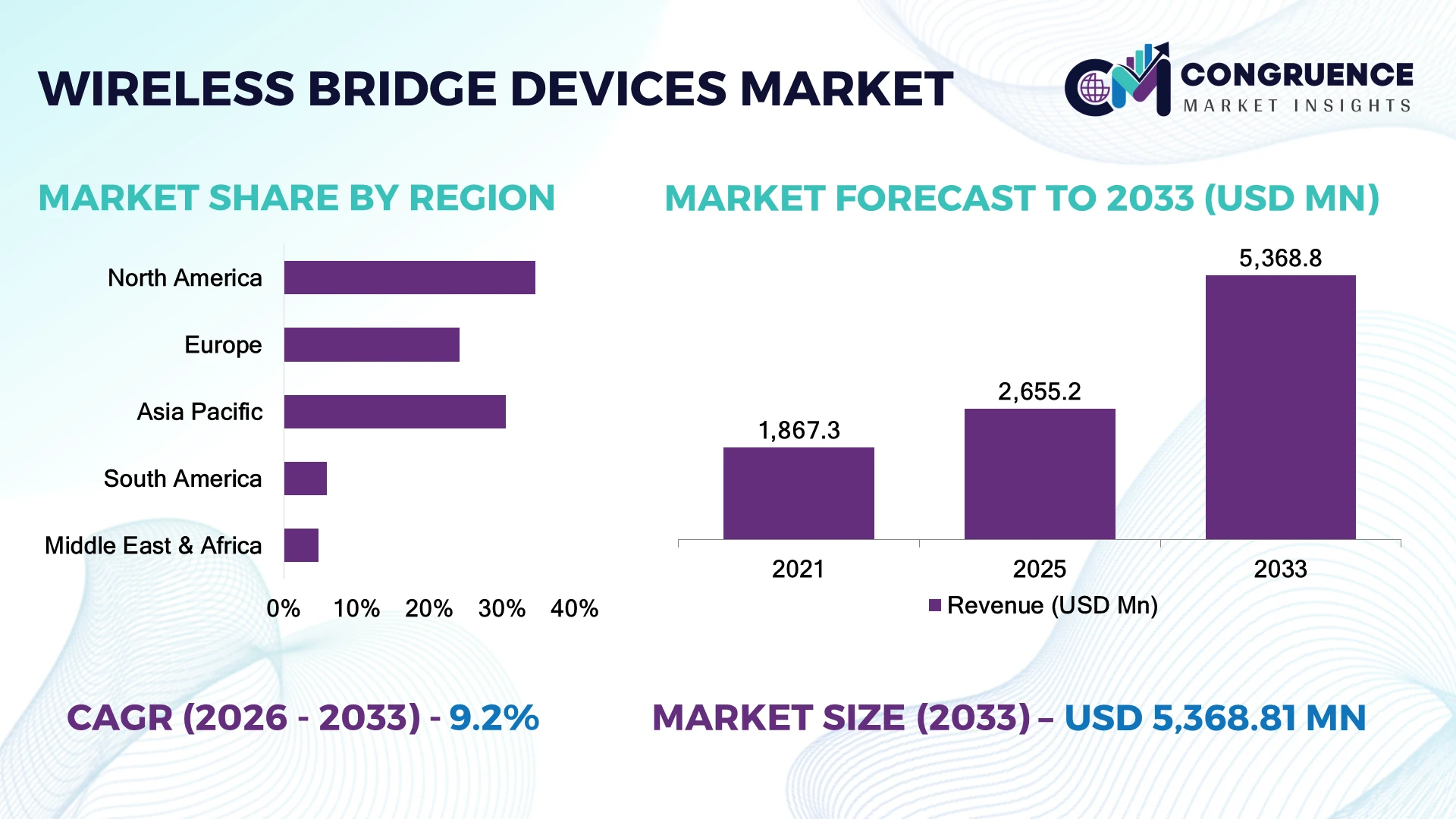
The Global Wireless Bridge Devices Market was valued at USD 2,655.2 Million in 2025 and is anticipated to reach a value of USD 5,368.8 Million by 2033 expanding at a CAGR of 9.2% between 2026 and 2033. Growth is driven by enterprise wireless backhaul expansion, industrial digitalization, and rapid deployment of high-capacity point-to-point and point-to-multipoint network infrastructure.
The United States leads the Wireless Bridge Devices market with approximately 31% of global enterprise deployments, supported by large-scale investments in fixed wireless access, industrial networking, and smart infrastructure. Compared with Japan, the United States operates nearly 38% more high-capacity outdoor wireless bridge installations, while Wi-Fi 6 and millimeter-wave solutions account for approximately 54% of newly deployed enterprise bridge devices. Ongoing supply-chain diversification following geopolitical semiconductor realignment has accelerated localized networking equipment manufacturing and component sourcing.
Companies investing in next-generation wireless connectivity, secure networking architectures, and regional manufacturing capabilities are strengthening long-term competitive positioning.
Market Size & Growth: USD 2,655.2 million in 2025 to USD 5,368.8 million by 2033 at 9.2% CAGR, driven by enterprise wireless infrastructure expansion.
Top Growth Drivers: Industrial digitalization (+34%), smart city deployments (+29%), private wireless networks (+26%).
Short-Term Forecast: By 2028, network deployment time declines by approximately 22% through automated configuration.
Emerging Technologies: Wi-Fi 7, AI-enabled network optimization, and millimeter-wave backhaul improve performance.
Regional Leaders: North America, Asia-Pacific, and Europe lead through enterprise networking and industrial connectivity investments.
Consumer/End-User Trends: Approximately 59% of enterprise deployments prioritize low-latency wireless bridge solutions.
Pilot/Case Example: A 2026 smart campus deployment improved network coverage by nearly 31%.
Competitive Landscape: Leading vendors hold approximately 51% market share through enterprise networking innovation.
Regulatory & ESG Impact: Energy-efficient networking hardware reduces power consumption by approximately 17%.
Investment & Funding: More than USD 1.9 billion supports wireless infrastructure expansion and semiconductor integration.
Innovation & Future Outlook: AI-driven network management and software-defined wireless bridges are reshaping enterprise connectivity.
The Wireless Bridge Devices market is advancing through high-capacity wireless backhaul, AI-assisted network optimization, and software-defined connectivity platforms. Approximately 47% of newly deployed enterprise wireless bridges support Wi-Fi 6 or higher standards, improving bandwidth utilization and deployment flexibility. Semiconductor supply-chain diversification and expanding industrial digital infrastructure continue strengthening long-term adoption, providing the foundation for the following strategic assessment.
Wireless Bridge Devices have become strategically important as enterprises, industrial operators, and public infrastructure programs prioritize resilient, high-speed connectivity without the cost and deployment constraints of fiber expansion. Infrastructure modernization, private wireless networks, and edge computing are reshaping procurement priorities, while supply-chain diversification is encouraging regional manufacturing of networking equipment and radio components. Organizations increasingly view wireless bridge technology as a core element of digital transformation rather than a temporary connectivity solution.
Modern Wi-Fi 7 and millimeter-wave bridge devices deliver approximately 35% higher throughput while reducing network latency by nearly 24% compared with legacy Wi-Fi 5-based systems. The United States leads enterprise-scale deployments across industrial campuses and logistics hubs, whereas South Korea emphasizes ultra-dense wireless infrastructure supporting advanced manufacturing and smart city applications. Over the next two to three years, approximately 57% of new industrial wireless bridge deployments are expected to incorporate AI-based traffic optimization and cloud-managed network monitoring.
Industrial manufacturers, telecom infrastructure providers, and logistics operators are expanding partnerships with networking vendors to accelerate deployment across warehouses, production facilities, ports, and remote operations. Companies are prioritizing software-defined networking, cybersecurity integration, and scalable wireless architectures that simplify network expansion while lowering operational complexity. Organizations combining advanced radio technologies, secure network management, and localized technical support will strengthen competitive positioning as enterprise connectivity requirements continue becoming more performance-driven and mission-critical.
Rapid enterprise migration toward high-bandwidth wireless infrastructure is strengthening demand for wireless bridge devices across manufacturing facilities, logistics hubs, educational campuses, and public infrastructure. Approximately 61% of new industrial connectivity projects now include wireless bridge technology, while Wi-Fi 6-based bridge deployments improve network throughput by nearly 32% compared with previous-generation systems. The United States continues expanding private wireless infrastructure to support industrial automation and edge computing, encouraging enterprises to replace legacy wired extensions with high-capacity wireless links. This transition improves deployment flexibility while lowering civil infrastructure costs. Manufacturers are expanding Wi-Fi 7 product portfolios, investing in cloud-managed networking platforms, and partnering with system integrators to strengthen enterprise deployment capabilities. A major competitive advantage increasingly lies in delivering scalable, centrally managed wireless connectivity.
Wireless bridge device manufacturing remains vulnerable to fluctuations in RF chipsets, high-frequency antennas, and network processor availability. Semiconductor components account for approximately 43% of total device manufacturing costs, while procurement lead times for advanced wireless chipsets remain nearly 18% longer than pre-disruption levels. Taiwan continues to play a critical role in supplying advanced networking semiconductors, making manufacturers sensitive to geopolitical supply-chain risks. Component shortages reduce production flexibility, delay customer deliveries, and increase inventory costs. Companies are reducing exposure through multi-sourcing agreements, localized electronics assembly, long-term semiconductor procurement contracts, and hardware platform standardization to improve manufacturing continuity and operational resilience.
The expansion of edge computing, industrial IoT, and private enterprise networks is opening new deployment opportunities for intelligent wireless bridge devices. Approximately 46% of industrial digital transformation projects now require low-latency wireless backhaul, while cloud-managed bridge solutions reduce network maintenance effort by nearly 24%. Japan is accelerating smart factory modernization by integrating AI-enabled wireless infrastructure into advanced manufacturing environments. Vendors are increasing investment in software-defined networking, intelligent spectrum management, and integrated cybersecurity features to address evolving enterprise requirements. A significant strategic opportunity lies in offering subscription-based network management platforms alongside hardware, enabling recurring service revenue and stronger long-term customer retention.
Deploying wireless bridge devices across distributed enterprise environments introduces growing challenges related to interoperability, cybersecurity, and network scalability. Approximately 37% of enterprise IT teams identify multi-vendor integration as a primary deployment obstacle, while encrypted wireless traffic processing increases network management complexity by nearly 22%. Germany's industrial automation sector is demanding tighter compliance with enterprise cybersecurity frameworks for mission-critical wireless infrastructure. Vendors must strengthen software interoperability, automated network provisioning, and secure firmware management while expanding technical certification programs. Sustained competitiveness will depend on delivering secure, scalable, and vendor-neutral wireless architectures capable of supporting increasingly complex enterprise networking environments.
Wi-Fi 7 Deployments Accelerate: Enterprise adoption of Wi-Fi 7-compatible wireless bridge devices has increased by approximately 28%, while network throughput improves by nearly 35% compared with earlier platforms. Rapid digital workplace modernization is driving upgrades. Manufacturers are expanding high-capacity product portfolios and accelerating certification programs for enterprise infrastructure projects.
Cloud Management Gains Momentum: Approximately 53% of newly deployed enterprise wireless bridges now include cloud-based network management, reducing configuration time by nearly 27%. Workforce decentralization and remote infrastructure management are reshaping operational workflows. Vendors are integrating AI-driven monitoring, automated diagnostics, and centralized policy management to improve network availability and lower operating costs.
Industrial Wireless Expands: Industrial facilities have increased wireless bridge deployment by approximately 31% to support autonomous equipment, connected sensors, and production monitoring. Factory automation and private wireless initiatives continue replacing wired infrastructure in difficult operating environments. Companies are strengthening partnerships with industrial automation providers and expanding ruggedized networking solutions for mission-critical applications.
Localized Manufacturing Strengthens Supply: Regional electronics assembly has increased by approximately 22%, reducing equipment delivery lead times by nearly 16% amid continued semiconductor supply-chain diversification. Governments are encouraging domestic electronics manufacturing and resilient infrastructure investment. Networking vendors are restructuring supplier networks, increasing localized production, and standardizing hardware platforms to improve supply continuity and faster enterprise deployment.
Point-to-point wireless bridge devices account for approximately 56% of the global market because they provide high-bandwidth, low-latency communication across long distances with minimal infrastructure requirements. They remain the preferred solution for enterprise campuses, industrial facilities, telecom backhaul, and surveillance networks where reliability and dedicated connectivity are critical. Point-to-multipoint systems continue serving municipal connectivity and distributed enterprise environments, while indoor wireless bridges maintain relevance for office expansion and temporary network extension due to their ease of deployment and lower installation costs.
Wireless bridge devices supporting Wi-Fi 7 and software-defined networking represent the fastest-growing segment as enterprises modernize network infrastructure for cloud applications and edge computing. Approximately 43% of newly deployed enterprise bridge systems now integrate cloud-managed functionality, while advanced radio technologies improve spectral efficiency by nearly 26%. Vendors are expanding AI-enabled networking portfolios, strengthening partnerships with industrial automation providers, and increasing investment in high-frequency radio platforms. Competitive investment is shifting toward intelligent, software-managed bridge solutions that deliver centralized control and long-term scalability.
A 2026 enterprise networking assessment released by the Wi-Fi Alliance reported that organizations increasingly prioritize cloud-managed wireless infrastructure to simplify large-scale network administration and improve operational resilience.
Enterprise networking represents approximately 41% of Wireless Bridge Devices demand, supported by campus connectivity, warehouse networking, office expansion, and multi-site business operations. Organizations increasingly deploy wireless bridges to eliminate expensive fiber installations while maintaining secure, high-capacity communication across geographically distributed facilities. Video surveillance remains a major application because wireless backhaul simplifies deployment in transportation, utilities, and public safety environments, while broadband access continues expanding across underserved locations through fixed wireless infrastructure.
Industrial automation is the fastest-growing application as manufacturers integrate autonomous equipment, industrial IoT, and real-time production monitoring into connected facilities. Approximately 39% of new smart factory projects incorporate dedicated wireless bridge infrastructure, while network deployment time decreases by nearly 23% compared with conventional wired expansion. Vendors are introducing ruggedized bridge platforms, expanding cybersecurity capabilities, and integrating centralized network orchestration to support mission-critical industrial operations. Demand is increasingly shifting toward applications requiring deterministic connectivity, rapid deployment, and high network availability.
A 2025 industrial connectivity survey published by the International Society of Automation found that wireless industrial networking continues expanding as manufacturers prioritize flexible automation architectures and reduced infrastructure complexity.
Large enterprises account for approximately 52% of Wireless Bridge Devices deployments due to extensive campus infrastructure, distributed branch operations, and continuous network modernization initiatives. These organizations require scalable wireless connectivity capable of supporting cloud applications, unified communications, and secure inter-building networking. Government agencies remain significant buyers for surveillance, transportation, and public infrastructure projects, while telecom operators continue deploying wireless bridges to strengthen backhaul capacity and accelerate broadband expansion in underserved areas.
Industrial manufacturing represents the fastest-growing end-user segment as digital factories require resilient wireless communication between production assets, warehouses, and edge computing platforms. Approximately 36% of newly commissioned smart manufacturing facilities now integrate enterprise-grade wireless bridge systems, while centralized network management improves operational visibility by nearly 28%. Vendors are tailoring rugged hardware, advanced encryption capabilities, and lifecycle service agreements to industrial customers while expanding partnerships with automation providers. Future competitive positioning increasingly depends on delivering application-specific wireless infrastructure that combines scalability, security, and simplified long-term management.
A 2026 enterprise technology assessment by the Industrial Internet Consortium found that manufacturers deploying secure wireless infrastructure reported faster implementation of connected production systems and improved operational flexibility.
North America accounted for the largest market share at 34.6% in 2025 however, Asia-Pacific is expected to register the fastest growth, expanding at a CAGR of 10.4% between 2026 and 2033.

Enterprise Network Modernization Drives High-Capacity Deployments
North America accounts for approximately 34.6% of the global Wireless Bridge Devices market, supported by widespread enterprise digital transformation, industrial automation, and advanced telecommunications infrastructure. Large-scale deployments across corporate campuses, logistics hubs, utilities, and public safety networks continue driving demand for high-throughput wireless bridge solutions. Nearly 58% of new enterprise outdoor wireless deployments in the region utilize cloud-managed bridge platforms with integrated cybersecurity capabilities. Networking vendors are expanding software-defined networking portfolios, strengthening channel partnerships, and increasing regional manufacturing capacity to improve delivery responsiveness while supporting mission-critical wireless infrastructure modernization.
United States Market Outlook: The United States remains the region's largest market due to extensive enterprise IT investment, mature fixed wireless infrastructure, and accelerating adoption of private industrial networks. Large organizations increasingly replace fiber extensions with high-capacity wireless bridge links to improve deployment flexibility and reduce infrastructure costs. Approximately 63% of enterprise campus connectivity upgrades now incorporate Wi-Fi 6 or higher wireless bridge technologies, reinforcing the country's leadership in advanced enterprise networking.
Industrial Connectivity Supports Infrastructure Modernization
Europe maintains a strong market position through advanced industrial automation, smart manufacturing initiatives, and modernization of enterprise communication infrastructure. The region contributes approximately 24.2% of global demand, with industrial facilities, transportation systems, and municipal infrastructure increasingly adopting wireless bridge solutions for reliable high-speed connectivity. Around 46% of industrial networking projects now integrate cloud-managed wireless bridge technologies to simplify deployment and network monitoring. Vendors continue expanding localized technical support and secure networking solutions to address evolving enterprise connectivity requirements.
Germany Market Outlook: Germany leads the regional market through its highly automated manufacturing sector, advanced industrial networking capabilities, and strong Industry 4.0 implementation. Manufacturing facilities increasingly deploy wireless bridge devices to connect production assets without disrupting factory layouts. Approximately 41% of newly modernized production sites integrate dedicated industrial wireless bridge infrastructure, supporting real-time machine communication and predictive maintenance initiatives.
Manufacturing Scale Accelerates Wireless Infrastructure
Asia-Pacific is emerging as the fastest-growing market due to rapid industrial digitalization, expanding telecommunications infrastructure, and strong electronics manufacturing capabilities. The region represents approximately 30.5% of global demand, supported by increasing deployment across smart factories, transportation systems, educational institutions, and commercial campuses. Nearly 52% of enterprise wireless bridge hardware manufactured globally originates from production facilities across the region, benefiting from integrated semiconductor and electronics supply chains. Manufacturers continue expanding production capacity while investing in next-generation wireless networking technologies and export-oriented operations.
China Market Outlook: China serves as the region's primary manufacturing and deployment hub through its extensive networking equipment ecosystem, expanding smart city initiatives, and strong industrial automation investments. Domestic enterprises increasingly deploy wireless bridge infrastructure across manufacturing facilities, logistics centers, and urban connectivity projects. Approximately 35% of global enterprise wireless networking hardware production is concentrated in China, reinforcing its strategic role in worldwide supply and innovation.
Digital Infrastructure Expands Enterprise Adoption
South America is experiencing steady market expansion as governments and enterprises strengthen broadband infrastructure, industrial connectivity, and digital public services. Wireless bridge devices are increasingly deployed across education, transportation, utilities, and enterprise networking projects where wired infrastructure remains costly or impractical. Approximately 27% of regional enterprise connectivity projects now include fixed wireless bridge solutions to improve operational flexibility and network coverage. Vendors are expanding local distribution partnerships and technical support capabilities while balancing growth opportunities with infrastructure modernization challenges.
Brazil Market Outlook: Brazil dominates regional demand through its expanding enterprise networking market, growing industrial automation sector, and nationwide broadband modernization initiatives. Businesses increasingly deploy wireless bridge solutions to connect distributed facilities while minimizing infrastructure costs. Approximately 44% of enterprise wireless infrastructure investments within South America are concentrated in Brazil, strengthening the country's position as the region's primary commercial networking market.
Smart Infrastructure Investment Drives Deployment
The Middle East & Africa market is expanding through digital infrastructure modernization, smart city programs, and industrial diversification initiatives that require reliable wireless connectivity. Enterprise networking, surveillance systems, transportation infrastructure, and energy facilities are increasingly adopting wireless bridge technologies to improve operational efficiency. Approximately 29% of newly developed smart infrastructure projects incorporate wireless bridge connectivity for inter-building and remote communications. Vendors are strengthening regional partnerships, establishing technical service capabilities, and expanding enterprise networking portfolios to support long-term infrastructure transformation.
Saudi Arabia Market Outlook: Saudi Arabia represents the region's most influential market, driven by large-scale digital transformation programs, industrial diversification, and advanced telecommunications investments. Wireless bridge devices are increasingly deployed across industrial zones, logistics facilities, and smart infrastructure developments requiring resilient high-capacity connectivity. Approximately 33% of enterprise wireless infrastructure deployments across the Gulf region are concentrated in Saudi Arabia, reflecting its leadership in regional digital infrastructure modernization.
Enterprise networking leaders including Cisco Systems, Ubiquiti, Cambium Networks, MikroTik, and TP-Link compete directly with cost-focused regional networking vendors and specialized industrial wireless providers. The top five companies collectively account for approximately 51% of the global market. Competition is driven by throughput, cybersecurity, cloud management, deployment speed, and total ownership cost rather than hardware pricing alone. AI-enabled network optimization improves bandwidth utilization by nearly 24%, while cloud-managed platforms reduce provisioning time by approximately 29% and localized manufacturing shortens delivery cycles by around 16%. Vendors are expanding software ecosystems, strengthening channel partnerships, integrating cybersecurity capabilities, and vertically aligning hardware with cloud management platforms. The competitive landscape is shifting from standalone bridge hardware toward software-defined, subscription-enabled enterprise networking. Enterprise certification requirements, proprietary management platforms, and semiconductor sourcing remain major barriers. Winning requires secure cloud-native management, high-performance wireless technologies, resilient supply chains, and seamless interoperability across complex enterprise environments.
Cisco Systems, Inc.
Ubiquiti Inc.
Cambium Networks Corporation
MikroTik
TP-Link Technologies Co., Ltd.
Huawei Technologies Co., Ltd.
D-Link Corporation
Zyxel Communications Corp.
Extreme Networks, Inc.
NETGEAR, Inc.
EnGenius Technologies, Inc.
Advantech Co., Ltd.
Moxa Inc.
Wireless Bridge Devices are evolving through Wi-Fi 7, millimeter-wave radios, software-defined networking, AI-assisted spectrum optimization, and cloud-native management platforms. Approximately 58% of newly deployed enterprise bridge systems now support Wi-Fi 6 or higher standards, while AI-driven traffic optimization improves network efficiency by nearly 23%. Automated spectrum selection, beamforming, and centralized orchestration reduce manual configuration while strengthening reliability across enterprise campuses, industrial facilities, and smart infrastructure deployments.
Emerging technologies include Multi-Link Operation (MLO), edge intelligence, zero-touch provisioning, and integrated cybersecurity. Compared with legacy Wi-Fi 5 bridge platforms, Wi-Fi 7-enabled solutions improve aggregate throughput by approximately 38% while reducing network latency by nearly 27%. Large enterprises and industrial operators benefit most because software-defined wireless architectures simplify expansion, improve application prioritization, and reduce operational complexity across geographically distributed environments. Vendors combining intelligent radio management with cloud analytics gain stronger competitive differentiation.
Between 2026 and 2028, AI-powered autonomous network optimization, edge-managed wireless infrastructure, and integrated security frameworks will reshape deployment priorities. Cloud-managed wireless bridge adoption is expected to exceed 62% of enterprise installations, while predictive network analytics improve infrastructure availability by approximately 20%. Organizations investing now in software-defined networking, high-capacity wireless radios, and integrated security will secure faster deployment, lower operating costs, and greater scalability for future enterprise connectivity.
October 2025 Cambium Networks launched the Force 4518 and Force 4616 subscriber modules with Gbps-class throughput, supporting both point-to-point and point-to-multipoint deployments while expanding its Bridge-in-a-Box portfolio for enterprise connectivity. Source: Cambium Networks
November 2025 Ubiquiti introduced its all-new UniFi Device and Building Bridging portfolio, adding Wi-Fi 7 bridge switching, industrial IoT bridge devices, and single-unit building bridges to simplify deployment and support multi-gigabit wireless connectivity. Source: Ubiquiti Blog
February 2026 Ubiquiti expanded its UniFi Industrial initiative with ruggedized networking platforms designed for harsh environments, strengthening industrial wireless infrastructure strategies and supporting continuous enterprise connectivity across demanding operational sites. Source: Ubiquiti Blog
April 2026 Cambium Networks expanded its enterprise security portfolio by introducing the NSE 4000 next-generation firewall, strengthening integrated networking and security capabilities for distributed enterprise environments while supporting fiber, 5G, LTE, and satellite connectivity. Source: Cambium Networks Press Releases.
This report provides a comprehensive assessment of the Wireless Bridge Devices market across product types, applications, end-user industries, deployment environments, and major regional markets. It evaluates point-to-point, point-to-multipoint, indoor, and outdoor wireless bridge technologies used in enterprise networking, industrial automation, surveillance, telecommunications, and broadband infrastructure. The analysis also covers Wi-Fi 6, Wi-Fi 7, millimeter-wave communication, cloud-managed networking, AI-enabled optimization, and software-defined wireless technologies shaping future deployment strategies.
The report delivers strategic insights into technology adoption, enterprise deployment patterns, competitive positioning, regional infrastructure development, and supply-chain evolution between 2026 and 2033. Approximately 58% of enterprise wireless bridge deployments now incorporate cloud-managed networking capabilities, reflecting the industry's transition toward intelligent, software-defined connectivity. The study supports investment planning, network expansion strategies, vendor benchmarking, technology selection, and long-term competitive positioning across enterprise, industrial, public infrastructure, and next-generation wireless communication markets.
| Report Attribute/Metric | Report Details |
|---|---|
|
Market Revenue in 2025 |
USD 2,655.2 Million |
|
Market Revenue in 2033 |
USD 5,368.8 Million |
|
CAGR (2026 - 2033) |
9.2% |
|
Base Year |
2025 |
|
Forecast Period |
2026 - 2033 |
|
Historic Period |
2021 - 2025 |
|
Segments Covered |
By Type
By Application
By End-User
|
|
Key Report Deliverable |
Revenue Forecast, Growth Trends, Market Dynamics, Segmental Overview, Regional and Country-wise Analysis, Competition Landscape |
|
Region Covered |
North America, Europe, Asia-Pacific, South America, Middle East, Africa |
|
Key Players Analyzed |
Cisco Systems, Inc., Ubiquiti Inc., Cambium Networks Corporation, MikroTik, TP-Link Technologies Co., Ltd., Huawei Technologies Co., Ltd., D-Link Corporation, Zyxel Communications Corp., Extreme Networks, Inc., NETGEAR, Inc., EnGenius Technologies, Inc., Advantech Co., Ltd., Moxa Inc. |
|
Customization & Pricing |
Available on Request (10% Customization is Free) |




