
Reports
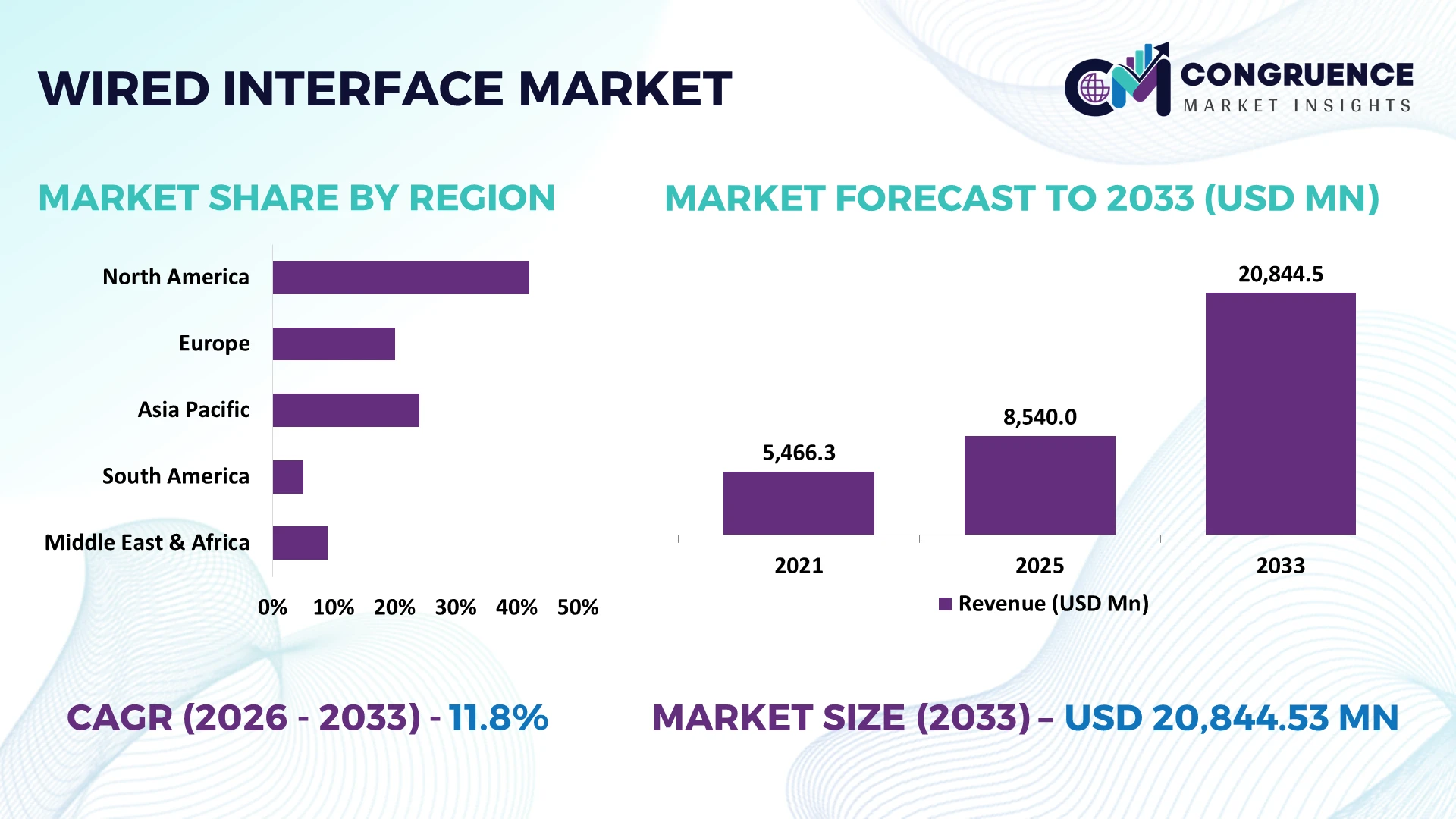
The Global Wired Interface Market was valued at USD 8540 Million in 2025 and is anticipated to reach a value of USD 20844.53 Million by 2033 expanding at a CAGR of 11.8% between 2026 and 2033. USB4, Thunderbolt, PCIe, HDMI, DisplayPort, automotive Ethernet, and high-speed SerDes adoption is accelerating as AI servers, vehicles, industrial systems, and consumer devices require higher-bandwidth, low-latency physical connectivity.
China anchors global wired-interface demand through its electronics manufacturing, EV, computing-hardware, and telecom-equipment ecosystems, producing more than 70% of smartphones and approximately 32% of global manufacturing output. USB-C deployment is widening across laptops, smartphones, peripherals, and power-delivery devices, while China’s EV production exceeded 13 million units in 2024, expanding automotive Ethernet and high-speed interface requirements. Compared with the United States, China dominates hardware assembly scale, while U.S. companies lead advanced interface silicon and AI-server architectures. U.S.–China semiconductor controls continue to accelerate interface-chip localization.
Strategically, suppliers should align high-speed interface roadmaps with Chinese manufacturing scale while securing diversified semiconductor, packaging, and electronics-production channels across Taiwan, Vietnam, India, and the United States.
Market Size & Growth: USD 8,540 million in 2025 reaches USD 20,844.53 million by 2033 at 11.8% CAGR, driven by AI computing, USB-C standardization, and automotive connectivity.
Top Growth Drivers: AI server bandwidth requirements are rising above 50%, USB-C adoption exceeds 80% across new premium devices, and EV electronic content is increasing approximately 10–15% annually.
Short-Term Forecast: By 2028, USB4 Version 2.0 enables 80 Gbps bidirectional throughput, doubling the 40 Gbps capability of first-generation USB4 implementations.
Emerging Technologies: USB4 80 Gbps, Thunderbolt 5 at 120 Gbps display bandwidth, and PCIe 6.0 at 64 GT/s are reshaping high-performance wired connectivity.
Regional Leaders: By 2033, Asia-Pacific approaches USD 9.0 billion, North America USD 5.4 billion, and Europe USD 3.8 billion, led respectively by electronics production, AI infrastructure, and automotive connectivity.
End-User Trends: USB-C now supports up to 240 W power delivery, consolidating charging, data, and display connectivity across smartphones, laptops, monitors, and peripherals.
Pilot/Case Example: Thunderbolt 5 deployment delivers 80 Gbps bidirectional bandwidth and up to 120 Gbps through Bandwidth Boost, tripling display-oriented throughput versus Thunderbolt 4.
Competitive Landscape: Texas Instruments holds an estimated low-teens interface-semiconductor position, competing with NXP, Analog Devices, Microchip Technology, and Broadcom across connectivity architectures.
Regulatory & ESG Impact: EU common-charger rules standardize USB-C across multiple device categories, reducing redundant charging hardware and targeting approximately 11,000 tonnes of electronic-waste reduction annually.
Investment & Funding: U.S. CHIPS programs provide USD 52.7 billion for semiconductor manufacturing, R&D, and workforce development, strengthening domestic production capacity relevant to advanced interface silicon.
Innovation & Future Outlook: PCIe 7.0 targets 128 GT/s per lane, doubling PCIe 6.0 throughput and shifting competitive differentiation toward signal integrity, retimers, PHY integration, and lower-power SerDes.
The Wired Interface Market is increasingly shaped by AI servers, data centers, EV electronics, industrial automation, gaming systems, displays, and multifunction consumer devices requiring deterministic high-speed connectivity. USB4 Version 2.0 reaches 80 Gbps, while Thunderbolt 5 supports up to 120 Gbps for bandwidth-intensive display configurations, intensifying requirements for advanced controllers, retimers, PHYs, and signal-conditioning components. USB-C regulatory standardization in Europe is simultaneously consolidating connector architectures, while electronics supply-chain diversification toward India and Vietnam is changing component qualification and sourcing strategies, establishing the operational context for strategic market development.
Wired interfaces are becoming strategic infrastructure as AI servers, EVs, industrial automation, and high-resolution displays require deterministic bandwidth that wireless links cannot consistently deliver. USB-C standardization in Europe and electronics supply-chain diversification toward India and Vietnam are simultaneously changing connector, controller, retimer, and PHY sourcing. The competitive focus is shifting from individual ports toward integrated data, display, and power-delivery architectures.
USB4 Version 2.0 provides 80 Gbps bidirectional bandwidth, twice USB4’s original 40 Gbps capability, while Thunderbolt 5 reaches 120 Gbps for display-intensive operation. This bandwidth improvement supports fewer physical connections and higher peripheral consolidation. China dominates electronics assembly scale, whereas the United States leads AI-server interface silicon and advanced SerDes development; Europe increasingly shapes connector adoption through USB-C regulation.
Through 2028, PCIe 6.0, USB4 80 Gbps, Thunderbolt 5, and automotive Ethernet will move deeper into production platforms. AI servers provide a practical example: higher-speed links require retimers and signal conditioning to preserve integrity across complex boards. Semiconductor suppliers are expanding PHY integration, reference designs, and OEM partnerships. Competitive positioning will increasingly depend on interoperability, signal integrity, power efficiency, and rapid certification across multiple interface standards.
AI servers and accelerated computing are forcing wired interfaces toward substantially higher data rates because GPU clusters require deterministic, low-latency communication between processors, storage, networking, and peripherals. PCIe 6.0 doubles PCIe 5.0 throughput to 64 GT/s, while USB4 Version 2.0 doubles maximum bidirectional bandwidth from 40 Gbps to 80 Gbps. Data-center electricity consumption already represents roughly 1.5% of global electricity use, intensifying pressure to move more data per watt. U.S. hyperscale infrastructure expansion is therefore increasing demand for SerDes, retimers, switches, and high-speed PHYs. Broadcom, Texas Instruments, Analog Devices, and Microchip are responding through higher-bandwidth interface portfolios and reference platforms. The strategic shift is clear: signal integrity is becoming a system-performance constraint rather than a peripheral design consideration.
Rising interface speeds sharply increase PCB, connector, cable, retimer, and validation costs because insertion loss, crosstalk, jitter, and electromagnetic interference become harder to control. PCIe bandwidth doubles between successive generations, while USB4 advances from 40 Gbps to 80 Gbps, forcing manufacturers toward lower-loss substrates and more sophisticated equalization. High-speed PCB materials can carry premiums exceeding 20–30% over conventional laminates, pressuring margins in cost-sensitive electronics. China’s central role in electronics assembly also exposes interface-component sourcing to U.S.–China semiconductor controls and logistics disruption. OEMs are reducing exposure through dual sourcing, regional qualification, modular controller architectures, and longer procurement agreements. Non-obviously, faster interfaces can increase total platform cost even when controller pricing falls because compliance testing and board engineering become substantially more demanding.
USB-C, USB4, Thunderbolt 5, and advanced Power Delivery create an opportunity to consolidate data, video, peripheral connectivity, and charging through fewer physical interfaces. USB Power Delivery supports up to 240 W, USB4 Version 2.0 provides 80 Gbps bidirectional bandwidth, and Thunderbolt 5 can reach 120 Gbps for display traffic. Europe’s common-charger requirements are accelerating USB-C standardization across consumer-device categories, creating scale advantages for controller, cable, connector, and power-management suppliers. Semiconductor companies are developing multifunction controllers, integrated retimers, protocol-conversion ICs, and certified reference platforms. The less obvious opportunity lies in reducing OEM SKU complexity: common interface architectures can simplify accessories, board layouts, and inventory. Suppliers supporting interoperability across multiple standards can capture more value per system than vendors supplying standalone connectivity components.
Interface convergence creates substantial execution complexity because devices increasingly combine PCIe, USB4, DisplayPort, Thunderbolt, Ethernet, and power delivery within tightly constrained electrical architectures. PCIe 6.0 operates at 64 GT/s using PAM4 signaling, while PCIe 7.0 targets 128 GT/s, significantly tightening jitter and channel-loss budgets. USB4 links simultaneously reach 80 Gbps, increasing requirements for retimers, equalization, thermal control, and compliance testing. Taiwanese and Chinese electronics manufacturers must validate these standards across diverse processors, operating systems, cables, docks, and peripherals while maintaining production yield. Semiconductor suppliers are investing in protocol analyzers, interoperability laboratories, firmware engineering, simulation tools, and ecosystem partnerships. Long-term advantage depends on achieving repeatable cross-platform compatibility; headline bandwidth provides limited commercial value when certification delays or interoperability failures postpone OEM product launches.
Retimers Move Closer to Processors: PCIe 5.0 and 6.0 deployments are increasing retimer density as server motherboards become larger and accelerator configurations more complex. PCIe 6.0 reaches 64 GT/s, double PCIe 5.0’s 32 GT/s, while PAM4 signaling tightens channel-loss budgets. U.S. server manufacturers are placing signal-conditioning silicon nearer GPUs and switches, prompting semiconductor suppliers to expand low-latency retimers and automated link-diagnostics capabilities.
Automotive Ethernet Replaces Legacy Wiring: Vehicle architectures are consolidating numerous dedicated communication links into zonal Ethernet networks. Automotive Ethernet has progressed from 100 Mbps toward 1–10 Gbps implementations, while zonal architectures can reduce wiring-harness weight by approximately 20–30%. German and Chinese automakers are redesigning domain controllers around centralized computing, encouraging interface suppliers to develop automotive-qualified PHYs, switches, connectors, and deterministic networking solutions.
Active Cables Gain Data-Center Share: Rising server bandwidth is accelerating migration from passive copper toward active electrical and optical connectivity where distance and signal integrity constrain performance. 400G and 800G links are expanding, while 1.6T connectivity is entering deployment roadmaps. Hyperscale operators are redesigning rack interconnects, and component suppliers are integrating signal conditioning directly into cable assemblies. The non-obvious shift is moving interface value from motherboard components into intelligent cabling.
Display Interfaces Target Extreme Resolution: Premium gaming, workstation, and content-creation systems are adopting higher-bandwidth display connectivity. DisplayPort 2.1 reaches 80 Gbps-class raw bandwidth, while Thunderbolt 5 provides up to 120 Gbps for display-intensive operation and supports multiple high-resolution monitors. PC manufacturers are updating docks, GPUs, monitors, and certified cables, shifting supplier competition toward interoperability, compression support, and reliable high-refresh-rate transmission.
USB represents the leading type with an estimated 35–40% market share, supported by its installed base across smartphones, computers, peripherals, industrial equipment, storage devices, and charging hardware. USB-C strengthens this position by combining data, display, and power functions within one reversible connector. USB4 supports 40 Gbps, while USB4 Version 2.0 doubles bidirectional performance to 80 Gbps. HDMI remains entrenched in televisions, gaming systems, and audiovisual equipment, while Ethernet dominates deterministic network connectivity across enterprise and industrial environments.
Thunderbolt is the fastest-growing type as premium PCs, workstations, docks, storage systems, and creator hardware require greater bandwidth consolidation. Thunderbolt 5 provides 80 Gbps bidirectionally and up to 120 Gbps for display-intensive operation. DisplayPort remains strategically important for high-resolution computing, Serial interfaces retain installed industrial and embedded demand, and Ethernet is advancing into vehicles. Suppliers are concentrating investment on multifunction controllers, retimers, certified cables, and protocol interoperability rather than isolated connector components.
Data Transfer represents the leading application with an estimated 30–35% share, reflecting extensive interface deployment across PCs, servers, storage, peripherals, embedded systems, and enterprise equipment. Increasing file sizes and accelerator workloads are pushing USB, PCIe-connected peripherals, and Thunderbolt toward higher throughput, with USB4 Version 2.0 reaching 80 Gbps. Video Transmission remains substantial through HDMI and DisplayPort ecosystems, while Network Connectivity relies heavily on Ethernet for predictable latency and scalable enterprise deployment.
Device Charging is the fastest-growing application as USB-C increasingly combines connectivity and power delivery. USB Power Delivery supports up to 240 W, expanding standardized charging from smartphones into notebooks, displays, docking stations, and selected high-power peripherals. Industrial Control maintains demand for reliable Serial and Ethernet connections, while Audio Connectivity increasingly converges onto USB-C and multifunction ports. Semiconductor and connector suppliers are integrating protocol control, power management, signal conditioning, and protection functions, increasing component value while reducing OEM board complexity and accessory fragmentation.
Consumer Electronics leads end-user demand with an estimated 35–40% share because smartphones, notebooks, monitors, televisions, gaming systems, storage devices, and peripherals require multiple standardized interfaces at enormous production volumes. USB-C adoption is consolidating data, charging, and display functions, while HDMI and DisplayPort remain essential for audiovisual equipment. Telecom continues deploying Ethernet-based connectivity, and Industrial users retain Serial and deterministic Ethernet interfaces where reliability and installed-equipment compatibility outweigh maximum bandwidth.
IT and Data Centers represent the fastest-growing end-user group as AI servers, storage platforms, network switches, and accelerator clusters require increasingly sophisticated high-speed physical interfaces. Data centers consumed approximately 1.5% of global electricity in 2024, making bandwidth-per-watt an important procurement consideration. Automotive demand is strengthening through Ethernet-based zonal architectures, while Healthcare equipment prioritizes dependable connectivity and long product qualification cycles. Suppliers are targeting these verticals through specialized PHYs, retimers, automotive-grade devices, reference designs, and interoperability partnerships.
Asia-Pacific accounted for the largest market share at 43% in 2025 however, Asia-Pacific is expected to register the fastest growth, expanding at a CAGR of 13.4% between 2026 and 2033.
AI Infrastructure Pushes Interface Performance Higher
North America accounted for approximately 27% of wired interface demand in 2025, supported by hyperscale data centers, AI computing, enterprise networking, automotive electronics, and premium computing hardware. The United States concentrates interface-controller, SerDes, retimer, switch, and connectivity-IP development, while AI clusters are accelerating migration toward PCIe 6.0, 800G Ethernet, USB4, and Thunderbolt 5. PCIe 6.0 delivers 64 GT/s, doubling PCIe 5.0 throughput and increasing requirements for signal conditioning across large server boards. Data centers consumed about 176 TWh of U.S. electricity in 2023, reinforcing the importance of bandwidth-per-watt. Semiconductor companies are consequently prioritizing lower-power PHYs, retimers, active cables, interoperability laboratories, and partnerships with server OEMs and hyperscale infrastructure operators.
United States Market Outlook: The United States combines semiconductor design leadership with concentrated cloud, AI, server, workstation, and networking demand. Domestic hyperscalers are transitioning toward 400G and 800G networks while preparing 1.6T infrastructure. CHIPS-related manufacturing expansion also strengthens local semiconductor capacity. This environment favors suppliers delivering high-speed SerDes, PCIe retimers, Ethernet PHYs, USB controllers, and qualified connectivity reference platforms.
Standardization Reshapes Device Connectivity Architecture
Europe represented approximately 20% of wired interface demand in 2025, with Germany, France, the Netherlands, and Nordic markets supporting automotive electronics, industrial automation, data centers, telecom equipment, and premium consumer devices. EU common-charger regulation is structurally accelerating USB-C adoption across covered portable electronics, while laptop requirements apply from April 2026. Automotive manufacturers are simultaneously replacing fragmented in-vehicle networks with Ethernet-based domain and zonal architectures capable of supporting 1–10 Gbps links. Germany’s industrial automation base strengthens demand for deterministic Ethernet and established Serial connectivity where equipment lifecycles extend beyond consumer-device replacement cycles. Interface suppliers are responding with automotive-qualified PHYs, rugged connectors, USB Power Delivery controllers, and interoperability solutions. Regulatory standardization is therefore reducing connector fragmentation while shifting differentiation toward controller performance and certification.
Germany Market Outlook: Germany represents Europe’s most strategically important automotive-industrial interface market. Vehicle manufacturers are adopting centralized computing, advanced driver-assistance systems, and Ethernet-based architectures to reduce wiring complexity. Zonal electrical architectures can lower harness weight by approximately 20–30%, making high-speed Ethernet strategically valuable for EV efficiency. Industrial machinery additionally sustains demand for deterministic Ethernet and legacy Serial interfaces requiring long-term component availability.
Electronics Manufacturing Scale Anchors Interface Demand
Asia-Pacific held approximately 43% of the wired interface market in 2025, supported by China’s electronics manufacturing, Taiwan’s semiconductor ecosystem, South Korea’s display and consumer-device production, Japan’s automotive technology, and India’s expanding electronics assembly. China remains the principal production hub for smartphones, PCs, networking equipment, peripherals, and EV electronics, creating concentrated demand for USB, HDMI, Ethernet, DisplayPort, and Serial components. Taiwan supplies advanced semiconductor manufacturing and server hardware supporting high-speed interface controllers and retimers. Electronics supply-chain diversification is simultaneously directing additional assembly toward India and Vietnam. India’s electronics production has expanded more than sixfold over the past decade, strengthening local demand for connectors, controllers, cables, and testing infrastructure. Suppliers are expanding regional design support, qualification capacity, distribution, and manufacturing partnerships.
China Market Outlook: China combines high-volume electronics assembly with the world’s largest EV manufacturing base and extensive telecom infrastructure. The country produced more than 13 million new-energy vehicles in 2025, increasing demand for automotive Ethernet, USB connectivity, display interfaces, and diagnostic links. Domestic semiconductor localization is also encouraging Chinese OEMs to qualify locally designed interface controllers, PHYs, switches, and signal-conditioning components.
Connectivity Modernization Expands Interface Deployment
South America accounted for approximately 4% of wired interface demand in 2025, led by Brazil’s data centers, telecom networks, consumer electronics, industrial automation, and vehicle manufacturing. Ethernet dominates enterprise and network infrastructure, while USB and HDMI remain volume interfaces across computers, televisions, peripherals, and digital equipment. Brazil’s expanding cloud footprint is increasing requirements for higher-speed server and networking connectivity, although dependence on imported semiconductors, connectors, and advanced electronic assemblies raises procurement costs and extends qualification cycles. 5G coverage expansion and industrial digitization are strengthening wired backhaul and equipment-interface requirements alongside wireless deployment. Suppliers are addressing these conditions through local distributors, regional inventories, technical support partnerships, and standardized interface portfolios rather than extensive domestic semiconductor production.
Brazil Market Outlook: Brazil provides South America’s deepest enterprise, automotive, telecom, and electronics demand base. Vehicle production exceeds 2 million units annually, supporting Ethernet, USB, display, diagnostic, and control-interface deployment. Large cloud and colocation projects are simultaneously expanding high-speed network requirements. Import taxation and currency exposure make local inventory, technical support, and multi-vendor qualification important competitive advantages for component suppliers.
Digital Infrastructure Investment Upgrades Connectivity
Middle East & Africa represented approximately 6% of wired interface demand in 2025, with the UAE, Saudi Arabia, Israel, and South Africa providing the strongest technology and infrastructure concentrations. Gulf investment in AI computing, cloud facilities, smart cities, telecom networks, and industrial digitalization is increasing deployment of Ethernet, USB, high-speed server interfaces, and structured data-center connectivity. Saudi Arabia and the UAE are developing large computing facilities requiring 400G and increasingly 800G network architectures, while Israel maintains substantial semiconductor and networking design capabilities. Africa remains more dependent on imported hardware, with infrastructure availability and equipment cost influencing adoption speed. Suppliers are responding through hyperscaler partnerships, regional distribution, data-center ecosystem participation, and enterprise networking deployments focused on reliable high-bandwidth connectivity.
Saudi Arabia Market Outlook: Saudi Arabia is becoming a concentrated demand center for wired connectivity through cloud expansion, AI infrastructure, smart-city development, industrial automation, and 5G-linked computing. National digital programs are driving new data-center capacity, where high-speed Ethernet and server interconnects are operational requirements. Large infrastructure projects also create demand for standardized industrial networking, structured cabling, USB connectivity, and rugged interface components.
Texas Instruments, NXP Semiconductors, Broadcom, Analog Devices, Microchip Technology, and Realtek compete across interface controllers, PHYs, retimers, switches, and connectivity ICs, with diversified semiconductor leaders challenging cost-focused Asian suppliers. The top five players collectively capture approximately 45–50% of addressable interface-semiconductor demand. Competition centers on bandwidth, interoperability, power efficiency, price, and qualification speed: next-generation interfaces double throughput between major generations, integrated controllers can reduce board component counts by 15–25%, and optimized PHYs target 10–20% lower power. Broadcom emphasizes data-center Ethernet and SerDes, while NXP targets automotive networking; Texas Instruments and Analog Devices compete through signal conditioning and industrial connectivity. Suppliers are expanding reference designs, OEM partnerships, software integration, and automotive-qualified portfolios. The competitive shift favors protocol integration and system-level engineering over standalone components. Complex standards certification, high-speed analog expertise, and OEM qualification remain key entry barriers. Winning requires interoperability, scalable supply, low-power performance, rapid qualification, and application-specific engineering support.
Texas Instruments Incorporated
NXP Semiconductors N.V.
Broadcom Inc.
Analog Devices, Inc.
Microchip Technology Inc.
Realtek Semiconductor Corp.
Renesas Electronics Corporation
Infineon Technologies AG
STMicroelectronics N.V.
Intel Corporation
Parade Technologies, Ltd.
Synopsys, Inc.
Diodes Incorporated
Marvell Technology, Inc.
Current wired-interface technology is centered on USB4, PCIe 5.0/6.0, HDMI 2.1, DisplayPort 2.1, multi-gigabit Ethernet, and signal-conditioning ICs. USB4 reaches 80 Gbps, doubling first-generation USB4 bandwidth, while PCIe 6.0 delivers 64 GT/s per lane, twice PCIe 5.0. Retimers, redrivers, and adaptive equalization increasingly preserve signal integrity across longer server boards, improving usable bandwidth and reducing retransmission overhead in AI infrastructure.
Emerging architectures combine USB-C data, display, and power delivery, automotive Ethernet, active electrical cables, and PAM4 signaling. Thunderbolt 5 provides 80 Gbps bidirectionally and 120 Gbps with Bandwidth Boost, delivering 200% more display bandwidth than Thunderbolt 4. Automotive Ethernet is progressing from 100 Mbps links toward 1–10 Gbps backbones. Semiconductor suppliers integrating PHYs, switches, security, and diagnostics benefit through lower OEM qualification complexity and faster platform deployment.
Disruptive development is shifting toward PCIe 7.0, 1.6T Ethernet, intelligent cabling, and automated protocol validation. PCIe 7.0 targets 128 GT/s per lane, another 100% generational increase, intensifying requirements for low-loss materials and advanced testing. Between 2026 and 2028, AI servers, software-defined vehicles, industrial edge systems, and premium computing will accelerate deployment. Companies investing now secure design wins before interoperability, power efficiency, and certification speed become decisive procurement criteria across global production-ready connectivity platforms.
January 2024 – ASMedia’s ASM4242 became the first Taiwanese USB4 host controller certified by USB-IF, supporting transfer speeds up to 3,800 MB/s, double USB 3.2 Gen2x2 performance, positioning the company for mass-production deployment across next-generation PCs and high-speed peripherals.
August 2024 – USB-IF launched a conformity test program supporting OEM and ODM compliance with the EU Common Charger Directive, strengthening USB Type-C interoperability as 27 December 2024 requirements approached and reducing certification risk for device manufacturers selling regulated electronics.
October 2025 – Microchip introduced its 3-nm Switchtec Gen 6 PCIe switches supporting up to 160 lanes and 64 GT/s signaling, doubling PCIe 5.0 per-lane data rates and enabling denser, lower-latency CPU, GPU, accelerator, and storage connectivity for AI infrastructure.
August 2026 – Teledyne LeCroy introduced Voyager M4120 protocol analysis for USB4 Gen 4 asymmetric links reaching 120 Gb/s, enabling engineering teams to emulate, debug, and validate next-generation hosts and devices as wired-interface qualification complexity increases across high-performance computing platforms.
The Wired Interface Market Report evaluates USB, HDMI, Ethernet, DisplayPort, Serial, and Thunderbolt technologies across Data Transfer, Video Transmission, Network Connectivity, Device Charging, Industrial Control, and Audio Connectivity. End-user coverage includes Consumer Electronics, Automotive, Telecom, IT and Data Centers, Industrial, and Healthcare, capturing the transition from mature connectivity standards toward 80 Gbps USB4, 120 Gbps Thunderbolt operation, multi-gigabit automotive Ethernet, and advanced signal conditioning.
Regional analysis covers North America, Europe, Asia-Pacific, South America, and Middle East & Africa, examining semiconductor ecosystems, electronics manufacturing, regulatory standardization, data-center deployment, and automotive digitization. The report assesses retimers, PHYs, active cables, PAM4 signaling, protocol integration, and PCIe 7.0 pathways targeting 128 GT/s. These insights support 2026–2033 investment planning, geographic expansion, product-roadmap prioritization, supplier selection, partnership development, and competitive positioning.
| Report Attribute/Metric | Report Details |
|---|---|
Market Revenue in 2025 | USD 8540 Million |
Market Revenue in 2033 | USD 20844.53 Million |
CAGR (2026 - 2033) | 11.8% |
Base Year | 2025 |
Forecast Period | 2026 - 2033 |
Historic Period | 2021 - 2025 |
Segments Covered | By Type
By Application
By End-User
|
Key Report Deliverable | Revenue Forecast, Growth Trends, Market Dynamics, Segmental Overview, Regional and Country-wise Analysis, Competition Landscape |
Region Covered | North America, Europe, Asia-Pacific, South America, Middle East, Africa |
Key Players Analyzed | Texas Instruments Incorporated, NXP Semiconductors N.V., Broadcom Inc., Analog Devices, Inc., Microchip Technology Inc., Realtek Semiconductor Corp., Renesas Electronics Corporation, Infineon Technologies AG, STMicroelectronics N.V., Intel Corporation, Parade Technologies, Ltd., Synopsys, Inc., Diodes Incorporated, Marvell Technology, Inc. |
Customization & Pricing | Available on Request (10% Customization is Free) |




