
Reports
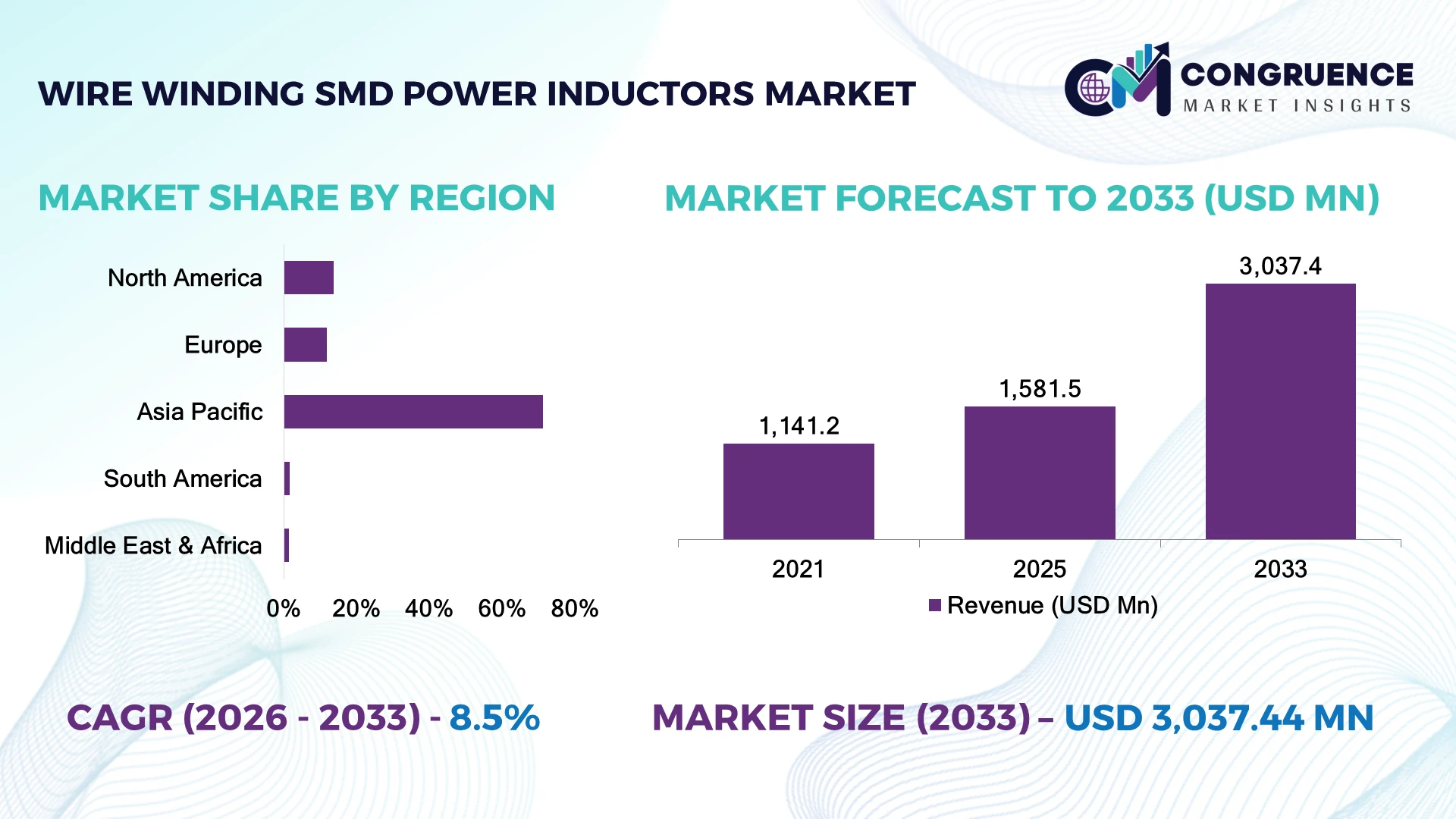
The Global Wire-winding SMD Power Inductors Market was valued at USD 1,581.5 Million in 2025 and is anticipated to reach a value of USD 3,037.4 Million by 2033 expanding at a CAGR of 8.5% between 2026 and 2033. Growth is driven by rising adoption of high-efficiency DC-DC converters, automotive power electronics, AI servers, and compact power management circuits requiring low-loss wire-winding SMD inductors.
China accounts for approximately 43% of global wire-winding SMD power inductor manufacturing capacity, supported by large-scale electronics production, EV supply chains, and semiconductor component ecosystems. Compared with Japan's technology-driven precision manufacturing base, China operates nearly 2.5 times higher production capacity, while automated inductor winding and inspection technologies have improved manufacturing efficiency by approximately 24%. Ongoing semiconductor localisation and electronics supply-chain diversification following global export-control measures continue accelerating investment in passive component manufacturing.
Manufacturers strengthening automated production, magnetic material innovation, and regional supply resilience are securing long-term competitive advantages across high-performance electronics markets.
Market Size & Growth: USD 1,581.5 million in 2025 to USD 3,037.4 million by 2033 at 8.5% CAGR, driven by advanced power management and automotive electronics.
Top Growth Drivers: Electric vehicles (+32%), AI servers (+29%), industrial automation (+25%).
Short-Term Forecast: By 2028, power conversion efficiency improves 17% while component footprint declines 14%.
Emerging Technologies: Magnetic composite cores, automated winding, AI-driven quality inspection strengthen product performance.
Regional Leaders: Asia-Pacific (~USD 2.0 billion), North America (~USD 420 million), Europe (~USD 360 million), supported by power electronics expansion.
Consumer/End-User Trends: Approximately 71% of compact power modules utilise wire-winding SMD inductors for high-current applications.
Pilot/Case Example: 2026 automated production deployment improved winding accuracy by nearly 21%.
Competitive Landscape: Leading supplier holds approximately 16% market share alongside TDK, Murata Manufacturing, Taiyo Yuden, and Vishay Intertechnology.
Regulatory & ESG Impact: High-efficiency power designs reduce energy losses by approximately 13% across electronic systems.
Investment & Funding: More than USD 2.2 billion committed to passive component capacity expansion and advanced manufacturing.
Innovation & Future Outlook: Miniaturised high-current inductors and advanced magnetic materials redefine next-generation power electronics.
Wire-winding SMD power inductors have become critical components across electric vehicles, telecommunications equipment, industrial automation, AI servers, and consumer electronics where efficient power conversion is essential. Approximately 64% of high-current power modules now incorporate advanced wire-winding designs to improve thermal performance and current handling. Continued passive component localisation and supply-chain optimisation are reshaping procurement priorities, creating a strong foundation for long-term strategic investment.
The Wire-winding SMD Power Inductors Market has become strategically important as electrification, AI computing, industrial automation, and advanced telecommunications accelerate demand for compact, high-efficiency power management solutions. Supply-chain restructuring is encouraging electronics manufacturers to regionalise passive component sourcing while reducing dependence on single-country production hubs. This transition is strengthening investment in automated manufacturing, magnetic material innovation, and vertically integrated component ecosystems.
Modern wire-winding technologies deliver approximately 18% higher current handling capacity and nearly 15% lower power losses than conventional multilayer inductor designs in demanding power conversion applications. Japan continues leading in premium magnetic material innovation and precision manufacturing, while China dominates large-scale production and integrated electronics supply chains. Over the next two to three years, nearly 47% of newly developed high-current power modules are expected to adopt next-generation wire-winding SMD inductors supporting AI infrastructure, electric mobility, and industrial power systems.
A practical example is electric vehicle onboard power converters, where advanced wire-winding inductors improve thermal stability under continuous high-current operation. Manufacturers are expanding automated production facilities, strengthening partnerships with automotive and industrial OEMs, and investing in advanced ferrite and composite magnetic materials. Companies combining manufacturing scale, material science expertise, and application-specific engineering will establish stronger competitive positions as power electronics continue advancing toward higher efficiency and greater power density.
The rapid expansion of electric vehicles, AI servers, industrial automation equipment, and telecommunications infrastructure is driving demand for wire-winding SMD power inductors with superior current handling and low DC resistance. Approximately 35% of newly designed automotive power modules now incorporate high-current wire-winding inductors, while demand for compact power management components has increased by nearly 28%. China's continued investment in electric vehicle production and semiconductor manufacturing has accelerated procurement of advanced passive components following global supply-chain diversification initiatives. This shift improves power conversion efficiency and thermal stability, encouraging manufacturers to expand automated winding capacity, develop advanced magnetic materials, and establish strategic partnerships with automotive and industrial OEMs. Companies delivering high-performance inductors with consistent electrical characteristics are strengthening their competitive positioning.
Wire-winding SMD power inductor production remains sensitive to fluctuations in ferrite core materials, copper wire costs, and specialised magnetic compounds. Raw materials account for approximately 54% of manufacturing expenses, while copper price volatility can influence finished component costs by nearly 16%. Japan's dependence on imported critical minerals and periodic supply disruptions affecting magnetic material processing continue creating procurement uncertainty for passive component manufacturers. These structural pressures compress operating margins, complicate long-term pricing strategies, and increase inventory carrying costs across electronics supply chains. Companies are reducing exposure through supplier diversification, regional manufacturing expansion, long-term procurement agreements, and increased adoption of alternative magnetic composite materials that maintain electrical performance while improving cost stability.
The rapid deployment of AI data centres, advanced networking equipment, and high-density computing platforms is creating new opportunities for high-current wire-winding SMD power inductors with improved thermal efficiency and compact form factors. Advanced magnetic composite materials increase power density by approximately 23%, while automated winding technologies improve manufacturing precision by nearly 18%. South Korea is strengthening investment in advanced semiconductor and AI infrastructure, creating additional demand for premium passive components supporting high-frequency power conversion. Manufacturers are expanding R&D for low-loss magnetic materials, collaborating with power management IC suppliers, and developing application-specific inductor platforms. A significant strategic opportunity lies in supplying customised inductors designed specifically for AI server power architectures rather than conventional consumer electronics.
Maintaining electrical stability, thermal performance, and mechanical reliability as component dimensions continue shrinking remains a major execution challenge for manufacturers. High-density packaging requirements have increased design complexity by approximately 26%, while qualification and reliability testing now account for nearly 21% of total product development cycles. Taiwan's advanced electronics manufacturing ecosystem continues demanding smaller inductors capable of supporting higher switching frequencies without compromising current capacity. Manufacturers must invest in precision winding technologies, advanced simulation software, and high-performance magnetic materials while strengthening collaboration with semiconductor and power electronics designers. Sustained competitiveness depends on achieving greater miniaturisation without sacrificing efficiency, durability, or production consistency.
Miniaturisation Gains Momentum: Compact wire-winding SMD inductors below 2.0 mm now represent approximately 36% of new power management designs, while component volume has decreased by nearly 18% without reducing current capacity. AI devices and portable electronics are accelerating design optimisation, prompting manufacturers to automate precision winding and redesign magnetic core architectures for higher power density.
Composite Core Materials Expand: Advanced composite magnetic cores improve saturation current by approximately 21% and reduce core losses by nearly 16% compared with conventional ferrite designs. As higher switching frequencies become standard in automotive and industrial electronics, component suppliers are scaling advanced material production and strengthening partnerships with magnetic material specialists to improve long-term product performance.
Automated Manufacturing Intensifies: Automated winding, laser welding, and AI-enabled optical inspection now support approximately 63% of production capacity in leading manufacturing facilities, reducing defect rates by nearly 19%. Labour shortages and stricter quality requirements are encouraging manufacturers to modernise production lines, improving throughput while maintaining consistent electrical performance across high-volume manufacturing.
Regional Supply Chains Diversify: Electronics manufacturers have increased regional sourcing of passive components by approximately 24%, while inventory lead times have fallen by nearly 13% through localisation strategies. Rather than relying solely on production expansion, suppliers are establishing engineering centres, regional distribution hubs, and collaborative design programmes to strengthen customer responsiveness and supply-chain resilience.
Shielded Wire-Winding SMD Power Inductors account for approximately 61% of the global market owing to their superior electromagnetic interference (EMI) suppression, high current capability, and stable performance in compact power circuits. Their widespread deployment across automotive electronics, industrial automation, AI servers, and telecommunications equipment has reinforced demand where signal integrity and thermal stability are critical. Non-Shielded Wire-Winding Inductors continue serving mature consumer electronics and cost-sensitive power management applications, offering simpler construction and lower manufacturing costs for standard electronic assemblies.
High-Current Shielded Inductors represent the fastest-growing type as electric vehicles, AI accelerators, and industrial power systems require greater power density and improved thermal management. Adoption of high-current wire-winding designs has increased by approximately 30%, while low-loss magnetic core integration has improved power conversion efficiency by nearly 18%. Manufacturers are expanding precision winding capacity, investing in advanced composite magnetic materials, and introducing application-specific product portfolios through strategic OEM collaborations. Investment priorities are steadily shifting toward premium inductors supporting high-frequency switching and compact power architectures.
According to a 2026 assessment published by the Power Sources Manufacturers Association (PSMA), shielded power inductors remain the preferred solution for high-current DC-DC converters because of their superior EMI performance and thermal stability in advanced power electronics.
Automotive Electronics account for approximately 34% of the Wire-winding SMD Power Inductors market, supported by increasing integration into electric drivetrains, battery management systems, onboard chargers, and advanced driver assistance platforms. High-current capability, compact size, and superior efficiency make wire-winding inductors indispensable for modern vehicle power management. Consumer Electronics continue representing a mature volume segment across smartphones, notebooks, and wearable devices, while Industrial Equipment and Telecommunications Infrastructure sustain stable demand through power supplies, networking equipment, and automation systems.
AI Servers and Data Centre Power Systems represent the fastest-growing application as high-performance processors require highly efficient voltage regulation and low-loss power conversion. High-current inductor deployment within AI server platforms has increased by approximately 28%, while advanced DC-DC converter efficiency has improved by nearly 17% through optimised magnetic component design. Manufacturers are expanding automated production, strengthening partnerships with power management IC suppliers, and developing customised inductor platforms that address demanding thermal and electrical requirements across next-generation computing infrastructure.
According to a 2025 enterprise assessment by the Open Compute Project Foundation, next-generation server power architectures continue increasing deployment of compact high-current magnetic components to improve power efficiency and thermal management in AI infrastructure.
Automotive OEMs and Tier-1 Suppliers account for approximately 38% of total Wire-winding SMD Power Inductors demand because of large-scale deployment across electric vehicles, hybrid powertrains, charging systems, and vehicle electronics. Increasing electrification, higher operating voltages, and stricter efficiency requirements continue driving procurement of premium magnetic components. Consumer electronics manufacturers remain significant buyers through high-volume production of mobile devices and computing equipment, while industrial equipment producers maintain consistent purchasing for factory automation, robotics, and energy management systems.
Cloud Infrastructure Providers and Data Centre Equipment Manufacturers represent the fastest-growing end-user group as AI computing expands demand for high-density power delivery systems. Procurement of high-current wire-winding inductors has increased by approximately 27%, while compact power module adoption has improved by nearly 19% across hyperscale computing platforms. Manufacturers are responding through customised product development, long-term supply agreements, collaborative engineering programmes, and regional inventory expansion. Competitive positioning increasingly depends on delivering application-specific inductors that balance miniaturisation, efficiency, and thermal reliability.
According to a 2026 industry assessment published by the Electronics Components Industry Association (ECIA), procurement of advanced magnetic components continues accelerating among automotive and AI infrastructure manufacturers as power density requirements increase across next-generation electronic systems.
Asia-Pacific accounted for the largest market share at 71.2% in 2025 however, Middle East & Africa is expected to register the fastest growth, expanding at a CAGR of 9.3% between 2026 and 2033.
AI Infrastructure Strengthens Power Component Demand
North America accounts for approximately 13.8% of the global Wire-winding SMD Power Inductors market, driven by AI data centres, electric vehicle production, aerospace electronics, and industrial automation. Demand is concentrated in high-current power management systems where compact inductors improve efficiency and thermal performance. Approximately 58% of newly developed AI server power supplies utilise advanced wire-winding SMD inductors for stable voltage regulation and high-frequency switching. Semiconductor reshoring initiatives and continued investment in advanced electronics manufacturing are strengthening regional sourcing strategies, prompting component suppliers to expand engineering support, automated production capabilities, and partnerships with power management IC manufacturers.
United States Market Outlook: The United States leads regional demand through large-scale AI infrastructure investment, semiconductor manufacturing expansion, and advanced automotive electronics development. High-performance computing, defence electronics, and industrial automation continue driving procurement of premium wire-winding inductors. Approximately 62% of newly commissioned high-density server power platforms integrate high-current wire-winding inductors, encouraging manufacturers to strengthen domestic technical support, collaborative product development, and long-term supply agreements.
Automotive Electrification Drives Component Innovation
Europe represents approximately 11.9% of the global market, supported by electric vehicle manufacturing, industrial automation, renewable energy systems, and precision power electronics. High-efficiency power conversion requirements continue increasing demand for compact wire-winding inductors with enhanced thermal stability and low core losses. Around 46% of new automotive power electronic platforms now integrate high-current wire-winding inductors to improve energy efficiency and operational reliability. Manufacturers are expanding application engineering capabilities while collaborating closely with automotive OEMs and industrial equipment suppliers to accelerate product qualification.
Germany Market Outlook: Germany remains the region's largest market through its advanced automotive supply chain, industrial automation leadership, and growing investment in power semiconductor manufacturing. Demand is concentrated in electric drivetrains, charging infrastructure, and factory automation equipment requiring reliable magnetic components. Approximately 43% of next-generation automotive power control modules utilise advanced wire-winding inductors designed for higher switching frequencies and improved thermal performance.
Manufacturing Leadership Supports Global Supply
Asia-Pacific contributes approximately 71.2% of global demand, supported by the world's largest electronics manufacturing ecosystem, semiconductor production, telecommunications equipment assembly, and electric vehicle supply chains. China, Japan, South Korea, Taiwan, and Malaysia continue expanding passive component manufacturing while increasing automation across magnetic component production. Approximately 74% of global wire-winding SMD inductor manufacturing capacity is concentrated within the region, supported by continuous investment in automated winding systems, precision inspection technologies, and advanced magnetic materials. Export-oriented production and integrated electronics supply chains continue reinforcing the region's dominant market position.
China Market Outlook: China remains the largest country market because of its extensive electronics manufacturing clusters, electric vehicle production, and integrated semiconductor ecosystem. Large-scale deployment of industrial automation and advanced power electronics continues driving procurement of premium wire-winding inductors. Approximately 68% of newly established passive component production lines incorporate automated winding and optical inspection systems, strengthening manufacturing efficiency, export competitiveness, and domestic supply-chain resilience.
Industrial Electronics Expand Market Potential
South America is experiencing steady demand growth through automotive assembly, industrial automation, renewable energy equipment, and consumer electronics manufacturing. Regional manufacturers continue increasing the use of wire-winding SMD inductors to improve power efficiency and meet international performance standards. Approximately 36% of industrial electronics manufacturers have upgraded high-efficiency power conversion systems using advanced magnetic components. Although reliance on imported passive components remains a structural limitation, companies are strengthening local distribution networks, inventory management, and technical partnerships to improve procurement flexibility and operational continuity.
Brazil Market Outlook: Brazil leads regional demand through its established automotive manufacturing base, industrial equipment production, and expanding renewable energy sector. Power management components are increasingly deployed across electric mobility, telecommunications infrastructure, and industrial automation projects. Approximately 39% of large-scale industrial power electronics systems now incorporate advanced wire-winding SMD inductors, encouraging suppliers to expand regional engineering support and application-specific product availability.
Industrial Modernisation Accelerates Electronics Deployment
The Middle East & Africa market is expanding through industrial diversification, digital infrastructure development, renewable energy investments, and advanced manufacturing initiatives. Demand for wire-winding SMD power inductors is increasing across telecommunications equipment, industrial automation, electric mobility, and smart infrastructure projects. Approximately 31% of newly established electronics manufacturing facilities now deploy advanced power management components to improve operational efficiency and energy performance. Manufacturers are strengthening regional distribution partnerships, expanding technical service capabilities, and supporting local electronics production through customised magnetic component solutions.
Saudi Arabia Market Outlook: Saudi Arabia is emerging as the region's leading market through industrial diversification programmes, investment in electronics manufacturing, and expansion of digital infrastructure. Demand is concentrated in industrial automation, renewable energy systems, telecommunications equipment, and smart city developments requiring efficient power conversion technologies. Approximately 35% of newly commissioned industrial electronics facilities now integrate advanced wire-winding SMD inductors, creating sustained opportunities for manufacturers offering high-reliability magnetic components and engineering support.
Global component leaders including TDK, Murata Manufacturing, Taiyo Yuden, Vishay Intertechnology, and Sumida compete directly in automotive, AI computing, and industrial power electronics, while Chinese manufacturers challenge primarily on cost and production scale. The top five suppliers collectively account for approximately 58% of the global market. Competition centres on current handling capability, magnetic material performance, miniaturisation, and supply reliability rather than price alone. Premium suppliers deliver nearly 20% lower DC resistance and approximately 17% higher saturation current, whereas regional manufacturers typically compete with 10–14% lower production costs. Companies are expanding automated winding capacity, vertically integrating magnetic material production, strengthening OEM partnerships, and accelerating customised product development. The competitive shift increasingly favours advanced magnetic materials and application-specific power inductors over standard catalogue products. Automotive qualification requirements, precision manufacturing expertise, and long customer validation cycles remain major entry barriers. Winning depends on superior magnetic engineering, scalable production, and dependable global supply.
TDK Corporation
Murata Manufacturing Co., Ltd.
Taiyo Yuden Co., Ltd.
Vishay Intertechnology, Inc.
Sumida Corporation
Chilisin Electronics Corp.
Sunlord Electronics Co., Ltd.
Coilcraft, Inc.
Bourns, Inc.
Würth Elektronik Group
Sagami Elec Co., Ltd.
Shenzhen Microgate Technology Co., Ltd.
Wire-winding SMD power inductors are increasingly built around high-saturation ferrite cores, metal composite magnetic materials, and precision automated winding processes that support compact, high-current power conversion. Approximately 69% of advanced automotive and industrial power modules now utilise wire-winding designs because of their superior current capability and lower DC resistance. Compared with conventional multilayer inductors, modern wire-winding technologies improve current handling by nearly 22% while reducing power loss by approximately 16%, providing higher conversion efficiency and longer operating life in demanding applications.
Emerging technologies include metal alloy composite cores, AI-enabled optical inspection, laser-assisted winding, and digital process monitoring integrated into automated production lines. Around 41% of newly commissioned passive component manufacturing facilities now incorporate intelligent inspection systems that reduce dimensional variation by approximately 18%. Automotive OEMs, AI server manufacturers, and industrial automation suppliers benefit most from these innovations through improved thermal stability, consistent electrical performance, and accelerated product qualification across increasingly compact power architectures.
Between 2026 and 2028, innovation will shift toward ultra-miniaturised high-current inductors, advanced magnetic powders, and digitally controlled manufacturing. Smart production platforms are expected to monitor more than 72% of critical manufacturing parameters, reducing defect rates by nearly 17% while improving throughput. Companies investing early in proprietary magnetic materials, precision automation, and application-specific engineering will strengthen competitive positioning as power electronics continue advancing toward higher switching frequencies, greater efficiency, and increased power density.
February 2025 TDK launched the ADL4532VK wire-wound inductor series for automotive power-over-coax applications, supporting currents up to 1,650 mA and operating temperatures to 155°C, improving ADAS power transmission reliability while reducing filter complexity. Source: TDK
July 2025 TDK expanded its ADL4524VL wire-wound automotive inductor series, enabling a single inductor to replace conventional three-component PoC filter designs across frequencies up to 1 GHz, reducing PCB space and wiring complexity. Source: TDK News Center
October 2025 Vishay Intertechnology completed a major inductor portfolio expansion, introducing more than 2,000 new SKUs while increasing manufacturing capacity across Asia, Mexico, and the Dominican Republic, strengthening supply resilience and design flexibility. Source: Vishay
September 2025 Bourns introduced the automotive-grade SDE0403AT Series SMD power inductors with saturation current up to 4.8 A and operating temperatures reaching 150°C, enhancing power efficiency and thermal reliability for advanced automotive electronics. Source: Bourns
The report provides comprehensive analysis of the Wire-winding SMD Power Inductors market across product types, power ratings, applications, and end-user industries, including automotive electronics, consumer electronics, industrial automation, telecommunications, AI infrastructure, and renewable energy systems. Regional assessment covers North America, Europe, Asia-Pacific, South America, and the Middle East & Africa, evaluating manufacturing concentration, technology adoption, deployment patterns, and supply-chain developments. More than 60% of the market assessment focuses on high-current power conversion applications where advanced magnetic technologies are driving product differentiation.
The study examines competitive positioning, manufacturing capabilities, magnetic material innovation, automation trends, and emerging power management technologies between 2026 and 2033. It evaluates deployment across automotive OEMs, industrial equipment manufacturers, cloud infrastructure providers, and electronics producers while analysing application-specific product strategies and regional expansion initiatives. The report supports investment planning, product portfolio development, supply-chain optimisation, competitive benchmarking, and long-term market positioning across the evolving global power electronics ecosystem.
| Report Attribute/Metric | Report Details |
|---|---|
|
Market Revenue in 2025 |
USD 1,581.5 Million |
|
Market Revenue in 2033 |
USD 3,037.4 Million |
|
CAGR (2026 - 2033) |
8.5% |
|
Base Year |
2025 |
|
Forecast Period |
2026 - 2033 |
|
Historic Period |
2021 - 2025 |
|
Segments Covered |
By Type
By Application
By End-User
|
|
Key Report Deliverable |
Revenue Forecast, Growth Trends, Market Dynamics, Segmental Overview, Regional and Country-wise Analysis, Competition Landscape |
|
Region Covered |
North America, Europe, Asia-Pacific, South America, Middle East, Africa |
|
Key Players Analyzed |
TDK Corporation, Murata Manufacturing Co., Ltd., Taiyo Yuden Co., Ltd., Vishay Intertechnology, Inc., Sumida Corporation, Chilisin Electronics Corp., Sunlord Electronics Co., Ltd., Coilcraft, Inc., Bourns, Inc., Würth Elektronik Group, Sagami Elec Co., Ltd., Shenzhen Microgate Technology Co., Ltd. |
|
Customization & Pricing |
Available on Request (10% Customization is Free) |




