
Reports
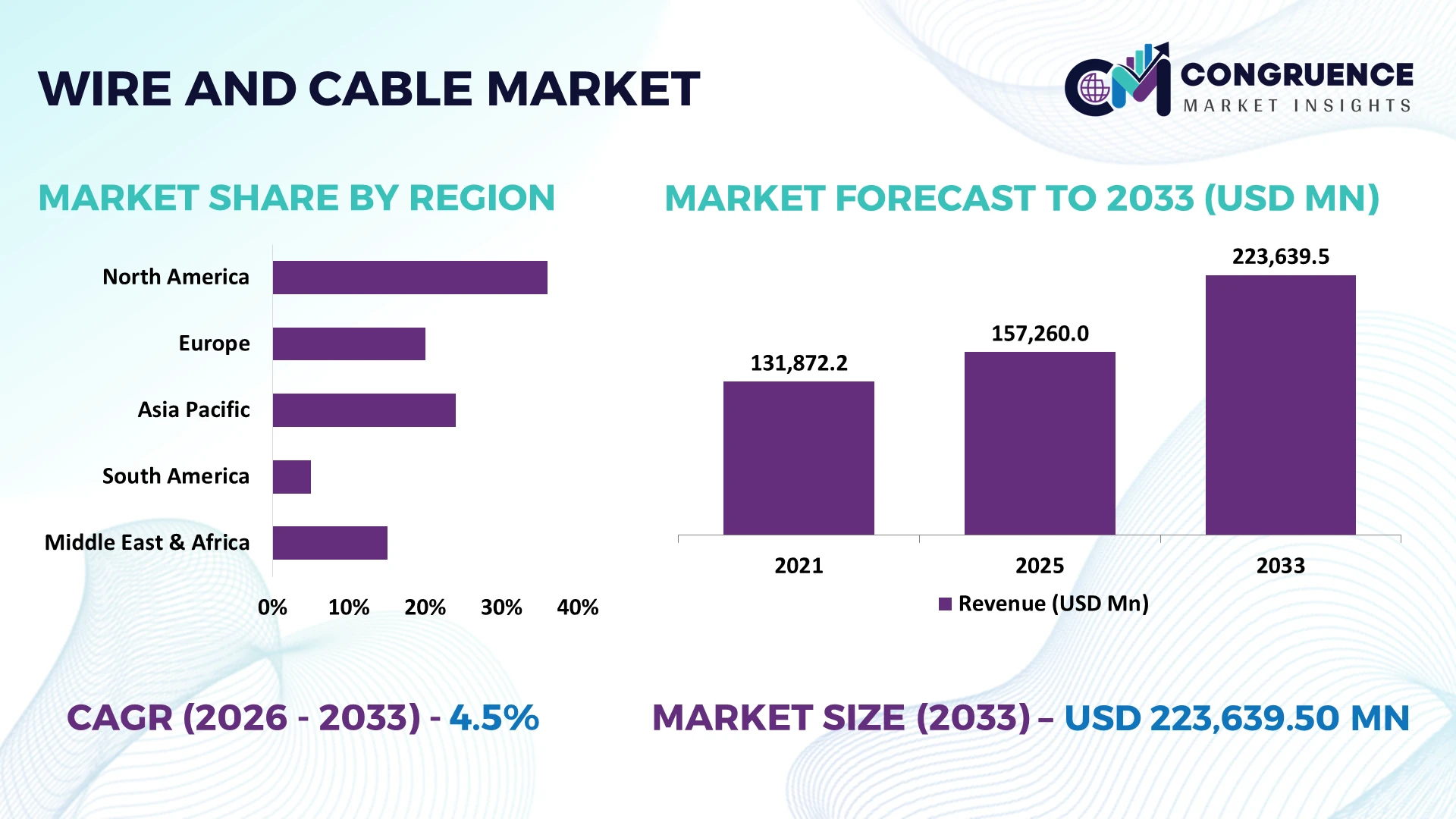
The Global Wire and Cable Market was valued at USD 157260 Million in 2025 and is anticipated to reach a value of USD 223639.5 Million by 2033 expanding at a CAGR of 4.5% between 2026 and 2033. Growth is being accelerated by grid modernization programs, high-voltage transmission expansion, electrified mobility infrastructure, renewable energy integration, and rapid data center construction requiring advanced power and fiber connectivity.
China remains the dominant manufacturing and consumption hub, accounting for approximately 38% of global wire and cable production capacity, supported by extensive power infrastructure, EV manufacturing, and industrial automation investments. India continues to outpace several mature markets with power transmission investments exceeding 50 GW of renewable grid integration projects, while the United States leads high-value specialty cable deployment for hyperscale data centers and defense applications. Ongoing supply-chain diversification following Red Sea shipping disruptions has further strengthened regional manufacturing strategies and localized sourcing decisions.
Manufacturers prioritizing regional production, advanced cable technologies, and resilient raw material procurement are positioned to secure long-term infrastructure and industrial contracts.
Market Size & Growth: USD 157260 Million in 2025, projected to reach USD 223639.5 Million by 2033 at a CAGR of 4.5%, supported by expanding power grids, renewable integration, and digital infrastructure.
Top Growth Drivers: Renewable installations contribute over 30% of new cable demand, data center expansion exceeds 18% annually, and EV charging infrastructure deployment grows by more than 25%.
Short-Term Forecast: By 2027, automated cable manufacturing improves production efficiency by nearly 15% while reducing material waste by approximately 10%.
Emerging Technologies: AI-enabled quality inspection, robotic production lines, advanced XLPE insulation, and high-density fiber solutions increase manufacturing precision by over 20%.
Regional Leaders: Asia-Pacific leads above USD 95 Billion, North America exceeds USD 45 Billion, and Europe approaches USD 42 Billion, driven by grid upgrades, offshore wind, and digital connectivity expansion.
Consumer/End-User Trends: More than 55% of utility and industrial projects specify high-performance, low-loss, and fire-resistant cable systems for critical infrastructure.
Pilot/Case Example: In 2026, a smart manufacturing cable facility achieved approximately 18% lower production downtime through AI-based predictive maintenance and automated inspection.
Competitive Landscape: The top five manufacturers collectively account for roughly 35% of global market activity, supported by diversified portfolios, regional manufacturing, and advanced technology capabilities.
Regulatory & ESG Impact: Low-carbon manufacturing initiatives reduce production-related emissions by nearly 20%, while stricter building and energy standards accelerate premium cable adoption.
Investment & Funding: More than USD 12 Billion in manufacturing expansion, localization, and capacity upgrades supports supply-chain resilience amid ongoing regional realignment.
Innovation & Future Outlook: High-voltage DC cables, recyclable insulation materials, and digital monitoring systems strengthen next-generation infrastructure while supporting resilient global network expansion.
Rapid electrification, renewable power transmission, hyperscale data centers, industrial automation, and electric mobility continue to reshape the Wire and Cable Market. Advanced fire-resistant materials, high-voltage DC cable systems, and AI-enabled quality inspection are improving operational reliability, with automated production raising manufacturing efficiency by nearly 15%. Continued regional manufacturing expansion and stricter infrastructure standards reinforce supply-chain resilience, setting the foundation for the strategic market discussion.
The Wire and Cable Market has become strategically important as governments and industries prioritize grid modernization, electrification, digital infrastructure, and manufacturing resilience. Competition increasingly depends on localized production, secure raw material sourcing, and high-performance cable technologies rather than production scale alone. Supply-chain restructuring following global logistics disruptions has accelerated investment in regional manufacturing hubs, while stricter electrical safety and energy-efficiency regulations are driving faster replacement of aging transmission and distribution networks.
Advanced XLPE-insulated and digitally monitored cable systems deliver approximately 12% lower transmission losses and reduce maintenance requirements by nearly 18% compared with conventional insulation technologies, improving lifecycle operating efficiency. China continues to dominate large-scale manufacturing capacity, while Germany emphasizes high-value industrial automation and specialty cable innovation for advanced manufacturing. Over the next two to three years, smart monitoring deployment across utility networks is expected to exceed 40% of newly commissioned high-voltage projects, improving predictive maintenance and network reliability.
Utilities are increasingly deploying fiber-integrated power cables for smart grid expansion, enabling faster fault detection and improved operational visibility. Leading manufacturers are expanding production facilities, strengthening copper and aluminum sourcing partnerships, and investing in recyclable insulation technologies to improve supply security and regulatory compliance. Companies combining advanced manufacturing with localized supply ecosystems will strengthen competitive positioning and secure long-term infrastructure contracts.
Power grid expansion, renewable energy integration, and industrial electrification remain the strongest structural growth catalysts for the Wire and Cable Market. More than 60% of newly commissioned utility transmission projects incorporate high-performance cable systems, while factory automation investments improve electrical infrastructure utilization by approximately 20%. India's nationwide transmission expansion and the United States' accelerated grid resilience programs continue to increase demand for high-voltage and specialty cables. These developments improve network reliability and support large-scale electrification projects. Manufacturers are responding by expanding domestic production capacity, investing in advanced extrusion technologies, and forming strategic partnerships with utilities to secure long-term supply agreements. Companies capable of delivering customized, standards-compliant cable solutions gain stronger positioning in infrastructure procurement cycles.
Copper and aluminum price fluctuations continue to pressure production economics, with raw materials representing nearly 65% of total cable manufacturing costs. Procurement costs can fluctuate by more than 15% during periods of supply disruption, directly affecting contract margins and project scheduling. Continued dependence on imported metals in several manufacturing countries exposes producers to logistics delays and geopolitical trade uncertainties. These constraints reduce pricing flexibility and complicate long-term infrastructure planning. Leading companies are mitigating risk through localized sourcing, multi-year procurement contracts, increased aluminum substitution where technically suitable, and recycling initiatives that improve material availability while reducing procurement exposure and operational uncertainty.
Digital infrastructure expansion is creating new opportunities for intelligent cable systems with embedded monitoring capabilities and advanced insulation materials. AI-enabled manufacturing improves quality inspection accuracy by approximately 25%, while predictive maintenance platforms reduce unexpected cable failures by nearly 20%. Japan and South Korea continue expanding high-performance cable deployment for semiconductor facilities, offshore energy, and smart manufacturing applications. Companies are accelerating research into recyclable insulation compounds, fiber-integrated power cables, and high-voltage DC transmission technologies to improve efficiency and sustainability. Strategic collaborations between utilities, equipment suppliers, and technology providers are creating integrated infrastructure ecosystems that deliver stronger lifecycle value beyond conventional cable manufacturing.
The transition toward digitally connected power infrastructure introduces execution challenges beyond manufacturing capacity. Smart cable monitoring systems require integration with utility control platforms, while qualified engineering talent remains limited, with technical workforce shortages exceeding 20% in several industrial economies. Large transmission projects also experience implementation delays averaging 10–15% because of permitting complexity and specialized installation requirements. These factors reduce deployment consistency and increase project management costs. Companies are investing in workforce development, digital engineering platforms, automated testing facilities, and collaborative partnerships with utilities and technology providers to standardize deployment practices. Organizations that successfully integrate digital capabilities with skilled technical execution will sustain long-term operational competitiveness and infrastructure reliability.
Smart Grid Cable Integration: Utilities are accelerating deployment of digitally monitored transmission networks, with smart cable monitoring adoption rising above 35% in new high-voltage projects and fault detection time improving by nearly 40%. Grid modernization regulations and aging infrastructure are driving this transition. Manufacturers are integrating embedded sensing technologies, expanding digital service partnerships, and standardizing predictive maintenance platforms to reduce outages and improve asset utilization.
Localized Manufacturing Expansion: Supply-chain diversification continues reshaping production strategies as more than 30% of large manufacturers expand regional manufacturing footprints to reduce logistics risk. Local sourcing initiatives have lowered delivery lead times by approximately 18% while improving inventory resilience. India and Mexico are attracting new cable production investments, prompting companies to restructure supplier networks, automate warehousing, and strengthen long-term procurement agreements for critical conductive materials.
Advanced Material Innovation: Cross-linked polyethylene insulation, recyclable compounds, and lightweight aluminum conductor technologies are replacing conventional materials, improving cable lifespan by around 20% and reducing installation weight by nearly 15%. Stricter energy-efficiency requirements and sustainability targets are accelerating adoption. Producers are increasing investment in advanced extrusion processes, material engineering, and collaborative development with utility operators to improve operational reliability and environmental performance.
Data Infrastructure Specialization: Fiber-rich connectivity projects and hyperscale computing facilities are increasing demand for specialized communication cables, with structured cabling installations expanding by approximately 25% and automated quality inspection improving manufacturing accuracy by over 20%. The shift toward AI-driven digital infrastructure requires higher transmission reliability. Companies are expanding specialty cable portfolios, strengthening enterprise partnerships, and deploying automated inspection systems to maintain quality consistency under rising production volumes.
Power Cables remain the leading segment, accounting for approximately 42% of overall demand because of their essential role in transmission networks, renewable energy integration, and industrial electrification. Their scalability, long operating life, and compatibility with high-voltage applications sustain broad deployment across utility projects. Fiber Optic Cables represent the fastest-growing category as digital infrastructure, hyperscale data centers, and 5G backhaul continue expanding, with deployment increasing by nearly 18% annually in several developed economies. Manufacturers are increasing investments in high-performance insulation, higher-capacity conductors, and specialty optical solutions to strengthen competitive differentiation.
Communication Cables continue supporting enterprise connectivity and broadband expansion, while Control Cables remain critical for factory automation and process industries requiring reliable signal transmission. Instrumentation Cables are strengthening their strategic role in energy facilities, petrochemical plants, and smart manufacturing environments where operational precision is essential. Companies are balancing mature power cable portfolios with higher-value specialty products, expanding manufacturing capabilities and technology partnerships to address evolving infrastructure priorities and improve long-term product mix.
Power Transmission & Distribution remains the dominant application, representing approximately 44% of total demand as utilities replace aging infrastructure and connect renewable generation assets. Large-scale transmission upgrades, substation modernization, and underground cabling projects continue concentrating procurement within this segment. Automotive is the fastest-growing application as electric vehicle production, charging infrastructure, and vehicle electronics increase demand for lightweight, heat-resistant, and high-voltage cable assemblies. Manufacturers are expanding specialized production lines and automation capabilities to support evolving vehicle architectures.
Telecommunications continues benefiting from fiber deployment and enterprise connectivity expansion, while Building & Construction maintains stable demand through commercial developments emphasizing fire-resistant wiring systems. Industrial Equipment applications are becoming increasingly sophisticated as robotics, digital factories, and automated production facilities require durable control and instrumentation cables. Companies are strengthening regional manufacturing, increasing customized product offerings, and integrating advanced testing technologies to support application-specific performance and compliance requirements across diverse industries.
Utilities remain the largest end-user group, accounting for approximately 40% of overall cable consumption because electricity transmission, distribution modernization, and renewable integration require extensive deployment of power and specialty cables. Automotive represents the fastest-growing end-user segment, supported by expanding electric vehicle manufacturing and higher electrical content per vehicle, with high-voltage cable demand increasing by nearly 20% across major production hubs. Suppliers are prioritizing customized solutions, localized manufacturing, and long-term framework agreements with utility operators and vehicle manufacturers.
Telecommunications continues expanding procurement for fiber-rich digital infrastructure, while Construction maintains consistent purchasing through commercial, residential, and public infrastructure projects. Industrial Manufacturing increasingly adopts advanced control and instrumentation cables to support automation, robotics, and process optimization. Companies are differentiating through application-specific engineering, lifecycle service offerings, and collaborative product development, enabling stronger customer retention while positioning portfolios toward high-value infrastructure and advanced manufacturing ecosystems.
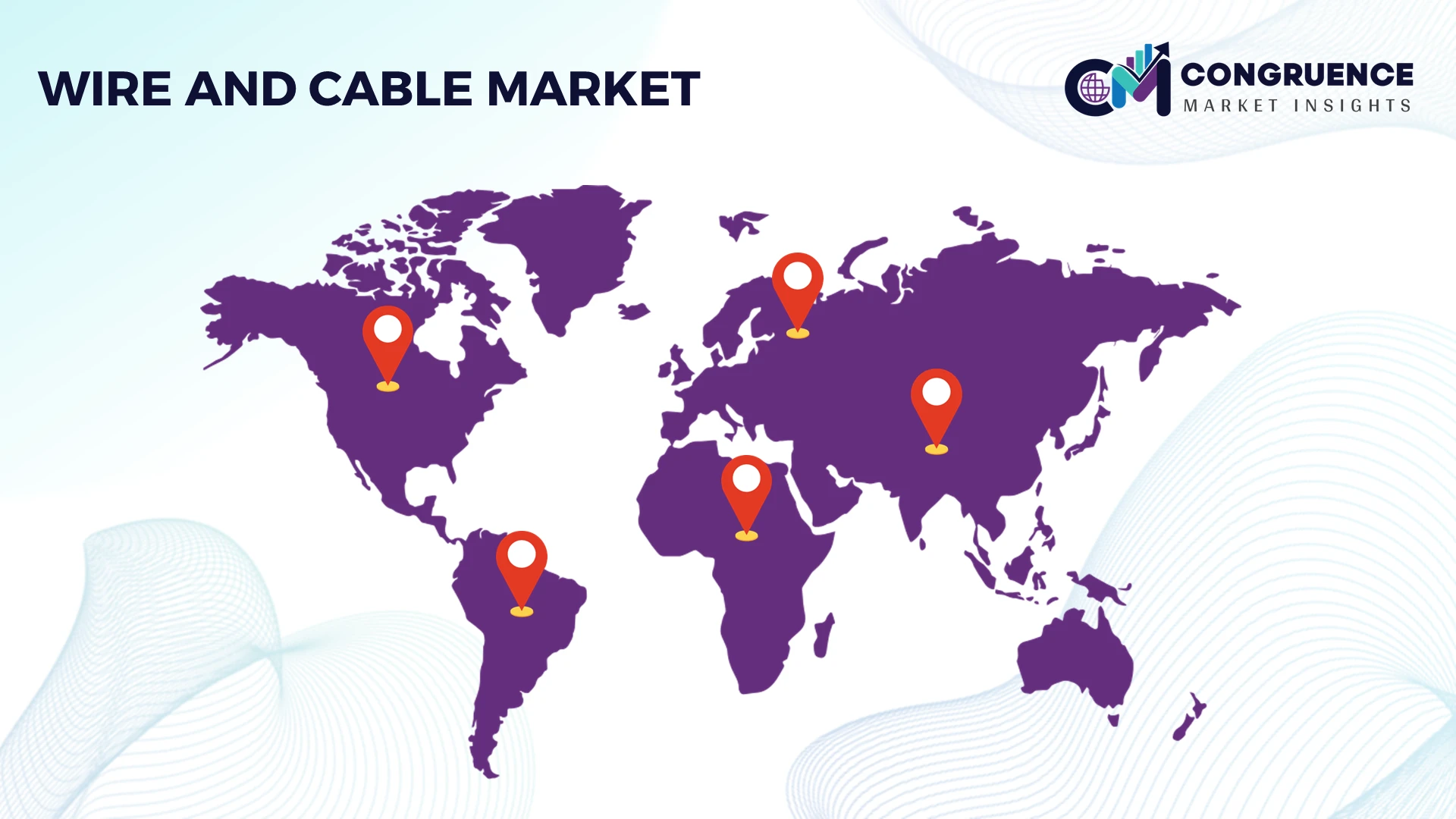
Asia-Pacific accounted for the largest market share at 47.8% in 2025 however, Middle East & Africa is expected to register the fastest growth, expanding at a 5.8% between 2026 and 2033.
Grid Resilience and Digital Infrastructure Expansion
North America maintains a strong position through extensive utility modernization, hyperscale data center construction, and advanced industrial electrification. The region represents approximately 23% of global market activity, supported by large-scale transmission upgrades and increasing deployment of underground power networks. Utilities continue replacing aging transmission assets with high-performance cable systems, while data center expansion drives specialty power and fiber cable demand. More than 40% of new utility transmission projects now incorporate digital monitoring capabilities, improving operational reliability and predictive maintenance. Manufacturers are expanding regional production capacity, strengthening domestic supply chains, and investing in automated manufacturing to improve delivery performance while meeting stricter technical specifications for critical infrastructure.
United States Market Outlook: The United States leads regional demand through nationwide grid modernization, semiconductor manufacturing expansion, and hyperscale cloud infrastructure development. More than 55% of regional high-voltage transmission investments are concentrated in the country, while domestic manufacturing incentives encourage localized cable production. Companies continue expanding advanced manufacturing facilities, strengthening utility partnerships, and increasing production of specialty power, communication, and fiber optic cables supporting strategic infrastructure projects.
Sustainable Infrastructure and Industrial Modernization
Europe accounts for nearly 22% of global demand, supported by renewable energy integration, offshore wind development, industrial automation, and stricter electrical safety standards. Underground transmission deployment continues expanding as utilities modernize aging networks while improving environmental resilience. Approximately 35% of new transmission projects include advanced high-voltage cable technologies designed to improve network efficiency and reduce maintenance requirements. Manufacturers are increasing investments in recyclable insulation materials, automated production systems, and localized supply chains to strengthen compliance with evolving sustainability requirements while improving operational flexibility across industrial sectors.
Germany Market Outlook: Germany remains Europe's strategic manufacturing center for advanced industrial cables, automation systems, and renewable energy infrastructure. The country's strong engineering ecosystem supports continuous innovation in specialty cable technologies used across automotive, machinery, and industrial manufacturing. More than 30% of industrial automation investments incorporate advanced control and instrumentation cable solutions, encouraging manufacturers to expand research partnerships and high-value production capabilities.
Manufacturing Scale and Infrastructure Leadership
Asia-Pacific dominates global production and deployment through unmatched manufacturing capacity, extensive electricity infrastructure development, and expanding industrial investment. The region contributes approximately 47.8% of global market demand while leading exports of power, communication, and fiber optic cable systems. Large-scale renewable energy integration, urban infrastructure expansion, and advanced manufacturing continue accelerating procurement across utility and industrial sectors. Production automation has improved manufacturing efficiency by nearly 18%, enabling suppliers to meet growing domestic and international demand. Companies continue expanding manufacturing facilities, increasing conductor processing capacity, and strengthening localized raw material supply networks to improve competitiveness.
China Market Outlook: China remains the world's largest manufacturing and consumption center for wire and cable products, supported by large-scale grid expansion, electric vehicle production, and industrial modernization. The country accounts for roughly 38% of global cable manufacturing capacity and continues investing in smart grid infrastructure and ultra-high-voltage transmission projects. Domestic producers are expanding advanced insulation technologies and export-oriented manufacturing while improving automation throughout production facilities.
Infrastructure Renewal Supports Industrial Demand
South America is strengthening its market position through electricity network expansion, mining investment, and modernization of transportation and industrial infrastructure. The region contributes approximately 5% of global demand, with Brazil accounting for the largest share of cable consumption. Utility modernization projects and renewable power integration continue supporting procurement of medium- and high-voltage cable systems. Manufacturing lead times have improved by nearly 12% through regional production investments, although logistics constraints and uneven infrastructure development remain operational challenges. Companies are increasing local manufacturing partnerships and strengthening distribution networks to improve project execution and reduce supply dependency.
Brazil Market Outlook: Brazil represents the region's largest operational market through extensive power transmission investment, industrial manufacturing, and renewable energy expansion. Growing electricity demand continues driving deployment of transmission and distribution cable systems across utility projects. Manufacturers are expanding regional production, improving localization strategies, and collaborating with infrastructure developers to support grid modernization while strengthening long-term domestic supply capabilities.
Energy Diversification and Infrastructure Investment
The Middle East & Africa is emerging as the fastest-expanding regional market due to large-scale utility modernization, urban development, renewable energy deployment, and industrial diversification initiatives. The region contributes approximately 7% of global demand while increasing investments in high-capacity transmission infrastructure and smart city developments. More than 25% of recently announced utility projects include advanced cable technologies designed for improved operational reliability and lower maintenance requirements. Companies are strengthening regional manufacturing partnerships, expanding logistics capabilities, and establishing localized distribution hubs to support infrastructure execution and reduce import dependence.
Saudi Arabia Market Outlook: Saudi Arabia leads regional investment through major power transmission projects, industrial diversification programs, and smart infrastructure initiatives. Continued expansion of utility networks, industrial cities, and renewable energy developments is increasing demand for high-performance cable systems. Manufacturers are establishing regional partnerships, expanding local assembly operations, and supplying advanced transmission solutions supporting long-term infrastructure transformation and domestic industrial development.
Global leaders including Prysmian Group, Nexans, Sumitomo Electric Industries, Furukawa Electric, and LS Cable & System compete directly against strong regional manufacturers through technology, manufacturing scale, and delivery capability. The top five players collectively control approximately 34% of market activity, while regional producers compete aggressively on localized supply, project responsiveness, and pricing. Competition increasingly centers on advanced insulation materials, high-voltage transmission solutions, and digital manufacturing, with automated production improving operating efficiency by nearly 18% and predictive quality systems reducing manufacturing defects by approximately 20%. Companies are expanding production facilities, strengthening raw material procurement, pursuing utility partnerships, and increasing vertical integration to secure conductor availability and shorten delivery cycles. Supply-chain resilience has become a decisive differentiator as infrastructure customers prioritize dependable sourcing over lowest cost. High capital requirements, technical certification, and utility qualification processes remain significant entry barriers. Winning requires advanced engineering capability, localized manufacturing, reliable procurement, and rapid customization for infrastructure and industrial applications.
Prysmian Group
Nexans
Sumitomo Electric Industries
Furukawa Electric Co., Ltd.
LS Cable & System
Southwire Company
Fujikura Ltd.
Leoni AG
Belden Inc.
Encore Wire Corporation
Hengtong Group
Jiangnan Group Limited
KEI Industries Limited
NKT A/S
Digital manufacturing, advanced cross-linked polyethylene (XLPE) insulation, and AI-based quality inspection define the current technology landscape across the Wire and Cable Market. Automated vision systems improve defect detection accuracy by approximately 22%, while smart extrusion controls reduce material waste by nearly 12%. More than 45% of newly commissioned high-capacity production lines now integrate real-time process monitoring, enabling higher throughput and tighter quality consistency. These technologies strengthen operational efficiency, shorten production cycles, and improve compliance with increasingly demanding utility, industrial, and telecommunications specifications.
Emerging technologies are shifting focus toward fiber-integrated power cables, digital twins for production optimization, recyclable insulation compounds, and embedded cable monitoring sensors. Compared with conventional cable monitoring, intelligent sensing systems reduce fault localization time by approximately 35% while lowering maintenance interventions by nearly 18%. Adoption of digitally connected cable systems has exceeded 30% across newly commissioned smart grid projects. Manufacturers deploying AI-driven predictive maintenance and advanced material engineering achieve stronger production reliability, while suppliers serving renewable energy, hyperscale data centers, and high-voltage transmission projects gain a competitive advantage through higher-performance product portfolios.
Between 2026 and 2028, high-voltage DC cable technologies, automated conductor processing, and low-carbon material innovation will become strategic differentiators. Robotics-assisted manufacturing is expected to improve production efficiency by around 15%, while digital quality traceability will expand across more than 50% of premium manufacturing facilities. Companies investing early in intelligent manufacturing, recyclable materials, and integrated monitoring technologies will secure faster qualification for infrastructure projects, stronger supply-chain resilience, and greater competitiveness in high-value global contracts.
November 2024 Prysmian completed the acquisition and integration of Encore Wire following its $4.2 billion transaction, strengthening its North American manufacturing platform and lifting third-quarter adjusted EBITDA by 32%. Business impact: expanded U.S. market presence and production scale. Source: Reuters
November 2024 France's transmission operator RTE signed long-term agreements with Prysmian, Nexans, NKT, and Hellenic Cables covering approximately 5,200 km of underground power cables. Business impact: secured manufacturing capacity for strategic grid expansion projects.
June 2026 Nexans completed the acquisition of Republic Wire, strengthening its position in the U.S. low-voltage market and expanding manufacturing capabilities across North America. Business impact: broader industrial platform supporting infrastructure modernization and data center demand. Source: Nexans
July 2026 Prysmian announced a long-term agreement with Molex and plans to more than double U.S. fiber production capacity for hyperscale data centers. Business impact: accelerated optical cable supply expansion supporting AI infrastructure deployment. Source: Prysmian United Kingdom
The report provides comprehensive analysis across Power Cables, Communication Cables, Fiber Optic Cables, Control Cables, and Instrumentation Cables while evaluating demand across Power Transmission & Distribution, Telecommunications, Building & Construction, Industrial Equipment, and Automotive applications. It further assesses procurement trends among Utilities, Telecommunications, Construction, Industrial Manufacturing, and Automotive end-users. Regional evaluation spans North America, Europe, Asia-Pacific, South America, and the Middle East & Africa, supported by operational benchmarking, deployment patterns, technology adoption, and competitive positioning across leading manufacturers.
The assessment incorporates manufacturing automation, smart cable monitoring, advanced insulation technologies, fiber integration, and sustainable material innovation while tracking deployment trends exceeding 45% for digitally enabled production facilities in premium manufacturing segments. Strategic insights support expansion planning, supply-chain optimization, partnership evaluation, product portfolio alignment, and competitive benchmarking between 2026 and 2033, helping stakeholders identify high-priority infrastructure investments, emerging application opportunities, regional manufacturing advantages, and technology-driven differentiation across evolving wire and cable value chains.
| Report Attribute/Metric | Report Details |
|---|---|
Market Revenue in 2025 | USD 157260 Million |
Market Revenue in 2033 | USD 223639.5 Million |
CAGR (2026 - 2033) | 4.5% |
Base Year | 2025 |
Forecast Period | 2026 - 2033 |
Historic Period | 2021 - 2025 |
Segments Covered | By Type
By Application
By End-User
|
Key Report Deliverable | Revenue Forecast, Growth Trends, Market Dynamics, Segmental Overview, Regional and Country-wise Analysis, Competition Landscape |
Region Covered | North America, Europe, Asia-Pacific, South America, Middle East, Africa |
Key Players Analyzed | Prysmian Group, Nexans, Sumitomo Electric Industries, Furukawa Electric Co., Ltd., LS Cable & System, Southwire Company, Fujikura Ltd., Leoni AG, Belden Inc., Encore Wire Corporation, Hengtong Group, Jiangnan Group Limited, KEI Industries Limited, NKT A/S |
Customization & Pricing | Available on Request (10% Customization is Free) |




