
Reports
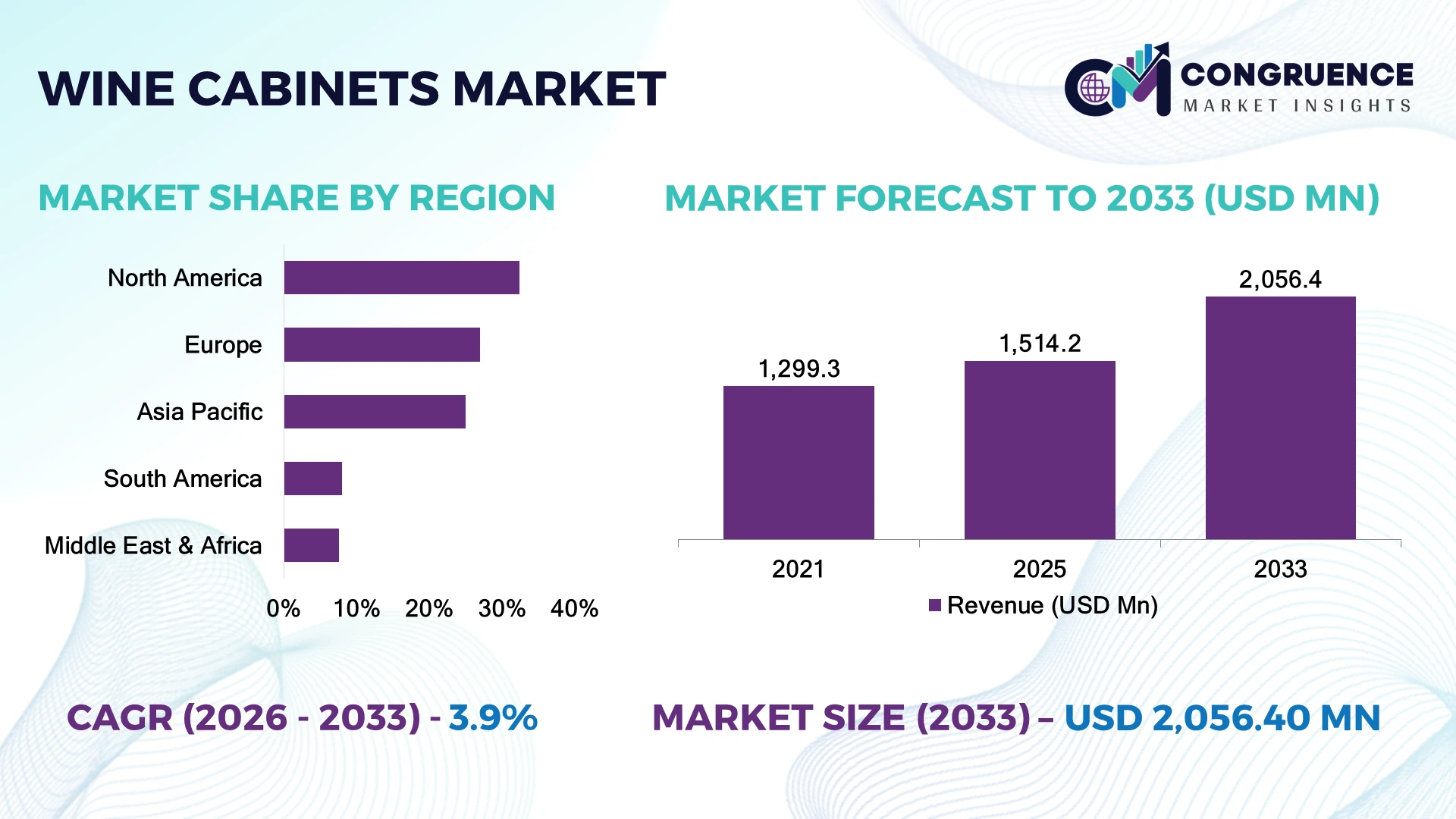
The Global Wine Cabinets Market was valued at USD 1,514.2 Million in 2025 and is anticipated to reach a value of USD 2,056.4 Million by 2033 expanding at a CAGR of 3.9% between 2026 and 2033. Growth is being driven by premium kitchen integration, multi-zone temperature control, smart monitoring, and replacement of basic wine coolers with purpose-built preservation systems.
The United States dominates wine cabinets, representing more than 25% of global demand, with over 600,000 annual unit shipments and strong premium-kitchen adoption; France accounts for 5.3% of residential wine cabinets, supported by established wine culture and hospitality installations. U.S.–China tariff changes introduced in 2025 are strengthening sourcing and inventory decisions, while app-enabled models already capture about 38% of U.S. buyers.
Strategic implication: manufacturers should prioritize energy-efficient connected cabinets, regional sourcing, and premium built-in formats to protect margins and accelerate channel penetration.
Market Size & Growth: USD 1,514.2 million in 2025 to USD 2,056.4 million by 2033 at 3.9% CAGR, driven by smart temperature control.
Top Growth Drivers: Premium residential upgrades 41%, smart adoption 38%, and hospitality modernization 32% are reshaping purchasing priorities.
Short-Term Forecast: By 2028, optimized compressors can reduce operating energy 10–15% while improving temperature consistency 15–20%.
Emerging Technologies: AI diagnostics, Wi-Fi monitoring, dual-zone compressors, low-GWP refrigerants, and vibration control are defining advanced cabinets.
Regional Leaders: North America approaches USD 850 million, Europe USD 450 million, and Asia-Pacific USD 400 million, with smart adoption accelerating.
Consumer/End-User Trends: Residential buyers represent 62% of smart-cellar demand, while Wi-Fi or app-enabled units capture 53% of connected sales.
Pilot/Case Example: 2025 European remodels recorded roughly 46% preference for integrated under-counter formats, strengthening space-efficient cabinet design.
Competitive Landscape: Sub-Zero leads the broader wine-cellar segment at about 2.7%, alongside EuroCave, Liebherr, Vinotemp, and U-Line.
Regulatory & ESG Impact: EU wine-storage appliances face a 172 EEI ceiling for transparent doors, accelerating efficient cooling and lower-impact refrigerants.
Investment & Funding: Manufacturers are investing in smart controls, low-GWP cooling, localized inventories, and connected after-sales service amid supply-chain volatility.
Innovation & Future Outlook: Dual-zone architectures, predictive maintenance, modular cabinetry, and cloud diagnostics are shifting competition toward efficiency and reliability.
The wine cabinets market is strengthening across premium residences, restaurants, hotels, and designer kitchens, with multi-zone and app-connected formats gaining traction. Connected models account for 53% of smart-cellar sales, while low-GWP cooling and quieter compressors improve usability. EU energy-efficiency reviews are tightening product design priorities, encouraging suppliers to localize components and upgrade electronics. This shift sets up the strategic discussion.
Wine cabinets are becoming strategically important as buyers increasingly evaluate preservation performance, kitchen integration, energy use, and connectivity together rather than treating storage as an accessory. The competitive shift favors brands combining refrigeration engineering with premium cabinetry and digital service. In 2025, U.S.–China tariff actions increased the value of diversified component sourcing and regional inventory planning.
Technology creates a measurable operating advantage. Modern variable-speed compressor systems can deliver roughly 10–15% lower energy use than fixed-output designs, while app-based monitoring reduces manual temperature checks and supports faster service intervention. North America remains larger in scale, while Europe places greater emphasis on energy efficiency, built-in aesthetics, and low-GWP refrigerants; Asia-Pacific is expanding through compact, dual-zone formats suited to urban housing.
Over the next 2–3 years, manufacturers should prioritize 40–150-bottle modular platforms, remote diagnostics, quieter cooling, and cabinet-ready dimensions. A practical deployment model is centralized monitoring across hospitality properties, where one platform flags temperature deviations before inventory is exposed. Partnerships with kitchen designers, appliance distributors, and refrigeration specialists will strengthen market access. Competitive positioning will increasingly depend on measurable energy performance, installation flexibility, service responsiveness, and dependable supply rather than bottle capacity alone.
Premium kitchen renovation and hospitality refurbishment are shifting wine storage from standalone cooling appliances toward built-in, multi-zone cabinets. Connected formats already represent about 53% of smart-cellar sales, while residential applications account for approximately 62% of demand. In the United States, premium kitchen integration is strengthening demand for 40–150-bottle configurations, particularly where dedicated cellar space is limited. EU energy-efficiency requirements are also accelerating compressor and refrigerant upgrades. Manufacturers are responding with variable-speed cooling, quieter compressors, app-based monitoring, and cabinet-ready dimensions. The non-obvious advantage is higher replacement value: connected cabinets create recurring service opportunities through diagnostics and maintenance rather than relying solely on new-unit sales.
Wine cabinet profitability remains exposed to refrigeration-component, electronics, and specialty-glass costs, with compressors and cooling assemblies representing roughly 30–40% of manufacturing cost in premium configurations. Imported components can add 8–15% to landed costs when freight or tariff conditions deteriorate, while specialized insulated glass can increase cabinet cost by 10–20%. U.S.–China trade measures introduced during 2025 have reinforced the need for diversified sourcing. Companies are responding through dual-supplier contracts, localized assembly, standardized compressor platforms, and regional safety-stock policies. A key operational constraint is that excessive SKU customization reduces purchasing leverage and increases spare-parts complexity; manufacturers therefore gain margin protection by standardizing internal cooling architectures while differentiating cabinetry and controls.
The strongest untapped opportunity lies in converting wine cabinets into connected cellar-management platforms rather than standalone appliances. App-enabled models already represent about 53% of smart-cellar sales, while remote temperature monitoring can reduce manual inspection activity by roughly 20%. Hotels, restaurants, collectors, and premium residential developers can use centralized alerts, inventory tracking, and predictive maintenance across multiple cabinets. Between 2026 and 2028, AI-assisted anomaly detection and lower-GWP refrigeration will strengthen this proposition as manufacturers upgrade control electronics. Companies can capture additional value through partnerships with kitchen designers, hospitality technology integrators, and premium appliance distributors. The strategic opportunity is particularly strong in India, the UAE, and Southeast Asian cities, where compact multi-zone storage fits space-constrained premium developments.
Connected wine cabinets introduce execution requirements that conventional refrigeration products largely avoided. Wi-Fi-enabled models require secure firmware management, reliable mobile applications, and interoperability across changing smart-home ecosystems, while electronic controls can increase component count by approximately 15–25%. Remote diagnostics also depend on stable connectivity, creating deployment inconsistencies in hospitality properties and secondary urban markets. Europe’s evolving refrigerant and energy-efficiency requirements add another engineering layer, particularly for manufacturers selling across multiple regulatory regimes. Companies must therefore invest in modular control architectures, cybersecurity testing, firmware support, and trained service networks. The non-obvious challenge is lifecycle support: a cabinet can remain mechanically functional for more than a decade while its connected electronics become obsolete much earlier, increasing warranty and replacement exposure.
Smart Monitoring Moves Mainstream: App-connected wine cabinets now represent roughly 53% of smart-cellar sales, with temperature alerts, humidity tracking, and remote diagnostics becoming standard premium features. Manufacturers are integrating cloud connectivity directly into control boards, reducing manual checks by about 20% and creating new after-sales service opportunities for hospitality operators and high-value residential users.
Dual-Zone Formats Gain Ground: Multi-zone cabinets are gaining preference where consumers store red and white wines at different temperatures, with dual-zone configurations accounting for approximately 45% of premium built-in purchases. U.S. kitchen remodelers increasingly specify under-counter formats, pushing manufacturers toward quieter compressors, thinner insulation profiles, and more flexible 40–150-bottle configurations.
Refrigerant Engineering Is Changing: European efficiency requirements are accelerating transitions toward lower-GWP refrigerants and variable-speed compressors. Advanced systems can reduce electricity consumption by approximately 10–15% versus conventional fixed-output cooling. Manufacturers are redesigning refrigeration modules around standardized platforms, helping simplify compliance, procurement, and servicing across multiple cabinet sizes.
Premium Hospitality Deployments Expand: Hotels and restaurants are increasingly installing distributed wine cabinets instead of relying exclusively on centralized cellars, improving access while reducing temperature exposure during service. Commercial installations can involve 10–30 cabinets per property, prompting suppliers to develop centralized monitoring, preventive-maintenance programs, and faster replacement-part logistics for multi-site hospitality operators.
Freestanding wine cabinets account for approximately 55–60% of global demand, supported by installation flexibility, retrofit compatibility, and lower deployment complexity across residential and hospitality settings. Their established position is strongest in the United States, where homeowners and restaurants can add controlled storage without modifying cabinetry. Built-in and integrated formats represent roughly 30–35% of demand and are gaining share as premium kitchen projects prioritize seamless appliance integration. Walk-in cellar systems remain a specialist category serving luxury hospitality, wineries, and high-volume collectors requiring centralized climate control.
Integrated and under-counter cabinets represent the fastest-growing product shift, supported by space-efficient urban housing and premium kitchen remodeling. These formats can command 10–20% higher selling prices than basic freestanding models while supporting dual-zone cooling, low-vibration operation, and connected monitoring. Manufacturers are expanding modular dimensions, front-ventilation designs, and smart controls. Investment is therefore shifting from basic storage capacity toward integration, energy efficiency, and differentiated user experience.
Industry analysis indicates freestanding configurations held approximately 60.8% of the smart wine cellar segment in 2025, while commercial walk-in systems are gaining adoption through scalable storage and centralized climate control.
Residential applications account for approximately 60–65% of global wine cabinet demand, driven by premium kitchen renovations, collectors, and households seeking dedicated temperature-controlled storage. Integrated residential installations are gaining share as homeowners prioritize space efficiency and coordinated cabinetry. Restaurants represent approximately 15–20% of demand, followed by hotels at around 10–15%, while pubs, bars, and other commercial venues comprise the remaining share. Residential purchasing remains fragmented and design-oriented, whereas commercial buyers emphasize durability, capacity, temperature zoning, and serviceability.
Restaurants and hotels represent the fastest-growing high-value application group as beverage programs increasingly require reliable preservation and accessible wine presentation. U.S. restaurants are incorporating display-oriented cabinets closer to service areas, while luxury hotels increasingly combine centralized cellars with distributed cabinet installations. Companies are responding with higher-capacity units, remote monitoring, commercial-grade components, and service contracts. The strategic implication is that residential applications sustain volume, while hospitality projects generate larger multi-unit orders and stronger recurring service opportunities.
A 2025 study based on real restaurant sales data found that the presence of a sommelier increased wine sales by 11.5%, reinforcing the commercial value of professional wine presentation and controlled service environments.
Households represent approximately 62% of global wine cabinet demand, supported by premium residential remodeling, wine collecting, and demand for controlled storage without dedicated cellar construction. Restaurants account for approximately 16–18%, hotels around 10–12%, while pubs, bars, and other commercial users represent the balance. Household buyers generally favor 40–150-bottle capacities, dual-zone temperature control, quiet operation, and cabinetry integration. Commercial buyers prioritize continuous operation, higher storage density, service accessibility, and standardized equipment, creating distinct purchasing requirements.
Hotels and restaurants form the fastest-growing high-value end-user group, particularly in premium hospitality markets where wine programs require consistent storage and presentation. Multi-unit hospitality installations can involve 10–30 cabinets per property, increasing demand for centralized monitoring and maintenance support. Manufacturers are targeting these customers through hospitality distributors, interior-design partnerships, leasing arrangements, and customized capacity configurations. This shift raises the strategic value of institutional accounts because one hospitality contract can generate substantially higher equipment volume and recurring service requirements than individual household purchases.
A 2025 commercial real-estate transaction involving an 8,000-square-foot climate-controlled wine-storage facility in Washington, D.C. demonstrates continued investment in specialized infrastructure serving collectors and restaurant customers.
North America accounted for the largest market share at 32.4% in 2025 however, Asia-Pacific is expected to register the fastest growth, expanding at a CAGR of 5.1% between 2026 and 2033.

Premium kitchen integration and connected storage are reshaping replacement demand
North America represents approximately 32.4% of global wine cabinets demand, led by the United States, where premium residential remodeling, restaurant wine programs, and luxury hospitality create concentrated demand for 40–150-bottle configurations. Built-in and dual-zone systems are gaining traction as kitchen designers increasingly specify appliances that integrate with custom cabinetry. Connected cabinets account for roughly 53% of smart-cellar purchases, strengthening demand for remote temperature alerts and predictive service. U.S. hospitality operators are also shifting toward distributed cabinet installations near service areas rather than relying entirely on centralized cellars. Manufacturers are responding through regional inventory expansion, quieter variable-speed compressors, and partnerships with kitchen-design and appliance distribution networks. The strategic advantage increasingly lies in combining refrigeration performance with seamless installation and responsive after-sales support.
United States Market Outlook: The United States remains the primary North American demand center, supported by premium kitchen renovation, wine collecting, and an extensive restaurant and hotel infrastructure. More than 600,000 wine-storage units are estimated to move annually across residential and commercial channels, with smart controls increasingly incorporated into premium configurations. Manufacturers are prioritizing U.S. distribution coverage, replacement parts, and designer partnerships.
Energy efficiency and premium built-in design are driving product modernization
Europe represents approximately 27% of global wine cabinets demand, with France, Germany, Italy, the United Kingdom, and Spain forming the principal consumption centers. Established wine culture supports dedicated residential storage, while luxury hospitality maintains demand for higher-capacity commercial installations. EU energy-efficiency and refrigerant requirements are accelerating adoption of variable-speed compressors, improved insulation, and lower-GWP cooling systems. Advanced configurations can reduce electricity consumption by approximately 10–15% compared with conventional fixed-output systems. Manufacturers are redesigning refrigeration modules around standardized platforms to simplify compliance and servicing across multiple cabinet sizes. Premium built-in formats are gaining particular relevance as European renovation projects increasingly integrate wine storage directly into fitted kitchens and hospitality interiors.
France Market Outlook: France combines strong wine-consumption culture with established hospitality and culinary infrastructure, creating sustained demand for temperature-controlled storage. Residential collectors increasingly favor compact multi-zone cabinets, while restaurants and hotels require higher-capacity systems with dependable temperature stability. Premium installations commonly prioritize low-vibration cooling and precise zoning, giving manufacturers opportunities to differentiate through refrigeration engineering, cabinetry integration, and energy-efficient product architectures.
Urban premium housing and manufacturing scale are expanding connected cabinet adoption
Asia-Pacific represents approximately 25% of global wine cabinets demand and has the strongest combination of manufacturing capacity and emerging consumer demand. China, Japan, South Korea, Australia, and India are the principal markets, with premium residential developments and luxury hospitality driving adoption. Urban apartments favor compact under-counter and dual-zone cabinets because dedicated cellar space is limited. Connected models are gaining traction, particularly among younger premium-appliance buyers, while Chinese manufacturing capabilities support cost-efficient electronics, compressors, and cabinet components. Manufacturers are increasing localized sourcing and distributor partnerships to shorten lead times by approximately 10–15%. The region also benefits from expanding premium appliance retail networks, allowing global brands and domestic manufacturers to scale beyond specialist wine retailers.
China Market Outlook: China is the region’s largest manufacturing and premium-appliance market, combining extensive electronics supply chains with growing demand from luxury residences, restaurants, hotels, and high-end property developments. Domestic component availability supports competitive cabinet production and faster product customization. Manufacturers are increasingly integrating Wi-Fi controls, touchscreen interfaces, and multi-zone cooling, while premium urban projects provide concentrated opportunities for built-in wine-storage installations.
Wine-producing economies are strengthening premium storage and hospitality demand
South America accounts for approximately 8% of global wine cabinets demand, with Brazil and Argentina representing the principal commercial centers and Chile providing an important wine-industry demand base. Wine production, tourism, restaurants, and premium residential development create a differentiated customer base compared with appliance-led markets elsewhere. Brazil's large urban centers support demand for compact residential cabinets, while Argentina and Chile generate specialist requirements from wineries, tasting rooms, hotels, and restaurants. Imported refrigeration components remain an operational constraint, with logistics and currency volatility capable of adding 10–15% to landed equipment costs. Companies are therefore increasing distributor inventories, regional service partnerships, and standardized product configurations to reduce replacement-part complexity and improve delivery reliability.
Brazil Market Outlook: Brazil is the largest consumption center in South America because of its population scale, developed hospitality sector, and concentration of premium residential construction in São Paulo and Rio de Janeiro. Demand is strongest for compact freestanding and built-in cabinets, while upscale restaurants increasingly use display-oriented units. Manufacturers with local distributors and readily available service components gain an advantage where imported equipment faces longer replenishment cycles.
Luxury hospitality investment is creating high-value demand for specialized storage
Middle East & Africa represents approximately 7.6% of global wine cabinets demand, with the UAE and Saudi Arabia serving as the most significant premium hospitality and luxury-residential markets. Dubai and Riyadh are adding hotels, restaurants, branded residences, and high-end entertainment facilities that require controlled beverage storage integrated into professionally designed interiors. Multi-property hospitality groups increasingly favor remote monitoring and centralized maintenance because cabinet fleets can span numerous outlets. High ambient temperatures also place greater emphasis on compressor capacity, insulation, and heat-rejection performance. Manufacturers are responding through regional distributors, technical service partnerships, and climate-optimized configurations. The non-obvious opportunity is concentrated institutional procurement: a single luxury hospitality project can require dozens of cabinets, creating substantially higher order values than fragmented household sales.
United Arab Emirates Market Outlook: The UAE leads regional premium adoption through Dubai's dense concentration of luxury hotels, restaurants, branded residences, and high-end retail. Hospitality developments commonly require multiple temperature-controlled units distributed across restaurants, suites, lounges, and service areas. Suppliers are emphasizing high-ambient operating capability, remote monitoring, and rapid local service, while designer and hospitality-contractor partnerships provide an efficient route into large project specifications.
Sub-Zero, EuroCave, Liebherr, Vinotemp, and U-Line compete across premium preservation, integrated kitchen storage, and mainstream specialty appliances. The top five collectively account for approximately 10.7% of global sales, indicating a fragmented structure. Competition centers on technology, design, channel reach, and price: smart features influence about 38% of premium purchases, while dual-zone systems account for roughly 45% of premium configurations; energy-efficient cooling can cut consumption 10–15%. EuroCave and Sub-Zero emphasize specialist preservation and designer integration; Liebherr competes through refrigeration engineering, while Vinotemp and U-Line target broader price points. Players are expanding built-in portfolios, strengthening dealer networks, and integrating connected monitoring. The competitive shift is toward AI-enabled inventory management, low-GWP refrigeration, and modular cabinetry rather than storage capacity alone. Entry barriers include compressor engineering, premium distribution, service infrastructure, and brand trust. Winning requires reliable temperature control, seamless installation, connected functionality, and efficient supply chains that convert technical differentiation into measurable ownership value.
Sub-Zero Group, Inc.
EuroCave
Liebherr Group
Vinotemp International
U-Line Corporation
Haier Smart Home Co., Ltd.
Miele & Cie. KG
Bosch Home Appliances
Perlick Corporation
Hoshizaki Corporation
Smeg S.p.A.
Marvel Refrigeration
Current wine cabinet technology is shifting from fixed-speed cooling and manual inventory tracking toward variable-speed compressors, connected sensors, and app-based controls. Variable-speed systems can reduce energy consumption by 10–15%, while sensor-based temperature monitoring can cut manual inspection activity by about 20%. Connected models now represent roughly 53% of smart-cellar sales, giving premium brands a stronger service and differentiation platform.
Emerging systems combine dual-zone control, low-GWP refrigerants, UV-resistant glazing, humidity management, and predictive diagnostics. Compared with conventional fixed-output cooling, modern variable-speed architectures improve temperature stability by approximately 15–20% while reducing energy demand. Standardized refrigeration modules also simplify maintenance and component procurement. Premium manufacturers benefit most because these technologies support higher-value built-in installations, hospitality contracts, and longer service relationships.
Between 2026 and 2028, AI-enabled bottle recognition, automated inventory mapping, and cloud-connected diagnostics will push wine cabinets toward intelligent cellar management. Samsung’s AI Wine Manager demonstrates this direction through camera-based label recognition and shelf-location tracking. Manufacturers integrating AI with efficient refrigeration can differentiate beyond bottle capacity, while specialist brands can protect margins through preservation expertise and design integration. The competitive priority is now measurable operating efficiency, connected functionality, and modular product platforms that scale across residential and hospitality deployments and premium service ecosystems.
December 2025 Samsung announced its Bespoke AI Wine Cellar for CES 2026, using AI Vision and cameras to recognize labels and track shelf locations. The development expands wine inventory automation, positioning connected cellar management as an appliance differentiator. Source: news.samsung.com (Samsung Global Newsroom)
March 2025 Liebherr introduced three freestanding Vinidor and Vinidor Selection wine refrigerators with two or three independently controlled zones, covering 41–68°F. The launch strengthens multi-zone preservation and premium kitchen positioning, giving commercial dealers expanded configuration options for premium installations. Source: liebherr.com (Liebherr)
May 2025 Miele introduced the KWTUS 7054 F built-under wine conditioning unit with 44-bottle capacity, FlexiFrame, ActiveHumidity, and UV-resistant glass. Its 36 dB operating level strengthens compact premium integration and quiet-storage positioning for residential kitchens and hospitality projects. Source: digitec.ch (Digitec)
September 2025 Perlick’s G5 Luxe wine reserve specification introduced RAPIDcool technology, R600a refrigerant, and triple-pane Low-E glass in a 24-inch format. The configuration combines faster cooling, lower-impact refrigeration, and custom cabinetry integration for premium indoor and outdoor installations. Source: perlick.com
The Wine Cabinets Market Report covers freestanding, built-in, and integrated cabinets across residential and commercial applications, with detailed assessment of households, restaurants, hotels, wineries, pubs, bars, and specialist hospitality users. Analysis spans North America, Europe, Asia-Pacific, South America, and Middle East & Africa, with country-level evaluation of demand concentration, premium appliance adoption, distribution structures, and emerging wine-storage hubs.
The report evaluates single- and dual-zone architectures, connected monitoring, AI-enabled inventory recognition, variable-speed compressors, low-GWP refrigerants, UV protection, humidity control, and modular cabinetry. Smart-cellar adoption is approximately 53%, while residential demand represents about 62% of the market. Competitive assessment covers global appliance manufacturers and wine-storage specialists, supporting investment planning, market-entry decisions, product portfolio expansion, channel partnerships, pricing strategy, technology prioritization, and competitive positioning through 2026–2033.
| Report Attribute/Metric | Report Details |
|---|---|
|
Market Revenue in 2025 |
USD 1,514.2 Million |
|
Market Revenue in 2033 |
USD 2,056.4 Million |
|
CAGR (2026 - 2033) |
3.9% |
|
Base Year |
2025 |
|
Forecast Period |
2026 - 2033 |
|
Historic Period |
2021 - 2025 |
|
Segments Covered |
By Type
By Application
By End-User
Companies Profiled
|
|
Key Report Deliverable |
Revenue Forecast, Growth Trends, Market Dynamics, Segmental Overview, Regional and Country-wise Analysis, Competition Landscape |
|
Region Covered |
North America, Europe, Asia-Pacific, South America, Middle East, Africa |
|
Key Players Analyzed |
Sub-Zero Group, Inc., EuroCave, Liebherr Group, Vinotemp International, U-Line Corporation, Haier Smart Home Co., Ltd., Miele & Cie. KG, Bosch Home Appliances, Perlick Corporation, Hoshizaki Corporation, Smeg S.p.A., Marvel Refrigeration |
|
Customization & Pricing |
Available on Request (10% Customization is Free) |




