
Reports
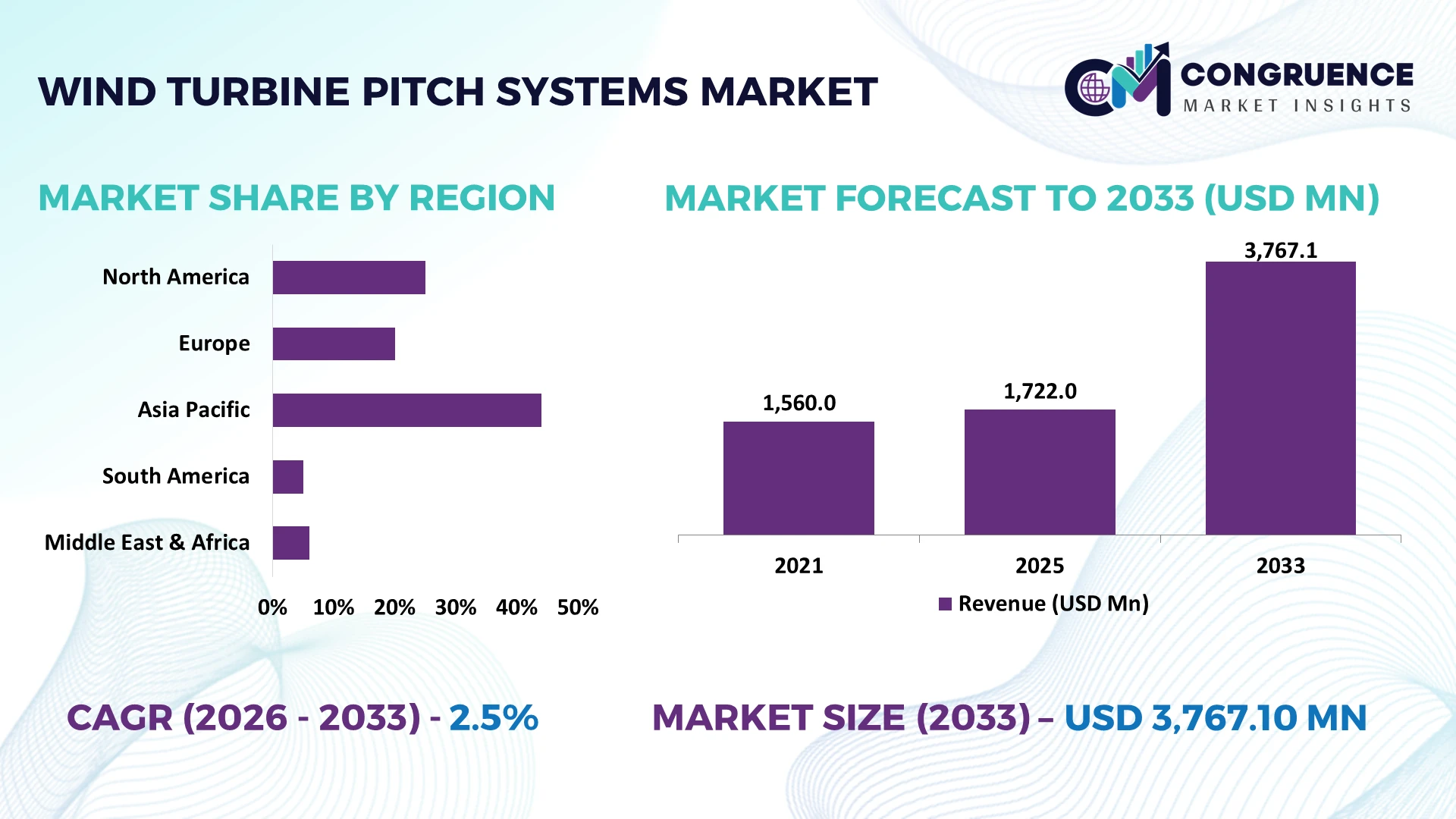
The Global Wind Turbine Pitch Systems Market was valued at USD 1722 Million in 2025 and is anticipated to reach a value of USD 3767.1 Million by 2033 expanding at a CAGR of 2.5% between 2026 and 2033. Growth is driven by utility-scale wind turbine installations, larger rotor diameters, offshore turbine modernization, and adoption of intelligent electric pitch control systems.
China dominates global wind turbine deployment, supported by domestic turbine manufacturing, extensive component supply chains, and large-scale renewable energy investments. The country installed approximately 80 GW of new wind capacity in 2024, accounting for more than 65% of global additions. Chinese manufacturers, including Goldwind and Envision Energy, integrate advanced pitch controllers, electric actuators, and blade load management technologies into utility-scale turbines. Compared with Germany, where wind installations emphasize repowering and grid integration, China benefits from higher production volumes and localized component manufacturing under its national renewable energy expansion programs.
Strategically, pitch system suppliers prioritizing high-reliability actuators, predictive maintenance capabilities, and compatibility with larger turbine platforms are positioned to secure long-term equipment and aftermarket contracts.
Market Size & Growth: Valued at USD 1722 Million in 2025, projected to USD 3767.1 Million by 2033 at 2.5% CAGR, driven by global wind capacity additions and pitch system electrification .
Top Growth Drivers: Electric pitch system adoption reaching 65–70% of new installations by 2035, offshore wind reliability requirements, and aftermarket retrofit demand from aging turbine fleets .
Short-Term Forecast: By 2027, electric pitch drives expand share as hydraulic systems are phased out in onshore designs, reducing maintenance requirements and eliminating hydraulic fluid leak risks .
Emerging Technologies: Individual pitch control reducing fatigue loads by 10–20% and extreme loads by 5–10%, condition-monitoring integration for predictive maintenance, and magnet-free motor designs reducing rare-earth dependency .
Regional Leaders: China at 67% of global installations and 130 GW new capacity, Europe at 12.3% of global installations with 94.5% domestic supplier share, and North America at 14.8% regional market share .
Consumer/End-User Trends: Onshore installations command 86.4% of pitch and yaw drive market share; the 1000W–3000W capacity segment grows at 9% CAGR through 2035 for repowering applications .
Pilot/Case Example: KEBA and Richardson Electronics partnership (July 2025) delivers TÜV-certified pitch systems across North America, integrating Pitch Energy Modules to reduce material input and lower operating costs .
Competitive Landscape: Vestas leads cumulative installations exceeding 200 GW; Siemens Gamesa, GE Vernova, Goldwind, and Envision compete across electric and hydraulic pitch platforms .
Regulatory & ESG Impact: IEC 61400 certification standards and grid code compliance govern pitch system qualification; EPR and WEEE directives influence design for recyclability of rare-earth magnets and electronics .
Investment & Funding: Strategic partnerships between pitch system suppliers and turbine OEMs secure long-term supply agreements; KEBA-Richardson collaboration exemplifies channel expansion into North America .
Innovation & Future Outlook: Electric pitch drives capture majority share as hydraulic systems decline; aftermarket retrofit segment forecast to reach USD 1.5–2.0 billion by 2035 .
The Wind Turbine Pitch Systems Market is evolving through advanced blade angle regulation, electric actuator integration, and condition-based maintenance across onshore and offshore wind farms. Larger rotor diameters increase mechanical loading on pitch bearings, motors, and control assemblies, strengthening demand for precise individual blade adjustment. Research on LiDAR-assisted pitch control has demonstrated up to 12% additional improvement in selected load-control performance measures compared with collective feedforward control. Meanwhile, turbine manufacturers are standardizing pitch interfaces to support platform scalability and component interchangeability. These developments place actuator reliability, control responsiveness, and lifecycle maintenance economics at the center of future competitive strategies.
Wind turbine pitch systems are becoming strategically important as turbine manufacturers pursue larger rotor diameters, improved blade-load management, and lower lifecycle maintenance costs. Increasing offshore turbine ratings are shifting procurement toward high-torque electric actuators, redundant safety controls, and digitally monitored pitch bearings. The transition from scheduled servicing to condition-based maintenance is also restructuring aftermarket contracts. Suppliers combining pitch drives, embedded controllers, and diagnostic software gain stronger positions in turbine platform development, where component reliability directly influences availability and operating expenditure.
Advanced individual pitch control adjusts all three blades independently, unlike conventional collective pitch systems that apply identical commands. Research demonstrates approximately 10–20% reductions in selected cyclic blade loads under suitable operating conditions, improving fatigue management. China leads large-scale turbine manufacturing, while Denmark and Germany emphasize sophisticated control algorithms and offshore equipment reliability. Between 2026 and 2028, manufacturers are expected to expand sensor-integrated actuators, automated fault detection, and standardized control interfaces to support increasingly complex turbine architectures.
Offshore installations provide a practical example: 15 MW-class turbines require coordinated pitch regulation to manage substantial aerodynamic forces and emergency blade feathering. Equipment manufacturers are strengthening partnerships with turbine original equipment manufacturers and investing in accelerated component testing, corrosion-resistant assemblies, and remote diagnostics. Competitive differentiation increasingly depends on verified fatigue-load reduction, actuator response accuracy, and dependable performance throughout extended turbine service intervals.
Increasing turbine rotor diameters are raising demand for advanced pitch drives, blade-angle sensors, and independent control systems. Wind turbines generally employ three blades, requiring coordinated actuation under changing aerodynamic loads. Research on individual pitch control demonstrates approximately 10–20% reductions in selected blade-root fatigue loads compared with conventional collective control. Larger rotors also increase the importance of reliable emergency feathering and accurate load balancing. China's turbine manufacturers are expanding high-capacity platforms, strengthening procurement requirements for torque-dense electric pitch motors and integrated control electronics. Suppliers are responding through higher-capacity actuator development, improved gearbox designs, and collaborative validation programs with turbine manufacturers. Reducing cyclic loading also supports longer component service intervals and improved turbine structural utilization.
Wind turbine pitch system procurement faces constraints from specialized bearings, industrial power electronics, and proprietary turbine control architectures. Electric pitch drives depend on semiconductor components, precision gearing, and backup energy storage, creating exposure to concentrated manufacturing networks. Retrofitting existing turbines requires compatibility with three independent blade actuators, safety interlocks, and original controller communication protocols. Pitch batteries also experience capacity degradation, with replacement thresholds commonly linked to approximately 80% of rated capacity. Germany's established wind fleet illustrates the complexity of maintaining multiple turbine generations with differing component specifications. Suppliers are reducing procurement risks through dual sourcing, refurbished component programs, and long-term service agreements. Standardized retrofit interfaces are becoming essential for controlling maintenance inventory and avoiding costly turbine-specific engineering.
Wind farm repowering creates opportunities for advanced pitch control upgrades, particularly where existing turbines retain commercially useful structural components. Germany's onshore wind sector provides an established replacement market, while Spain's aging installations create demand for control modernization. Research on feedforward and individual pitch control demonstrates double-digit reductions in selected structural load metrics, supporting targeted upgrades without complete turbine replacement. Sensor-based monitoring also enables operators to track actuator current, gearbox vibration, and blade-angle deviations. Advanced analytics can identify developing faults before conventional inspection intervals, improving maintenance scheduling. Suppliers are investing in digital retrofit kits, modular controllers, and remote diagnostic platforms. The strongest opportunity lies in combining pitch hardware modernization with recurring condition-monitoring services and performance-based maintenance agreements.
Scaling pitch systems for next-generation offshore turbines introduces complex reliability, software validation, and maintenance challenges. Turbines rated above 15 MW require pitch assemblies capable of handling substantial aerodynamic loads while maintaining accurate blade positioning. Offshore installations also operate in corrosive environments, increasing requirements for sealing, corrosion protection, and electrical insulation. Individual pitch control depends on synchronized feedback from three blade assemblies, making sensor integrity and communication reliability essential. Denmark's offshore turbine engineering ecosystem is advancing integrated control validation as turbine platforms become more sophisticated. Manufacturers must strengthen hardware-in-the-loop testing, cybersecurity protection, and fault-tolerant control architectures. Maintaining emergency feathering capability during power disturbances is particularly important because pitch system failures can trigger extended shutdowns and expensive offshore maintenance interventions.
Supercapacitor Backup Systems Replace Conventional Batteries: Electric pitch assemblies increasingly incorporate supercapacitors to maintain emergency blade feathering during grid interruptions. Compared with conventional batteries, supercapacitors support substantially higher charge-discharge cycle counts, frequently exceeding 500,000 cycles. Manufacturers are integrating dedicated charging electronics and energy monitoring systems, reducing battery replacement requirements and improving emergency actuation readiness across utility-scale turbines.
Offshore Pitch Components Adopt Corrosion Protection: Saltwater exposure is increasing demand for sealed pitch drives, protected electrical connectors, and corrosion-resistant bearing interfaces. Offshore turbines increasingly operate with rotor diameters exceeding 200 meters and equipment ratings above 12 MW. Suppliers are adopting protective coatings, improved enclosure sealing, and environmental qualification procedures, strengthening component durability while reducing maintenance interventions requiring specialized offshore vessels.
Automated Endurance Testing Improves Manufacturing Consistency: Pitch system manufacturers are introducing programmable actuator test benches, automated torque measurement, and electronic production records. Testing increasingly reproduces repeated blade-angle adjustments across three independent actuation channels. German industrial automation suppliers are integrating sensor-based verification into assembly operations, improving fault detection before shipment and reducing commissioning delays associated with electrical calibration and mechanical alignment.
Floating Turbines Demand Motion-Aware Pitch Algorithms: Floating offshore wind projects require pitch controllers to respond to platform movement alongside aerodynamic loading. Research on 15 MW floating turbine configurations demonstrates the importance of coordinated platform-motion and blade-pitch control. Technology developers are refining controller tuning, motion sensors, and simulation environments to limit platform oscillations and improve operating stability under changing sea conditions.
Electric Pitch Systems represent the leading technology category within wind turbine pitch systems, supported by precise blade positioning, straightforward integration with digital controllers, and reduced dependence on hydraulic fluid infrastructure. Their electronically regulated drives provide repeatable positioning across variable wind conditions, while backup energy storage supports emergency feathering. Electromechanical Pitch Systems combine electric motors, gearboxes, and mechanical transmission components, offering high positioning accuracy and modular servicing advantages. Hydraulic Pitch Systems remain relevant for turbine platforms requiring substantial actuation force and established hydraulic maintenance capabilities.
Individual Pitch Systems represent an important emerging control category as turbine manufacturers seek more sophisticated blade-specific load management. Unlike Collective Pitch Systems, which apply common blade-angle commands, individual control adjusts three blades independently to compensate for asymmetric aerodynamic loading. Research demonstrates approximately 10–20% reductions in selected fatigue-load measurements under suitable operating conditions. Manufacturers are developing integrated motor drives, higher-resolution position sensors, and adaptive control software. Investment priorities increasingly favor systems combining reliable physical actuation with advanced blade-level control, particularly for large offshore turbines where structural loading directly affects lifecycle maintenance economics.
Blade Angle Control represents the foundational application of wind turbine pitch systems because every variable-pitch turbine requires continuous adjustment of aerodynamic blade positioning. Rotor Speed Regulation supports stable operation when wind conditions exceed rated operating thresholds, while Power Output Optimization coordinates pitch commands with generator controls to maintain targeted electrical production. Modern utility-scale turbines generally employ three independently actuated blades, enabling precise aerodynamic regulation across changing operating conditions. Emergency Shutdown applications require dependable feathering capability to protect equipment during electrical faults and extreme wind events.
Load Reduction is emerging as a strategically important application as larger turbine rotors create increasingly complex structural loading conditions. Individual blade adjustments can reduce selected cyclic loads by approximately 10–20%, depending on turbine design and operating conditions. Wind Turbine Protection applications integrate pitch actuation with overspeed detection, vibration monitoring, and safety control systems. Manufacturers are improving controller response, actuator diagnostics, and redundant power arrangements to support these functions. Equipment investment increasingly reflects the ability to combine production optimization with mechanical protection, reducing unplanned shutdowns and supporting predictable component service intervals.
Wind Turbine Manufacturers represent the primary direct procurement group for new pitch systems because actuator selection, control architecture, and safety integration are determined during turbine platform development. Manufacturers typically specify three blade actuation assemblies per utility-scale turbine, creating repeatable component demand across standardized production platforms. Wind Farm Operators represent an important aftermarket customer group, purchasing replacement motors, controllers, energy storage components, and maintenance services. Renewable Energy Developers influence equipment specifications through project performance requirements, while Utility Companies prioritize operational availability and long-term generation reliability.
Wind Turbine Service Providers are gaining importance as installed fleets require specialized pitch diagnostics, component refurbishment, and controller upgrades. Independent Power Producers increasingly evaluate pitch equipment through lifecycle maintenance obligations and turbine performance guarantees. In Germany, approximately 30,000 onshore wind turbines form a substantial installed equipment base requiring ongoing maintenance and component replacement. Suppliers are developing service partnerships, standardized replacement assemblies, and turbine-specific maintenance packages. Competitive positioning increasingly depends on balancing original equipment integration with dependable aftermarket support, especially where operators maintain multiple turbine generations.
Asia-Pacific accounted for the largest market share at an estimated 48% in 2025 however, Asia-Pacific is expected to register the fastest growth, expanding at a CAGR of approximately 4.2% between 2026 and 2033.

Utility-Scale Wind Modernization Strengthens Pitch Control Demand
North America represents an established market for wind turbine pitch systems, supported by extensive operating wind fleets, advanced turbine engineering, and specialized maintenance infrastructure. The United States dominates regional equipment demand, while Canada contributes wind installations across Alberta, Ontario, and Quebec. The region's installed wind fleet exceeds 170 GW, creating substantial requirements for replacement actuators, pitch bearings, control electronics, and emergency backup systems. Texas, Iowa, and Oklahoma represent important maintenance markets because of their concentrated turbine installations. Operators are increasingly evaluating pitch system performance through actuator reliability, component replacement intervals, and turbine availability rather than initial equipment specifications alone. Suppliers are expanding condition-monitoring services, establishing regional spare-parts inventories, and developing compatible replacement assemblies for aging turbine platforms. This aftermarket concentration strengthens opportunities for manufacturers offering standardized servicing across multiple turbine generations.
United States Market Outlook: The United States maintains a competitive position through established wind turbine manufacturing, industrial automation expertise, and a large operating asset base. The country has more than 150 GW of installed wind generation capacity, supporting recurring demand for pitch motor refurbishment, blade-angle sensor replacement, and controller modernization. Wind operators in the Great Plains prioritize component reliability under substantial seasonal temperature variations. Domestic service providers are investing in predictive diagnostics and specialized maintenance capabilities to reduce turbine downtime and improve fleet operating economics.
Offshore Turbine Engineering Drives Advanced Pitch System Integration
Europe maintains a technologically advanced wind turbine pitch systems market, supported by offshore wind development, precision engineering, and established turbine component manufacturing. Denmark, Germany, Spain, and the United Kingdom contribute specialized expertise in pitch actuation, wind turbine controls, and maintenance engineering. European wind capacity exceeded 280 GW by the end of 2024, creating a substantial installed base for component replacement and operational modernization. Offshore installations in the North Sea require pitch assemblies capable of handling substantial aerodynamic loading, saltwater exposure, and restricted maintenance access. European suppliers are strengthening high-reliability electric drive development, protective sealing technologies, and integrated safety controls. Wind turbine manufacturers are also standardizing pitch control interfaces across product platforms to simplify manufacturing and servicing. These developments favor component suppliers with established certification capabilities, advanced testing facilities, and long-term relationships with turbine original equipment manufacturers.
Germany Market Outlook: Germany represents a significant market for pitch system modernization through its established onshore wind fleet and domestic engineering capabilities. The country installed approximately 4.3 GW of new onshore wind capacity in 2024, supporting equipment procurement and maintenance activity. German manufacturers specialize in industrial motion control, precision gearing, and safety-critical automation. Repowering projects create opportunities for advanced blade actuation systems, while existing turbines sustain demand for replacement controllers, bearings, and backup power assemblies.
Large-Scale Turbine Manufacturing Strengthens Component Supply Integration
Asia-Pacific leads global wind turbine pitch system demand through extensive manufacturing capacity, renewable energy deployment, and vertically integrated component supply chains. China represents the region's principal production and installation center, supported by domestic turbine manufacturers, industrial automation suppliers, and precision mechanical component producers. India contributes an expanding manufacturing ecosystem, while Japan and South Korea emphasize specialized offshore wind technologies. Chinese wind installations exceeded 79 GW during 2024, generating substantial procurement requirements for pitch drives, blade bearings, electronic controllers, and emergency power systems. Regional manufacturers are increasing automation in actuator assembly and component testing to support high-volume turbine production. Localization of motors, gearboxes, and control electronics improves procurement coordination and reduces exposure to international delivery constraints. Competitive differentiation increasingly depends on manufacturing consistency, high-torque performance, and compatibility with larger offshore turbine platforms.
China Market Outlook: China benefits from concentrated turbine manufacturing clusters in Jiangsu, Zhejiang, and other industrial provinces. Goldwind, Envision Energy, and Mingyang Smart Energy support domestic demand for advanced pitch systems through increasingly sophisticated turbine platforms. Chinese manufacturers have introduced offshore wind turbines exceeding 18 MW in rated capacity, increasing requirements for high-capacity actuators and advanced blade-load control. Domestic component integration supports production scalability, while automated quality testing strengthens equipment consistency across high-volume manufacturing operations.
Wind Fleet Expansion Supports Specialized Component Maintenance
South America's wind turbine pitch systems market is developing through utility-scale wind installations, renewable electricity procurement, and expanding turbine maintenance requirements. Brazil dominates regional wind generation infrastructure, while Chile and Argentina contribute installations across resource-rich coastal and inland locations. Brazil's installed wind capacity exceeded 33 GW by the end of 2024, establishing a substantial equipment base requiring ongoing pitch actuator servicing, bearing maintenance, and electronic control replacement. Wind installations in northeastern Brazil operate under demanding environmental conditions, including high temperatures, airborne dust, and coastal humidity. These conditions increase the importance of sealed actuator housings, dependable electrical connectors, and preventive maintenance procedures. Regional suppliers are strengthening service partnerships and component inventories to improve equipment availability. Transmission limitations and geographically dispersed wind farms increase maintenance coordination costs, favoring suppliers capable of providing local technical support and rapid replacement services.
Brazil Market Outlook: Brazil represents the region's principal market through established wind turbine manufacturing, industrial supply chains, and concentrated wind farm development in Bahia, Rio Grande do Norte, and Ceará. The country's wind sector includes equipment manufacturing and service operations supporting international turbine brands. Local suppliers are targeting pitch motor refurbishment, controller diagnostics, and bearing maintenance. Brazilian operators increasingly prioritize maintenance scheduling around seasonal wind production patterns to limit lost electricity generation during component servicing.
Utility-Scale Renewable Projects Accelerate Turbine Equipment Deployment
The Middle East & Africa wind turbine pitch systems market is shaped by renewable electricity infrastructure investment, utility-scale project development, and industrial energy diversification. South Africa, Egypt, Morocco, and Saudi Arabia represent important markets for wind turbine installations and associated control equipment. Egypt's Gulf of Suez wind corridor supports large turbine projects requiring reliable pitch actuation under strong wind conditions and elevated operating temperatures. Saudi Arabia's 400 MW Dumat Al Jandal wind farm demonstrates commercial-scale turbine deployment within the region's electricity diversification strategy. Equipment suppliers are focusing on heat-resistant electronic components, sealed pitch drives, and dependable backup actuation systems suited to desert operating environments. Limited specialized maintenance infrastructure increases the importance of remote diagnostics and local service partnerships. Manufacturers offering robust environmental protection and comprehensive technical support gain advantages in regional equipment procurement.
South Africa Market Outlook: South Africa offers significant opportunities for pitch system suppliers through its established wind generation sector and renewable electricity procurement programs. The country has approximately 3.5 GW of installed wind capacity, concentrated primarily in the Eastern Cape, Western Cape, and Northern Cape. Wind farm operators require dependable pitch systems to manage variable wind conditions and maintain equipment availability. Local service partnerships, technician training, and spare-parts distribution are becoming important competitive factors as the operating turbine fleet expands.
Vestas, Siemens Gamesa, GE Vernova, Nordex, and Goldwind lead the wind turbine pitch and yaw drive market, with the top five players commanding approximately 55–60% of global revenue through vertically integrated OEM platforms . Competition bifurcates between integrated OEMs that design pitch systems in-house for turbine control optimization and independent specialists including Liebherr, Moog, and Nidec Conversion that compete on drivetrain durability and lifecycle cost . The basis of competition centers on reliability and service coverage: onshore systems drive 86.4% of volume, while offshore-grade systems command substantial price premiums for corrosion protection and redundancy . Players compete through localized manufacturing, long-term OEM supply agreements, and aftermarket MRO services capturing higher gross margins than original equipment sales . The competitive shift is toward electric pitch systems displacing hydraulic architectures for reduced maintenance and leak elimination .
Vestas Wind Systems
Siemens Gamesa Renewable Energy
GE Vernova
Nordex Group
Goldwind Science and Technology
Enercon
Moog
Nidec Conversion
Liebherr
Bosch Rexroth
Parker Hannifin
Mita-Teknik
KEBA
SSB Wind Systems
Modern wind turbine pitch systems integrate electric servo drives, high-resolution encoders, and programmable safety controllers to regulate aerodynamic loading. Individual blade control enables independent adjustment across three blades, improving response to asymmetric wind conditions. Compared with conventional collective pitch control, advanced individual pitch algorithms demonstrate approximately 10–20% reductions in selected fatigue loads under suitable operating conditions. Utility-scale turbines increasingly employ electrically actuated systems with integrated emergency energy storage, strengthening positioning accuracy, maintenance accessibility, and turbine availability during electrical disturbances and demanding operating conditions.
Emerging technologies combine LiDAR-assisted feedforward control, machine learning diagnostics, and sensor-integrated pitch bearings. Forward-looking wind measurements enable controllers to anticipate approaching gusts rather than reacting exclusively to rotor feedback. Experimental control studies demonstrate approximately 5–15% reductions in selected structural loading indicators under defined operating conditions. Digital monitoring platforms analyze motor current, bearing temperature, and actuator vibration to identify mechanical deterioration. Offshore operators benefit from improved maintenance scheduling, while specialized component manufacturers gain competitive advantages through integrated hardware and diagnostic capabilities.
Between 2026 and 2028, disruptive innovation will emphasize adaptive control algorithms, fault-tolerant electronics, and digital twin integration. Advanced controllers will coordinate blade positioning with turbine operating conditions and structural response. Manufacturers investing in simulation-based validation and standardized control interfaces will strengthen equipment qualification, reduce integration complexity, and support larger offshore turbine platforms.
July 2024: Moog introduced an integrated slip ring and fiber-optic rotary joint for GE wind turbines rated 2.5 MW and above, replacing conventional carbon-brush interfaces. The innovation improves pitch-control signal transmission reliability and reduces maintenance requirements for existing turbine fleets. Source: moog.com.
April 2025: Vestas published a patent application covering individual blade pitch control using tower acceleration signals, including 3P frequency components. The development addresses structural fatigue management and advances proprietary control methods for improving turbine reliability and extending component service life. Source: patents.google.com.
June 2025: Nidec inaugurated its 50-acre Orchard Hub manufacturing campus in Karnataka, India, comprising six production plants. The expansion supports wind turbine generators, industrial drives, and renewable energy equipment, strengthening localized manufacturing capacity and regional component supply-chain integration capabilities. Source: nidec.com.
December 2025: Siemens Gamesa secured a United States patent covering individual wind turbine blade pitching methods, following its earlier application publication. The patented control approach strengthens intellectual property protection for blade-specific regulation and supports differentiated turbine control engineering capabilities. Source: patents.google.com.
The Wind Turbine Pitch Systems Market Report evaluates equipment technologies, application requirements, end-user procurement patterns, and competitive developments across five system categories: Electric Pitch Systems, Hydraulic Pitch Systems, Electromechanical Pitch Systems, Individual Pitch Systems, and Collective Pitch Systems. Application coverage includes blade angle control, rotor speed regulation, power output optimization, emergency shutdown, load reduction, and turbine protection. End-user analysis examines wind farm operators, turbine manufacturers, renewable energy developers, independent power producers, utility companies, and specialized service providers.
Regional coverage includes North America, Europe, Asia-Pacific, South America, and the Middle East & Africa. The report assesses actuator technology, sensor integration, safety-critical controls, and offshore turbine engineering requirements. Analysis spanning 2026–2033 supports investment planning, manufacturing expansion, aftermarket service strategies, supplier benchmarking, and competitive positioning across emerging and established wind energy markets.
| Report Attribute/Metric | Report Details |
|---|---|
Market Revenue in 2025 | USD 1722 Million |
Market Revenue in 2033 | USD 3767.1 Million |
CAGR (2026 - 2033) | 2.5% |
Base Year | 2025 |
Forecast Period | 2026 - 2033 |
Historic Period | 2021 - 2025 |
Segments Covered | By Type
By Application
By End-User
|
Key Report Deliverable | Revenue Forecast, Growth Trends, Market Dynamics, Segmental Overview, Regional and Country-wise Analysis, Competition Landscape |
Region Covered | North America, Europe, Asia-Pacific, South America, Middle East, Africa |
Key Players Analyzed | Vestas Wind Systems, Siemens Gamesa Renewable Energy, GE Vernova, Nordex Group, Goldwind Science and Technology, Enercon, Moog, Nidec Conversion, Liebherr, Bosch Rexroth, Parker Hannifin, Mita-Teknik, KEBA, SSB Wind Systems |
Customization & Pricing | Available on Request (10% Customization is Free) |




