
Reports
The Global Whistleblowing Software Market was valued at USD 279.03 Million in 2025 and is anticipated to reach a value of USD 461.8 Million by 2033 expanding at a CAGR of 6.5% between 2026 and 2033. The growth is primarily driven by rising regulatory compliance requirements and increasing corporate governance initiatives.
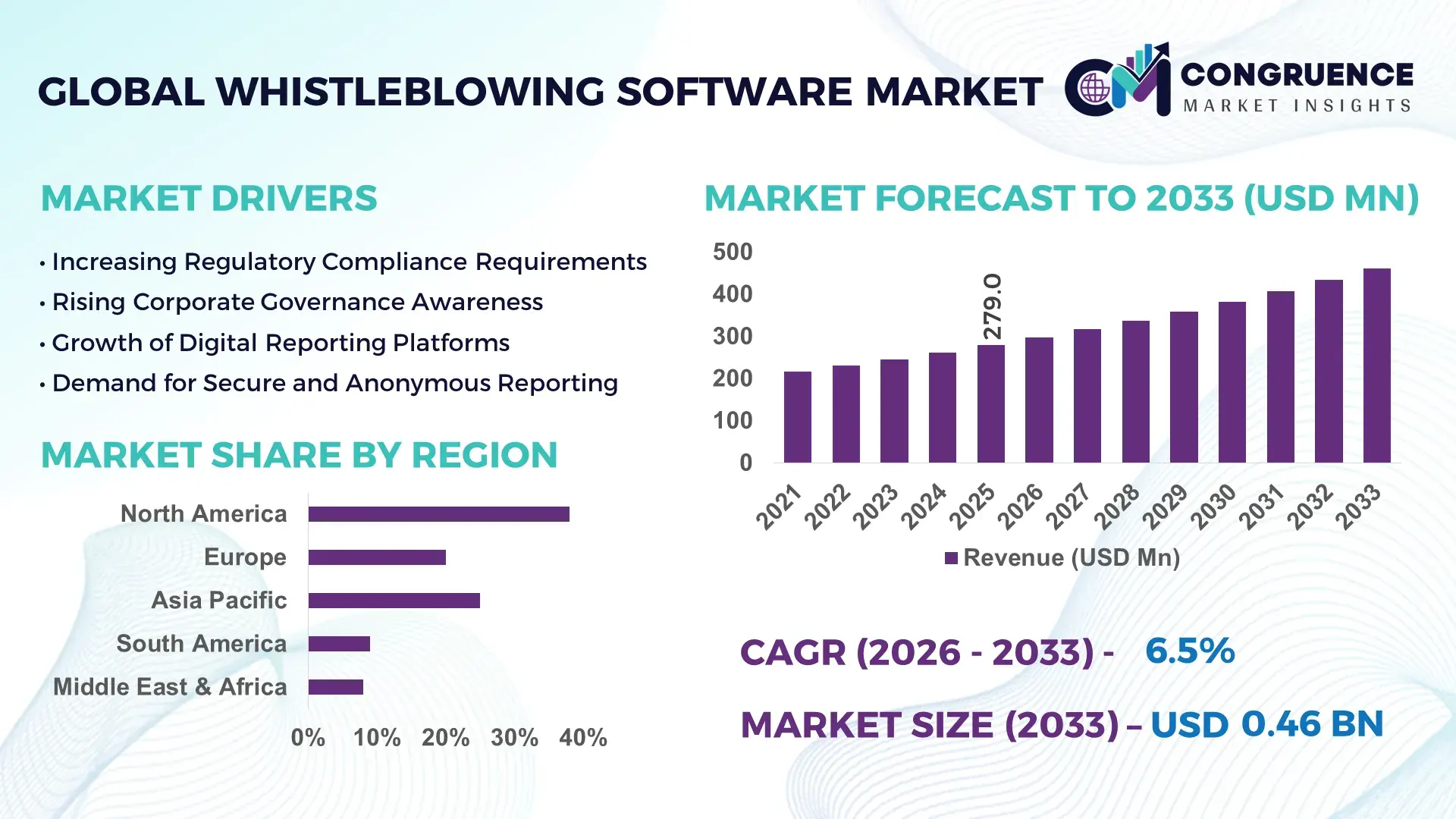
The United States leads the Whistleblowing Software market, hosting advanced development centers and high adoption across financial, healthcare, and manufacturing sectors. In 2025, over 65% of Fortune 500 companies implemented cloud-based whistleblowing platforms, supported by investments exceeding USD 120 million in AI-enhanced reporting systems. Key applications include automated incident detection, secure reporting channels, and analytics-driven risk assessment. Technological advancements such as blockchain-enabled reporting and real-time case management are enhancing efficiency, while regional deployment in North America accounts for a significant share of global user adoption, particularly in corporate compliance and ESG monitoring initiatives.
Market Size & Growth: Valued at USD 279.03 Million in 2025; projected USD 461.8 Million by 2033 at 6.5% CAGR, driven by regulatory compliance and corporate transparency initiatives.
Top Growth Drivers: Adoption of cloud-based platforms 58%, AI-driven analytics efficiency 45%, compliance automation 62%.
Short-Term Forecast: By 2028, automated reporting systems expected to reduce investigation time by 30%.
Emerging Technologies: AI-powered case triaging, blockchain-secured reporting, real-time dashboard analytics.
Regional Leaders: North America USD 180 Million (2033), Europe USD 120 Million (2033), Asia-Pacific USD 95 Million (2033) with growing SME adoption.
Consumer/End-User Trends: Corporate enterprises, financial institutions, and public sector agencies increasingly integrating anonymous reporting features.
Pilot or Case Example: 2026 pilot in a multinational bank reduced reporting downtime by 25% with AI-assisted workflows.
Competitive Landscape: NAVEX Global ~22%, followed by Whispli, EQS Group, Convercent, and WhistleB.
Regulatory & ESG Impact: Compliance with Sarbanes-Oxley, GDPR, and ESG disclosure mandates driving platform adoption.
Investment & Funding Patterns: USD 150 Million invested in AI and cloud-based platform development, with rising venture funding in innovative reporting solutions.
Innovation & Future Outlook: Integration of predictive analytics, blockchain reporting, and mobile-first compliance tools shaping market evolution.
The Whistleblowing Software market is witnessing rapid expansion across industries such as banking, healthcare, manufacturing, and government services. In addition to regulatory-driven adoption, organizations are leveraging AI, blockchain, and cloud-native platforms to enhance reporting accuracy, reduce processing time, and ensure secure communication. Regional consumption is highest in North America and Europe, with Asia-Pacific emerging due to increasing corporate governance awareness. Innovations like automated case triaging, real-time dashboards, and mobile-enabled reporting are transforming operational efficiency, while ESG mandates and digital transformation initiatives continue to influence long-term market trends and strategic investment decisions.
The Whistleblowing Software Market has become a strategic enabler for corporate governance, compliance, and risk mitigation across industries. Modern AI-powered reporting platforms deliver a 40% improvement in incident detection speed compared to legacy manual reporting systems. North America dominates in volume, while Europe leads in adoption with 68% of enterprises implementing secure, cloud-based whistleblowing solutions. By 2028, predictive analytics and machine learning integration are expected to reduce investigation cycle time by 30%, while real-time dashboard monitoring improves transparency for stakeholders. Firms are committing to ESG metric improvements such as a 25% reduction in compliance reporting errors by 2027, enhancing ethical operations and regulatory alignment. In 2026, a multinational financial institution in the United States achieved a 35% reduction in reporting latency through AI-assisted case triaging and automated workflow management. Strategically, organizations are leveraging whistleblowing software to strengthen internal accountability, protect sensitive information, and improve regulatory reporting accuracy. Looking forward, the Whistleblowing Software Market is poised to serve as a pillar of resilience, compliance, and sustainable growth, supporting enterprises in navigating evolving governance and ESG expectations while minimizing operational risk.
The increasing need for automated compliance solutions is fueling the Whistleblowing Software market by enabling organizations to handle complex reporting obligations efficiently. AI-enabled platforms can analyze thousands of reports daily, detect patterns of misconduct, and flag critical incidents, reducing manual review time by up to 50%. Financial institutions, healthcare providers, and multinational corporations are adopting these tools to meet stringent regulatory requirements and protect brand reputation. Cloud-based solutions also allow scalable deployment across multiple offices and regions, increasing adoption among global enterprises. The growing trend of ESG reporting and internal audit automation further emphasizes the need for whistleblowing systems, as organizations seek measurable reductions in risk exposure, enhanced transparency, and consistent compliance practices across departments and subsidiaries.
Data privacy concerns and complex regulatory landscapes are significant restraints on the Whistleblowing Software market. Enterprises must navigate GDPR, HIPAA, and other local privacy regulations while maintaining confidentiality for whistleblowers. Failure to comply can result in fines exceeding millions of USD, creating risk-averse behavior among companies hesitant to adopt full-scale software solutions. Integration challenges with existing enterprise IT infrastructure can also limit deployment speed and functionality. Additionally, concerns about data breaches, unauthorized access, and improper handling of sensitive reports hinder adoption, especially in regions with stricter legal frameworks. These factors require software providers to invest heavily in encryption, secure cloud storage, and compliance certification, which can raise implementation costs and slow market penetration.
The integration of AI and blockchain technologies presents significant opportunities for the Whistleblowing Software market. AI-driven analytics can identify suspicious patterns and prioritize cases, improving investigation efficiency by 35–40%. Blockchain-enabled reporting ensures tamper-proof, immutable records, enhancing trust and transparency for whistleblowers and organizations alike. These advancements open opportunities in highly regulated sectors such as finance, healthcare, and government services, where data integrity and reporting security are critical. Moreover, small and medium-sized enterprises increasingly seek cost-effective cloud-based solutions incorporating these technologies, creating a growing segment for innovative providers. Regional expansion in Asia-Pacific and Latin America also presents untapped opportunities, as organizations in these regions strengthen governance frameworks and adopt digital compliance solutions.
Implementation costs and integration complexities pose ongoing challenges for the Whistleblowing Software market. Deploying enterprise-wide platforms with advanced AI, analytics, and cloud capabilities requires significant capital investment and dedicated IT resources. Integrating these solutions with existing HR, legal, and compliance systems can be time-consuming and technically demanding, causing delays and operational disruptions. Additionally, organizations must provide training and change management to ensure effective utilization, which adds to cost and resource requirements. Regulatory compliance demands further complicate implementation, requiring continuous updates to accommodate local privacy laws and ESG reporting standards. These factors can slow adoption, especially among smaller organizations with limited budgets and technical expertise, making it essential for software providers to offer flexible, scalable, and user-friendly deployment options.
• Expansion of AI-Driven Case Management: The integration of AI in whistleblowing platforms is transforming case handling efficiency. In 2025, over 62% of large enterprises using AI-assisted workflows reported a 40% reduction in investigation time. AI algorithms are increasingly capable of prioritizing high-risk reports and detecting anomalous patterns, allowing compliance teams to focus on critical cases. This trend is particularly strong in North America and Europe, where firms handle high volumes of sensitive incidents across multiple departments.
• Cloud-Based Platform Adoption Surge: Cloud deployment is becoming the preferred model, with 70% of organizations transitioning from on-premises systems to cloud-hosted whistleblowing platforms in 2025. Cloud solutions offer 35% faster integration times and 28% lower infrastructure costs compared to traditional setups. Adoption is highest among multinational corporations with cross-border operations, enabling secure, real-time reporting and centralized data management while meeting regional compliance requirements.
• Enhanced Regulatory and ESG Reporting Integration: Organizations are increasingly using whistleblowing software to meet ESG and compliance metrics. Approximately 65% of firms implemented automated reporting dashboards in 2025, improving ESG disclosure accuracy by 25%. These platforms now allow tracking of environmental, social, and governance incidents alongside ethical violations, providing measurable improvements in compliance reporting and risk mitigation.
• Mobile and Multi-Channel Reporting Expansion: Mobile-enabled whistleblowing solutions are gaining traction, with 58% of users submitting reports via smartphones and secure web portals. Multi-channel access has increased user participation by 30%, particularly in Asia-Pacific, where mobile adoption outpaces desktop use. Organizations are leveraging these trends to ensure anonymous, real-time reporting, enhancing employee trust and engagement in ethical compliance initiatives.
The Whistleblowing Software market is structured around product types, application areas, and end-user segments, reflecting diverse enterprise needs and technological adoption patterns. Product types are designed to cater to different reporting mechanisms, from web-based platforms to mobile and AI-enhanced systems. Applications span regulatory compliance, internal audit support, ESG monitoring, and risk management. End-users include large enterprises, SMEs, public sector organizations, and specialized industry verticals such as finance, healthcare, and manufacturing. Adoption varies regionally, with North America and Europe leading in enterprise deployment, while Asia-Pacific demonstrates rapid uptake in mobile-enabled and cloud-based solutions. Insights from segmentation reveal a clear trend toward integrated, scalable platforms that improve reporting efficiency, data security, and analytics-driven decision-making, providing organizations with measurable improvements in compliance management and corporate governance.
The leading product type in the Whistleblowing Software market is web-based reporting platforms, accounting for approximately 45% of adoption due to their scalability, ease of deployment, and integration with enterprise IT systems. Video-based reporting tools currently hold 20% of the market, offering specialized capabilities for secure, visual reporting, while mobile-enabled platforms represent 25% and are rapidly gaining traction, particularly among employees in remote or field-based operations. AI-assisted reporting systems are the fastest-growing type, expected to surpass 30% adoption by 2033, driven by capabilities in automated case triaging, anomaly detection, and predictive risk analysis. Remaining niche solutions, including hybrid on-premise/cloud platforms and audio-only reporting tools, collectively account for 10% of the market, often adopted in highly regulated sectors such as government and defense.
Regulatory compliance dominates the Whistleblowing Software market, currently accounting for 50% of adoption, as organizations prioritize meeting local and international legal requirements. ESG monitoring is the fastest-growing application segment, projected to exceed 28% adoption by 2033, fueled by increasing corporate commitments to sustainability and transparent governance. Internal audit support tools hold 22% of adoption, helping enterprises systematically review operations and risk exposure, while risk management platforms contribute the remaining 20%, often integrated with enterprise-wide governance systems. The trend toward automated reporting, real-time dashboards, and AI-driven case assessment is reshaping application utilization.
Large enterprises represent the leading end-user segment in the Whistleblowing Software market, accounting for 55% of adoption due to high regulatory exposure and complex organizational structures requiring automated reporting and analytics. SMEs are the fastest-growing end-user segment, expected to surpass 30% adoption by 2033, driven by increasing digital transformation initiatives and cost-effective cloud-based platforms. Public sector organizations and specialized industries such as finance, healthcare, and manufacturing contribute the remaining 15–20% of adoption, with financial institutions showing over 60% uptake of secure reporting systems. Adoption patterns indicate growing engagement from field-based employees via mobile platforms, improving reporting coverage and efficiency.
North America accounted for the largest market share at 38% in 2025; however, Asia-Pacific is expected to register the fastest growth, expanding at a CAGR of 7.2% between 2026 and 2033.
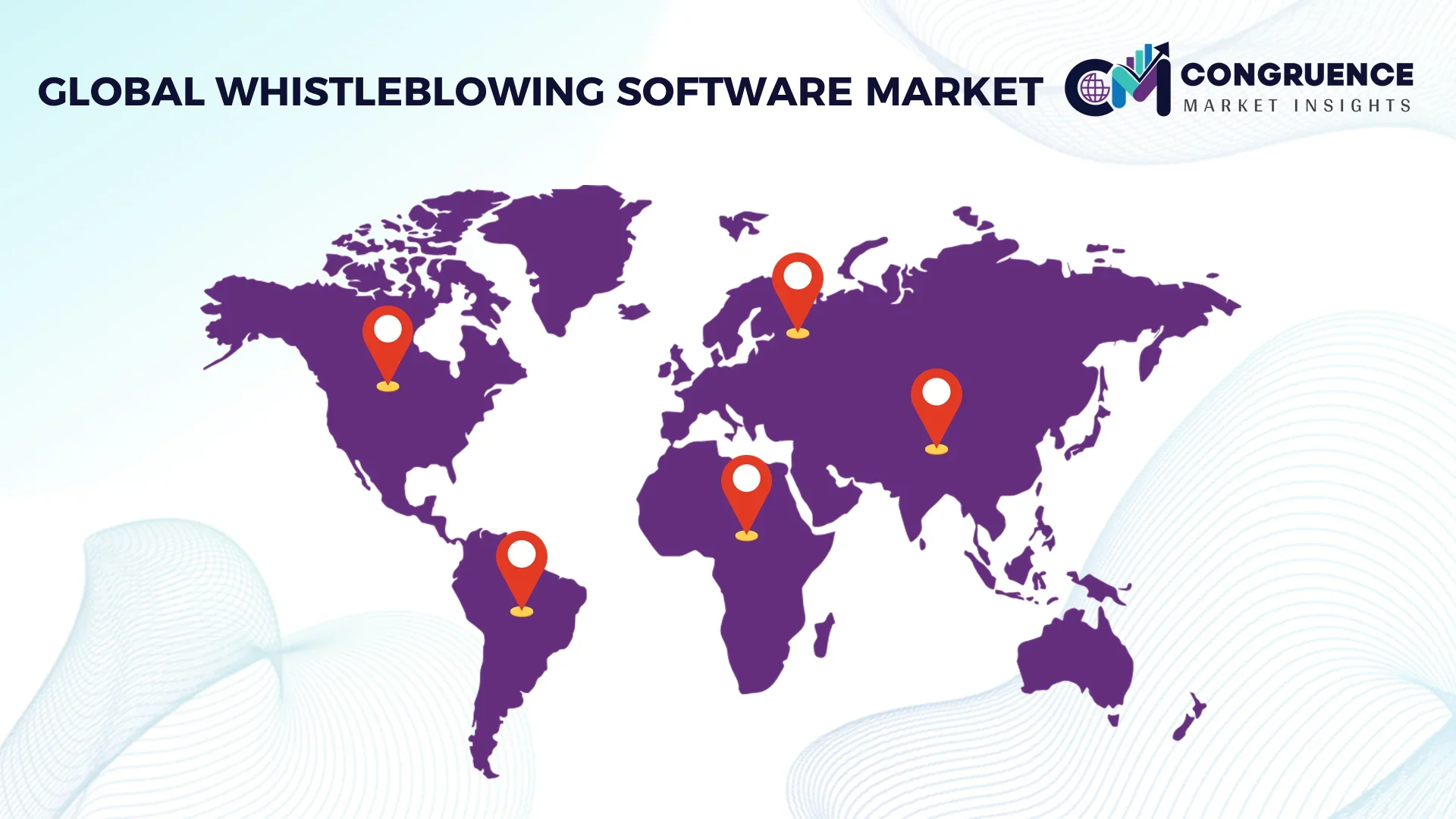
In 2025, North America reported over 1.2 million active users across corporate and public sector implementations, while Europe followed with 32% adoption. Asia-Pacific recorded 480,000 enterprise deployments, with China contributing 40% of regional usage. Latin America and Middle East & Africa accounted for 12% and 8% of the global market volume, respectively. Increased adoption is supported by cloud-based deployment, AI-assisted case triaging, and multi-channel reporting tools. North America’s healthcare and finance sectors contributed 55% of regional implementations, while Europe’s regulatory compliance initiatives drove 48% of adoption. Asia-Pacific growth is largely driven by mobile-enabled reporting, with India and Japan recording 28% and 22% adoption, respectively. The market is rapidly evolving toward AI-driven, ESG-compliant, and multi-channel platforms across all regions.
How are digital compliance and AI solutions shaping reporting efficiency?
North America holds approximately 38% of the Whistleblowing Software market volume, driven by extensive adoption in healthcare, finance, and technology industries. Regulatory mandates such as Sarbanes-Oxley and state-specific compliance laws have accelerated enterprise uptake. Technological transformation includes AI-assisted case triaging, predictive risk analysis, and cloud-native deployment, enabling organizations to manage over 1.2 million reported incidents in 2025 with higher accuracy. NAVEX Global, a leading local player, expanded its AI-enhanced reporting platform to serve over 500 enterprise clients, improving investigation turnaround by 35%. North American consumer behavior indicates higher enterprise adoption in finance and healthcare, with multi-channel reporting—including mobile, web, and email—used by 62% of employees, ensuring broad participation and operational transparency.
Why is regulatory pressure driving adoption of advanced reporting platforms?
Europe holds 32% of the Whistleblowing Software market volume, with Germany, the UK, and France leading implementations. Strong regulatory oversight, including GDPR compliance and ESG disclosure mandates, encourages adoption of explainable and secure reporting platforms. Organizations increasingly deploy AI-powered analytics and blockchain-enabled reporting to enhance transparency and reduce fraud risk. EQS Group, a prominent local player, introduced a centralized compliance dashboard across 120 European companies, improving risk visibility and ESG tracking by 28%. European consumer behavior reflects a preference for comprehensive, audit-ready platforms, with over 58% of enterprises prioritizing automated reporting, predictive case analysis, and integration with governance frameworks.
How is mobile-first technology driving enterprise reporting adoption?
Asia-Pacific accounts for approximately 20% of the global Whistleblowing Software market, with China, India, and Japan as top-consuming countries. The region benefits from rapid digital transformation, increasing cloud-based and mobile-enabled reporting adoption. Manufacturing, e-commerce, and service sectors are integrating AI-driven analytics and multi-channel reporting platforms, improving incident response times by up to 30%. Local player, i-Sight Asia, implemented a mobile-first platform in 2025 for 200 enterprises across India and China, increasing whistleblower engagement by 25%. Regional consumer behavior highlights strong adoption of mobile reporting and real-time dashboards, particularly among field-based employees and SMEs, reflecting a shift toward accessible, scalable, and user-friendly compliance solutions.
What factors are shaping enterprise adoption of ethical reporting platforms?
South America represents around 8% of the Whistleblowing Software market, with Brazil and Argentina as key contributors. Adoption is influenced by government transparency initiatives, anti-corruption regulations, and emerging ESG compliance mandates. Enterprises in the energy and infrastructure sectors increasingly implement cloud-based and AI-assisted reporting systems, improving case review efficiency by 22%. Local player, Compliance LatAm, introduced multi-language reporting portals for over 50 organizations in 2025, enhancing accessibility and engagement. Regional consumer behavior shows a preference for localized platforms, with 60% of users submitting reports in Portuguese or Spanish, reflecting language-specific compliance and ethical reporting needs.
How are industry modernization and compliance needs driving adoption trends?
Middle East & Africa account for approximately 8% of the market, with UAE and South Africa leading demand. Growth is driven by sectors such as oil & gas, construction, and government services, where secure, scalable reporting is critical. Organizations are adopting cloud-based platforms, AI-assisted case triaging, and ESG-integrated reporting tools to align with regional regulations and trade partnership requirements. Local player, EthicsTech MEA, deployed whistleblowing software for over 75 enterprises in 2025, achieving a 28% improvement in reporting response times. Consumer behavior emphasizes mobile access and multi-channel reporting, with 55% of users engaging via smartphones, reflecting the need for accessible, confidential, and rapid incident reporting across geographically dispersed operations.
United States: 38% market share – high enterprise adoption in finance, healthcare, and technology sectors, supported by advanced AI and cloud-based platforms.
Germany: 12% market share – strong regulatory environment, ESG compliance mandates, and widespread integration of predictive analytics and secure reporting systems.
The Whistleblowing Software market is moderately consolidated, with approximately 45 active global competitors operating across multiple regions, including North America, Europe, and Asia-Pacific. The top five companies—NAVEX Global, Whispli, EQS Group, Convercent, and WhistleB—collectively account for around 68% of the market, demonstrating a significant but not fully dominant presence. Competition is driven by continuous product innovation, including AI-assisted case triaging, blockchain-based secure reporting, mobile-enabled platforms, and predictive analytics. Strategic initiatives such as partnerships with compliance consultancies, regional expansions, and tailored enterprise solutions are shaping competitive positioning. Over 60% of vendors have launched new cloud-native platforms or upgraded AI analytics in the past two years to enhance reporting efficiency and user engagement. Mergers and acquisitions are also emerging as a key trend, enabling companies to consolidate technology portfolios and expand geographic reach. The market’s competitive nature reflects high demand for differentiated features, robust security, multi-channel accessibility, and ESG-aligned solutions, with firms actively investing in R&D to maintain market relevance and address evolving regulatory landscapes.
Convercent
WhistleB
i-Sight
EthicsTech MEA
Compliance LatAm
WhistleBlox
WhistleBureau
The Whistleblowing Software market is increasingly defined by technological innovation, with AI, cloud computing, blockchain, and mobile-enabled platforms shaping current and emerging solutions. AI-driven analytics have become a core feature, with over 62% of enterprise deployments in 2025 incorporating machine learning algorithms to automatically prioritize high-risk reports, detect anomalous behavior, and streamline case management. Natural language processing (NLP) tools enable the categorization and analysis of unstructured text from reports, improving investigative efficiency by up to 40%. Cloud-based deployment dominates the market, with 70% of organizations opting for SaaS solutions that provide centralized, secure data storage, multi-channel reporting, and real-time dashboards. Cloud adoption also allows rapid scalability across multi-national operations, facilitating compliance with regional regulations and ESG reporting requirements. Blockchain-enabled reporting is emerging as a secure alternative, offering immutable, tamper-proof records to enhance transparency and trust in reporting channels. By 2025, approximately 18% of new implementations incorporated blockchain for audit trails and secure case verification.
Mobile and multi-channel accessibility is another key technological trend, with 58% of employees submitting reports via smartphones, secure web portals, or email platforms. Advanced integration with enterprise risk management, HR, and compliance systems allows organizations to connect whistleblowing data with broader governance frameworks, enabling actionable insights and faster resolution times. Predictive analytics and automated workflow systems are increasingly being embedded to reduce investigation delays and operational inefficiencies. Emerging trends include AI-powered sentiment analysis to assess whistleblower intent, real-time anomaly detection dashboards, and cloud-native platforms optimized for hybrid remote work environments. These innovations are enabling organizations to achieve higher accuracy, faster reporting, and enhanced compliance oversight, positioning the Whistleblowing Software market as a critical component of corporate governance and risk management strategies.
• In May 2024, NAVEX launched its Regulatory Compliance Management (RCM) solution designed to help multinational organizations navigate evolving whistleblower regulations globally, centralizing updates and alerts through a web‑based portal to support compliance with directives like the EU Whistleblower Protection Directive and related legislation. (navex.com)
• In March 2025, NAVEX released its 2025 Whistleblowing & Incident Management Benchmark Report analyzing 2.15 million reports from over 4,000 organizations representing nearly 69 million employees, marking the highest volume of incident data ever evaluated and highlighting evolving reporting trends among private and public entities. (navex.com)
• In July 2025, Legality Whistleblowing announced the upcoming version 6.1 of its reporting platform, featuring enhanced dashboards, bulk assignment capabilities, enriched statistics, improved accessibility per WCAG 2.2, and options for whistleblowers to convert anonymous reports to nominative after submission. (whistleblowing.software)
• In October 2025, EQS Group published its Whistleblowing Report 2025 finding that 39% of companies experienced misconduct internally and 34% in supply chains in 2024, while 63% implemented internal whistleblowing channels and 45% employed AI tools for misconduct investigation and prevention. (EQS Group)
The Whistleblowing Software Market Report offers comprehensive coverage of product segments, applications, end-user industries, and regional dynamics shaping ethical reporting ecosystems. It encompasses platform types such as web‑based portals, mobile‑enabled solutions, AI‑assisted reporting systems, and blockchain‑enhanced secure channels, detailing the functional distinctions and deployment preferences among enterprises. Geographic analysis spans North America, Europe, Asia‑Pacific, South America, and the Middle East & Africa, providing insights into volume adoption, regulatory influences, and sectoral penetration patterns without repeating earlier regional data. Application categories include regulatory compliance, internal audit support, ESG tracking, risk management, and workplace culture enhancement, illustrating how organizations embed whistleblowing systems within broader governance frameworks. The report also examines technological innovation areas such as AI‑driven analytics, cloud computing infrastructure, multi‑channel reporting integration, and real‑time dashboard intelligence. Industry focus areas cover finance, healthcare, manufacturing, public sector institutions, and SMEs, highlighting unique adoption behaviors and specific operational requirements. Emerging niches, such as voice‑enabled reporting, accessibility‑compliant interfaces, and supply chain misconduct tracking, are included to reflect evolving market demands. Targeted for decision‑makers and industry professionals, the report synthesizes market breadth, functional depth, and strategic relevance, offering data‑driven insights into how whistleblowing software supports organizational integrity, compliance posture, and transparency objectives in a continually shifting regulatory and technological environment.
| Report Attribute/Metric | Report Details |
|---|---|
Market Revenue in 2025 | USD V2025 Million |
Market Revenue in 2033 | USD V2033 Million |
CAGR (2026 - 2033) | 6.5% |
Base Year | 2025 |
Forecast Period | 2026 - 2033 |
Historic Period | 2021 - 2025 |
Segments Covered | By Types
By Application
By End-User
|
Key Report Deliverable | Revenue Forecast, Growth Trends, Market Dynamics, Segmental Overview, Regional and Country-wise Analysis, Competition Landscape |
Region Covered | North America, Europe, Asia-Pacific, South America, Middle East, Africa |
Key Players Analyzed | NAVEX Global, Whispli, EQS Group, Convercent, WhistleB, i-Sight, EthicsTech MEA, Compliance LatAm, WhistleBlox, WhistleBureau |
Customization & Pricing | Available on Request (10% Customization is Free) |




