
Reports
The Global Wet Shaver Market was valued at USD 6721 Million in 2025 and is anticipated to reach a value of USD 8317.58 Million by 2033 expanding at a CAGR of 2.7% between 2026 and 2033. Growth is driven by recurring cartridge replacement, premium multi-blade upgrades, skin-sensitive shaving systems, expanding female grooming routines, and wider penetration of refillable razors through organized retail and e-commerce channels.
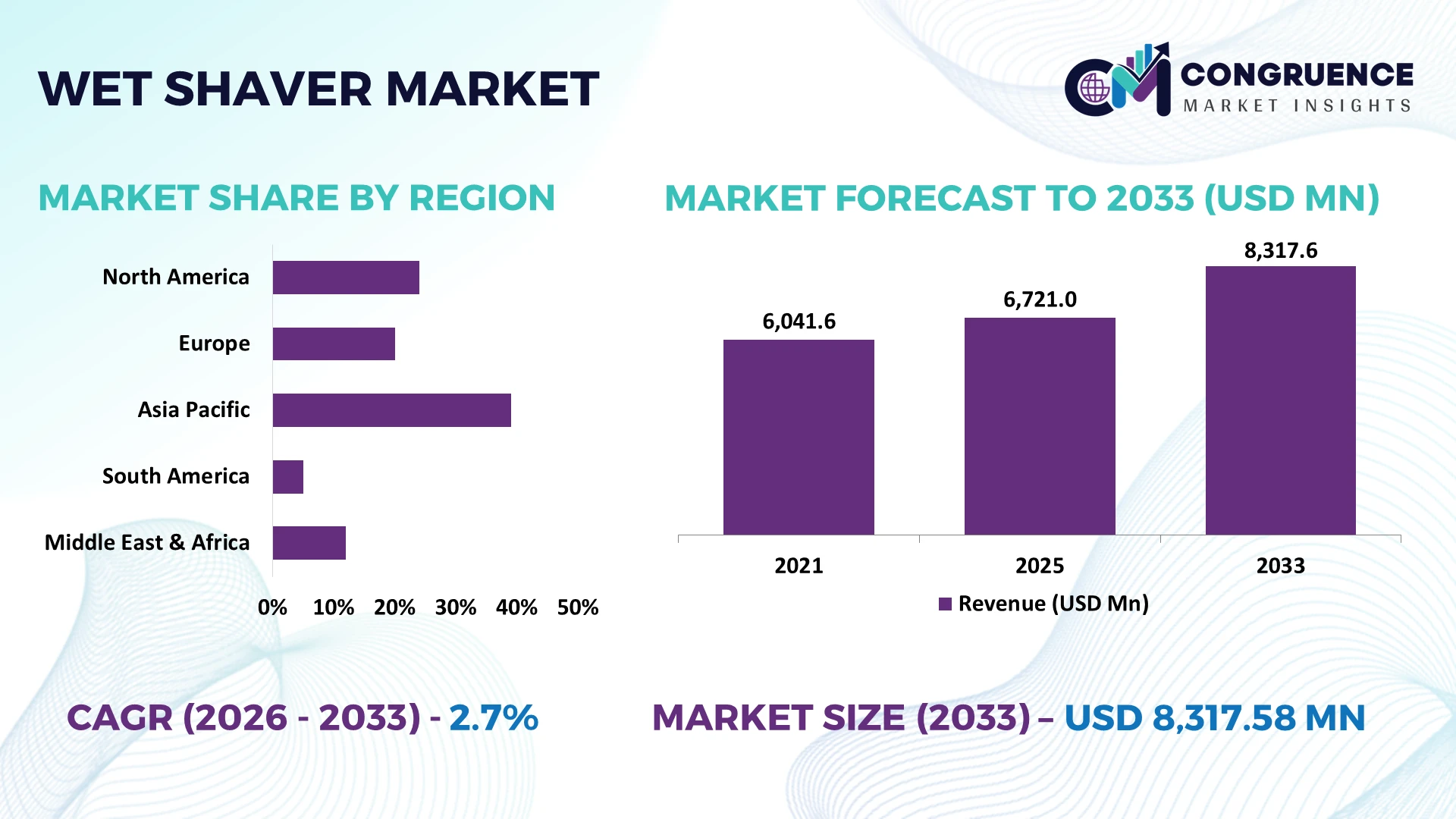
The United States dominates premium wet shaving, with North America accounting for approximately 30% of global consumption, supported by high cartridge usage, established Gillette and Schick distribution, and rapid adoption of five-blade and skin-protection systems. India offers a contrasting volume opportunity, where low-cost disposable and double-edge formats remain important. P&G controls more than 60% of the global blades-and-razors category, highlighting the scale advantage of established manufacturers. Compared with mature U.S. replacement cycles, India and other Asian markets benefit from expanding organized retail and younger grooming populations, while post-pandemic supply-chain localization is increasing regional sourcing of handles, steel blades, and packaging components.
Strategically, suppliers should combine premium refill systems in developed markets with affordable, locally manufactured formats in Asia, where distribution depth and replacement economics determine competitive gains.
Market Size & Growth: USD 6,721 million in 2025 is projected to reach USD 8,317.58 million by 2033 at 2.7% CAGR, supported by cartridge replacement and premium multi-blade upgrades.
Top Growth Drivers: Cartridge replenishment contributes approximately 35% of recurring demand momentum, premiumization about 25%, and expanding female grooming nearly 20%, strengthening repeat-purchase economics.
Short-Term Forecast: By 2027, manufacturing automation and optimized blade-coating processes are positioned to reduce per-unit production costs by approximately 5–8% for scaled suppliers.
Emerging Technologies: Five-blade architectures, low-friction coatings, precision trimmers, flexible blade suspension, and skin-guard technologies are shifting competition from basic shaving toward comfort and irritation reduction.
Regional Leaders: North America approaches USD 2.1 billion, Europe USD 1.9 billion, and Asia-Pacific USD 1.8 billion, with premium cartridges, sustainability, and affordable disposables respectively shaping adoption.
Consumer/End-User Trends: Approximately 60% of category value is associated with refillable shaving systems, reinforcing replacement cartridges as the strongest recurring-consumption opportunity for branded manufacturers.
Pilot/Case Example: In 2025, Gillette advanced razor and blade upgrades emphasizing closer shaving and improved skin protection, with Venus gaining approximately 1.4 percentage points of category share.
Competitive Landscape: P&G commands above 60% of global blades-and-razors sales, while Edgewell Personal Care, BIC, Dorco, and Harry’s intensify competition across cartridges, disposables, and direct-to-consumer channels.
Regulatory & ESG Impact: Packaging redesigns targeting 30–50% lower virgin-plastic usage are accelerating recyclable paper packs, reduced-plastic handles, and longer-life refill systems across major consumer-goods portfolios.
Investment & Funding: Global manufacturers are directing hundreds of millions of USD across automated blade production, packaging conversion, digital commerce, and manufacturing expansion, prioritizing productivity over capacity-only investment.
Innovation & Future Outlook: Next-generation wet shavers will combine recyclable materials, precision blade geometry, skin-sensitive lubrication, and subscription replenishment, shifting competitive advantage toward lifetime customer value rather than single-razor sales.
Wet shaver demand is concentrated across daily male grooming, female body shaving, barbershop use, and premium personal-care routines. Five-blade cartridges, skin guards, precision trimmers, and recyclable handles are improving product differentiation, while refillable systems represent approximately 60% of category value. Regionalized manufacturing and plastic-packaging reduction are reshaping sourcing strategies, establishing replacement economics and sustainable design as central strategic priorities.
Wet shaving is becoming strategically important because value is migrating from standalone razor purchases toward recurring cartridges, premium skin-protection features, and direct replenishment models. Refillable systems represent roughly 60% of category value, strengthening lifetime customer economics. Simultaneously, plastic-reduction commitments are restructuring packaging and material sourcing, pushing manufacturers toward paper-based packs, recycled polymers, and lighter handles without compromising blade performance.
Technology is widening competitive separation. Advanced five-blade cartridges with low-friction coatings, flexible mounts, and precision trimmers can deliver approximately 15–20% more effective cutting contact than conventional two- or three-blade architectures while extending comfortable replacement intervals. The United States remains concentrated around premium cartridges, whereas India retains substantial double-edge and value-disposable usage, creating distinctly different product architectures, pricing strategies, and distribution requirements.
Through 2026–2028, automated grinding, coating inspection, and assembly should reduce blade-production defects by approximately 8–12% across modernized lines. A practical example is manufacturers converting plastic blister packs to fiber-based packaging while retaining existing cartridge platforms, reducing material intensity without forcing consumer switching. Leading suppliers are therefore investing simultaneously in blade engineering, automated manufacturing, sustainable packaging, and localized Asian distribution. Competitive advantage will increasingly depend on controlling replacement ecosystems while matching product architecture to country-level affordability and grooming behavior.
Recurring blade replacement remains the strongest structural demand engine as manufacturers convert razor-handle users into long-duration cartridge customers. Refillable systems represent approximately 60% of category value, while premium three-to-five-blade formats command substantially higher unit economics than basic disposables. In the United States, established cartridge penetration supports replacement intervals commonly measured in weeks rather than annual hardware cycles, creating predictable retail throughput. At the same time, female shaving and skin-sensitive products are broadening addressable usage occasions. Gillette, Venus, Schick, and emerging direct-to-consumer brands are responding with lubrication strips, flexible blade mounts, precision edging, and subscription replenishment. The strategic advantage lies in installed handle bases: every compatible handle creates recurring cartridge demand, making ecosystem retention more valuable than competing primarily on initial razor price.
Wet-shaver profitability remains exposed to precision steel, polymers, coatings, packaging, and high-volume manufacturing economics. Stainless steel represents only a small fraction of razor weight but determines cutting consistency, corrosion resistance, and replacement performance, limiting manufacturers' ability to substitute cheaper materials. Retailers can capture approximately 20–30% price differences between branded cartridges and private-label alternatives, intensifying down-trading when household budgets tighten. India amplifies this constraint because double-edge blades and low-priced disposables establish exceptionally low reference prices against premium cartridges. Meanwhile, plastic-packaging reduction is forcing redesign expenditure across established product lines. Manufacturers are mitigating pressure through automated blade grinding, thinner packaging, regional sourcing, and platform standardization across multiple razor families. Operationally, reducing component complexity is becoming as important as procurement negotiation because fewer proprietary parts improve production utilization and protect margins.
The strongest untapped opportunity sits at the intersection of refillability, localized affordability, and skin-specific product engineering. Refillable formats already account for around 60% of category value, yet substantial disposable and double-edge usage across India, Indonesia, Brazil, and other populous markets leaves room for affordable cartridge migration. Manufacturers that reduce cartridge material requirements by 10–15% through thinner steel profiles, optimized lubrication systems, and simplified housings can narrow the price gap without abandoning premium performance. Digital replenishment creates another opening: subscriptions and automatic reorder functions convert irregular purchases into predictable replacement cycles. Companies are positioning through localized pack sizes, entry-price handles, recyclable packaging, and country-specific e-commerce partnerships. The non-obvious opportunity is compatibility architecture—creating inexpensive handles that accept higher-margin upgraded cartridges allows brands to acquire price-sensitive consumers today while monetizing premium replacement behavior later.
Long-term competitiveness depends on improving sustainability without weakening shave quality, manufacturing tolerances, or consumer acceptance. A five-blade cartridge requires micron-level alignment across multiple cutting edges, meaning even small assembly deviations can affect drag, irritation, and perceived sharpness. Converting packaging and handles toward recycled or reduced-plastic materials adds another engineering variable because dimensional stability must remain consistent through transportation, moisture exposure, and repeated bathroom use. Major consumer-goods companies are targeting substantial reductions in virgin-plastic consumption, increasing pressure on established razor architectures. Japan and the United States further raise performance expectations through mature premium-grooming segments where consumers readily compare cartridge longevity and comfort. Manufacturers must therefore invest in automated optical inspection, coating control, material qualification, and supplier collaboration. The strategic challenge is achieving lower material intensity without creating higher defect rates or shortening replacement intervals.
Plastic-Light Packaging Becomes Standard: Wet-shaver manufacturers are accelerating blister-pack replacement as consumer-goods groups target 30–50% reductions in virgin-plastic usage. Paperboard sleeves, recyclable cartons, and reduced-material cartridge trays are lowering packaging weight by roughly 15–25%. European packaging regulation is accelerating conversion, prompting major brands to redesign packs and consolidate packaging suppliers without altering established blade platforms.
Premium Systems Target Skin Comfort: Product development is moving beyond blade count toward pressure management, lubrication, and irritation control. Five-blade cartridges can provide roughly 15–20% greater cutting-edge contact than conventional three-blade configurations, while flexible heads improve contour coverage. U.S. brands are expanding dermatologically positioned ranges and optimizing lubricating strips, blade spacing, and skin guards to defend premium shelf positioning.
Digital Channels Reshape Replenishment: Cartridge purchasing is shifting toward e-commerce, subscriptions, and automatic replenishment, shortening the path between replacement need and purchase. Online channels now represent approximately 20–25% of grooming-product transactions in digitally mature markets, while subscription bundles can reduce reorder friction by 10–15%. Brands are restructuring pack sizes and deploying direct-consumer data to improve cartridge retention.
Precision Manufacturing Gains Priority: Automated grinding, edge inspection, coating control, and cartridge assembly are replacing manual quality checks across high-volume plants. Machine-vision inspection can reduce blade-related defects by approximately 8–12%, while automated handling improves line throughput by 10–15%. Manufacturers are concentrating capital on process consistency because micron-scale edge variation directly affects comfort, cartridge longevity, returns, and brand loyalty.
Cartridge Razors lead the Wet Shaver Market with an estimated 45–50% share, supported by installed handle bases, recurring replacement demand, multi-blade performance, and strong supermarket and pharmacy distribution. Their replaceable architecture separates durable handle acquisition from repeat blade consumption, creating stronger lifetime economics than Disposable Razors. Disposable Razors retain approximately 25–30% share because low unit prices and travel convenience sustain volume, particularly across India and other price-sensitive markets.
Safety Razors represent the fastest-expanding type as plastic reduction, lower lifetime blade costs, and renewed interest in traditional grooming increase adoption among premium users. Straight Razors retain specialist relevance in professional barbering, while Electric Wet Shavers occupy a smaller hybrid niche combining powered cutting with water, foam, or gel compatibility. Manufacturers are consequently balancing cartridge innovation with metal safety-razor platforms, recyclable handles, precision blade coatings, and simplified refill packs. Investment is shifting toward products that either maximize replacement retention or differentiate through durability and reduced material consumption.
Facial Shaving remains the largest application, accounting for approximately 55–60% of wet-shaver consumption because beard removal requires frequent blade replacement and supports extensive cartridge, disposable, and safety-razor portfolios. Beard Shaping provides a complementary precision segment as defined facial-hair styles increase demand for edging blades and compact trimmers. Head Shaving remains smaller but operationally demanding because larger skin coverage increases requirements for flexible heads, lubrication, and contour control.
Sensitive Skin Shaving is the fastest-growing application, supported by greater consumer focus on razor burn, ingrown hair, friction, and dermatological compatibility. Skin-protection configurations are gaining prominence, with five-blade systems offering approximately 15–20% more cutting-edge contact than conventional three-blade arrangements while pressure-distributing designs reduce repeated strokes. Body Grooming also strengthens product diversification, particularly through gender-neutral and female-focused formats. Gillette, Venus, Schick, and specialist brands are responding with lubrication technology, guarded blades, flexible cartridges, precision edging, and application-specific handles, shifting R&D spending from blade count alone toward skin-interface engineering.
Individual Consumers dominate the Wet Shaver Market with approximately 85–90% of product consumption, reflecting household-scale facial shaving, body grooming, head shaving, and cartridge replacement. Their purchasing behavior determines shelf assortment, refill architecture, promotional intensity, and direct-to-consumer strategies. Barbershops represent a smaller but operationally intensive group because hygiene practices require frequent blade replacement, particularly for straight razors and replaceable-blade safety systems. Grooming Centers similarly prioritize precision and rapid tool turnover.
Beauty Salons are emerging as the fastest-growing professional end-user as body grooming and specialized personal-care services broaden beyond traditional facial shaving. Hospitality Facilities remain a niche buyer, primarily purchasing low-cost Disposable Razors for guest amenity kits rather than premium refill systems. Professional channels collectively represent below 15% of consumption but influence product visibility and trial disproportionately. Manufacturers are targeting individual users through subscriptions, multipacks, and compatibility ecosystems while serving professional operators with bulk blades, hygienic single-use formats, and durable handles. This segmentation favors companies capable of maintaining consumer-scale distribution while selectively developing professional-grade portfolios.
North America accounted for the largest market share at approximately 31% in 2025 however, Asia-Pacific is expected to register the fastest growth, expanding at a CAGR of approximately 4.1% between 2026 and 2033.

Premium Cartridge Ecosystems Strengthen Retention
North America accounts for approximately 31% of global wet-shaver demand, supported by high cartridge penetration, established replacement routines, and concentrated mass-retail distribution. The United States drives regional consumption, where Gillette, Schick, Harry’s, and private-label products compete across supermarkets, pharmacies, clubs, and digital channels. Premium five-blade systems and sensitive-skin architectures are increasing value per replacement cycle, while direct-to-consumer replenishment is reducing dependence on store visits. Manufacturers are simultaneously converting plastic-heavy blister packaging toward paperboard and reduced-material configurations. E-commerce represents more than 20% of beauty and personal-care purchasing in the United States, strengthening multipack and subscription economics. Operationally, suppliers are prioritizing automated blade inspection, cartridge compatibility, and retailer-specific pack configurations rather than adding undifferentiated razor platforms.
United States Market Outlook: The United States provides the region’s deepest premium wet-shaving ecosystem, supported by high household grooming expenditure and nationwide retail infrastructure. P&G’s Gillette and Venus platforms provide substantial installed-handle scale, while Harry’s and Edgewell intensify competition through differentiated cartridges and digital distribution. Five-blade, lubrication-enhanced, and dermatologically positioned products increasingly determine premium shelf allocation.
Sustainability Reshapes Product Architecture
Europe represents approximately 27% of global wet-shaver consumption, with Germany, the United Kingdom, France, and Italy providing the strongest retail concentration. The market is shifting from plastic-intensive disposable formats toward refillable systems, metal handles, recyclable cartons, and reduced-plastic cartridge packaging. EU packaging rules and retailer sustainability requirements are accelerating redesign programs, making material efficiency an operational requirement rather than solely a brand attribute. Cartridge razors remain central to premium consumption, while safety razors are regaining relevance among sustainability-focused consumers. Manufacturers are reducing packaging material by approximately 20–30% on redesigned product configurations and increasing recycled-content utilization. Competitive differentiation increasingly depends on combining skin-comfort engineering with measurable packaging improvements. Suppliers capable of standardizing cartridges across multiple European markets gain procurement and manufacturing advantages while meeting increasingly stringent packaging specifications.
Germany Market Outlook: Germany combines premium grooming demand with strong sustainability expectations and extensive drugstore distribution through channels such as dm and Rossmann. Refillable and durable shaving formats benefit from consumer emphasis on waste reduction, while private labels exert significant pricing pressure. Germany’s implementation of EU packaging requirements strengthens the commercial case for recyclable cartons, lower-plastic handles, and simplified refill packaging.
Volume Scale Meets Premium Migration
Asia-Pacific accounts for approximately 25% of global wet-shaver demand and offers the strongest volume-to-premium conversion opportunity. India, China, and Japan present sharply different consumption structures: India retains substantial double-edge and disposable usage, Japan supports sophisticated premium blade systems, and China combines mass-market products with rapidly expanding digital distribution. Large populations and localized manufacturing provide scale advantages for blade stamping, plastic molding, assembly, and packaging. India’s grooming market increasingly supports cartridge migration as organized retail and e-commerce extend branded-product availability beyond major metropolitan areas. Manufacturers are introducing lower-priced handles, smaller refill packs, and localized blade configurations to reduce initial adoption barriers. Japan simultaneously pushes precision engineering through advanced coatings and multi-blade designs. This diversity makes portfolio localization more commercially effective than deploying standardized premium architectures across the entire region.
India Market Outlook: India offers exceptional replacement-volume potential because double-edge blades coexist with expanding cartridge adoption. Gillette India reported its highest-ever blades-and-razors market share during FY2025, demonstrating continued branded-product penetration. Local manufacturing, low-unit-price packs, neighborhood retail, and expanding e-commerce provide suppliers with multiple routes for converting value-oriented users toward higher-retention refill platforms.
Affordable Grooming Drives Format Mix
South America represents approximately 10% of global wet-shaver demand, with Brazil contributing the largest national consumption base. Disposable and value-oriented cartridge razors retain strong positions because purchasing decisions remain highly sensitive to replacement cost, pack size, and promotional pricing. Brazil’s extensive supermarket, pharmacy, and personal-care retail networks provide global brands with distribution scale, while domestic currency volatility increases pressure to localize sourcing and manufacturing. Manufacturers are responding with smaller cartridge packs, simplified handles, and locally optimized disposable configurations that protect accessible price points. Premium systems are concentrated more heavily in metropolitan consumers and digital channels. Brazil’s established consumer-products manufacturing base creates an operational advantage for regional supply, reducing exposure to imported finished razors. Winning portfolios balance affordability with enough blade differentiation to encourage consumers to trade up gradually.
Brazil Market Outlook: Brazil is South America’s strategic wet-shaving center because of its population scale, established beauty culture, and developed consumer-goods manufacturing infrastructure. More than 85% of its population is urban, supporting efficient access through supermarkets, pharmacies, specialist beauty retailers, and e-commerce. Localized production and compact refill packs help manufacturers manage currency exposure while maintaining broad price coverage.
Modern Retail Expands Branded Access
Middle East & Africa accounts for approximately 7% of global wet-shaver consumption, with demand fragmented between premium Gulf markets and price-sensitive African economies. Saudi Arabia and the UAE support premium cartridges through high urbanization, modern pharmacies, hypermarkets, and expanding digital commerce, while Egypt, South Africa, and Nigeria maintain greater exposure to disposable and value blade formats. Tourism and hospitality additionally create institutional demand for individually packaged disposable razors. Gulf retail modernization is increasing availability of imported five-blade and sensitive-skin systems, whereas currency and import-cost pressure elsewhere favors economical packs and locally distributed products. Manufacturers are strengthening distributor partnerships, expanding e-commerce availability, and segmenting pack sizes by purchasing power. The operational priority is distribution coverage: product availability and replenishment consistency often matter more than incremental blade sophistication outside premium urban clusters.
Saudi Arabia Market Outlook: Saudi Arabia combines high urban concentration with rapidly modernizing retail and hospitality infrastructure. More than 80% urbanization supports efficient branded-grooming distribution, while Vision 2030-linked tourism and hotel development expands travel and amenity-related consumption. Premium cartridges benefit from pharmacy and hypermarket penetration, encouraging suppliers to strengthen local distributors, digital availability, and targeted multipack strategies.
P&G, Edgewell Personal Care, BIC, Harry’s, and Kai Group anchor competition, with global cartridge leaders confronting disposable cost specialists, digital challengers, and precision-blade manufacturers. The top five control approximately 75% of organized wet-shaver sales, reflecting strong brand, tooling, distribution, and installed-handle advantages. P&G competes through Gillette and Venus ecosystems, while Edgewell’s Schick emphasizes skin protection; BIC targets price-sensitive disposables, Harry’s leverages direct consumer engagement, and Kai differentiates through blade engineering. Premium cartridges command roughly 20–40% price advantages over basic formats, while automated grinding and inspection can lower defect rates by 8–12%. Players are redesigning packaging, expanding digital replenishment, localizing production, and protecting proprietary cartridge compatibility. Competition is shifting from blade count toward comfort, sustainability, and replacement retention. Precision manufacturing, retailer access, and consumer switching costs remain formidable entry barriers. Winning requires scalable blade quality, disciplined pricing, differentiated skin performance, and control of recurring refill relationships.
Procter & Gamble
Edgewell Personal Care Company
BIC
Harry’s, Inc.
Kai Corporation
Feather Safety Razor Co., Ltd.
Dorco Co., Ltd.
Mühle
Edwin Jagger Limited
Super-Max Personal Care Pvt. Ltd.
Bombay Shaving Company
LetsShave
Parker Safety Razor
Henson Shaving
Precision blade grinding, diamond-like carbon coatings, automated edge inspection, and flexible cartridge mounts define current wet-shaver technology. Machine-vision inspection can cut edge-defect rates by 8–12%, while advanced coatings can improve glide durability by 10–15%. Adoption is highest across premium cartridge lines, where five-blade architectures and lubricating strips increasingly replace simpler fixed-head designs, protecting brand differentiation and replacement loyalty.
Emerging systems integrate skin guards, pressure-responsive pivots, precision trimmers, recycled polymers, and data-led manufacturing control. Compared with conventional three-blade cartridges, optimized five-blade systems can increase cutting-edge contact by roughly 15–20%, reducing repeat strokes and irritation exposure. Automated coating and assembly lines can lower unit-processing cost by 5–8%, benefiting scaled manufacturers with proprietary cartridge ecosystems and high-volume retail distribution.
From 2026–2028, disruptive competition will center on multifunctional wet-shave tools, recyclable refill platforms, and AI-assisted quality control. Hybrid trim-and-shave devices are moving beyond niche deployment, while recycled-content handles and fiber packaging are expanding across mainstream portfolios. Manufacturers that integrate precision inspection, skin-sensitive engineering, and modular refill compatibility can raise throughput efficiency by another 8–10%. Acting now matters because tooling, cartridge lock-in, and retailer adoption create multiyear competitive advantages that late entrants cannot replicate quickly without significant capital expenditure and consumer reacquisition costs at scale.
December 2024 P&G increased specialized stainless-steel sourcing for Gillette from India; Reuters reported Jindal material was 20–25% cheaper than Japanese and Swedish alternatives. The shift strengthened tariff resilience and input-cost control for precision razor production at manufacturing scale. Source: Reuters
June 2025 P&G advanced Venus with its largest razor upgrade in 25 years, adding a redesigned handle, improved blades, recyclable packaging, and shower hook. Venus gained 1.4 share points, strengthening premium female grooming execution globally across key markets. Source: P&G
July 2025 Edgewell expanded Billie into Australia and New Zealand, its first markets outside North America, through major grocery and pharmacy channels. Women’s shave value growth subsequently reached 25.6%, validating portfolio-led geographic expansion and refill adoption across Oceania. Source: Edgewell
February 2026 BIC launched Flex 5 Trim & Shave, combining a five-blade cartridge with dual-length trimming. Consumer testing showed 80% satisfaction and purchase intent, while 89% rated performance equal to or better than competitors, broadening BIC’s grooming position.
The Wet Shaver Market Report evaluates Disposable Razors, Safety Razors, Cartridge Razors, Straight Razors, and Electric Wet Shavers across Facial Shaving, Head Shaving, Body Grooming, Beard Shaping, and Sensitive Skin Shaving. Coverage extends across Individual Consumers, Barbershops, Beauty Salons, Grooming Centers, and Hospitality Facilities. Cartridge razors represent approximately 45–50% of organized demand, while individual consumers account for roughly 85–90% of product consumption.
Regional assessment covers North America, Europe, Asia-Pacific, South America, and Middle East & Africa, with additional attention to refill ecosystems, precision blade coatings, automated inspection, recyclable handles, hybrid trim-and-shave systems, and skin-sensitive designs. The report evaluates competitive positioning, country-level adoption, manufacturing localization, distribution strategies, replacement economics, and emerging premiumization pathways through 2026–2033, supporting investment planning, geographic expansion, portfolio prioritization, partnership decisions, and technology-led differentiation.
| Report Attribute/Metric | Report Details |
|---|---|
Market Revenue in 2025 | USD 6721 Million |
Market Revenue in 2033 | USD 8317.58 Million |
CAGR (2026 - 2033) | 2.7% |
Base Year | 2025 |
Forecast Period | 2026 - 2033 |
Historic Period | 2021 - 2025 |
Segments Covered | By Type
By Application
By End-User
|
Key Report Deliverable | Revenue Forecast, Growth Trends, Market Dynamics, Segmental Overview, Regional and Country-wise Analysis, Competition Landscape |
Region Covered | North America, Europe, Asia-Pacific, South America, Middle East, Africa |
Key Players Analyzed | Procter & Gamble, Edgewell Personal Care Company, BIC, Harry’s, Inc., Kai Corporation, Feather Safety Razor Co., Ltd., Dorco Co., Ltd., Mühle, Edwin Jagger Limited, Super-Max Personal Care Pvt. Ltd., Bombay Shaving Company, LetsShave, Parker Safety Razor, Henson Shaving |
Customization & Pricing | Available on Request (10% Customization is Free) |




