
Reports
The Global Wet Scrubbers Market was valued at USD 3100 Million in 2025 and is anticipated to reach a value of USD 5528.78 Million by 2033 expanding at a CAGR of 7.5% between 2026 and 2033. Growth is being driven by tighter industrial emission compliance, expansion of chemical processing capacity, and accelerated installation of high-efficiency air pollution control systems across power, metals, and manufacturing facilities.
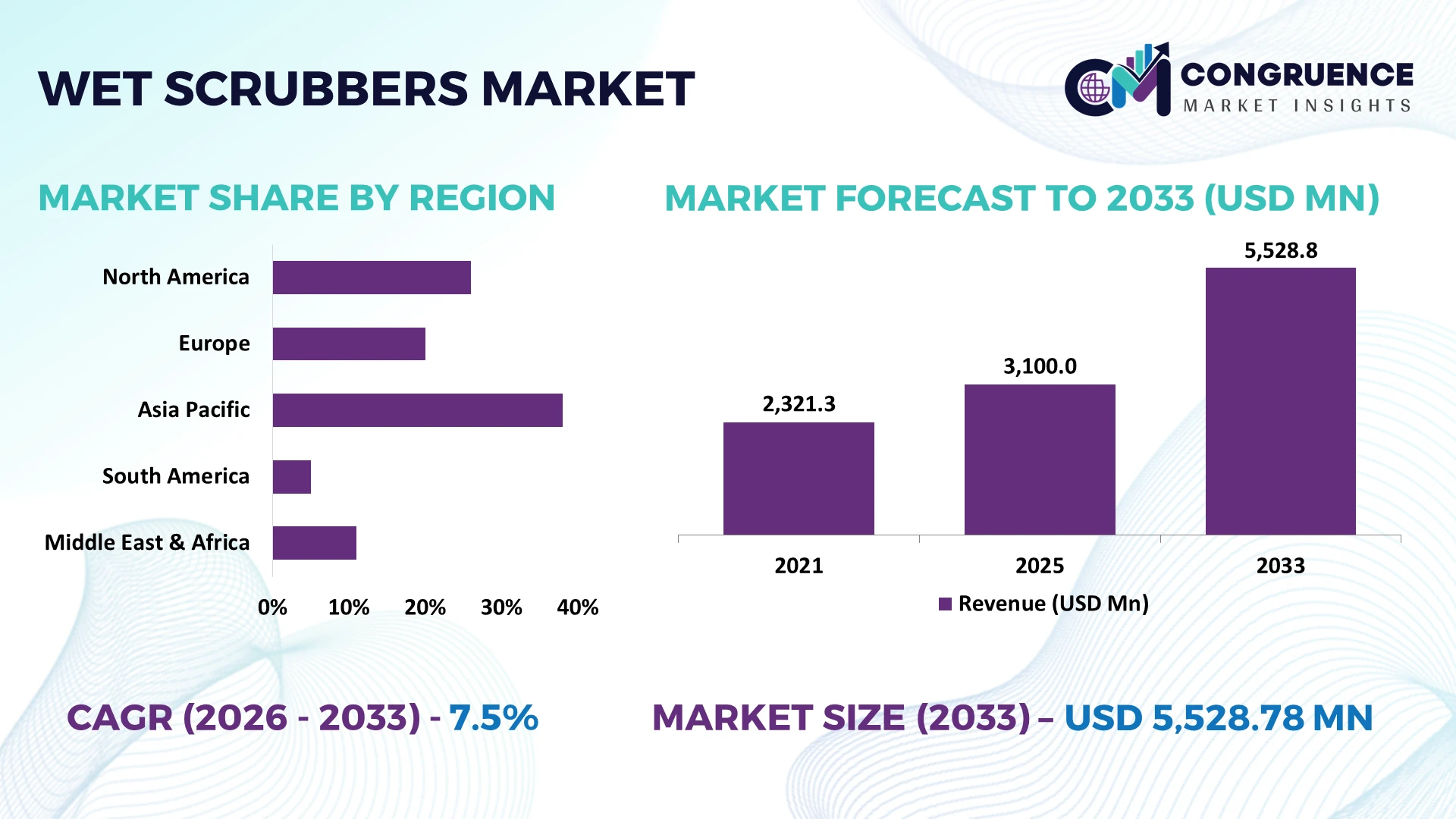
China remains the dominant country, accounting for approximately 36% of global wet scrubber manufacturing capacity, supported by multi-billion-dollar industrial modernization programs and widespread deployment across steel, cement, and chemical industries. More than 72% of newly commissioned large industrial emission-control projects incorporate advanced gas-cleaning systems, compared with about 24% in India, while European facilities continue upgrading digital monitoring for compliance under stricter industrial emission frameworks amid evolving carbon-border trade measures.
Manufacturers and investors should prioritize production expansion, localized engineering capabilities, and advanced automation integration in high-capacity industrial regions to strengthen long-term competitive positioning.
Market Size & Growth: USD 3100 Million in 2025, reaching USD 5528.78 Million by 2033 at a CAGR of 7.5%, driven by advanced industrial emission-control upgrades and cleaner manufacturing investments.
Top Growth Drivers: Industrial emission compliance contributes nearly 42% of new demand, chemical processing expansion 28%, and metal manufacturing upgrades 19%.
Short-Term Forecast: By 2027, automated monitoring and optimized liquid circulation improve pollutant removal efficiency by 16% while reducing operating costs by 11%.
Emerging Technologies: AI-based process optimization, IoT-enabled predictive maintenance, and corrosion-resistant composite materials improve system uptime by approximately 18%.
Regional Leaders: Asia-Pacific exceeds USD 2400 Million, Europe approaches USD 1450 Million, and North America surpasses USD 1180 Million, supported by regional industrial modernization and supply-chain expansion.
Consumer/End-User Trends: More than 68% of large industrial facilities prioritize integrated multi-pollutant wet scrubber systems to improve environmental compliance and operational reliability.
Pilot/Case Example: A 2026 heavy-industrial modernization project achieved a 21% reduction in particulate emissions and a 13% decrease in maintenance downtime after advanced scrubber integration.
Competitive Landscape: Leading manufacturers collectively control approximately 46% of the global market, with competition centered on Ducon Technologies, Babcock & Wilcox, CECO Environmental, Duall, and Tri-Mer Corporation.
Regulatory & ESG Impact: New environmental compliance programs reduce targeted industrial emissions by up to 25%, accelerating investment in advanced wet scrubbing technologies.
Investment & Funding: More than USD 1.8 Billion in industrial environmental infrastructure investments supports manufacturing expansion, strategic partnerships, and technology localization across major regions.
Innovation & Future Outlook: Digital twins, modular scrubber platforms, and energy-efficient circulation systems reduce lifecycle operating costs by nearly 15%, strengthening long-term industrial competitiveness.
Wet Scrubbers Market demand is expanding across chemical processing, steel production, waste incineration, marine applications, and power generation as industries adopt integrated air pollution control solutions. Advanced automation, corrosion-resistant materials, and intelligent process monitoring improve operational efficiency by nearly 18%, while evolving environmental regulations and regional manufacturing diversification continue reshaping equipment procurement strategies, setting the foundation for the following strategic market assessment.
Wet scrubbers have become strategically important as industrial producers strengthen emission control while modernizing manufacturing assets to remain competitive under stricter environmental compliance. The market is increasingly shaped by supply-chain localization, infrastructure upgrades, and digital process optimization rather than standalone equipment replacement. Heavy industries are prioritizing integrated gas-cleaning systems that reduce operational interruptions while improving regulatory performance, particularly as cross-border industrial production adjusts to evolving environmental trade requirements in 2026.
Modern digitally monitored wet scrubbers deliver approximately 15% lower water consumption and 18% higher particulate removal efficiency than conventional fixed-control systems through automated process balancing and predictive maintenance. China continues leading large-scale deployment across steel and chemical complexes, while Germany focuses on advanced retrofit projects combining digital monitoring with energy optimization for existing facilities. Over the next two to three years, more than 40% of newly commissioned large industrial plants are expected to integrate intelligent emission monitoring alongside wet scrubbing technology to improve operational consistency and compliance reporting.
A 2026 refinery modernization project integrating automated wet scrubbers with centralized process controls reduced maintenance interventions by 14% while improving continuous operating availability. Manufacturers are responding through engineering partnerships, localized fabrication facilities, and expanded aftermarket service capabilities to strengthen customer retention. Companies establishing integrated environmental technology portfolios and digital service ecosystems will secure stronger competitive positioning through higher operational reliability, faster project execution, and long-term industrial value creation.
Industrial decarbonization strategies and tighter particulate emission standards are accelerating replacement of legacy pollution-control infrastructure with advanced wet scrubber systems. Nearly 64% of new heavy industrial environmental projects now specify integrated gas-cleaning solutions, while automated process controls improve equipment utilization by approximately 17% and reduce maintenance planning requirements by 12%. China continues expanding steel and chemical production with mandatory emission modernization programs, creating sustained equipment demand. This structural shift is prompting manufacturers to expand engineering capacity, strengthen EPC partnerships, and develop modular systems with digital monitoring capabilities. Companies combining process optimization software with high-efficiency scrubbing technology achieve stronger project differentiation, shorter commissioning periods, and improved lifecycle service opportunities, creating a durable operational advantage beyond equipment sales.
Large-scale wet scrubber deployment remains constrained by high installation complexity, specialized infrastructure requirements, and volatile prices for corrosion-resistant materials. Engineering and installation activities typically account for nearly 35% of total project expenditure, while stainless steel and specialty alloy cost fluctuations of around 14% complicate procurement planning. Industrial facilities in India and several Southeast Asian manufacturing hubs often encounter retrofit limitations due to restricted plant layouts and aging utility infrastructure. These factors delay commissioning schedules and reduce deployment flexibility. Manufacturers are responding through localized component sourcing, long-term supplier agreements, and standardized modular designs that reduce engineering customization while improving installation efficiency and minimizing project execution uncertainty.
Digital transformation is creating high-value opportunities through intelligent wet scrubbers integrated with industrial automation platforms, predictive analytics, and remote performance diagnostics. AI-assisted control algorithms improve process stability by approximately 16%, while predictive maintenance reduces unexpected shutdowns by nearly 20%. Japan is expanding deployment of smart environmental equipment across advanced manufacturing facilities, encouraging suppliers to develop connected emission-control ecosystems. Companies are increasing investment in sensor-enabled platforms, digital service contracts, and collaborative technology partnerships that generate recurring operational value beyond equipment delivery. A significant emerging opportunity lies in hybrid water-recovery systems that simultaneously reduce resource consumption and strengthen compliance performance, creating measurable operational savings for continuous-process industries.
Long-term market expansion depends on consistent execution across increasingly sophisticated industrial environments where engineering integration, workforce capability, and digital interoperability remain challenging. More than 31% of industrial operators report shortages of specialized environmental engineering expertise, while integrated commissioning activities extend project timelines by roughly 18% in highly complex facilities. The United States continues facing pressure to modernize aging industrial infrastructure without disrupting production continuity, increasing implementation complexity. Companies must strengthen engineering training, expand certified installation networks, and improve interoperability between emission-control equipment and plant automation systems. Organizations that build robust technical partnerships and standardized deployment methodologies will achieve superior operational consistency, stronger customer confidence, and sustainable competitive differentiation.
Digital Process Intelligence Expands Industrial operators are integrating AI-enabled controllers, cloud diagnostics, and predictive maintenance into wet scrubber systems to improve process stability. Around 46% of newly installed industrial units now include continuous digital monitoring, while predictive analytics lowers unplanned maintenance events by nearly 19% and improves operating efficiency by 14%. Manufacturers are expanding software partnerships and remote service capabilities as skilled labor shortages increase demand for automated environmental control platforms.
Water Recovery Becomes Competitive Priority Rising industrial water management requirements are driving deployment of closed-loop circulation and advanced liquid recovery technologies. Modern wet scrubbers reduce freshwater consumption by approximately 18%, while wastewater treatment integration cuts disposal volumes by nearly 16%. China and Singapore are promoting industrial water-efficiency initiatives, encouraging equipment suppliers to redesign systems with higher recycling capability and modular filtration components that lower operating costs over the equipment lifecycle.
Modular Manufacturing Gains Momentum Industrial customers increasingly prefer factory-built modular wet scrubbers that shorten installation schedules by almost 22% and reduce on-site engineering work by nearly 17%. Supply-chain disruptions affecting large fabrication projects have accelerated this transition. Equipment manufacturers are restructuring production toward standardized platforms, enabling faster delivery, simplified maintenance, and scalable deployment across chemicals, metals, and cement facilities without extensive plant redesign.
Hybrid Emission Control Integration Companies are combining wet scrubbers with advanced filtration, real-time emission sensors, and centralized plant automation to improve multi-pollutant removal. Integrated systems increase operational availability by around 15% while reducing manual inspection frequency by nearly 20%. Germany's industrial modernization programs continue supporting intelligent environmental infrastructure, prompting suppliers to strengthen technology alliances and deliver complete emission-management solutions instead of standalone equipment.
Venturi wet scrubbers remain the leading product segment, accounting for approximately 38% of market deployment due to their superior capability in removing fine particulate matter from high-velocity industrial exhaust streams. Their compatibility with steel, cement, and mining operations, combined with stable operating performance, continues to support large-scale adoption. Spray Tower systems maintain strong demand where lower-pressure operation and simpler maintenance are priorities, while Tray Tower configurations remain strategically relevant for specialized chemical processing applications requiring enhanced gas-liquid contact efficiency.
Packed Bed wet scrubbers represent the fastest-growing segment as industries pursue higher absorption efficiency for corrosive gases and stricter emission compliance. Adoption has increased by nearly 17% across advanced chemical processing facilities, while process optimization reduces chemical consumption by approximately 12%. Manufacturers are expanding modular Packed Bed product lines, investing in corrosion-resistant materials, and strengthening engineering partnerships to address complex industrial applications. Investment priorities increasingly favor flexible designs capable of supporting multiple industrial processes while reducing maintenance complexity and improving long-term operational performance.
Air Pollution Control remains the largest application, representing approximately 44% of wet scrubber installations because heavy industries continue prioritizing compliance with increasingly stringent emission standards. Large manufacturing complexes require integrated systems capable of removing particulate matter, acidic gases, and hazardous emissions simultaneously. Gas Cleaning is emerging as the fastest-growing application, with deployment expanding by nearly 18% as chemical producers upgrade process safety and environmental performance. These investments increasingly combine wet scrubbing with digital monitoring platforms for continuous compliance verification.
Dust Collection continues supporting demand in cement, mining, and bulk material handling operations where airborne particulate management remains operationally critical, while Fume Removal is expanding within metal fabrication and specialty manufacturing. Automated emission monitoring has improved application efficiency by approximately 15%, encouraging suppliers to develop integrated environmental control platforms rather than standalone equipment. Companies are expanding sector-specific product portfolios, strengthening engineering support, and deploying modular configurations to improve installation flexibility across diverse industrial environments.
The Chemical industry represents the largest end-user segment with approximately 34% of total demand because continuous processing facilities require reliable removal of corrosive gases, hazardous vapors, and particulate emissions. High operating intensity and strict environmental compliance sustain consistent replacement and modernization activity. Power Generation is the fastest-growing end-user segment, with advanced emission-control deployments increasing by nearly 16% as aging facilities integrate modern environmental equipment alongside plant efficiency upgrades.
Metal Processing, Mining, and Cement remain strategically significant because each industry operates under demanding emission-control requirements and high-volume exhaust conditions. Customized wet scrubber configurations improve pollutant removal efficiency by approximately 18%, while predictive monitoring reduces maintenance interventions by nearly 13%. Manufacturers are responding through application-specific engineering, localized service networks, long-term maintenance agreements, and collaborative partnerships with industrial EPC contractors. Competitive positioning increasingly depends on delivering integrated environmental systems tailored to complex operational requirements rather than standardized equipment alone.
Asia-Pacific accounted for the largest market share at 46% in 2025 however, Middle East & Africa is expected to register the fastest growth, expanding at a 9.1% between 2026 and 2033.

Advanced Industrial Modernization Strengthens Deployment
North America represents approximately 24% of global Wet Scrubbers Market demand, supported by modernization across chemical processing, refining, power generation, and metal manufacturing. Industrial operators are replacing aging emission-control infrastructure with digitally monitored wet scrubbers that improve process reliability and regulatory compliance. More than 43% of newly approved environmental upgrade projects integrate automated monitoring and predictive diagnostics. Engineering companies are expanding lifecycle service contracts while manufacturers strengthen localized fabrication and aftermarket capabilities to shorten delivery schedules. Increased investment in industrial decarbonization and process optimization continues supporting deployment of high-performance scrubber technologies across large manufacturing facilities. Strategic collaboration between equipment suppliers and EPC contractors is improving commissioning efficiency and reducing project execution risks.
United States Market Outlook: The United States remains the regional leader because of its extensive industrial base, refinery network, and continuous environmental infrastructure upgrades. More than 48% of industrial emission modernization projects incorporate integrated pollution-control technologies, particularly within chemicals and metals. Equipment suppliers continue investing in domestic engineering centers, digital monitoring platforms, and long-term maintenance partnerships that strengthen operational reliability while supporting compliance with evolving industrial emission standards.
Regulatory Modernization Drives Technology Replacement
Europe accounts for nearly 22% of global market activity, supported by industrial modernization, strict environmental regulations, and advanced manufacturing investments. Chemical processing, waste treatment, and metal production remain major deployment sectors. Approximately 41% of retrofit projects now integrate intelligent environmental monitoring alongside wet scrubber installations, improving operating consistency and maintenance planning. Manufacturers increasingly focus on modular designs and corrosion-resistant materials to improve lifecycle performance. Industrial operators continue replacing legacy systems with integrated environmental platforms that reduce operational complexity while strengthening compliance. Partnerships between engineering companies and technology providers are accelerating deployment of digitally connected emission-control systems across established industrial facilities.
Germany Market Outlook: Germany leads regional adoption through its advanced engineering capabilities and strong industrial manufacturing base. Nearly 45% of large industrial environmental modernization projects include digitally integrated wet scrubber solutions. Domestic equipment manufacturers emphasize automation, energy optimization, and customized engineering services, allowing industrial facilities to improve environmental performance while maintaining high production efficiency across chemical and metal processing operations.
Manufacturing Scale Sustains Global Leadership
Asia-Pacific contributes approximately 46% of global market demand through extensive industrial production, infrastructure expansion, and manufacturing investment. Steel, cement, chemicals, mining, and power generation collectively drive large-scale wet scrubber deployment across major industrial corridors. More than 55% of newly commissioned heavy industrial facilities incorporate integrated emission-control technologies from the design stage. Manufacturers continue expanding localized production facilities and engineering capabilities to meet rising equipment requirements while improving delivery efficiency. Industrial automation, environmental modernization, and increasing export-oriented manufacturing strengthen long-term deployment across high-capacity production hubs.
China Market Outlook: China remains the largest national market due to its dominant steel, cement, and chemical industries. Approximately 36% of global wet scrubber manufacturing capacity is concentrated within the country, while automated environmental monitoring is increasingly integrated into industrial operations. Domestic manufacturers continue expanding production, investing in advanced materials, and strengthening international partnerships to support both domestic demand and export competitiveness.
Mining Investments Expand Industrial Demand
South America represents approximately 5% of global deployment, with mining, cement, metals, and chemical processing supporting steady equipment demand. Environmental modernization programs are encouraging industrial operators to replace older emission-control systems with more efficient wet scrubber technologies. Around 29% of new mining processing facilities now integrate advanced air pollution control solutions during initial construction. Infrastructure limitations and extended procurement cycles remain execution challenges, yet localized engineering partnerships and modular equipment designs are improving project implementation. Equipment suppliers increasingly establish regional service capabilities to reduce maintenance delays and improve operational support.
Brazil Market Outlook: Brazil leads regional demand because of its mining, steel, and industrial manufacturing sectors. More than one-third of large industrial environmental improvement projects include advanced wet scrubber installations. Companies continue expanding local technical support, engineering partnerships, and customized equipment offerings to improve deployment efficiency across resource-intensive industrial operations while strengthening long-term customer relationships.
Industrial Diversification Accelerates Environmental Investment
The Middle East & Africa market is strengthening through refinery modernization, mining expansion, petrochemical investment, and industrial diversification initiatives. Approximately 24% of new large industrial infrastructure projects include advanced emission-control equipment during construction planning. Governments and industrial enterprises increasingly prioritize environmentally compliant manufacturing while expanding downstream processing capacity. Equipment suppliers are establishing regional engineering partnerships and localized technical support to improve project delivery and lifecycle services. Modern industrial developments continue creating demand for integrated wet scrubber systems capable of handling complex process emissions across multiple industries.
Saudi Arabia Market Outlook: Saudi Arabia leads regional investment through refinery expansion, petrochemical development, and industrial diversification initiatives. Around 38% of newly commissioned heavy industrial facilities incorporate advanced environmental control technologies during construction. Manufacturers are strengthening local partnerships, engineering support, and service capabilities to support large industrial projects while improving operational performance and long-term environmental compliance.
The Wet Scrubbers Market is led by global engineering specialists competing against regional process-equipment manufacturers and customized industrial system integrators. CECO Environmental, Babcock & Wilcox, Ducon Technologies, Tri-Mer Corporation, and Duall collectively account for approximately 43% of the market, competing primarily on engineering capability, technology integration, lifecycle services, and delivery speed. Regional manufacturers challenge global leaders through lower production costs and customized project execution, while technology-focused companies differentiate with automated monitoring that improves operating efficiency by nearly 15% and reduces maintenance requirements by approximately 12%. Competition increasingly centers on localized manufacturing, EPC partnerships, aftermarket services, and vertically integrated environmental solutions rather than standalone equipment sales. Strategic acquisitions and technology collaborations are strengthening product portfolios and expanding industrial coverage. High engineering complexity, certification requirements, and long project qualification cycles remain key entry barriers. Winning requires superior process expertise, reliable execution, digital service capability, and strong long-term industrial customer relationships.
CECO Environmental
Babcock & Wilcox
Ducon Technologies Inc.
Tri-Mer Corporation
Duall
Monroe Environmental
KCH Engineered Systems
Schutte & Koerting
Nederman
Verantis Environmental Solutions Group
Hamon
GEA Group
Croll Reynolds
Envitech Inc.
Wet scrubber technology is shifting from conventional mechanical operation toward digitally controlled, high-efficiency emission management platforms. AI-enabled process optimization, intelligent flow regulation, and continuous emissions monitoring are now deployed in approximately 48% of new industrial installations, improving particulate capture efficiency by nearly 17% while reducing water consumption by around 14%. Corrosion-resistant composite materials and advanced mist eliminators further extend equipment life and reduce maintenance frequency. Companies integrating these technologies achieve stronger environmental compliance with lower lifecycle operating costs, creating a competitive advantage in chemicals, metals, power generation, and cement manufacturing.
Emerging technologies between 2026 and 2028 include predictive maintenance, digital twins, and hybrid wet scrubbing systems integrated with industrial automation platforms. Around 36% of large industrial facilities are implementing remote diagnostics to reduce unexpected downtime by approximately 19%. Compared with legacy manually controlled systems, intelligent wet scrubbers improve process stability by nearly 18% and shorten maintenance planning cycles by about 15%. Manufacturers are increasingly combining IoT sensors with cloud-based analytics, enabling centralized performance optimization across multiple production sites while strengthening operational consistency and regulatory reporting.
Disruptive innovation is centered on closed-loop water recovery, modular engineering, and integrated multi-pollutant treatment systems. Factory-built modular units reduce installation time by approximately 22%, while automated water recycling lowers freshwater demand by nearly 16%. Technology leaders investing in digital environmental platforms, advanced materials, and service-based monitoring ecosystems will strengthen competitive positioning through faster deployment, higher reliability, and scalable industrial compliance as modernization accelerates through 2028.
May 2026 CECO Environmental published new high-efficiency mist eliminator guidance demonstrating improved wet scrubber reliability and performance for industrial emission control, supporting stronger compliance and reduced downstream carryover. Business impact: enhanced lifecycle efficiency for industrial operators.
May 2026 Babcock & Wilcox reported more than 90 installed wet scrubber systems within its environmental technology portfolio while expanding flue-gas pre-treatment capabilities for carbon capture applications. Business impact: strengthened technology leadership across utility and industrial projects. Source: https://www.babcock.com/
June 2024 Babcock & Wilcox introduced modular wet scrubber solutions for small and mid-sized industrial facilities, improving deployment flexibility and reducing installation complexity. Business impact: faster project execution and broader addressable industrial demand.
July 2026 Ducon Environmental highlighted custom-engineered wet scrubber systems capable of achieving over 99.99% particulate and gaseous pollutant removal efficiency in integrated industrial applications. Business impact: reinforced competitive positioning in high-performance air pollution control solutions. Source: https://duconenv.com/
This report provides comprehensive analysis across Venturi, Packed Bed, Spray Tower, and Tray Tower technologies, evaluating deployment trends, operational performance, and investment priorities across Air Pollution Control, Gas Cleaning, Dust Collection, and Fume Removal applications. It examines demand from chemical, power generation, metal processing, mining, and cement industries while covering North America, Europe, Asia-Pacific, South America, and the Middle East & Africa. More than 45% of industrial deployments now incorporate digitally monitored emission-control systems, highlighting the transition toward intelligent environmental infrastructure.
The study assesses technology adoption, competitive positioning, manufacturing strategies, and regional deployment dynamics influencing market direction between 2026 and 2033. It evaluates automation, predictive maintenance, modular engineering, water recovery technologies, and integrated emission-control platforms alongside company expansion strategies, partnership activity, and product innovation. The report supports investment planning, portfolio optimization, expansion decisions, competitive benchmarking, and long-term industrial strategy by identifying high-priority application segments, evolving buyer requirements, and emerging operational opportunities across mature and developing industrial markets.
| Report Attribute/Metric | Report Details |
|---|---|
Market Revenue in 2025 | USD 3100 Million |
Market Revenue in 2033 | USD 5528.78 Million |
CAGR (2026 - 2033) | 7.5% |
Base Year | 2025 |
Forecast Period | 2026 - 2033 |
Historic Period | 2021 - 2025 |
Segments Covered | By Type
By Application
By End-User
|
Key Report Deliverable | Revenue Forecast, Growth Trends, Market Dynamics, Segmental Overview, Regional and Country-wise Analysis, Competition Landscape |
Region Covered | North America, Europe, Asia-Pacific, South America, Middle East, Africa |
Key Players Analyzed | CECO Environmental, Babcock & Wilcox, Ducon Technologies Inc., Tri-Mer Corporation, Duall, Monroe Environmental, KCH Engineered Systems, Schutte & Koerting, Nederman, Verantis Environmental Solutions Group, Hamon, GEA Group, Croll Reynolds, Envitech Inc. |
Customization & Pricing | Available on Request (10% Customization is Free) |




