
Reports
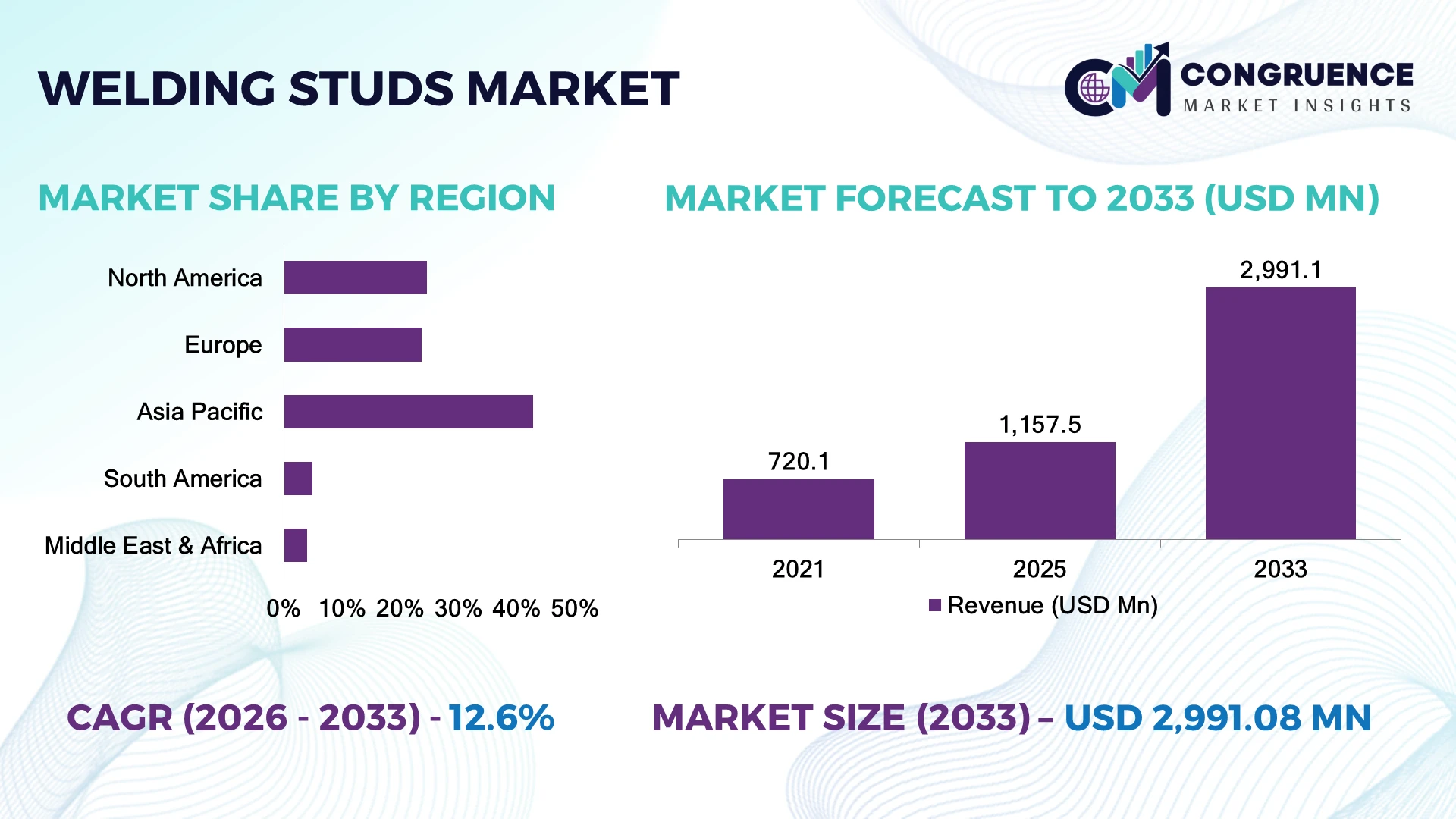
The Global Welding Studs Market was valued at USD 1,157.5 Million in 2025 and is anticipated to reach a value of USD 2,991.1 Million by 2033 expanding at a CAGR of 12.6% between 2026 and 2033. Growth is driven by expanding structural steel fabrication, automated stud welding adoption, and increasing infrastructure, shipbuilding, renewable energy, and industrial manufacturing projects.
China dominates the Welding Studs market with approximately 37% of global production capacity, supported by large-scale steel manufacturing, infrastructure investment, and automated fabrication facilities. Compared with Germany, China produces nearly four times more industrial welding fasteners, while over 62% of large fabrication plants utilize CNC-integrated stud welding systems. Ongoing global supply-chain diversification following geopolitical manufacturing realignment has accelerated regional production investments across Asia and North America.
Manufacturers strengthening automation capabilities, localized production, and high-performance fastening solutions are securing long-term competitive advantage.
Market Size & Growth: USD 1,157.5 million in 2025 to USD 2,991.1 million by 2033 at 12.6% CAGR, driven by automated steel fabrication.
Top Growth Drivers: Infrastructure expansion (+35%), renewable energy projects (+29%), robotic welding adoption (+26%).
Short-Term Forecast: By 2028, welding cycle time declines by approximately 21% through robotic automation.
Emerging Technologies: Robotic stud welding, AI-assisted quality inspection, and advanced alloy studs improve manufacturing efficiency.
Regional Leaders: Asia-Pacific, North America, and Europe lead through industrial manufacturing and infrastructure investments.
Consumer/End-User Trends: Approximately 57% of heavy fabrication facilities prioritize automated stud welding equipment.
Pilot/Case Example: A 2026 automated fabrication project increased fastening productivity by nearly 30%.
Competitive Landscape: Leading manufacturers collectively control approximately 49% of the global market through engineering expertise.
Regulatory & ESG Impact: Precision welding technologies reduce material waste by approximately 16%.
Investment & Funding: More than USD 1.4 billion supports automated manufacturing expansion and capacity modernization.
Innovation & Future Outlook: Digital welding systems and lightweight fastening solutions are transforming industrial production.
The Welding Studs market is advancing through robotic welding systems, high-strength alloy materials, and automated quality inspection technologies. Approximately 48% of new industrial production lines now integrate robotic stud welding to improve productivity and fastening consistency. Supply-chain localization and stricter structural quality requirements continue accelerating investment in advanced fastening technologies, setting the foundation for the strategic developments shaping future market competition.
The Welding Studs market has become strategically important as infrastructure modernization, renewable energy installations, industrial manufacturing, and shipbuilding projects require faster, stronger, and more consistent fastening solutions. Manufacturers are restructuring supply chains through regional production expansion to reduce procurement risks while supporting domestic infrastructure programs. This shift is encouraging greater investment in automated welding systems capable of delivering higher productivity with consistent quality.
Modern capacitor discharge and drawn arc stud welding systems improve fastening productivity by approximately 33% while reducing material waste by nearly 18% compared with conventional manual fastening processes. China leads high-volume manufacturing and export capacity, whereas Germany focuses on precision-engineered welding studs for advanced industrial equipment and automotive production. Over the next two to three years, approximately 55% of newly commissioned fabrication facilities are expected to integrate robotic stud welding and digital production monitoring.
Steel fabricators, EPC contractors, and industrial equipment manufacturers are strengthening partnerships with automation providers to improve throughput and reduce labor dependency. Companies are expanding localized manufacturing, investing in high-performance alloy development, and integrating real-time quality monitoring into production workflows. Organizations combining advanced fastening technologies, manufacturing flexibility, and reliable supply capabilities will establish stronger competitive positioning as structural fabrication continues shifting toward highly automated production environments.
The rapid transition toward automated steel fabrication is accelerating demand for welding studs across construction, shipbuilding, renewable energy, and heavy engineering sectors. Approximately 61% of newly commissioned structural fabrication facilities now incorporate robotic stud welding, while automated systems improve fastening productivity by nearly 34% and reduce rework by around 19%. The United States continues expanding domestic infrastructure and manufacturing capacity, encouraging fabricators to adopt automated fastening technologies that improve throughput and quality consistency. This operational shift shortens project schedules and lowers labor dependency. Manufacturers are responding through investments in robotic welding equipment, high-strength stud development, and partnerships with industrial automation providers. Competitive differentiation increasingly depends on delivering precision-engineered fastening systems compatible with digitally integrated production environments.
Manufacturing welding studs remains highly dependent on stable supplies of carbon steel, stainless steel, and specialty alloy materials. Raw materials account for approximately 48% of production costs, while fluctuations in alloy pricing have increased procurement expenditure by nearly 17% for several industrial fastener manufacturers. Germany's engineering sector continues facing elevated specialty steel procurement costs following global supply-chain realignment and energy-intensive steel production challenges. These conditions reduce pricing flexibility, compress operating margins, and complicate long-term supply planning for fabricators serving infrastructure and industrial projects. Companies are mitigating exposure through localized sourcing strategies, long-term steel procurement agreements, diversified supplier networks, and expanded recycling of production scrap to strengthen manufacturing resilience and improve cost predictability.
Digital manufacturing is creating high-value opportunities for intelligent stud welding systems capable of improving productivity and quality assurance. Approximately 46% of advanced fabrication facilities now evaluate AI-assisted welding inspection, while digital process monitoring reduces quality deviations by nearly 24%. Japan is accelerating factory modernization through connected production environments where automated fastening systems exchange real-time performance data with manufacturing execution platforms. Equipment suppliers are investing in sensor-enabled welding guns, predictive maintenance software, and collaborative robotics to strengthen production efficiency. A significant strategic opportunity lies in supplying integrated hardware, software, and lifecycle service packages that improve equipment utilization while generating recurring aftermarket business beyond conventional welding stud sales.
Expanding automated stud welding operations requires specialized programming, welding process optimization, and equipment maintenance capabilities that remain difficult to scale. Approximately 39% of fabrication companies report shortages of qualified robotic welding technicians, while commissioning advanced welding cells increases implementation timelines by nearly 21%. South Korea's advanced manufacturing sector continues increasing demand for digitally skilled welding personnel as industrial automation expands across heavy fabrication. Limited technical expertise affects deployment consistency, equipment utilization, and long-term productivity. Manufacturers must strengthen workforce development through technical partnerships, digital training platforms, simulation-based certification, and simplified machine interfaces to ensure advanced welding technologies achieve consistent operational performance across increasingly automated production facilities.
Robotic Welding Becomes Standard: Automated stud welding installations have increased by approximately 32%, while robotic fastening improves production consistency by nearly 28% and reduces cycle time by around 22%. Persistent skilled labor shortages are accelerating automation investments. Manufacturers are expanding robotic integration partnerships and redesigning production workflows to maximize throughput and quality control.
High-Strength Alloys Gain Preference: Demand for high-strength stainless steel and alloy welding studs has risen by approximately 27% as renewable energy, offshore structures, and heavy industrial equipment require superior corrosion resistance. Material optimization lowers maintenance requirements by nearly 18%. Producers are expanding advanced metallurgy capabilities and strengthening specialized alloy supply agreements.
Digital Quality Monitoring Expands: Approximately 44% of automated fabrication facilities now deploy real-time weld monitoring systems capable of reducing defect rates by nearly 25%. Increasing customer quality requirements are driving adoption of digital inspection technologies. Equipment manufacturers are integrating sensors, machine analytics, and automated documentation into welding platforms to improve production traceability.
Localized Production Reshapes Supply: Regional manufacturing capacity has expanded by approximately 20%, reducing average delivery times by nearly 15% amid continuing supply-chain diversification. Industrial buyers increasingly prioritize dependable local sourcing over lowest-cost procurement. Welding stud manufacturers are restructuring supplier networks, investing in regional production facilities, and standardizing product platforms to strengthen operational resilience and customer responsiveness.
Threaded welding studs account for approximately 58% of the global market because they provide secure mechanical fastening, excellent load-bearing performance, and compatibility with automated stud welding equipment across construction, shipbuilding, industrial machinery, and structural steel fabrication. Their standardized dimensions, broad material availability, and ease of installation make them the preferred solution for high-volume manufacturing. Unthreaded welding studs continue serving permanent structural applications, while shear connectors remain strategically important for composite steel-concrete construction and bridge infrastructure where high structural integrity is essential.
Insulation pins are emerging as the fastest-growing product category as industrial plants, LNG facilities, and commercial buildings increase thermal insulation installations. Approximately 42% of newly commissioned energy infrastructure projects now utilize advanced insulation fastening systems, while robotic stud welding improves installation productivity by nearly 29%. Manufacturers are expanding corrosion-resistant product portfolios, investing in automated production lines, and collaborating with EPC contractors to address specialized application requirements. Investment priorities are steadily shifting toward application-specific welding studs offering higher durability and improved installation efficiency.
A 2026 assessment published by the American Welding Society highlighted continued expansion of automated stud welding in structural steel fabrication, driven by increasing demand for consistent fastening quality and higher production efficiency.
Construction represents approximately 46% of Welding Studs demand, supported by structural steel buildings, commercial complexes, bridges, industrial facilities, and public infrastructure projects requiring durable mechanical fastening. Welding studs simplify installation while providing strong structural connections without additional drilling or bolting, improving project productivity and reducing fabrication time. Shipbuilding remains an established application requiring corrosion-resistant fastening systems, while automotive and industrial equipment manufacturing continue utilizing precision welding studs for lightweight assemblies and automated production environments.
Renewable energy infrastructure is the fastest-growing application as offshore wind farms, utility-scale solar projects, and energy storage facilities require durable fastening systems capable of operating under demanding environmental conditions. Approximately 34% of newly developed renewable energy facilities integrate automated stud welding during structural assembly, while digital fabrication reduces installation time by nearly 22%. Manufacturers are strengthening automation capabilities, expanding customized fastening solutions, and integrating quality assurance technologies. Demand is increasingly concentrating in applications requiring structural reliability, rapid installation, and long-term operational durability.
A 2025 industry assessment by the Steel Construction Institute indicated that automated stud welding continues gaining adoption across structural steel projects to improve installation consistency and reduce fabrication complexity.
Construction contractors account for approximately 44% of Welding Studs procurement due to extensive deployment across commercial buildings, transportation infrastructure, industrial facilities, and public works projects. Large-scale structural fabrication requires standardized fastening systems capable of supporting accelerated construction schedules and consistent quality. Industrial manufacturers remain major purchasers for heavy machinery and production equipment, while shipyards continue investing in corrosion-resistant welding studs designed for demanding marine environments and long operational life.
Renewable energy developers represent the fastest-growing end-user segment as offshore wind, utility-scale solar, and hydrogen infrastructure projects expand globally. Approximately 31% of new energy infrastructure developments specify automated stud welding systems to improve assembly speed and structural reliability, while digitally controlled welding equipment enhances fastening consistency by nearly 24%. Manufacturers are developing sector-specific product lines, expanding partnerships with EPC contractors, and offering customized engineering support to strengthen competitive positioning. Future purchasing patterns increasingly favor suppliers capable of delivering specialized fastening systems with dependable technical service and localized supply capabilities.
A 2026 enterprise survey conducted by the International Institute of Welding found that infrastructure and industrial contractors increasingly prioritize automated stud welding solutions to improve productivity, weld consistency, and project delivery efficiency.
Asia-Pacific accounted for the largest market share at 42.8% in 2025 however, Middle East & Africa is expected to register the fastest growth, expanding at a CAGR of 13.8% between 2026 and 2033.

Infrastructure Modernization Accelerates Automated Fastening
North America represents approximately 24.6% of the global Welding Studs market, supported by expanding infrastructure renewal, industrial automation, energy projects, and advanced steel fabrication. Structural steel contractors, EPC companies, and heavy equipment manufacturers increasingly deploy automated stud welding systems to improve installation efficiency and reduce labor dependence. Nearly 54% of large fabrication facilities now utilize robotic stud welding for repetitive fastening operations, improving production consistency and project execution. Manufacturers are strengthening domestic production, expanding engineering support, and integrating digital welding technologies to address demand from transportation, commercial construction, and renewable energy projects while enhancing supply-chain resilience.
United States Market Outlook: The United States leads regional demand through large-scale infrastructure investment, advanced manufacturing capabilities, and extensive structural steel construction activity. Commercial buildings, industrial facilities, transportation networks, and energy installations continue driving high-volume welding stud consumption. Approximately 61% of newly commissioned automated steel fabrication lines incorporate digitally controlled stud welding equipment, reinforcing the country's position as North America's largest industrial fastening market.
Precision Engineering Supports Industrial Modernization
Europe maintains a strong position through advanced manufacturing, industrial automation, and strict structural quality standards across construction, transportation, and heavy engineering sectors. The region accounts for approximately 23.7% of global demand, supported by increasing adoption of automated stud welding in steel fabrication and industrial equipment production. Around 48% of precision fabrication facilities now integrate robotic fastening technologies to improve weld consistency and reduce production variability. Manufacturers continue investing in high-strength alloy products and digitally controlled welding systems to support advanced engineering applications.
Germany Market Outlook: Germany remains the region's most influential market due to its world-class engineering sector, advanced industrial automation, and extensive structural steel fabrication capabilities. Heavy machinery manufacturers, automotive suppliers, and industrial contractors increasingly specify precision-engineered welding studs for automated production environments. Approximately 44% of industrial fabrication facilities operate digitally integrated welding systems, supporting high-quality fastening across complex manufacturing operations.
Manufacturing Scale Drives Global Supply
Asia-Pacific leads the global Welding Studs market with approximately 42.8% share, supported by large-scale steel production, industrial manufacturing, infrastructure expansion, and shipbuilding activities. The region serves as the primary manufacturing base for welding studs, benefiting from integrated steel supply chains and competitive production economics. Nearly 57% of global automated stud welding equipment installations are concentrated within major manufacturing hubs across the region. Producers continue expanding production capacity, investing in robotic fabrication, and strengthening export-oriented manufacturing to meet rising international demand.
China Market Outlook: China dominates regional production through its extensive steel industry, large infrastructure pipeline, and globally competitive manufacturing ecosystem. Structural fabrication, shipbuilding, railway construction, and renewable energy projects generate sustained demand for welding studs. Approximately 37% of global welding stud manufacturing capacity is concentrated in China, enabling efficient domestic supply while supporting international exports through large-scale automated production facilities.
Industrial Construction Supports Market Expansion
South America is witnessing steady demand as industrial construction, mining infrastructure, transportation projects, and energy developments expand across key economies. Welding studs are increasingly adopted in structural steel fabrication where installation speed and long-term durability are operational priorities. Approximately 29% of new industrial construction projects now incorporate automated stud welding systems, improving fastening consistency while reducing project completion time. Manufacturers are strengthening regional distribution networks and technical service capabilities, although infrastructure modernization and production capacity remain uneven across several markets.
Brazil Market Outlook: Brazil represents the region's largest market, supported by expanding industrial manufacturing, commercial construction, mining investments, and transportation infrastructure upgrades. Structural steel contractors increasingly adopt automated welding technologies to improve productivity and reduce labor-intensive installation processes. Approximately 46% of South America's heavy industrial fabrication activity is concentrated in Brazil, reinforcing its leadership in regional demand for advanced fastening solutions.
Mega Infrastructure Projects Strengthen Demand
The Middle East & Africa market is expanding through large-scale infrastructure development, industrial diversification, energy investments, and commercial construction projects requiring reliable structural fastening systems. Welding studs are increasingly specified for steel-intensive developments including transportation networks, industrial facilities, logistics hubs, and renewable energy installations. Approximately 33% of newly awarded large infrastructure contracts within the Gulf region incorporate automated structural steel fabrication methods. Manufacturers are establishing regional partnerships, expanding inventory networks, and improving localized engineering support to serve complex construction projects efficiently.
Saudi Arabia Market Outlook: Saudi Arabia leads regional demand through extensive infrastructure modernization, industrial expansion, and large-scale construction initiatives under long-term economic diversification programs. Steel-intensive developments across logistics, energy, manufacturing, and commercial construction continue increasing demand for automated fastening technologies. Approximately 36% of Gulf industrial steel fabrication projects are currently concentrated in Saudi Arabia, strengthening its position as the region's primary market for advanced welding stud applications.
Global fastening specialists including Nelson Stud Welding, HBS Studweld, Tru-Weld, Köco GmbH, and Soyer compete directly with regional stud manufacturers and low-cost steel fastener suppliers for infrastructure, shipbuilding, and industrial fabrication contracts. The top five companies collectively control approximately 47% of the global market. Competition centers on welding performance, alloy quality, production lead time, and application-specific customization rather than price alone. Automated manufacturing improves production efficiency by nearly 26%, precision machining reduces dimensional variation by approximately 18%, and localized inventories shorten delivery cycles by around 20%. Leading manufacturers are expanding regional production, partnering with welding equipment suppliers, introducing corrosion-resistant alloys, and vertically integrating machining with stud welding technologies. Competition is shifting toward complete fastening solutions combining engineered studs, welding equipment, and technical support. Stringent certification requirements, metallurgical expertise, and automated production capabilities remain key entry barriers. Winning requires certified quality, reliable supply, advanced engineering support, and application-specific product innovation.
Nelson Stud Welding (Stanley Engineered Fastening)
HBS Studweld GmbH
Soyer GmbH
Köco GmbH
Tru-Weld Stud Welding
Taylor Studwelding Systems Ltd.
Sunbelt Stud Welding, Inc.
Midwest Fasteners, Inc.
Stud Craft (India) Pvt. Ltd.
Changzhou Longren Mechanical & Electrical Co., Ltd.
PFS Fastening Technology LLC
Image Industries, Inc.
Stud Welding Products, Inc.
Welding stud manufacturing is increasingly driven by robotic stud welding, CNC machining, capacitor discharge welding, and digitally controlled drawn arc welding systems. Approximately 56% of large fabrication facilities now utilize automated stud welding cells, improving fastening consistency by nearly 29% while reducing production downtime by around 18%. Vision-based inspection systems and real-time weld parameter monitoring strengthen quality assurance across construction, shipbuilding, and industrial manufacturing.
Emerging technologies include AI-assisted weld inspection, digital twin-enabled production planning, predictive maintenance, and high-performance corrosion-resistant alloy development. Compared with conventional manual stud welding, robotic systems improve installation productivity by approximately 35% while lowering weld defects by nearly 24%. Large infrastructure contractors and precision engineering manufacturers gain the greatest competitive advantage through automated quality control, standardized production, and integrated manufacturing execution systems that enhance operational reliability.
Between 2026 and 2028, intelligent welding cells, sensor-enabled welding guns, and connected production analytics will become standard across advanced fabrication facilities. Automated welding platforms are expected to exceed 60% adoption among high-volume manufacturers, while predictive quality monitoring improves first-pass acceptance rates by approximately 21%. Companies investing now in integrated automation, advanced metallurgy, and digital production intelligence will strengthen manufacturing flexibility, reduce operating costs, and secure long-term competitiveness in structural fastening applications.
January 2025 Hilti released the updated Cordless Stud Fusion technical platform with enhanced process controls for F-BT stud installation, improving weld consistency and supporting standardized field qualification across structural steel applications. Source: Hilti
October 2025 Nelson Stud Welding received reissued ICC-ES approval for its shear connector studs under updated 2024 International Building Code requirements, strengthening compliance for composite steel construction and supporting broader specification acceptance. Source: ICC-ES
October 2025 Nelson Stud Welding updated its global standard product catalog, expanding application coverage for threaded studs, shear connectors, insulation pins, and specialty ferrules, supporting broader industrial and structural fabrication requirements. Source: Stanley Engineered Fastening
February 2026 Engineering guidance highlighted increased scrutiny of stud-to-stud welding practices, reinforcing compliance with established stud welding standards and encouraging fabricators to prioritize approved installation methods for structural integrity. Source: SEPco Consulting Engineers.
This report provides a comprehensive assessment of the Welding Studs market across product types, applications, end-user industries, manufacturing technologies, and major regional markets. It evaluates threaded studs, unthreaded studs, shear connectors, insulation pins, and specialized fastening solutions used in construction, shipbuilding, industrial equipment, renewable energy, transportation, and heavy engineering. The analysis also covers robotic stud welding, capacitor discharge welding, drawn arc welding, AI-enabled inspection, and digital manufacturing technologies shaping production efficiency and fastening quality.
The report delivers strategic insights into product adoption, manufacturing capacity, competitive positioning, regional production dynamics, and supply-chain transformation between 2026 and 2033. Approximately 58% of structural steel fabrication projects now prioritize automated stud welding technologies, reflecting the industry's transition toward digitally integrated manufacturing. The study supports investment planning, production expansion, supplier benchmarking, technology adoption, and long-term competitive positioning across infrastructure, industrial fabrication, energy, and advanced engineering applications.
| Report Attribute/Metric | Report Details |
|---|---|
|
Market Revenue in 2025 |
USD 1,157.5 Million |
|
Market Revenue in 2033 |
USD 2,991.1 Million |
|
CAGR (2026 - 2033) |
12.6% |
|
Base Year |
2025 |
|
Forecast Period |
2026 - 2033 |
|
Historic Period |
2021 - 2025 |
|
Segments Covered |
By Type
By Application
By End-User
|
|
Key Report Deliverable |
Revenue Forecast, Growth Trends, Market Dynamics, Segmental Overview, Regional and Country-wise Analysis, Competition Landscape |
|
Region Covered |
North America, Europe, Asia-Pacific, South America, Middle East, Africa |
|
Key Players Analyzed |
Nelson Stud Welding (Stanley Engineered Fastening), HBS Studweld GmbH, Soyer GmbH, Köco GmbH, Tru-Weld Stud Welding, Taylor Studwelding Systems Ltd., Sunbelt Stud Welding, Inc., Midwest Fasteners, Inc., Stud Craft (India) Pvt. Ltd., Changzhou Longren Mechanical & Electrical Co., Ltd., PFS Fastening Technology LLC, Image Industries, Inc., Stud Welding Products, Inc. |
|
Customization & Pricing |
Available on Request (10% Customization is Free) |




