
Reports
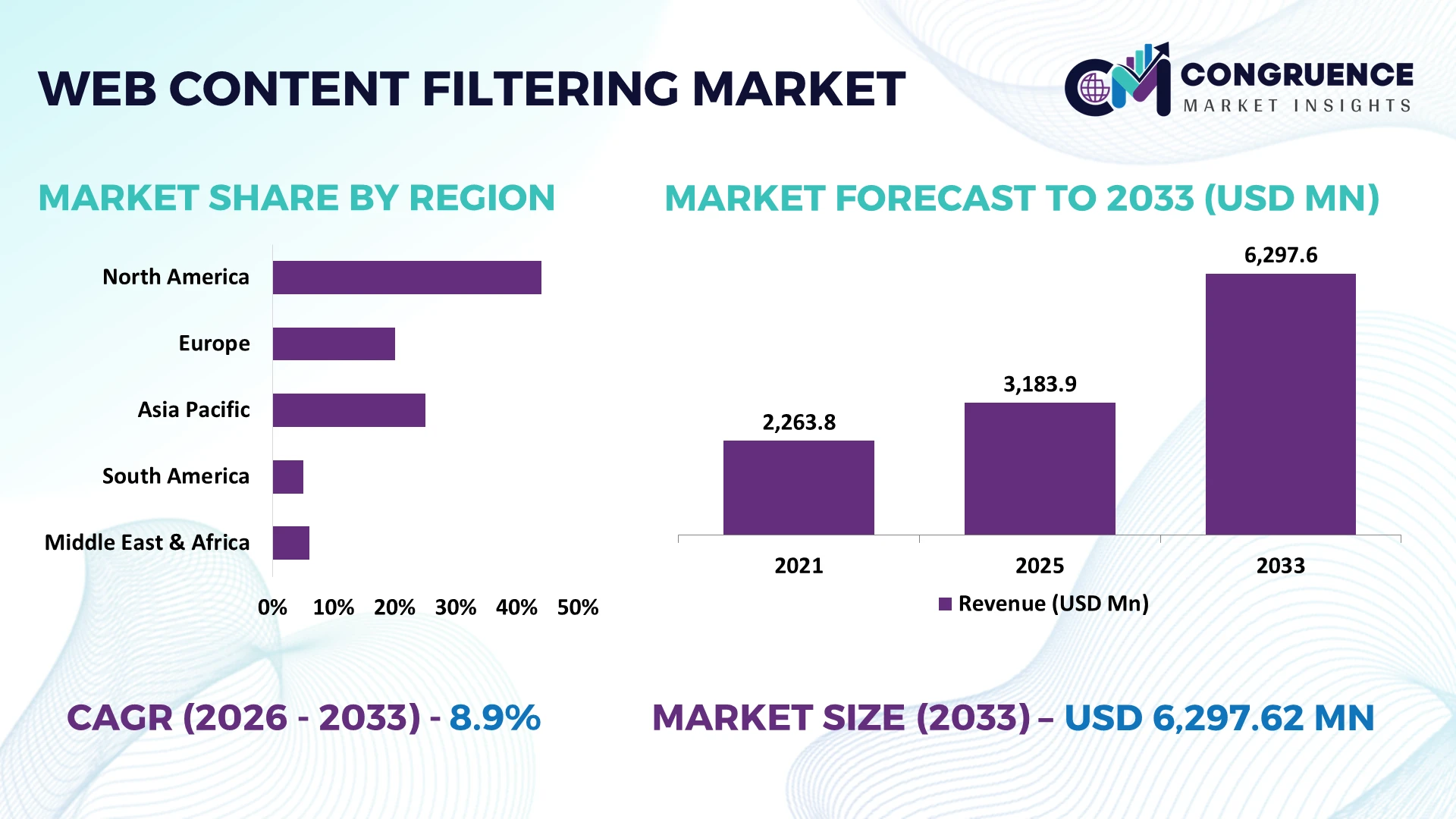
The Global Web Content Filtering Market was valued at USD 3183.85 Million in 2025 and is anticipated to reach a value of USD 6297.62 Million by 2033 expanding at a CAGR of 8.9% between 2026 and 2033. Growth is driven by secure web gateways, DNS filtering, zero-trust adoption, cloud-delivered security, encrypted-traffic inspection, and AI-based detection of phishing, malware, and malicious web destinations.
The United States accounts for approximately 38–42% of global web content filtering demand, supported by extensive cloud adoption, cybersecurity spending, regulated industries, and distributed workforces. More than 90% of large organizations use cloud services, expanding requirements for policy enforcement beyond corporate networks. Compared with Germany, the U.S. has greater hyperscale and SaaS deployment concentration, while European adoption faces stricter privacy controls. U.S.-China cyber tensions and state-linked threat activity are reinforcing investment in DNS security, zero-trust access, and real-time threat intelligence.
Strategically, vendors combining cloud-native filtering, AI classification, encrypted-traffic visibility, and zero-trust integration gain stronger positioning as security enforcement shifts from network perimeters toward users, browsers, and cloud applications.
Market Size & Growth: USD 3,183.85 million in 2025 reaches USD 6,297.62 million by 2033 at 8.9% CAGR, driven by cloud-delivered secure web gateways.
Top Growth Drivers: Cloud migration contributes approximately 35%, phishing and malware protection 30%, and zero-trust transformation 20% to incremental demand.
Short-Term Forecast: By 2028, AI-assisted URL classification can reduce manual web-policy investigation workloads by approximately 25–35%.
Emerging Technologies: AI classification, browser isolation, and DNS-layer security can block malicious destinations before connection, reducing downstream remediation requirements by 20–30%.
Regional Leaders: By 2033, North America approaches USD 2.6 billion, Europe USD 1.6 billion, and Asia-Pacific USD 1.5 billion as cloud security adoption expands.
Consumer/End-User Trends: Large enterprises represent approximately 55–60% of advanced filtering deployments as hybrid work extends policy enforcement beyond corporate gateways.
Pilot/Case Example: In 2025, cloud-delivered filtering deployments consolidated 3 security functions—web filtering, threat inspection, and access policy—within unified security platforms.
Competitive Landscape: Broadcom holds an estimated 10–15% position, competing with Cisco, Cloudflare, Palo Alto Networks, Fortinet, and Zscaler across enterprise web security.
Regulatory & ESG Impact: NIS2 introduces cybersecurity obligations across 18 critical sectors, strengthening requirements for controlled web access, threat detection, logging, and incident management.
Investment & Funding: More than USD 1 billion in broader secure-access and cloud-security investment supports browser security, zero-trust platforms, threat intelligence, and security consolidation.
Innovation & Future Outlook: AI-driven filtering increasingly evaluates 3+ signals—URL reputation, content behavior, and user context—shifting protection from static blocklists toward adaptive enforcement.
The Web Content Filtering Market is shifting from appliance-based URL blocking toward cloud-delivered secure web gateways, DNS-layer controls, browser isolation, AI classification, and zero-trust policy enforcement. Financial services, government, healthcare, education, and distributed enterprises represent high-intensity deployment environments because users increasingly access SaaS and web applications outside managed networks. With more than 90% of large organizations using cloud services, enforcement is moving closer to identities and endpoints. NIS2 requirements across European critical sectors further strengthen logging and access-control priorities, establishing the strategic context for platform consolidation and adaptive web security.
Web content filtering is becoming a strategic security control as enterprise traffic shifts from corporate networks toward SaaS platforms, unmanaged browsers, remote endpoints, and cloud applications. More than 90% of large organizations use cloud services, weakening traditional perimeter enforcement. NIS2 requirements across 18 critical sectors are simultaneously increasing attention to access governance, logging, threat detection, and incident accountability, pushing filtering into broader zero-trust and secure-access architectures.
Cloud-delivered filtering can consolidate URL control, malware inspection, DNS security, and access policies, reducing separate security tools by 20–30% in rationalized environments compared with appliance-centric architectures. The United States leads cloud-native deployment and security-platform consolidation, while Germany and France emphasize privacy, data residency, and regulatory controls. Through 2026–2028, AI classification, browser isolation, and identity-aware filtering will increasingly replace static URL-category policies.
A distributed enterprise can enforce identical browsing policies across headquarters, home workers, and mobile devices through one cloud security layer, eliminating backhauling to centralized gateways. Cisco, Palo Alto Networks, Cloudflare, Fortinet, and Zscaler are expanding integrated security platforms, threat intelligence, and browser controls. Competitive advantage increasingly depends on stopping web threats without adding latency or operational complexity.
Cloud migration and distributed work are shifting web filtering from centralized appliances toward cloud-delivered enforcement. More than 90% of large enterprises use cloud services, while encrypted HTTPS traffic represents over 90% of browser activity, requiring filtering platforms to inspect destinations, identities, and encrypted sessions without degrading performance. Phishing remains involved in a substantial share of initial-access incidents, making malicious URL control operationally important. U.S. enterprises are increasingly consolidating secure web gateways with zero-trust access and cloud security platforms rather than maintaining standalone filters. Cisco, Palo Alto Networks, Zscaler, Cloudflare, and Fortinet are responding through unified policy engines, DNS security, threat intelligence, and browser controls. The strategic shift is from filtering websites to continuously governing user-to-web interactions across every network location.
Encryption protects legitimate traffic but reduces native visibility for security gateways, forcing enterprises to decrypt, inspect, and re-encrypt sessions when policy permits. HTTPS exceeds 90% of mainstream web traffic, while TLS inspection can introduce 10–30% performance overhead depending on hardware, cipher strength, and traffic composition. Privacy requirements further restrict inspection of sensitive categories such as healthcare and financial activity. Germany’s strict privacy environment illustrates the operational tension between cybersecurity monitoring and data-protection obligations. Enterprises must therefore maintain bypass rules, certificate management, endpoint controls, and additional processing capacity. Vendors are reducing exposure through selective inspection, metadata-based classification, DNS filtering, and endpoint/browser enforcement. The non-obvious restraint is computational economics: stronger encryption increases security-processing requirements even when overall employee traffic remains unchanged.
Enterprise browsers and remote browser isolation create an opportunity to move security enforcement directly into the user’s web session. Browser-level controls can inspect downloads, uploads, copy-paste activity, SaaS interactions, and risky destinations without routing every connection through traditional gateways. Organizations can eliminate 20–30% of overlapping point-security functions when browser, DNS, and secure-access controls are rationalized effectively, while isolation can prevent 100% of untrusted active web content from executing locally. U.S. technology firms are integrating browser security with zero-trust identity and data-loss prevention. Vendors are investing in isolated rendering, AI-assisted content classification, SaaS controls, and endpoint partnerships. A less obvious opportunity is contractor security: organizations can enforce corporate browsing controls on unmanaged devices without taking full ownership of the endpoint.
Generative AI, encrypted applications, dynamic websites, and rapidly changing domains are making binary allow/block policies operationally inadequate. Automated classifiers must distinguish legitimate AI services from phishing, shadow SaaS, malicious redirects, and inappropriate content without disrupting productivity. Even a 1% false-positive rate becomes significant when enterprises process millions of web requests daily, while security teams can face thousands of automated alerts. NIS2 implementation across 18 critical sectors also increases requirements for defensible controls and incident evidence. Vendors must improve contextual classification, explainable policy decisions, multilingual models, threat-intelligence freshness, and automated exception management. Companies are expanding AI-assisted policy engines and behavioral analytics accordingly. The long-term challenge is precision at scale: aggressive filtering improves protection only when false positives remain low enough to preserve employee workflows and application availability.
Policy Engines Become Context Aware: Enterprises are replacing static category lists with policies combining identity, device posture, application context, and threat reputation. More than 90% of browser traffic is encrypted, while organizations commonly manage 100+ SaaS applications. Vendors are integrating continuous risk scoring and automated policy updates, reducing manual rule maintenance and enabling differentiated controls for employees, contractors, and unmanaged endpoints.
DNS Protection Moves Upstream: Organizations increasingly block malicious infrastructure during DNS resolution rather than waiting for HTTP inspection. DNS-layer controls can evaluate millions of domain requests without decrypting application payloads, while protective DNS can prevent connections before content reaches endpoints. Government cybersecurity mandates are accelerating adoption. Providers are expanding recursive DNS security, newly registered-domain detection, and threat-intelligence automation, lowering gateway processing requirements while improving protection for roaming users.
Security Platforms Consolidate Controls: Enterprises are reducing overlapping filtering, firewall, access-control, and threat-inspection products as security teams face operational complexity. Consolidation programs increasingly target reductions of 20–30% in point tools, while unified platforms can manage 3–5 web-security functions through one policy framework. Cisco, Palo Alto Networks, Fortinet, and Zscaler are integrating filtering with broader security stacks, simplifying policy administration and procurement.
Encrypted Applications Reshape Visibility: TLS 1.3, QUIC, and encrypted DNS are changing how filtering engines identify web activity because traditional network inspection sees less application metadata. HTTPS exceeds 90% of browser traffic, while QUIC commonly uses UDP/443. Vendors are shifting classification toward endpoint telemetry, DNS intelligence, browser controls, and behavioral signals, allowing security teams to preserve visibility without universally decrypting sensitive traffic.
URL Filtering represents approximately 40–45% of Web Content Filtering demand because enterprises rely on granular category, reputation, path, and application policies across employee browsing environments. Mature secure web gateways integrate URL databases with malware inspection and identity controls, allowing centralized enforcement across thousands of users. Keyword Filtering remains relevant for education and tightly controlled environments but provides less contextual accuracy against dynamic applications. IP Filtering supports infrastructure-level blocking, although shared hosting and cloud services reduce the precision of IP-only decisions.
DNS Filtering is the fastest-growing type as organizations move protection earlier in the connection workflow. Protective DNS blocks domains before web sessions are established, reducing endpoint exposure without requiring full content inspection. With encrypted browser traffic exceeding 90%, DNS intelligence increasingly complements URL-level controls. Vendors are expanding domain reputation, algorithmically generated-domain detection, newly registered-domain analysis, and roaming-client coverage. Investment priorities are shifting toward layered URL-plus-DNS architectures rather than dependence on one filtering mechanism.
Web Security represents approximately 35–40% of application demand because organizations require centralized protection against phishing, malicious URLs, exploit delivery, unsafe downloads, and compromised websites. Malware Prevention closely complements this function as encrypted sessions increasingly carry web-delivered threats. Access Control remains established across corporate and institutional environments, where identity and acceptable-use policies determine which applications and content categories users can reach. Content Management retains importance in education and regulated workplaces requiring granular browsing restrictions.
Compliance is the fastest-growing application as cybersecurity regulations increase requirements for policy enforcement, logging, risk controls, and demonstrable governance. NIS2 applies cybersecurity obligations across 18 critical sectors in the European Union, expanding operational accountability beyond traditional technology organizations. Providers are integrating audit trails, identity-aware rules, data controls, and automated reporting into filtering platforms. Business demand is therefore moving beyond website blocking toward security systems that simultaneously prevent threats and produce evidence supporting governance requirements.
Enterprises account for approximately 45–50% of end-user demand because distributed workforces, SaaS adoption, branch networks, and unmanaged endpoints require consistent web policies beyond traditional corporate gateways. Financial Institutions maintain particularly stringent controls around phishing, malware, data leakage, and regulatory monitoring. Government Agencies emphasize protective DNS, secure browsing, and centralized policy enforcement, while Schools depend heavily on category and keyword controls to manage student internet access across large device fleets.
Healthcare Organizations are the fastest-growing end-user segment as cloud applications, connected clinical environments, third-party access, and sensitive patient information increase browser-related exposure. More than 90% of modern browser traffic is encrypted, forcing healthcare security teams to balance inspection with privacy requirements. Vendors are responding with healthcare-specific policy templates, selective TLS inspection, DNS security, identity integration, and managed security services. Competitive positioning increasingly depends on delivering sector-specific controls without increasing administration burdens for security teams facing persistent staffing constraints.
North America accounted for the largest market share at 41% in 2025 however, Asia-Pacific is expected to register the fastest growth, expanding at a CAGR of 10.8% between 2026 and 2033.

Cloud Security Consolidation Reshapes Enterprise Filtering
North America represents approximately 41% of global Web Content Filtering activity, supported by extensive SaaS usage, distributed workforces, mature cybersecurity procurement, and large cloud infrastructure. U.S. enterprises are replacing standalone URL-filtering appliances with secure web gateway, DNS security, zero-trust, and data-protection platforms. HTTPS exceeds 90% of mainstream browser traffic, increasing reliance on selective TLS inspection, endpoint telemetry, and domain intelligence. Federal adoption of Protective DNS reinforces pre-connection threat blocking, while financial services and healthcare organizations require identity-aware controls and detailed auditability. Cisco, Cloudflare, Palo Alto Networks, Fortinet, and Zscaler are consolidating web controls into broader security architectures. Operationally, platform consolidation can remove 20–30% of overlapping point-security functions where enterprises rationalize filtering, access, and threat-inspection tools.
United States Market Outlook: The United States dominates regional deployment through hyperscale cloud adoption, federal cybersecurity programs, financial-services security requirements, and large distributed enterprises. Protective DNS deployment across government environments strengthens demand for malicious-domain blocking before connection establishment. U.S. buyers increasingly prioritize cloud-delivered policy enforcement, browser controls, threat intelligence, and integrations spanning identity, endpoint, and secure-access infrastructure.
Regulation Elevates Policy Enforcement Requirements
Europe accounts for approximately 26% of global Web Content Filtering activity, with adoption shaped strongly by cybersecurity regulation, privacy requirements, hybrid work, and enterprise cloud migration. NIS2 establishes cybersecurity obligations across 18 critical sectors, increasing requirements for access governance, threat monitoring, incident controls, and auditable security policies. GDPR simultaneously creates constraints around indiscriminate traffic inspection, encouraging selective TLS decryption, DNS intelligence, and privacy-aware classification. Germany, France, the Netherlands, and the United Kingdom maintain substantial enterprise security ecosystems, while public-sector organizations increasingly integrate web filtering with zero-trust access. Vendors are expanding European cloud infrastructure, policy localization, and data-residency capabilities. The competitive requirement differs from purely performance-driven markets: providers must deliver strong threat visibility while minimizing unnecessary exposure of personal or sensitive web-session information.
Germany Market Outlook: Germany combines a large industrial base, regulated financial institutions, healthcare networks, government agencies, and security-sensitive manufacturers. Enterprises increasingly require web controls compatible with GDPR and sector-specific cybersecurity obligations. Germany’s implementation of NIS2-related requirements broadens security accountability across critical and important entities, strengthening demand for auditable filtering, identity-aware access, DNS protection, and locally governed security infrastructure.
Digital Scale Accelerates Security Modernization
Asia-Pacific represents approximately 22% of global Web Content Filtering activity, supported by rapid cloud migration, expanding digital workforces, cybersecurity regulation, and large education and government networks. India’s expanding digital-services economy generates substantial demand for cloud-delivered filtering across technology services, banking, education, and public-sector environments. Australia maintains mature secure-access adoption, while Japan prioritizes enterprise-grade controls, reliability, and regulated-data protection. Singapore functions as a regional cybersecurity and cloud hub serving multinational enterprises. Mobile-first internet usage and geographically distributed operations make DNS-layer enforcement and lightweight endpoint controls particularly valuable. Vendors are expanding local points of presence, managed security partnerships, multilingual classification, and cloud-native policy engines. Enterprises increasingly favor subscription platforms that scale across branches and remote users without requiring dedicated filtering appliances at every location.
India Market Outlook: India offers significant deployment scale through IT services, banking, government digitalization, education, and cloud-native enterprises. Internet usage exceeds 900 million users, creating an extensive digital threat surface for organizations serving employees and customers online. Enterprise buyers increasingly combine DNS filtering, URL controls, endpoint protection, and identity policies, while managed-security providers extend advanced filtering to organizations lacking large internal security teams.
Cloud Adoption Expands Managed Filtering
South America represents approximately 5% of global Web Content Filtering activity, with Brazil driving enterprise adoption across banking, telecommunications, government, education, retail, and cloud-based services. Organizations are gradually replacing on-premises filtering appliances with subscription-based gateways and managed security services, reducing infrastructure ownership requirements. Brazil’s LGPD strengthens attention to data governance, while persistent phishing and credential theft increase demand for domain reputation and malicious-link controls. Chile, Colombia, and Argentina show expanding adoption among financial institutions and digitally intensive enterprises. Deployment remains constrained by cybersecurity skill shortages and uneven IT budgets, particularly among smaller organizations. Vendors are responding through channel partnerships, managed-service offerings, localized threat intelligence, and cloud points of presence. The operational opportunity centers on delivering enterprise-grade protection without requiring customers to maintain specialized filtering infrastructure internally.
Brazil Market Outlook: Brazil combines the region’s largest digital economy with sophisticated banking, fintech, telecommunications, and e-commerce ecosystems. LGPD compliance and high exposure to credential-based attacks strengthen demand for controlled browsing and threat intelligence. Local managed-security partners are important because organizations increasingly seek integrated web, DNS, endpoint, and identity protection while limiting internal infrastructure and specialized staffing requirements.
Digital Infrastructure Raises Security Requirements
Middle East & Africa represents approximately 6% of global Web Content Filtering activity, with deployment concentrated in the UAE, Saudi Arabia, Israel, South Africa, financial centers, government networks, and large infrastructure operators. Gulf countries are expanding cloud computing, digital government, financial technology, and smart infrastructure, increasing requirements for centralized web policy enforcement. Saudi Arabia’s cloud-first transformation and the UAE’s extensive government digitalization favor secure web gateways, DNS filtering, identity-aware access, and managed security. African adoption is more fragmented because enterprise cybersecurity maturity and connectivity vary substantially between markets. Vendors are responding with local cloud infrastructure, telecommunications partnerships, managed-security services, and Arabic-language classification capabilities. The strongest commercial model combines filtering with broader security platforms, reducing deployment complexity for organizations modernizing networks and cloud environments simultaneously.
Saudi Arabia Market Outlook: Saudi Arabia provides substantial demand through government digital services, banking, energy, healthcare, and Vision 2030 technology programs. Cloud adoption and data-localization requirements are encouraging security providers to strengthen domestic infrastructure and partnerships. Organizations increasingly favor integrated platforms combining web filtering, DNS protection, zero-trust access, threat intelligence, and centralized policy management across expanding digital operations.
Broadcom, Cisco, Zscaler, Palo Alto Networks, Fortinet, and Cloudflare compete across enterprise web security, with platform vendors challenging traditional gateway suppliers through cloud-native delivery. The top five providers collectively control approximately 45–50% of advanced deployments. Competition centers on threat-detection accuracy, latency, platform integration, and policy automation; AI-assisted classification can reduce investigation workloads 25–35%, while security consolidation can eliminate 20–30% of overlapping tools. Zscaler and Cloudflare emphasize globally distributed cloud enforcement, while Cisco, Palo Alto Networks, and Fortinet leverage broader networking and security portfolios. Broadcom retains strength in established secure-web-gateway environments. Competitive investment is shifting toward browser security, DNS intelligence, zero-trust integration, and unified policy engines rather than standalone URL databases. Large threat-intelligence datasets, global cloud infrastructure, enterprise integrations, and switching complexity create substantial entry barriers. Winning requires low-latency enforcement, accurate classification, scalable cloud delivery, regulatory alignment, and seamless integration across identity, endpoint, network, and data-security workflows.
Broadcom
Cisco
Zscaler
Palo Alto Networks
Fortinet
Cloudflare
Forcepoint
Check Point Software Technologies
Trend Micro
Netskope
Proofpoint
McAfee
DNSFilter
iboss
Current web content filtering combines cloud secure web gateways, DNS security, URL reputation, TLS inspection, and identity-aware policy engines. AI classification evaluates domain age, behavior, content, and threat intelligence, improving malicious-site detection roughly 10–20% over static category databases. DNS controls block connections before sessions begin, while cloud delivery removes appliance bottlenecks. Adoption is strongest among distributed enterprises, where encrypted traffic exceeds 90% of browser activity.
Emerging technologies include remote browser isolation, enterprise browsers, AI-driven DLP, and contextual risk scoring. Compared with legacy allow/block filtering, browser isolation prevents untrusted active webpage code from executing locally while preserving controlled access. AI-enhanced DNS tunneling detection has demonstrated an 11.1% detection improvement. Platform vendors benefit because integrated SWG, CASB, ZTNA, DNS, and browser controls reduce complexity and strengthen customer retention.
Disruptive development is shifting enforcement into browsers and distributed security edges, where policy follows identities rather than office networks. Through 2026–2028, post-quantum TLS, agentic-AI governance, clientless isolation, and adaptive content classification will enter mainstream enterprise architectures. Cloud platforms processing hundreds of billions of daily requests gain intelligence advantages from telemetry. Companies should prioritize unified policy engines, low-latency inspection, multilingual classification, and open integrations now, because filtering accuracy increasingly determines cyber-risk exposure and workforce productivity.
April 2024 Fortinet integrated remote browser isolation into FortiSASE alongside AI-powered DLP and digital experience monitoring, extending web-threat protection for BYOD and agentless users. Native isolation strengthened unified SASE operations by preventing risky browsing content from reaching endpoints. Source: Fortinet
September 2025 Palo Alto Networks launched Prisma SASE 4.0 with in-browser advanced web protection and AI-augmented data classification delivering 10-times fewer false positives. The upgrade strengthened filtering of encrypted, evasive threats that traditional secure web gateways can miss. Source: Palo Alto
February 2026 Zscaler acquired SquareX for $112.8 million, extending Zero Trust browser security to unmanaged devices through lightweight extensions for standard browsers. The transaction strengthens policy enforcement for SaaS and private applications without requiring separate enterprise browsers. Source: SEC
May 2025 Cisco expanded Secure Access DNS Defense with AI-based DNS tunneling and DGA detection, improving tunneling detection 11.1%. Supporting more than 40,000 customers and 800 billion daily connections, the enhancement strengthens pre-connection blocking while reducing false positives. Source: Cisco
The report evaluates URL Filtering, DNS Filtering, IP Filtering, and Keyword Filtering, with URL Filtering representing approximately 40–45% of deployment activity. Application coverage includes Web Security, Access Control, Malware Prevention, Content Management, and Compliance, while end-user analysis spans Enterprises, Schools, Government Agencies, Healthcare Organizations, and Financial Institutions. Enterprises account for approximately 45–50% of advanced deployments.
Regional analysis covers North America, Europe, Asia-Pacific, South America, and Middle East & Africa, examining cloud-security maturity, regulation, digital infrastructure, and enterprise deployment patterns. Technology coverage includes secure web gateways, AI classification, DNS intelligence, remote browser isolation, enterprise browsers, TLS inspection, contextual risk scoring, and zero-trust integration. The 2026–2033 assessment supports investment planning, geographic expansion, platform partnerships, product positioning, and competitive strategy as filtering shifts toward cloud-delivered, identity-aware, browser-centric security architectures.
| Report Attribute/Metric | Report Details |
|---|---|
Market Revenue in 2025 | USD 3183.85 Million |
Market Revenue in 2033 | USD 6297.62 Million |
CAGR (2026 - 2033) | 8.9% |
Base Year | 2025 |
Forecast Period | 2026 - 2033 |
Historic Period | 2021 - 2025 |
Segments Covered | By Type
By Application
By End-User
|
Key Report Deliverable | Revenue Forecast, Growth Trends, Market Dynamics, Segmental Overview, Regional and Country-wise Analysis, Competition Landscape |
Region Covered | North America, Europe, Asia-Pacific, South America, Middle East, Africa |
Key Players Analyzed | Broadcom, Cisco, Zscaler, Palo Alto Networks, Fortinet, Cloudflare, Forcepoint, Check Point Software Technologies, Trend Micro, Netskope, Proofpoint, McAfee, DNSFilter, iboss |
Customization & Pricing | Available on Request (10% Customization is Free) |




