
Reports
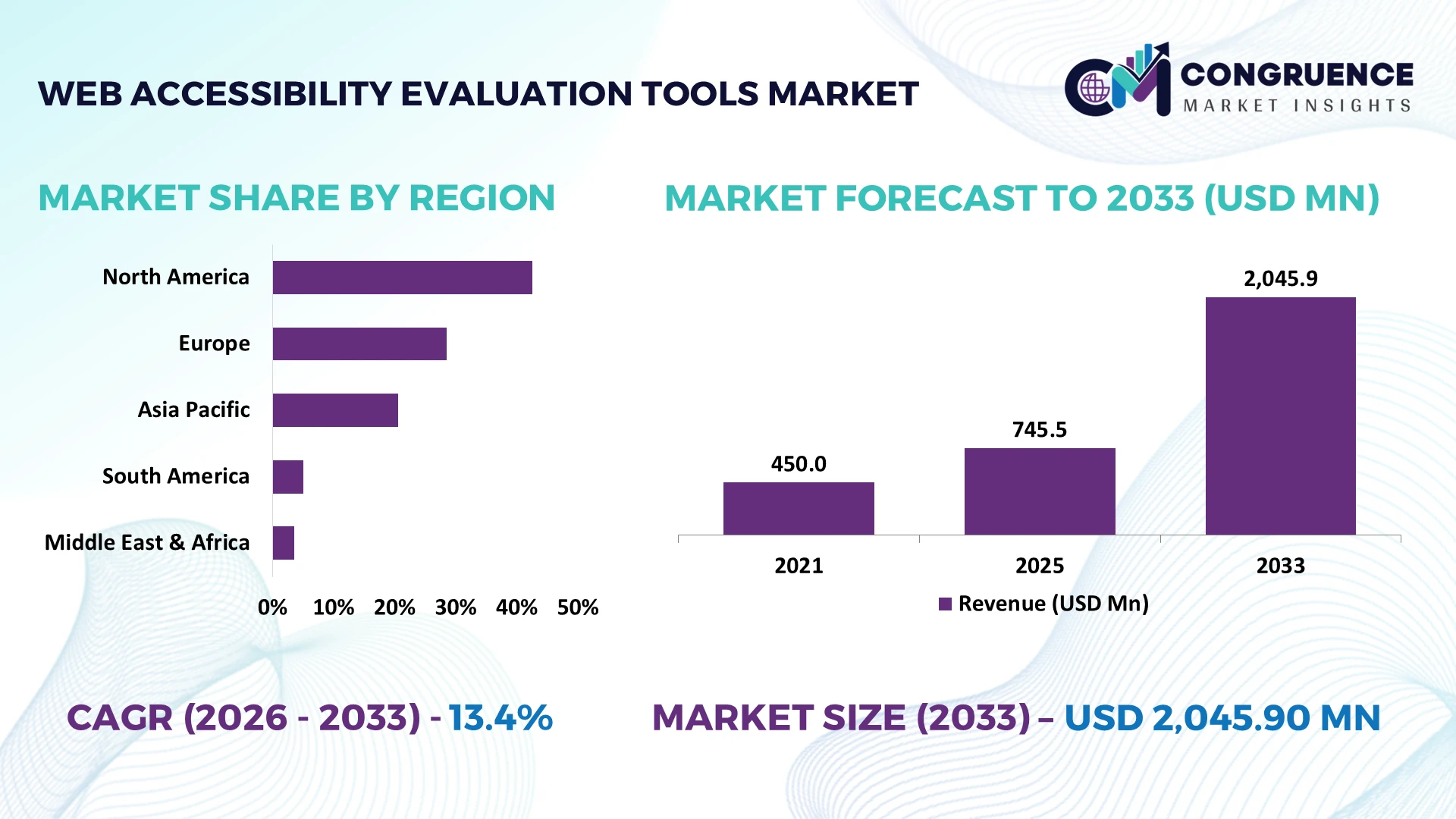
The Global Web Accessibility Evaluation Tools Market was valued at USD 745.5 Million in 2025 and is anticipated to reach a value of USD 2,045.9 Million by 2033 expanding at a CAGR of 13.45% between 2026 and 2033. Market growth is driven by mandatory digital accessibility compliance, automated WCAG testing integration, and increasing enterprise investment in inclusive digital infrastructure.
The United States leads the market with an estimated 35.8% global share in 2025, supported by investments across banking, healthcare, e-commerce, education, and government platforms. Approximately 28.7% of American adults have a disability, reinforcing accessibility requirements. Unlike Canada’s federally focused accessibility framework, the United States combines ADA enforcement with mandatory WCAG 2.1 Level AA requirements for state and local government websites.
Enterprise technology investments must prioritize continuous accessibility monitoring, automated remediation workflows, and development-stage compliance validation to strengthen competitive positioning.
Market Size & Growth: USD 745.5 Million in 2025, reaching USD 2,045.9 Million by 2033 at 13.45% CAGR, driven by mandatory digital accessibility compliance.
Top Growth Drivers: Regulatory compliance (42%), digital transformation (34%), and automated accessibility testing adoption (24%).
Short-Term Forecast: By 2028, integrated accessibility testing targets a 30% reduction in manual auditing workloads.
Emerging Technologies: Three transformative technologies include AI-powered defect detection, automated remediation, and continuous accessibility monitoring.
Regional Leaders: By 2033, North America (USD 818.4 Million) leads enterprise adoption, Europe (USD 572.9 Million) emphasizes compliance, and Asia Pacific (USD 491.0 Million) accelerates cloud deployment.
Consumer/End-User Trends: Approximately 94.8% of leading website homepages contain detectable accessibility failures, reinforcing enterprise testing requirements.
Pilot/Case Example: The 2025 WebAIM Million evaluation recorded detectable accessibility failures declining from 95.9% to 94.8%.
Competitive Landscape: Deque Systems holds an estimated 16% share, competing with Level Access, Siteimprove, BrowserStack, and accessiBe.
Regulatory & ESG Impact: European Accessibility Act enforcement across 27 EU member states strengthens inclusive digital service requirements.
Investment & Funding: accessiBe secured USD 58 Million across announced Series A financing rounds, supporting AI-enabled accessibility innovation.
Innovation & Future Outlook: Three strategic priorities include predictive defect identification, developer-integrated testing, and automated compliance documentation.
The Web Accessibility Evaluation Tools Market encompasses automated website scanners, accessibility auditing platforms, browser-based testing extensions, and enterprise compliance management solutions. Demand concentrates across financial services, public administration, healthcare, and online retail. With approximately 79.1% of evaluated homepages containing low-contrast text in 2025, advanced visual accessibility detection remains critical. European regulatory enforcement further accelerates the transition toward continuous compliance management.
Web accessibility evaluation tools are becoming strategically important as digital inclusivity shifts from discretionary website optimization to an enterprise-wide compliance and operational requirement. The European Accessibility Act, effective from June 2025, is restructuring digital service delivery across banking, e-commerce, transportation, and consumer technology. Organizations increasingly incorporate accessibility performance into software procurement, digital governance, and product development decisions.
Automated accessibility evaluation platforms offer substantial operational advantages over conventional manual auditing, targeting 25–35% reductions in repetitive testing workloads when integrated into development pipelines. The United States leads enterprise-scale implementation through established accessibility enforcement, while Germany and France emphasize regulatory conformity across consumer-facing digital services. Between 2026 and 2028, continuous accessibility monitoring is expected to expand across approximately 40% of large-enterprise accessibility programs.
For example, financial institutions integrate accessibility testing into online banking release cycles, identifying navigation, contrast, and form-labeling defects before customer deployment. Companies such as Deque Systems, BrowserStack, and Level Access are strengthening developer integrations, automated reporting, and enterprise accessibility management capabilities. Competitive advantage increasingly depends on preventing accessibility defects during development rather than financing expensive post-deployment remediation.
Strengthening digital accessibility regulations is accelerating enterprise adoption of automated evaluation platforms across customer-facing websites and applications. In 2025, approximately 94.8% of leading website homepages exhibited detectable WCAG failures, while 79.1% contained low-contrast text and 55.5% featured missing alternative text for images. The European Accessibility Act introduces mandatory accessibility requirements across covered digital products and services, while United States government entities face WCAG 2.1 Level AA compliance obligations. These requirements increase demand for recurring accessibility assessments rather than isolated audits. Deque Systems, Level Access, and Siteimprove are expanding automated scanning, compliance reporting, and developer-integrated testing capabilities. Continuous validation reduces remediation backlogs and transforms accessibility compliance into a measurable software quality requirement.
Automated accessibility evaluation tools remain constrained by their inability to independently verify complex usability requirements involving assistive technologies, contextual interpretation, and interactive navigation. Automated testing typically identifies approximately 30–50% of accessibility issues, depending on website complexity and testing methodology. Consequently, an estimated 50–70% of issues require additional contextual assessment or manual verification. In the United States, organizations operating legacy banking, healthcare, and government portals face significant validation requirements across interconnected digital systems. Dependence on specialist auditors increases implementation expenditure and restricts affordability for smaller enterprises. Providers including Level Access and Deque Systems combine automated detection with expert-led assessments and guided remediation workflows. Commercial scalability depends on reducing human verification requirements without compromising accessibility assessment reliability.
Artificial intelligence and development-stage accessibility testing create opportunities to expand beyond conventional website scanning into predictive defect prevention and intelligent remediation. Approximately 48.2% of evaluated homepages contained empty links in 2025, while 45.4% exhibited missing form input labels, highlighting recurring defects suitable for automated detection and remediation assistance. Integrated testing workflows target 25–35% reductions in repetitive quality assurance workloads. India’s expanding software development and digital services ecosystem presents opportunities for embedding accessibility evaluation within outsourced application development projects. BrowserStack and Deque Systems are strengthening developer-oriented testing integrations, while accessibility technology providers are advancing AI-assisted defect classification. The highest-value opportunity lies in monetizing accessibility intelligence throughout software development rather than relying exclusively on periodic compliance assessments.
Maintaining consistent accessibility performance across frequently updated websites, mobile applications, and component-based digital platforms represents a significant execution challenge. Approximately 94.8% of evaluated homepages exhibited detectable accessibility failures in 2025, compared with 95.9% in 2024, demonstrating limited progress despite expanding awareness. Additionally, approximately 29.6% contained missing document language declarations, reflecting persistent implementation inconsistencies. In the United States, enterprises deploying rapid software release cycles must coordinate accessibility validation across development teams, third-party components, and external technology vendors. Fragmented accountability increases defect recurrence and undermines compliance consistency. Companies must invest in centralized accessibility governance, regression testing, reusable accessible design components, and standardized development workflows. Long-term competitiveness depends on preventing recurring defects across distributed digital infrastructure.
Centralized Accessibility Governance Across Enterprises: Organizations are consolidating fragmented accessibility assessments into centralized management dashboards, enabling standardized reporting across multiple digital properties. With 94.8% of evaluated homepages exhibiting accessibility failures in 2025 and an average of 51 detectable errors per page, companies are prioritizing portfolio-wide visibility. Siteimprove and Level Access are expanding centralized monitoring and issue-management capabilities.
Accessibility Testing Across Mobile Interfaces: Mobile-first digital service delivery is shifting evaluation beyond desktop websites toward responsive interfaces and native applications. Smartphones account for approximately 60% of global website traffic, while mobile accessibility assessments must accommodate two major operating systems. BrowserStack and Deque Systems are expanding cross-device testing capabilities to reduce duplicated assessments and improve release consistency.
Standardized Accessibility Procurement and Documentation: Enterprise procurement teams increasingly require Accessibility Conformance Reports and standardized vendor assessments before software acquisition. The European Accessibility Act covers 27 EU member states, while WCAG 2.2 introduces nine additional success criteria compared with WCAG 2.1. Providers are expanding documentation workflows, reducing procurement delays and strengthening accessibility-related vendor accountability.
Component-Level Accessibility Quality Management: Enterprises are shifting from individual page assessments toward reusable design-system validation. With six common error categories accounting for approximately 96% of detected homepage accessibility errors, correcting shared components delivers broader operational benefits. Technology providers are integrating component libraries and issue-tracking platforms to reduce recurring defects across interconnected digital properties.
Automated Evaluation Tools accounted for an estimated 67.5% market share in 2025, supported by their ability to evaluate extensive digital assets, identify WCAG violations, and generate standardized compliance reports. Enterprise adoption concentrates on automated website crawlers, browser extensions, and integrated accessibility testing platforms that support recurring assessments without proportionally increasing specialist staffing requirements. Automated Evaluation Tools also represent the fastest-growing segment, driven by expanding cloud infrastructure, software development automation, and continuous quality assurance requirements. Integrated automated workflows target 25–35% reductions in repetitive accessibility testing workloads.
Manual Evaluation Tools remain essential for assessing keyboard navigation, screen reader compatibility, contextual content interpretation, and complex user interactions. Unlike automated platforms, manual tools enable specialists to examine accessibility barriers requiring human judgment and assistive technology validation. Companies such as Deque Systems, Level Access, and Siteimprove are strengthening complementary automated and manual assessment capabilities through integrated testing environments and expert-guided workflows. Investment priorities increasingly favor unified evaluation platforms that combine scalable defect identification with contextual validation, supporting enterprise compliance without sacrificing assessment accuracy.
Website Owners accounted for an estimated 49.5% market share in 2025, reflecting their direct responsibility for digital accessibility compliance, website usability, and customer-facing service performance. Organizations managing extensive website portfolios increasingly deploy accessibility evaluation tools to prioritize remediation, monitor compliance performance, and maintain consistent user experiences. Demand remains particularly strong among operators managing transactional websites and frequently updated digital content. Centralized evaluation workflows target approximately 20–30% reductions in duplicated accessibility assessment activities across distributed website portfolios.
Website Developers represent the fastest-growing application segment as accessibility evaluation becomes embedded within software development, quality assurance, and deployment processes. Developers increasingly utilize browser extensions, integrated development environment plugins, and automated testing frameworks to identify defects before production releases. Sales Teams represent a specialized application, using accessibility assessment reports to demonstrate product conformity, support enterprise procurement, and strengthen customer acquisition strategies. Companies including BrowserStack, Deque Systems, and Level Access are expanding developer integrations and customizable reporting capabilities. Investment is shifting toward evaluation tools that connect technical defect identification with measurable commercial and compliance outcomes.
Large Enterprises accounted for an estimated 43.5% market share in 2025, supported by extensive digital infrastructure, multiple customer-facing platforms, and complex accessibility governance requirements. Enterprises operating across international markets increasingly procure centralized evaluation solutions that support standardized auditing, remediation prioritization, and cross-functional compliance reporting. Extensive website portfolios and frequent software releases encourage investment in subscription-based platforms with integrated monitoring capabilities. Enterprise implementations typically target 20–30% reductions in repetitive assessment and compliance documentation workloads.
Small and Medium-Sized Enterprises (SMEs) represent the fastest-growing end-user segment as affordable cloud-based platforms, flexible subscription models, and simplified accessibility reporting reduce implementation barriers. Government and Public Sector Organizations maintain structured demand through mandatory digital accessibility requirements, while Educational Institutions prioritize accessible learning platforms and institutional websites. Healthcare Organizations increasingly evaluate patient portals, appointment systems, and digital information services. Companies such as Siteimprove, Level Access, and Deque Systems are targeting differentiated buyer requirements through scalable pricing, sector-specific integrations, and accessibility management capabilities. Future demand increasingly favors modular solutions that accommodate organizational complexity without imposing substantial implementation overhead.
North America accounted for the largest market share at 42.5% in 2025 however, Asia Pacific is expected to register the fastest growth, expanding at a CAGR of 16.2% between 2026 and 2033.
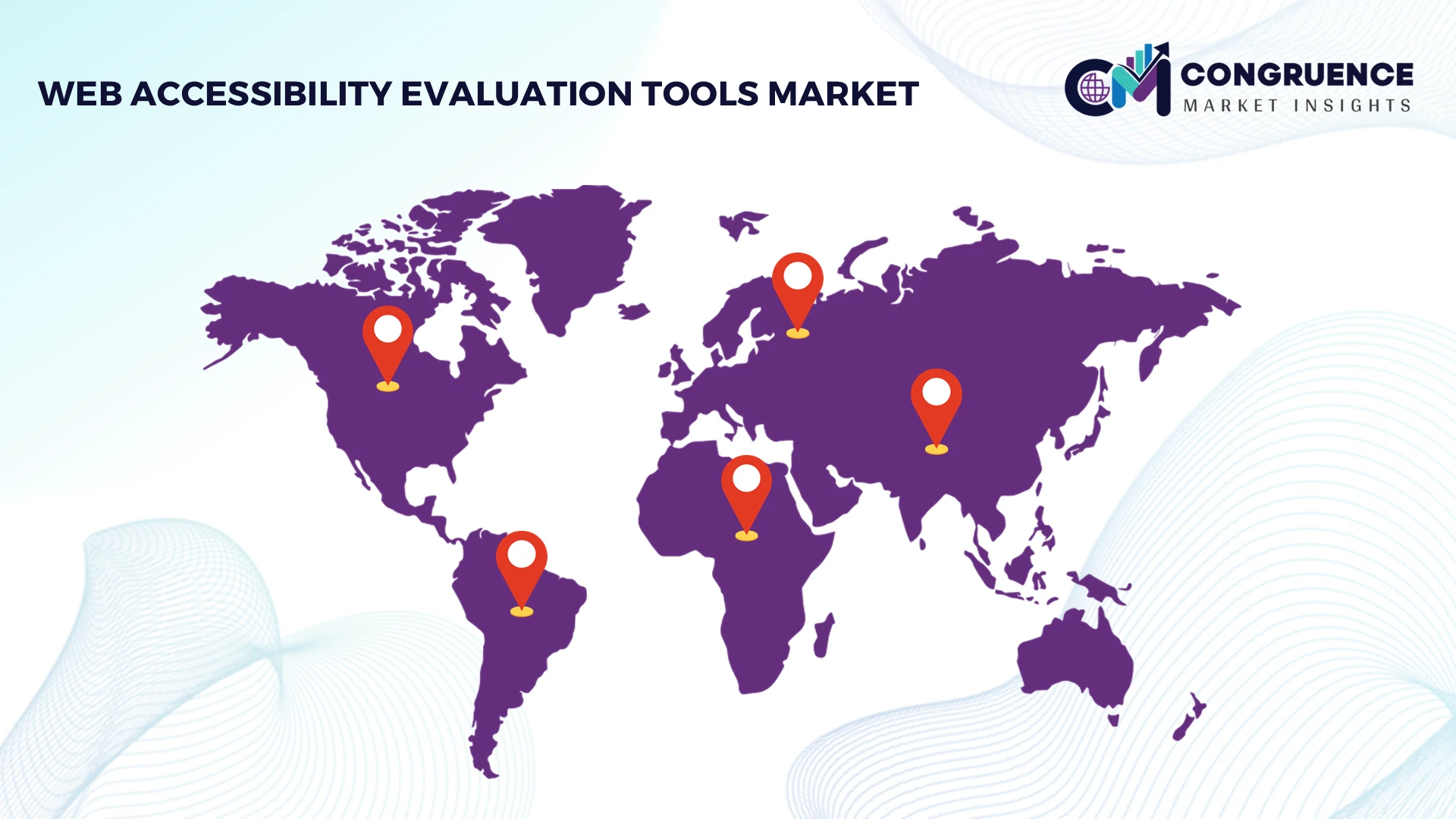
North America accounted for 42.5% of the global market share in 2025, supported by established digital accessibility regulations, advanced enterprise software infrastructure, and widespread adoption of automated testing platforms. Financial institutions, healthcare providers, government agencies, and e-commerce companies increasingly integrate accessibility evaluation into software development and digital governance frameworks. The United States Department of Justice introduced WCAG 2.1 Level AA requirements for state and local government websites and mobile applications, with compliance deadlines differentiated by population size, including jurisdictions serving 50,000 or more residents. This regulatory development strengthens demand for recurring accessibility assessments and standardized compliance documentation. Deque Systems, Level Access, and BrowserStack are expanding integrated testing capabilities and enterprise accessibility management solutions. Regional purchasing decisions increasingly prioritize centralized monitoring, remediation accountability, and compatibility with existing development environments.
United States Market Outlook: The United States dominates regional demand through its established enterprise technology ecosystem, extensive digital commerce infrastructure, and accessibility-related legal enforcement. Approximately 28.7% of American adults have a disability, reinforcing the commercial importance of inclusive digital services. Banking institutions, healthcare networks, and technology companies increasingly incorporate accessibility evaluation into procurement requirements, software quality assurance, and customer experience optimization strategies.
Europe accounted for 28.5% of the global market share in 2025, driven by harmonized accessibility legislation, mature digital infrastructure, and increasing enterprise accountability for inclusive service delivery. The European Accessibility Act became applicable in June 2025 across 27 European Union member states, introducing accessibility obligations for covered banking services, e-commerce platforms, electronic communications, and passenger transportation services. Organizations are restructuring digital compliance workflows to incorporate standardized evaluation, accessibility documentation, and remediation tracking. Multinational enterprises increasingly require evaluation platforms capable of supporting multilingual websites and jurisdiction-specific compliance reporting. Technology providers are strengthening partnerships with accessibility consultants, software developers, and digital transformation specialists to address these requirements. Regional competition increasingly centers on regulatory alignment, multilingual testing capabilities, and integration with enterprise content management systems rather than standalone website scanning functionality.
Germany Market Outlook: Germany represents a strategically significant market through its extensive industrial software ecosystem, financial services infrastructure, and enterprise digitalization initiatives. The German Accessibility Strengthening Act became applicable on June 28, 2025, establishing accessibility obligations for covered consumer-facing products and services. Enterprise investment increasingly targets accessible online banking, digital retail platforms, and standardized accessibility documentation across interconnected business applications.
Asia Pacific accounted for 20.5% of the global market share in 2025, supported by expanding digital commerce, government modernization, software development outsourcing, and mobile-first service delivery. China, Japan, India, Australia, and South Korea are strengthening digital accessibility through differentiated regulatory frameworks and enterprise technology investments. Japan's revised Act for the Elimination of Discrimination Against Persons with Disabilities introduced mandatory reasonable accommodation requirements for private businesses in April 2024, reinforcing accessibility considerations across service delivery. Regional software development companies increasingly incorporate automated evaluation into application testing and international client projects. Cloud-based platforms and browser-integrated testing tools are gaining traction because of their scalability and comparatively lower implementation requirements. Technology providers are expanding localized interfaces, multilingual evaluation capabilities, and developer-focused partnerships to accommodate diverse digital ecosystems and enterprise requirements.
China Market Outlook: China benefits from extensive digital commerce infrastructure, large-scale internet platforms, and government-supported information accessibility initiatives. The country recorded approximately 1.12 billion internet users by mid-2025, creating substantial requirements for accessible digital services. The Law on Building Accessible Environments strengthens information accessibility obligations, encouraging technology companies, public institutions, and online service providers to improve website navigation, interface compatibility, and inclusive mobile experiences.
South America accounted for 5.0% of the global market share in 2025, supported by expanding financial technology ecosystems, digital government services, online retail platforms, and enterprise cloud adoption. Brazil, Argentina, Colombia, and Chile represent important demand centers as organizations modernize customer-facing digital infrastructure. Brazil's Pix instant payment system processed more than 60 billion transactions in 2024, demonstrating the operational scale of digital financial services requiring inclusive user interfaces. Financial institutions and public agencies increasingly recognize accessibility evaluation as an essential component of service reliability and customer participation. However, limited specialist availability, fragmented legacy infrastructure, and constrained technology budgets restrict comprehensive deployment. Accessibility solution providers are responding through affordable subscription models, Portuguese and Spanish language support, and partnerships with local technology consultancies, improving deployment flexibility for smaller organizations.
Brazil Market Outlook: Brazil leads regional demand through its established digital banking ecosystem, extensive e-commerce infrastructure, and statutory accessibility requirements. The Brazilian Inclusion Law, particularly Article 63, establishes website accessibility obligations for covered businesses and government organizations. Financial technology companies and digital retailers are increasingly incorporating accessibility evaluation into interface development, customer onboarding, and mobile application testing to strengthen regulatory conformity and customer reach.
Middle East & Africa accounted for 3.5% of the global market share in 2025, supported by government digital transformation programs, financial services modernization, and expanding telecommunications infrastructure. Saudi Arabia, the United Arab Emirates, and South Africa represent important deployment centers for accessibility evaluation platforms across public administration, banking, education, and healthcare. Saudi Arabia's Digital Government Authority established a digital transformation measurement framework covering more than 200 government entities, demonstrating the scale of institutional modernization. Accessibility evaluation increasingly supports digital service quality, inclusive citizen engagement, and standardized government website performance. Nevertheless, uneven infrastructure maturity and limited accessibility expertise constrain broader enterprise implementation. Technology providers are strengthening regional partnerships, Arabic-language evaluation capabilities, and cloud-based assessment services. Investment priorities increasingly favor scalable platforms that accommodate multilingual interfaces and government digital service requirements.
United Arab Emirates Market Outlook: The United Arab Emirates benefits from advanced telecommunications infrastructure, government-led digital transformation, and established enterprise technology investment. Internet penetration exceeds 99%, reinforcing the importance of accessible digital service delivery. The UAE National Digital Accessibility Policy strengthens accessibility requirements across government digital platforms, encouraging investment in automated evaluation, assistive technology compatibility, and standardized compliance monitoring across public institutions and commercial service providers.
Deque Systems, Level Access, and Siteimprove compete through comprehensive enterprise accessibility management, while BrowserStack and accessiBe challenge established providers through developer integrations and automated remediation technologies. The market exhibits moderate concentration, with the five leading players collectively accounting for an estimated 52.5% share. Competition centers on detection accuracy, deployment scalability, regulatory coverage, and subscription flexibility. Automated evaluation typically identifies 30–50% of accessibility issues, while integrated testing workflows target 25–35% reductions in repetitive auditing workloads. Deque Systems emphasizes developer ecosystems, Level Access strengthens managed compliance services, and BrowserStack expands accessibility testing across software development environments. Competitive differentiation is shifting from standalone scanning toward continuous accessibility governance, intelligent defect prioritization, and integrated remediation management. Entry barriers include proprietary testing algorithms, specialist expertise, regulatory knowledge, and established enterprise relationships. Winning requires combining reliable automated detection with contextual validation, seamless workflow integration, and cost-effective accessibility management across complex digital infrastructure and distributed enterprise environments.
Deque Systems
Level Access
Siteimprove
BrowserStack
accessiBe
UserWay
AudioEye
Silktide
TPGi
DubBot
AccessibilityChecker.org
WebAIM
Evinced
Automated accessibility scanning, rule-based WCAG validation, and browser-integrated testing constitute the technological foundation of the market. Automated evaluation typically detects 30–50% of accessibility barriers, enabling enterprises to prioritize remediation before specialist assessments. Compared with conventional manual auditing, integrated automated workflows target 25–35% reductions in repetitive testing workloads. Cloud-based deployment supports simultaneous evaluation across extensive website portfolios, improving operational scalability and compliance visibility.
Emerging technologies include artificial intelligence, computer vision, machine learning, and contextual accessibility analysis. AI-assisted evaluation targets 20–30% improvements in defect classification efficiency, while intelligent remediation recommendations reduce developer investigation requirements. Continuous integration and continuous deployment pipelines increasingly incorporate accessibility testing alongside functional quality assurance. With approximately 94.8% of evaluated homepages exhibiting detectable accessibility failures in 2025, development-stage intervention represents a significant operational priority.
Between 2026 and 2028, predictive accessibility analytics, component-level validation, and intelligent regression testing are expected to reshape enterprise evaluation strategies. Integrated platforms target 15–25% reductions in recurring accessibility defects through standardized development workflows. Providers combining automated detection, assistive technology simulation, and contextual human validation gain competitive advantages over standalone scanning solutions. Enterprises benefit through reduced remediation expenditure, faster release cycles, and stronger compliance accountability, making accessibility infrastructure investment essential for maintaining consistent digital service quality across distributed environments.
March 2024, Level Access completed its acquisition of UserWay, integrating AI-powered remediation with enterprise accessibility management. With 34% of surveyed organizations already using automated remediation in 2023, the acquisition strengthens its technology portfolio and expands accessibility solutions across diverse enterprise requirements. Source: levelaccess.com
December 2024, Siteimprove received Optimizely’s Industry Solution Partner of the Year award following expanded platform integration. Serving more than 7,500 clients, Siteimprove strengthened its partner ecosystem through integrated accessibility, content governance, and digital optimization capabilities, supporting comprehensive enterprise digital experience management. Source: siteimprove.com
February 2025, Deque Systems announced advanced AI-powered accessibility evaluation capabilities, including intelligent guided testing and machine vision. Building upon automated testing coverage of 57% by issue volume, these innovations target broader defect detection, reduced manual intervention, and improved software development efficiency. Source: deque.com
January 2026, BrowserStack launched Accessibility DevTools, embedding real-time accessibility evaluation within integrated development environments. Responding to a reported 37% increase in ADA lawsuits during early 2025, the platform enables developers to identify accessibility defects during coding, reducing downstream remediation and development rework. Source: browserstack.com
The Web Accessibility Evaluation Tools Market Report provides comprehensive analysis across two tool types, including Automated Evaluation Tools and Manual Evaluation Tools, alongside applications encompassing Website Owners, Website Developers, and Sales Teams. End-user coverage includes Large Enterprises, Small and Medium-Sized Enterprises, Government and Public Sector Organizations, Educational Institutions, and Healthcare Organizations. Geographic analysis encompasses North America, Europe, Asia Pacific, South America, and Middle East & Africa, highlighting regional adoption patterns, regulatory developments, and enterprise digital accessibility requirements.
The report evaluates automated WCAG validation, AI-powered defect detection, assistive technology compatibility testing, cloud-based monitoring, and development pipeline integration. Competitive intelligence covers product innovation, strategic acquisitions, partnership ecosystems, pricing strategies, and emerging accessibility management solutions. The assessment supports investment planning, market expansion, competitive positioning, technology procurement, and identification of high-potential business opportunities between 2026 and 2033.
| Report Attribute / Metric | Details |
|---|---|
| Market Revenue (2025) | USD 745.5 Million |
| Market Revenue (2033) | USD 2,045.9 Million |
| CAGR (2026–2033) | 13.45% |
| Base Year | 2025 |
| Forecast Period | 2026–2033 |
| Historic Period | 2021–2025 |
| Segments Covered |
By Type
By Application
By End-User
|
| Key Report Deliverables | Revenue Forecast; Market Trends; Growth Drivers & Restraints; Technology Insights; Segmentation Analysis; Regional Insights; Competitive Landscape; Regulatory & ESG Overview; Recent Developments |
| Regions Covered | North America; Europe; Asia-Pacific; South America; Middle East & Africa |
| Key Players Analyzed | Deque Systems; Level Access; Siteimprove; BrowserStack; accessiBe; UserWay; AudioEye; Silktide; TPGi; DubBot; AccessibilityChecker.org; WebAIM; Evinced |
| Customization & Pricing | Available on Request (10% Customization Free) |




