
Reports
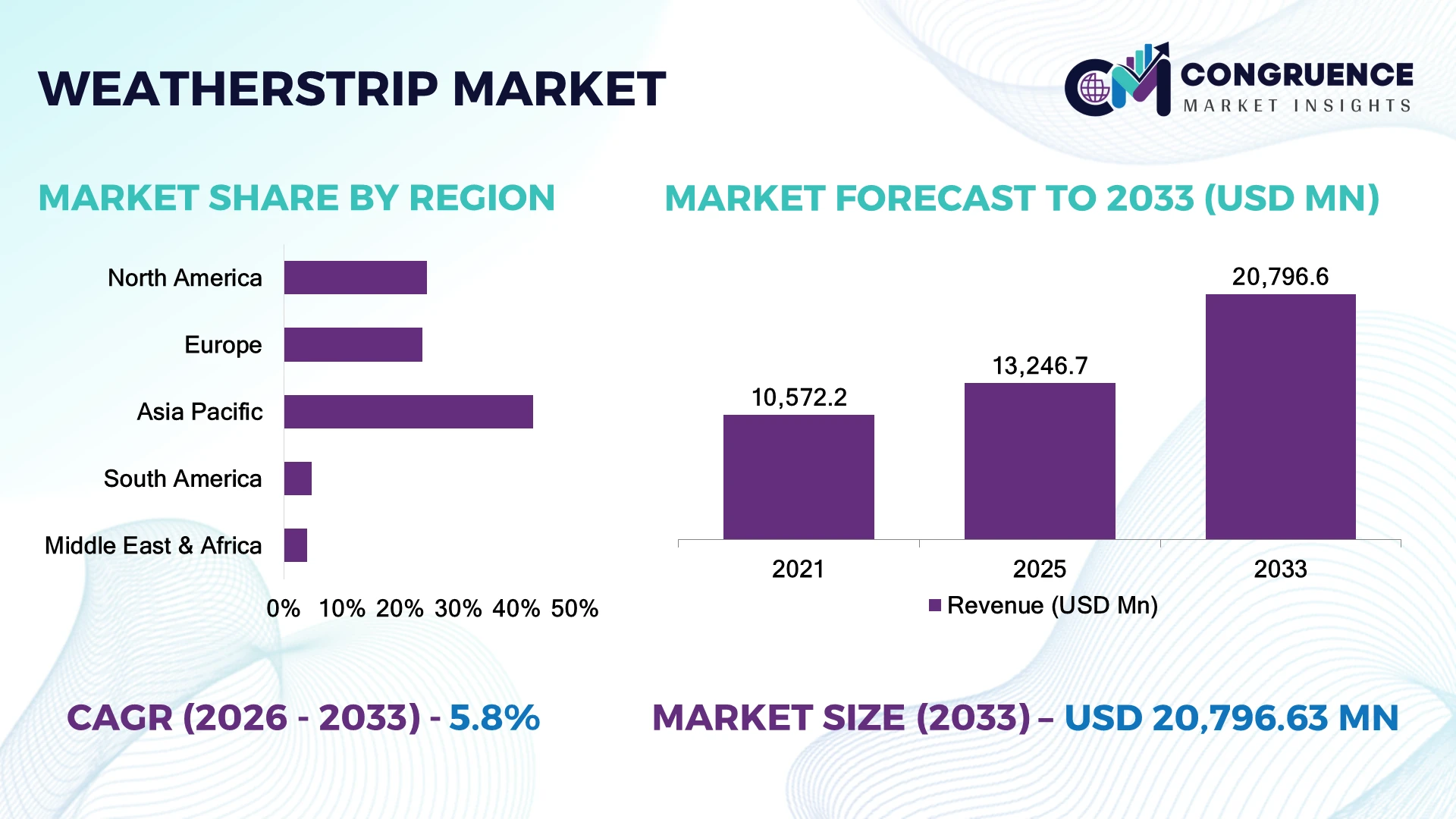
The Global Weatherstrip Market was valued at USD 13,246.7 Million in 2025 and is anticipated to reach a value of USD 20,796.6 Million by 2033 expanding at a CAGR of 5.8% between 2026 and 2033. Growth is driven by expanding electric vehicle production, higher energy-efficiency standards for buildings, and increasing adoption of advanced thermoplastic elastomer sealing systems.
China dominates the Weatherstrip market with approximately 35% of global production capacity, supported by large-scale automotive manufacturing, expanding construction activity, and integrated polymer processing facilities. Compared with Germany, China manufactures nearly 43% more automotive sealing components annually, while advanced EPDM and thermoplastic elastomer weatherstrips account for approximately 57% of new vehicle installations. Continued supply-chain diversification following global geopolitical trade realignments has accelerated regional material sourcing and localized manufacturing investments.
Manufacturers strengthening advanced material capabilities and regional production networks are securing long-term competitive advantage across automotive and construction applications.
Market Size & Growth: USD 13,246.7 million in 2025 to USD 20,796.6 million by 2033 at 5.8% CAGR, driven by EV production and advanced sealing materials.
Top Growth Drivers: Electric vehicles (+31%), energy-efficient buildings (+27%), lightweight materials (+22%).
Short-Term Forecast: By 2028, automated extrusion improves manufacturing efficiency by approximately 18%.
Emerging Technologies: Thermoplastic elastomers, AI quality inspection, and robotic extrusion enhance sealing precision.
Regional Leaders: Asia-Pacific, Europe, and North America lead through automotive production and sustainable construction demand.
Consumer/End-User Trends: Approximately 61% of OEM demand favors recyclable sealing materials with improved durability.
Pilot/Case Example: A 2026 automated sealing line reduced material waste by nearly 16%.
Competitive Landscape: Leading suppliers control approximately 54% market share through vertical integration and material innovation.
Regulatory & ESG Impact: Lightweight sealing solutions improve vehicle efficiency while reducing material usage by approximately 14%.
Investment & Funding: More than USD 2.3 billion supports extrusion modernization, automation, and regional manufacturing expansion.
Innovation & Future Outlook: Multi-material weatherstrips and digital production monitoring strengthen next-generation sealing performance.
The Weatherstrip market continues evolving through advanced elastomer formulations, automated extrusion technologies, and precision sealing solutions for automotive and construction applications. Approximately 49% of premium vehicle platforms now integrate lightweight thermoplastic weatherstrips to improve sealing efficiency and reduce component weight. Regional polymer supply diversification and stricter building energy regulations continue influencing manufacturing strategies, creating a strong foundation for the following strategic assessment.
The Weatherstrip market has become strategically important as automotive manufacturers and building material suppliers prioritize durability, energy efficiency, and lightweight engineering within increasingly competitive production environments. Supply-chain restructuring, localized elastomer sourcing, and automation investments are reshaping manufacturing strategies while strengthening resilience against raw material disruptions. Companies are differentiating through advanced polymer formulations, precision extrusion, and integrated sealing system capabilities.
Modern thermoplastic elastomer weatherstrips improve dimensional stability by approximately 21% while reducing component weight by nearly 15% compared with conventional rubber sealing materials. China leads large-scale manufacturing and cost-efficient production, whereas Germany emphasizes premium automotive engineering and high-performance sealing technologies. Over the next two to three years, approximately 58% of newly introduced automotive sealing systems are expected to incorporate recyclable materials and automated quality inspection technologies.
Manufacturers are expanding extrusion capacity, forming partnerships with automotive OEMs, and investing in digital process monitoring to improve consistency across high-volume production lines. Advanced co-extrusion technologies enable multi-functional sealing profiles that reduce assembly complexity while improving acoustic insulation and water resistance. Companies combining material innovation, localized production, and automated manufacturing will strengthen competitive positioning as vehicle electrification and high-performance building envelopes continue redefining global weatherstrip requirements.
The transition toward electric vehicles is increasing demand for advanced weatherstrip systems capable of improving cabin insulation, battery protection, and noise reduction. Approximately 63% of newly launched electric vehicle platforms incorporate multi-material sealing solutions, while lightweight thermoplastic weatherstrips reduce component weight by nearly 18% compared with conventional rubber profiles. China continues expanding EV manufacturing capacity, prompting OEMs to localize sealing component procurement and establish long-term supplier partnerships. The shift toward integrated body architectures is encouraging weatherstrip manufacturers to invest in precision co-extrusion technologies, automated production lines, and advanced elastomer formulations. A key competitive advantage increasingly depends on delivering customized sealing systems during early vehicle platform development.
Weatherstrip manufacturers remain exposed to fluctuations in EPDM rubber, thermoplastic elastomers, and specialty polymer prices, creating sustained pressure on production economics. Raw materials account for approximately 46% of total manufacturing costs, while polymer feedstock prices have experienced fluctuations of nearly 19% across global procurement markets. Germany's automotive supply chain continues facing higher specialty material procurement costs following energy market adjustments, affecting production planning and pricing stability. These conditions reduce profitability and complicate long-term supply agreements with automotive OEMs. Manufacturers are mitigating risks through regional sourcing diversification, recycled polymer integration, long-term procurement contracts, and localized compounding facilities to improve supply continuity and cost predictability.
Digital manufacturing technologies are creating new opportunities to improve weatherstrip quality, production flexibility, and operational efficiency. Automated extrusion monitoring and AI-enabled quality inspection reduce defect rates by approximately 24%, while predictive maintenance improves equipment utilization by nearly 17%. Japan's advanced manufacturing sector is accelerating adoption of machine vision and digital process control for precision sealing production. Companies are expanding investment in Industry 4.0 platforms, robotic material handling, and intelligent extrusion systems to optimize throughput and reduce production waste. A notable strategic opportunity lies in combining digital manufacturing with recyclable elastomer formulations, enabling premium products while lowering lifecycle production costs.
Growing demand for lightweight, recyclable, and high-performance sealing systems is increasing manufacturing complexity across automotive and construction applications. Approximately 34% of new sealing programs require multi-material co-extrusion, while production changeover time increases by nearly 21% when customized sealing profiles are introduced. The United States automotive industry is placing greater emphasis on platform-specific sealing performance, requiring tighter dimensional tolerances and extensive validation testing. Manufacturers must strengthen tooling precision, workforce capabilities, and digital production monitoring while investing in advanced testing infrastructure. Long-term competitiveness increasingly depends on balancing manufacturing flexibility with consistent quality across diverse product portfolios.
Advanced Elastomers Gain Preference: Thermoplastic elastomer adoption has increased by approximately 29%, while lightweight sealing profiles reduce vehicle mass by nearly 16%. Automotive electrification and stricter efficiency standards are accelerating material substitution. Manufacturers are expanding multi-material extrusion capabilities and increasing investment in advanced polymer development to improve durability and design flexibility.
Automation Reshapes Production Lines: Automated extrusion and inline vision inspection have improved production throughput by approximately 21% while reducing manufacturing defects by nearly 18%. Rising labor costs and tighter OEM quality requirements are accelerating factory modernization. Companies are deploying robotics, digital quality monitoring, and predictive maintenance to improve consistency across high-volume manufacturing operations.
Localized Supply Networks Expand: Regional sourcing of sealing compounds has increased by approximately 24%, reducing procurement lead times by nearly 19% following continued global supply-chain restructuring. Automotive manufacturers increasingly favor localized suppliers for production stability. Weatherstrip producers are establishing new compounding facilities and strengthening partnerships with domestic polymer processors to improve operational resilience.
Co-Extrusion Designs Advance: Multi-functional co-extruded weatherstrips now represent approximately 42% of premium automotive sealing programs, improving acoustic insulation while reducing assembly complexity by nearly 15%. Vehicle platform consolidation is encouraging standardized sealing architectures. Companies are redesigning extrusion platforms, integrating recyclable materials, and expanding engineering collaboration with OEMs to accelerate product development and shorten validation cycles.
EPDM weatherstrips account for approximately 48% of the global market due to their superior resistance to ultraviolet radiation, ozone exposure, moisture, and temperature fluctuations. Their long service life and cost-effective manufacturing make them the preferred sealing material across passenger vehicles, commercial vehicles, and building applications. PVC weatherstrips remain relevant in cost-sensitive construction projects because of their affordability and ease of installation, while rubber-based products continue serving industrial equipment requiring robust sealing performance under demanding operating conditions.
Thermoplastic Elastomer (TPE) weatherstrips represent the fastest-growing segment as vehicle lightweighting, recyclability, and design flexibility become higher priorities for OEMs. Approximately 36% of newly developed automotive sealing platforms now incorporate TPE-based profiles, while advanced co-extruded TPE designs reduce component weight by nearly 15% compared with conventional rubber systems. Manufacturers are expanding multi-material extrusion capacity, investing in recyclable polymer technologies, and strengthening partnerships with automotive OEMs. Investment priorities are shifting toward sustainable, lightweight sealing solutions that improve manufacturing efficiency without compromising long-term durability.
A 2026 assessment by the European Automobile Manufacturers' Association indicated that lightweight polymer sealing materials are being integrated into an increasing share of next-generation vehicle platforms to improve energy efficiency and manufacturing sustainability.
The automotive sector represents approximately 69% of total Weatherstrip demand, supported by continuous vehicle production, increasing electrification, and stricter cabin comfort requirements. Weatherstrips remain critical for sealing doors, windows, trunks, sunroofs, and battery compartments while improving acoustic insulation and environmental protection. Building and construction applications continue expanding through energy-efficient commercial buildings and modern residential projects, whereas industrial machinery and rail transportation maintain steady demand for specialized sealing profiles designed for harsh operating environments.
Building and construction is the fastest-growing application as governments strengthen energy-efficiency regulations and developers increasingly adopt advanced building envelope technologies. Approximately 41% of newly constructed commercial buildings now specify high-performance sealing systems, while advanced weatherstrips improve air leakage performance by nearly 22%. Manufacturers are expanding automated extrusion capacity, introducing fire-resistant sealing materials, and collaborating with construction system suppliers to improve installation efficiency. Demand is steadily shifting toward integrated sealing solutions that support long-term operational efficiency across modern infrastructure projects.
A 2025 industry performance survey released by the Air Barrier Association of America found that high-performance sealing systems are increasingly specified in commercial construction projects to improve building envelope efficiency and indoor environmental performance.
Automotive OEMs account for approximately 58% of total Weatherstrip demand because they require high-volume, platform-specific sealing systems integrated directly into vehicle manufacturing. Continuous production schedules, strict dimensional tolerances, and long-term supply agreements concentrate purchasing within this segment. Aftermarket replacement demand remains significant due to weather-related component wear and increasing vehicle age, while construction contractors continue adopting specialized sealing systems to comply with evolving energy-efficiency requirements across commercial and residential developments.
Construction and infrastructure developers represent the fastest-growing end-user segment as sustainable building programs and modernization projects accelerate demand for advanced sealing products. Approximately 33% of premium building envelope projects now specify multi-functional weatherstrip systems, while energy-efficient sealing solutions reduce uncontrolled air infiltration by nearly 19%. Manufacturers are developing application-specific product portfolios, expanding contractor partnerships, and strengthening localized distribution networks to improve project responsiveness. Future competitive positioning increasingly depends on delivering customized sealing systems tailored to both industrial-scale manufacturing and infrastructure modernization requirements.
A 2026 enterprise procurement assessment conducted by the National Institute of Building Sciences reported that high-performance sealing components are becoming standard specifications in energy-efficient building projects because of their measurable impact on long-term operational performance.
Asia-Pacific accounted for the largest market share at 42.8% in 2025 however, Middle East & Africa is expected to register the fastest growth, expanding at a CAGR of 6.6% between 2026 and 2033.
Strong OEM Integration Strengthens Premium Sealing Demand
North America represents a mature Weatherstrip market supported by advanced automotive manufacturing, energy-efficient building construction, and high adoption of precision-engineered sealing technologies. The region accounts for approximately 24.6% of global demand, with automotive OEM procurement remaining the primary consumption channel. Nearly 62% of newly introduced premium vehicle platforms incorporate multi-functional weatherstrip systems designed to improve acoustic insulation, weather resistance, and battery compartment sealing. Continued investments in automated extrusion facilities and localized elastomer compounding are improving production efficiency while reducing procurement lead times. Manufacturers are strengthening long-term supply partnerships with vehicle producers to support increasing demand for lightweight and recyclable sealing solutions.
United States Market Outlook: The United States leads regional consumption through its large automotive manufacturing base, expanding electric vehicle production, and advanced construction sector. Vehicle manufacturers increasingly specify platform-specific sealing systems with enhanced durability and lightweight performance. Approximately 58% of domestically produced premium passenger vehicles now utilize advanced co-extruded weatherstrips, while ongoing investments in automated manufacturing and polymer processing continue strengthening domestic supply chain resilience.
Sustainability Accelerates Material Innovation
Europe maintains a strong position through premium automotive engineering, strict energy-efficiency regulations, and widespread adoption of recyclable sealing materials. The region contributes approximately 23.8% of global demand, supported by modernization across vehicle manufacturing and commercial construction. Nearly 44% of newly developed automotive sealing programs incorporate recyclable thermoplastic elastomers, reflecting growing emphasis on sustainable component design. Manufacturers continue expanding advanced extrusion capabilities and lightweight material development to meet evolving regulatory and OEM performance requirements.
Germany Market Outlook: Germany remains Europe's strategic manufacturing hub because of its advanced automotive supply chain, precision polymer processing expertise, and leadership in premium vehicle production. Domestic suppliers increasingly collaborate with OEMs during early vehicle development to optimize sealing performance. Approximately 47% of newly developed premium sealing profiles manufactured in Germany utilize multi-material co-extrusion technologies that improve installation efficiency and long-term durability.
Manufacturing Scale Drives Global Supply Leadership
Asia-Pacific dominates the Weatherstrip market through integrated automotive production, extensive polymer manufacturing capacity, and highly competitive component supply chains. The region contributes approximately 42.8% of global demand, with China, Japan, and South Korea serving as major production centers. Nearly 55% of global automotive weatherstrip exports originate from manufacturers across the region, supported by localized raw material availability and high-volume automated extrusion facilities. Companies continue investing in intelligent manufacturing systems, recyclable elastomer technologies, and export-oriented production capacity to strengthen international competitiveness.
China Market Outlook: China represents the largest country market owing to its unmatched automotive manufacturing scale, integrated polymer supply chain, and rapid electric vehicle expansion. Domestic manufacturers continue increasing production of lightweight sealing systems for both local consumption and exports. Approximately 35% of global weatherstrip production capacity is concentrated in China, reinforcing its role as the industry's primary manufacturing and supply hub.
Automotive Recovery Supports Market Expansion
South America is witnessing gradual demand growth as automotive production recovers and commercial construction activity strengthens across major economies. Regional manufacturers are increasing procurement of locally produced sealing components to reduce import dependency and improve production flexibility. Approximately 29% of automotive sealing demand is now supplied through localized manufacturing operations, supporting shorter delivery cycles and greater supply stability. Companies are expanding regional distribution partnerships and investing in flexible extrusion lines while balancing growth opportunities against infrastructure limitations and logistics costs.
Brazil Market Outlook: Brazil leads the regional market through its established automotive manufacturing industry, expanding aftermarket sector, and growing domestic polymer processing capabilities. Vehicle assembly operations continue increasing procurement from regional sealing suppliers to improve supply continuity. Approximately 48% of South America's automotive production is concentrated in Brazil, creating sustained demand for advanced weatherstrip systems across both OEM and replacement markets.
Infrastructure Modernization Expands Industrial Demand
The Middle East & Africa market is advancing through large-scale infrastructure development, industrial diversification, and modernization of commercial construction standards. Demand is increasing for high-performance weatherstrips capable of improving thermal insulation and environmental sealing under extreme operating conditions. Approximately 26% of new commercial building developments specify advanced sealing systems to improve energy efficiency and operational performance. Manufacturers are strengthening regional distribution networks, technical support capabilities, and partnerships with construction system suppliers to capture expanding project opportunities.
Saudi Arabia Market Outlook: Saudi Arabia is the region's most influential market, driven by major infrastructure investments, industrial diversification initiatives, and large-scale commercial construction programs. High-performance sealing products are increasingly specified for modern building envelopes designed to withstand harsh climatic conditions. Approximately 31% of premium sealing products supplied within the Gulf construction sector are deployed in Saudi Arabia, highlighting its growing strategic importance for weatherstrip manufacturers targeting high-value infrastructure projects.
Global sealing specialists including Cooper Standard, Toyoda Gosei, Hutchinson, SaarGummi, and Nishikawa Rubber compete directly with regional extrusion manufacturers and cost-focused suppliers serving local OEMs. The top five companies collectively control approximately 54% of the global market through long-term automotive contracts and engineering capabilities. Competition centers on material innovation, manufacturing precision, supply-chain reliability, and platform customization rather than price alone. Advanced co-extrusion technologies improve sealing performance by nearly 22%, while automated inspection reduces production defects by approximately 18% and localized sourcing shortens delivery lead times by about 15%. Leading suppliers are expanding regional production, forming OEM development partnerships, investing in recyclable elastomers, and vertically integrating polymer compounding operations. The competitive landscape is shifting toward lightweight, electric-vehicle-specific sealing systems supported by digital manufacturing. Strict OEM qualification cycles, proprietary tooling, and material validation remain significant entry barriers. Winning requires engineering collaboration, localized production, scalable automation, and differentiated material technology that consistently exceeds OEM performance requirements.
Cooper Standard
Toyoda Gosei Co., Ltd.
Hutchinson SA
SaarGummi Group
Nishikawa Rubber Co., Ltd.
Henniges Automotive
Standard Profil Group
Tokai Kogyo Co., Ltd.
Kinugawa Rubber Industrial Co., Ltd.
Hwaseung Corporation
Magna International Inc.
PPAP Automotive Limited
Zhejiang Xiantong Rubber & Plastic Co., Ltd.
Advanced EPDM compounds, thermoplastic elastomers (TPE), co-extrusion technologies, and AI-enabled inline inspection are redefining weatherstrip manufacturing. Approximately 61% of premium automotive sealing programs now utilize multi-material profiles, while automated vision inspection reduces defect rates by nearly 18%. Digital extrusion monitoring improves dimensional consistency and minimizes material waste, allowing manufacturers to meet increasingly stringent OEM tolerance requirements while strengthening production efficiency and quality assurance.
Emerging technologies include recyclable TPE formulations, laser profile measurement, predictive maintenance, and digital twin-enabled extrusion optimization. Compared with conventional single-material rubber weatherstrips, advanced co-extruded sealing systems reduce component weight by approximately 16% while improving acoustic insulation by nearly 21%. Automotive OEM suppliers benefit most because lightweight sealing solutions support electric vehicle efficiency, simplify assembly, and improve long-term sealing durability across complex vehicle architectures.
Between 2026 and 2028, intelligent extrusion platforms, bio-based elastomers, and automated material traceability will reshape competitive positioning. Adoption of AI-assisted process control is expected to exceed 55% among high-volume automotive sealing manufacturers, while predictive manufacturing systems improve equipment utilization by approximately 19%. Companies investing early in sustainable materials, digital quality assurance, and integrated polymer processing will strengthen supply resilience, reduce operating costs, and secure future vehicle platform programs.
March 2024 Cooper Standard introduced its FlushSeal™ sealing technology for electric vehicle platforms, improving aerodynamic efficiency and reducing cabin noise while supporting next-generation vehicle designs. The solution targets measurable drag reduction for OEMs. Source: Cooper Standard
September 2024 Hutchinson introduced low-emission thermoplastic automotive sealing compounds to improve recyclability and lightweight vehicle design, strengthening sustainable material adoption for electric vehicle applications and expanding its advanced sealing portfolio. Source: Hutchinson
February 2025 Toyoda Gosei opened a new automotive sealing production line in India to support growing local passenger vehicle manufacturing, strengthening regional supply capability and improving responsiveness for automotive OEM customers. Source: Toyoda Gosei
January 2025 REHAU introduced recyclable co-extruded sealing profiles for low-emission vehicle glazing applications, expanding sustainable product offerings and improving material circularity for European automotive manufacturers. Source: Research industry update
This report provides a comprehensive assessment of the Weatherstrip market across material types, applications, end-user industries, and key regional markets. It evaluates EPDM, thermoplastic elastomer, PVC, and other sealing materials used across automotive, construction, industrial equipment, and infrastructure applications. The study also analyzes manufacturing technologies, automation trends, lightweight material adoption, supply-chain developments, and competitive strategies shaping industry performance across established and emerging markets.
The report delivers strategic insights into deployment patterns, regional manufacturing concentration, technology adoption, and competitive positioning between 2026 and 2033. More than 60% of premium automotive sealing programs now incorporate advanced multi-material weatherstrip systems, reflecting the industry's transition toward lightweight, sustainable, and precision-engineered sealing solutions. It supports investment planning, capacity expansion, supplier selection, product portfolio optimization, and long-term competitive strategy by examining leading manufacturers, emerging technologies, operational benchmarks, and evolving customer requirements across global markets.
| Report Attribute/Metric | Report Details |
|---|---|
|
Market Revenue in 2025 |
USD 13,246.7 Million |
|
Market Revenue in 2033 |
USD 20,796.6 Million |
|
CAGR (2026 - 2033) |
5.8% |
|
Base Year |
2025 |
|
Forecast Period |
2026 - 2033 |
|
Historic Period |
2021 - 2025 |
|
Segments Covered |
By Type
By Application
By End-User
|
|
Key Report Deliverable |
Revenue Forecast, Growth Trends, Market Dynamics, Segmental Overview, Regional and Country-wise Analysis, Competition Landscape |
|
Region Covered |
North America, Europe, Asia-Pacific, South America, Middle East, Africa |
|
Key Players Analyzed |
Cooper Standard, Toyoda Gosei Co., Ltd., Hutchinson SA, SaarGummi Group, Nishikawa Rubber Co., Ltd., Henniges Automotive, Standard Profil Group, Tokai Kogyo Co., Ltd., Kinugawa Rubber Industrial Co., Ltd., Hwaseung Corporation, Magna International Inc., PPAP Automotive Limited, Zhejiang Xiantong Rubber & Plastic Co., Ltd. |
|
Customization & Pricing |
Available on Request (10% Customization is Free) |




