
Reports
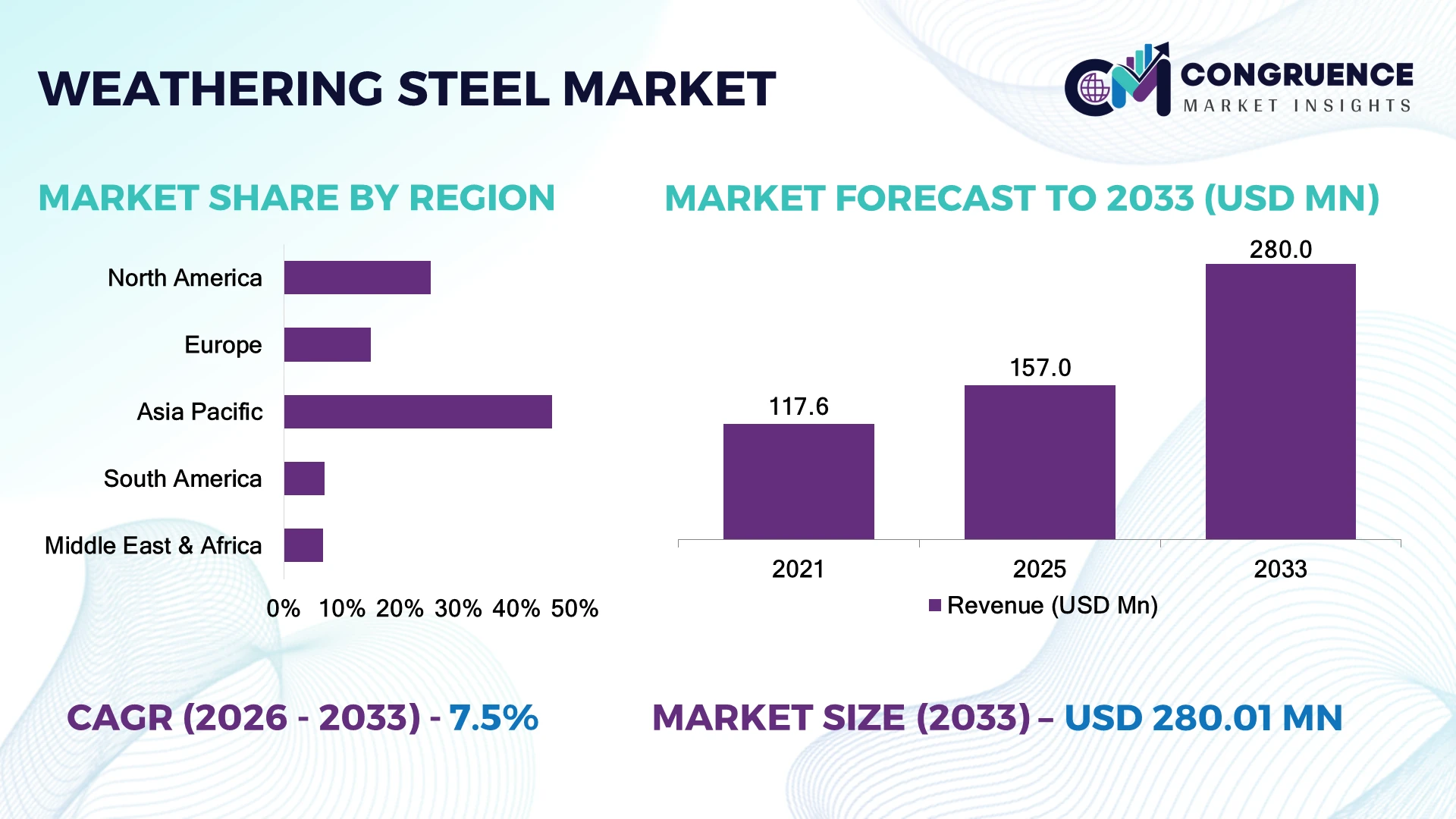
The Global Weathering Steel Market was valued at USD 157.0 Million in 2025 and is anticipated to reach a value of USD 280.0 Million by 2033 expanding at a CAGR of 7.5% between 2026 and 2033. Growth is driven by the replacement of conventional painted steel with corrosion-resistant weathering grades that eliminate repeated coating cycles and reduce bridge and infrastructure maintenance requirements.
China represents the dominant adoption market, supported by extensive bridge, railway, and urban infrastructure construction, while Japan maintains a mature weathering-steel bridge base with approximately 75% of domestic applications linked to bridges. The U.S. is expanding rehabilitation use, where suitable weathering-steel structures can achieve more than 30% lifecycle-cost savings versus painted alternatives. China's infrastructure scale remains substantially larger than Japan's, reinforcing Asia's manufacturing and deployment advantage.
Strategically, suppliers with advanced grades, localized capacity, and application-specific corrosion engineering are best positioned to secure infrastructure contracts.
Market Size & Growth: USD 157.0 Million in 2025 to USD 280.0 Million by 2033 at a 7.5% CAGR, driven by infrastructure modernization and reduced maintenance requirements.
Top Growth Drivers: Infrastructure modernization, bridge rehabilitation, and lifecycle-cost optimization are driving adoption, with lifecycle savings exceeding 30% in suitable applications.
Short-Term Forecast: By 2028, broader use of unpainted grades is positioned to reduce coating-related construction costs by more than 10% and improve project execution efficiency.
Emerging Technologies: High-strength alloys, digital corrosion monitoring, and advanced patina-control technologies are improving structural efficiency and material-selection accuracy.
Regional Leaders: Asia Pacific leads with large infrastructure deployment, North America benefits from bridge rehabilitation, and Europe emphasizes sustainable architectural and transportation applications.
Consumer/End-User Trends: Bridges and civil infrastructure accounted for 34.45% of demand in 2025, confirming transportation infrastructure as the leading application segment.
Pilot/Case Example: In 2025, a major Chinese expressway project deployed approximately 15,000 tonnes of weathering steel, demonstrating large-scale infrastructure adoption.
Competitive Landscape: ArcelorMittal, Tata Steel, Nippon Steel, SSAB, POSCO, JFE Steel, and U.S. Steel compete through advanced grades, capacity expansion, engineering support, and regional partnerships.
Regulatory & ESG Impact: Eliminating recurring painting can reduce VOC emissions and coating waste while supporting lifecycle-cost reductions exceeding 30% in appropriate applications.
Investment & Funding: Steel producers are increasing investment in advanced-grade production, infrastructure partnerships, and regional supply capabilities as procurement shifts toward durable materials.
Innovation & Future Outlook: High-strength weathering grades, corrosion modeling, digital inspection, and lighter structural designs are shifting competition toward performance engineering and lifecycle optimization.
Weathering steel demand is concentrated across bridges, rail infrastructure, architectural structures, industrial facilities, and exposed structural frameworks where reduced maintenance provides a measurable operating advantage. Suitable applications can achieve lifecycle savings exceeding 30%, strengthening adoption among infrastructure owners. High-strength grades and digital corrosion-monitoring technologies are improving structural efficiency and asset management. At the same time, infrastructure modernization and sustainability requirements are encouraging material substitution away from repeatedly coated conventional steel, creating opportunities for advanced product development and application-specific engineering.
Weathering steel is becoming strategically important as infrastructure owners prioritize lifecycle performance, maintenance reduction, and durable construction. Suitable unpainted applications can reduce lifecycle costs by more than 30%, while eliminating repeated coating operations can lower initial construction costs by over 10%. This shift is particularly relevant to bridge rehabilitation and infrastructure modernization, where maintenance closures create additional operational costs.
Compared with conventional painted steel, weathering steel eliminates recurring surface-preparation and coating operations, improving project efficiency and reducing maintenance intervention. Japan has extensive experience with weathering-steel bridges, while the U.S. is emphasizing lifecycle optimization in bridge rehabilitation. China combines large-scale infrastructure deployment with expanding domestic steelmaking capabilities. Over the next 2–3 years, digital corrosion monitoring and high-strength grades will improve application screening and structural design efficiency.
A practical deployment example is China's 2025 use of approximately 15,000 tonnes of weathering steel in a major expressway structure. Steelmakers are responding through advanced-grade development, localized production, engineering partnerships, and infrastructure-focused product strategies. Competitive positioning will increasingly depend on material performance, application expertise, and supply reliability.
Infrastructure owners are increasingly replacing conventional painted steel with weathering grades to reduce recurring coating and inspection requirements. Suitable weathering-steel structures can deliver lifecycle savings exceeding 30%, while eliminating coating operations can reduce initial construction costs by more than 10%. Japan demonstrates strong structural adoption, with approximately 75% of domestic weathering-steel applications associated with bridges. The U.S. is also expanding usage through bridge rehabilitation programs. Steel producers are responding with high-strength grades, technical engineering services, and infrastructure partnerships. The non-obvious advantage is reduced construction disruption because eliminating repainting limits future traffic closures, making weathering steel particularly attractive for heavily used transportation assets.
Weathering steel faces deployment limitations in high-chloride, continuously wet, and salt-exposed environments where protective patina formation can be compromised. Coastal infrastructure and bridges exposed to deicing salts therefore require detailed environmental assessment before specification. Conventional bridge painting typically represents a significant portion of structural maintenance expenditure, but unsuitable weathering-steel deployment can create additional remediation requirements. U.S. infrastructure projects must account for chloride exposure and drainage conditions during material selection. Producers are addressing these constraints through improved alloy formulations, application guidelines, alternative corrosion-resistant grades, and technical support. The key operational constraint is environmental qualification rather than material availability, making project-level corrosion assessment essential for protecting margins and preventing costly specification changes.
High-strength weathering steel creates opportunities to reduce structural weight while retaining corrosion resistance and lowering maintenance requirements. Suitable applications can achieve lifecycle savings above 30%, while advanced alloying improves atmospheric corrosion performance. China and India present significant opportunities through large-scale bridge, railway, industrial, and urban infrastructure programs. Digital corrosion monitoring adds another opportunity by enabling condition-based inspection and more precise asset-management decisions. Steelmakers are investing in R&D, specialized grades, regional production, and engineering partnerships to capture these applications. A less obvious opportunity is the combination of high-strength weathering steel with prefabricated construction, which can reduce fabrication complexity and accelerate infrastructure delivery while preserving the low-maintenance advantage.
Weathering-steel deployment requires consistent structural detailing, drainage, inspection, and corrosion management to maintain performance over long service periods. Poor drainage and chloride accumulation can compromise patina development, increasing inspection requirements and reducing the expected maintenance advantage. Projects with frequent washing requirements can experience lifecycle-cost increases of approximately 5–11%, particularly where contaminants accumulate on exposed surfaces. Infrastructure owners also face shortages of specialized corrosion-engineering expertise. Companies must address these challenges through digital inspection systems, engineering training, application-specific design services, and partnerships with infrastructure authorities. The strategic challenge is ensuring consistent performance after installation, requiring suppliers to move beyond steel production toward integrated material, engineering, monitoring, and asset-management solutions.
High-Strength Grade Adoption: Demand is shifting toward higher-performance weathering grades as infrastructure specifications prioritize load capacity, durability, and material efficiency. A588 accounted for 41.11% of 2025 type demand, while ASTM A709 Grade 50W is the fastest-growing grade at 7.88%. Steelmakers are expanding specialized product portfolios and engineering support to capture bridge and civil-infrastructure projects.
Low-Carbon Production Shift: EAF-based weathering steel containing more than 75% scrap is entering industrial supply chains, linking corrosion resistance with lower embodied carbon. Renewable-powered production is strengthening the sustainability profile of these grades as infrastructure buyers tighten procurement requirements. Producers are increasing recycled-content offerings and localizing production near fabricators to reduce logistics exposure and improve supply responsiveness.
Localized Supply Chain Expansion: Asia-Pacific accounted for 46.13% of market share in 2024, supported by Chinese mega-bridge projects and Indian capacity expansion, while North American grid reinforcement is increasing demand for plates, pipes, and piles. Regional EAF producers are positioning closer to fabricators, shortening lead times and reducing dependence on long-distance heavy-steel shipments.
Digital Corrosion Monitoring: Bridge and infrastructure operators are moving toward condition-based inspection as weathering steel expands across long-life assets. Digital corrosion assessment is improving inspection planning and helping owners identify drainage, chloride, and patina-development issues earlier. Steelmakers and engineering firms are responding by combining material supply with technical specification, monitoring, and asset-management services, creating a more integrated procurement model.
Corten-B is the leading type in the Global Weathering Steel Market, supported by its tensile strength, toughness, weldability, and suitability for heavy structural applications. Corten-B accounted for approximately 41.11% of type demand in 2025, giving it a clear scalability advantage over Corten-A and other specialized grades. Corten-A remains relevant in architectural and lighter structural applications where atmospheric corrosion resistance and surface appearance are important. Other types serve specialized requirements where customized alloy chemistry or mechanical performance is required.
The fastest-growing shift is toward ASTM A709 Grade 50W, which is advancing at approximately 7.88% as bridge rehabilitation and high-load structural projects increase demand for higher-performance grades. Compared with mature Corten-B applications, these grades provide greater specification-driven opportunities for infrastructure suppliers. Companies are expanding high-strength portfolios, strengthening technical support, and partnering with fabricators to match grade selection with structural requirements. The business implication is a shift from standardized weathering-steel volumes toward application-specific products with stronger engineering value.
Building & Construction remains the leading application, accounting for approximately 47.4% of weathering-steel volume in established market assessments. Demand is concentrated in bridges, structural frameworks, façades, and infrastructure where corrosion resistance and reduced maintenance requirements support long-term asset performance. Transportation is another established application, particularly for railway vehicles and shipping containers, while Art & Architecture benefits from the distinctive patina of weathering steel. Industrial applications remain relevant for exposed structures and equipment requiring durable corrosion performance.
Transportation is strengthening as infrastructure operators prioritize durable materials for rail and heavy-duty applications. Railway vehicles made from weathering steel combine high strength, durability, payload capability, and relatively low structural weight compared with conventional steel. This creates a different demand profile from construction, where project-scale procurement dominates. Companies are responding through application-specific grades, fabrication partnerships, and expanded plate and sheet availability. The business implication is that transportation demand is becoming increasingly specification-driven, rewarding suppliers that provide engineering support alongside material supply.
Industry backed insight, Jacobs Engineering Group designed three weathering-steel bridges for Australia's Country Rail Network in New South Wales, demonstrating practical deployment of the material in railway infrastructure modernization.
Building & Construction is the dominant end-user group because of its extensive requirement for weathering steel across bridges, structural frameworks, façades, roads, and civil infrastructure. Bridges and civil infrastructure accounted for approximately 34.45% of 2025 demand, demonstrating the strong concentration of purchasing among infrastructure owners and contractors. Transportation remains an established buyer group, while Art & Architecture generates smaller but highly specification-driven demand. Industrial users continue adopting weathering steel for exposed structures and machinery where corrosion resistance can reduce maintenance requirements.
Renewable-energy structures represent the fastest-growing end-user group, advancing at approximately 8.23% as weathering steel expands into exposed structural components and infrastructure supporting energy assets. This contrasts with established construction procurement, which emphasizes standardized specifications, project volume, and delivery reliability. Companies are responding with customized grades, engineering partnerships, regional distribution, and application-specific technical services. The business implication is a gradual shift toward buyers evaluating weathering steel through lifecycle performance rather than initial material cost, creating stronger opportunities for suppliers with specialized engineering and ecosystem capabilities.
Asia Pacific accounted for the largest market share at 46.1% in 2025 however, North America is expected to register the fastest growth, expanding at a CAGR of 5.0% between 2026 and 2033.
North America accounted for 25.2% of the global weathering steel market in 2025, making it the second-largest regional market. The United States dominates regional consumption through bridge rehabilitation, highway modernization, rail infrastructure, and utility projects. Domestic steel production is gaining strategic importance as U.S. trade measures encourage localized sourcing and protect domestic mills. Transmission infrastructure also represents a growing deployment area, with U.S. grid operators investing approximately USD 115 billion in transmission infrastructure during 2025. Steel producers are responding through EAF capacity additions, regional distribution agreements, and greater availability of weathering plates, shapes, piles, and poles. The region's competitive advantage lies in its mature engineering standards and established infrastructure procurement ecosystem, while supply localization is becoming increasingly important for project schedules and cost control.
United States Market Outlook: The United States remains the principal North American market, supported by its extensive bridge inventory and large-scale transportation infrastructure. Domestic producers are strengthening weathering-steel availability as infrastructure programs increase requirements for durable structural materials. The country's established A588 and A709 specifications support consistent engineering adoption, while EAF expansion is improving regional production flexibility and reducing dependence on imported structural grades.
Europe accounted for approximately 15.0% of the global weathering steel market in 2025, with demand increasingly influenced by sustainable construction requirements, infrastructure modernization, and low-carbon steel procurement. Germany, Italy, the United Kingdom, and France represent important consumption centers, particularly for bridges, rail infrastructure, architectural structures, and exposed structural applications. European producers are accelerating low-carbon steel initiatives as embodied-carbon requirements become more prominent in construction procurement. ArcelorMittal's XCarb deliveries to Vestas have achieved a reported 36% reduction in tower emissions, demonstrating the commercial integration of lower-carbon steel into industrial supply chains. Companies are also expanding premium plate capabilities and strengthening partnerships with engineering firms. Europe's market is therefore becoming increasingly specification-driven, with lifecycle performance and carbon intensity influencing material selection alongside structural properties.
Germany Market Outlook: Germany represents a strategically significant European manufacturing base, supported by a large engineering sector, established steel-processing infrastructure, and extensive industrial construction capabilities. German producers are investing in lower-carbon steelmaking and modernization as European procurement increasingly emphasizes emissions performance. The country's strong fabrication ecosystem enables weathering-steel suppliers to integrate advanced grades into bridge, industrial, architectural, and transportation projects while meeting increasingly demanding sustainability specifications.
Asia Pacific accounted for 46.1% of the global weathering steel market in 2025, establishing the region as the dominant demand and production center. China drives large-volume consumption through bridge, railway, highway, and urban infrastructure projects, while India is strengthening its position through domestic steel-capacity expansion. Japan contributes advanced welding and fabrication expertise, and South Korea supports demand through industrial and offshore infrastructure. India's Kalinganagar expansion adds approximately 8 million tonnes per annum of steel capacity, strengthening regional availability. China's extensive bridge construction provides a major outlet for weathering plates and structural grades. Producers are expanding capacity, improving alloy performance, and developing regional supply partnerships. The scale advantage is reinforced by integrated steelmaking and fabrication networks, allowing Asian suppliers to respond rapidly to infrastructure projects and large engineered orders.
China Market Outlook: China is the most strategically significant country in the Asia-Pacific weathering steel market because of its steelmaking scale and extensive infrastructure deployment. The country remains a major global steel producer and exporter, with steel exports reaching approximately 131.2 million tonnes in 2025. Large bridge, railway, and expressway programs create substantial domestic demand for weathering grades, while integrated mills provide strong control over production, processing, and project-scale supply.
South America accounted for approximately 7.0% of the global weathering steel market in 2025, with Brazil representing the principal demand center because of its steelmaking base, transportation infrastructure, mining activity, and large-scale industrial projects. Weathering steel is gaining attention in bridges, rail corridors, industrial structures, and exposed infrastructure where lower maintenance requirements provide an operational advantage. Brazil's apparent steel use reached approximately 125.9 million tonnes in 2025, supporting a substantial downstream industrial ecosystem. However, uneven infrastructure investment and project financing remain important execution considerations across the region. Producers are focusing on targeted infrastructure contracts, local distribution, and relationships with engineering contractors rather than broad capacity expansion. The strategic opportunity is concentrated in high-value transportation and industrial projects where durability and reduced maintenance justify premium material specifications.
Brazil Market Outlook: Brazil leads South American weathering-steel opportunities through its integrated steel industry, mining infrastructure, rail networks, and large construction base. Domestic steel consumption reached approximately 125.9 million tonnes in 2025, providing strong downstream fabrication capabilities. Suppliers can leverage Brazil's established steel ecosystem to support weathering grades for bridges, rail infrastructure, mining facilities, and industrial structures while reducing dependence on long-distance imports.
The Middle East & Africa accounted for approximately 6.7% of the global weathering steel market in 2025, with demand concentrated around infrastructure modernization, industrial construction, transportation networks, and major urban-development programs. Saudi Arabia and the United Arab Emirates are strengthening engineered-steel demand through large infrastructure and diversification projects, while South Africa remains important for mining, transportation, and industrial applications. Middle Eastern steel consumption reached approximately 205.7 million tonnes in 2025, demonstrating the scale of the broader regional steel ecosystem. Companies are prioritizing project-specific specifications, local distribution, and partnerships with engineering contractors rather than relying solely on commodity sales. Climate and environmental conditions require careful application engineering, particularly where humidity, salinity, or persistent wetness can affect patina formation and long-term corrosion performance.
Saudi Arabia Market Outlook: Saudi Arabia represents the region's strongest strategic opportunity because of its large infrastructure pipeline, industrial diversification programs, and expanding construction ecosystem. Major transportation, tourism, urban-development, and industrial projects are increasing demand for durable structural materials. Suppliers with localized technical support and application expertise can position weathering steel for exposed infrastructure where reduced coating requirements and lifecycle performance provide measurable operational benefits.
ArcelorMittal, Nippon Steel, Tata Steel, SSAB and POSCO compete as global leaders, while BlueScope, voestalpine and regional mills challenge them through localized supply and project specialization. The top five players collectively account for an estimated 35% of global sales, leaving a fragmented field for regional producers. Competition centers on grade performance, price, delivery reliability, customization and technical support, with high-strength grades delivering 15–25% structural weight savings and maintenance intervals extending up to 2x in painted applications. Players are expanding weathering portfolios, adding S420/S460 grades, improving EAF and recycled-content supply, and partnering with bridge engineers and fabricators. The competitive shift is toward low-carbon steel, application engineering and supply-chain control rather than commodity pricing alone. Entry barriers include metallurgical expertise, qualification standards, mill scale and infrastructure relationships, while raw-material volatility pressures margins. Winning requires verified grade performance, dependable regional availability, low-carbon credentials and engineering partnerships that convert material advantages into lifecycle-cost savings.
ArcelorMittal
Nippon Steel Corporation
Tata Steel Limited
SSAB AB
POSCO
BlueScope Steel Limited
voestalpine AG
United States Steel Corporation
JFE Steel Corporation
Steel Dynamics, Inc.
Salzgitter AG
Ternium S.A.
High-strength weathering steel is replacing conventional structural grades in demanding bridges and transport assets. SSAB now offers 420 ML and 460 ML grades, while its portfolio reaches 700–960 MPa yield strength in specialized applications. Higher strength can reduce steel weight by around 10–20%, improving fabrication efficiency and lowering transport loads. Adoption is strongest where structural weight and maintenance access directly affect project economics.
Digital engineering is becoming a second differentiator. Building-information modeling, corrosion mapping and condition monitoring integrate material selection with inspection workflows, reducing avoidable maintenance interventions by an estimated 10–15% in data-led programs. Compared with periodic manual inspection, digital workflows provide faster condition visibility and support targeted intervention. Suppliers with engineering teams and digital service capabilities gain stronger specification influence.
Low-carbon steelmaking is the third major transition for 2026–2028. EAF production, recycled feedstock and renewable electricity are becoming procurement differentiators, while advanced weathering grades align durability with embodied-carbon targets. ArcelorMittal’s 2026 portfolio adds S420/S460 options alongside XCarb low-carbon steel. Companies acting now can secure premium infrastructure specifications, strengthen ESG credentials and reduce dependence on price-only competition. This combination favors suppliers that can certify performance, document carbon intensity, and support engineers from specification through commissioning, as owners tighten procurement criteria.
May 2026 ArcelorMittal expanded its Indaten and Arcorox weathering-steel portfolio with S420 and S460 grades and updated EN 10025-5:2019 compliance. The expansion strengthens higher-strength infrastructure specifications while integrating XCarb low-carbon steel into sustainable architecture and bridge projects and fabricated structures. Source: constructalia.arcelormittal.com
March 2025 SSAB promoted Strenx Weathering grades at 700 and 960 MPa yield strength as alternatives to galvanized steel. The higher-strength portfolio supports lighter structures, improved corrosion protection, and lower maintenance exposure for transport, bridge, and industrial applications in environments. Source: ssab.com
June 2025 BlueScope and HERA released an updated Australian weathering-steel bridge design guide covering design, detailing, fabrication, inspection, maintenance, and rehabilitation. The partnership strengthens specification confidence and supports broader REDCOR deployment across short-span, long-span, rail, and pedestrian bridges locally. Source: bluescopesteel.com.au
May 2025 Tata Steel inaugurated Phase II expansion at Kalinganagar, adding 5 MTPA capacity and strengthening value-added steel availability. The expansion improves domestic supply resilience and product-mix flexibility, supporting infrastructure customers requiring specialized structural grades across India and infrastructure programs. Source: tatasteel.com
The Weathering Steel Market Report evaluates demand across Corten-A, Corten-B and other weathering grades, with application coverage spanning Building & Construction, Transportation, Industrial, and Art & Architecture uses. End-user analysis examines Building & Construction, Transportation, Industrial, Art & Architecture, and emerging renewable-energy structures. Regional coverage includes North America, Europe, Asia-Pacific, South America, and Middle East & Africa, with country-level assessment of major production and deployment centers.
The report analyzes high-strength alloy development, low-carbon steelmaking, digital corrosion monitoring, fabrication workflows, and lifecycle-cost optimization. With Asia-Pacific representing 46.1% of 2025 demand and infrastructure-led applications accounting for significant consumption, the study identifies where procurement, production, and specification activity is concentrated. Competitive profiling covers major global and regional producers, supporting investment planning, capacity expansion, partnership decisions, market-entry assessment, and competitive positioning through 2026–2033.
| Report Attribute / Metric | Details |
|---|---|
| Market Revenue (2025) | USD 157.0 Million |
| Market Revenue (2033) | USD 280.0 Million |
| CAGR (2026–2033) | 7.5% |
| Base Year | 2025 |
| Forecast Period | 2026–2033 |
| Historic Period | 2021–2025 |
| Segments Covered |
By Type
By Application
By End-User
|
| Key Deliverables | Revenue Forecast; Market Trends; Growth Drivers & Restraints; Technology Insights; Segmentation Analysis; Regional Insights; Competitive Landscape; Regulatory & ESG Overview; Recent Developments |
| Regions Covered | North America; Europe; Asia-Pacific; South America; Middle East & Africa |
| Companies Profiled | ArcelorMittal; Nippon Steel Corporation; Tata Steel Limited; SSAB AB; POSCO; BlueScope Steel Limited; voestalpine AG; United States Steel Corporation; JFE Steel Corporation; Steel Dynamics, Inc.; Salzgitter AG; Ternium S.A. |
| Customization & Pricing | Available on Request (10% Customization Free) |




