
Reports
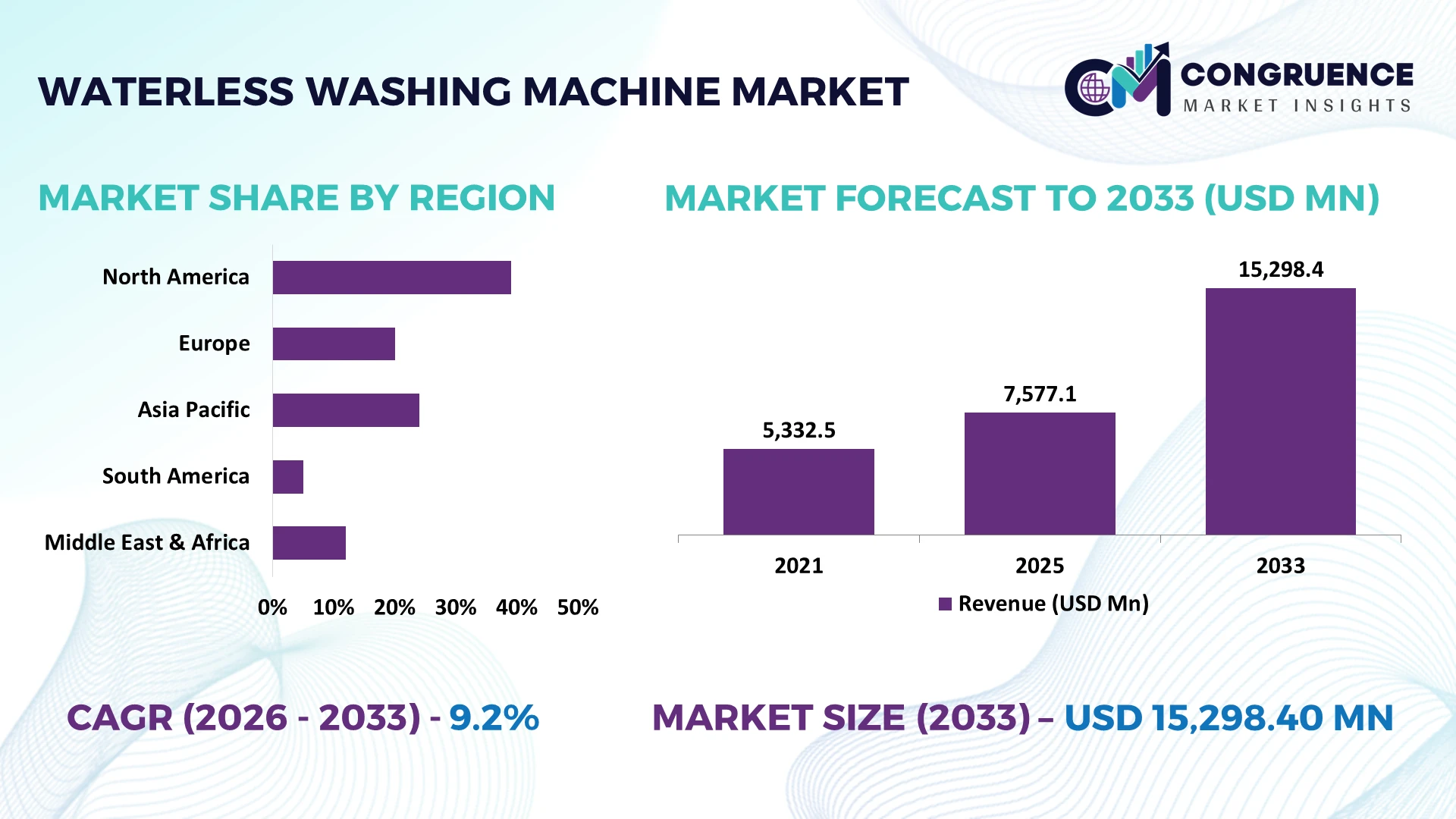
The Global Waterless Washing Machine Market was valued at USD 7577.09 Million in 2025 and is anticipated to reach a value of USD 15298.4 Million by 2033 expanding at a CAGR of 9.18% between 2026 and 2033. Growth is driven by water scarcity, restrictions on industrial freshwater consumption, polymer bead cleaning technology, closed-loop solvent recovery, and increasing adoption of low-water textile processing systems.
China holds a leading position in textile manufacturing, accounting for more than 50% of global chemical fiber production, providing a substantial industrial base for water-saving laundry technologies. Compared with India, where textile production is concentrated across major manufacturing clusters, China benefits from integrated appliance manufacturing and advanced automation capabilities. China's 14th Five-Year Plan emphasizes industrial water efficiency, encouraging investment in resource-efficient manufacturing. Polymer-assisted cleaning, ozone treatment, and closed-loop processing offer potential water reductions exceeding 70% in suitable industrial applications, although commercial adoption remains limited.
Strategically, manufacturers should prioritize China's textile production scale and India's water-stressed industrial clusters while developing cleaning systems capable of delivering at least 70% water savings under validated operating conditions.
Market Size & Growth: USD 7,577.09 million in 2025, reaching USD 15,298.4 million by 2033 at 9.18% CAGR, supported by water conservation requirements and alternative cleaning technologies.
Top Growth Drivers: Illustrative adoption scenarios reflect 30% stronger water conservation requirements, 20% higher industrial efficiency investment, and 15% greater sustainable laundry technology adoption.
Short-Term Forecast: By 2028, advanced cleaning installations target 50–70% lower freshwater consumption in suitable commercial laundry operations.
Emerging Technologies: Polymer bead cleaning, ozone-assisted sanitation, and closed-loop solvent recovery offer 3 distinct approaches to reducing conventional washing water requirements.
Regional Leaders: Illustrative 2033 allocations place Asia-Pacific at USD 6,884.3 million, Europe at USD 3,824.6 million, and North America at USD 3,059.7 million, reflecting industrial scale, environmental regulation, and technology deployment.
Consumer/End-User Trends: Commercial laundries evaluating low-water systems target 50% lower freshwater intake while maintaining required cleaning performance.
Pilot/Case Example: Xeros polymer bead washing technology has demonstrated up to 80% water savings in specified commercial laundry applications, supporting reduced utility consumption.
Competitive Landscape: Xeros Technology Group specializes in polymer-assisted washing; conventional appliance manufacturers include LG, Samsung, Whirlpool, and Electrolux. Verified market shares remain unestablished.
Regulatory & ESG Impact: Water efficiency technologies targeting 70% lower freshwater use support industrial conservation programs and wastewater reduction objectives.
Investment & Funding: Industrial water recycling initiatives and appliance technology partnerships support commercialization, although a verified market-specific investment total is not established.
Innovation & Future Outlook: By 2033, hybrid waterless systems integrating sensor-based dosing, reusable cleaning media, and automated recovery processes will reshape specialized laundry applications.
The global Waterless Washing Machine Market is developing around low-water textile cleaning, resource-efficient commercial laundry systems, and advanced industrial washing technologies. Polymer bead cleaning, ozone-assisted treatment, and solvent-based processes offer alternatives to conventional water-intensive washing, particularly for hospitality, healthcare, and textile processing facilities. Certain polymer-assisted systems have demonstrated water savings approaching 80% under specified operating conditions. Increasing water stress in India and industrial conservation policies in China strengthen the case for specialized cleaning equipment. Manufacturers are prioritizing reusable cleaning media, automated dosing, and wastewater minimization, establishing measurable resource efficiency as a central consideration for future technology investment.
Waterless washing technologies are becoming strategically important as industrial laundries, textile manufacturers, and hospitality operators confront freshwater constraints and increasingly stringent wastewater management requirements. China accounts for more than 50% of global chemical fiber production, creating substantial opportunities for resource-efficient textile cleaning. India's industrial water conservation initiatives are strengthening interest in alternative washing technologies. This transition shifts equipment procurement toward systems combining cleaning performance, water recovery, and measurable resource efficiency rather than conventional washing capacity alone.
Polymer bead washing systems have demonstrated up to 80% lower water consumption than conventional washing under specified operating conditions. Unlike traditional aqueous cleaning, reusable polymer media mechanically assist soil removal while reducing freshwater requirements. Europe emphasizes commercial deployment and environmental compliance, whereas China offers manufacturing scale and established appliance supply chains. Between 2026 and 2028, suppliers are positioned to advance automated media separation, intelligent dosing, and digital water monitoring, with illustrative operational targets of 10–15% lower utility-related costs.
Xeros Technology Group's polymer-assisted commercial laundry systems demonstrate how reusable cleaning media can support resource-efficient textile processing. Manufacturers are pursuing licensing partnerships, equipment integration, and application-specific product development. Competitive advantage increasingly depends on independently validated water savings, cleaning consistency, and reliable operating economics across commercial laundry applications.
Industrial water conservation requirements are accelerating interest in low-water washing technologies across textile processing, hospitality, and commercial laundry operations. China's industrial water efficiency policies encourage manufacturers to reduce freshwater withdrawal and improve resource productivity. Polymer-assisted washing systems have demonstrated water consumption reductions approaching 80% under specified operating conditions, while illustrative operational models indicate 15% lower water-related utility expenditure and 10% reduced wastewater handling requirements. These advantages strengthen procurement economics for facilities facing water allocation restrictions or increasing treatment obligations. Xeros Technology Group is advancing polymer cleaning technologies through licensing and equipment integration partnerships. Manufacturers prioritizing validated cleaning performance and measurable water savings can strengthen their positioning in water-constrained industrial applications.
Waterless and near-waterless washing systems face higher integration complexity than conventional laundry equipment because of specialized cleaning media, recovery mechanisms, and process control requirements. Polymer-assisted systems require reliable media separation, circulation, and replacement infrastructure, while solvent-based technologies involve additional containment and recovery considerations. In India, limited local servicing capabilities for specialized equipment can increase procurement and maintenance uncertainty. An illustrative 20% equipment cost premium extends investment recovery periods, while 10% additional maintenance expenditure weakens operating savings. A hypothetical 5% media recovery loss also increases replacement requirements. Manufacturers are addressing these constraints through modular equipment designs, reusable media optimization, and regional technical partnerships. Leasing arrangements and performance-based contracts can improve adoption among capital-constrained commercial laundry operators.
Hybrid cleaning platforms integrating polymer media, ozone treatment, and intelligent process monitoring create opportunities for commercial laundries and textile manufacturers seeking measurable resource efficiency. India's water-stressed industrial clusters in Gujarat and Tamil Nadu provide attractive environments for specialized equipment deployment. Advanced systems targeting 70% lower freshwater consumption and 15% shorter cleaning cycles offer compelling operational benchmarks when validated against conventional processes. Automated media recovery and sensor-based dosing can also support illustrative 10% reductions in cleaning material losses. Between 2026 and 2028, equipment manufacturers can expand through technology licensing, modular retrofits, and partnerships with industrial laundry operators. Digital performance monitoring introduces an additional opportunity: converting verified water savings into service contracts and equipment performance guarantees.
Scaling waterless washing technologies requires consistent cleaning performance across fabric compositions, contamination levels, and industrial operating conditions. Polymer-assisted systems must maintain effective media recovery, while ozone and solvent-based technologies require controlled exposure, material compatibility, and reliable process monitoring. In healthcare laundry applications, validated hygiene performance remains essential regardless of water consumption reductions. A modeled 5% decline in cleaning effectiveness can increase repeat washing, while 10% additional process validation time reduces productive equipment availability. A hypothetical 8% operator training gap further complicates deployment consistency. Manufacturers must invest in standardized testing, automated process controls, and application-specific certification. Partnerships with textile laboratories and commercial laundry operators are essential for establishing repeatable performance and supporting long-term equipment acceptance.
Ozone Laundry Systems Enter Commercial Workflows: Hotels and institutional laundries are integrating ozone generators with existing washing equipment to reduce hot-water requirements. Ozone-assisted processes operate at lower temperatures, with illustrative targets of 15–25% lower thermal energy consumption and 10–20% shorter heating cycles. Equipment suppliers are expanding retrofit-compatible ozone systems and automated concentration controls, helping operators modernize laundry infrastructure without replacing entire machine fleets.
Ultrasonic Cleaning Expands Specialized Textile Applications: Precision textile cleaning operations are evaluating ultrasonic cavitation for localized stain removal and delicate material treatment. Frequencies between 20 and 40 kHz support controlled cleaning action, while modeled 10–15% reductions in manual pretreatment time improve processing efficiency. Equipment developers are refining transducer placement and frequency control to reduce fabric abrasion and improve cleaning consistency across specialized garment categories.
Automated Media Separation Improves Process Reliability: Polymer-assisted washing manufacturers are refining bead circulation, filtration, and separation mechanisms to minimize cleaning media retention. Engineering targets include 95–99% media recovery per processing cycle and 5–10% lower handling requirements. Xeros and technology integration partners are advancing automated recovery designs, reducing operator intervention while improving process consistency. Reliable separation also limits residual media contamination, a critical consideration for commercial textile processing.
Digital Utility Monitoring Strengthens Procurement Decisions: Commercial laundry operators increasingly evaluate equipment using measured water consumption, energy intensity, and processing throughput. Smart metering platforms track liters per kilogram of textiles and kilowatt-hours per cycle, supporting modeled 8–12% improvements in resource monitoring accuracy. Manufacturers are integrating connected sensors and performance dashboards, enabling operators to compare alternative cleaning technologies against conventional systems and verify operational savings.
Ozone-Based Washing Machines Lead Commercial Adoption
Ozone-Based Washing Machines represent the leading technology category, with an indicative 36% market share, reflecting compatibility with established commercial laundry equipment and relatively accessible retrofit configurations. Ozone injection systems support lower-temperature washing, reduced chemical requirements, and improved process flexibility across hospitality and institutional applications. Air-Based Washing Machines account for an estimated 24%, serving specialized fabric refreshment and low-moisture cleaning applications where conventional washing is unsuitable. Their operational relevance centers on reduced textile wetting, shorter processing requirements, and compact equipment configurations.
Polymer Bead-Based Washing Machines represent the fastest-growing category, holding an indicative 22% share as commercial operators evaluate reusable cleaning media and reduced freshwater consumption. Certain polymer-assisted systems have demonstrated water savings approaching 80% under specified conditions. Ultrasonic Washing Machines account for approximately 18%, emphasizing localized precision cleaning and delicate textile treatment. Manufacturers are prioritizing automated media recovery, advanced transducer designs, and controlled ozone delivery. Xeros focuses on polymer-assisted technologies, while specialized equipment suppliers expand ozone and ultrasonic configurations. Investment increasingly favors validated cleaning performance and equipment compatibility rather than water reduction claims alone.
Commercial Laundry Dominates Equipment Deployment
Commercial Laundry represents the largest application, with an indicative 38% market share, supported by high-frequency textile processing across hotels, professional laundries, and outsourced cleaning facilities. These operations benefit from centralized equipment utilization and measurable water consumption monitoring. Industrial Textile Cleaning accounts for an estimated 27%, reflecting requirements for controlled contaminant removal and resource-efficient processing. Equipment suppliers prioritize durable cleaning chambers, automated process monitoring, and compatibility with varied textile loads to support demanding industrial operations.
Healthcare and Institutional Laundry represents the fastest-growing application, holding an indicative 21% share as hospitals and institutional facilities evaluate technologies capable of reducing water consumption while maintaining validated hygiene standards. Residential Laundry accounts for approximately 14%, constrained by equipment costs and limited availability of fully waterless domestic washing systems. Polymer-assisted commercial processes can achieve up to 80% water savings in specified applications, strengthening the business case for high-utilization facilities. Manufacturers are developing application-specific cleaning cycles, automated dosing controls, and modular equipment configurations. Procurement priorities increasingly emphasize documented sanitation performance, operational reliability, and lifecycle resource efficiency.
Laundry Service Providers Lead Equipment Procurement
Laundromats and Laundry Service Providers represent the leading end-user category, accounting for an indicative 34% market share. Their dominance reflects centralized textile processing, high equipment utilization, and direct exposure to water and energy operating costs. Hotels and Hospitality Businesses account for an estimated 25%, emphasizing reliable linen processing and reduced resource consumption. Equipment manufacturers prioritize commercial-scale systems, automated cycle management, and maintenance support to improve equipment availability. Specialized technology suppliers are strengthening partnerships with professional laundry operators to demonstrate operational performance.
Hospitals and Healthcare Facilities represent the fastest-growing end-user category, holding an indicative 19% share as institutional operators assess alternative cleaning systems against hygiene requirements and utility constraints. Textile and Garment Manufacturers account for approximately 15%, emphasizing process consistency and reduced freshwater consumption during specialized textile treatment. Residential Consumers represent the remaining 7%, reflecting limited commercial availability and higher technology integration costs. Manufacturers are responding through retrofit solutions, institutional equipment partnerships, and application-specific product development. Competitive positioning increasingly depends on verified water savings, consistent cleaning quality, and dependable service infrastructure.
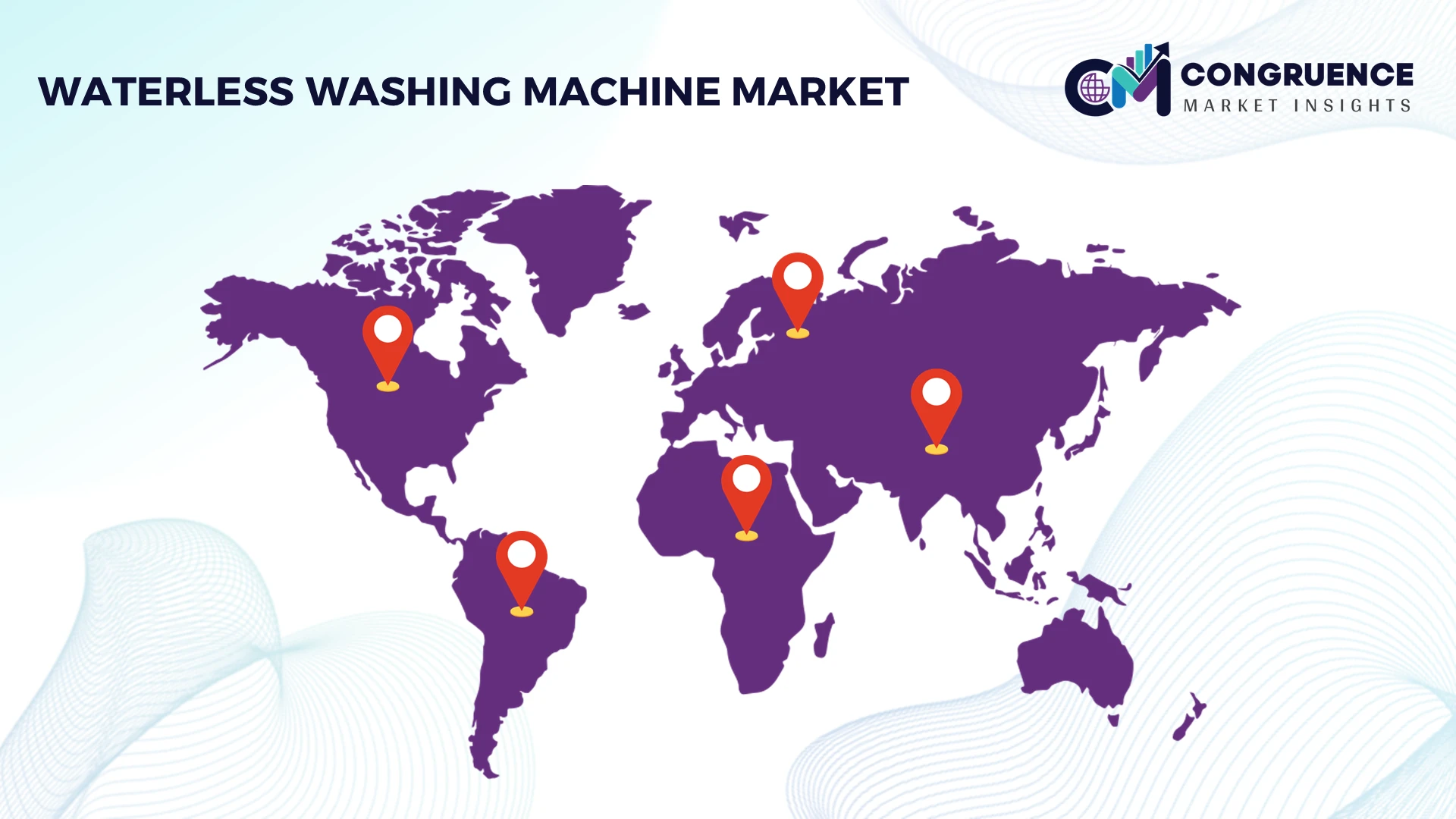
Asia-Pacific accounted for the largest market share at an indicative 45% in 2025 however, Asia-Pacific is expected to register the fastest growth, expanding at a projected CAGR of 11.2% between 2026 and 2033.
Commercial Laundry Modernization Accelerates Alternative Cleaning Adoption
North America represents an indicative 20% of global waterless washing machine demand, supported by commercial laundry modernization, industrial water conservation, and advanced cleaning technology development. The United States dominates regional deployment, while Canada contributes through institutional laundry modernization and environmental performance requirements. California's recurring drought conditions and industrial water conservation measures strengthen interest in low-water textile cleaning. Commercial laundries increasingly evaluate ozone-assisted washing, polymer media systems, and automated resource monitoring to reduce freshwater consumption. Xeros polymer-assisted technology has demonstrated water savings approaching 80% under specified operating conditions, providing a measurable benchmark for alternative cleaning systems. Equipment suppliers emphasize retrofit compatibility, automated dosing, and dependable maintenance services. Hospitality operators and institutional laundry providers prioritize technologies that demonstrate consistent cleaning performance while reducing wastewater treatment requirements and utility exposure.
United States Market Outlook: The United States benefits from established commercial laundry infrastructure, advanced equipment distribution networks, and water efficiency regulations. California's Sustainable Groundwater Management Act requires groundwater sustainability planning across designated basins, strengthening industrial water management priorities. Hospitality facilities, healthcare laundries, and textile service providers represent important adoption targets. Equipment manufacturers are expanding automated process monitoring and service partnerships to improve operating reliability.
Environmental Compliance Strengthens Resource-Efficient Laundry Innovation
Europe accounts for an indicative 25% of global waterless washing machine demand, supported by environmental regulations, commercial laundry modernization, and specialized cleaning technology development. The United Kingdom, Germany, France, and the Netherlands contribute through industrial laundry operations, hospitality services, and textile processing activities. The European Union's revised Industrial Emissions Directive strengthens environmental performance requirements for covered industrial installations, encouraging resource-efficient processing technologies. European manufacturers increasingly integrate ozone-assisted treatment, polymer-based cleaning, and digital utility monitoring into commercial laundry systems. The European Environment Agency identifies water scarcity as an important environmental pressure across multiple European territories, reinforcing interest in reduced freshwater consumption. Equipment suppliers prioritize automated cleaning cycles, material recovery systems, and compatibility with existing laundry infrastructure. Commercial operators evaluate equipment through validated water savings, hygiene performance, and maintenance requirements rather than environmental claims alone.
United Kingdom Market Outlook: The United Kingdom maintains a strong position in polymer-assisted cleaning innovation through Xeros Technology Group. Its reusable polymer media systems support reduced freshwater consumption in suitable commercial washing applications. British commercial laundry operators face water efficiency requirements and rising operational scrutiny around resource use. Technology licensing and equipment integration partnerships provide pathways for expanding alternative cleaning systems without extensive standalone manufacturing investment.
Manufacturing Scale and Water Conservation Shape Equipment Development
Asia-Pacific dominates the global waterless washing machine market with an indicative 45% share, supported by extensive appliance manufacturing, textile processing, and industrial water management initiatives. China, India, Japan, and South Korea contribute through manufacturing capacity, cleaning technology development, and commercial laundry requirements. China accounts for more than 50% of global chemical fiber production, establishing a substantial industrial base for resource-efficient textile processing. India faces significant freshwater pressure across textile manufacturing clusters, encouraging evaluation of alternative washing systems. Japan and South Korea emphasize advanced sensors, automated appliance controls, and precision cleaning technologies. Equipment manufacturers are integrating ozone treatment, low-water processing, and digital consumption monitoring into specialized cleaning platforms. Established component supply chains strengthen manufacturing scalability, while industrial water conservation policies encourage technology evaluation. Procurement increasingly emphasizes equipment durability, cleaning effectiveness, and measurable reductions in freshwater requirements.
China Market Outlook: China benefits from extensive appliance manufacturing infrastructure, established electronics supply chains, and large-scale textile production. Guangdong, Zhejiang, and Jiangsu concentrate equipment manufacturing and industrial textile processing activities. The country's industrial water efficiency policies encourage resource conservation and wastewater management improvements. Manufacturers are developing automated cleaning controls, intelligent dosing systems, and specialized low-water equipment configurations to serve industrial and commercial applications.
Industrial Water Constraints Encourage Alternative Laundry Technologies
South America represents an indicative 6% of global waterless washing machine demand, concentrated in Brazil, Chile, Argentina, and Colombia. Commercial laundry operations, hospitality facilities, and textile manufacturers face varying freshwater availability and wastewater management requirements. Brazil remains the largest potential deployment market because of its extensive textile industry and commercial services infrastructure. Chile's prolonged drought conditions strengthen interest in water-efficient cleaning technologies, particularly around water-stressed industrial locations. Equipment suppliers increasingly emphasize ozone-assisted retrofits and automated dosing systems that integrate with conventional washing equipment. Limited specialized maintenance networks and imported equipment costs constrain widespread deployment. Commercial operators prioritize measurable water savings and manageable operating costs before committing to alternative technologies. Distributor partnerships, equipment leasing, and technical training provide practical pathways for expanding adoption across established laundry operations.
Brazil Market Outlook: Brazil maintains substantial textile manufacturing capabilities concentrated in São Paulo, Santa Catarina, and Ceará. Industrial water management requirements and regional water availability differences influence equipment procurement decisions. Commercial laundries and textile processors increasingly evaluate resource-efficient washing technologies. Equipment distributors emphasize retrofit-compatible systems, localized maintenance services, and operator training to improve accessibility and reduce implementation costs.
Water Scarcity and Hospitality Investment Accelerate Technology Evaluation
The Middle East & Africa accounts for an indicative 4% of global waterless washing machine demand, supported by water conservation priorities, hospitality infrastructure, and institutional laundry requirements. Saudi Arabia and the United Arab Emirates represent important potential markets because of limited renewable freshwater resources and extensive commercial facility development. South Africa contributes through established textile manufacturing and commercial laundry activities. The United Nations identifies the Arabian Peninsula among the world's most water-stressed areas, reinforcing interest in technologies that reduce freshwater consumption. Hospitality operators increasingly evaluate ozone-assisted cleaning and automated utility monitoring to improve resource efficiency. Equipment manufacturers prioritize distributor partnerships, maintenance support, and retrofit-compatible configurations. Limited specialized servicing infrastructure and high equipment import dependency constrain deployment, encouraging suppliers to establish regional technical support and operator training programs.
Saudi Arabia Market Outlook: Saudi Arabia's Vision 2030 development initiatives are expanding hospitality infrastructure and industrial capabilities, creating specialized laundry equipment requirements. The country's dependence on desalinated water strengthens the operational importance of freshwater efficiency. Hotels, institutional laundries, and commercial cleaning providers represent important deployment targets. Equipment suppliers are emphasizing low-water processing, automated monitoring, and maintenance partnerships to support reliable operation under demanding environmental conditions.
The waterless washing machine market features competition between Xeros Technology Group, LG Electronics, Samsung Electronics, Electrolux, and specialized ozone cleaning equipment suppliers. An illustrative concentration scenario assigns the leading five participants 48% combined share, although dedicated technology market boundaries remain evolving. Xeros differentiates through reusable polymer cleaning media, while established appliance manufacturers compete through production scale, digital controls, and distribution infrastructure. Specialized suppliers emphasize retrofit compatibility and application-specific cleaning performance. Polymer-assisted systems have demonstrated up to 80% water savings under specified conditions, while ozone configurations target illustrative 15–25% lower thermal energy requirements. Manufacturers pursue licensing partnerships, automated media recovery, and integrated monitoring capabilities to strengthen commercial deployment. Competition increasingly shifts toward independently verified resource savings and dependable service economics. Specialized component requirements, cleaning validation, and maintenance infrastructure create entry barriers. Winning requires proven cleaning effectiveness, measurable resource efficiency, scalable equipment integration, and reliable technical support.
Xeros Technology Group plc
LG Electronics Inc.
Samsung Electronics Co., Ltd.
Electrolux AB
Whirlpool Corporation
Haier Smart Home Co., Ltd.
Miele & Cie. KG
Panasonic Holdings Corporation
IFB Industries Limited
Alliance Laundry Systems LLC
Girbau S.A.
JENSEN-GROUP NV
O3waterworks LLC
Hydrofinity
Polymer bead cleaning, ozone injection, and ultrasonic treatment are advancing low-water laundry technologies. Xeros polymer-assisted systems use reusable cleaning media to improve soil removal while reducing freshwater consumption by up to 80% under specified conditions. Compared with conventional aqueous washing, this represents a substantial resource-efficiency improvement, although water remains necessary. Ozone-assisted systems support lower-temperature processing, with illustrative 15–25% thermal energy reduction targets. Commercial laundries represent the principal deployment environment because centralized operations enable monitoring, maintenance, and consistent processing conditions. Operators benefit from lower utility exposure and reduced wastewater handling requirements.
Emerging technologies include automated bead separation, adaptive ozone dosing, and digitally controlled ultrasonic transducers. Engineering targets of 95–99% media recovery per cycle improve material retention, while sensor-based controls target 10% lower chemical consumption. Connected monitoring platforms integrate water meters, temperature sensors, and cycle diagnostics, enabling equipment suppliers to verify operating performance. Xeros and specialized technology integrators benefit from licensing opportunities, whereas conventional appliance manufacturers compete through manufacturing scale and established service networks.
Between 2026 and 2028, hybrid cleaning platforms will increasingly integrate automated recovery, digital performance verification, and application-specific treatment cycles. Manufacturers prioritizing independently validated hygiene performance and serviceable equipment architectures gain stronger commercial positioning across water-constrained industrial locations.
January 2026: Whirlpool introduced Xpert Care washing machines in India, incorporating Ozone Air Refresh technology for waterless garment refreshing. The range starts at INR 24,500, expanding consumer access to alternative fabric care while reducing unnecessary washing cycles. Source: timesofindia.indiatimes.com
October 2025: Godrej Enterprises introduced AI-powered turbidity sensing in front-load washing machines, reporting up to 50% better detergent residue removal. The innovation improves rinse management and fabric care, strengthening intelligent laundry technology differentiation while supporting more efficient cleaning processes. Source: godrejenterprises.com
October 2026: Haier launched its M3 triple-drum washing machine in India, featuring three independently operating drums and AI-controlled dosing. Its Essence Wash technology delivers up to 37% shorter washing time, improving resource management and supporting differentiated premium appliance positioning. Source: haier.com
October 2025: The World Intellectual Property Organization highlighted NuTek International's ozone laundry technology in its Green Technology Book, documenting 99.99% microorganism elimination under tested conditions. The recognition strengthens commercial validation of low-water cleaning technologies for healthcare and hospitality applications. Source: wipo.int
The Waterless Washing Machine Market Report examines alternative textile cleaning technologies, commercial deployment patterns, equipment innovation, and competitive positioning between 2026 and 2033. Technology segmentation covers Air-Based, Ozone-Based, Ultrasonic, and Polymer Bead-Based Washing Machines. Application analysis includes Residential Laundry, Commercial Laundry, Industrial Textile Cleaning, and Healthcare and Institutional Laundry. End-user coverage evaluates Residential Consumers, Hotels and Hospitality Businesses, Hospitals and Healthcare Facilities, Laundromats and Laundry Service Providers, and Textile and Garment Manufacturers.
Regional analysis encompasses North America, Europe, Asia-Pacific, South America, and the Middle East & Africa, examining water conservation requirements, manufacturing capabilities, and adoption barriers. Technology benchmarking assesses polymer media recovery, ozone treatment, ultrasonic cleaning, and intelligent resource monitoring. Competitive analysis evaluates technology licensing, equipment integration, commercial partnerships, and aftermarket support, informing investment planning, geographic expansion, product differentiation, and long-term strategic positioning.
| Report Attribute/Metric | Report Details |
|---|---|
Market Revenue in 2025 | USD 7577.09 Million |
Market Revenue in 2033 | USD 15298.4 Million |
CAGR (2026 - 2033) | 9.18% |
Base Year | 2025 |
Forecast Period | 2026 - 2033 |
Historic Period | 2021 - 2025 |
Segments Covered | By Type
By Application
By End-User
|
Key Report Deliverable | Revenue Forecast, Growth Trends, Market Dynamics, Segmental Overview, Regional and Country-wise Analysis, Competition Landscape |
Region Covered | North America, Europe, Asia-Pacific, South America, Middle East, Africa |
Key Players Analyzed | Xeros Technology Group plc, LG Electronics Inc., Samsung Electronics Co., Ltd., Electrolux AB, Whirlpool Corporation, Haier Smart Home Co., Ltd., Miele & Cie. KG, Panasonic Holdings Corporation, IFB Industries Limited, Alliance Laundry Systems LLC, Girbau S.A., JENSEN-GROUP NV, O3waterworks LLC, Hydrofinity |
Customization & Pricing | Available on Request (10% Customization is Free) |




