
Reports
The Global Waterless Coolant Market was valued at USD 500.5 Million in 2025 and is anticipated to reach a value of USD 899.3 Million by 2033 expanding at a CAGR of 7.6% between 2026 and 2033. Growth is driven by elimination of water-related corrosion, higher boiling-point performance, extended coolant service intervals, and growing adoption in high-temperature engines and specialty industrial equipment.
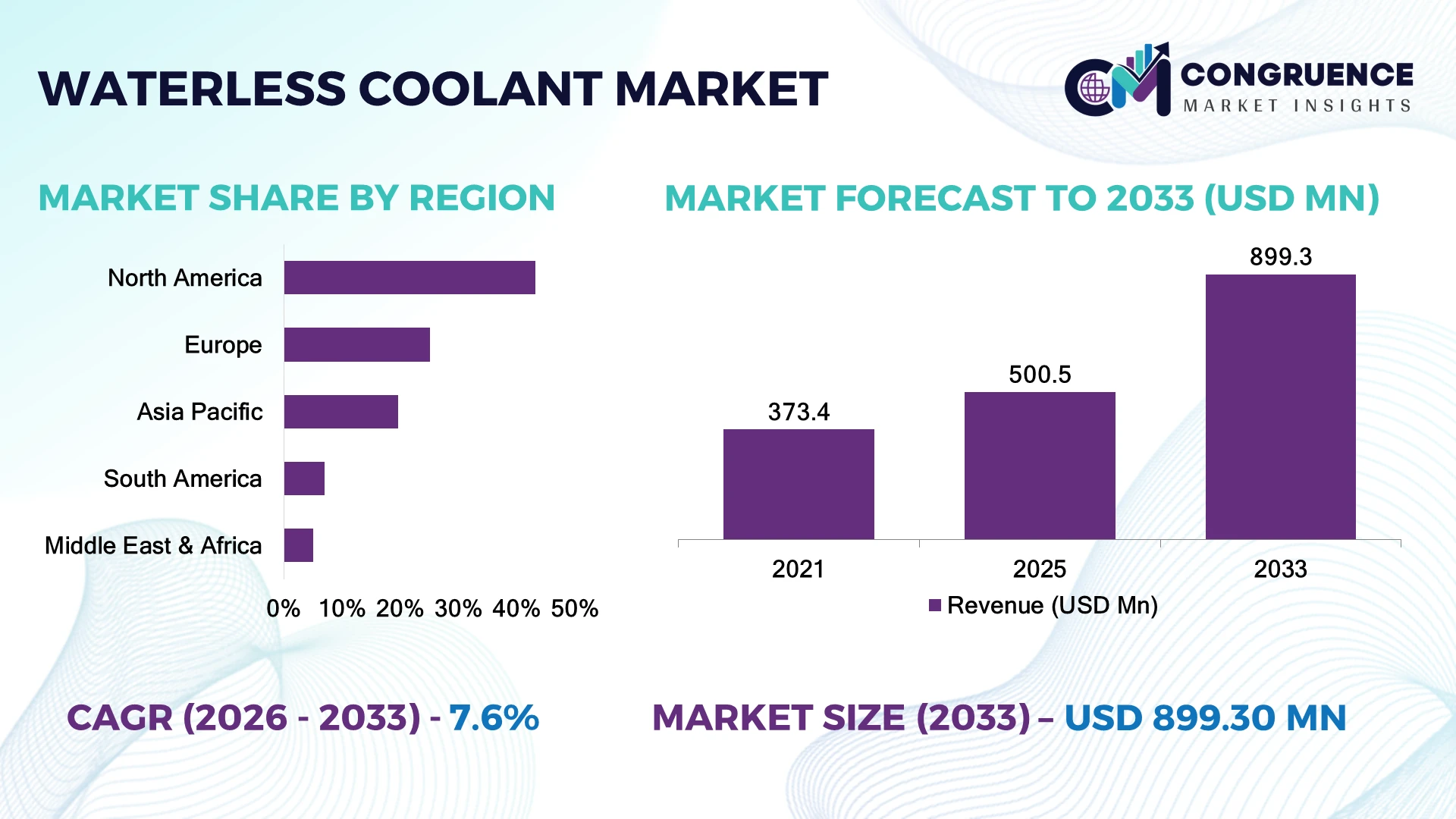
The United States remains the dominant market, accounting for approximately 42% of global waterless coolant demand, supported by automotive aftermarket, classic vehicles, motorsport, agricultural equipment, and industrial engines. U.S.-based technology leadership contrasts with Europe's stricter vehicle-emission and chemical-management environment. Waterless formulations can operate at boiling points above 180°C and eliminate pressurized water-coolant behavior, reducing corrosion-related maintenance by approximately 20–30% in suitable applications. Supply-chain localization is gaining importance amid global logistics volatility.
Strategic implication: suppliers that combine validated thermal performance with distribution reach and application-specific conversion support are best positioned to capture premium coolant demand.
Market Size & Growth: USD 500.5 million in 2025 to USD 899.3 million by 2033 at 7.6% CAGR, driven by high-temperature engine protection and extended service intervals.
Top Growth Drivers: Corrosion reduction 20–30%; service-life extension 3–5×; high-temperature operating tolerance 15–25% above conventional water-based systems.
Short-Term Forecast: By 2028, optimized conversion workflows can reduce coolant-related maintenance events 15–25% and improve thermal-system uptime 5–10%.
Emerging Technologies: Propylene-glycol formulations, advanced inhibitor packages, thermal monitoring, and application-specific coolant engineering are strengthening performance consistency.
Regional Leaders: North America could exceed USD 360 million; Europe approaches USD 250 million; Asia-Pacific moves toward USD 190 million, supported by industrial and automotive adoption.
Consumer/End-User Trends: Automotive aftermarket and specialty engines represent roughly 55–60% of demand, with performance-oriented users prioritizing corrosion protection and longer service intervals.
Pilot/Case Example: 2026 specialty-engine deployments demonstrate service-interval potential of 3–5 times conventional coolant replacement cycles when systems are properly converted and maintained.
Competitive Landscape: Evans Cooling Systems leads the specialized segment, competing with manufacturers and distributors including Peak, Shell, BASF, and Valvoline across performance and aftermarket channels.
Regulatory & ESG Impact: Eliminating routine water-coolant disposal can reduce coolant-related fluid waste by approximately 20–40% in long-service applications.
Investment & Funding: Manufacturers are directing millions of dollars toward formulation development, distribution expansion, industrial partnerships, and application engineering as specialized coolant demand broadens.
Innovation & Future Outlook: 2026–2028 priorities include longer-life formulations, thermal diagnostics, recyclable packaging, fleet conversion programs, and coolant systems engineered for electrified and high-load equipment.
The Waterless Coolant Market serves automotive aftermarket, motorsport, agricultural machinery, classic vehicles, heavy equipment, and stationary engines requiring enhanced thermal stability. Propylene-glycol formulations can deliver boiling points above 180°C, while corrosion-inhibitor systems support longer service intervals. Adoption is increasingly moving toward specialty fleets and high-value engines as maintenance costs and water-related corrosion become stronger procurement considerations.
Waterless coolant is becoming strategically relevant because it changes the maintenance economics of thermal-management systems rather than simply replacing conventional antifreeze. By removing water, these formulations eliminate a major corrosion and boiling-related failure mechanism and support operation at substantially higher boiling temperatures. For high-value engines, this shifts coolant from a consumable toward a longer-life performance component.
Compared with conventional water-based coolant systems, waterless formulations can extend replacement intervals by approximately 3–5 times and reduce corrosion-related maintenance by 20–30% in suitable applications. North America currently leads through established aftermarket and specialty-engine adoption, while Europe emphasizes chemical compliance and efficiency, and China and India are developing opportunities across commercial vehicles, agricultural machinery, and industrial equipment.
During 2026–2028, manufacturers are expected to prioritize fleet-conversion programs, application-specific inhibitor chemistry, thermal diagnostics, and distributor training. Practical deployment increasingly involves complete system conversion, including removal of residual water before filling, making installer capability a critical commercial differentiator. Companies are therefore investing in technical-service networks alongside formulation innovation. Competitive advantage will depend on proving lifecycle savings, simplifying conversion, and establishing reliable distribution rather than competing on coolant price alone.
Waterless coolant adoption is accelerating as performance-oriented engine operators seek higher thermal margins and longer maintenance intervals. Propylene-glycol-based systems can provide boiling points above 180°C and extend coolant service intervals by approximately 3–5 times versus conventional water-based systems, while corrosion-related maintenance can decline 20–30% in suitable applications. U.S. motorsport, classic-vehicle, agricultural, and specialty-engine users are driving early adoption because overheating and corrosion carry high downtime costs. Manufacturers are responding with application-specific formulations, conversion kits, installer training, and expanded aftermarket distribution. The strategic shift is that coolant is increasingly evaluated on lifecycle cost rather than purchase price, allowing premium suppliers to monetize durability and reduced maintenance rather than competing solely on fluid volume.
The largest current constraint is conversion complexity because residual water must be removed before installing waterless coolant. Incomplete conversion can compromise thermal performance and force additional flushing, increasing installation labor by approximately 10–20% and initial service costs by 15–25%. Conventional coolants also remain substantially cheaper at purchase, making waterless formulations difficult to justify for low-value vehicles with short ownership cycles. U.S. aftermarket installers therefore remain critical to adoption, while European distributors emphasize technical guidance and compatibility assessment. Manufacturers are reducing friction through pre-conversion flush products, installation kits, technician training, and distributor agreements. The operational insight is that channel capability, rather than formulation chemistry alone, determines how quickly premium coolant converts into recurring fleet and workshop demand.
Commercial fleets, agricultural machinery, generators, and specialty industrial engines offer an underdeveloped opportunity because long service intervals can amplify the economic benefit of waterless coolant. Fleet operators can potentially reduce coolant-related maintenance events by 15–25% and fluid replacement frequency by 60–80% when systems are properly converted and maintained. In India and Brazil, where agricultural and off-road equipment operates under demanding thermal conditions, conversion programs can combine coolant supply with inspection and maintenance services. Companies are developing fleet pilots, technician certification, and bundled conversion contracts rather than selling fluid independently. Emerging thermal-monitoring technologies also create opportunities for condition-based coolant servicing, shifting suppliers toward recurring service models based on engine operating data.
Scaling waterless coolant requires consistent conversion procedures, application validation, and technician competency across fragmented service networks. Improper flushing or incompatible residual fluids can increase conversion-related rework by approximately 10–15%, while inconsistent maintenance practices can undermine expected service-life benefits by 20% or more. This is particularly relevant in geographically dispersed agricultural and commercial-vehicle fleets where workshop standards vary significantly. Manufacturers must invest in standardized conversion protocols, diagnostic tools, installer certification, and technical partnerships with distributors. The longer-term challenge is building repeatable deployment quality rather than simply expanding product availability. Suppliers that connect formulation technology with service documentation, training, and post-conversion monitoring can protect performance claims and establish stronger customer retention.
Conversion Kits Become More Standardized: Manufacturers are packaging flush chemicals, testing tools, fill procedures, and technical instructions into integrated conversion kits. Standardized workflows can reduce installation time by approximately 10–20% and conversion-related errors by 10–15%. U.S. aftermarket distributors are increasingly supporting trained installers, making workshop capability an important competitive differentiator rather than a secondary sales function.
Long-Life Maintenance Gains Attention: Fleet operators are increasingly evaluating coolant through total maintenance economics rather than initial fluid price. Properly converted systems can extend replacement intervals by approximately 3–5 times and reduce coolant-related service events by 15–25%. Suppliers are responding with fleet programs, maintenance documentation, and technical support targeted at agricultural machinery, generators, and specialty engines.
Thermal Monitoring Enters Premium Systems: Advanced users are pairing long-life coolant with temperature sensors, engine diagnostics, and condition-based maintenance. Real-time monitoring can improve abnormal-temperature detection by approximately 10–20% and reduce unnecessary coolant interventions by 5–10%. This creates a non-obvious shift toward coolant-plus-diagnostics packages, particularly for high-value engines where downtime costs exceed fluid costs.
Aftermarket Training Gains Importance: As adoption expands beyond specialist users, manufacturers are increasing technician education, distributor certification, and application-specific guidance. Proper conversion can reduce post-installation performance issues by approximately 10–15%, making trained workshops commercially important. Labor shortages in automotive service are reinforcing demand for simplified procedures, prompting suppliers to develop clearer kits, standardized checklists, and faster diagnostic workflows.
Propylene glycol-based waterless coolant is the leading type, accounting for approximately 60–65% of global demand in 2025, supported by its established use in high-performance engines, specialty vehicles, agricultural equipment, and applications requiring extended thermal stability. Ethylene glycol-based waterless coolant represents roughly 30–35%, retaining relevance where higher thermal performance and established engine compatibility outweigh toxicity considerations. Other glycol-based and specialty formulations remain niche, generally below 5%, but support highly specific operating environments.
Ethylene glycol-based formulations represent the faster-growing premium segment, with adoption increasing approximately 8–12% as motorsport, heavy-duty equipment, and high-load engines prioritize higher boiling-point margins. Modern formulations can provide boiling points around 190°C or higher, while advanced low-viscosity products improve coolant circulation by approximately 5–10%. Manufacturers are responding with application-specific chemistry, lower-viscosity formulations, and conversion packages. The investment priority is shifting toward formulations engineered around engine architecture rather than one universal coolant specification.
Evans' current product portfolio includes dedicated waterless formulations for high-performance, agriculture, powersports, classic vehicles, diesel, CNG, and LP engines, demonstrating increasing application-specific product segmentation.
Automotive engines represent the leading application, accounting for approximately 55–60% of global waterless coolant consumption. Passenger cars, performance vehicles, classic vehicles, and light-duty trucks dominate because coolant conversion directly addresses overheating, corrosion, and maintenance requirements. Agricultural and off-road equipment contributes approximately 15–20%, while heavy-duty and stationary engines account for roughly 12–16%. Industrial and specialty applications remain smaller but command higher technical specifications.
Agricultural and off-road equipment is among the fastest-growing applications, with adoption expanding approximately 9–12% as operators prioritize equipment uptime and thermal reliability in demanding environments. Waterless formulations can operate at substantially higher boiling points than conventional water-based systems, while reduced vapor formation lowers cooling-system pressure. Manufacturers are consequently expanding agriculture-specific formulations, fleet conversion programs, and distributor training. The business implication is a move from enthusiast-led demand toward operational equipment where avoided downtime and longer maintenance intervals provide a clearer economic justification.
A 2025 heavy-duty truck coolant study found that more than 50% of engine failures were associated with poor coolant-system maintenance, reinforcing the operational importance of coolant monitoring and maintenance discipline in fleet applications.
The automotive aftermarket is the leading end-user group, representing approximately 58–62% of global waterless coolant demand. Independent workshops, performance specialists, classic-vehicle owners, and enthusiast communities account for substantial consumption because conversion can be performed during cooling-system maintenance or restoration. Fleet operators represent approximately 18–22%, while agricultural and industrial equipment operators contribute around 12–16%. OEM-linked and other specialty users remain comparatively limited because factory cooling-system specifications generally favor conventional coolant architectures.
Fleet and agricultural operators represent the fastest-growing end-user group, with adoption expanding approximately 9–12% as maintenance downtime becomes a larger operating-cost consideration. Unlike enthusiast buyers, these customers evaluate coolant through service intervals, equipment availability, and lifecycle maintenance economics. Manufacturers are responding with bulk packaging, conversion contracts, technical training, and distributor partnerships. The competitive opportunity is therefore shifting toward B2B deployment: suppliers that can standardize conversion procedures across dispersed workshops and provide technical documentation can secure recurring fleet demand rather than relying on one-time retail purchases.
Evans currently markets dedicated waterless coolant products across light- and heavy-duty diesel, agriculture, off-road, CNG, LP, powersports, and classic-vehicle applications, indicating deliberate expansion beyond the traditional performance-vehicle customer base.
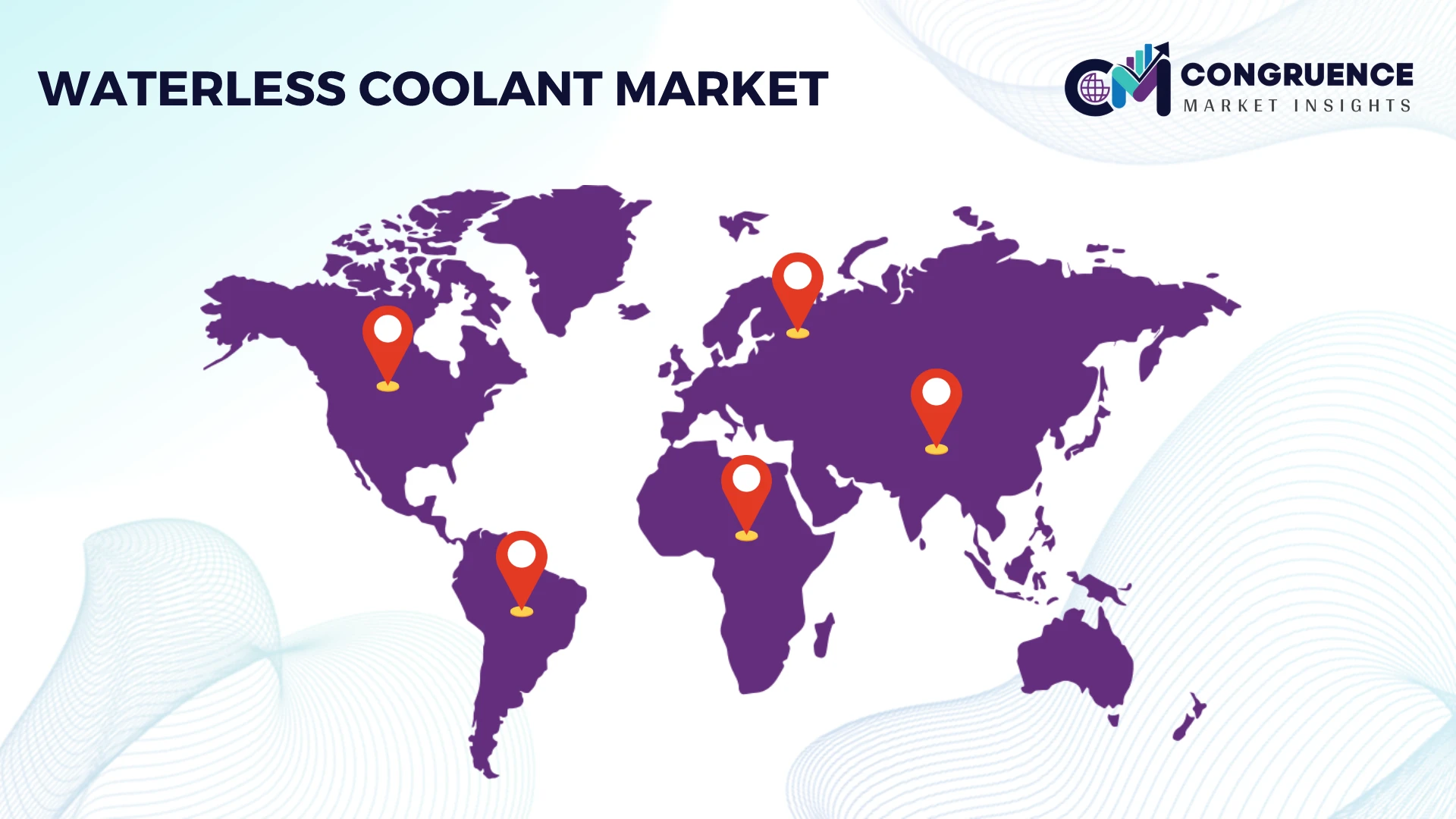
North America accounted for the largest market share at 43.2% in 2025 however, Asia-Pacific is expected to register the fastest growth, expanding at a CAGR of 8.4% between 2026 and 2033.
Specialty Engine Adoption Strengthens Premium Coolant Positioning
North America accounts for approximately 43.2% of global waterless coolant demand, supported by the United States' mature automotive aftermarket, motorsport ecosystem, classic-vehicle population, agricultural machinery, and specialty-engine applications. The region benefits from established conversion expertise and dedicated distribution channels, giving waterless formulations greater visibility than in newer markets. High-performance users increasingly prioritize boiling-point protection and extended service intervals, with properly converted systems supporting approximately 3–5 times longer coolant replacement intervals. Manufacturers are expanding installer networks, conversion kits, bulk packaging, and application-specific formulations. The U.S. aftermarket remains the primary commercial engine, while Canada provides additional demand from agricultural and off-road equipment. The strategic advantage is channel maturity: trained workshops can convert existing cooling systems without requiring vehicle-level redesign.
United States Market Outlook: The United States represents the dominant national market, supported by a large specialty-vehicle and aftermarket ecosystem. Waterless coolant adoption is particularly established among performance vehicles, classic cars, agricultural machinery, and motorsport applications. Specialized distributors and trained installers reduce conversion friction, while high vehicle-maintenance costs strengthen the economic case for longer service intervals and reduced corrosion-related interventions.
Premium Thermal Management Aligns with Efficiency Requirements
Europe represents approximately 25.1% of global waterless coolant demand, with adoption concentrated in Germany, the United Kingdom, France, Italy, and specialist automotive markets. European buyers place greater emphasis on chemical handling, environmental performance, vehicle efficiency, and maintenance optimization. Waterless systems can extend coolant service intervals by approximately 3–5 times, supporting reduced workshop intervention for suitable applications. Performance automotive, classic vehicles, agricultural machinery, and specialist industrial engines remain important niches. Manufacturers are strengthening distributor training, technical documentation, and application compatibility programs to address stricter purchasing requirements. Germany's engineering-intensive automotive ecosystem provides an important premium market, while the United Kingdom's motorsport and enthusiast base supports specialist adoption.
Germany Market Outlook: Germany is strategically important because of its automotive engineering base, specialist workshops, performance-vehicle ecosystem, and extensive industrial equipment population. Demand is increasingly tied to thermal-management optimization rather than simple coolant replacement. Premium workshops can differentiate through conversion and diagnostic services, while manufacturers benefit from customers willing to evaluate coolant using lifecycle maintenance costs rather than initial purchase price.
Industrialization Creates a New High-Performance Coolant Segment
Asia-Pacific represents approximately 19.6% of global waterless coolant demand but is developing the strongest expansion opportunity as automotive production, agricultural mechanization, commercial vehicles, and industrial equipment increase. China, Japan, India, South Korea, and Australia represent the principal demand centers, although adoption remains less mature than in North America. India is particularly attractive for agricultural machinery and heavy-duty equipment, where high ambient temperatures and demanding operating cycles increase the value of thermal stability. Manufacturers are building distributor partnerships, localized packaging, technical training, and application-specific product portfolios. Adoption in suitable industrial and fleet applications can reduce coolant-related service interventions by approximately 15–25%, improving equipment availability.
China Market Outlook: China provides the region's largest industrial opportunity through its extensive automotive manufacturing base, commercial-vehicle population, construction equipment, and agricultural machinery. Domestic distribution scale allows manufacturers to reach specialist workshops and equipment operators efficiently. The principal commercial opportunity is converting high-utilization equipment where reduced maintenance and thermal reliability provide clearer economic justification than in conventional passenger-vehicle applications.
Agricultural Equipment Creates the Strongest Adoption Niche
South America accounts for approximately 7.0% of global waterless coolant demand, with Brazil representing the principal market because of its automotive fleet, agricultural machinery, mining equipment, and industrial-engine base. High equipment utilization in agriculture creates a stronger economic case for extended coolant intervals than low-mileage passenger vehicles. Properly converted systems can reduce coolant-related maintenance events by approximately 15–25%, particularly where equipment operates under sustained thermal loads. Import dependence for specialized formulations creates exposure to freight costs, currency movements, and distributor inventory cycles. Suppliers are therefore expanding regional warehousing, bulk packaging, technical partnerships, and workshop training. Brazil's agricultural machinery ecosystem provides the clearest route for commercial expansion.
Brazil Market Outlook: Brazil is the region's strongest opportunity because its agricultural, mining, automotive, and construction-equipment sectors operate large numbers of high-utilization engines. Local distributor networks around São Paulo, Paraná, and major agricultural corridors can improve product availability and conversion support. Fleet-oriented programs offer stronger recurring demand than standalone retail sales because operators directly measure maintenance intervals and equipment downtime.
Extreme Operating Conditions Strengthen Thermal-Protection Demand
Middle East & Africa represents approximately 5.1% of global waterless coolant demand, with Saudi Arabia, the United Arab Emirates, South Africa, and selected North African markets accounting for most commercial activity. High ambient temperatures, construction equipment utilization, generators, mining machinery, and performance vehicles create applications where thermal stability carries measurable operational value. Waterless formulations can provide boiling points above 180°C, giving specialized equipment greater thermal margin than conventional water-based systems. Suppliers are developing distributor partnerships, fleet conversion services, and larger packaging formats to address fragmented service infrastructure. The strategic opportunity is strongest in equipment-intensive sectors where downtime costs materially exceed the premium paid for specialized coolant.
Saudi Arabia Market Outlook: Saudi Arabia is the region's most strategically significant market because of its construction, oilfield services, power-generation, logistics, and industrial-equipment base. Equipment frequently operates under high ambient temperatures, increasing the importance of thermal-system reliability. Fleet and industrial customers represent stronger opportunities than mass passenger-vehicle adoption, particularly where conversion programs can combine coolant supply, system flushing, technician training, and scheduled maintenance.
Evans Cooling Systems leads specialized waterless engine coolants, competing with conventional coolant suppliers such as Shell, Valvoline, BASF, and regional aftermarket formulators. The top five are estimated to control about 55% of market value. Competition centers on thermal performance, conversion support, distribution, and formulation: waterless systems can deliver boiling points above 180°C, while proper conversion requires water content below 3%. Evans differentiates through application-specific products, distributors, and conversion protocols; broader lubricant companies compete through channel scale and pricing. The competitive shift is toward lifetime-fluid positioning, fleet conversion, and formulations rather than commodity antifreeze volume. Entry barriers include formulation IP, application validation, installer education, and aftermarket relationships. Winning requires proven high-temperature protection, conversion support, broad distribution, specialized chemistry, and lifecycle economics compelling enough to overcome higher upfront costs. Regional players can gain share by pairing localized inventory with certified workshops and fleet contracts, but brand trust remains decisive in engine applications.
Evans Cooling Systems, Inc.
Anglo American Oil Company Ltd.
Shell plc
Valvoline Inc.
BASF SE
FUCHS SE
TotalEnergies SE
Exxon Mobil Corporation
Old World Industries, LLC
LIQUI MOLY GmbH
Red Line Synthetic Oil Corporation
Royal Purple
Mishimoto Automotive
RSC Bio Solutions
Waterless coolant technology is moving from specialist glycol formulations toward application-specific, lower-viscosity chemistry and structured conversion systems. Modern formulations provide boiling points around 298–375°F, while SuperLight products target smaller passages and higher-flow cooling circuits. Evans' current portfolio spans high-performance, agriculture, powersports, classic vehicles, and specialized racing applications, showing increasing product specialization.
Conversion technology is equally important. Prep fluids, refractometers, water-content testing, and standardized flushing reduce installation variability; maintaining residual water below 3% is a critical operating threshold. Compared with basic drain-and-fill practices, controlled preparation improves conversion consistency and reduces rework exposure. Digital service documentation and installer training are gaining importance as fleet adoption expands.
From 2026–2028, lower-viscosity formulations, condition monitoring, and application-specific coolant packages will strengthen adoption. Advanced suppliers benefit most where cooling systems have tight passages, high thermal loads, or expensive downtime. Competitive advantage will come from integrating chemistry, diagnostics, conversion equipment, and technical service into one deployment model rather than selling coolant as a standalone fluid. Emerging sensor integration can improve temperature anomaly detection by 10–20%, while predictive maintenance can reduce unnecessary service interventions by 5–10%. These capabilities favor suppliers with established workshop networks and data-enabled fleet relationships, especially in commercial, agricultural, motorsport, and industrial engine fleets globally.
June 2025 BRP-Rotax updated its 912-series installation manual, requiring permanent cylinder-head-temperature monitoring for waterless coolant applications. The revision formalized conversion labeling and water-mixing warnings, strengthening installation control and reducing compatibility errors across aviation maintenance operations globally today commercially. Source: rotax-owner.com
July 2025 Evans Cooling Systems’ distributor documentation highlighted EC42001 preparation, requiring residual water below 3% before conversion. The standardized flush workflow strengthens installation reliability and supports professional workshop adoption by reducing conversion failures caused by retained water consistently. Source: bulk55.com
September 2026 NHC Motors documented a 2024 Hyundai Avante CN7 Hybrid conversion using Evans coolant, with the customer reporting 30.2 km/L and seven readings above 30 km/L. The case strengthens aftermarket visibility for waterless coolant in hybrid applications. Source: nhcmotors.com
March 2025 Project Farm compared 9 coolant products, including Evans Waterless, across boiling point, freeze point, pH, reserve alkalinity, and heat-exchange performance. The independent test broadened consumer visibility into waterless coolant specifications and intensified performance-based product comparison globally. Source: projectfarm.com
The Waterless Coolant Market Report evaluates propylene glycol-based, ethylene glycol-based, and other specialty waterless formulations across automotive engines, agricultural equipment, heavy-duty machinery, motorsport, powersports, and stationary industrial engines. End-user coverage distinguishes automotive aftermarket buyers, fleet operators, agricultural users, industrial operators, and specialty performance applications, capturing the shift from enthusiast adoption toward operational fleet conversion.
Regional analysis covers North America, Europe, Asia-Pacific, South America, and Middle East & Africa, with country-level assessment of the United States, Germany, China, India, Brazil, and Saudi Arabia. Technology coverage includes high-boiling-point chemistry, lower-viscosity formulations, conversion fluids, refractometer-based water testing, thermal monitoring, and condition-based maintenance. The report supports investment planning, distribution expansion, formulation development, fleet partnerships, competitive positioning, and deployment strategy through 2026–2033, including niche opportunities where lifecycle maintenance savings outweigh higher upfront costs.
| Report Attribute/Metric | Report Details |
|---|---|
|
Market Revenue in 2025 |
USD 500.5 Million |
|
Market Revenue in 2033 |
USD 899.3 Million |
|
CAGR (2026 - 2033) |
7.6% |
|
Base Year |
2025 |
|
Forecast Period |
2026 - 2033 |
|
Historic Period |
2021 - 2025 |
|
Segments Covered |
By Type
By Application
By End-User
|
|
Key Report Deliverable |
Revenue Forecast, Growth Trends, Market Dynamics, Segmental Overview, Regional and Country-wise Analysis, Competition Landscape |
|
Region Covered |
North America, Europe, Asia-Pacific, South America, Middle East, Africa |
|
Key Players Analyzed |
Evans Cooling Systems, Inc., Anglo American Oil Company Ltd., Shell plc, Valvoline Inc., BASF SE, FUCHS SE, TotalEnergies SE, Exxon Mobil Corporation, Old World Industries, LLC, LIQUI MOLY GmbH, Red Line Synthetic Oil Corporation, Royal Purple, Mishimoto Automotive, RSC Bio Solutions |
|
Customization & Pricing |
Available on Request (10% Customization is Free) |




