
Reports
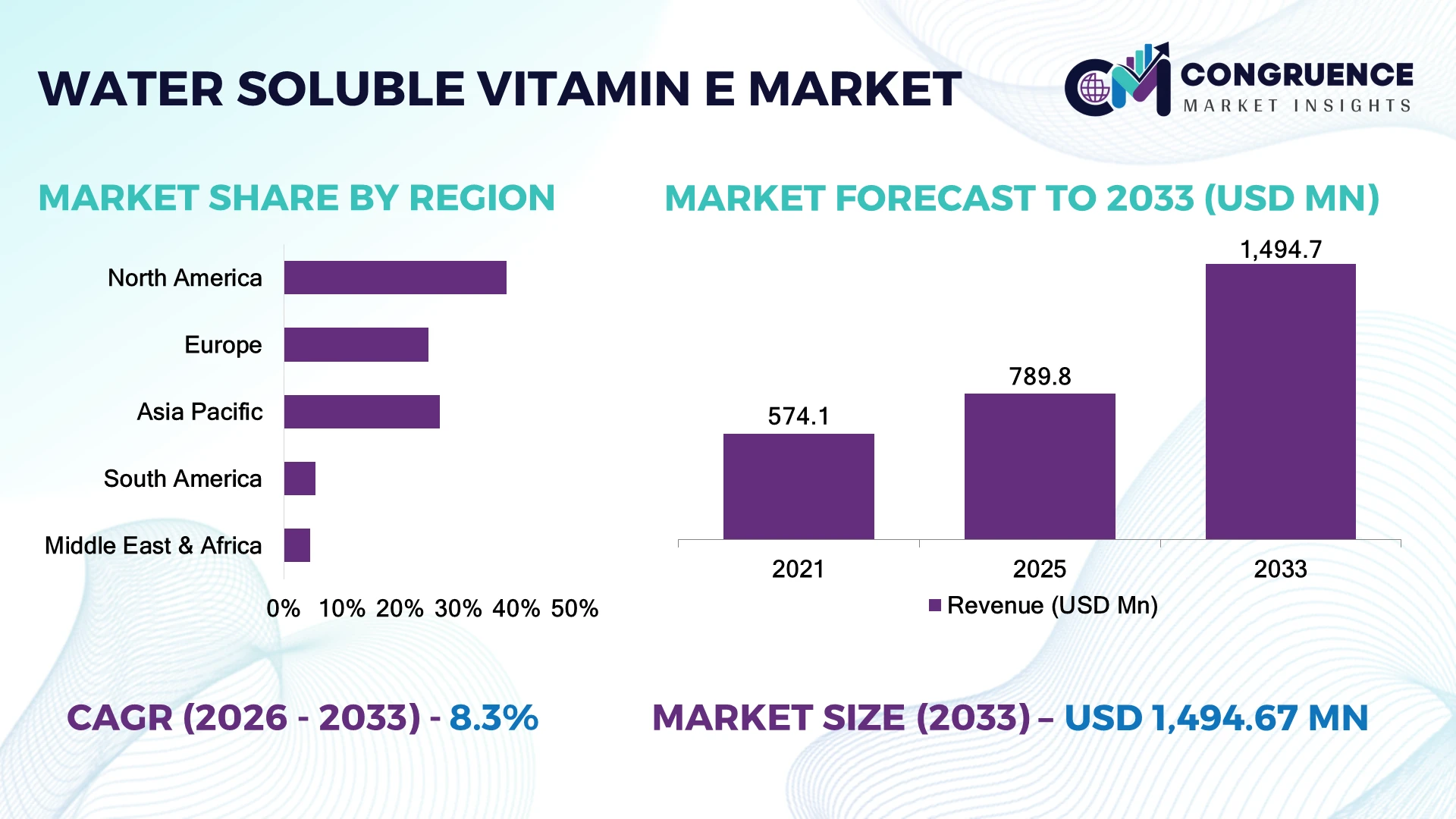
The Global Water Soluble Vitamin E Market was valued at USD 789.8 Million in 2025 and is anticipated to reach a value of USD 1,494.7 Million by 2033 expanding at a CAGR of 8.3% between 2026 and 2033. Growing adoption of fortified beverages, clinical nutrition formulations, functional foods, and water-based dietary supplements is accelerating demand for highly bioavailable water soluble vitamin E ingredients.
The United States leads the market with approximately 31% global consumption, supported by advanced nutraceutical manufacturing, widespread functional beverage innovation, and over 65% consumer preference for preventive wellness supplements. Compared with Germany, the U.S. launches nearly 2.3× more vitamin-enriched food and supplement products annually. Amid continued global supply-chain diversification following Red Sea shipping disruptions, manufacturers are strengthening domestic formulation capabilities and investing in microencapsulation technologies to improve stability and absorption efficiency.
Companies securing resilient ingredient sourcing and advanced formulation capabilities are best positioned to capture premium opportunities across pharmaceutical, food, and nutrition applications.
Market Size & Growth: USD 789.8 Million (2025) to USD 1,494.7 Million (2033) at 8.3% CAGR, driven by functional nutrition innovation.
Top Growth Drivers: Clinical nutrition +21%, fortified beverages +18%, nutraceutical demand +16%.
Short-Term Forecast: By 2028, formulation efficiency improves 15% through advanced encapsulation technologies.
Emerging Technologies: Microencapsulation, nanoemulsion, and spray-drying improve bioavailability by up to 30%.
Regional Leaders: North America, Europe, and Asia-Pacific exceed USD 980 Million combined by 2033 with expanding preventive healthcare adoption.
Consumer/End-User Trends: More than 58% of supplement buyers prefer water-dispersible antioxidant formulations.
Pilot/Case Example: 2026 beverage reformulation reduced ingredient sedimentation by 28% while improving shelf stability.
Competitive Landscape: Top suppliers command nearly 47% share through formulation expertise and pharmaceutical-grade quality.
Regulatory & ESG Impact: Clean-label adoption increased 24% following stricter additive transparency requirements.
Investment & Funding: More than USD 230 Million supports production expansion and specialty ingredient innovation.
Innovation & Future Outlook: AI-assisted formulation and precision nutrient delivery strengthen premium product differentiation.
Water Soluble Vitamin E is gaining traction across sports nutrition, infant nutrition, medical foods, and fortified beverages where rapid dispersion and enhanced absorption are essential. Microencapsulation technologies have improved ingredient stability by nearly 30%, while clean-label reformulation continues to reshape product development. Supply-chain diversification for specialty excipients is strengthening manufacturing resilience, setting the stage for broader strategic market expansion.
Water soluble vitamin E has become strategically important as manufacturers compete through bioavailability, formulation flexibility, and premium nutritional performance rather than ingredient volume alone. Preventive healthcare, personalized nutrition, and stricter product quality standards are reshaping investment priorities across functional foods, pharmaceuticals, and dietary supplements. Supply-chain restructuring since recent global logistics disruptions has accelerated regional ingredient processing and formulation capabilities.
Modern microencapsulation technologies deliver approximately 30% higher bioavailability than conventional oil-based vitamin E systems while improving formulation stability in beverages and aqueous pharmaceutical products. North America leads clinical nutrition innovation, whereas Asia-Pacific is rapidly expanding production capacity through contract manufacturing and nutraceutical exports. More than 40% of newly introduced functional beverage formulations now incorporate water-dispersible micronutrients, reflecting stronger commercial adoption across consumer health categories.
Manufacturers are expanding partnerships with beverage formulators and pharmaceutical companies while investing in encapsulation technologies and clean-label ingredient platforms. A practical example includes fortified ready-to-drink nutritional beverages achieving improved dispersion without affecting product clarity or taste. During the next two to three years, companies combining advanced formulation science, resilient sourcing strategies, and application-specific product development will establish stronger competitive positioning across premium nutrition markets.
The rapid expansion of functional beverages, clinical nutrition, and fortified food formulations is strengthening demand for water soluble vitamin E with superior dispersion and bioavailability. More than 58% of newly launched immunity-focused beverages now incorporate water-dispersible micronutrients, while pharmaceutical-grade formulations have improved absorption efficiency by nearly 30% through advanced encapsulation. Japan and the United States continue investing in precision nutrition products as preventive healthcare gains policy support. This shift is increasing demand for stable, water-compatible antioxidant ingredients across multiple dosage formats. Manufacturers are responding through encapsulation technology investments, strategic partnerships with beverage producers, and dedicated production lines, enabling faster commercialization and higher-value product portfolios while improving formulation consistency.
Volatility in natural tocopherol feedstock availability and specialized encapsulation materials continues to pressure production economics. Ingredient procurement costs fluctuate by nearly 18%, while encapsulation accounts for approximately 20–25% of finished formulation expenses. China's periodic tightening of environmental compliance for chemical manufacturing has added operational complexity for intermediate suppliers, extending procurement cycles. These constraints affect production scalability, contract manufacturing margins, and inventory planning for global nutraceutical brands. Companies are mitigating risk by diversifying sourcing across Southeast Asia, establishing long-term procurement agreements, and adopting hybrid formulation technologies that reduce dependency on premium emulsifiers while maintaining product performance and regulatory compliance.
Next-generation delivery platforms are opening new opportunities across medical nutrition, personalized supplements, and functional hydration products. Nanoemulsion and multilayer microencapsulation technologies improve ingredient utilization by nearly 32%, while formulation losses decline by approximately 18% during beverage processing. South Korea is accelerating innovation through advanced nutraceutical manufacturing and AI-assisted formulation development, enabling rapid commercialization of customized health products. Companies are strengthening R&D collaborations with ingredient specialists and contract manufacturers to develop application-specific solutions. A non-obvious opportunity lies in integrating water soluble vitamin E into protein beverages and medical recovery formulations, where enhanced dispersion creates measurable formulation advantages without increasing ingredient dosage.
Maintaining consistent bioavailability and stability across diverse food, beverage, and pharmaceutical applications remains a major execution challenge. Performance variability between production batches can reach 12% if encapsulation parameters are not tightly controlled, while accelerated shelf-life testing extends product qualification by nearly 20%. Germany's increasingly stringent quality expectations for nutraceutical ingredients are raising validation requirements for export-oriented manufacturers. These technical demands affect commercialization speed and long-term customer confidence. Companies must invest in automated process monitoring, digital quality management systems, and advanced analytical testing while strengthening partnerships with specialized formulation providers to achieve consistent global product performance and regulatory acceptance.
Advanced Encapsulation Adoption Microencapsulation and nanoemulsion technologies now improve bioavailability by nearly 30% while reducing oxidative degradation by around 22%. Beverage manufacturers are redesigning formulation workflows to improve clarity and stability, prompting ingredient suppliers to expand encapsulation capacity and establish technology partnerships that accelerate premium product launches.
Clean Label Formulation Shift More than 55% of new water soluble vitamin E product developments emphasize clean-label positioning, while natural-origin ingredient usage has increased approximately 24%. Stricter ingredient transparency requirements in Europe are encouraging reformulation initiatives, leading companies to optimize processing methods and reduce synthetic processing aids without compromising stability.
Clinical Nutrition Integration Medical nutrition applications have expanded rapidly as hospital nutrition programs increasingly specify highly bioavailable antioxidant ingredients. Water-dispersible vitamin formulations improve mixing efficiency by nearly 20% and reduce preparation variability by about 15%. Manufacturers are collaborating with pharmaceutical formulators to develop specialized products for enteral nutrition and recovery beverages.
Regional Manufacturing Diversification Ingredient producers are expanding manufacturing footprints beyond traditional sourcing hubs, reducing procurement lead times by approximately 18% and improving supply continuity by nearly 16%. Supply-chain realignment following global logistics disruptions is encouraging localized production, while companies strengthen regional partnerships and digital inventory management to improve operational resilience and customer responsiveness.
Powder water soluble vitamin E accounted for approximately 62% of the global market in 2025, supported by superior storage stability, easier transportation, and seamless integration into dietary supplements, beverage premixes, and pharmaceutical formulations. Its longer shelf life and compatibility with high-volume manufacturing make it the preferred choice for contract manufacturers and global nutraceutical brands. Liquid water soluble vitamin E represents the fastest-growing segment, expanding through ready-to-drink beverages, pediatric nutrition, and liquid dietary supplements where rapid dispersion and formulation flexibility are essential. Manufacturers report formulation efficiency improvements of nearly 20% using advanced emulsification technologies, while powder formulations reduce logistics costs by approximately 15% compared with equivalent liquid systems.
The market is gradually shifting toward application-specific formulations rather than standardized ingredient offerings. Powder products continue to dominate pharmaceutical and dry nutrition blends, whereas liquid variants gain momentum across functional beverages and clinical nutrition. Companies are expanding encapsulation capabilities, introducing customized concentration grades, and forming formulation partnerships with beverage and medical nutrition producers to strengthen product differentiation and improve commercial scalability.
According to findings released by the Council for Responsible Nutrition (CRN) in 2025, more than 70% of supplement manufacturers identified improved bioavailability and formulation stability as primary priorities when selecting advanced vitamin ingredient technologies.
Dietary supplements held approximately 46% of the market share in 2025, driven by preventive healthcare, healthy aging initiatives, and widespread adoption of daily antioxidant formulations. Pharmaceutical applications represent the fastest-growing segment as manufacturers increasingly incorporate water soluble vitamin E into clinical nutrition products, pediatric formulations, and specialized therapeutic supplements. Food and beverage applications continue expanding through fortified beverages, dairy alternatives, and functional foods, while animal nutrition maintains strategic importance by improving nutrient absorption and feed performance. More than 55% of newly developed functional nutrition products now incorporate water-dispersible micronutrient systems, reflecting changing formulation priorities.
Demand is shifting toward multifunctional applications requiring improved ingredient compatibility and higher formulation precision. Companies are integrating automated blending technologies, expanding production for pharmaceutical-grade ingredients, and developing customized solutions tailored to specific application requirements. Investment increasingly favors formulations capable of supporting multiple product categories while maintaining stability, processing efficiency, and regulatory compliance.
A 2026 industry survey published by the International Alliance of Dietary/Food Supplement Associations (IADSA) indicated that functional nutrition remains among the fastest-expanding supplement categories, with antioxidant ingredients continuing to gain adoption across preventive health formulations.
Nutraceutical manufacturers accounted for nearly 49% of total demand in 2025, supported by extensive deployment across dietary supplements, wellness products, and functional nutrition portfolios. Pharmaceutical companies represent the fastest-growing end-user group as demand accelerates for water-dispersible antioxidant ingredients in medical nutrition and specialized therapeutic formulations. Food and beverage manufacturers continue expanding fortified product portfolios, while animal nutrition companies increasingly adopt advanced vitamin delivery systems to improve nutrient utilization. Nearly 60% of premium nutraceutical product launches now emphasize enhanced absorption and formulation performance, reinforcing demand for specialized water soluble vitamin E ingredients.
Competitive positioning is increasingly shaped by customized formulation services rather than commodity ingredient supply. Manufacturers are strengthening partnerships with brand owners, offering application-specific technical support, and expanding regional production to improve delivery reliability. Pricing strategies increasingly reward formulation performance, allowing suppliers with encapsulation expertise and regulatory capabilities to secure long-term contracts across pharmaceutical, food, and nutrition markets.
The Consumer Healthcare Products Association (CHPA) highlighted in a 2025 consumer supplement assessment that demand for scientifically supported, convenient nutritional products continues to rise, encouraging manufacturers to prioritize advanced bioavailable ingredient technologies.
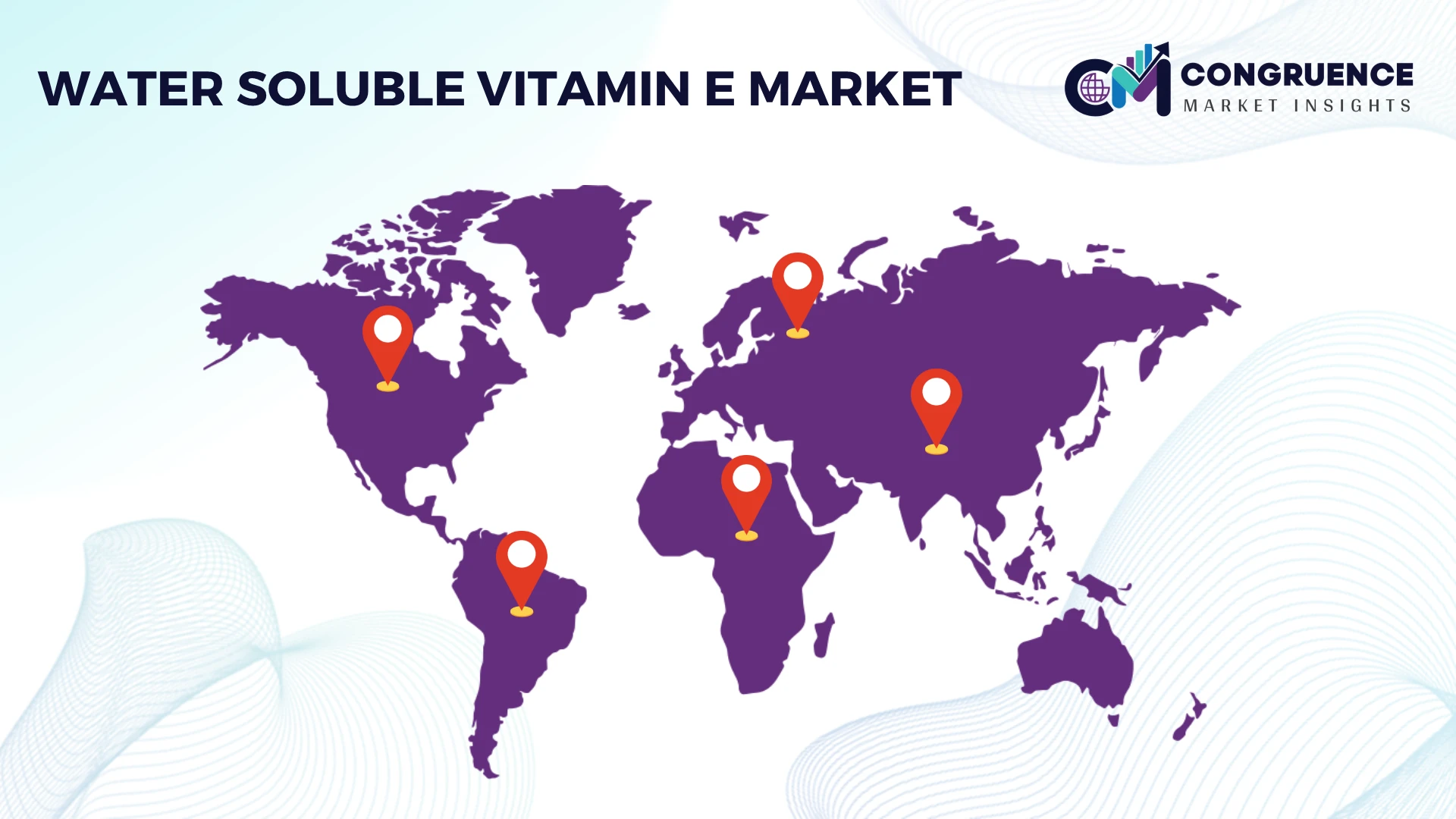
North America accounted for the largest market share at 38.2% in 2025 however, Asia-Pacific is expected to register the fastest growth, expanding at a CAGR of 9.4% between 2026 and 2033.
Advanced nutraceutical manufacturing strengthens premium ingredient demand
North America maintains its leadership through a mature nutraceutical ecosystem, advanced pharmaceutical manufacturing, and high adoption of functional beverages. The region contributes nearly 38.2% of global demand, supported by large-scale deployment of water-dispersible ingredients across dietary supplements, medical nutrition, and fortified food products. More than 60% of premium supplement launches emphasize enhanced bioavailability, driving investment in encapsulation technologies and application-specific formulations. Ingredient suppliers continue expanding production capacity while strengthening partnerships with beverage and pharmaceutical companies to accelerate commercialization. Digital quality management, automated formulation systems, and resilient domestic supply networks further reinforce operational efficiency and product consistency, positioning the region as the benchmark for high-value nutritional ingredient innovation.
United States Market Outlook: The United States dominates regional consumption through its extensive dietary supplement industry, sophisticated contract manufacturing infrastructure, and strong investment in preventive healthcare products. More than 65% of adult supplement users consume antioxidant-based formulations regularly, encouraging manufacturers to expand production of highly bioavailable vitamin ingredients. Advanced formulation expertise, strict quality standards, and close collaboration between ingredient suppliers and finished-product manufacturers continue strengthening the country's competitive position in premium nutrition markets.
Clean-label innovation accelerates formulation modernization
Europe remains a strategically important market due to stringent product quality regulations, strong consumer preference for clean-label nutrition, and advanced pharmaceutical manufacturing. Approximately 28% of regional product innovation focuses on naturally derived antioxidant ingredients with improved dispersion characteristics. Companies are investing in sustainable processing technologies, advanced encapsulation methods, and localized ingredient sourcing to improve product consistency and regulatory compliance. Pharmaceutical nutrition and functional beverage manufacturers increasingly prioritize water soluble vitamin E to support premium formulations with enhanced stability and processing efficiency.
Germany Market Outlook: Germany leads regional demand through its well-established nutraceutical, pharmaceutical, and functional food industries. Manufacturers emphasize pharmaceutical-grade production, precision formulation, and export-oriented quality systems. More than 40% of the country's nutritional ingredient innovation targets enhanced absorption technologies, encouraging continuous investment in research facilities and specialized production capabilities that support high-value European and international markets.
Manufacturing scale drives global supply expansion
Asia-Pacific is emerging as the fastest-expanding market due to large-scale ingredient manufacturing, expanding nutraceutical production, and increasing health awareness. China, Japan, and South Korea are strengthening regional manufacturing capabilities through investments in encapsulation technology and specialty ingredient production. More than 50% of regional output is directed toward export-oriented nutraceutical and food ingredient markets, while automation and process optimization improve manufacturing efficiency. Companies continue expanding formulation facilities and strategic collaborations with international nutrition brands to strengthen supply reliability.
China Market Outlook: China serves as the region's manufacturing hub with integrated production of vitamin intermediates, specialty ingredients, and finished nutritional formulations. Advanced processing infrastructure and expanding domestic wellness consumption support continuous investment in water soluble vitamin technologies. Production modernization initiatives have improved manufacturing efficiency by approximately 20%, reinforcing China's role as a critical supplier for global nutraceutical and food manufacturers.
Functional nutrition adoption supports steady expansion
South America is witnessing increasing demand as functional foods, dietary supplements, and preventive healthcare products become more widely adopted. Brazil accounts for the largest share of regional consumption, supported by an expanding food processing industry and improving nutraceutical manufacturing capabilities. Regional companies are investing in localized formulation facilities and distribution partnerships to reduce import dependence while improving supply continuity. Infrastructure constraints remain, but stronger private-sector investment is steadily improving production efficiency and product availability across key consumer markets.
Brazil Market Outlook: Brazil leads regional market development through its growing dietary supplement sector, expanding food processing capacity, and increasing consumer focus on wellness products. Domestic manufacturers continue investing in advanced formulation technologies and localized ingredient sourcing. Growing pharmaceutical and functional beverage production strengthens demand for premium water soluble vitamin E ingredients while improving regional manufacturing competitiveness.
Healthcare modernization expands specialty nutrition demand
The Middle East & Africa market is developing through healthcare modernization, expanding pharmaceutical manufacturing, and increasing investment in preventive nutrition. Functional food imports remain significant, but regional formulation capacity is steadily improving through new production partnerships and specialized nutrition projects. Rising investment in healthcare infrastructure and premium nutritional products is encouraging suppliers to establish stronger regional distribution and technical support networks. These developments improve product accessibility while supporting long-term market expansion.
Saudi Arabia Market Outlook: Saudi Arabia is emerging as the region's most strategically important market through healthcare diversification, expanding pharmaceutical production, and government-backed food security initiatives. Local manufacturers are increasing investment in nutritional ingredient processing and specialized supplement production. The country's expanding preventive healthcare programs and modern manufacturing infrastructure continue attracting international ingredient suppliers seeking long-term partnerships and regional market access.
Global ingredient innovators such as BASF, dsm-firmenich, and ADM compete directly with high-volume Chinese producers including Zhejiang Medicine and NHU, while specialty formulation companies compete through customized delivery systems rather than scale. The top five suppliers collectively control approximately 48% of the market. Competition centers on encapsulation technology, formulation stability, regulatory support, and supply reliability, with bioavailability improvements of 25–30% and production efficiency gains near 18% differentiating premium suppliers from cost-focused manufacturers. Companies are strengthening positions through regional production expansion, long-term raw material agreements, pharmaceutical partnerships, and vertical integration spanning tocopherol extraction to finished ingredient formulation. The competitive landscape is shifting toward proprietary delivery technologies and application-specific solutions, reducing dependence on commodity vitamin ingredients. High regulatory validation costs, advanced encapsulation expertise, and stringent quality requirements remain significant entry barriers. Winning requires scalable manufacturing, scientifically validated formulations, resilient supply chains, and strong technical collaboration with nutraceutical, pharmaceutical, and functional food manufacturers.
BASF SE
dsm-firmenich
Archer-Daniels-Midland Company (ADM)
Zhejiang Medicine Co., Ltd.
NHU (Zhejiang NHU Co., Ltd.)
Kemin Industries
Davos Life Science Pte. Ltd.
Vitae Naturals
Nutralliance
Matrix Fine Sciences Pvt. Ltd.
BTSA Biotecnologías Aplicadas S.L.
Merck KGaA
Advanced encapsulation technologies are transforming water soluble vitamin E formulations by improving stability, dispersibility, and absorption across beverages, pharmaceuticals, and dietary supplements. Microencapsulation improves oxidative stability by approximately 28%, while nanoemulsion technology enhances bioavailability by nearly 30% compared with conventional oil-based systems. More than 55% of premium formulation projects now incorporate advanced delivery technologies, enabling manufacturers to reduce sedimentation and extend product shelf life. Companies with proprietary encapsulation platforms gain stronger pricing power and faster commercialization across regulated nutrition markets.
Emerging technologies include multilayer encapsulation, precision spray-drying, and AI-assisted formulation optimization. Compared with traditional emulsified vitamin systems, next-generation nanoencapsulation reduces formulation losses by around 20% while improving ingredient dispersion by nearly 25%. Automated process monitoring strengthens batch consistency and reduces production variability. Nutraceutical and pharmaceutical manufacturers benefit most because application-specific formulations improve product differentiation while supporting increasingly demanding regulatory and quality standards.
Between 2026 and 2028, digital formulation platforms, precision particle engineering, and sustainable plant-derived emulsifiers will redefine product development. Adoption of intelligent manufacturing systems is expected to exceed 45% among large specialty ingredient producers, improving operational efficiency and reducing formulation development cycles. Companies investing now in advanced encapsulation science, automated production, and customized delivery technologies will strengthen competitive positioning as customers increasingly prioritize performance-based nutritional ingredients over conventional commodity formulations.
January 2025 BASF announced plans to expand vitamin E acetate production capacity at its Ludwigshafen facility by approximately 10% before 2027, strengthening long-term supply for nutrition and specialty ingredient markets while reinforcing manufacturing resilience.
March 2025 Louis Dreyfus Company introduced a new portfolio of plant-based vitamin E ingredients at Food Ingredients China 2025, expanding mixed tocopherol, acetate, and succinate offerings to strengthen value-added nutrition solutions and specialty ingredient commercialization.
April 2025 dsm-firmenich recommenced operations at its vitamin E manufacturing facility, restoring production capabilities and improving supply availability for food, beverage, and dietary supplement manufacturers following earlier operational disruptions.
March 2024 dsm-firmenich expanded its plant-based nutritional ingredient portfolio to strengthen supply availability for naturally sourced antioxidant formulations, supporting premium supplement manufacturers and broader clean-label product development.
This report delivers comprehensive analysis of the global water soluble vitamin E market across product types, applications, end-users, and major regional markets. It evaluates powder and liquid formulations, dietary supplements, pharmaceuticals, food and beverages, animal nutrition, and emerging specialty nutrition applications. The assessment covers North America, Europe, Asia-Pacific, South America, and the Middle East & Africa while examining technology adoption, manufacturing trends, competitive positioning, and formulation innovation. More than 45% of the analysis emphasizes high-value application segments and evolving delivery technologies shaping commercial demand.
The report also examines encapsulation technologies, nanoemulsion systems, precision formulation methods, and supply-chain developments influencing market competitiveness between 2026 and 2033. Strategic insights include company positioning, regional manufacturing expansion, application-specific demand patterns, deployment trends, and innovation priorities supporting investment evaluation, product portfolio optimization, partnership development, and long-term competitive strategy across pharmaceutical, nutraceutical, and functional food industries.
| Report Attribute/Metric | Report Details |
|---|---|
|
Market Revenue in 2025 |
USD 789.8 Million |
|
Market Revenue in 2033 |
USD 1,494.7 Million |
|
CAGR (2026 - 2033) |
8.3% |
|
Base Year |
2025 |
|
Forecast Period |
2026 - 2033 |
|
Historic Period |
2021 - 2025 |
|
Segments Covered |
By Type
By Application
By End-User
|
|
Key Report Deliverable |
Revenue Forecast, Growth Trends, Market Dynamics, Segmental Overview, Regional and Country-wise Analysis, Competition Landscape |
|
Region Covered |
North America, Europe, Asia-Pacific, South America, Middle East, Africa |
|
Key Players Analyzed |
BASF SE, dsm-firmenich, Archer-Daniels-Midland Company (ADM), Zhejiang Medicine Co., Ltd., NHU (Zhejiang NHU Co., Ltd.), Kemin Industries, Davos Life Science Pte. Ltd., Vitae Naturals, Nutralliance, Matrix Fine Sciences Pvt. Ltd., BTSA Biotecnologías Aplicadas S.L., Merck KGaA |
|
Customization & Pricing |
Available on Request (10% Customization is Free) |




