
Reports
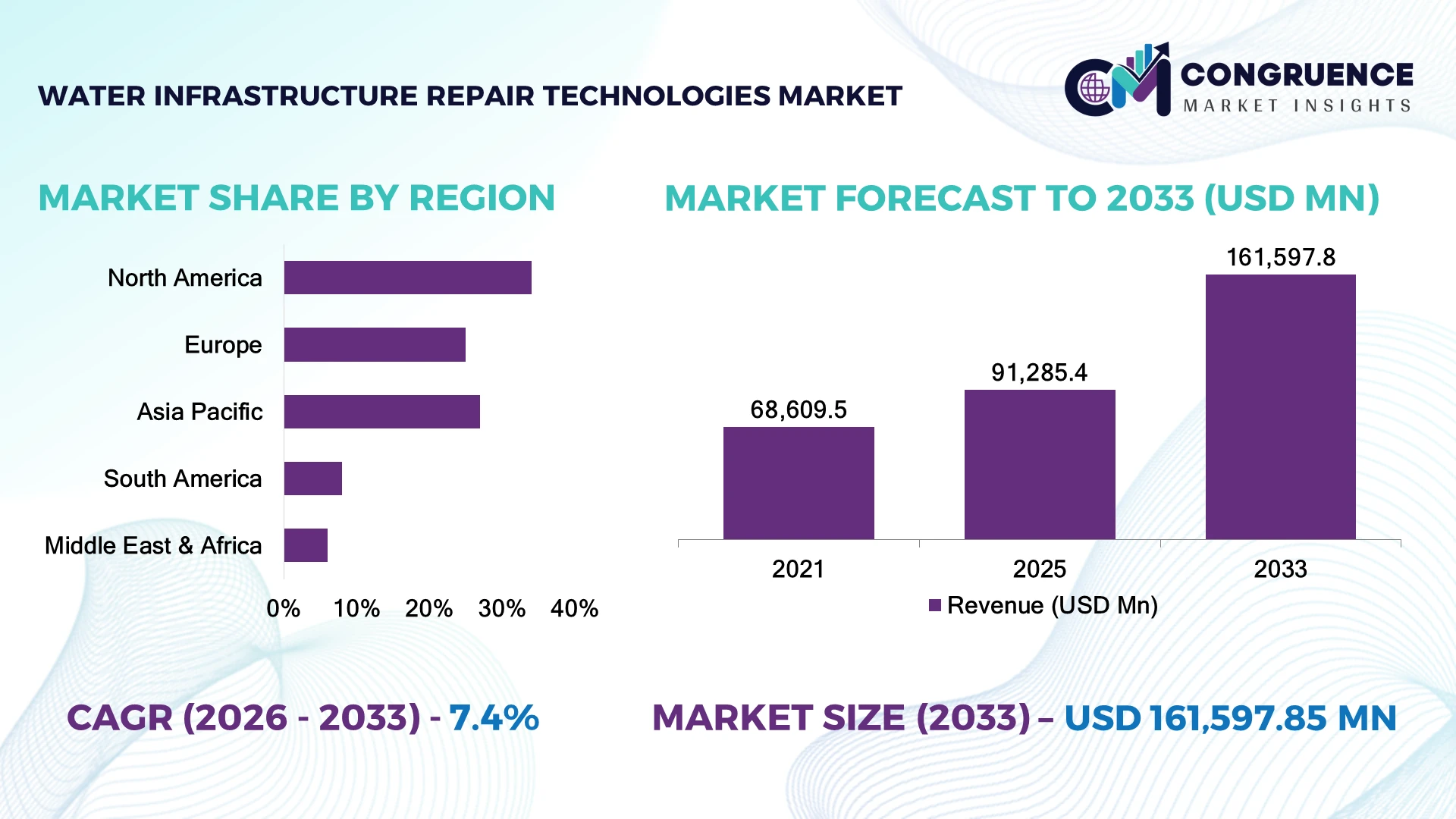
The Global Water Infrastructure Repair Technologies Market was valued at USD 91,285.4 Million in 2025 and is anticipated to reach a value of USD 161,597.8 Million by 2033 expanding at a CAGR of 7.4% between 2026 and 2033. Growth is being driven by aging pipelines, escalating non-revenue water losses, stricter water-quality requirements, and utilities shifting from excavation-heavy replacement toward trenchless rehabilitation, robotic inspection, and digitally monitored repair systems.
The United States remains a dominant market, with more than 16,000 publicly owned wastewater treatment facilities and extensive buried water networks requiring rehabilitation. China combines large-scale municipal investment with rapid smart-water deployment, while India is prioritizing urban water-network modernization through major infrastructure programs. In mature U.S. systems, leakage reduction of 15–25% is achievable through targeted rehabilitation and pressure management, creating stronger economics for precision repair.
Strategic priority is shifting toward asset-condition intelligence, localized repair capacity, and technologies that extend pipeline life without disrupting urban operations.
Market Size & Growth: USD 91.3 billion in 2025 to USD 161.6 billion by 2033 at 7.4% CAGR, driven by aging networks and trenchless rehabilitation.
Top Growth Drivers: 31% aging-pipeline pressure; 27% leakage reduction; 21% smart-water adoption.
Short-Term Forecast: By 2028, digital inspection adoption is positioned to increase 20–25%, improving repair prioritization.
Emerging Technologies: AI leak detection, robotic inspection, cured-in-place lining and fiber-optic monitoring are reshaping rehabilitation workflows.
Regional Leaders: North America leads advanced rehabilitation; Europe prioritizes leakage control; Asia-Pacific expands smart-network deployment.
Consumer/End-User Trends: Utilities increasingly target 15–25% reductions in non-revenue water through pressure management and targeted repairs.
Pilot/Case Example: 2025 smart-water programs demonstrated approximately 20% faster leak identification through sensor-enabled monitoring.
Competitive Landscape: Leading technology suppliers compete through trenchless systems, robotics, inspection platforms and integrated asset-management solutions.
Regulatory & ESG Impact: Water-loss reduction programs increasingly prioritize measurable efficiency improvements exceeding 15% in targeted networks.
Investment & Funding: Infrastructure spending is increasingly directed toward rehabilitation, monitoring and resilience rather than full pipeline replacement.
Innovation & Future Outlook: Autonomous inspection, predictive maintenance and digital twins will shift utilities toward condition-based repair decisions.
Water Infrastructure Repair Technologies are increasingly concentrated in municipal water networks, wastewater systems, industrial utilities, and aging transmission pipelines. Demand is strongest for trenchless rehabilitation, acoustic leak detection, robotic inspection, pipe bursting, and advanced lining systems that reduce excavation requirements. Digital monitoring is becoming operationally important, with sensor-enabled networks targeting leakage reductions of 15–25%. In 2026, utilities are also prioritizing resilience against drought, extreme rainfall, and supply-chain disruptions affecting pumps, valves, liners, and replacement pipe. This transition is moving procurement from individual repair products toward integrated inspection, diagnosis, rehabilitation, and lifecycle-management solutions.
Water infrastructure repair technologies have become strategically important because utilities are balancing aging assets, constrained capital budgets, climate resilience, and uninterrupted service requirements. The business case is shifting from replacing deteriorated pipelines after failure toward condition-based rehabilitation that identifies structural weakness before service disruption. In the United States and Europe, mature networks emphasize asset renewal and leakage reduction, while China and India are combining network expansion with digital monitoring and modernization.
Trenchless rehabilitation provides a measurable operational advantage over conventional excavation. Cured-in-place pipe systems and similar methods can reduce surface disruption and project duration by approximately 30–50% on suitable projects, while minimizing road restoration and traffic-management costs. Robotic inspection further improves repair targeting by identifying localized defects instead of replacing entire pipeline sections.
During 2026–2028, utilities are expected to increase integration of acoustic sensors, AI-based leak analytics, robotic crawlers, GIS asset databases, and digital twins. A practical deployment model combines continuous pressure monitoring with targeted robotic inspection before rehabilitation crews are dispatched. Utilities are consequently redirecting capital toward predictive maintenance, framework contracts, and technology partnerships. Competitive advantage will increasingly depend on extending asset life, reducing service interruptions, and delivering measurable rehabilitation outcomes with minimal excavation.
Aging buried networks and stricter leakage-control targets are shifting utility budgets toward trenchless rehabilitation, robotic inspection, and cured-in-place technologies. In the United States, non-revenue water commonly represents more than 20% of system input in inefficient networks, while targeted pressure and rehabilitation programs can reduce losses by 15–25%. The UK and Germany are also prioritizing condition-based renewal as excavation costs and urban disruption increase. Utilities are responding through multi-year rehabilitation contracts, sensor integration, and technology partnerships that combine inspection with repair execution. The non-obvious advantage is lifecycle continuity: restoring structurally sound pipe sections avoids unnecessary replacement while preserving service capacity. Suppliers are therefore investing in robotic diagnostics, faster-curing liners, and digitally managed field workflows.
Fragmented pipe materials, inconsistent asset records, and difficult access conditions limit standardized deployment of advanced repair technologies. Approximately 20–30% of municipal pipeline assets in mature systems can require condition assessment before rehabilitation decisions, while material-specific compatibility can alter repair economics by 10–15%. In India, highly variable network construction and incomplete underground mapping increase survey and excavation uncertainty. Volatility in resin, polymer liner, equipment, and specialized labor costs further pressures project margins. Utilities are mitigating exposure through framework procurement, localized service capacity, multi-supplier contracts, and standardized inspection protocols. The operational pressure is not simply repair cost; incompatible technologies can create repeat mobilization and downtime, making integrated inspection-to-rehabilitation platforms increasingly valuable for controlling total project expenditure.
AI-assisted leak analytics, autonomous inspection, digital twins, and sensor-based condition monitoring are opening higher-margin opportunities beyond conventional repair contracting. Utilities deploying continuous monitoring can target 15–25% reductions in avoidable water losses, while predictive maintenance can prioritize intervention before failures become emergency projects. Singapore and the Netherlands are particularly relevant markets for digitally coordinated water-asset management because dense infrastructure and high service reliability requirements favor precision monitoring. Companies are developing integrated offerings combining acoustic sensing, GIS, hydraulic modeling, robotic inspection, and trenchless rehabilitation. The strategic opportunity lies in converting repair suppliers into lifecycle partners: recurring monitoring contracts create earlier access to rehabilitation decisions and improve equipment utilization. Vendors with interoperable platforms and strong field-service networks are best positioned to capture this shift.
Connecting legacy hydraulic assets with modern sensors, GIS platforms, SCADA systems, and AI analytics remains a major execution barrier. Data-quality gaps can affect 15–30% of older asset records, while workforce shortages in specialized inspection and trenchless operations can extend project schedules by 10–20%. Cybersecurity adds another layer as remotely monitored pumps, valves, and treatment infrastructure become digitally connected. U.S. utilities are increasing segmentation and access controls, while European operators face stricter requirements for critical infrastructure resilience. Companies must invest in interoperable data architectures, technician training, secure edge devices, and standardized asset identifiers. The non-obvious risk is fragmented digital ownership: disconnected inspection, engineering, and repair platforms can undermine predictive models even when individual technologies perform effectively.
Robotic Inspection Moves Upstream: Utilities are shifting robotic crawlers from emergency diagnostics toward scheduled condition assessment, with automated inspection workflows reducing manual review requirements by roughly 20–30%. In the United States, increasingly instrumented networks are combining CCTV, acoustic sensing, and AI defect classification. Suppliers are integrating inspection data directly with rehabilitation planning, shortening the interval between defect identification and repair authorization.
CIPP Systems Improve Field Speed: Cured-in-place pipe deployment is increasingly optimized through UV curing, resin monitoring, and automated quality controls. Advanced workflows can reduce installation time by 20–40% compared with excavation-intensive replacement on suitable assets while reducing surface restoration requirements. European contractors are expanding equipment fleets and technician training as urban congestion and permitting constraints make low-disruption rehabilitation commercially preferable.
Leak Analytics Becomes Continuous: Utilities are moving from periodic leak surveys toward continuous pressure, acoustic, and flow monitoring. Sensor-enabled programs targeting 15–25% reductions in non-revenue water are gaining traction, particularly where drought pressure increases operational scrutiny. Companies are pairing analytics platforms with field-service teams so detected anomalies trigger prioritized inspections instead of broad maintenance rounds.
Digital Twins Gain Operational Role: Water operators are increasingly linking hydraulic models, GIS records, sensor feeds, and maintenance histories into digital asset environments. Early deployments can improve repair prioritization by approximately 15–20% by combining failure probability with service criticality. The shift is especially relevant for large metropolitan networks, where companies are building interoperable platforms rather than isolated monitoring tools to support 2026–2028 asset-renewal decisions.
Trenchless Rehabilitation Leads, Digital Inspection Accelerates
Trenchless rehabilitation technologies represent the leading type, estimated at approximately 34% of the market, supported by lower surface disruption, faster reinstatement, and suitability for dense urban networks. Cured-in-place pipe, sliplining, and spray-applied lining remain mature solutions, particularly where utilities need to extend asset life without full excavation. These technologies typically reduce construction disruption by 25–40% versus conventional replacement on suitable pipeline sections, strengthening their procurement position. Companies are expanding liner production, upgrading curing equipment, and forming engineering partnerships to improve installation consistency.
Robotic inspection and digital condition-assessment technologies are the fastest-growing type, with adoption expanding as utilities move toward risk-based maintenance. Their deployment share is estimated at roughly 18%, while AI-assisted defect classification can reduce manual inspection review by around 20–30%. Conventional pipe replacement and mechanical repair remain strategically relevant for severely deteriorated assets. Investment is therefore shifting toward integrated platforms that connect inspection, diagnosis, and rehabilitation rather than isolated repair equipment.
The U.S. EPA's 2026 infrastructure assessment identifies $422.9 billion in distribution and transmission needs for pipeline replacement or rehabilitation, reinforcing the scale of technology-led asset renewal.
Distribution Networks Concentrate Repair Expenditure
Water distribution pipeline repair is the leading application, accounting for an estimated 46% share, reflecting extensive buried-network exposure, leakage, pressure failures, and aging mains. Rehabilitation demand is concentrated in metropolitan systems where excavation disrupts traffic, commercial activity, and utility corridors. Trenchless methods can reduce surface restoration requirements by approximately 30–50%, giving utilities a stronger lifecycle-cost rationale than conventional open-cut replacement. Wastewater collection networks follow as a mature application, while treatment-plant repair remains more equipment-intensive and project-specific.
Leak detection and condition-based rehabilitation is the fastest-growing application, supported by continuous sensing, acoustic monitoring, GIS integration, and predictive analytics. Adoption across digitally managed networks is estimated to be 20–25% higher than conventional periodic inspection programs. Companies are increasingly bundling monitoring with repair contracts, allowing utilities to move from reactive work orders toward prioritized intervention. This strengthens recurring service models and makes data interoperability a competitive differentiator as repair decisions become increasingly tied to asset criticality, hydraulic performance, and failure probability.
The U.S. EPA's 2025–2026 infrastructure programs demonstrate increasing integration of real-time leak identification, inspection, work-order generation, and GIS-based asset management, reinforcing the shift toward integrated detection-to-repair workflows.
Municipal Utilities Remain Core Buyers
Municipal water and wastewater utilities represent the dominant end-user group, estimated at approximately 58% of market demand because of extensive distribution assets, regulatory obligations, and recurring rehabilitation programs. Their purchasing decisions emphasize lifecycle cost, service continuity, regulatory compliance, and compatibility with existing GIS and asset-management systems. Industrial water operators account for a smaller but technically intensive share, with spending concentrated around process-water reliability and high-consequence failures. Municipal buyers increasingly favor framework agreements and multi-year rehabilitation programs, while industrial customers prioritize response speed and customized engineering.
Private water companies and commercial or institutional operators form the fastest-expanding buyer groups, supported by outsourcing, performance-based contracts, and digital monitoring. Their technology adoption is estimated at 15–20% above traditional procurement models where remote diagnostics and predictive maintenance are embedded. Companies are responding with modular service packages, subscription-based monitoring, localized field teams, and partnerships with engineering contractors. The strategic shift is toward lifecycle service ecosystems: suppliers that combine inspection, analytics, repair, and asset documentation gain stronger contract retention and earlier visibility into future capital projects.
The American Water Works Association's 2025 asset-management guidance emphasizes proactive renewal planning, condition assessment, and multi-year investment prioritization as utilities strengthen infrastructure management practices.
North America accounted for the largest market share at 34% in 2025 however, Asia-Pacific is expected to register the fastest growth, expanding at a CAGR of 8.6% between 2026 and 2033.
Federal Infrastructure Funding Accelerates Rehabilitation
North America leads the market through its extensive aging pipeline base, high rehabilitation expenditure, and rapid adoption of trenchless renewal, robotic inspection, leak detection, and asset-management technologies. The United States represents the dominant deployment market, with drinking-water distribution and transmission infrastructure alone representing $422.9 billion in identified replacement or rehabilitation needs. This creates sustained demand for technologies that extend asset life while minimizing excavation and service interruptions. Municipal utilities are increasingly integrating condition assessment with GIS, hydraulic modeling, and predictive maintenance. Companies are responding through framework contracts, regional service expansion, automated inspection platforms, and integrated repair offerings. The strategic advantage is shifting toward suppliers capable of combining field execution with digital asset intelligence rather than selling standalone repair equipment.
United States Market Outlook: The United States remains the strongest country market because of its large installed infrastructure base, extensive municipal utility network, and structured public funding mechanisms. The latest national assessment identifies $625 billion in drinking-water infrastructure needs over the next 20 years, with approximately $422.9 billion concentrated in distribution and transmission. Rehabilitation, lead-service-line replacement, leak detection, and trenchless renewal therefore remain priority applications. Technology providers with certified field-service networks, regulatory expertise, and interoperable inspection platforms are positioned to capture larger municipal procurement programs.
Low-Disruption Rehabilitation Reshapes Asset Renewal
Europe is moving from reactive pipeline replacement toward condition-based rehabilitation, driven by aging networks, environmental requirements, urban excavation constraints, and lifecycle-cost optimization. Germany, the United Kingdom, France, Italy, and the Netherlands remain important deployment markets for trenchless repair, robotic inspection, leakage management, and digital hydraulic modeling. Existing infrastructure represents the majority of rehabilitation requirements, strengthening the commercial case for technologies that preserve service corridors rather than replacing entire networks. Companies are expanding cured-in-place systems, robotic diagnostics, polymer-based rehabilitation, and digital asset-management capabilities. Procurement increasingly rewards measurable reductions in excavation, traffic disruption, restoration work, and water losses, making integrated engineering and technology capabilities more valuable than equipment-only offerings.
Germany Market Outlook: Germany combines a large municipal infrastructure base with advanced engineering capabilities and stringent requirements for water quality, reliability, and environmental performance. Utility modernization increasingly favors trenchless rehabilitation, automated condition assessment, and precision leak detection where conventional excavation would create substantial urban disruption. The country's industrial ecosystem also supports rapid deployment of specialized inspection equipment and rehabilitation materials. Suppliers offering technically certified solutions, localized engineering support, and lifecycle-based maintenance contracts are well positioned as German utilities prioritize asset reliability and controlled infrastructure renewal.
Large-Scale Infrastructure Modernization Expands Repair Demand
Asia-Pacific is shifting rapidly from network expansion toward rehabilitation, leakage reduction, resilience, and digitally managed water assets. China represents the largest infrastructure investment base, while Japan, South Korea, Singapore, India, and Australia provide strong opportunities for specialized monitoring and repair technologies. China invested more than 1.28 trillion yuan in water conservancy facilities during 2025 and initiated 47,563 projects, demonstrating the scale of infrastructure activity. The region's diverse network conditions are increasing demand for localized repair methods, robotic inspection, GIS-based asset management, and predictive monitoring. Companies are expanding manufacturing and field-service capacity, partnering with utilities, and adapting technologies to local pipe materials and operating conditions. Scale, localization, and service responsiveness are becoming decisive competitive advantages.
China Market Outlook: China represents the region's most strategically significant market because of its exceptional infrastructure investment scale and national water-network modernization program. Water conservancy investment exceeded 1.28 trillion yuan in 2025, while 47,563 projects were undertaken nationwide. Rural tap-water coverage also reached 96%, increasing the importance of maintaining and modernizing increasingly extensive networks. Suppliers are targeting opportunities through localized production, domestic engineering partnerships, robotic inspection, digital monitoring, and rehabilitation technologies that can operate across large and geographically dispersed infrastructure systems.
Sanitation Investment Opens Rehabilitation Opportunities
South America is developing into an increasingly relevant repair market as sanitation investment, aging networks, and water-loss reduction programs converge. Brazil dominates regional activity because of its large municipal systems, sanitation concessions, and infrastructure modernization pipeline. Demand is concentrated in pipeline rehabilitation, leakage management, pumping infrastructure, wastewater networks, and trenchless renewal. Compared with mature North American and European markets, technology adoption remains less standardized, creating opportunities for suppliers able to combine equipment with engineering, financing, and local implementation support. Companies are strengthening partnerships with sanitation operators and contractors while developing modular repair packages suited to varied municipal budgets. The strongest opportunity lies in converting infrastructure investment into repeatable rehabilitation programs rather than isolated projects.
Brazil Market Outlook: Brazil is the region's principal market because of its extensive water and sanitation infrastructure and growing concession-based modernization model. Large-scale infrastructure programs are increasing requirements for leak detection, pipeline rehabilitation, pumping-system upgrades, and network diagnostics. Market development remains highly dependent on municipal and concessionaire execution capacity, making local engineering relationships particularly important. Companies with Brazilian service teams, flexible procurement structures, and trenchless technologies can reduce project disruption while addressing infrastructure renewal requirements across dense urban networks and expanding sanitation systems.
Water Security Investment Drives High-Specification Rehabilitation
Middle East & Africa demand is increasingly shaped by water scarcity, desalination, long-distance transmission, and infrastructure resilience requirements. Saudi Arabia leads technology-intensive activity, supported by major desalination, storage, transmission, and network modernization programs. The region favors high-performance inspection, corrosion management, leak monitoring, predictive maintenance, and specialized rehabilitation technologies capable of operating under harsh climatic and hydraulic conditions. Companies are responding with remote monitoring, advanced pipeline diagnostics, durable rehabilitation materials, and integrated asset-management platforms. Unlike mature replacement markets, procurement is increasingly tied to water-security performance and network availability. This creates a premium opportunity for suppliers that can demonstrate reliability, remote service capability, and lifecycle performance across critical water infrastructure.
Saudi Arabia Market Outlook: Saudi Arabia is the most strategically significant country because water security is directly linked to urban development, industrial expansion, and national infrastructure resilience. Its large desalination and transmission systems create sustained requirements for pipeline integrity management, inspection, leak detection, and rehabilitation. The country's water-transmission network extends across more than 14,000 kilometers, creating substantial operational requirements for predictive maintenance and asset monitoring. Suppliers combining high-durability repair technologies with remote diagnostics and localized technical support are positioned to benefit from continued water-security infrastructure investment.
Global water infrastructure repair is contested by technology-led suppliers such as Xylem and Mueller Water Products, rehabilitation specialists such as Azuria Water Solutions and Vortex Companies, engineering groups such as WSP and Black & Veatch, and regional contractors competing on execution economics. The top five players collectively account for an estimated 10–15% share, leaving a fragmented field where specialization matters most. Competition centers on rehabilitation performance, digital diagnostics, installation speed, lifecycle cost, and service coverage. Trenchless solutions can cut surface disruption by 30–50%, while automated inspection can reduce manual assessment time by 20–30%. Leading firms are expanding through acquisitions, integrating inspection with rehabilitation, and forming utility partnerships. The competitive shift is toward vertically integrated platforms combining sensors, analytics, engineering, materials, and field execution. Entry barriers include certification, utility procurement relationships, specialized crews, and references. Winning requires lifecycle savings, reliable deployment capacity, interoperable technology, and localized execution backed by engineering expertise.
Xylem Inc.
Mueller Water Products, Inc.
Azuria Water Solutions
Trelleborg AB
Vortex Companies
Kurita Water Industries Ltd.
Flowserve Corporation
IDEX Corporation
Black & Veatch
WSP Global Inc.
SUEZ
LOGISTEC Corporation
Water repair technology is shifting from isolated equipment toward integrated rehabilitation platforms. UV-cured CIPP, robotic inspection, acoustic sensing, and AI-assisted leak analytics are moving into mainstream utility workflows. Automated inspection can reduce manual review by 20–30%, while UV curing shortens onsite rehabilitation cycles and improves process control. Adoption is strongest in large municipal networks where service continuity matters. This improves documentation, compliance traceability, procurement transparency, and lifecycle planning across distributed utility portfolios.
Emerging systems connect sensors, GIS, hydraulic models, and digital twins to prioritize failures before catastrophic breaks. Digital condition assessment can improve intervention prioritization by roughly 15–20% versus age-based scheduling, while continuous leak monitoring can reduce non-revenue water by 10–25% in targeted networks. Companies with proprietary analytics and integrated field-service capabilities gain an advantage because they convert data into recurring rehabilitation contracts.
From 2026–2028, autonomous inspection robots, edge analytics, low-emission liners, and closed-loop curing will become more important. New digitally coordinated workflows can improve repair productivity by 15–25% compared with fragmented inspection-to-repair processes. Technology leaders benefit first through higher equipment utilization and faster project turnaround, while utilities gain fewer emergency failures and lower disruption. Acting now matters because interoperability, trained crews, and validated asset datasets increasingly determine deployment speed.
February 2026 Azuria Water Solutions acquired Waterline Renewal Technologies, adding Perma-Liner, LMK, LightRay and APM to its rehabilitation portfolio. The transaction expanded CIPP and UV-curing capabilities across municipal markets, strengthening integrated product distribution, service delivery, and technology integration. Source: azuria.com
April 2026 Vortex Companies acquired Mainlining America, adding more than 70 years of water-main rehabilitation experience. The transaction expanded Vortex Water’s East Coast capacity and strengthened turnkey potable-water rehabilitation, replacement, and construction services across utilities and municipal projects. Source: vortexcompanies.com
September 2025 Xylem and Amazon partnered with Mexico City and Monterrey on smart-water upgrades projected to save more than 1.3 billion liters annually. The deployment strengthens leak analytics, improves supply reliability, and demonstrates digital infrastructure partnerships strategically for water-stressed cities. Source: xylem.com
December 2025 The U.S. EPA approved a $12 million WIFIA loan for San Juan Water District’s reservoir rehabilitation and replacement project, serving 330,000 people. The investment targets aging potable-water storage assets, improving reliability while supporting long-term infrastructure resilience. Source: U.S. EPA
The Water Infrastructure Repair Technologies Market Report covers the technology, service, and deployment landscape supporting rehabilitation of aging water assets. Segmentation spans assessment, spot repair, rehabilitation, replacement, and associated repair systems, with applications across public facilities, industrial sites, residential buildings, agriculture, and wastewater networks. End-user analysis distinguishes municipal utilities, private water operators, industrial organizations, and commercial infrastructure owners.
Regional coverage evaluates North America, Europe, Asia-Pacific, South America, and Middle East & Africa, with country-level assessment of infrastructure maturity, leakage conditions, regulatory priorities, funding availability, and technology adoption. The report examines trenchless rehabilitation, CIPP, robotic inspection, AI-enabled leak detection, digital twins, acoustic monitoring, and advanced lining materials. Competitive analysis tracks 10–14 major participants and strategic shifts. Findings support investment planning, geographic expansion, technology selection, procurement strategy, and competitive positioning through 2026–2033.
| Report Attribute/Metric | Report Details |
|---|---|
|
Market Revenue in 2025 |
USD 91,285.4 Million |
|
Market Revenue in 2033 |
USD 161,597.8 Million |
|
CAGR (2026 - 2033) |
7.4% |
|
Base Year |
2025 |
|
Forecast Period |
2026 - 2033 |
|
Historic Period |
2021 - 2025 |
|
Segments Covered |
By Type
By Application
By End-User
|
|
Key Report Deliverable |
Revenue Forecast, Growth Trends, Market Dynamics, Segmental Overview, Regional and Country-wise Analysis, Competition Landscape |
|
Region Covered |
North America, Europe, Asia-Pacific, South America, Middle East, Africa |
|
Key Players Analyzed |
Xylem Inc., Mueller Water Products, Inc., Azuria Water Solutions, Trelleborg AB, Vortex Companies, Kurita Water Industries Ltd., Flowserve Corporation, IDEX Corporation, Black & Veatch, WSP Global Inc., SUEZ, LOGISTEC Corporation |
|
Customization & Pricing |
Available on Request (10% Customization is Free) |




