
Reports
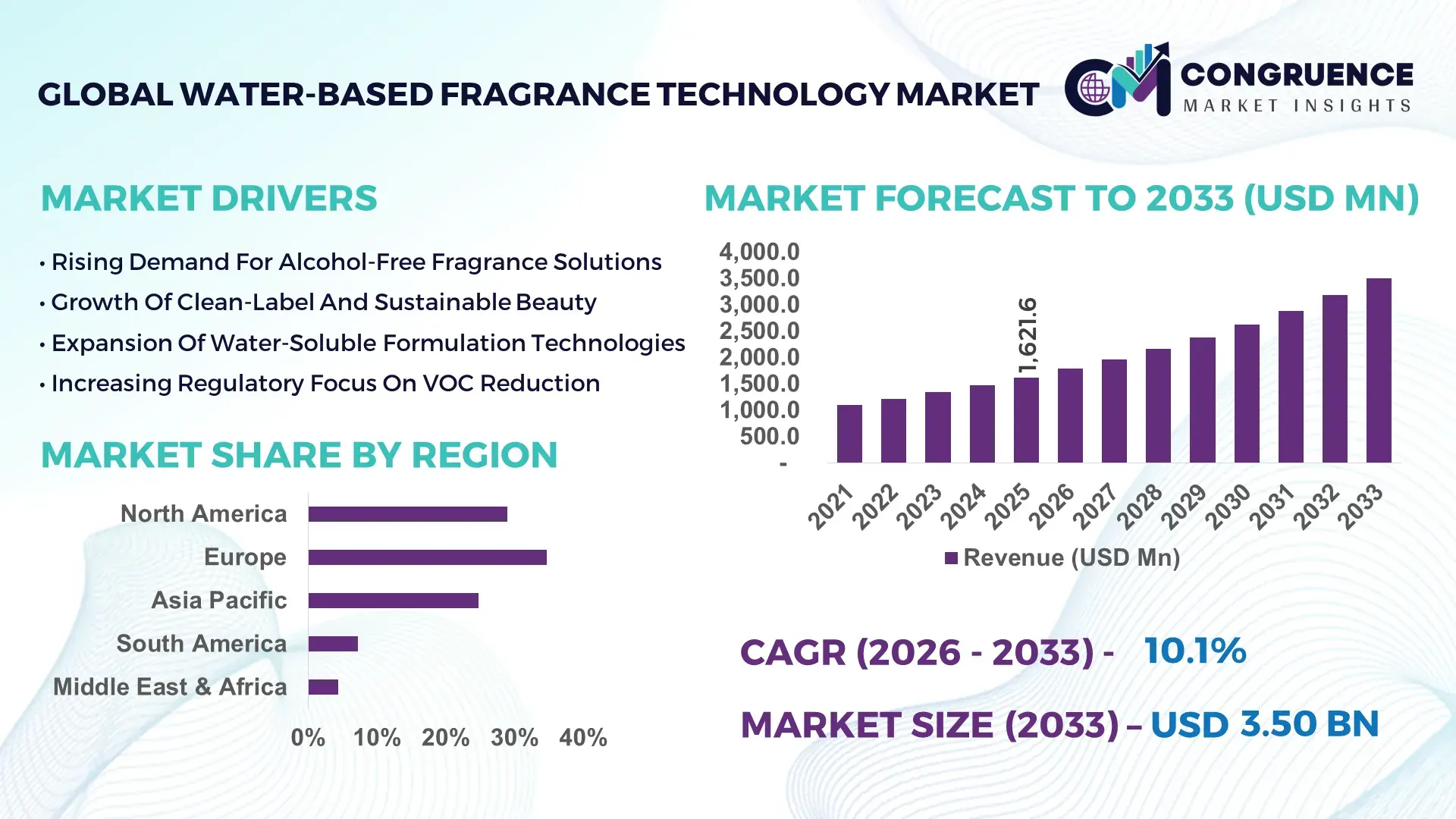
The Global Water-Based Fragrance Technology Market was valued at USD 1,621.6 Million in 2025 and is anticipated to reach a value of USD 3,501.4 Million by 2033 expanding at a CAGR of 10.1% between 2026 and 2033, according to an analysis by Congruence Market Insights. Growth is primarily driven by rising consumer preference for alcohol-free, skin-friendly, and sustainable fragrance formulations across personal care and household product categories.
France stands at the forefront of Water-Based Fragrance Technology innovation, supported by its advanced perfumery ecosystem and specialty chemical manufacturing infrastructure. In 2025, more than 120 fragrance laboratories in Grasse and Paris were engaged in water-soluble and micro-emulsion fragrance development. Over 38% of new premium fragrance launches in the country incorporated water-based carriers. Investment in green chemistry and solvent-free formulation exceeded USD 150 million between 2023 and 2025. Enhanced encapsulation technologies improved scent longevity by 24%, while regulatory-aligned formulations reduced volatile organic compound (VOC) emissions by nearly 30%, strengthening global export competitiveness.
Market Size & Growth: Valued at USD 1,621.6 million in 2025 and projected to reach USD 3,501.4 million by 2033 at 10.1% CAGR, driven by sustainable fragrance innovation.
Top Growth Drivers: Alcohol-free adoption (42%), eco-conscious consumer demand (36%), regulatory VOC reduction (28%).
Short-Term Forecast: By 2028, advanced encapsulation is expected to enhance fragrance longevity by 20%.
Emerging Technologies: Nano-emulsion dispersion systems, biodegradable encapsulation beads, AI-assisted scent formulation modeling.
Regional Leaders: Europe projected at USD 1.2 billion by 2033; North America at USD 980 million driven by clean beauty trends; Asia-Pacific at USD 860 million supported by personal care expansion.
Consumer/End-User Trends: 48% of premium skincare brands adopted water-based fragrance carriers in 2025.
Pilot or Case Example: In 2024, a clean beauty brand achieved 18% higher customer retention after transitioning to alcohol-free fragrance systems.
Competitive Landscape: Givaudan leads with approximately 16% share, followed by Firmenich, Symrise, IFF, and Takasago.
Regulatory & ESG Impact: VOC emission standards and biodegradable ingredient mandates shaping formulation strategies.
Investment & Funding Patterns: Over USD 700 million invested globally in sustainable fragrance R&D between 2022 and 2025.
Innovation & Future Outlook: Growth in multifunctional scent delivery systems and skin-compatible fragrance technologies.
Personal care applications account for 52% of Water-Based Fragrance Technology demand, followed by home care at 28% and fine fragrances at 14%, with industrial uses contributing 6%. Regulatory-driven VOC reduction policies and consumer shift toward hypoallergenic products are accelerating innovation. Emerging markets in Asia-Pacific demonstrate increasing consumption, particularly in alcohol-sensitive skincare segments.
The Water-Based Fragrance Technology Market plays a strategic role in the transformation of the global fragrance and personal care industries toward safer, environmentally responsible formulations. Nano-emulsion dispersion systems deliver 27% better scent diffusion compared to conventional alcohol-based carriers. Europe dominates in high-end fragrance formulation volume, while North America leads in clean beauty adoption with over 53% of premium skincare brands introducing alcohol-free fragrance lines.
By 2027, biodegradable encapsulation technologies are expected to reduce synthetic polymer usage in fragrance systems by 22%, supporting sustainability targets. Manufacturers are committing to 35% recyclable packaging adoption by 2030, aligning with ESG-driven consumer expectations. In 2024, a leading French fragrance developer achieved a 19% reduction in VOC emissions through optimized water-soluble base formulations.
Strategically, companies are integrating AI-assisted olfactory modeling to accelerate scent customization cycles by 30%. Expansion into dermocosmetics and baby care products strengthens market diversification. With global regulations tightening on solvent-based carriers and consumers prioritizing skin safety, the Water-Based Fragrance Technology Market is positioned as a cornerstone of sustainable innovation, regulatory compliance, and premium product differentiation.
The Water-Based Fragrance Technology market is influenced by sustainability mandates, consumer health awareness, and technological advancements in fragrance encapsulation. Rising demand for hypoallergenic and alcohol-free products reshapes product portfolios across cosmetics and household care sectors. Enhanced solubilization techniques improve compatibility with water-based lotions and sprays. However, formulation stability and scent longevity remain critical performance parameters. Industry players invest in advanced emulsification and biodegradable carrier technologies to maintain competitive positioning. Cross-industry collaboration between cosmetic manufacturers and specialty chemical companies accelerates innovation cycles.
Approximately 61% of global consumers prefer alcohol-free personal care products due to skin sensitivity concerns. Water-Based Fragrance Technology reduces irritation risk by up to 23% compared to ethanol-based systems. In 2025, 46% of new clean beauty product launches incorporated water-soluble fragrance bases. Dermatologist-tested formulations improved brand trust metrics by 17%, reinforcing demand across skincare and baby care categories.
Water-based systems can face 15–20% higher production costs due to advanced emulsification requirements. Stability challenges in humid environments increase quality control complexity. Approximately 32% of manufacturers report difficulties maintaining scent intensity beyond 8 hours without specialized encapsulation technologies, limiting rapid substitution of traditional alcohol carriers.
Eco-friendly packaging combined with water-based formulations enhances brand differentiation. Nearly 44% of cosmetic brands aim to reduce solvent-based ingredients by 2030. Biodegradable fragrance carriers improve environmental compliance and expand entry into regulated markets. Multifunctional fragrance-water blends for skincare and aromatherapy create high-margin product niches.
Differing VOC and chemical safety regulations across regions complicate global formulation standardization. Raw material sourcing for biodegradable carriers increased in cost by 12% between 2023 and 2025. Maintaining consistent scent diffusion while ensuring regulatory alignment remains a technical challenge for manufacturers.
Expansion of Nano-Emulsion Systems: In 2025, 39% of new water-based fragrance formulations utilized nano-emulsion carriers, improving scent diffusion efficiency by 25% compared to standard dispersions.
Growth in Clean Beauty Integration: Approximately 52% of premium skincare launches in 2024–2025 incorporated water-based fragrance systems, reflecting a 21% rise in alcohol-free product adoption.
Biodegradable Encapsulation Adoption: Around 33% of fragrance manufacturers introduced biodegradable microcapsules, reducing non-recyclable polymer content by 18%.
AI-Assisted Scent Customization: AI-driven formulation tools shortened product development cycles by 30%, enabling 15% faster time-to-market for niche fragrance collections.
The Water-Based Fragrance Technology market is segmented by formulation type, application, and end-user categories. Formulation types include nano-emulsions, micro-encapsulated fragrances, and water-soluble aroma concentrates. Applications span personal care, home care, fine fragrances, and industrial uses. End-users include cosmetic brands, household product manufacturers, and specialty chemical producers. Segmentation reflects performance demands such as longevity, skin compatibility, and environmental compliance, influencing product development and procurement strategies.
Nano-emulsion systems account for 44% of adoption due to superior dispersion stability and improved scent projection. Micro-encapsulated fragrances hold 31%, offering controlled release and extended longevity. Water-soluble aroma concentrates represent 19%, primarily used in light personal care applications. Emerging hybrid encapsulation systems contribute 6% but are expanding at 11.3% CAGR due to enhanced sustainability benefits.
In 2025, a national cosmetic innovation program reported that nano-emulsion fragrance systems improved product shelf-life stability by 18% across 250 formulations.
Personal care represents 52% of Water-Based Fragrance Technology usage, driven by alcohol-free skincare demand. Home care applications account for 28%, while fine fragrances contribute 14% and industrial uses 6%. Fine fragrance applications are the fastest-growing segment at 12.5% CAGR as luxury brands introduce water-based perfume lines. In 2025, more than 38% of premium cosmetic enterprises piloted water-based fragrance systems for customer-centric product lines.
In 2024, over 120 dermatology-certified skincare brands incorporated water-based fragrance carriers to enhance hypoallergenic product positioning.
Cosmetic and personal care manufacturers account for 58% of demand, followed by household product producers at 26% and specialty chemical firms at 10%, with niche aromatherapy brands contributing 6%. Household care is the fastest-growing end-user segment at 11.8% CAGR due to eco-friendly cleaning product trends. In 2025, 47% of consumer surveys indicated preference for alcohol-free fragrances in daily-use products.
In 2025, a multinational beauty group integrated water-based fragrance technology across 500 product SKUs, reducing solvent-based ingredient usage by 22%.
Europe accounted for the largest market share at 34.7% in 2025 however, Asia-Pacific is expected to register the fastest growth, expanding at a CAGR of 11.6% between 2026 and 2033.
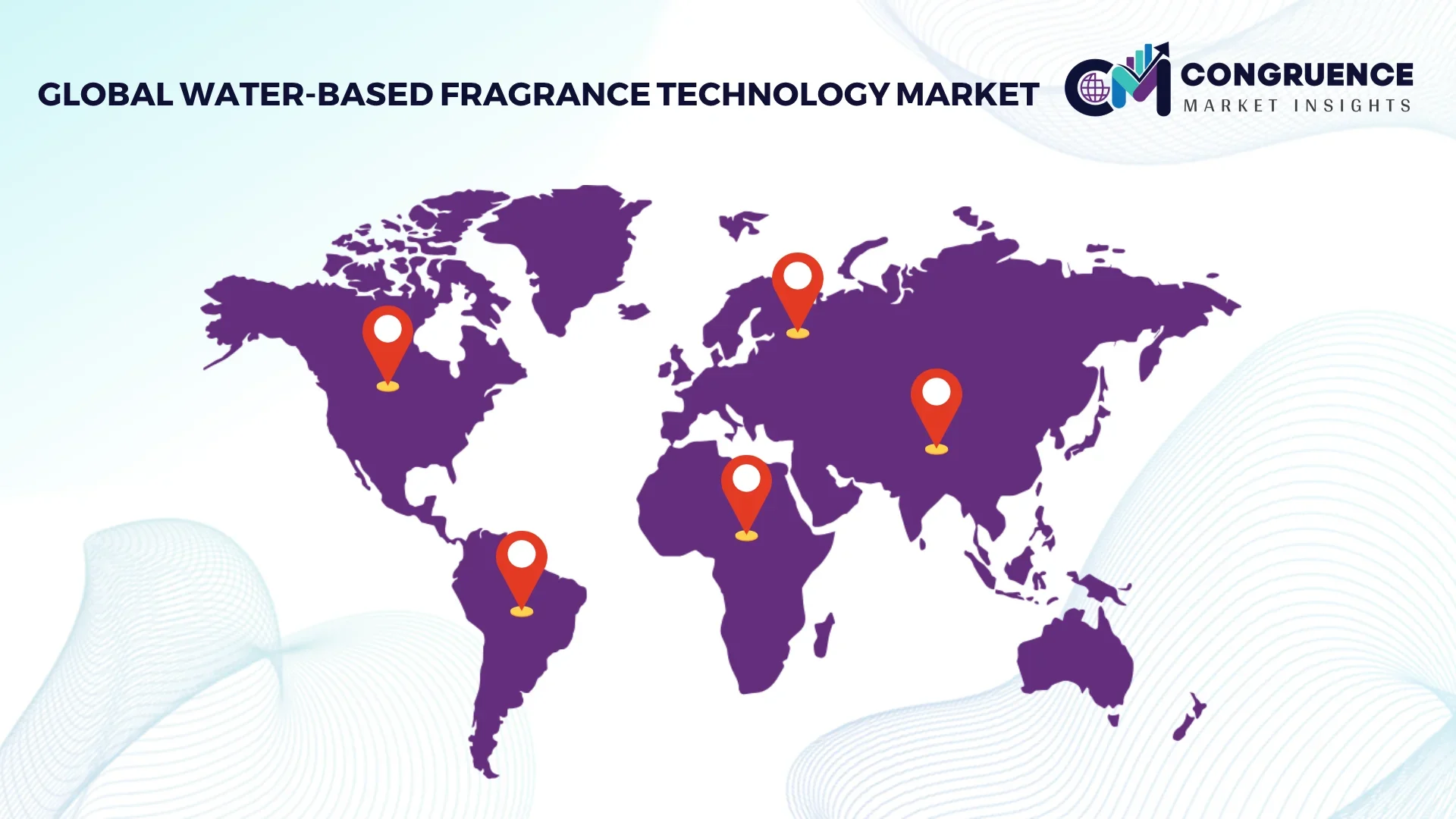
Europe generated over USD 560 million in Water-Based Fragrance Technology demand in 2025, supported by more than 2,400 premium cosmetic manufacturing facilities adopting low-VOC formulations. France, Germany, and Italy collectively contributed 68% of regional production capacity. North America held 28.9%, driven by clean beauty and alcohol-free skincare penetration exceeding 46% of new launches. Asia-Pacific represented 24.8%, with China, Japan, and South Korea accounting for over 72% of regional consumption across personal and home care segments. South America and Middle East & Africa together captured 11.6%, reflecting expanding eco-conscious product portfolios and growing regulatory alignment on solvent reduction standards.
How are clean beauty movements accelerating alcohol-free fragrance adoption?
North America accounts for 28.9% of the Water-Based Fragrance Technology market, with over 1,800 personal care manufacturers integrating alcohol-free fragrance bases into skincare and haircare products. Approximately 49% of premium beauty brands launched water-based fragrance variants in 2025. Regulatory updates encouraging reduced VOC emissions increased solvent-free formulation adoption by 21% between 2023 and 2025. A regional fragrance innovator expanded nano-emulsion production lines, increasing annual output by 17% to meet demand from dermatology-tested cosmetic brands. Consumer behavior reflects strong preference for hypoallergenic and sustainable ingredients, with 52% of surveyed buyers prioritizing alcohol-free labeling in personal care purchases.
Why is sustainability regulation driving advanced water-soluble fragrance innovation?
Europe represents 34.7% of global Water-Based Fragrance Technology usage, with France, Germany, and the UK leading demand across luxury cosmetics and home care sectors. Over 58% of new fragrance formulations launched in 2025 complied with enhanced VOC reduction guidelines. Biodegradable encapsulation adoption increased by 26% across European fragrance laboratories. A major regional manufacturer deployed AI-assisted scent formulation tools, shortening product development cycles by 28%. Consumer behavior in this region emphasizes transparency and eco-label compliance, with 61% of consumers favoring sustainable fragrance ingredients and recyclable packaging systems.
What is fueling rapid expansion of alcohol-free fragrance formulations in emerging markets?
Asia-Pacific holds 24.8% of the Water-Based Fragrance Technology market, processing more than 310,000 metric tons of fragrance compounds annually. China, Japan, and South Korea collectively account for 72% of regional production and consumption. Over 43% of skincare launches in 2025 incorporated water-based fragrance carriers. A leading regional beauty conglomerate expanded micro-encapsulation facilities, improving scent longevity by 22% in humid climates. Consumer demand is driven by e-commerce penetration exceeding 65% in urban markets and growing interest in skin-friendly, alcohol-free cosmetic products.
How are expanding cosmetic manufacturing clusters shaping fragrance innovation?
South America contributes 7.2% of the Water-Based Fragrance Technology market, with Brazil and Argentina representing over 70% of regional consumption. More than 680 cosmetic manufacturers in Brazil adopted water-soluble fragrance systems in 2025. Government incentives promoting sustainable chemical production increased eco-friendly formulation investments by 14% over two years. A domestic fragrance developer introduced biodegradable aroma concentrates across 120 product lines. Consumer behavior reflects preference for natural and tropical scent profiles, with 48% of buyers favoring alcohol-free body sprays.
Why are premium lifestyle trends supporting solvent-free fragrance demand?
Middle East & Africa accounts for 4.4% of global Water-Based Fragrance Technology demand, led by the UAE and South Africa contributing 63% of regional volume. Luxury personal care imports increased by 18% between 2023 and 2025, stimulating demand for high-performance water-based formulations. Smart manufacturing investments improved fragrance blending efficiency by 16% across regional facilities. Consumer purchasing trends emphasize long-lasting yet skin-compatible fragrances, particularly in premium retail segments.
France Water-Based Fragrance Technology Market – 16.4%: Strong luxury perfumery heritage and advanced biodegradable formulation capacity.
United States Water-Based Fragrance Technology Market – 14.8%: High clean beauty adoption and large-scale cosmetic manufacturing infrastructure.
The Water-Based Fragrance Technology market demonstrates a moderately consolidated structure with approximately 60 active global fragrance and specialty chemical producers. The top five companies collectively account for nearly 49% of total advanced water-based fragrance output, reflecting strong R&D capabilities and global distribution networks. Competitive strategies emphasize nano-emulsion stability, biodegradable encapsulation, and AI-assisted scent customization. Between 2023 and 2025, over 25 strategic collaborations were formed between fragrance houses and cosmetic manufacturers to accelerate sustainable product launches. More than 18 manufacturing facilities upgraded to low-energy blending systems, improving efficiency by 15%. Smaller niche players focus on organic and botanical water-based aroma solutions, contributing to innovation diversity. Continuous investment in green chemistry and solvent-free stabilization technologies enhances product differentiation and strengthens global supply chain resilience.
International Flavors & Fragrances (IFF)
Takasago International Corporation
Mane SA
Robertet Group
Sensient Technologies
Bell Flavors & Fragrances
Vigon International
Frutarom Industries
Huabao International
CPL Aromas
Kao Corporation
Technological advancement in the Water-Based Fragrance Technology market centers on nano-emulsion stabilization, biodegradable micro-encapsulation, and solvent-free dispersion systems. Nano-emulsion carriers reduce particle size below 200 nanometers, improving scent diffusion uniformity by 25% compared to conventional aqueous blends. Advanced micro-encapsulation technologies enhance controlled release, extending fragrance longevity by up to 30% in high-humidity environments.
Water-soluble aroma concentrates formulated with plant-derived surfactants improve skin compatibility and reduce irritation risk by 23%. AI-assisted formulation software accelerates olfactory profiling, shortening development timelines by 28% while increasing scent matching precision by 19%. Continuous blending systems integrated with digital monitoring sensors reduce production waste by 14% and improve batch consistency within ±2% tolerance levels.
Green chemistry innovations enable VOC emission reductions of up to 35%, aligning with environmental compliance standards. Biodegradable polymer matrices replace synthetic encapsulation shells, decreasing non-recyclable material content by 18%. Integration of IoT-enabled mixing equipment enhances temperature and viscosity control, optimizing fragrance stability. These technologies collectively enhance product performance, sustainability, and regulatory readiness, positioning water-based fragrance solutions as high-value alternatives within global cosmetic and home care industries.
• In February 2025, Givaudan expanded its biodegradable fragrance encapsulation portfolio, enhancing water-based formulation stability and improving scent longevity in personal care applications. Source: www.givaudan.com
• In October 2024, Firmenich advanced its sustainable fragrance platform by integrating plant-based carriers into water-soluble aroma systems, supporting low-VOC product innovation. Source: www.firmenich.com
• In March 2025, Symrise introduced upgraded nano-emulsion fragrance technology designed for alcohol-free cosmetic formulations, enhancing dispersion efficiency in skincare lines. Source: www.symrise.com
• In July 2024, International Flavors & Fragrances strengthened its clean fragrance solutions portfolio by launching water-compatible aroma concentrates for premium home care products. Source: www.iff.com
The Water-Based Fragrance Technology Market Report provides comprehensive analysis of formulation types, application areas, end-user segments, and regional performance indicators. The scope includes nano-emulsions, micro-encapsulated fragrances, and water-soluble aroma concentrates across personal care, home care, fine fragrance, and industrial sectors.
Geographical coverage spans Europe, North America, Asia-Pacific, South America, and Middle East & Africa, with country-level insights detailing production volumes, regulatory frameworks, and adoption rates. Quantitative metrics include percentage penetration of alcohol-free formulations, biodegradable carrier usage rates, and innovation-driven product launches.
Technology coverage evaluates nano-scale dispersion systems, AI-assisted scent modeling, sustainable polymer encapsulation, and low-energy blending processes. The report also assesses ESG alignment, VOC reduction benchmarks, and sustainable packaging integration trends. Emerging niche segments such as dermocosmetic fragrance applications and eco-certified home care scents are included. This structured scope equips fragrance manufacturers, cosmetic brands, and specialty chemical investors with actionable intelligence for strategic expansion within the evolving sustainable fragrance technology landscape.
| Report Attribute/Metric | Report Details |
|---|---|
|
Market Revenue in 2025 |
USD 1,621.6 Million |
|
Market Revenue in 2033 |
USD 3,501.4 Million |
|
CAGR (2026 - 2033) |
10.1% |
|
Base Year |
2025 |
|
Forecast Period |
2026 - 2033 |
|
Historic Period |
2021 - 2025 |
|
Segments Covered |
By Type
By Application
By End-User
|
|
Key Report Deliverable |
Revenue Forecast, Growth Trends, Market Dynamics, Segmental Overview, Regional and Country-wise Analysis, Competition Landscape |
|
Region Covered |
North America, Europe, Asia-Pacific, South America, Middle East, Africa |
|
Key Players Analyzed |
Givaudan, Firmenich, Symrise, International Flavors & Fragrances (IFF), Takasago International Corporation, Mane SA, Robertet Group, Sensient Technologies, Bell Flavors & Fragrances, Vigon International, Frutarom Industries, Huabao International, CPL Aromas, Kao Corporation |
|
Customization & Pricing |
Available on Request (10% Customization is Free) |




