
Reports
The Global Water-based Epoxy Floor Coating Market was valued at USD 1,586.7 Million in 2025 and is anticipated to reach a value of USD 2,788.0 Million by 2033 expanding at a CAGR of 7.3% between 2026 and 2033. Growth is driven by tightening low-VOC regulations, rapid expansion of industrial and logistics facilities, and increasing adoption of durable, environmentally compliant flooring systems across manufacturing and commercial infrastructure.
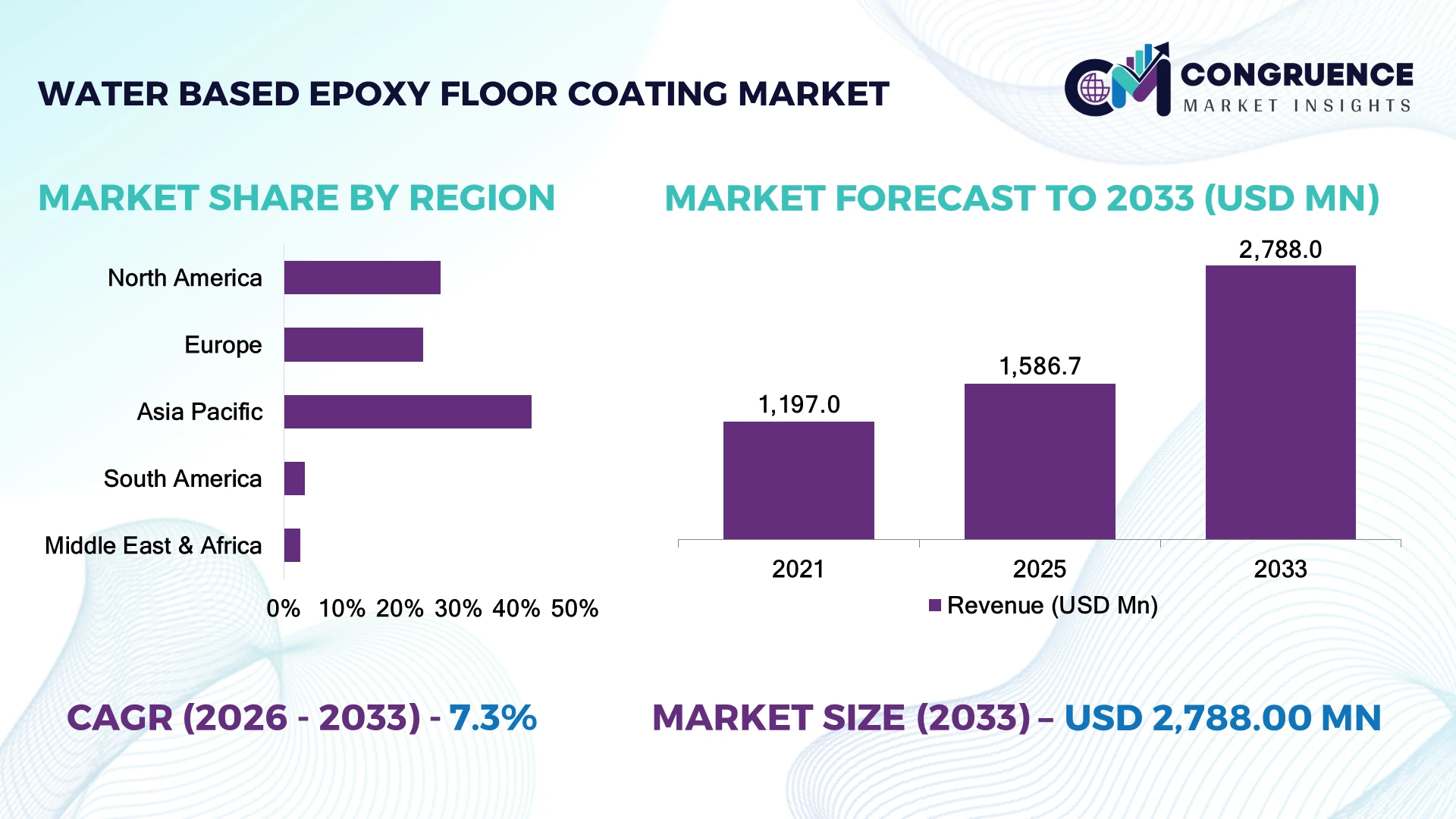
China leads the global market with an estimated 31% share, supported by extensive manufacturing capacity, warehouse construction, and investments in electric vehicle, electronics, and pharmaceutical industries. Compared with Germany, which emphasizes premium low-emission flooring technologies, China benefits from larger industrial installation volumes, with over 62% of newly constructed logistics facilities specifying water-based coating systems. Ongoing global supply-chain diversification since the Red Sea shipping disruptions has accelerated localized production and regional procurement strategies for industrial coatings.
Manufacturers prioritizing low-emission formulations, production localization, and high-performance flooring solutions are securing stronger positions in industrial infrastructure and commercial construction projects.
Market Size & Growth: USD 1,586.7 million (2025) to USD 2,788.0 million (2033) at 7.3% CAGR, driven by low-VOC industrial flooring adoption.
Top Growth Drivers: Industrial construction (+34%), environmental compliance (+29%), warehouse expansion (+26%).
Short-Term Forecast: By 2028, installation efficiency improves 18% while maintenance costs decline 16%.
Emerging Technologies: Nano-enhanced epoxy, antimicrobial coatings, and automated application systems improve durability and consistency.
Regional Leaders: Asia-Pacific (~USD 1.2 billion), North America (~USD 780 million), Europe (~USD 610 million), supported by industrial modernization.
Consumer/End-User Trends: More than 64% of new logistics facilities specify water-based flooring systems for sustainability compliance.
Pilot/Case Example: A 2026 manufacturing facility reduced maintenance downtime by 22% following advanced water-based epoxy floor installation.
Competitive Landscape: Leading suppliers hold approximately 41% share through technology, distribution, and industrial partnerships.
Regulatory & ESG Impact: Low-VOC coating adoption reduces solvent emissions by nearly 45% in compliant industrial projects.
Investment & Funding: More than USD 2.3 billion supports capacity expansion, green manufacturing, and regional production networks.
Innovation & Future Outlook: Smart coatings and rapid-curing formulations strengthen long-term industrial flooring performance.
Water-based Epoxy Floor Coating solutions are increasingly specified across warehouses, pharmaceutical plants, food processing facilities, healthcare buildings, and commercial infrastructure where durability and environmental compliance are equally important. Nearly 58% of industrial flooring upgrades now prioritize low-VOC formulations with improved abrasion resistance. Accelerating regional manufacturing localization and stricter environmental standards are reinforcing technology innovation, setting the foundation for the market's evolving strategic landscape.
The Water-based Epoxy Floor Coating market has become strategically significant as manufacturers, infrastructure developers, and facility owners transition toward environmentally compliant construction materials without compromising floor durability or chemical resistance. Stricter environmental regulations, supply-chain localization, and industrial modernization are reshaping procurement priorities across manufacturing, healthcare, logistics, electronics, and food processing facilities. Buyers increasingly evaluate lifecycle performance alongside emissions compliance and maintenance efficiency.
Modern water-based epoxy technologies provide approximately 24% lower VOC emissions and improve indoor application safety compared with conventional solvent-based systems while reducing maintenance interventions by nearly 19% through enhanced abrasion resistance. North America leads adoption in commercial renovation and industrial compliance projects, whereas Asia-Pacific benefits from large-scale manufacturing expansion and rapid warehouse construction. Over the next two to three years, automated application systems and high-performance low-emission formulations are expected to become standard specifications for new industrial flooring projects.
Manufacturers are expanding regional production capacity, strengthening raw material partnerships, and investing in advanced resin technologies to improve product performance and supply reliability. Industrial developers increasingly specify water-based epoxy coatings for automated warehouses, battery manufacturing facilities, and cleanroom environments where operational continuity and environmental compliance are critical. Companies combining sustainable formulations, application efficiency, and long-term durability will strengthen competitive positioning as industrial construction standards continue to evolve.
Stringent environmental regulations and industrial modernization are accelerating the adoption of water-based epoxy floor coatings across manufacturing, logistics, healthcare, and food processing facilities. More than 61% of newly specified industrial flooring projects now prioritize low-VOC coating systems, while advanced formulations reduce solvent emissions by approximately 45% and improve indoor application safety by nearly 28%. Germany's tightening industrial emission standards and green building initiatives are encouraging facility operators to replace conventional solvent-based flooring solutions. This regulatory shift is expanding demand for environmentally compliant, high-performance coatings. Manufacturers are responding through capacity expansion, bio-based resin innovation, and strategic partnerships with construction contractors. A key operational advantage is that compliance-driven flooring upgrades increasingly align with long-term maintenance cost optimization rather than regulatory obligations alone.
Fluctuating prices of epoxy resins, specialty additives, and curing agents continue limiting production stability and pricing consistency. Approximately 38% of coating manufacturers report procurement cost variability affecting contract profitability, while raw material expenses account for nearly 55% of total production costs. Supply disruptions following shipping route adjustments through the Red Sea have increased lead times for imported chemical intermediates, placing pressure on inventory planning and delivery schedules. These conditions reduce pricing flexibility for large industrial projects and compress operating margins. Producers are mitigating risks by diversifying regional suppliers, localizing resin procurement, establishing long-term purchasing agreements, and increasing formulation flexibility to reduce dependence on single-source chemical inputs while improving supply resilience.
Advanced functional coatings integrating antimicrobial protection, anti-static performance, and sensor-compatible surfaces are creating new growth opportunities beyond conventional industrial flooring. Smart flooring systems can reduce maintenance interventions by approximately 22%, while rapid-curing formulations shorten installation downtime by nearly 31%. Japan is expanding semiconductor and electronics manufacturing capacity, increasing demand for electrostatic discharge-resistant water-based epoxy coatings in cleanroom environments. Manufacturers are strengthening R&D programmes, collaborating with industrial automation providers, and introducing multifunctional coating technologies. A notable strategic opportunity lies in combining protective flooring with predictive facility maintenance systems, enabling operational monitoring while extending asset lifespan across high-value industrial infrastructure.
Achieving uniform coating quality across diverse environmental conditions remains a significant execution challenge for contractors and manufacturers. Nearly 34% of application failures are associated with improper substrate preparation or uncontrolled humidity, while inconsistent curing conditions can reduce coating durability by approximately 20%. Large logistics developments in India increasingly require accelerated installation schedules that heighten application risks without standardized quality control procedures. Variability in installer expertise directly affects long-term floor performance, maintenance frequency, and customer confidence. Companies are investing in certified applicator training, automated surface preparation technologies, digital inspection systems, and advanced curing formulations to improve installation consistency and strengthen long-term product performance in demanding industrial environments.
Rapid-Curing Systems Expand: Industrial facilities increasingly specify rapid-curing water-based epoxy coatings, reducing floor downtime by approximately 35% while increasing installation productivity by nearly 24%. Accelerated warehouse construction and manufacturing expansion are encouraging producers to optimize formulation chemistry and expand contractor training programmes for faster project completion.
Low-Emission Formulations Advance: Environmental compliance continues reshaping product portfolios, with low-VOC formulations representing approximately 67% of new industrial coating specifications. Tightening building regulations and corporate sustainability targets are driving manufacturers to reformulate products, expand green certification programmes, and strengthen regional production capabilities for compliant industrial applications.
Automation Improves Application Quality: Automated mixing, spraying, and digital thickness monitoring improve coating consistency by approximately 21% while reducing material waste by nearly 17%. Rising labour shortages across industrial construction are accelerating investment in automated application equipment, enabling contractors to improve productivity and maintain consistent installation quality across large projects.
Functional Surface Performance Grows: Demand is increasing for antimicrobial, anti-static, and chemical-resistant flooring systems, with multifunctional coatings improving operational durability by approximately 26%. A non-obvious shift is the integration of flooring specifications into broader facility asset management strategies rather than standalone construction decisions. Manufacturers are expanding specialty coating portfolios and partnering with industrial infrastructure developers to deliver application-specific flooring solutions.
Two-Component Water-based Epoxy Floor Coatings account for approximately 68% of the global market due to superior chemical resistance, higher mechanical strength, and longer service life across demanding industrial environments. These systems are widely adopted in manufacturing plants, logistics centres, pharmaceutical facilities, and commercial buildings where heavy traffic and chemical exposure require durable flooring solutions. Single-Component coatings continue serving light-duty commercial and residential applications because of simplified installation and reduced labour requirements, although their performance remains comparatively limited under intensive operating conditions.
Single-Component Water-based Epoxy Coatings represent the fastest-growing segment as facility owners increasingly prioritize rapid renovation projects with lower application complexity. Ready-to-use formulations reduce installation time by approximately 26%, while labour requirements decline by nearly 18% compared with conventional multi-component systems. Manufacturers are introducing improved resin technologies, expanding low-VOC product portfolios, and strengthening contractor partnerships to improve application efficiency without compromising durability. Investment is gradually shifting toward easy-to-apply, environmentally compliant coating systems for commercial refurbishment and light industrial projects.
According to a 2026 industrial coatings survey released by the American Coatings Association (ACA), two-component water-based epoxy systems remained the preferred specification for high-performance industrial flooring because of their durability, chemical resistance, and lifecycle performance.
Manufacturing facilities represent the largest application segment with approximately 36% market share, supported by continuous investment in automotive, electronics, pharmaceutical, and food processing plants requiring durable, hygienic, and chemical-resistant flooring. Warehouses and logistics centres remain another major application area as automated material handling systems increase demand for abrasion-resistant surfaces. Commercial buildings and healthcare facilities continue expanding adoption through stricter indoor air quality standards and lower-emission construction specifications.
Warehouses and Logistics Centres constitute the fastest-growing application segment as global distribution networks expand and industrial automation accelerates. Water-based epoxy flooring improves maintenance efficiency by approximately 23% while extending floor service life by nearly 27% under continuous forklift operations. Manufacturers are developing rapid-curing formulations, anti-slip coatings, and automated application technologies to support faster project completion. Demand is strengthening across battery manufacturing, cold storage, and fulfilment centres where operational continuity and environmental compliance have become essential purchasing criteria.
A 2025 enterprise facilities study conducted by the Material Handling Institute (MHI) found that industrial warehouse operators increasingly selected low-maintenance, high-durability flooring systems to support automation and continuous logistics operations.
Industrial Manufacturing accounts for approximately 48% of total market demand because production facilities require chemically resistant, abrasion-resistant, and low-maintenance flooring capable of supporting continuous operations. Automotive, electronics, pharmaceuticals, food processing, and chemical manufacturing plants continue investing in water-based epoxy systems to improve workplace safety and regulatory compliance. Commercial infrastructure, healthcare facilities, and institutional buildings remain important buyers, while residential demand continues to expand gradually through premium renovation projects.
Logistics and Warehousing represents the fastest-growing end-user segment as global supply chains invest in automated distribution infrastructure and high-performance industrial flooring. Advanced water-based epoxy coatings reduce maintenance frequency by approximately 21% while improving floor durability under heavy equipment traffic by nearly 24%. Manufacturers are introducing sector-specific formulations, strengthening distribution partnerships, and offering customized installation support to address operational requirements across different industries. Competitive positioning increasingly depends on delivering application-specific coating performance rather than standardized flooring solutions.
According to a 2026 industry assessment published by the World Green Building Council, industrial developers increasingly specified low-emission flooring materials that combine operational durability with environmental compliance as part of modern sustainable facility construction strategies.
Asia-Pacific accounted for the largest market share at 42.6% in 2025 however, Middle East & Africa is expected to register the fastest growth, expanding at a CAGR of 8.4% between 2026 and 2033.
Industrial Facility Modernization Accelerates Low-VOC Flooring Adoption
North America represents a mature market, accounting for approximately 27% of global demand, supported by extensive industrial renovation, warehouse automation, and stringent environmental compliance standards. Manufacturing facilities, pharmaceutical plants, food processing units, and distribution centres increasingly specify water-based epoxy flooring to improve durability while reducing workplace emissions. More than 63% of newly constructed logistics facilities incorporate low-VOC flooring systems as part of sustainable building specifications. Continuous investments in automated manufacturing, battery production, and healthcare infrastructure are increasing demand for rapid-curing, abrasion-resistant coatings. Coating manufacturers are expanding regional production, strengthening contractor networks, and introducing advanced formulations with enhanced chemical resistance to improve lifecycle performance and operational efficiency.
United States Market Outlook: The United States dominates the regional market through its extensive manufacturing base, advanced logistics infrastructure, and strict workplace environmental regulations. Large investments in semiconductor fabrication, electric vehicle manufacturing, pharmaceutical production, and automated warehousing continue driving specification of premium water-based epoxy flooring systems. Approximately 68% of industrial flooring replacement projects now prioritize low-emission coatings with improved lifecycle durability, encouraging manufacturers to expand domestic production capacity and strengthen technical service capabilities.
Sustainability Standards Reshape Industrial Flooring Specifications
Europe continues strengthening demand through industrial decarbonization, green building standards, and modernization of manufacturing facilities. The region contributes nearly 24% of global consumption, with industrial operators increasingly replacing solvent-based coatings to meet environmental and occupational safety requirements. More than 58% of new industrial flooring projects now specify water-based systems across food processing, pharmaceuticals, and electronics manufacturing. Product innovation is centred on bio-based additives, enhanced abrasion resistance, and rapid-curing technologies. Manufacturers are investing in regional production facilities and expanding certified applicator partnerships to support compliance-focused industrial construction and renovation projects.
Germany Market Outlook: Germany remains Europe's largest market due to its advanced automotive, machinery, chemical, and industrial manufacturing sectors. Strong environmental regulations continue accelerating replacement of conventional flooring materials with low-VOC alternatives across production facilities. Nearly 61% of industrial refurbishment projects involving factory flooring now include environmentally compliant coating systems, reinforcing demand for high-performance formulations with superior chemical resistance and long operational life.
Manufacturing Expansion Strengthens Industrial Coating Demand
Asia-Pacific leads the global market with approximately 42.6% share, supported by extensive industrial construction, electronics manufacturing, logistics infrastructure, and expanding chemical production. China, India, Japan, and Southeast Asian economies continue investing in factories, warehouses, and clean manufacturing facilities requiring durable flooring systems. More than 66% of newly commissioned industrial buildings across key manufacturing hubs utilize water-based epoxy flooring because of improved environmental compliance and operational durability. Coating manufacturers are expanding regional resin production, strengthening local distribution networks, and developing application-specific products for electronics, battery manufacturing, and pharmaceutical industries.
China Market Outlook: China remains the region's largest consumer and producer of water-based epoxy floor coatings due to its extensive industrial infrastructure and construction activity. Large investments in electric vehicle manufacturing, semiconductor fabrication, and automated logistics facilities continue supporting high-volume flooring installations. Approximately 70% of newly developed industrial parks specify environmentally compliant flooring materials, encouraging manufacturers to invest in advanced low-emission coating technologies and localized supply chains.
Industrial Upgrades Support Premium Flooring Demand
South America is witnessing steady adoption of water-based epoxy flooring through expanding food processing, mining support infrastructure, pharmaceuticals, and logistics developments. Brazil and neighbouring markets are increasing investment in industrial modernization while replacing ageing concrete flooring with durable, low-maintenance coating systems. Approximately 44% of large industrial refurbishment projects now include water-based epoxy applications to improve operational safety and maintenance efficiency. Although economic volatility continues influencing capital expenditure, manufacturers are strengthening distributor partnerships and regional inventory networks to improve project execution and supply continuity across industrial customers.
Brazil Market Outlook: Brazil leads regional demand through its diversified manufacturing base, agribusiness processing industry, automotive production, and expanding warehouse infrastructure. Industrial operators increasingly prioritize flooring systems capable of withstanding heavy equipment traffic and aggressive cleaning procedures. Around 52% of modern logistics developments specify high-performance water-based epoxy coatings, creating opportunities for suppliers offering rapid installation, localized technical support, and application-specific product portfolios.
Infrastructure Investment Drives Advanced Flooring Deployment
The Middle East & Africa market is expanding through industrial diversification, large-scale infrastructure development, healthcare investment, and logistics modernization. Countries across the Gulf continue constructing advanced manufacturing facilities, airports, warehouses, and commercial complexes requiring durable and environmentally compliant flooring systems. Nearly 39% of newly developed industrial facilities in major Gulf economies incorporate water-based epoxy coatings to improve operational safety and reduce lifecycle maintenance requirements. Manufacturers are expanding regional distribution, forming partnerships with construction contractors, and introducing climate-resistant formulations designed for high-temperature operating environments.
Saudi Arabia Market Outlook: Saudi Arabia represents the region's most influential market through sustained investment in industrial cities, logistics hubs, healthcare facilities, and manufacturing diversification programmes. Large infrastructure developments increasingly specify environmentally compliant flooring systems that deliver long-term durability under demanding operating conditions. More than 47% of recently awarded industrial construction projects include advanced protective floor coating specifications, encouraging coating suppliers to expand local technical support, warehousing, and contractor training capabilities.
Global coatings leaders Sika, Sherwin-Williams, PPG Industries, AkzoNobel, and RPM International compete with regional flooring specialists and private-label manufacturers for industrial infrastructure projects, while technology innovators challenge cost-focused suppliers through advanced low-VOC formulations. The top five companies collectively control approximately 49% of global demand. Competition centres on formulation performance, application speed, distribution reach, and lifecycle durability rather than price alone. Advanced water-based technologies extend coating service life by nearly 22%, rapid-curing systems reduce installation downtime by approximately 28%, and localized supply chains shorten delivery cycles by about 17%. Leading manufacturers strengthen market positions through production expansion, contractor certification programmes, raw material partnerships, and vertically integrated flooring systems. Competitive momentum is shifting toward sustainable, high-performance coating platforms meeting stricter environmental standards. High formulation expertise, regulatory compliance, and established contractor networks remain key entry barriers. Winning requires differentiated chemistry, reliable supply, technical support, and application-specific performance.
Sika AG
Sherwin-Williams Company
PPG Industries, Inc.
AkzoNobel N.V.
RPM International Inc.
Jotun A/S
Hempel A/S
Axalta Coating Systems
Nippon Paint Holdings Co., Ltd.
Kansai Paint Co., Ltd.
Asian Paints Limited
Berger Paints India Limited
Teknos Group
DAW SE
Water-based epoxy floor coating technology is rapidly evolving through ultra-low-VOC resin chemistry, nano-reinforced additives, and fast-curing hardener systems. Approximately 64% of newly launched industrial flooring products now incorporate low-emission formulations, while nano-modified coatings improve abrasion resistance by nearly 24% and chemical durability by approximately 19%. Digital colour matching and automated mixing systems reduce material waste, improve application consistency, and strengthen project execution across manufacturing and logistics facilities.
Emerging technologies include graphene-enhanced coatings, antimicrobial additives, moisture-tolerant primers, and bio-based epoxy hardeners integrated with sustainable construction standards. Compared with conventional solvent-based systems, next-generation water-based coatings reduce VOC emissions by approximately 90% while improving indoor application safety and shortening recoating intervals by nearly 20%. Global manufacturers benefit through compliance-driven product differentiation, whereas regional suppliers compete by offering application-specific formulations and localized technical support.
Between 2026 and 2028, multifunctional coatings combining anti-static, antimicrobial, and predictive maintenance capabilities will become increasingly specified for electronics, healthcare, and battery manufacturing facilities. Companies investing in advanced resin chemistry, digital formulation platforms, and sustainable raw materials will strengthen competitive positioning through higher product performance, improved contractor productivity, and faster regulatory compliance. Early technology adoption will secure premium industrial projects where lifecycle value increasingly outweighs initial material cost.
March 2025 – Sika and BASF jointly launched the Baxxodur EC 151 epoxy hardener for flooring applications, delivering up to 90% lower VOC emissions than conventional hardeners while improving application performance. Business impact: accelerated adoption of sustainable industrial flooring systems. Source: Sika
July 2024 – PPG introduced its next-generation AQUAPON WB EP water-based epoxy technology featuring faster drying and enhanced abrasion resistance for industrial and commercial facilities. Business impact: improved maintenance efficiency and reduced facility downtime. Source: PPG
February 2025 – PPG expanded availability of PPG Flooring 2640 and related waterborne epoxy systems for demanding concrete applications, supporting heavy-duty industrial environments with enhanced moisture tolerance and chemical resistance. Business impact: broader specification opportunities across manufacturing and warehouse projects. Source: PPG Protective & Marine Coatings
March 2025 – Sherwin-Williams continued deployment of Armorseal 8100 water-based epoxy flooring across food, pharmaceutical, and industrial applications, offering VOC levels below 100 g/L and LEED-compliant performance. Business impact: strengthened position in sustainability-driven industrial flooring specifications. Source: Sherwin-Williams product portfolio update.
This report provides a comprehensive assessment of the global Water-based Epoxy Floor Coating market across product types, applications, end-user industries, and major geographic regions. It evaluates two-component and single-component technologies across manufacturing facilities, warehouses, commercial buildings, healthcare infrastructure, institutional projects, and residential applications. The study analyses deployment patterns, purchasing behaviour, formulation trends, distribution strategies, and competitive positioning across established manufacturers and specialist coating suppliers. More than 60% of industrial demand is concentrated in high-performance manufacturing and logistics environments requiring durable, low-emission flooring systems.
The report further examines advanced coating technologies including ultra-low-VOC formulations, nano-enhanced additives, antimicrobial coatings, rapid-curing systems, and sustainable resin innovations shaping industry development between 2026 and 2033. It supports investment prioritisation, product development, capacity expansion, geographic market entry, and competitive benchmarking by identifying evolving customer requirements, technology adoption trends, industrial modernization initiatives, and emerging application opportunities across both mature and high-growth infrastructure sectors.
| Report Attribute/Metric | Report Details |
|---|---|
|
Market Revenue in 2025 |
USD 1,586.7 Million |
|
Market Revenue in 2033 |
USD 2,788.0 Million |
|
CAGR (2026 - 2033) |
7.3% |
|
Base Year |
2025 |
|
Forecast Period |
2026 - 2033 |
|
Historic Period |
2021 - 2025 |
|
Segments Covered |
By Type
By Application
By End-User
|
|
Key Report Deliverable |
Revenue Forecast, Growth Trends, Market Dynamics, Segmental Overview, Regional and Country-wise Analysis, Competition Landscape |
|
Region Covered |
North America, Europe, Asia-Pacific, South America, Middle East, Africa |
|
Key Players Analyzed |
Sika AG, Sherwin-Williams Company, PPG Industries, Inc., AkzoNobel N.V., RPM International Inc., Jotun A/S, Hempel A/S, Axalta Coating Systems, Nippon Paint Holdings Co., Ltd., Kansai Paint Co., Ltd., Asian Paints Limited, Berger Paints India Limited, Teknos Group, DAW SE |
|
Customization & Pricing |
Available on Request (10% Customization is Free) |




