
Reports
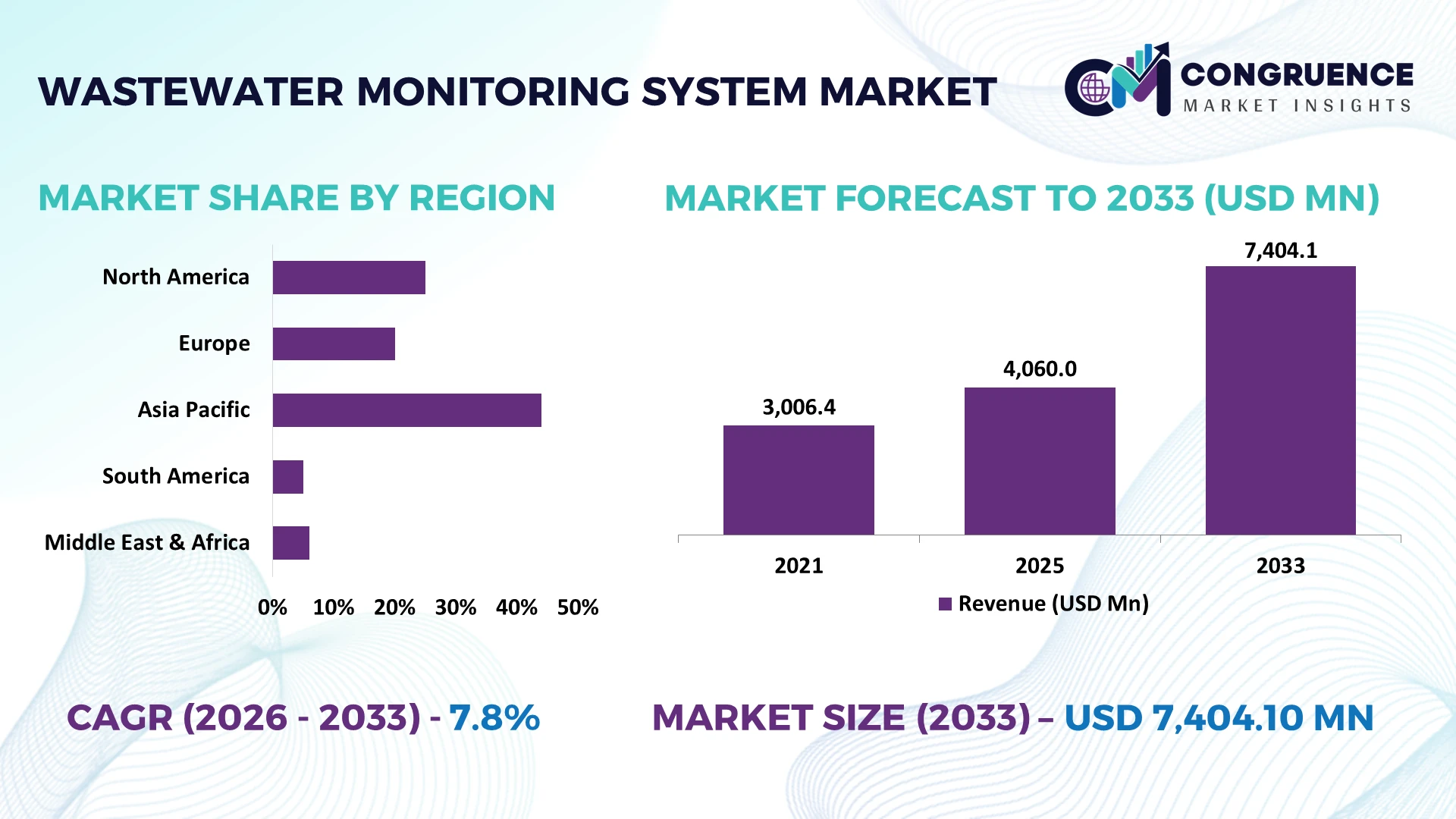
The Global Wastewater Monitoring System Market was valued at USD 4060 Million in 2025 and is anticipated to reach a value of USD 7404.1 Million by 2033 expanding at a CAGR of 7.8% between 2026 and 2033. Growth is driven by stricter industrial effluent discharge regulations, real-time water quality surveillance, automated treatment plant operations, and adoption of IoT-enabled monitoring sensors.
China represents a major wastewater monitoring market, supported by extensive municipal treatment infrastructure and industrial discharge regulation. Its urban wastewater treatment rate exceeds 95%, compared with India's urban sewage treatment capacity coverage of approximately 50%. China's environmental monitoring investments support online chemical oxygen demand, ammonia nitrogen, and total phosphorus measurement across municipal and industrial facilities. An indicative market model assigns China 25% of global wastewater monitoring demand, reflecting infrastructure scale rather than verified market share. Industrial clusters in Jiangsu, Guangdong, and Shandong strengthen demand for automated compliance monitoring.
Manufacturers prioritizing multiparameter sensing, remote diagnostics, and automated calibration can target modeled 15% lower monitoring expenditure and 20% faster contamination detection.
Market Size & Growth: USD 4,060 million in 2025, reaching USD 7,404.1 million by 2033 at 7.8% CAGR, driven by automated effluent compliance monitoring.
Top Growth Drivers: Illustrative demand contributions comprise discharge compliance at 40%, treatment automation at 35%, and industrial water reuse at 25%.
Short-Term Forecast: By 2028, connected monitoring deployments target 20% faster contamination detection and 15% lower manual sampling expenditure.
Emerging Technologies: Three innovations include AI-based anomaly detection, optical nutrient sensors, and IoT-enabled multiparameter monitoring platforms.
Regional Leaders: Illustrative 2033 allocations place Asia-Pacific at USD 3,109.72 million, Europe at USD 1,851.03 million, and North America at USD 1,629.02 million, reflecting infrastructure expansion, regulatory compliance, and digital monitoring.
Consumer/End-User Trends: An indicative 55% of demand concentrates in municipal treatment facilities and industrial effluent monitoring installations.
Pilot/Case Example: A proposed 2027 treatment plant monitoring upgrade targets 25% fewer manual sampling interventions through automated water quality surveillance.
Competitive Landscape: Hach, Xylem, Endress+Hauser, ABB, and Thermo Fisher Scientific compete in analytical monitoring; individual market shares remain unverified.
Regulatory & ESG Impact: Industrial discharge standards encourage continuous monitoring; modeled sensor deployment targets 20% faster identification of noncompliant effluent.
Investment & Funding: The United States allocated approximately USD 12.7 billion for clean water infrastructure through the Bipartisan Infrastructure Law.
Innovation & Future Outlook: Next-generation systems integrate three capabilities: predictive water quality analytics, automated sensor cleaning, and cloud-based compliance reporting.
The Wastewater Monitoring System Market supports municipal sewage treatment, industrial effluent management, environmental compliance, and water reuse operations. Online chemical oxygen demand analyzers, dissolved oxygen sensors, turbidity meters, and nutrient monitoring instruments provide continuous visibility into treatment performance. Illustrative digital monitoring scenarios target 20% faster contamination identification and 15% fewer manual sampling interventions. China's industrial discharge requirements and the European Union's updated Urban Wastewater Treatment Directive are strengthening demand for connected analytical equipment. Manufacturers increasingly integrate optical sensing, automated calibration, and remote diagnostics, creating opportunities for scalable monitoring networks and data-driven treatment optimization.
Wastewater monitoring systems are becoming essential infrastructure for industrial compliance, municipal treatment efficiency, and water reuse investment. Regulatory requirements increasingly connect discharge quality with operating permits, making reliable analytical measurements commercially important. The European Union's revised Urban Wastewater Treatment Directive strengthens treatment obligations, while China's industrial discharge controls support continuous monitoring deployment. Equipment manufacturers are expanding connected analytical platforms that combine chemical oxygen demand, nutrient measurement, and automated reporting to reduce operational uncertainty.
Online multiparameter analyzers offer advantages over conventional laboratory-dependent monitoring. An illustrative operating comparison indicates 20% faster contamination identification and 15% lower manual sampling expenditure through automated measurement and remote diagnostics. China provides extensive deployment scale across municipal and industrial facilities, Germany emphasizes precision instrumentation and regulatory compliance, and India presents opportunities through treatment infrastructure modernization. These differences influence sensor localization, technical servicing, and digital integration priorities.
Between 2026 and 2028, wastewater operators are expected to prioritize predictive analytics, automated sensor cleaning, and integrated compliance dashboards. A treatment facility operating 20 monitoring points could target 25% fewer manual inspection visits through connected diagnostics. Hach, Xylem, Endress+Hauser, and ABB are strengthening digital measurement portfolios and service integration capabilities. Competitive advantage increasingly depends on dependable analytical accuracy, lower maintenance requirements, and scalable monitoring infrastructure.
Industrial wastewater discharge regulations are accelerating adoption of continuous analytical monitoring across municipal treatment plants and manufacturing facilities. China's industrial discharge framework requires operators to maintain reliable measurement and reporting of regulated pollutants, strengthening demand for chemical oxygen demand, ammonia nitrogen, and total phosphorus analyzers. Conventional periodic sampling provides limited visibility into sudden contamination events. An illustrative modernization scenario targets 20% faster detection of abnormal discharge conditions, 15% lower manual sampling expenditure, and 10% improved reporting efficiency. Municipal utilities and industrial operators increasingly integrate online sensors with supervisory control systems to strengthen compliance documentation. Hach, Endress+Hauser, and Xylem are expanding connected analytical instruments and automated maintenance capabilities. Suppliers providing reliable calibration and traceable measurement data gain stronger positioning in regulated procurement.
Wastewater monitoring deployment faces structural limitations from sensor fouling, calibration requirements, and inadequate supporting infrastructure. Industrial effluent containing suspended solids, oils, and aggressive chemicals accelerates probe contamination and increases maintenance frequency. India's wastewater treatment infrastructure gaps complicate installation of advanced monitoring systems where reliable power, communications, and trained technicians remain limited. An illustrative ownership cost model assigns 25% of annual monitoring expenditure to maintenance and calibration, 15% to replacement consumables, and 10% to communications infrastructure. These requirements constrain adoption among smaller treatment operators with limited technical budgets. Manufacturers are responding through automated sensor cleaning, modular replacement components, and localized servicing partnerships. Standardized instrument interfaces and preventive maintenance contracts reduce operational disruption while improving equipment availability.
Advanced wastewater analytics creates opportunities for suppliers integrating low-maintenance sensors, predictive algorithms, and distributed monitoring networks. India's expanding sewage treatment infrastructure and industrial water reuse initiatives support demand for scalable analytical platforms. Optical nutrient sensors and connected edge devices enable more frequent measurement without extensive laboratory infrastructure. An illustrative deployment scenario targets 25% fewer manual sampling interventions, 20% faster anomaly identification, and 15% lower monitoring expenditure through automated diagnostics. Equipment manufacturers are developing compact multiparameter platforms, cloud-based compliance reporting, and subscription-supported monitoring services. Partnerships with treatment plant operators and industrial automation integrators accelerate deployment. Suppliers offering integrated analytics and maintenance services can establish recurring customer relationships while supporting more efficient chemical dosing and treatment optimization.
Scaling wastewater monitoring networks requires reliable sensor integration, cybersecurity protection, and consistent analytical performance across changing effluent conditions. Industrial facilities frequently operate mixed generations of programmable controllers, laboratory systems, and proprietary communication interfaces, complicating data consolidation. Sensor drift and biofouling can distort measurements, while inadequate cybersecurity controls expose connected monitoring networks to operational disruption. An illustrative integration scenario assigns 15% additional commissioning effort to protocol compatibility, 10% increased maintenance workload to measurement verification, and 8% higher testing requirements for cybersecurity validation. Germany's industrial digitalization environment reinforces the importance of secure data exchange and documented measurement traceability. Manufacturers must invest in standardized communications, automated calibration verification, and secure remote access. Long-term competitiveness depends on dependable data quality, resilient connectivity, and consistent compliance reporting.
Optical Sensors Replace Reagent-Intensive Testing: Wastewater operators are expanding ultraviolet absorption and fluorescence measurement for organic contamination assessment. Illustrative deployment benchmarks target 20% lower reagent consumption and 15% shorter analytical response times. German instrumentation manufacturers are refining optical measurement systems, reducing chemical handling requirements while improving measurement continuity across industrial wastewater treatment operations.
Automated Sampling Strengthens Laboratory Workflows: Municipal utilities are connecting programmable samplers with laboratory information management systems to improve sample traceability. An illustrative workflow model targets 25% fewer manual documentation errors and 15% faster laboratory processing. Equipment suppliers are integrating barcode identification and automated collection schedules, strengthening audit readiness without replacing laboratory reference testing.
Industrial Water Reuse Changes Sensor Requirements: Semiconductor and pharmaceutical manufacturers increasingly require wastewater monitoring across treatment and reuse processes. Illustrative engineering targets include 10% tighter conductivity control and 15% fewer off-specification water events. Singapore's NEWater infrastructure demonstrates the importance of advanced water quality verification. Manufacturers are expanding high-sensitivity instrumentation and specialized measurement packages for reuse applications.
Decentralized Monitoring Expands Network Visibility: Industrial estates and smaller treatment facilities are deploying compact monitoring stations across dispersed discharge locations. Illustrative operating targets include 20% lower installation labor requirements and 15% faster equipment commissioning. Indian system integrators are adopting modular enclosures, cellular connectivity, and standardized sensor interfaces, reducing installation complexity where centralized monitoring infrastructure is limited.
Online Monitoring Systems represent the leading type, accounting for an indicative 42% of global wastewater monitoring system demand. Their dominance reflects continuous measurement requirements across municipal treatment facilities, industrial discharge locations, and centralized monitoring infrastructure. Online platforms integrate chemical oxygen demand, dissolved oxygen, pH, conductivity, and nutrient measurement with supervisory control systems. Automated data acquisition reduces dependence on periodic laboratory sampling and supports rapid operational adjustments. Laboratory-Based Monitoring Systems contribute an estimated 25%, retaining importance for reference testing, complex chemical analysis, and analytical verification.
In-Situ Monitoring Systems account for an illustrative 20% and represent the fastest-growing type, supported by demand for direct measurement within treatment tanks, discharge channels, and distributed monitoring locations. Portable Monitoring Systems contribute approximately 13%, serving field inspections, maintenance verification, and temporary monitoring requirements. An illustrative deployment comparison targets 20% faster abnormal condition identification through in-situ instrumentation. Hach, Xylem, and Endress+Hauser are expanding rugged sensor assemblies, automated cleaning capabilities, and digital measurement interfaces. Procurement priorities increasingly emphasize sensor reliability, installation flexibility, and lower maintenance intensity.
Water Quality Monitoring represents the leading application, accounting for an indicative 34% of global wastewater monitoring system demand. Its dominance reflects extensive measurement requirements across treatment processes, receiving waters, and discharge monitoring locations. Operators track dissolved oxygen, pH, turbidity, conductivity, and nutrient concentrations to maintain treatment stability and identify abnormal water conditions. Municipal Wastewater Treatment contributes an estimated 29%, supported by continuous process monitoring and treatment optimization requirements. Equipment suppliers are integrating multiparameter sensors with plant automation systems to improve operational visibility.
Industrial Effluent Monitoring accounts for approximately 23% and represents the fastest-growing application within an illustrative market model, driven by complex discharge characteristics in chemical manufacturing, pharmaceuticals, and industrial processing. Regulatory Compliance Monitoring contributes the remaining 14%, emphasizing traceable measurements and reporting accuracy. An illustrative industrial deployment targets 20% faster detection of abnormal discharge conditions and 15% fewer manual sampling interventions. ABB, Hach, and Endress+Hauser are strengthening analytical instrumentation, automated calibration, and digital integration capabilities. Demand increasingly favors application-specific measurement systems rather than standardized standalone sensors.
Municipal Water Utilities represent the dominant end-user group, accounting for an indicative 36% of global wastewater monitoring system demand. Their procurement requirements reflect extensive collection networks, centralized monitoring responsibilities, and the need to coordinate water quality surveillance across multiple treatment assets. Wastewater Treatment Plants contribute an estimated 30%, emphasizing direct process measurement, aeration control, and treatment performance verification. Utility procurement increasingly prioritizes integrated monitoring platforms that support centralized supervision and consistent analytical reporting across geographically dispersed installations.
Industrial Manufacturing Plants account for approximately 24% and represent the fastest-growing end-user group within an illustrative segmentation model. Chemical processing, pharmaceutical manufacturing, and electronics production require specialized monitoring of variable effluent composition and treatment performance. Environmental Monitoring Agencies contribute the remaining 10%, supporting independent surveillance and environmental assessment. An illustrative industrial monitoring program targets 15% lower sampling expenditure and 20% faster contamination identification. Xylem, Thermo Fisher Scientific, and Hach are strengthening application-specific instrumentation, technical servicing, and integrated monitoring solutions. Competitive differentiation increasingly depends on analytical reliability and customer-specific measurement capabilities.
Asia-Pacific accounted for the largest market share at an estimated 42% in 2025 however, Asia-Pacific is expected to register the fastest growth, expanding at a CAGR of 9.1% between 2026 and 2033.
Digital Utility Modernization and Industrial Discharge Surveillance
North America accounted for an estimated 22% of global wastewater monitoring system demand in 2025, supported by established municipal treatment infrastructure, industrial discharge regulations, and advanced analytical instrumentation. The United States dominates regional procurement through municipal utilities, chemical manufacturing, pharmaceutical production, and environmental monitoring programs. Canada's mining, pulp and paper, and industrial processing facilities contribute specialized demand for continuous water quality measurement. The United States Environmental Protection Agency regulates more than 14,000 publicly owned wastewater treatment plants, creating substantial monitoring infrastructure requirements. Utilities increasingly integrate dissolved oxygen, ammonia, turbidity, and chemical oxygen demand analyzers with supervisory control systems. An illustrative modernization scenario targets 20% faster contamination identification and 15% lower manual sampling expenditure. Equipment manufacturers emphasize remote diagnostics, automated calibration, and secure data integration to strengthen long-term utility relationships.
United States Market Outlook: The United States benefits from extensive environmental compliance infrastructure and established analytical instrumentation manufacturers. The Clean Water Act's National Pollutant Discharge Elimination System supports demand for reliable effluent measurement and reporting. Industrial clusters in Texas, California, and Louisiana require specialized monitoring for chemical processing and manufacturing discharges. The Bipartisan Infrastructure Law allocated approximately USD 11.7 billion to the Clean Water State Revolving Fund, supporting wastewater infrastructure improvements and related monitoring requirements.
Regulatory Modernization and Advanced Nutrient Monitoring
Europe represented an estimated 25% of global wastewater monitoring system demand in 2025, reflecting established environmental regulation, advanced treatment infrastructure, and strong analytical instrumentation capabilities. Germany leads industrial measurement technology, while France, the Netherlands, and the United Kingdom contribute substantial municipal treatment and industrial effluent monitoring requirements. The European Union's revised Urban Wastewater Treatment Directive entered into force in January 2025, strengthening requirements for wastewater treatment, micropollutant removal, and environmental monitoring. These obligations encourage investment in nutrient analyzers, automated sampling, and digital compliance reporting. An illustrative operational upgrade targets 15% lower manual inspection expenditure and 20% faster identification of treatment performance deviations. Endress+Hauser, ABB, and specialized instrumentation manufacturers are expanding connected analytical platforms and maintenance services. Procurement increasingly prioritizes traceable measurements, interoperability, and reliable long-term sensor performance.
Germany Market Outlook: Germany maintains strong wastewater monitoring capabilities through advanced instrumentation manufacturing, industrial automation, and established municipal treatment infrastructure. The country operates approximately 9,000 municipal wastewater treatment plants, supporting extensive requirements for process measurement and analytical verification. Industrial facilities in North Rhine-Westphalia and Baden-Württemberg require specialized monitoring of chemical and manufacturing effluents. German equipment suppliers emphasize optical sensors, automated cleaning systems, and integration with industrial control networks, strengthening domestic engineering and export competitiveness.
Large-Scale Treatment Infrastructure and Connected Monitoring Deployment
Asia-Pacific dominated the wastewater monitoring system market with an estimated 42% share in 2025, supported by extensive municipal treatment infrastructure, industrial manufacturing, and expanding environmental surveillance networks. China represents the largest regional demand center through industrial discharge monitoring and urban wastewater treatment operations. India contributes opportunities through sewage treatment infrastructure development, while Japan and South Korea emphasize precision instrumentation and advanced water quality analytics. China's urban wastewater treatment rate exceeds 95%, illustrating substantial treatment infrastructure coverage and associated monitoring requirements. An illustrative digital modernization scenario targets 20% faster detection of abnormal discharge conditions and 15% lower manual sampling requirements. Equipment manufacturers are expanding localized sensor production, modular monitoring stations, and automated reporting interfaces. Regional procurement increasingly emphasizes measurement reliability, scalable connectivity, and compatibility with existing treatment automation systems.
China Market Outlook: China maintains extensive wastewater monitoring requirements across industrial centers in Jiangsu, Guangdong, Shandong, and Zhejiang. Industrial discharge regulations encourage continuous measurement of chemical oxygen demand, ammonia nitrogen, and other regulated pollutants. China's 14th Five-Year Plan established wastewater infrastructure and environmental quality improvement priorities through 2025. Domestic instrumentation manufacturers are strengthening online analytical equipment, connected monitoring platforms, and localized servicing networks to support municipal and industrial customers.
Sanitation Infrastructure Expansion and Industrial Water Surveillance
South America represented an estimated 6% of global wastewater monitoring system demand in 2025, supported by municipal sanitation investments, industrial effluent monitoring, and environmental protection requirements. Brazil anchors regional demand through extensive urban wastewater infrastructure and manufacturing activity, while Chile contributes specialized requirements from mining and industrial processing. Argentina supports monitoring demand across chemical manufacturing, food processing, and municipal treatment facilities. Brazil's sanitation framework establishes a target of 90% sewage collection and treatment coverage by 2033, creating a measurable infrastructure development objective. Monitoring suppliers are responding through compact analytical stations, portable instruments, and regional service partnerships. An illustrative modernization scenario targets 15% lower monitoring expenditure through modular equipment deployment. Infrastructure financing limitations and uneven technical servicing availability continue to influence procurement schedules and equipment selection.
Brazil Market Outlook: Brazil's wastewater monitoring market benefits from sanitation infrastructure development and industrial water quality requirements across São Paulo, Rio de Janeiro, and Minas Gerais. The country's sanitation framework also targets 99% access to drinking water by 2033, supporting broader utility modernization. Municipal operators and industrial facilities require reliable turbidity, pH, dissolved oxygen, and nutrient measurement. Equipment suppliers offering localized calibration, maintenance, and technical support are positioned to address operational requirements across geographically dispersed treatment installations.
Water Reuse Investment and Advanced Treatment Monitoring
The Middle East & Africa accounted for an estimated 5% of global wastewater monitoring system demand in 2025, supported by water scarcity, industrial water reuse requirements, and municipal treatment infrastructure development. Saudi Arabia and the United Arab Emirates anchor advanced treatment investment, while South Africa contributes monitoring requirements from municipal utilities, mining, and industrial processing. Water reuse programs require reliable measurement of turbidity, conductivity, nutrients, and microbial indicators to protect downstream applications. Saudi Arabia's Vision 2030 infrastructure priorities reinforce investment in water management and treatment modernization. An illustrative connected monitoring program targets 20% faster identification of water quality deviations and 15% fewer manual inspection visits. Equipment manufacturers are expanding regional servicing partnerships, ruggedized sensor configurations, and automated analytical platforms suited to demanding operating environments.
Saudi Arabia Market Outlook: Saudi Arabia's wastewater monitoring requirements are shaped by municipal treatment expansion, industrial water management, and increasing use of treated wastewater. Riyadh, Jeddah, and major industrial cities provide concentrated opportunities for analytical instrumentation deployment. The country has established a national objective of reusing 70% of treated wastewater by 2030. Monitoring suppliers are prioritizing conductivity measurement, nutrient analysis, automated sampling, and reliable sensor operation to support treatment quality and reuse infrastructure.
The Wastewater Monitoring System Market features competition between Hach, Xylem, Endress+Hauser, ABB, and Thermo Fisher Scientific, alongside specialized analytical instrumentation suppliers. An illustrative concentration model assigns these five manufacturers a combined 48% market share, pending independent verification. Hach and Xylem compete through water quality instrumentation and utility relationships, while Endress+Hauser and ABB emphasize industrial process integration. Thermo Fisher Scientific targets laboratory and environmental analytical requirements. Competition increasingly centers on measurement accuracy, sensor maintenance, connectivity, and lifecycle servicing. Illustrative technology comparisons indicate 20% faster contamination identification, 15% lower manual sampling expenditure, and 10% improved monitoring availability through connected instrumentation. Manufacturers strengthen market positioning through sensor innovation, service partnerships, and integrated analytical platforms. Automated calibration and digital reporting are shifting procurement away from standalone measurement devices. Analytical certification, technical servicing, and system interoperability remain significant entry barriers. Winning requires dependable measurement performance, secure connectivity, responsive maintenance, and application-specific monitoring expertise.
Hach Company
Xylem Inc.
Endress+Hauser Group
ABB Ltd.
Thermo Fisher Scientific Inc.
Emerson Electric Co.
Siemens AG
Yokogawa Electric Corporation
HORIBA, Ltd.
Shimadzu Corporation
KROHNE Group
SUEZ
Veolia Environnement S.A.
Badger Meter, Inc.
Current wastewater monitoring technologies combine electrochemical probes, optical turbidity sensors, ultraviolet absorption analyzers, and automated sampling equipment. Continuous measurement platforms transmit dissolved oxygen, pH, conductivity, and nutrient readings into supervisory control systems. Compared with periodic laboratory sampling, connected online instruments target an illustrative 20% faster contamination identification and 15% lower sampling expenditure. Deployment concentrates in municipal treatment plants, chemical manufacturing facilities, and regulated industrial discharge networks requiring dependable analytical traceability.
Emerging technologies integrate fluorescence spectroscopy, reagentless nutrient measurement, automated sensor cleaning, and edge computing. Optical analyzers reduce chemical consumption, while self-cleaning probes maintain measurement stability under challenging effluent conditions. Illustrative engineering benchmarks target 25% fewer maintenance interventions and 12% improved measurement availability. German instrumentation manufacturers emphasize precision analytics, whereas Indian system integrators prioritize compact monitoring stations and affordable connectivity. Operators benefit from reduced maintenance exposure and more consistent treatment control.
Disruptive innovation centers on artificial intelligence, digital treatment twins, and predictive water quality forecasting. Machine learning models combine sensor histories with hydraulic and treatment parameters to identify abnormal discharge patterns. Illustrative deployments target 18% fewer undetected process deviations. Between 2026 and 2028, manufacturers integrating secure communications, adaptive calibration, and predictive diagnostics will gain competitive advantages. Utilities benefit from improved compliance assurance, while industrial operators secure more reliable treatment performance and reduced operating uncertainty.
February 2025: Hach introduced its NH6000sc ammonia analyzer in North America, offering 30% lower reagent consumption and up to 67% fewer operator touchpoints. The product strengthens continuous nutrient monitoring while reducing maintenance demands and improving wastewater treatment efficiency. Source: hach.com
May 2025: Xylem selected 13 startups from nine countries for its Partnerships Accelerator, including developers of wastewater nutrient recovery and real-time pathogen detection technologies. The initiative expands innovation partnerships and supports commercialization of advanced environmental monitoring solutions worldwide. Source: xylem.com
June 2025: ABB showcased its UviTec optical water monitoring platform at ENVEX 2025 in South Korea, demonstrating biochemical and chemical oxygen demand measurements within five seconds. The technology strengthens rapid wastewater assessment and supports faster industrial treatment decisions. Source: abb.com
August 2025: HORIBA launched its fifth-generation Aqualog-Next spectrometer, combining absorbance and fluorescence measurements with EzSpec software. Its simultaneous analytical acquisition improves contaminant characterization and simplifies laboratory workflows, strengthening environmental research capabilities and advanced water quality assessment. Source: rdworldonline.com
The Wastewater Monitoring System Market Report evaluates industry developments from 2026 to 2033 across Online Monitoring Systems, Portable Monitoring Systems, In-Situ Monitoring Systems, and Laboratory-Based Monitoring Systems. Application coverage includes Water Quality Monitoring, Industrial Effluent Monitoring, Municipal Wastewater Treatment, and Regulatory Compliance Monitoring. End-user assessment examines Municipal Water Utilities, Industrial Manufacturing Plants, Environmental Monitoring Agencies, and Wastewater Treatment Plants. Geographic analysis covers North America, Europe, Asia-Pacific, South America, and the Middle East & Africa, with an indicative 42% market share attributed to Asia-Pacific.
Technology assessment examines optical analyzers, multiparameter sensing, automated sampling, predictive analytics, and connected monitoring networks. Competitive evaluation covers 14 major industry participants, instrumentation portfolios, and technical servicing capabilities. The report supports investment planning, geographic expansion, procurement optimization, regulatory compliance, and competitive positioning across established and emerging wastewater monitoring applications.
| Report Attribute/Metric | Report Details |
|---|---|
Market Revenue in 2025 | USD 4060 Million |
Market Revenue in 2033 | USD 7404.1 Million |
CAGR (2026 - 2033) | 7.8% |
Base Year | 2025 |
Forecast Period | 2026 - 2033 |
Historic Period | 2021 - 2025 |
Segments Covered | By Type
By Application
By End-User
|
Key Report Deliverable | Revenue Forecast, Growth Trends, Market Dynamics, Segmental Overview, Regional and Country-wise Analysis, Competition Landscape |
Region Covered | North America, Europe, Asia-Pacific, South America, Middle East, Africa |
Key Players Analyzed | Hach Company, Xylem Inc., Endress+Hauser Group, ABB Ltd., Thermo Fisher Scientific Inc., Emerson Electric Co., Siemens AG, Yokogawa Electric Corporation, HORIBA, Ltd., Shimadzu Corporation, KROHNE Group, SUEZ, Veolia Environnement S.A., Badger Meter, Inc |
Customization & Pricing | Available on Request (10% Customization is Free) |




