
Reports
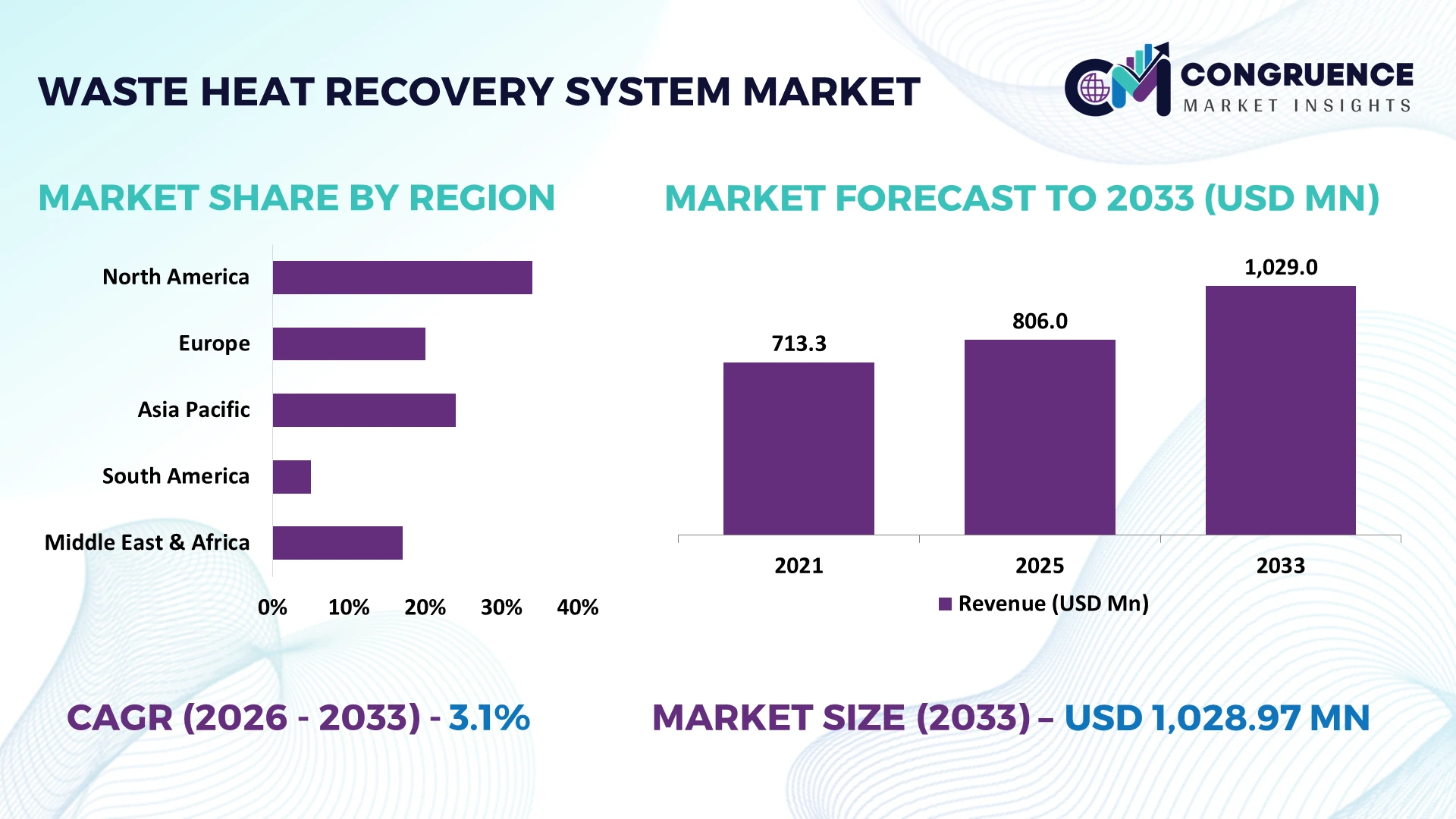
The Global Waste Heat Recovery System Market was valued at USD 806 Million in 2025 and is anticipated to reach a value of USD 1028.97 Million by 2033 expanding at a CAGR of 3.1% between 2026 and 2033. Growth is driven by industrial decarbonization investments, tighter energy-efficiency requirements, and wider deployment of heat exchangers, organic Rankine cycle systems, and waste heat boilers across cement, steel, refining, and chemical facilities.
China remains the dominant deployment base, supported by its large steel, cement, chemical, and refining industries, with industrial energy-efficiency programs targeting measurable reductions in energy intensity. Europe follows through carbon-cost pressure and industrial electrification, while Japan emphasizes compact high-efficiency recovery units; advanced installations increasingly target 10–20% reductions in purchased fuel or process-energy consumption. Geopolitical supply-chain diversification is also encouraging regional equipment manufacturing and localized component sourcing.
Strategically, suppliers with modular designs, high-temperature recovery capability, and digitally monitored systems are positioned to capture retrofit-led opportunities across energy-intensive industries.
Market Size & Growth: USD 806M in 2025 to USD 1,028.97M by 2033 at 3.1% CAGR, driven by industrial energy recovery.
Top Growth Drivers: Industrial decarbonization 28%, energy-efficiency mandates 24%, fuel-cost optimization 19%.
Short-Term Forecast: By 2028, digital controls reduce operating costs 8%, while recovery efficiency improves 6%.
Emerging Technologies: AI monitoring, automation, advanced heat-resistant materials improve system performance by 5–9%.
Regional Leaders: Asia-Pacific USD 472M, Europe USD 318M, North America USD 239M, led by retrofit adoption.
Consumer/End-User Trends: Around 42% of industrial buyers prioritize integrated heat-recovery packages in new efficiency projects.
Pilot/Case Example: 2025 industrial recovery projects achieved 12% fuel reduction through optimized exhaust-heat utilization.
Competitive Landscape: Top suppliers collectively command about 35% share, including Siemens Energy, Mitsubishi Heavy Industries, Kawasaki Heavy Industries, Bosch, and Thermax.
Regulatory & ESG Impact: Carbon-accounting programs drive 10–15% higher project prioritization for measurable energy savings.
Investment & Funding: More than USD 1.5B in industrial efficiency investments supports heat-recovery retrofits, partnerships, and regional expansion.
Innovation & Future Outlook: Next-generation systems integrate AI diagnostics, thermal storage, modular ORC units, and predictive maintenance for higher asset utilization.
The Waste Heat Recovery System Market is gaining traction across cement, steel, refining, chemicals, and power-intensive manufacturing, where recovering exhaust energy directly improves thermal utilization. In 2026, digitally monitored systems are delivering efficiency gains of about 5–9%, while modular ORC and advanced heat-exchanger designs support retrofit deployment. European carbon-cost pressure and Asia-Pacific industrial expansion are accelerating investment, creating a stronger transition toward integrated, data-driven recovery platforms.
Industrial competitiveness is increasingly defined by how efficiently manufacturers convert wasted thermal energy into productive output, making waste heat recovery systems a strategic investment rather than a compliance upgrade. Infrastructure modernization across steel, cement, chemicals, and refining is accelerating deployment as energy costs remain structurally elevated. Digital monitoring, predictive maintenance, and integrated thermal management are also reshaping procurement priorities, while supply-chain localization is reducing dependence on imported heat-exchange components and improving project execution timelines.
Modern organic Rankine cycle and advanced plate heat exchanger systems deliver 12–18% higher thermal recovery efficiency than conventional steam-only recovery units while lowering maintenance requirements by nearly 15%. China leads large-scale industrial deployment through manufacturing capacity and retrofit programs, whereas Germany emphasizes high-efficiency engineering and digitally connected recovery platforms. This contrast reflects scale-driven expansion in Asia and innovation-led optimization across European industrial facilities.
During the next two to three years, more than 30% of new installations are expected to include AI-enabled performance analytics for continuous efficiency optimization. Cement manufacturers are increasingly pairing waste heat recovery with on-site power generation to stabilize electricity consumption, while equipment suppliers are expanding partnerships with automation firms to deliver turnkey energy-management solutions. Companies securing integrated technology ecosystems will strengthen operational resilience and long-term competitive positioning.
Energy-intensive manufacturers are prioritizing waste heat recovery as a core productivity strategy, particularly across steel, cement, and petrochemical facilities where thermal losses often exceed 30% of process energy. High-temperature recovery systems now improve overall plant efficiency by 10–20%, while digitally optimized controls reduce fuel consumption by nearly 8%. China's industrial modernization programs and India's expansion of low-carbon manufacturing are accelerating retrofit activity across heavy industry. In response, engineering companies are expanding modular product portfolios, investing in high-temperature heat exchangers, and forming automation partnerships that shorten deployment cycles. The strongest competitive advantage increasingly belongs to suppliers capable of combining thermal recovery hardware with intelligent energy-management software for measurable operational savings.
Despite strong efficiency benefits, upfront installation costs remain a significant barrier for mid-sized industrial operators, particularly where retrofit projects require extensive plant redesign. Engineering integration can increase project costs by 20–35%, while specialized alloy components remain exposed to raw material price fluctuations of nearly 15%. Many aging facilities in Southeast Asia and Eastern Europe also face infrastructure limitations that complicate heat recovery integration without extended production shutdowns. To reduce exposure, manufacturers are localizing component sourcing, negotiating long-term procurement contracts, and introducing standardized modular systems that reduce engineering complexity. The market increasingly favors suppliers capable of lowering total lifecycle costs rather than competing solely on equipment pricing.
The next phase of market expansion is emerging through AI-enabled optimization, thermal energy storage, and hybrid waste heat-to-power platforms that transform recovered energy into dispatchable industrial electricity. Smart control systems improve heat utilization by 6–9%, while predictive diagnostics reduce unplanned maintenance by nearly 18%. Japan and South Korea are advancing compact recovery technologies for electronics and precision manufacturing, opening opportunities beyond traditional heavy industry. Equipment providers are increasing R&D investment in modular organic Rankine cycle units and collaborating with industrial software companies to create integrated energy platforms. The most valuable opportunity lies in converting operational efficiency into measurable carbon and electricity savings without major production disruption.
Long-term competitiveness depends less on hardware performance and more on successful integration across complex industrial environments with varying equipment generations. More than 40% of large manufacturing facilities operate mixed legacy and digital control architectures, increasing commissioning time and interoperability challenges. Cybersecurity requirements for connected industrial energy systems have also intensified, adding approximately 10% to digital implementation costs in critical infrastructure sectors. Germany and the United States are responding with standardized industrial communication frameworks, while global suppliers are expanding engineering and workforce training capabilities. Companies that solve interoperability, digital security, and skilled implementation simultaneously will achieve more consistent deployment performance and stronger customer retention.
Heat exchangers represent the leading type, accounting for approximately 42% of Waste Heat Recovery System Market deployment because they integrate directly with existing furnaces, boilers, kilns, and exhaust streams while requiring comparatively limited process redesign. Their mature engineering base, scalable configurations, and broad temperature compatibility keep adoption strong across China, India, Germany, and the United States. Steam generators follow at nearly 25%, remaining important where recovered thermal energy can support established steam networks. Companies are prioritizing corrosion-resistant alloys and compact exchanger designs to improve reliability in demanding environments.
Organic Rankine Cycle systems are the fastest-growing type, with adoption expanding at an estimated 9–11% annually as manufacturers seek electricity generation from lower-temperature waste streams. Heat pumps remain strategically important for sub-200°C applications, with deployment expanding as industrial electrification progresses. The shift is moving investment from standalone recovery hardware toward integrated heat-to-power and heat-upgrading platforms, improving asset utilization by approximately 6–9%.
Power Generation leads applications with an estimated 38% share, supported by mature waste-heat-to-electricity configurations in cement, steel, refining, and large industrial plants. Steam Recovery accounts for roughly 27%, particularly where facilities already operate centralized steam systems. Process Heating is the fastest-expanding application, with adoption rising approximately 8–10% as manufacturers increasingly redirect recovered heat into dryers, preheaters, furnaces, and thermal processing lines rather than converting all available heat into electricity.
The operational shift is particularly visible in China and India, where expanding industrial capacity favors direct thermal reuse because it avoids conversion losses. District Heating remains smaller but strategically valuable in Germany and Northern Europe, where existing networks provide ready heat sinks. Companies are integrating heat exchangers, heat pumps, controls, and thermal storage into single systems, improving useful heat utilization by approximately 10–15% and strengthening project economics.
Cement is the leading end-user, representing approximately 31% of installations because kiln exhaust provides continuous, high-temperature waste streams suitable for heat exchangers, steam generation, and onsite power production. Steel follows at around 24%, supported by furnaces and hot-gas streams but facing more complex process integration. Chemical facilities are emerging as the fastest-growing buyers, with adoption increasing roughly 9–11% as plants target simultaneous thermal efficiency and emissions reduction across multiple process stages.
Oil & Gas remains a significant user at nearly 20%, with refineries prioritizing heat integration to reduce fuel consumption across furnaces and distillation units. Power Generation retains demand for turbine exhaust and cooling-system recovery, while increasingly selective capital allocation favors projects with measurable payback. Suppliers are responding with sector-specific engineering, performance contracts, and long-term maintenance partnerships. The strongest competitive opportunity is shifting toward chemical and diversified industrial sites where one recovery platform can serve several thermal loads.
North America accounted for the largest market share at 27% in 2025 however, Asia-Pacific is expected to register the fastest growth, expanding at a CAGR of 4.2% between 2026 and 2033.
Industrial retrofits are shifting toward digitally managed thermal recovery
North America holds approximately 27% of global Waste Heat Recovery System Market activity, supported by mature refining, chemical, steel, cement, and power-generation infrastructure. The United States concentrates most deployments, particularly across Gulf Coast refining and chemical clusters, where continuous high-temperature exhaust streams improve project economics. More than 35% of new industrial recovery installations increasingly incorporate digital monitoring for thermal performance and predictive maintenance. Aging process infrastructure is encouraging brownfield upgrades rather than complete plant replacement, while domestic manufacturing initiatives are strengthening equipment localization. Suppliers are responding with modular heat exchangers, ORC packages, and integrated control systems that reduce installation disruption. Rising emphasis on industrial energy efficiency is also improving investment visibility for projects with measurable fuel and electricity savings.
United States Market Outlook:
The United States remains the regional technology and deployment center, supported by extensive refining and chemical capacity. Industrial facilities increasingly prioritize recovery systems capable of handling high-temperature exhaust streams, with digitally monitored installations improving operating efficiency by approximately 6–9%. Suppliers are strengthening local engineering, service, and component capabilities.
Carbon-cost pressure is accelerating industrial heat integration
Europe represents approximately 24% of market activity, with Germany, Italy, France, and the United Kingdom accounting for a substantial share of industrial installations. Energy-intensive manufacturers are integrating recovery systems with district heating, process heating, and electrification infrastructure to reduce exposure to volatile energy costs. Nearly 30% of newer projects increasingly combine thermal recovery with digital energy-management platforms. Germany's industrial modernization programs are supporting replacement of inefficient legacy equipment, while Northern European markets emphasize networked heat utilization. Equipment manufacturers are responding through compact exchangers, heat pumps, thermal storage integration, and long-term service agreements. The competitive advantage increasingly depends on integrating recovered heat into multiple demand points rather than maximizing recovery from a single process stream.
Germany Market Outlook:
Germany leads European adoption through its dense manufacturing base, advanced process engineering, and established industrial heat networks. Chemical, steel, glass, and machinery producers are prioritizing integrated thermal management. Approximately 8–12% efficiency improvements are increasingly targeted through digitally controlled recovery systems, strengthening demand for customized equipment and engineering partnerships.
Manufacturing scale is driving high-volume recovery deployment
Asia-Pacific represents approximately 34% of global market activity and holds the strongest deployment pipeline, supported by China's cement, steel, chemicals, refining, and power industries. China alone accounts for an estimated 22% of global installations, while India is expanding rapidly through industrial modernization and energy-efficiency investments. More than 40% of new large-scale projects in major manufacturing hubs increasingly incorporate modular heat recovery components. Localized production is reducing procurement lead times and improving equipment affordability, while domestic engineering capabilities are expanding technology customization. Japan and South Korea emphasize compact, high-efficiency systems for advanced manufacturing facilities. Suppliers are increasing regional manufacturing capacity, forming automation partnerships, and developing standardized retrofit packages to capture large brownfield opportunities.
China Market Outlook:
China remains the dominant national market because of its extensive high-temperature industrial base and large installed capacity across cement, steel, and chemicals. Waste heat recovery is increasingly embedded in plant modernization projects, with advanced systems targeting 8–12% improvements in usable energy efficiency. Local manufacturers are strengthening cost competitiveness and delivery speed.
Industrial efficiency investment is concentrating around export industries
South America accounts for approximately 7% of global market activity, with Brazil representing the primary deployment center across steel, cement, pulp and paper, chemicals, and food processing. Industrial operators are prioritizing recovery systems where continuous thermal loads support predictable payback, while infrastructure limitations constrain more complex networked applications. Approximately 20% of newer projects increasingly emphasize modular equipment that can operate without extensive plant reconstruction. Brazil's expanding industrial modernization is encouraging equipment suppliers to strengthen local service capabilities and establish regional partnerships. Chile and Argentina provide additional opportunities through mining and mineral-processing operations, where high-temperature exhaust streams create attractive recovery potential. Companies are favoring scalable systems that limit imported component exposure and reduce commissioning complexity.
Brazil Market Outlook:
Brazil dominates South American deployment through its large industrial manufacturing base and extensive energy-intensive processing activity. Cement, steel, pulp, and chemicals provide consistent thermal streams suitable for recovery applications. Industrial operators increasingly target 7–10% energy-efficiency improvements, encouraging suppliers to offer locally supported modular systems and maintenance contracts.
Industrial diversification is redirecting investment toward thermal efficiency
Middle East & Africa represents approximately 8% of global market activity, with Saudi Arabia, the United Arab Emirates, and South Africa leading deployment across refining, petrochemicals, cement, metals, and power generation. Large industrial complexes provide concentrated high-temperature exhaust streams, making integrated recovery economically attractive. Approximately 25% of new projects increasingly incorporate digital monitoring or automated thermal controls. Gulf industrial diversification programs are encouraging investment beyond conventional hydrocarbons, while South African mining and metals facilities are pursuing energy-saving retrofits. Suppliers are responding through local partnerships, service hubs, and customized equipment designed for harsh operating environments. Water scarcity and high ambient temperatures also increase the importance of reliable thermal-management systems capable of maintaining performance under demanding conditions.
Saudi Arabia Market Outlook:
Saudi Arabia is emerging as the region's principal investment hub through refinery, petrochemical, metals, and industrial diversification projects. Large integrated facilities support centralized waste heat recovery, while modernization programs increasingly prioritize energy optimization. New installations targeting 8–10% lower thermal-energy consumption are strengthening demand for high-temperature exchangers and digitally monitored systems.
Siemens Energy, Mitsubishi Heavy Industries, Kawasaki Heavy Industries, Thermax, and Bosch compete across global OEM, engineering, and integrated thermal-management segments, while regional suppliers challenge them through customization and cost efficiency. The top five players collectively hold approximately 32% market share, leaving substantial space for specialized technology providers. Competition centers on technology, price, delivery speed, and lifecycle service, with advanced systems improving thermal efficiency by 6–10% and modular designs reducing installation time by 15–20%. Leading companies are expanding manufacturing, partnering with automation providers, and integrating monitoring software into recovery equipment. Regional suppliers are strengthening localized production to counter logistics costs and shorten lead times. The competitive shift is moving from standalone equipment toward integrated energy platforms combining heat exchangers, ORC systems, controls, and maintenance services. High-temperature engineering expertise, project financing capability, and established industrial relationships remain major entry barriers. Winning requires measurable efficiency gains, rapid deployment, reliable supply, and strong lifecycle support.
Siemens Energy
Mitsubishi Heavy Industries
Kawasaki Heavy Industries
Thermax
Bosch
Alfa Laval
MAN Energy Solutions
Ormat Technologies
Boustead International Heaters
Echogen Power Systems
Forbes Marshall
Nooter/Eriksen
Dürr Group
Enertime
Current deployment centers on high-efficiency plate and shell-and-tube heat exchangers, waste-heat boilers, and automated controls. Advanced exchangers typically deliver 3–6% higher thermal-transfer performance than older designs, while digital monitoring cuts maintenance-related energy losses by 2–4%. Adoption is strongest in cement, steel, refining, and chemical plants, where continuous exhaust streams support rapid payback and improve fuel utilization across aging plants facing tighter industrial efficiency requirements.
Emerging systems combine Organic Rankine Cycle modules, industrial heat pumps, thermal storage, and AI-based optimization. ORC units can improve low-temperature heat-to-power conversion by 5–10% versus legacy steam-only recovery, while heat pumps raise usable heat output by 8–12% when upgrading lower-grade streams. Around 25–35% of newer large industrial installations are increasingly incorporating digital monitoring or integrated controls, giving operators tighter process visibility, faster fault detection, and stronger energy-cost management.
From 2026–2028, supercritical CO₂ cycles, advanced corrosion-resistant materials, modular thermal storage, and digital twins will push recovery into lower-temperature and variable-load applications. Integrated systems can reduce installation time by 15–20% through standardized modules. Technology leaders with automation, heat-exchanger, and ORC portfolios benefit most, while industrial buyers gain competitive advantage from higher energy productivity and reduced fuel exposure. Acting now secures retrofit capacity before engineering and component demand intensifies.
November 2024 — GEA supplied two waste heat recovery plants to Asahi India Glass, each rated at 1.8 MWel. The systems are expected to generate 15,500 MWh annually per plant, with approximately 13,000 tonnes of carbon savings, strengthening energy self-sufficiency.
Source: GEA
July 2025 — Goltens partnered with Orcan Energy to engineer and install modular marine ORC systems internationally. The agreement expands deployment of low-temperature waste-heat-to-power technology, helping ship operators reduce fuel consumption and meet tightening EEXI, CII, and FuelEU Maritime requirements.
Source: Goltens
June 2026 — Newheat commissioned its waste heat recovery installation at a tile plant in France, combining flue-gas recovery with 122 MWh thermal storage. The system cuts dryer gas consumption by nearly 80% and avoids 2,000 tonnes of CO₂ annually.
Source: Newheat
August 2024 — General Motors received recognition for a Fort Wayne Assembly heat-recovery project that eliminated steam-based heating. Recovered heat now supplies more than 80% of building heating needs while reducing site natural-gas consumption and associated carbon emissions by 30%.
Source: Better Buildings
The report evaluates the Waste Heat Recovery System Market across Heat Exchangers, Steam Generators, Organic Rankine Cycle, and Heat Pumps, with applications covering Power Generation, Process Heating, Steam Recovery, and District Heating. End-user coverage spans Cement, Steel, Chemical, Oil & Gas, and Power Generation, enabling comparison of deployment intensity, technology fit, and investment priorities. Regional assessment includes North America, Europe, Asia-Pacific, South America, and Middle East & Africa, with country-level analysis emphasizing industrial concentration and modernization activity.
The scope examines emerging opportunities in modular ORC systems, industrial heat pumps, thermal storage, digital controls, and integrated heat-to-power platforms. Approximately 40% of large industrial projects are increasingly incorporating monitoring or automation, strengthening visibility into thermal performance. The analysis supports investment planning, expansion strategy, supplier positioning, partnership development, and technology prioritization while identifying operational shifts to influence deployment decisions between 2026 and 2033.
| Report Attribute/Metric | Report Details |
|---|---|
Market Revenue in 2025 | USD 806 Million |
Market Revenue in 2033 | USD 1028.97 Million |
CAGR (2026 - 2033) | 3.1% |
Base Year | 2025 |
Forecast Period | 2026 - 2033 |
Historic Period | 2021 - 2025 |
Segments Covered | By Type
By Application
By End-User
|
Key Report Deliverable | Revenue Forecast, Growth Trends, Market Dynamics, Segmental Overview, Regional and Country-wise Analysis, Competition Landscape |
Region Covered | North America, Europe, Asia-Pacific, South America, Middle East, Africa |
Key Players Analyzed | Siemens Energy, Mitsubishi Heavy Industries, Kawasaki Heavy Industries, Thermax, Bosch, Alfa Laval, MAN Energy Solutions, Ormat Technologies, Boustead International Heaters, Echogen Power Systems, Forbes Marshall, Nooter/Eriksen, Dürr Group, Enertime |
Customization & Pricing | Available on Request (10% Customization is Free) |




