
Reports
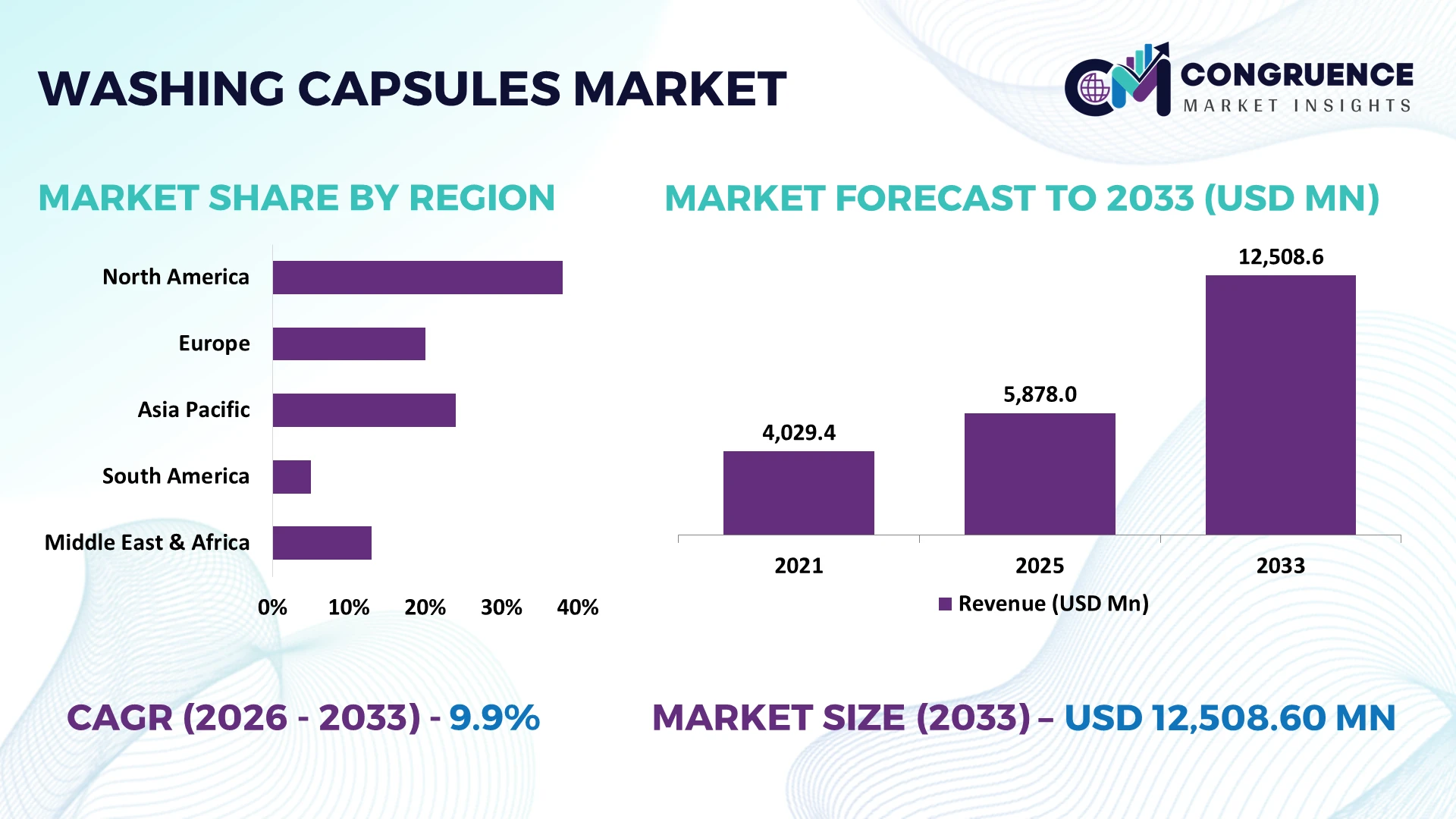
The Global Washing Capsules Market was valued at USD 5878 Million in 2025 and is anticipated to reach a value of USD 12508.6 Million by 2033 expanding at a CAGR of 9.9% between 2026 and 2033. Growth is driven by single-dose convenience, concentrated detergent chemistry, cold-water cleaning performance, automatic dosing accuracy, and household migration from bulky liquid and powder formats toward pre-measured capsules.
The United States represents approximately 30% of global washing capsule demand, supported by high automatic-washer penetration, premium laundry brands, and large-scale retail distribution. Leading manufacturers are advancing concentrated chemistry and recyclable packaging, while cold-water formulations can reduce wash-cycle energy use by up to 90% versus hot-water washing. The UK remains more capsule-intensive per household, reflecting stronger European single-dose adoption. Persistent geopolitical and Red Sea shipping disruptions have reinforced the value of compact, lightweight detergent formats that improve freight density and reduce packaging-material exposure across global home-care supply chains.
Manufacturers combining high-performance enzymes, lower-plastic packaging, cold-wash efficacy, and reliable regional production are best positioned to defend premium pricing while reducing logistics and material intensity.
Market Size & Growth: USD 5,878 million in 2025 advances toward USD 12,508.6 million by 2033 at 9.9% CAGR as consumers migrate toward concentrated, accurately dosed laundry formats.
Top Growth Drivers: Convenience-led format switching contributes approximately 35%, premium cleaning performance 30%, and cold-water plus sustainability positioning nearly 20% of incremental washing capsule demand.
Short-Term Forecast: By 2028, formulation concentration and packaging redesign are positioned to reduce material and logistics intensity by approximately 10–20% per wash across advanced capsule portfolios.
Emerging Technologies: Multi-chamber capsules, enzyme stabilization, fast-dissolving PVA films, and cold-active surfactants are improving stain removal while supporting washing temperatures 20–30°C below traditional hot-cycle practices.
Regional Leaders: Europe approaches USD 4.3 billion, North America USD 3.7 billion, and Asia-Pacific USD 3.2 billion by 2033 as premiumization, convenience adoption, and urban washer penetration strengthen.
Consumer/End-User Trends: Single-dose detergents increasingly capture premium households, while 30–40% of frequent users prioritize pre-measured dosing because capsules eliminate manual detergent measurement and reduce overdosing.
Pilot/Case Example: P&G's 2024 Tide evo rollout introduced 100% concentrated fiber-based detergent designed for cold washing, enabling up to 90% lower washing energy than hot-water cycles.
Competitive Landscape: P&G leads with an estimated 30% global position, competing with Henkel, Unilever, Reckitt, and Church & Dwight through capsule architecture, cleaning efficacy, fragrance, and retail execution.
Regulatory & ESG Impact: Henkel's newer Persil capsule packaging uses approximately 40% less plastic than its previous all-plastic format, sharpening lifecycle efficiency as packaging regulation tightens.
Investment & Funding: More than USD 100 million in estimated formulation, packaging, production, and capacity initiatives is moving toward concentrated detergents, recyclable formats, automated filling, and localized supply networks.
Innovation & Future Outlook: P&G's next-generation concentrated laundry platform is protected by more than 50 granted patents, signalling competition shifting from conventional pods toward waterless, fiber-based, highly concentrated formats.
Washing capsules are gaining strategic relevance across automatic-washer households, premium laundry care, e-commerce, and convenience-driven urban consumers. Multi-chamber dosing, cold-active enzymes, faster-dissolving films, and reduced-plastic packaging are improving performance while lowering material intensity; newer packaging configurations cut plastic use by around 40%. Supply-chain pressure on bulky detergent formats further favors concentrated single-dose products, setting up the market's strategic transformation.
Washing capsules are becoming strategically important because concentrated dosing, premium cleaning chemistry, and compact logistics are reshaping competition across household laundry care. Manufacturers are shifting investment from conventional liquid-heavy portfolios toward single-dose systems that combine enzymes, surfactants, fragrance, and fabric-care functions. Packaging regulation and retailer pressure are simultaneously accelerating recyclable packs, lower-plastic formats, and more efficient distribution configurations.
Multi-chamber capsules provide pre-measured detergent with virtually no consumer overdosing, compared with liquid detergent usage that can exceed recommended doses by roughly 15–25%. Europe maintains deeper capsule penetration and stronger premium-format acceptance, while China and India offer greater conversion potential as automatic washing-machine ownership expands. By 2028, advanced multi-chamber and cold-active formulations should account for more than 45% of premium capsule deployments, while packaging plastic intensity continues declining.
Operationally, manufacturers can ship more wash doses per pallet by increasing formulation concentration and reducing packaging weight, lowering warehouse and transportation requirements. Companies are therefore expanding enzyme R&D, high-speed pod filling, film engineering, and localized production partnerships. Long-term advantage will belong to brands combining superior low-temperature cleaning, precise dosing, safer packaging, and scalable manufacturing economics.
Consumer migration from manually measured powders and liquids toward pre-dosed formats is the strongest structural demand driver. Washing capsules eliminate measuring steps and can reduce detergent overdosing by approximately 15–25%, while concentrated chemistry lowers detergent mass required per wash. In the United Kingdom and other capsule-intensive markets, single-dose formats already hold materially higher household penetration than in emerging economies, demonstrating the conversion potential as washing-machine ownership rises. Retailers are also allocating greater shelf space to compact products because more wash loads fit within equivalent storage areas. Manufacturers are responding with multi-chamber designs, enhanced enzyme systems, fragrance differentiation, and larger value packs. The strategic advantage extends beyond convenience: accurate dosing improves repeatable cleaning performance while allowing suppliers to premiumize each wash rather than compete primarily on detergent volume.
Water-soluble PVA film, concentrated surfactants, enzymes, and multi-compartment manufacturing make capsules structurally more expensive per wash than entry-level powders. Capsule formats can carry approximately 20–40% price premiums over basic detergent alternatives, limiting penetration among price-sensitive households in India, Indonesia, and parts of Latin America. Child-safety requirements add another layer of packaging complexity because opaque containers, secure closures, bittering agents, and stronger film specifications increase material and conversion costs. Polymer and specialty-chemical price fluctuations further pressure contract manufacturing economics. Producers are reducing exposure through film-supplier diversification, localized filling operations, larger pack sizes, and formula simplification without sacrificing cleaning performance. A critical operational insight is that lowering packaging and film cost per dose matters more for mass-market expansion than reducing active-ingredient concentration alone.
Next-generation capsules designed for effective cleaning at 20–30°C create a valuable intersection between performance, energy savings, and appliance modernization. Household water heating represents a major portion of laundry-cycle energy consumption, and switching from hot to cold cycles can reduce washing energy use by up to 80–90% depending on the appliance and temperature differential. This strengthens demand for cold-active enzymes, rapid-dissolution films, and concentrated stain-removal systems. China and India provide additional whitespace as automatic washer penetration rises while capsule usage remains below mature European levels. Companies are directing R&D toward enzyme stabilization, multi-chamber separation, biodegradable-film development, and compact packaging. The non-obvious opportunity is appliance-linked formulation: detergent brands partnering with washing-machine manufacturers can optimize capsule chemistry around eco-cycle temperatures and create stronger consumer switching incentives.
Capsules must dissolve reliably across short cycles, cold water, hard water, varying drum loads, and different washer architectures, creating a complex execution challenge absent from conventional powders. At wash temperatures near 20°C, slower film dissolution can leave residue when machines are overloaded or capsules become trapped between garments. Even a 2–5% failure rate would materially damage consumer trust because single-dose products command premium pricing and promise consistent convenience. Manufacturers must also maintain compartment stability during storage despite moisture exposure while ensuring rapid dissolution once washing begins. Companies are investing in thinner but stronger films, humidity-controlled manufacturing, enzyme-compatible barriers, and machine-specific testing. Long-term competitiveness therefore depends on achieving near-universal dissolution performance without weakening child resistance, shelf stability, or concentrated ingredient separation—a technical balance that directly determines repeat purchase and brand credibility.
Multi-Chamber Designs Gain Shelf Space: Three- and four-compartment capsules are replacing simpler single-chamber formats as brands separate enzymes, surfactants, softeners, and fragrance for better stability. Indian products now combine 3 chambers in 21-gram doses, while newer 2026 platforms use 4 chambers. Companies are scaling compartment-forming equipment and reformulating concentrated actives to increase cleaning functionality per dose without enlarging pack footprints.
Low-Temperature Washing Shapes Formulation: Around 60% of European laundry cycles now run at 40°C or below, forcing capsule manufacturers to improve dissolution and enzymatic activity at lower temperatures. Brands are increasing cold-active enzyme deployment and thinner water-soluble films, reducing rewashing risk and supporting lower-energy washing. The technology transition favors suppliers with stronger formulation control rather than commodity detergent blenders.
Localized Manufacturing Reduces Import Exposure: Indian capsule producers are shifting from imported finished pods toward domestic formulation and filling. Local manufacturers now serve more than 25 countries, while emerging Indian brands report over 500,000 completed washes. Companies are adding contract manufacturing, export documentation, and localized surfactant supply, improving replenishment speed while reducing exposure to ocean-freight disruptions and foreign-label dependence.
Sustainable Attributes Influence Premium Choice: European consumer research shows stronger preference for reduced plastic packaging and renewable surfactants than for washing temperature or cleaning-efficiency claims. New plant-based capsules use 100% recyclable packaging, while some formulations are marketed as fully biodegradable. Manufacturers are restructuring product development around renewable chemistry, concentrated dosing, and lower-packaging formats to defend premium positioning as sustainability scrutiny intensifies.
Laundry Detergent Capsules account for approximately 55–60% of type-level demand because they combine standardized dosing, broad washing-machine compatibility, mass-retail distribution, and scalable high-speed production. Their mature supply chains and established consumer familiarity keep unit economics ahead of specialized alternatives. Multi-Compartment Capsules are the fastest-growing type, supported by three- and four-chamber architectures that physically separate enzymes, surfactants, fragrance, and fabric-care ingredients. Advanced configurations now deliver three or more functions from a single 20–25 gram dose, allowing brands to premiumize performance without increasing consumer dosing complexity.
Bio-Based Capsules are gaining relevance as renewable surfactants and biodegradable formulations become stronger purchase criteria, while Non-Bio Capsules maintain demand among fragrance-sensitive and enzyme-averse users. Fabric Softener Capsules remain more specialized but support bundling and cross-category expansion. Manufacturers are shifting R&D toward compartment stability, plant-based chemistry, high-speed sealing, and lower-film weight. This redirects investment from basic single-dose capacity toward differentiated multifunctional platforms with stronger margins and retailer positioning.
Household Laundry represents approximately 75–80% of application demand because washing capsules were engineered around residential automatic machines, standardized loads, and consumer convenience. High repeat purchase frequency and established grocery and e-commerce distribution reinforce this concentration. Commercial Laundry is the fastest-growing application as laundries seek controlled dosing, reduced chemical handling, and simplified employee workflows; unit-dose systems can cut detergent overdosing by roughly 15–25% versus manually poured liquids. Suppliers are adapting pack sizes and formulations for higher-cycle environments while maintaining machine compatibility.
Institutional Laundry uses capsules selectively where standardized load sizes and handling safety outweigh bulk-chemical economics. Delicate Garment Care is gaining specialized formulations with gentler enzymes and controlled surfactant systems, while Heavy-Duty Cleaning favors higher-active multi-compartment capsules capable of handling oils, soils, and repeated washing. Companies are expanding commercial-dose formats, contract-manufacturing capacity, and application-specific enzyme blends. The business implication is a gradual extension of capsule economics beyond households into smaller professional operations where dosing labor and process consistency carry measurable value.
Households account for approximately 80% of end-user demand because single-dose detergent adoption remains concentrated in residential washing machines, supermarkets, and e-commerce channels. Pre-measured dosing, reduced storage requirements, and multi-function formulations support repeat purchasing, particularly in the United States, United Kingdom, and Western Europe. Commercial Laundry Services are the fastest-growing end-user segment as smaller operators adopt capsules to standardize chemical input and reduce manual overpouring, potentially lowering detergent waste by 15–25%.
Laundromats are increasingly relevant for vending-based single-dose sales, while Hotels selectively deploy pre-measured formats in decentralized or smaller laundry operations where staff training and storage simplicity matter. Hospitals remain more dependent on validated institutional detergents and controlled disinfection processes, limiting general capsule penetration. Manufacturers are therefore differentiating residential, professional, and hygiene-sensitive formulations rather than using one universal product. Competitive positioning is shifting toward bulk capsule packs, dispensing partnerships, private-label manufacturing, and institutional formulations calibrated for load size, temperature, and wash-cycle requirements.
Europe accounted for the largest market share at 34% in 2025 however, Asia-Pacific is expected to register the fastest growth, expanding at a CAGR of 12.4% between 2026 and 2033.

Premium Pods Shift Toward Concentrated Formats
North America accounted for approximately 29% of global washing capsule demand in 2025, anchored by high automatic-washing-machine ownership, mature modern retail, and established single-dose purchasing behavior. The United States drives regional deployment, where Tide PODS and Arm & Hammer compete across mass retail, club stores, and e-commerce. Product development is shifting from conventional liquid-filled pods toward highly concentrated formats, multi-benefit chambers, and cold-water performance. Washing in cold water can reduce laundry-cycle energy consumption by up to 90% compared with hot-water operation, strengthening capsule formulations optimized for lower temperatures. Retailers also favor compact packs because higher wash-dose density improves shelf and warehouse productivity. Manufacturers are responding through formulation upgrades, automated packing, digital merchandising, and packaging reduction rather than relying on larger detergent volumes.
United States Market Outlook: The United States accounts for roughly 85% of North American capsule consumption, supported by more than 80% household washing-machine access and sophisticated grocery distribution. P&G's transition toward Tide evo demonstrates the country's innovation advantage in concentrated, lightweight laundry formats. Competitive investment increasingly targets cold-cycle cleaning, reduced packaging, subscription-compatible pack sizes, and premium stain-removal functionality.
Sustainability Rules Reshape Product Architecture
Europe held approximately 34% of global washing capsule demand in 2025, making it the largest regional market due to mature pod adoption in the United Kingdom, France, Germany, and Italy. About 60% of European laundry cycles operate at 40°C or below, pushing manufacturers toward cold-active enzymes and faster-dissolving films. EU packaging regulation is simultaneously forcing brands to reduce unnecessary material and improve recyclability, increasing the strategic value of compact refill-oriented formats. Multi-chamber capsules are gaining shelf presence because ingredient separation supports concentrated stain removal, fabric care, and fragrance within one dose. Manufacturers including P&G, Henkel, and Unilever are redesigning packaging, increasing renewable ingredients, and optimizing low-temperature chemistry. European competition increasingly depends on measurable environmental performance alongside wash efficacy, creating stronger barriers for undifferentiated private-label formulations.
United Kingdom Market Outlook: The United Kingdom is one of Europe's most capsule-intensive laundry markets, supported by high automatic-washer penetration and strong supermarket private-label competition. Consumers routinely use 30–40°C programs, making rapid film dissolution operationally important. Retailers increasingly allocate premium shelf space to concentrated multi-benefit capsules, pushing branded suppliers toward larger value packs, recyclable packaging, and stronger fragrance differentiation.
Localization Unlocks High-Volume Consumer Conversion
Asia-Pacific represented approximately 25% of global washing capsule demand in 2025, with China, Japan, Australia, South Korea, and India creating sharply different adoption profiles. China combines enormous automatic-washer scale with sophisticated e-commerce distribution, while Japan favors compact, performance-oriented household products. India remains earlier in capsule conversion but provides significant upside as premium laundry formats move beyond metropolitan consumers. Domestic producers are increasingly manufacturing three-chamber capsules locally and supplying more than 25 export markets, reducing dependence on imported finished pods. E-commerce lowers the distribution barrier for emerging brands because compact capsules are easier to ship and store than bulky liquid detergents. Suppliers are expanding contract manufacturing, localized fragrances, smaller trial packs, and temperature-adapted formulations. The competitive advantage increasingly belongs to companies matching capsule pricing with local washing habits rather than importing Western product architectures unchanged.
China Market Outlook: China provides the region's strongest scale opportunity through hundreds of millions of washing-machine-equipped households and extensive domestic surfactant, packaging, and consumer-goods manufacturing. Online marketplaces accelerate trial of concentrated capsules without requiring immediate nationwide physical distribution. Local brands compete through aggressive pack pricing and fragrance innovation, while multinational suppliers emphasize multi-chamber performance, brand trust, and premium fabric-care functionality.
Modern Retail Expands Premium Format Access
South America accounted for approximately 7% of global washing capsule demand in 2025, with Brazil providing the largest consumer and retail base. Capsule penetration remains below liquid and powder detergents because price-per-wash sensitivity is substantially higher, but supermarkets, hypermarkets, and e-commerce are widening access to premium single-dose formats. Brazil's washing-machine penetration exceeds 60% of households, establishing the appliance base required for capsule conversion, particularly among higher-income urban consumers. Imported water-soluble films and specialty ingredients expose manufacturers to currency and freight volatility, encouraging local formulation and contract-packing strategies. Companies are responding with smaller pack counts, promotional pricing, concentrated formulations, and retailer partnerships designed to lower initial purchase barriers. The operational opportunity lies in improving affordability per wash without removing the multi-benefit functionality that differentiates capsules from established powders.
Brazil Market Outlook: Brazil dominates South American washing capsule potential through its large urban population, established detergent manufacturing base, and nationwide supermarket networks. São Paulo and other major metropolitan markets provide the strongest premium-product penetration. Suppliers are increasingly using locally sourced surfactants and regional filling capabilities while retaining imported specialty films, balancing manufacturing economics with the performance requirements of single-dose products.
Urban Retail Modernization Broadens Capsule Access
Middle East & Africa accounted for approximately 5% of global washing capsule demand in 2025, with adoption concentrated in the UAE, Saudi Arabia, South Africa, and higher-income urban centers. Gulf markets combine high washing-machine ownership, modern hypermarkets, expatriate consumers, and strong multinational brand availability, supporting premium multi-benefit capsules. Saudi Arabia's retail modernization and expanding e-commerce infrastructure are widening distribution beyond traditional metropolitan outlets. African adoption remains constrained by lower automatic-washer penetration and strong powder-detergent economics, requiring different pack sizes and price architectures. Manufacturers are using import distributors, regional warehouses, marketplace channels, and smaller trial packs rather than committing uniformly to local capsule production. Compact products also improve freight efficiency compared with water-heavy liquid detergents, an important advantage where long-distance distribution and port-dependent supply chains materially affect landed costs.
Saudi Arabia Market Outlook: Saudi Arabia provides the strongest scale combination of household purchasing power, automatic appliance adoption, and organized retail within the region. More than 80% of households have access to washing machines, supporting capsule compatibility. Premium brands benefit from hypermarket and digital channels, while localization initiatives create incentives for future detergent packaging and filling investments closer to Gulf consumers.
Procter & Gamble competes with Henkel and Unilever in premium branded capsules, while Church & Dwight, McBride, and private-label manufacturers pressure pricing and retailer control. The top five suppliers collectively hold approximately 55–60% of global capsule sales, giving leading brands scale advantages in formulation, advertising, and shelf access. Competition centers on cleaning efficacy, multi-chamber technology, supply reliability, and price per wash; advanced capsules command roughly 15–30% premiums, while concentrated designs can reduce packaging material by 20–40%. Leaders are expanding automated pod-filling capacity, reformulating for cold-water cycles, partnering with retailers, and integrating film and packaging development more closely with manufacturing. The competitive shift favors differentiated multi-benefit capsules and private-label alternatives over basic single-dose products. Entry barriers include water-soluble film expertise, high-speed sealing accuracy, child-safety packaging, retailer access, and formulation stability. Winning requires superior low-temperature performance, scalable production, disciplined cost control, distinctive functionality, and dependable distribution across both physical and digital channels.
Procter & Gamble
Henkel AG & Co. KGaA
Unilever
Church & Dwight Co., Inc.
Reckitt
McBride plc
Nice Group
Liby Group
Lion Corporation
Kao Corporation
Blue Moon Group
Guangzhou Lonkey Industrial Co., Ltd.
Dropps
Ecozone Ltd.
Current capsule technology centers on water-soluble PVA films, multi-chamber dosing, concentrated surfactants, and cold-active enzymes. Four-chamber architectures separate incompatible actives until washing, improving formulation stability and stain performance. Pre-measured dosing can reduce detergent overuse by 15–25%, while optimized cold-water chemistry supports energy reductions approaching 90% versus hot cycles. Adoption is strongest across premium European and North American laundry portfolios.
Emerging systems combine faster-dissolving films, enzyme stabilization, fragrance microcapsules, and appliance-specific wash programming. Compared with legacy single-chamber pods, newer three- and four-chamber formats provide 25–33% more separately controlled formulation zones, enabling simultaneous stain, whiteness, freshness, and fabric-care functions. Smart washer integration further optimizes dissolution and cycle temperature. Brands controlling formulation science and film engineering gain premium shelf positioning and fewer performance-related complaints.
Disruptive development through 2026–2028 will focus on ultra-concentrated fiber structures, bio-based surfactants, lower-material films, and digitally optimized manufacturing. Fiber-based detergent formats already eliminate conventional liquid fillers, while recyclable paper packs reduce dependence on rigid plastic. Automated filling, vision inspection, and predictive process controls should lower line waste by 5–10% as deployment scales. Manufacturers investing now can reduce logistics intensity, meet tightening packaging requirements, and defend differentiation as concentrated formats shift competition from detergent volume toward cleaning performance per gram.
April 2024 Samsung and Procter & Gamble launched a multi-year partnership creating a Tide POD Cold wash cycle for Bespoke AI Laundry Combo, supporting P&G’s target to shift three of four laundry loads to cold by 2030 globally. Source: news.samsung.com
April 2024 Procter & Gamble recalled approximately 8.2 million bags of Tide Pods, Gain Flings, Ace Pods and Ariel Pods after zipper-track packaging defects created child-access risks, intensifying safety-packaging controls across the single-dose detergent category and retail operations nationwide. Source: reuters.com
August 2025 Henkel launched Persil Gigant Discs in Germany, with one disc delivering the washing power of two Persil 4in1 Discs and triple-action deep cleaning, addressing larger machine loads while simplifying dosing for increasingly full household wash cycles. Source: henkel.de
June 2026 Unilever introduced a redesigned Dirt Is Good capsule architecture, moving from three chambers to four and adding patented Nano-Power and Nano-Sense technologies, strengthening stain removal, fragrance delivery, and premium positioning across Persil, OMO, and Skip portfolios. Source: linkedin.com
The Washing Capsules Market Report covers Laundry Detergent Capsules, Bio-Based Capsules, Non-Bio Capsules, Fabric Softener Capsules, and Multi-Compartment Capsules across Household Laundry, Commercial Laundry, Institutional Laundry, Delicate Garment Care, and Heavy-Duty Cleaning. End-user assessment spans Households, Laundromats, Hotels, Hospitals, and Commercial Laundry Services, with households representing approximately 80% of current capsule consumption and standard detergent capsules retaining the largest type-level deployment.
Regional analysis covers North America, Europe, Asia-Pacific, South America, and Middle East & Africa, supported by country-level evaluation of retail penetration, washing-machine infrastructure, manufacturing localization, and regulatory pressure. Technology coverage includes multi-chamber architecture, water-soluble films, cold-active enzymes, bio-based chemistry, automated filling, and concentrated fiber formats. The 2026–2033 framework supports investment planning, capacity allocation, geographic expansion, product portfolio decisions, partnership strategy, and competitive positioning while tracking emerging opportunities in low-temperature washing, sustainable packaging, private-label production, and professional single-dose applications.
| Report Attribute/Metric | Report Details |
|---|---|
Market Revenue in 2025 | USD 5878 Million |
Market Revenue in 2033 | USD 12508.6 Million |
CAGR (2026 - 2033) | 9.9% |
Base Year | 2025 |
Forecast Period | 2026 - 2033 |
Historic Period | 2021 - 2025 |
Segments Covered | By Type
By Application
By End-User
|
Key Report Deliverable | Revenue Forecast, Growth Trends, Market Dynamics, Segmental Overview, Regional and Country-wise Analysis, Competition Landscape |
Region Covered | North America, Europe, Asia-Pacific, South America, Middle East, Africa |
Key Players Analyzed | Procter & Gamble, Henkel AG & Co. KGaA, Unilever, Church & Dwight Co., Inc., Reckitt, McBride plc, Nice Group, Liby Group, Lion Corporation, Kao Corporation, Blue Moon Group, Guangzhou Lonkey Industrial Co., Ltd., Dropps, Ecozone Ltd. |
Customization & Pricing | Available on Request (10% Customization is Free) |




