Global Warm Edge Spacer Market Report Overview
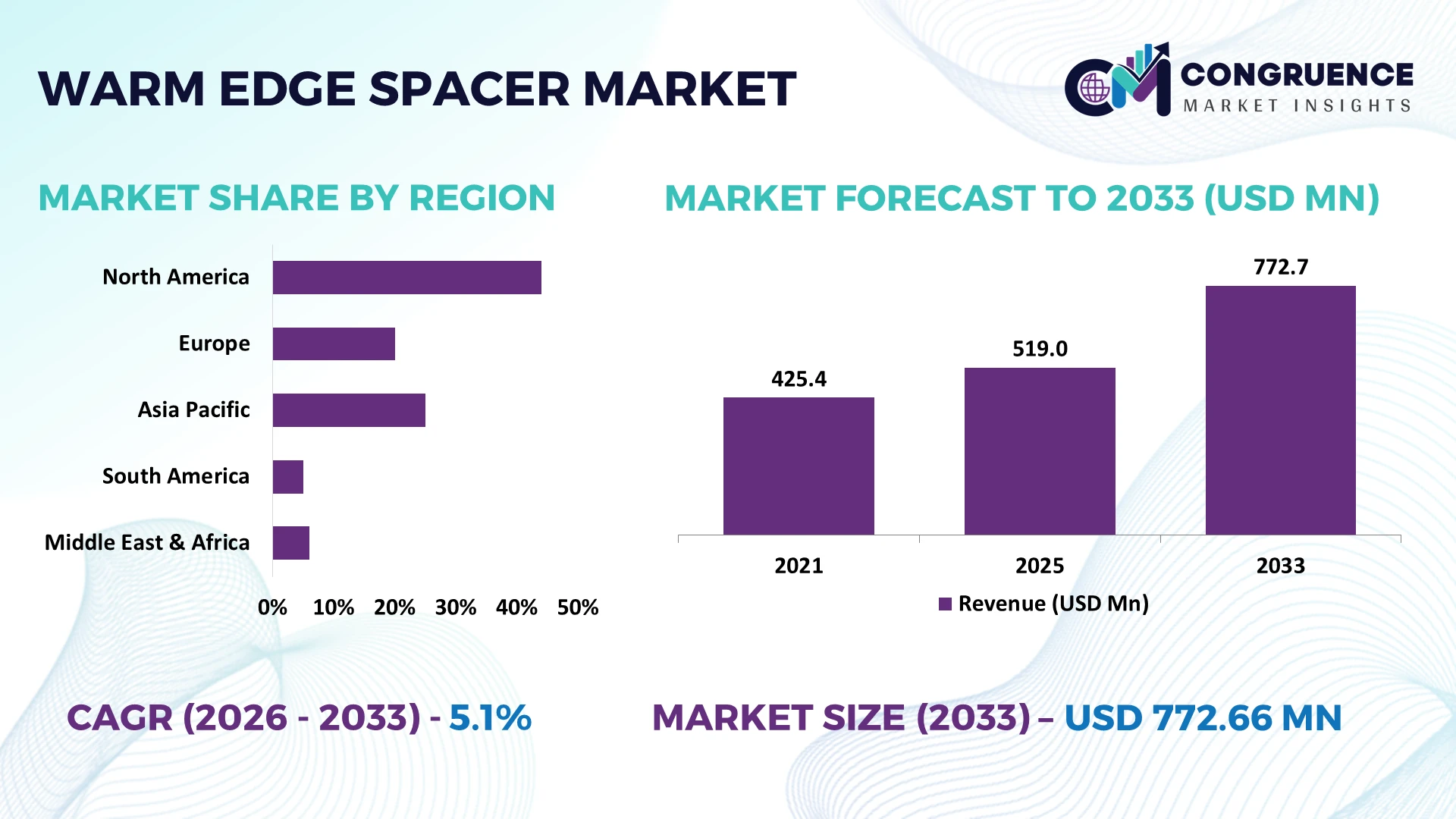
The Global Warm Edge Spacer Market was valued at USD 519 Million in 2025 and is anticipated to reach a value of USD 772.66 Million by 2033 expanding at a CAGR of 5.1% between 2026 and 2033. Growth is driven by stricter building energy-efficiency requirements, increased adoption of triple-glazed insulating glass units, and replacement of conductive aluminum spacers with polymer-based thermal barrier systems.
China represents a major manufacturing center for warm edge spacer demand, supported by its extensive architectural glass, curtain wall, and insulating glass production industries. The country accounts for more than 50% of global flat glass production, providing substantial downstream processing capacity compared with Germany. China's building energy-efficiency policies encourage adoption of advanced insulating glazing, while the European Union's revised Energy Performance of Buildings Directive reinforces demand for thermally optimized window components. Manufacturers are expanding automated spacer application, composite material processing, and insulating glass assembly capabilities.
Suppliers investing in low-conductivity spacer materials, automated insulating glass production, and energy-efficient glazing partnerships are positioned to secure higher-value architectural glass contracts.
Key Highlights of the Global Warm Edge Spacer Market
-
Market Size & Growth: USD 519 million in 2025, reaching USD 772.66 million by 2033 at 5.1% CAGR, driven by energy-efficient glazing adoption.
-
Top Growth Drivers: Approximately 55% lower edge thermal transmission, 16% inefficient building renovation threshold, and 26% additional European building performance threshold.
-
Short-Term Forecast: By 2028, advanced polymer spacers will support up to 62% lower glazing-edge thermal transmission compared with conventional aluminum alternatives in selected configurations.
-
Emerging Technologies: Three innovations include thermoplastic spacer systems, multilayer vapor barriers, and automated spacer-frame assembly for precision insulating glass production.
-
Regional Leaders: Asia-Pacific leads manufacturing scale, Europe advances triple glazing, and North America prioritizes high-performance insulating glass for energy-efficient construction.
-
Consumer/End-User Trends: Triple glazing with 0.7 W/m²K center-glass performance strengthens demand for low-conductivity spacer systems in premium window installations.
-
Pilot/Case Example: Swisspacer's automated Frame:racer technology demonstrates spacer-frame assembly and filling in under 20 seconds, improving manufacturing throughput potential.
-
Competitive Landscape: Quanex, Swisspacer, Technoform, Edgetech, and Fenzi compete through thermal performance, moisture resistance, and compatibility with automated glazing lines.
-
Regulatory & ESG Impact: The EU's revised building directive targets the worst-performing 16% of nonresidential buildings by 2030, strengthening renovation specifications.
-
Investment & Funding: Quanex completed its approximately USD 1.1 billion Tyman acquisition in 2024, expanding building component integration and manufacturing reach.
-
Innovation & Future Outlook: Spacer profiles supporting glazing cavities up to 36 mm enable advanced insulating units and more flexible architectural specifications.
The Warm Edge Spacer Market is evolving through demand for thermally efficient insulating glass units across residential windows, commercial façades, and building renovation projects. Polymer composite spacers, stainless-steel hybrid designs, and integrated desiccant systems improve glazing-edge insulation while controlling moisture penetration. Advanced spacer configurations achieve approximately 62% lower linear thermal transmittance than conventional aluminum alternatives in comparable window assemblies. European building energy-performance regulations are encouraging glass processors to prioritize thermally optimized components. Automated spacer-frame fabrication and recyclable material formulations are becoming important competitive differentiators, establishing the foundation for strategic investment in advanced glazing technologies.
What Is the Strategic Relevance and Future Pathways of the Warm Edge Spacer Market?
The Warm Edge Spacer Market is becoming strategically important as window manufacturers face stricter thermal performance requirements and increasing demand for energy-efficient building envelopes. The European Union's revised Energy Performance of Buildings Directive requires improvements in the worst-performing 16% of nonresidential buildings by 2030, accelerating renovation planning. Spacer manufacturers are consequently shifting toward integrated insulating glass solutions that combine thermal efficiency, moisture resistance, and automated production compatibility. These developments strengthen the strategic importance of component-level performance in building energy certification.
Advanced polymer composite spacers can reduce glazing-edge thermal transmission by approximately 55–62% compared with conventional aluminum alternatives, depending on window configuration. Germany emphasizes high-performance triple glazing and automated insulating glass production, while China benefits from extensive architectural glass processing capacity and localized component manufacturing. Swisspacer's Frame:racer technology demonstrates spacer-frame assembly and filling in under 20 seconds, illustrating how production automation improves manufacturing responsiveness and supports consistent component quality.
Between 2026 and 2028, manufacturers will prioritize thermoplastic spacer systems, integrated vapor barriers, and digitally controlled spacer application equipment. Quanex, Technoform, and Swisspacer are strengthening product engineering and relationships with insulating glass manufacturers to address evolving thermal specifications. Suppliers combining validated insulation performance, production-line compatibility, and reliable material sourcing will establish stronger competitive positions across construction and renovation markets.
Warm Edge Spacer Market Dynamics
DRIVER:
Building Energy Regulations and High-Performance Glazing Adoption
Stricter building energy-efficiency requirements are accelerating the replacement of conventional aluminum spacers with thermally optimized alternatives. The European Union's revised building performance framework targets renovation of the worst-performing 16% of nonresidential buildings by 2030 and 26% by 2033, increasing demand for improved window insulation. Advanced warm edge spacers can reduce glazing-edge thermal transmission by approximately 55% compared with traditional aluminum systems under comparable configurations. Germany's building modernization programs reinforce adoption of low-conductivity glazing components across residential and commercial projects. Manufacturers including Swisspacer, Technoform, and Quanex are expanding thermally optimized spacer portfolios and automated processing compatibility. Suppliers delivering certified thermal performance gain stronger access to specification-driven construction contracts.
RESTRAINT:
Polymer Material Costs and Manufacturing Conversion Requirements
Warm edge spacer manufacturing faces structural constraints from specialized polymer compounds, stainless-steel components, and insulating glass production-line conversion requirements. Advanced spacer configurations can achieve approximately 55–62% lower edge thermal transmission than conventional aluminum designs, but performance advantages require compatible sealing systems and controlled assembly processes. The European Union's 16% building renovation threshold increases specification pressure while exposing smaller glass processors to equipment investment requirements. In Germany, established aluminum spacer processing infrastructure creates conversion costs involving bending machinery, adhesive application, and material handling. Manufacturers are reducing procurement risks through diversified polymer sourcing, hybrid stainless-steel designs, and long-term material supply agreements. Standardized spacer profiles and compatible processing equipment help limit capital expenditure and production interruptions.
OPPORTUNITY:
Triple Glazing Expansion and Automated Spacer Processing
Increasing adoption of triple glazing creates opportunities for advanced spacer profiles, integrated desiccant technologies, and automated insulating glass manufacturing. High-performance glazing assemblies achieve center-glass thermal transmittance approaching 0.7 W/m²K, while selected warm edge configurations reduce edge thermal transmission by approximately 62% compared with conventional aluminum spacers. The European Union's requirement to improve the worst-performing 26% of nonresidential buildings by 2033 strengthens the renovation pipeline. Swisspacer's automated Frame:racer system demonstrates spacer-frame assembly and filling in under 20 seconds, supporting high-throughput production. Manufacturers are developing thermoplastic systems, automated sealing technologies, and recyclable composite materials. Integrated spacer and sealant solutions offer suppliers opportunities to improve processing consistency and expand customer relationships.
CHALLENGE:
Long-Term Seal Durability and Glazing System Validation
Maintaining consistent thermal performance across insulating glass lifecycles presents significant engineering challenges involving moisture penetration, gas retention, thermal expansion, and sealant compatibility. Advanced warm edge spacers can lower edge thermal transmission by approximately 55–62%, but performance depends on complete glazing system integrity rather than spacer conductivity alone. Triple-glazed units targeting approximately 0.7 W/m²K center-glass performance require precise cavity spacing and reliable perimeter sealing. Germany's stringent building performance specifications increase pressure for validated durability under repeated temperature cycling. Manufacturers must address differences in polymer expansion, adhesive bonding, and desiccant performance through accelerated aging tests and production quality monitoring. Suppliers investing in standardized testing, automated inspection, and integrated sealing technologies can reduce warranty exposure and strengthen long-term specification acceptance.
Warm Edge Spacer Market Latest Trends
-
Precision Spacer Placement Becomes Automated: Insulating glass processors are integrating robotic spacer positioning and automated corner joining to improve dimensional consistency. Swisspacer's Frame:racer technology supports frame processing in under 20 seconds, while modern insulating glass lines accommodate 2–3 glazing cavities. Equipment manufacturers are combining digital measurement, automated dispensing, and synchronized sealing operations to reduce manual handling and improve production throughput.
-
Low Conductivity Composite Profiles Advance: Spacer manufacturers are refining polymer-metal hybrid structures to minimize thermal bridging without sacrificing mechanical stability. Selected warm edge designs deliver approximately 55–62% lower edge thermal transmission than aluminum alternatives. Technoform and Swisspacer are developing optimized composite geometries and integrated diffusion barriers, allowing glass processors to maintain narrow sightlines while improving condensation resistance and architectural glazing performance.
-
Gas Retention Monitoring Gains Priority: Manufacturers are strengthening perimeter seal inspection as insulating glass units increasingly incorporate argon-filled cavities. EN 1279 testing limits long-term gas leakage to approximately 1% annually under specified conditions, while initial gas concentrations commonly target at least 90%. Suppliers are improving barrier coatings, adhesive compatibility, and automated inspection to reduce warranty exposure and preserve insulating performance.
-
Renovation Specifications Favor Thermal Optimization: Window manufacturers are adjusting product specifications to meet stricter building energy requirements. The European Union targets improvements in the worst-performing 16% of nonresidential buildings by 2030 and 26% by 2033. Glass processors are expanding certified warm edge glazing configurations and coordinating with façade contractors to improve specification compliance, reduce thermal bridging, and strengthen renovation project competitiveness.
Segmentation Analysis
By Type
Composite Spacers Lead Thermal Performance Optimization
Composite Spacers represent a major category within the Warm Edge Spacer Market, combining low-conductivity polymers with reinforcing materials and integrated moisture barriers. These products balance thermal insulation, dimensional stability, and compatibility with automated insulating glass production. Selected composite systems achieve approximately 55–62% lower glazing-edge thermal transmission than conventional aluminum spacers, strengthening their appeal in energy-efficient residential and commercial windows. Manufacturers including Technoform and Swisspacer are refining profile geometries, diffusion barriers, and material formulations to improve thermal performance without increasing assembly complexity. Stainless Steel Spacers retain relevance where structural rigidity, durability, and established processing compatibility influence purchasing decisions.
Thermoplastic Spacers represent an emerging technology category because flexible application processes support automated spacer deposition and reduced manual frame assembly. Silicone Foam Spacers offer compressibility and integrated desiccant functionality, while Hybrid Spacers combine metallic reinforcement with polymer insulation for demanding glazing applications. High-performance triple-glazed units commonly target center-glass thermal transmittance around 0.7 W/m²K, increasing the importance of optimized edge systems. Suppliers are investing in material engineering, automated application equipment, and sealing compatibility to strengthen specification acceptance.
- The European Commission's 2025 building energy-efficiency implementation framework reinforces demand for thermally optimized glazing components, with minimum energy performance standards targeting the worst-performing 16% of nonresidential buildings by 2030 and 26% by 2033.
By Application
Residential Buildings Dominate Energy-Efficient Glazing Demand
Residential Buildings represent the principal application segment for warm edge spacers, supported by extensive window replacement activity, new housing construction, and building envelope efficiency requirements. Insulating glass manufacturers increasingly incorporate thermally optimized spacers into double- and triple-glazed residential windows to reduce perimeter heat transfer and improve interior surface temperatures. Advanced spacer systems can reduce glazing-edge thermal transmission by approximately 55% compared with conventional aluminum alternatives under comparable conditions. Germany, France, and the United Kingdom maintain substantial renovation activity, encouraging window manufacturers to expand high-performance glazing portfolios. Suppliers are strengthening relationships with residential window fabricators and developing standardized spacer profiles for high-volume production.
Commercial Buildings represent an important emerging application as façade engineering increasingly emphasizes thermal performance, condensation control, and long-term insulating glass durability. Industrial Buildings prioritize robust glazing systems, while Refrigeration and Cold Storage applications require reliable thermal separation and moisture resistance. Automotive Glazing represents a specialized application involving insulated vehicle glazing configurations. Triple-glazed architectural systems can achieve center-glass performance approaching 0.7 W/m²K, encouraging adoption of low-conductivity perimeter components. Manufacturers are developing application-specific spacer materials and automated fabrication solutions to address these requirements.
- The European Commission's 2025 implementation guidance for the revised Energy Performance of Buildings Directive establishes stronger renovation requirements, supporting demand for high-performance residential windows and improved commercial building envelopes across European construction markets.
By End-User
Insulating Glass Manufacturers Lead Component Procurement
Insulating Glass Unit Manufacturers represent the primary direct purchasing group for warm edge spacers because these components are integrated during insulated glazing assembly. Their procurement decisions depend on thermal conductivity, moisture resistance, production-line compatibility, and long-term sealing performance. Modern insulating glass production accommodates double-glazed units with one cavity and triple-glazed configurations with two cavities, increasing spacer material requirements per finished window. Advanced warm edge systems can reduce perimeter thermal transmission by approximately 55–62% compared with conventional aluminum alternatives. Manufacturers including Swisspacer, Technoform, and Quanex are strengthening processor relationships through technical support, automated processing compatibility, and customized spacer profiles.
Window and Door Manufacturers influence component specifications through thermal performance targets, frame compatibility, and customer requirements. Construction Companies increasingly prioritize certified glazing assemblies for building envelope projects, while Automotive Glass Manufacturers represent a specialized purchasing category for insulated vehicle glazing. The transition toward triple glazing creates additional demand for spacer consistency, dimensional precision, and reliable gas retention. Suppliers are expanding integrated glazing solutions, technical certification support, and application engineering partnerships to strengthen procurement relationships across the value chain.
- The National Fenestration Rating Council's 2025 certification framework continues to evaluate whole-window thermal performance, including glazing-edge effects. This reinforces the importance of spacer selection for insulating glass manufacturers supplying energy-efficient window systems.
Region-Wise Market Insights
Asia-Pacific accounted for the largest market share in 2025, while Asia-Pacific is also positioned for the fastest expansion between 2026 and 2033, supported by China's insulating glass manufacturing scale and India's expanding architectural glazing industry.

North America Warm Edge Spacer Market
High-Performance Window Manufacturing and Glazing System Integration
North America's warm edge spacer industry is shaped by energy-efficient window manufacturing, residential replacement activity, and increasingly sophisticated insulating glass production. The United States dominates regional procurement through its extensive window fabrication networks, while Canada maintains strong demand for cold-climate glazing systems. Mexico contributes manufacturing capacity through architectural glass processing and export-oriented window assembly. Quanex and other specialized suppliers compete through spacer thermal performance, automated production compatibility, and technical relationships with insulating glass manufacturers. ENERGY STAR Version 7.0, effective in October 2023, tightened window performance requirements and strengthened demand for improved glazing-edge insulation. Manufacturers are increasingly coordinating spacer selection with frame materials, gas filling, and low-emissivity coatings. This system-level approach improves certification performance while reducing the risk of condensation and perimeter heat loss in finished windows.
United States Market Outlook: The United States remains the region's principal warm edge spacer manufacturing and consumption center, supported by established residential window brands and insulating glass processors. ENERGY STAR's northern climate window criteria include a maximum U-factor of 0.22 Btu/h·ft²·°F, encouraging manufacturers to optimize complete glazing assemblies. Domestic component availability and automated fabrication capabilities provide advantages in production scheduling and product customization.
Europe Warm Edge Spacer Market
Building Renovation Standards Accelerate Thermal Component Modernization
Europe represents a technologically advanced warm edge spacer market, supported by stringent building efficiency regulations and extensive experience with triple-glazed windows. Germany, Poland, France, and the United Kingdom maintain significant insulating glass processing and window manufacturing infrastructure. The revised Energy Performance of Buildings Directive requires member states to establish renovation pathways targeting the worst-performing 16% of nonresidential buildings by 2030. This regulatory shift increases the importance of low-conductivity glazing-edge components within whole-window thermal calculations. Swisspacer, Technoform, and other European suppliers compete through polymer composite engineering, moisture barrier performance, and compatibility with automated insulating glass lines. Poland's export-oriented window industry strengthens regional component distribution, while Nordic markets prioritize condensation resistance and cold-climate durability. Manufacturers are investing in validated spacer systems and integrated glazing specifications to support renovation contracts.
Germany Market Outlook: Germany combines established insulating glass manufacturing expertise with demanding building energy-performance standards. The country's Building Energy Act establishes a 0.24 W/m²K U-value limit for certain replacement windows in existing buildings, supporting thermally optimized glazing assemblies. German glass processors benefit from proximity to specialized spacer manufacturers, automated production equipment suppliers, and technical certification infrastructure.
Asia-Pacific Warm Edge Spacer Market
Large-Scale Glass Processing and Localized Spacer Manufacturing
Asia-Pacific leads the warm edge spacer market through extensive flat glass production, expanding insulating glass processing capacity, and growing investment in thermally efficient architectural glazing. China dominates regional manufacturing scale, while Japan emphasizes precision glass processing and South Korea supports advanced façade applications. India is developing additional insulating glass capacity as commercial construction and premium residential projects adopt higher-performance windows. China's industrial ecosystem provides access to glass substrates, polymer compounds, metallic reinforcement materials, and automated assembly machinery. Domestic spacer suppliers compete on processing compatibility and localized distribution, while international manufacturers differentiate through verified thermal performance and long-term sealing reliability. China's building energy-efficiency requirements increasingly influence architectural glass specifications, encouraging manufacturers to integrate low-conductivity spacers with coated glazing. Regional competitiveness depends on balancing production scale with consistent moisture resistance and dimensional accuracy.
China Market Outlook: China represents the region's strongest warm edge spacer production and consumption base, supported by large architectural glass clusters in Guangdong, Hebei, and Shandong. Its building energy-efficiency standard GB 55015-2021 became mandatory in April 2022, strengthening thermal performance requirements for building envelopes. Localized material sourcing and integrated glass processing facilities support cost-efficient manufacturing and faster product development.
South America Warm Edge Spacer Market
Commercial Glazing Modernization and Import-Dependent Component Supply
South America's warm edge spacer market is concentrated in Brazil, Argentina, and Chile, where commercial construction, premium residential windows, and architectural glass processing support demand. Brazil provides the strongest manufacturing base through established flat glass production and insulating glass fabrication networks. Regional processors increasingly specify low-conductivity spacer profiles for commercial façades, acoustic glazing, and temperature-controlled buildings. Brazil's residential building performance standard ABNT NBR 15575 establishes thermal performance requirements that influence window and glazing selection. However, imported polymer composites, specialized sealants, and automated spacer equipment expose processors to exchange-rate fluctuations and longer procurement cycles. Manufacturers are responding through local distributor agreements, standardized spacer dimensions, and technical partnerships with glass fabricators. Competitive advantage increasingly depends on dependable component availability and the ability to deliver consistent insulating glass quality without extensive production-line modifications.
Brazil Market Outlook: Brazil remains South America's most strategically important warm edge spacer market, supported by construction activity in São Paulo, Paraná, and Santa Catarina. The country's bioclimatic zoning framework recognizes 8 climatic zones, creating different glazing performance requirements across residential projects. Domestic glass processors can strengthen their position by supplying application-specific spacer systems that balance condensation control, solar performance, and fabrication costs.
Middle East & Africa Warm Edge Spacer Market
High-Performance Façades and Climate-Responsive Glazing Investment
The Middle East & Africa warm edge spacer market is influenced by commercial façade development, premium construction, and rising attention to building cooling efficiency. The United Arab Emirates and Saudi Arabia are important demand centers for high-performance insulating glass, while South Africa and Egypt support architectural glazing production and regional distribution. Extreme summer temperatures increase the importance of controlling heat transfer through building envelopes, particularly in extensively glazed commercial developments. Dubai's Al Sa'fat Green Building System establishes mandatory sustainability requirements for new buildings, reinforcing the role of efficient glazing assemblies. Regional processors increasingly combine solar-control coatings, insulated glazing cavities, and low-conductivity perimeter components. Imported spacer materials and specialist fabrication equipment remain important supply considerations. Manufacturers are strengthening technical partnerships with façade contractors and insulating glass processors to improve specification compliance and installation reliability.
United Arab Emirates Market Outlook: The United Arab Emirates is a strategic market for advanced warm edge spacer applications because Dubai and Abu Dhabi maintain extensive commercial façade and premium residential construction activity. Dubai's Al Sa'fat framework uses 4 building classification levels, creating differentiated sustainability specifications. Local glass processors benefit from proximity to major construction projects and demand for integrated solar-control insulating glass systems.
Market Competition Landscape
The Warm Edge Spacer Market features direct competition between Technoform, Swisspacer, Quanex, Fenzi, and specialized Asian manufacturers. Established European suppliers emphasize validated thermal performance and production compatibility, while regional producers compete through localized supply and competitive pricing. A reliable combined market share for the five leading suppliers is not publicly established. Advanced warm edge configurations deliver approximately 55–62% lower glazing-edge thermal transmission than conventional aluminum systems, making insulation performance a decisive purchasing criterion. European renovation requirements targeting the worst-performing 16% of nonresidential buildings by 2030 strengthen specification-driven competition. Technoform advances composite profile engineering, Swisspacer emphasizes integrated glazing solutions, and Quanex leverages insulating glass component distribution. Manufacturers increasingly compete through automated processing compatibility, material traceability, and technical partnerships with glass fabricators. Qualification testing, moisture-barrier reliability, and production-line integration create substantial entry barriers. Winning requires independently validated performance, dependable supply, and efficient manufacturing integration.
Companies Profiled in the Warm Edge Spacer Market Report
Technology Insights for the Warm Edge Spacer Market
Current warm edge spacer technologies combine stainless steel reinforcement, polymer composites, and multilayer vapor barriers to reduce thermal bridging in insulating glass units. Selected composite systems achieve approximately 55–62% lower glazing-edge thermal transmission than conventional aluminum spacers, depending on window configuration. Silicone foam spacers integrate desiccants and flexible sealing surfaces, supporting consistent cavity spacing during fabrication. Automated profile bending and corner joining improve dimensional accuracy, benefiting high-volume window manufacturers producing double- and triple-glazed units with demanding thermal specifications.
Emerging thermoplastic spacer technologies integrate automated dispensing, precision temperature control, and continuous perimeter sealing. Compared with conventional manually assembled aluminum frames, automated warm edge application eliminates separate frame positioning steps and reduces handling requirements. Gas-filled glazing systems commonly target initial argon concentrations of at least 90%, making barrier integrity essential for insulation durability. Manufacturers combining spacer application with digital inspection strengthen process repeatability and reduce quality-related production interruptions.
Between 2026 and 2028, digitally monitored spacer deposition, recyclable polymer formulations, and integrated moisture-barrier technologies will shape equipment investment. Glass processors adopting automated application and inline quality verification gain advantages in production consistency, material utilization, and specification compliance. Suppliers offering compatible materials, validated sealing performance, and reliable technical integration will secure stronger positions in advanced architectural glazing markets.
Recent Developments in the Global Warm Edge Spacer Market
-
December 2024: Technoform introduced its SP25 hybrid warm edge spacer with matte black sidewalls, measuring 6.85 mm high. Designed for structural silicone glazing, the innovation reduces visible metallic reflections and improves finished façade aesthetics while retaining established thermal performance. Source: technoform.com
-
February 2025: Glaston announced automated production technology for triple insulating glass incorporating center panes as thin as 0.5 mm. Its patented thermoplastic spacer process reduces handling stresses, enabling lighter high-performance glazing units and supporting renovation applications without extensive frame replacement. Source: glaston.net
-
September 2025: Thermoseal Group reported manufacturing 60% more Thermoflex warm edge spacers in July than June, following machinery investment and expanded production runs. The increase strengthened its ability to supply flexible silicone spacers across domestic and international insulating glass markets. Source: glassonweb.com
-
July 2026: Technoform, GED Integrated Solutions, and Vitro Architectural Glass advanced Intercept Extreme, featuring 3 spacer options manufactured on one machine. The jointly developed hybrid system improves production flexibility while helping residential window manufacturers address ENERGY STAR 7.0 performance requirements. Source: windowanddoor.com
Scope of the Warm Edge Spacer Market Report
The Warm Edge Spacer Market Report evaluates material technologies, manufacturing processes, application requirements, and competitive developments between 2026 and 2033. Type coverage includes Stainless Steel Spacers, Thermoplastic Spacers, Silicone Foam Spacers, Hybrid Spacers, and Composite Spacers. Application analysis examines Residential Buildings, Commercial Buildings, Industrial Buildings, Refrigeration and Cold Storage, and Automotive Glazing. End-user assessment covers Insulating Glass Unit Manufacturers, Window and Door Manufacturers, Construction Companies, and Automotive Glass Manufacturers. Technology coverage addresses thermal barriers, automated spacer application, gas retention, and recyclable materials.
Regional analysis evaluates North America, Europe, Asia-Pacific, South America, and the Middle East & Africa. Selected warm edge configurations achieve 55–62% lower glazing-edge thermal transmission than conventional aluminum alternatives. The report supports supplier benchmarking, manufacturing investment decisions, geographic expansion, technology selection, and identification of specialized high-performance glazing opportunities.
Warm Edge Spacer Market Report Summary
| Report Attribute/Metric | Report Details |
|---|
Market Revenue in 2025 | USD 519 Million |
Market Revenue in 2033 | USD 772.66 Million |
CAGR (2026 - 2033) | 5.1% |
Base Year | 2025 |
Forecast Period | 2026 - 2033 |
Historic Period | 2021 - 2025 |
Segments Covered | By TypeBy ApplicationRefrigeration and Cold Storage
By End-UserInsulating Glass Unit Manufacturers Window and Door Manufacturers Automotive Glass Manufacturers
|
Key Report Deliverable | Revenue Forecast, Growth Trends, Market Dynamics, Segmental Overview, Regional and Country-wise Analysis, Competition Landscape |
Region Covered | North America, Europe, Asia-Pacific, South America, Middle East, Africa |
Key Players Analyzed | Technoform, Swisspacer, Quanex Building Products Corporation, Fenzi Group, Alu-Pro S.r.l., Thermoseal Group, Ensinger GmbH, KÖMMERLING Chemische Fabrik GmbH, Glasslam, Viracon |
Customization & Pricing | Available on Request (10% Customization is Free) |