
Reports
The Global Warehouse Barcode Scanner Market was valued at USD 395.0 Million in 2025 and is anticipated to reach a value of USD 694.1 Million by 2033 expanding at a CAGR of 7.3% between 2026 and 2033. Growth is primarily driven by rapid warehouse automation, rising e-commerce fulfillment volumes, and the integration of AI-enabled inventory tracking systems across large-scale logistics networks.
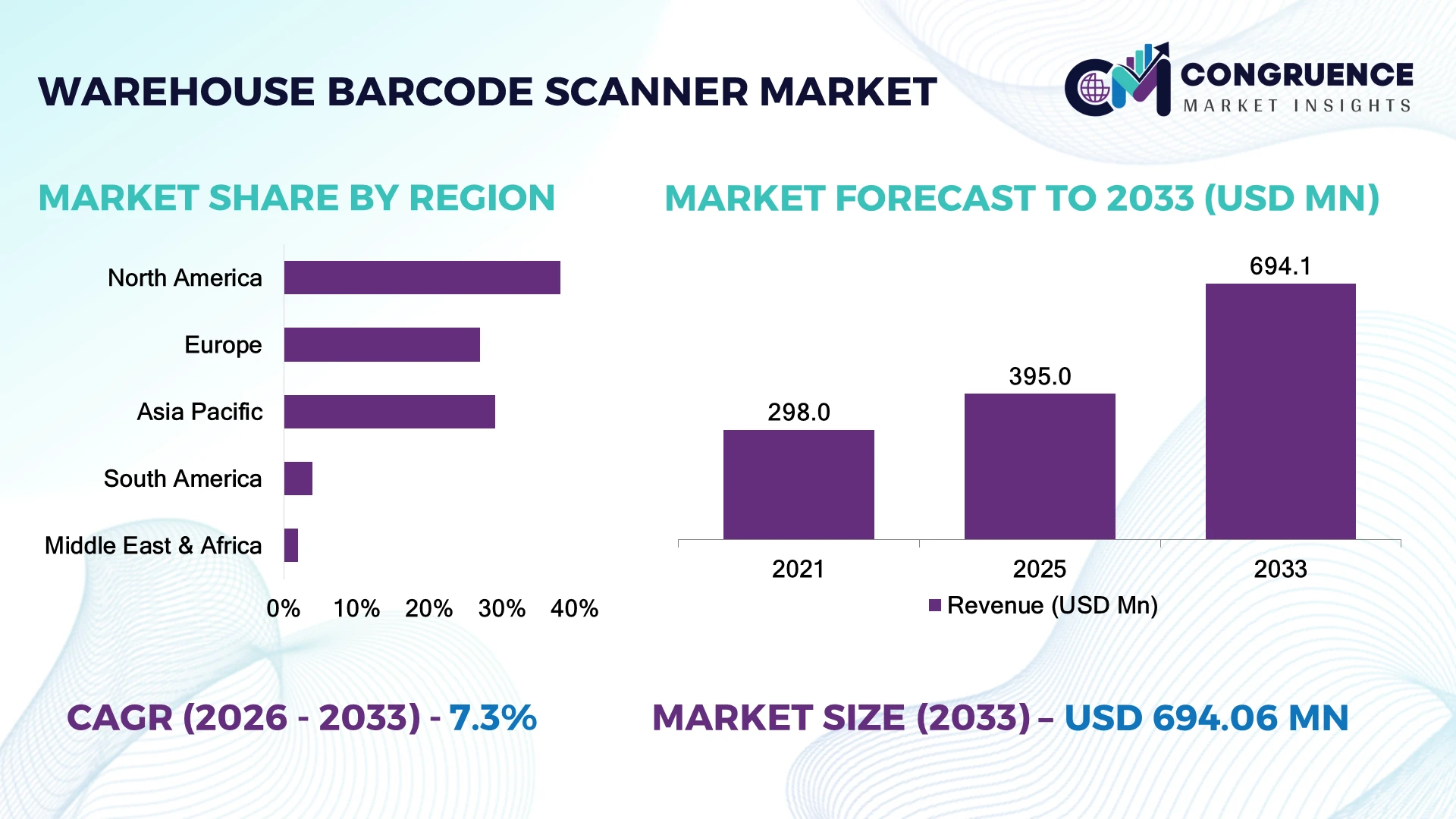
The United States dominates the market with an estimated 32% share, supported by over 20,000 large warehouse facilities, strong investments in logistics automation exceeding USD 15 billion annually, and widespread adoption of real-time inventory visibility platforms. China follows with approximately 24% share, benefiting from large-scale manufacturing exports and smart logistics deployment across major industrial clusters. More than 68% of Tier-1 distribution centers in the U.S. utilize advanced scanning infrastructure compared with nearly 55% in China, reflecting different stages of digital warehouse maturity amid ongoing supply-chain restructuring after Red Sea shipping disruptions.
For stakeholders, leadership increasingly depends on deploying intelligent scanning ecosystems that enhance inventory accuracy, labor productivity, and fulfillment responsiveness across complex distribution networks.
Market Size & Growth: USD 395.0 Million in 2025 reaching USD 694.1 Million by 2033, supported by warehouse automation, omnichannel fulfillment, and smart inventory management.
Top Growth Drivers: E-commerce warehouse expansion (+18%), automation investments (+22%), and inventory accuracy initiatives (+30%).
Short-Term Forecast: By 2028, warehouse picking efficiency is projected to improve by 25% while manual inventory errors decline by 35%.
Emerging Technologies: AI-powered scanning, machine vision integration, and cloud-connected mobile data capture platforms accelerate operational intelligence.
Regional Leaders: North America (~USD 220 Million), Asia-Pacific (~USD 185 Million), and Europe (~USD 145 Million), driven by logistics modernization and fulfillment automation.
Consumer/End-User Trends: More than 70% of large fulfillment centers prioritize real-time inventory visibility and mobile scanning workflows.
Pilot/Case Example: In 2024, a major distribution network achieved 28% faster order processing after deploying advanced handheld barcode scanners.
Competitive Landscape: Zebra Technologies holds roughly 28% market share; Honeywell, Datalogic, Cognex, and Unitech remain key competitors.
Regulatory & ESG Impact: Digital inventory tracking reduces paper-based workflows by over 40% and improves traceability compliance.
Investment & Funding: More than USD 2.5 billion has been directed toward warehouse digitization, robotics, and data-capture technologies.
Innovation & Future Outlook: AI-assisted scanning, edge analytics, and autonomous warehouse ecosystems are redefining next-generation fulfillment operations.
Warehouse barcode scanners have become essential operational tools across e-commerce fulfillment centers, manufacturing warehouses, and third-party logistics facilities. Demand is rising for rugged mobile scanners, wireless connectivity, and AI-assisted decoding capabilities that improve inventory accuracy by more than 30%. A notable trend is the convergence of barcode scanning with warehouse management software as companies respond to tighter delivery timelines, labor constraints, and increasingly complex supply-chain operations, creating a foundation for broader strategic transformation.
Warehouse barcode scanners have evolved from simple identification devices into critical infrastructure supporting inventory visibility, warehouse productivity, and supply-chain resilience. As companies compete on delivery speed and inventory accuracy, advanced scanning solutions have become central to operational excellence strategies. Ongoing warehouse modernization, digital transformation initiatives, and global supply-chain restructuring are increasing the strategic importance of intelligent data-capture systems across logistics and manufacturing environments.
Modern barcode scanners equipped with AI-based image processing and wireless connectivity deliver inventory accuracy rates above 99%, compared with approximately 92–95% for legacy manual entry processes. Large distribution hubs in the United States and Germany emphasize integrated scanning ecosystems and analytics-driven workflows, while emerging logistics centers in India and Southeast Asia focus on scalable deployment and cost-efficient digitization. Adoption of mobile scanning platforms continues to accelerate as warehouse operators seek faster inventory reconciliation and improved labor utilization.
Over the next two to three years, companies are expected to prioritize scanner-software integration, warehouse automation partnerships, and cloud-based inventory visibility platforms. For example, large retailers increasingly deploy connected handheld scanners across fulfillment networks to improve picking efficiency and reduce stock discrepancies. Organizations that establish intelligent scanning capabilities today will strengthen competitive positioning through higher operational agility, improved customer service levels, and superior supply-chain performance.
Warehouse operators are rapidly deploying advanced barcode scanning systems to support automation-driven fulfillment models. E-commerce order volumes have increased by more than 18% over recent years, while automated warehouse investments have expanded by approximately 22%. Advanced scanning solutions can improve inventory accuracy by over 30%, creating measurable gains in order fulfillment performance. The continued shift toward omnichannel logistics and same-day delivery expectations has intensified demand for real-time inventory visibility. In the United States, large distribution centers increasingly integrate barcode scanners with warehouse management systems and autonomous material-handling equipment. This operational shift improves throughput, reduces stock discrepancies, and enhances workforce productivity. In response, technology providers are expanding product portfolios, investing in AI-enabled scanning capabilities, and establishing strategic partnerships with logistics software vendors to strengthen end-to-end warehouse digitization capabilities.
A major limitation remains the integration of modern scanning systems with fragmented warehouse infrastructure and aging enterprise software. Approximately 40% of medium-sized warehouses continue operating legacy inventory management environments, while integration projects can increase deployment timelines by 20–30%. Interoperability challenges often arise between scanners, warehouse management platforms, and enterprise resource planning systems. Supply-chain disruptions affecting semiconductor availability have also periodically increased hardware procurement lead times. These factors directly impact scalability and delay modernization initiatives. Warehouse operators in developing economies face additional infrastructure constraints, including inconsistent wireless network coverage and limited IT resources. To mitigate these issues, companies are adopting modular deployment models, localized system integration partnerships, and multi-vendor procurement strategies that reduce dependency on a single technology ecosystem while improving operational flexibility.
The strongest opportunity lies in combining barcode scanning with AI, machine vision, and cloud-based analytics platforms. AI-enhanced decoding technologies can improve scan success rates by more than 25%, while intelligent inventory tracking solutions reduce manual verification requirements by nearly 35%. India's logistics modernization initiatives and manufacturing expansion programs are creating substantial demand for scalable warehouse technologies. At the same time, cross-border trade corridors and new fulfillment infrastructure investments are expanding deployment opportunities beyond traditional logistics hubs. Technology vendors are increasingly investing in edge computing, predictive inventory analytics, and integrated scanning ecosystems. A particularly valuable opportunity exists in connecting barcode scanners with autonomous mobile robots, enabling synchronized inventory tracking and warehouse orchestration. Companies pursuing ecosystem partnerships and platform-based solutions are positioned to capture long-term operational value from next-generation warehouse environments.
As warehouse operations become increasingly connected, maintaining consistent performance across large-scale scanning networks presents a significant challenge. More than 60% of enterprise warehouses now rely on connected devices, increasing cybersecurity exposure and data-management complexity. Workforce shortages in warehouse technology management roles have risen by roughly 15% in several major logistics markets, creating implementation bottlenecks. Multi-site deployments often require continuous software updates, device monitoring, and network optimization to sustain operational reliability. In Germany and Japan, highly automated facilities face growing pressure to integrate scanning systems with robotics, analytics platforms, and digital twins without disrupting existing workflows. Companies must address these challenges through cybersecurity investments, workforce development programs, and scalable infrastructure architectures. Those that successfully standardize deployment frameworks will secure stronger operational resilience and long-term competitive advantage.
AI-Enhanced Scan Accuracy Gains Advanced decoding algorithms are improving first-pass read rates by 20–30%, particularly for damaged labels and high-density barcodes. Large U.S. fulfillment operators have expanded AI-assisted scanning deployments across more than 40% of newly automated facilities. The shift reduces exception handling, accelerates inventory reconciliation, and lowers manual verification workloads. Scanner manufacturers are responding through software-centric upgrades, cloud analytics integration, and strategic partnerships with warehouse management platform providers.
Wearable Mobility Expansion Wearable barcode scanners are experiencing adoption increases exceeding 25% in high-volume distribution centers as labor shortages push operators toward hands-free workflows. Pick-path efficiency improvements of 15–20% and order processing gains above 18% are being reported across large warehouse networks. Companies are restructuring picking operations around wearable ecosystems, integrating scanners with voice-directed workflows and mobile workforce applications to improve throughput consistency.
Cloud-Connected Device Management Enterprise warehouses are increasing cloud-based scanner fleet management adoption by nearly 35%, enabling centralized monitoring, software updates, and performance diagnostics. Multi-site operators in Germany and Japan are prioritizing remote device administration to reduce support costs and improve uptime. This transition strengthens operational visibility while minimizing deployment complexity. Vendors are scaling subscription-based management platforms and expanding integration capabilities across connected warehouse infrastructure.
Traceability-Driven Deployment Growth Supply-chain transparency requirements and product traceability initiatives are increasing barcode scanning utilization by over 30% across pharmaceutical, food, and industrial logistics operations. Compliance-driven scanning workflows are reducing inventory discrepancies by approximately 22% while improving shipment verification speed. Companies are expanding serialization capabilities, strengthening supplier data integration, and investing in end-to-end tracking architectures to support increasingly complex distribution networks.
Handheld barcode scanners remain the leading segment, accounting for approximately 52% of market demand due to their deployment flexibility, lower implementation complexity, and compatibility with diverse warehouse workflows. Their ability to support receiving, picking, packing, and inventory verification functions makes them the preferred option across logistics and retail fulfillment environments. Enterprises continue prioritizing ruggedized handheld devices capable of operating in demanding warehouse conditions, with adoption rates exceeding 70% among large distribution facilities. Fixed-mount scanners maintain strong relevance in conveyor-based automation environments where continuous scanning accuracy and throughput are critical. Wearable barcode scanners represent the fastest-growing segment as warehouse operators seek labor optimization and hands-free productivity improvements. Adoption within high-volume fulfillment centers has increased by more than 25%, supported by growing investments in worker-assistance technologies. Fixed-mount systems continue expanding within automated sorting environments, while mobile computer-integrated scanners are gaining traction in complex inventory management operations. Manufacturers are responding through ergonomic product innovation, software integration enhancements, and strategic partnerships with warehouse automation providers. Investment priorities increasingly favor intelligent devices capable of supporting real-time analytics and connected warehouse ecosystems.
Inventory management accounts for approximately 38% of barcode scanner deployments, making it the dominant application segment. Warehouses increasingly depend on continuous inventory visibility to reduce stock discrepancies and improve replenishment accuracy. Real-time scanning workflows have reduced inventory reconciliation times by nearly 30% in many large distribution operations. Receiving and shipping applications continue generating substantial demand as companies strengthen traceability, shipment validation, and dock-to-stock efficiency. The widespread integration of scanners with warehouse management systems further reinforces demand concentration within core inventory processes. Order picking is emerging as the fastest-growing application due to rising fulfillment speed requirements and labor productivity initiatives. Warehouse operators report picking efficiency improvements ranging from 15–25% following advanced scanner deployment. Packing and shipment verification functions are also gaining strategic importance as businesses seek to minimize fulfillment errors and return costs. Companies are expanding scanning infrastructure, integrating mobile workflows, and automating data capture across fulfillment processes. Demand is increasingly shifting toward applications that directly influence delivery performance and customer satisfaction metrics.
Third-party logistics providers and warehousing operators constitute the largest end-user segment with an estimated 42% market share. Their extensive facility networks, high transaction volumes, and dependence on real-time inventory visibility create substantial demand for barcode scanning infrastructure. Large logistics enterprises continue investing in warehouse digitization programs to improve fulfillment speed and operational consistency. Retail and e-commerce operators also represent significant buyers due to increasing order volumes and omnichannel inventory management requirements. Deployment intensity remains highest among organizations managing complex distribution networks and multi-location inventory operations. E-commerce companies represent the fastest-growing end-user group as fulfillment expectations continue to tighten. Scanner deployments within major online retail operations have expanded by more than 28% in recent years, driven by order accuracy and same-day fulfillment objectives. Manufacturing facilities remain important adopters, particularly for warehouse-to-production inventory synchronization and material traceability. Healthcare and pharmaceutical logistics operators are also increasing adoption to support compliance-driven tracking requirements. Vendors are targeting these segments through customized device configurations, industry-specific software integration, and ecosystem partnerships designed to address specialized operational requirements.
North America accounted for the largest market share at 38% in 2025 however, Asia-Pacific is expected to register the fastest growth, expanding at a CAGR of 8.6% between 2026 and 2033.
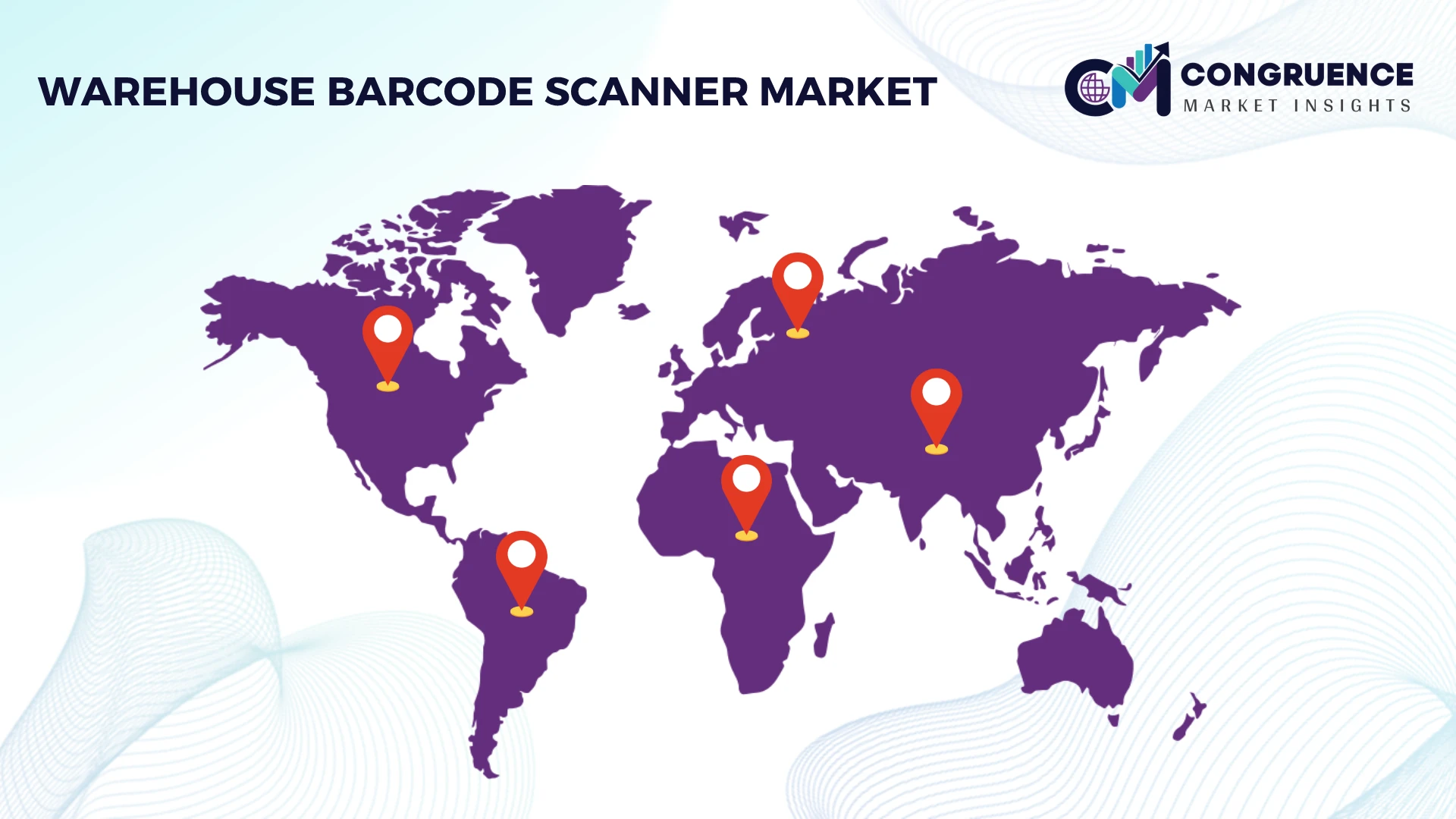
North America represents the most mature warehouse barcode scanner ecosystem, supported by extensive fulfillment infrastructure, advanced warehouse management systems, and large-scale automation deployments. The region accounts for approximately 38% of global demand, with adoption concentrated across e-commerce, retail logistics, healthcare distribution, and industrial warehousing. Large distribution operators increasingly integrate barcode scanners with robotics, AI-enabled inventory systems, and cloud-connected warehouse platforms to improve inventory accuracy and throughput. More than 70% of Tier-1 fulfillment facilities have implemented advanced scanning infrastructure as part of broader warehouse modernization strategies. Strategic partnerships between technology vendors and logistics providers continue accelerating deployment scale, while investments in omnichannel fulfillment networks strengthen demand for high-performance data-capture solutions. Labor optimization initiatives and increasing delivery-speed requirements remain key operational priorities shaping procurement decisions across the region.
United States Market Outlook: The United States serves as the region’s primary demand center due to its extensive logistics infrastructure, advanced fulfillment operations, and strong warehouse automation investments. The country operates more than 20,000 large warehouse facilities supporting retail, manufacturing, and third-party logistics activities. Adoption of connected scanning solutions exceeds 68% among major distribution networks, reflecting strong digital transformation momentum. Continuous investments in fulfillment technology, inventory visibility platforms, and warehouse robotics reinforce the country's leadership position. Enterprise operators increasingly prioritize integrated scanning ecosystems that support real-time analytics, predictive inventory management, and higher operational efficiency across national distribution networks.
Europe maintains a strong position in the warehouse barcode scanner market through advanced logistics infrastructure, regulatory traceability requirements, and widespread warehouse digitization initiatives. The region contributes approximately 27% of global market activity, with deployment concentrated in manufacturing, retail distribution, pharmaceutical logistics, and industrial supply chains. Barcode scanning adoption continues expanding as organizations strengthen inventory transparency and operational compliance. Smart warehouse investments have accelerated across Germany, France, and the Netherlands, where companies increasingly deploy connected scanning devices alongside automated storage and retrieval systems. More than 55% of newly modernized logistics facilities now integrate mobile data-capture technologies within warehouse management workflows. Sustainability objectives and operational efficiency targets further support scanner deployment across distribution and inventory management functions.
Germany Market Outlook: Germany leads the European market through its industrial scale, export-driven manufacturing base, and advanced logistics infrastructure. The country serves as a major distribution hub for automotive, industrial equipment, and consumer goods sectors. Warehouse operators increasingly integrate barcode scanners with Industry 4.0 initiatives and intelligent inventory platforms. More than 60% of large logistics facilities have adopted advanced warehouse digitization frameworks. Strong enterprise technology adoption, efficient transportation networks, and continued investments in smart logistics infrastructure position Germany as a strategic center for next-generation warehouse operations and automated inventory management systems.
Asia-Pacific accounts for approximately 29% of global market activity and represents the fastest-expanding deployment environment for warehouse barcode scanners. Rapid growth in e-commerce fulfillment, manufacturing output, and logistics infrastructure development continues accelerating adoption across major economies. China, India, Japan, and Southeast Asian countries are expanding warehouse automation capabilities to support rising inventory complexity and export activity. Large fulfillment centers increasingly deploy mobile scanners, wearable devices, and cloud-connected inventory systems to improve operational responsiveness. More than 45% of newly commissioned logistics facilities across major industrial hubs incorporate advanced scanning technologies as standard operational infrastructure. Expanding industrial production and cross-border trade flows continue strengthening long-term deployment demand throughout the region.
China Market Outlook: China remains the region's most influential market due to its manufacturing scale, export-oriented supply chains, and rapidly expanding logistics sector. The country operates some of the world's largest e-commerce fulfillment networks, creating significant demand for advanced warehouse technologies. Adoption of intelligent scanning systems has increased across major logistics operators seeking greater inventory accuracy and warehouse productivity. Approximately 55% of large fulfillment facilities utilize integrated digital inventory management platforms. Continued investment in smart logistics parks, automated distribution centers, and industrial digitization programs reinforces China's strategic importance within the warehouse barcode scanner ecosystem.
South America is experiencing steady market expansion as retailers, logistics providers, and industrial operators modernize warehouse operations. The region contributes approximately 4% of global market demand, with adoption concentrated in distribution, retail fulfillment, food logistics, and manufacturing supply chains. E-commerce growth continues driving investments in inventory visibility and warehouse efficiency technologies. Barcode scanning deployments are increasingly integrated into warehouse management systems to improve order accuracy and reduce manual processing requirements. Logistics infrastructure development and fulfillment network expansion are supporting broader technology adoption. However, uneven digital infrastructure and capital investment constraints continue influencing deployment pace across several markets. Companies are addressing these limitations through phased implementation strategies and targeted warehouse modernization programs.
Brazil Market Outlook: Brazil represents the largest market within South America due to its extensive consumer base, growing e-commerce sector, and expanding logistics infrastructure. Large retailers and third-party logistics providers continue investing in fulfillment modernization initiatives to improve operational performance. Warehouse digitization projects have accelerated across major metropolitan logistics corridors, with advanced scanning deployments increasing in high-volume distribution facilities. More than 40% of large fulfillment operators have expanded inventory visibility programs in recent years. Strong domestic consumption, improving logistics capabilities, and increasing enterprise technology adoption support Brazil's leadership position within the regional market.
The Middle East & Africa market is advancing through large-scale logistics infrastructure investments, distribution network expansion, and warehouse modernization initiatives. The region accounts for approximately 2% of global market activity, with demand concentrated in retail logistics, industrial warehousing, healthcare distribution, and trade-focused logistics hubs. Governments and private-sector operators continue prioritizing supply-chain efficiency and inventory visibility improvements. Advanced barcode scanning solutions are increasingly deployed within free trade zones, logistics parks, and modern distribution facilities. Several large warehouse development projects have incorporated digital inventory management technologies from inception, supporting operational efficiency and scalability. Continued infrastructure investment and trade facilitation programs are creating favorable conditions for technology adoption across the region.
United Arab Emirates Market Outlook: The United Arab Emirates serves as the region's leading market due to its strategic trade position, world-class logistics infrastructure, and strong warehouse modernization activity. Major logistics hubs in Dubai and Abu Dhabi continue expanding fulfillment and distribution capabilities to support international trade flows. Advanced warehouse technologies are increasingly integrated into logistics parks and free-zone operations. More than 50% of newly developed large-scale distribution facilities include digital inventory tracking and automated data-capture systems. Strong government support for logistics innovation, infrastructure development, and supply-chain digitization strengthens the country's position as a regional technology deployment leader.
The Warehouse Barcode Scanner Market is led by Zebra Technologies, Honeywell, Datalogic, Cognex, and Unitech, with the top five players collectively controlling approximately 62% of global market activity. Competition is primarily between global technology leaders and regional cost-focused suppliers, while machine-vision specialists increasingly challenge traditional scanner vendors in automated warehouse environments. Zebra and Honeywell compete through ecosystem breadth and software integration, whereas Datalogic and Cognex focus on advanced imaging, traceability, and automation performance. Technology capability influences more than 45% of enterprise purchasing decisions, while deployment speed and lifecycle support affect nearly 30% of vendor selection outcomes. Companies are expanding through warehouse automation partnerships, AI-enabled scanning innovation, cloud-based device management, and fulfillment network integrations. The competitive shift is moving from hardware differentiation toward intelligent data-capture platforms and connected warehouse ecosystems. High integration requirements, enterprise certification standards, and software interoperability create significant entry barriers. Winning requires superior automation compatibility, operational intelligence, deployment scalability, and long-term customer ecosystem value.
Honeywell International Inc.
Datalogic S.p.A.
Cognex Corporation
Unitech Electronics Co., Ltd.
CipherLab Co., Ltd.
Bluebird Inc.
Newland AIDC
SICK AG
Toshiba Tec Corporation
JADAK
Socket Mobile, Inc.
Opticon Sensors Europe B.V.
Juniper Systems, Inc.
Warehouse barcode scanning technology is rapidly evolving from conventional laser-based hardware toward intelligent image-based and AI-assisted platforms. Modern 2D imaging scanners deliver scan accuracy improvements of 20–30% over legacy laser devices while decoding damaged, low-contrast, and high-density barcodes more effectively. More than 65% of newly deployed enterprise warehouse scanners now support advanced imaging capabilities. Businesses benefit through reduced exception handling, higher inventory accuracy, and faster fulfillment execution. Large logistics operators increasingly integrate scanners with warehouse management systems and cloud-based inventory platforms to create continuous operational visibility.
Emerging technologies include AI-powered decoding, edge analytics, wearable scanning systems, and cloud-managed device fleets. AI-assisted scanners improve first-pass read performance by approximately 25%, while wearable devices increase picking productivity by 15–20% in high-volume fulfillment environments. Adoption of cloud-based scanner management platforms has surpassed 35% among multi-site warehouse operators. These technologies enable centralized device monitoring, predictive maintenance, and workflow optimization while reducing support costs and deployment complexity.
Disruptive innovation is increasingly centered on machine vision, autonomous warehouse integration, and intelligent traceability platforms. Organizations deploying AI-enabled scanning ecosystems report inventory verification cycle reductions exceeding 30%. Technology leaders such as Zebra, Honeywell, Datalogic, and Cognex gain competitive advantages through software-driven differentiation rather than hardware alone. Between 2026 and 2028, integration with robotics, digital twins, and predictive inventory systems will become a critical operational requirement, making early technology adoption a decisive competitive advantage.
March 2025 – Zebra Technologies introduced the Aurora Velocity™ scan tunnel at ProMat 2025, designed for high-speed automated warehouse sorting. The platform combines multiple machine-vision functions in one architecture, improving barcode-reading performance across conveyor operations and strengthening warehouse automation capabilities. Source: zebra.com
October 2024 – Honeywell launched the AI-capable CT37, CK67, and CK62 mobile computing devices for warehouse operations. The new platform supports next-generation AI applications and workflow optimization, helping frontline workers improve productivity and operational responsiveness in demanding logistics environments. Source: honeywell.com
March 2025 – Datalogic showcased advanced Matrix™, AV900, and AV7000 12K scanning solutions at ProMat 2025, targeting high-volume logistics environments. The systems enhance conveyor scanning precision and throughput, supporting growing automation requirements across transportation and warehouse operations. Source: datalogic.com
March 2024 – Cognex launched the 380 Modular Vision Tunnel powered by the DataMan® 380 barcode reader. The scalable solution improves throughput and traceability in logistics facilities, enabling automated barcode reading across diverse package profiles while supporting warehouse automation expansion. Source: prnewswire.com (Cognex Release)
This report provides comprehensive analysis of the Warehouse Barcode Scanner Market across major scanner types, operational applications, end-user industries, and regional markets. The assessment covers handheld, wearable, fixed-mount, and mobile computer-integrated scanning technologies alongside applications including inventory management, receiving, shipping, picking, and warehouse tracking operations. The study evaluates adoption patterns across logistics providers, e-commerce operators, manufacturing enterprises, healthcare distribution networks, and retail fulfillment organizations. More than 60% of current deployments are concentrated within digitally enabled warehouse environments emphasizing real-time inventory visibility and automated workflow execution.
The report further examines competitive positioning, deployment trends, technology evolution, and regional operational dynamics across North America, Europe, Asia-Pacific, South America, and the Middle East & Africa. Key strategic areas include AI-enabled scanning, machine vision integration, cloud-based fleet management, wearable technologies, and intelligent warehouse ecosystems. The analysis supports investment planning, expansion prioritization, technology selection, competitive benchmarking, and long-term operational strategy development between 2026 and 2033.
| Report Attribute / Metric | Details |
|---|---|
| Market Revenue (2025) | USD 395.0 Million |
| Market Revenue (2033) | USD 694.1 Million |
| CAGR (2026–2033) | 7.3% |
| Base Year | 2025 |
| Forecast Period | 2026–2033 |
| Historic Period | 2021–2025 |
| Segments Covered |
By Type
By Application
By End-User
|
| Key Deliverables | Revenue Forecast; Market Trends; Growth Drivers & Restraints; Technology Insights; Segmentation Analysis; Regional Insights; Competitive Landscape; Regulatory & ESG Overview; Recent Developments |
| Regions Covered | North America; Europe; Asia-Pacific; South America; Middle East & Africa |
| Companies Profiled | Zebra Technologies Corporation; Honeywell International Inc.; Datalogic S.p.A.; Cognex Corporation; Unitech Electronics Co., Ltd.; CipherLab Co., Ltd.; Bluebird Inc.; Newland AIDC; SICK AG; Toshiba Tec Corporation; JADAK; Socket Mobile, Inc.; Opticon Sensors Europe B.V.; Juniper Systems, Inc. |
| Customization & Pricing | Available on Request (10% Customization Free) |




