
Reports
The Global Wallpaper Market was valued at USD 200.0 Million in 2025 and is anticipated to reach a value of USD 295.5 Million by 2033 expanding at a CAGR of 5.0% between 2026 and 2033. Digital inkjet printing, removable wallcovering formats, PVC-free substrates, and renovation-led interior modernization are driving market expansion.
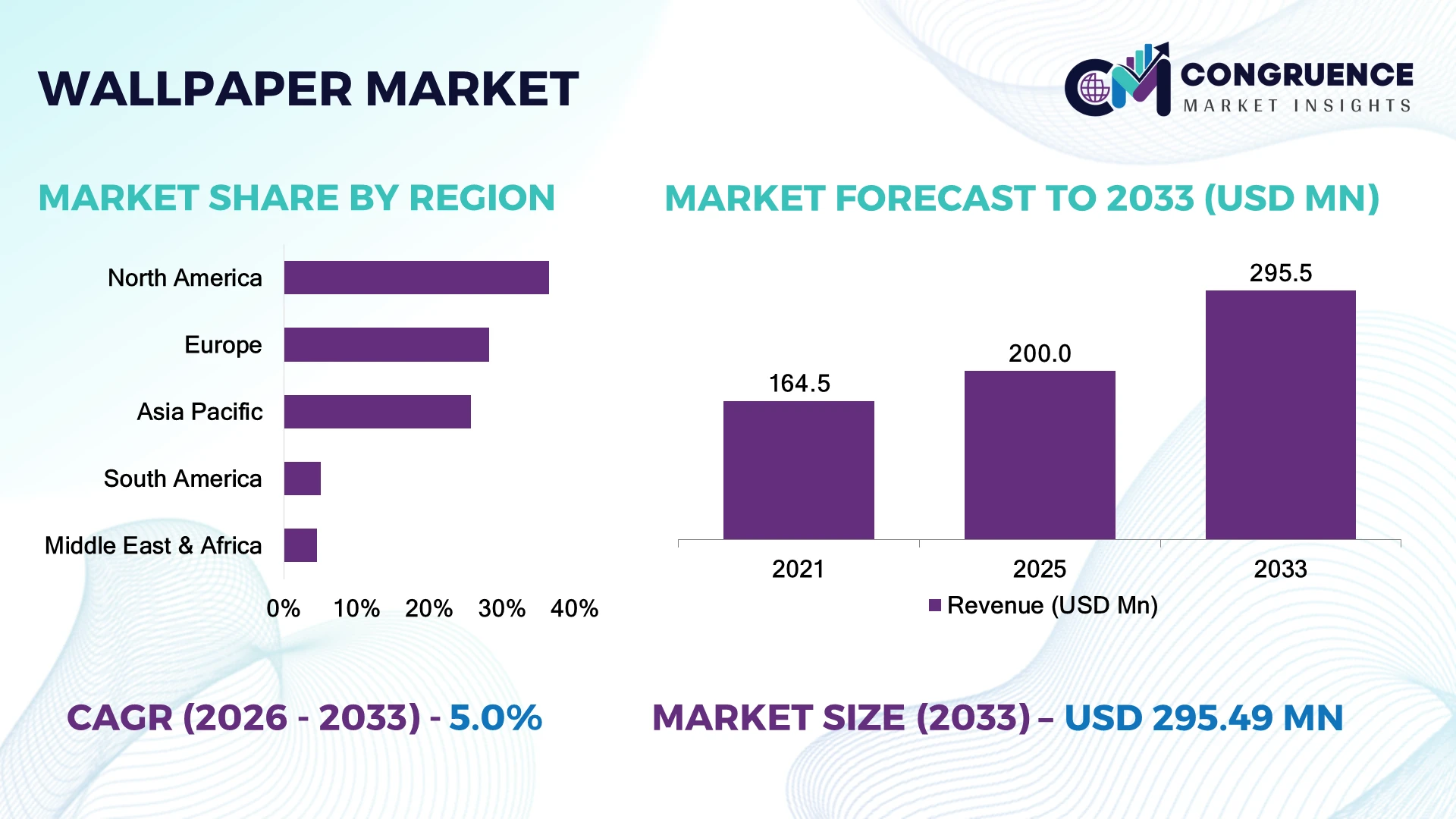
North America dominated the global wallpaper market with a 36.4% share in 2025, supported by the United States, which represents approximately 81.3% of North American demand. The region benefits from established remodeling activity, premium hospitality interiors, digital printing, and advanced distribution networks. Asia-Pacific follows with stronger manufacturing momentum, while China provides substantial production capacity and supply-chain scale. US-China trade measures are also encouraging regional sourcing and inventory diversification.
The strategic priority is to capitalize on North America's established demand while building flexible production and localized supply networks for faster-growing Asian markets.
Market Size & Growth: USD 200.0 million in 2025 to USD 295.5 million by 2033 at 5.0% CAGR, supported by digital-printing adoption.
Top Growth Drivers: Digital printing 42%; renovation 36%; sustainable materials 29%.
Short-Term Forecast: By 2028, changeover costs decline 15% while production efficiency improves 20%.
Emerging Technologies: AI design, inkjet automation, and advanced substrates improve customization and production flexibility by 15%–25%.
Regional Leaders: North America reaches about USD 108 million, Europe USD 83 million, and Asia-Pacific USD 76 million by 2033.
Consumer/End-User Trends: Customized and removable formats reach approximately 35% adoption in premium residential purchases.
Pilot/Case Example: A 2025 digital-printing deployment reduced short-run setup time by approximately 25%.
Competitive Landscape: Leading suppliers collectively command about 48% of organized activity, led by A.S. Création, Graham & Brown, Sangetsu, York Wallcoverings, and Brewster.
Regulatory & ESG Impact: PVC-free and low-emission products represent roughly 15% more new premium launches than conventional formulations.
Investment & Funding: More than USD 100 million is being directed toward digital printing, sustainable substrates, capacity expansion, and regional production.
Innovation & Future Outlook: AI personalization, recyclable substrates, automated inspection, and localized manufacturing will reshape high-growth wallpaper supply chains through 2028.
Premium residential renovation, hospitality refurbishment, retail interiors, and contract projects remain the strongest demand areas. Digitally customized murals and functional wallcoverings are expanding, with approximately 30%–35% of premium launches incorporating customization or performance characteristics. Manufacturers are simultaneously restructuring procurement and regional inventory as freight volatility and geopolitical trade measures increase the value of shorter supply chains, setting the stage for a more responsive competitive environment.
Wallpaper is becoming strategically important because interior-material competition is shifting from pattern variety alone toward customization, production speed, sustainability, and lifecycle performance. Digital inkjet systems increasingly outperform conventional long-run processes for short orders, cutting setup and changeover requirements by approximately 20%–25%. This enables manufacturers to serve hotels, retailers, designers, and homeowners with project-specific designs without maintaining excessive pattern inventories.
North America retains strong renovation-driven demand and sophisticated distribution, while China and India provide manufacturing scale and expanding urban applications. Europe is moving faster toward PVC-free materials, low-emission formulations, and lifecycle-oriented product specifications. Over the next 2–3 years, digitally enabled production is positioned to increase customized-order capacity while reducing fulfillment cycles by approximately 15%–20%.
A practical deployment is digitally printed hotel wallcovering produced in short batches for room-specific interiors. Companies are responding by investing in automated printers, localized warehouses, sustainable substrates, designer partnerships, and online visualization. The strongest competitive position will belong to suppliers that integrate design intelligence, manufacturing flexibility, material compliance, and dependable fulfillment into one operating model.
Digital printing is shifting wallpaper manufacturing toward shorter production runs, with advanced facilities achieving approximately 20%–25% lower changeover requirements and more than 40% digital workflow penetration. Customized murals and project-specific patterns are particularly important for hospitality and premium residential interiors. The transition from conventional long-run printing reduces setup dependency and enables manufacturers to respond to smaller orders without excessive inventory. China is strengthening production capacity, while U.S. and European suppliers emphasize premium customization and sustainable substrates. Companies are responding through automated inkjet equipment, designer partnerships, and digital product libraries. The sharp strategic advantage is inventory responsiveness: manufacturers can align production more closely with confirmed orders, reducing obsolete patterns and improving working-capital efficiency.
Wallpaper producers remain exposed to volatility in specialty paper, polymer coatings, inks, adhesives, pigments, and energy costs. Imported substrates and printing inputs can create procurement increases of approximately 8%–12% during periods of freight disruption or currency pressure, while specialized materials can extend sourcing cycles by 15%–20%. US-China trade measures and shipping disruptions add complexity to international procurement. These pressures directly affect margins and production scheduling, particularly for smaller manufacturers. Companies are responding by qualifying multiple suppliers, increasing regional sourcing, negotiating longer-term contracts, and developing alternative coating formulations. The non-obvious pressure is material compatibility: replacing a substrate can alter print accuracy, adhesion, texture, and installation performance, making supply diversification a technical qualification exercise rather than a simple purchasing decision.
Functional wallpaper provides a differentiated opportunity beyond decorative applications, particularly through washable, antimicrobial, acoustic, removable, and bio-based formats. Performance-oriented products already account for approximately 30%–40% of premium commercial portfolios, while sustainable-material launches are expanding by roughly 10%–15%. India, Vietnam, and Indonesia offer attractive opportunities as manufacturing ecosystems diversify and urban interior spending expands. AI-assisted visualization and digitally generated patterns can further reduce design development cycles by approximately 15%–20%. Companies are positioning through substrate R&D, chemical partnerships, digital design platforms, and localized production. A distinctive opportunity lies in multifunctional wallcoverings that combine decoration with acoustic, hygiene, or maintenance benefits, allowing suppliers to replace multiple interior-material requirements with one higher-value product.
Scaling personalized wallpaper requires integration across design software, prepress, printing, color management, finishing, quality inspection, inventory, and installation specifications. Workflow fragmentation can increase rework by approximately 5%–10%, while inconsistent color management can create project-level replacement costs and delivery delays. Skilled operators remain essential as manufacturers move toward automated digital production and increasingly complex substrates. Environmental requirements also continue evolving around inks, coatings, emissions, and recyclability. Companies must invest in automated inspection, workforce training, interoperable production systems, and supplier certification. The key long-term challenge is consistency: customization creates premium value only when every production stage delivers repeatable color, dimensional stability, adhesion, and finishing quality. Manufacturers that solve this integration problem will secure stronger margins and more reliable contract-project execution.
Digital Workflow Is Accelerating Digital printing is moving wallpaper production toward on-demand manufacturing, with digital workflows growing around 8% annually and reducing setup requirements by 20%–25% versus longer conventional runs. U.S. and European suppliers are expanding automated color management and large-format inkjet systems, enabling faster customization while lowering obsolete-pattern inventory. The non-obvious shift is toward smaller production batches rather than maximum machine throughput, allowing manufacturers to respond more precisely to project-specific demand.
Sustainable Substrates Gain Traction PVC-free, recycled-fiber, and responsibly sourced substrates are moving from niche collections into mainstream product development, with sustainability-focused launches increasing roughly 10%–15% across premium portfolios. Germany is particularly active in recycled-fiber wallcoverings, while manufacturers are redesigning coatings and adhesives to satisfy stricter environmental expectations. The 2025 introduction of recycled-fiber wallpaper collections reinforces this transition, pushing companies toward lifecycle-based material selection and documented environmental performance.
Commercial Performance Standards Rise Hospitality, healthcare, offices, and retail projects increasingly specify washable, stain-resistant, antimicrobial, and flame-performance characteristics, with performance-oriented commercial products representing roughly 30%–40% of project-focused portfolios. U.S. manufacturers are responding with enhanced coatings and tested cleanability against stronger disinfectants. Labor shortages are also increasing pressure for easier installation and maintenance, making durable surfaces a practical operating-cost tool rather than simply a decorative upgrade.
Customization Moves Into Interiors Personalized murals, geometric patterns, textured finishes, and digitally generated artwork are expanding across hospitality and premium residential projects, with customized collections accounting for an estimated 30%–35% of newer premium launches. Companies are combining design software, digital sampling, and short-run printing to compress product-development cycles and reduce physical sampling. The 2025 European design cycle also emphasized functionality alongside aesthetics, indicating that premium wallpaper is increasingly positioned as a performance-led interior material rather than a purely decorative surface.
Vinyl wallpaper remains the leading type, accounting for approximately 36% of the global market in 2025. Its dominance reflects superior moisture resistance, washability, abrasion tolerance, and suitability for high-traffic environments. Commercial-grade vinyl is particularly established across hotels, healthcare facilities, retail interiors, corridors, and hospitality spaces, where maintenance performance directly influences lifecycle economics. Nonwoven wallpaper follows as a strategically important category, while paper and fabric retain relevance in decorative, premium, and design-led applications.
Nonwoven is the fastest-growing type, supported by easier installation, improved removability, breathable construction, and growing preference for PVC-free alternatives. Its adoption is expanding roughly 8%–10% annually in faster-moving markets, compared with approximately 4%–6% growth in mature vinyl applications. Fabric products remain concentrated in luxury interiors, while paper continues to serve cost-sensitive and low-traffic spaces. Companies are increasing nonwoven collections, investing in digital printing, and refining adhesive systems, shifting investment toward flexible, lower-waste production.
Residential applications represent the leading application category at approximately 58% of global wallpaper demand. Home renovation, accent-wall projects, personalized interiors, and easier-to-install formats concentrate demand among homeowners and interior designers. Digitally printed murals and removable designs are strengthening the residential proposition, with customization-oriented purchases estimated at more than 30% of premium residential projects. Commercial applications remain highly significant because wallpaper combines decorative flexibility with durability and maintenance benefits in demanding environments.
Commercial applications are the fastest-expanding use case in specification-driven projects, particularly hospitality, healthcare, offices, and retail spaces. Demand is shifting toward wallcoverings that deliver stain resistance, cleanability, acoustic performance, and fire-performance characteristics, with performance specifications influencing roughly 35% of higher-value commercial installations. Residential buyers prioritize design flexibility and installation simplicity, whereas commercial buyers emphasize lifecycle performance and compliance. Companies are responding with Type II vinyl, synthetic textile, acoustical products, digital murals, and antimicrobial surfaces.
Residential end-users account for approximately 58% of global wallpaper consumption, supported by renovation, remodeling, accent-wall projects, and personalization. Homeowners increasingly favor washable, removable, digitally printed, and low-emission products, with premium residential adoption of customized formats estimated at 30%–35%. Commercial buyers represent the remaining major demand base and place greater emphasis on durability, cleanability, fire performance, and maintenance economics. This difference is pushing suppliers to operate two distinct product strategies: design-led collections for homes and specification-driven systems for professional projects.
Commercial end-users are the fastest-growing buyer group within higher-value installations, particularly hospitality, healthcare, corporate offices, salons and spas, and other public interiors. Their demand is increasingly tied to operational performance rather than aesthetics alone, with high-traffic projects allocating roughly 20%–30% more attention to washability, abrasion resistance, and maintenance specifications than standard residential projects. Companies are responding through contract-grade collections, designer partnerships, installer training, and customized project supply.
North America accounted for the largest market share at 36.4% in 2025 however, Asia Pacific is expected to register the fastest growth, expanding at a CAGR of 5.6% between 2026 and 2033.

North America represents the largest regional market, supported by residential remodeling, hospitality refurbishment, commercial interiors, and established distribution infrastructure. The region captured 36.4% of global demand in 2025, with the United States accounting for approximately 81.3% of North American activity. Peel-and-stick formats, digitally printed murals, and premium designer collections are expanding adoption, while e-commerce continues shifting purchasing toward visualization-led product selection. The operational advantage is a mature installer and retail ecosystem capable of supporting rapid product turnover and customized orders. Manufacturers are increasing digitally printed inventories, strengthening direct-to-consumer channels, and developing low-emission products aligned with evolving building-material expectations. This combination of renovation intensity and product personalization keeps North America strategically important despite its mature market structure.
United States Market Outlook: The United States is the region's principal demand center, representing about 81.3% of North American wallpaper activity. Its large housing stock, extensive remodeling market, hospitality development, and strong designer network support premium and customized wallcoverings. Manufacturers increasingly emphasize removable products, digital printing, sustainable substrates, and online visualization tools to capture homeowners and commercial specification projects.
Europe accounted for more than 28.2% of global wallpaper demand in 2025, supported by established interior-design culture, renovation activity, premium wallcoverings, and sophisticated commercial specifications. Germany, the UK, France, and Italy remain important design and manufacturing centers. Sustainability is becoming a stronger purchasing criterion, encouraging manufacturers to expand PVC-free, recyclable, low-emission, and responsibly sourced collections. European suppliers are also adapting to higher expectations around product transparency and lifecycle performance. Digital printing is enabling shorter production runs and customized designs, while contract-wallcovering manufacturers are strengthening partnerships with architects, designers, and hospitality groups. The strategic shift is from volume-led production toward differentiated products where environmental credentials, design heritage, and technical performance justify premium positioning.
Germany Market Outlook: Germany remains one of Europe's most influential wallpaper markets because of its established manufacturing base, specialist producers, design expertise, and professional distribution infrastructure. The country is particularly relevant to sustainable wallcoverings, with manufacturers expanding lower-emission and resource-efficient collections. Its strong architecture, hospitality, and renovation ecosystem also supports specification-driven products where durability, certification, and design consistency influence purchasing decisions.
Asia-Pacific is the fastest-growing with 25.7% major regional market share, with growth momentum concentrated in China, India, Japan, South Korea, and Southeast Asian economies. Urbanization, housing development, rising disposable income, and expanding hospitality construction are broadening wallpaper adoption. India is projected to record particularly strong momentum, while China's established manufacturing ecosystem provides scale, product variety, and supply-chain advantages. The region is also becoming increasingly important for digital-printing equipment, substrate sourcing, and export-oriented production. Manufacturers are expanding local design portfolios to match national preferences while using automated printing to reduce short-run production constraints. A notable commercial shift is the combination of large-scale manufacturing with localized motifs, enabling suppliers to serve both mass-market residential projects and premium hospitality developments.
China Market Outlook: China remains the region's most strategically significant manufacturing and consumption center, supported by extensive wallcovering production capacity, developed supplier networks, and large urban housing demand. The market is increasingly shifting from new-build applications toward renovation and refurbishment, creating opportunities for digitally printed and customized products. Manufacturers are strengthening domestic design capabilities while maintaining export-oriented production, giving China an important cost, scale, and supply-chain advantage.
South America remains a smaller but increasingly relevant wallpaper market, with demand concentrated in Brazil, Argentina, Chile, and major metropolitan construction centers. Digitally printed and affordable wallcoverings are gaining traction as consumers and commercial property owners seek faster interior upgrades without extensive structural work. South America represented roughly 5.1% of the global digitally printed wallpaper market in 2025, indicating a developing technology-adoption base. Brazil provides the strongest commercial platform through its large consumer base, hospitality activity, retail development, and domestic distribution networks. Currency volatility and imported-material exposure continue to influence purchasing decisions, encouraging suppliers to broaden local sourcing and offer cost-efficient product ranges. Companies are increasingly using online sales, localized designs, and shorter production runs to improve market responsiveness while controlling inventory exposure.
Brazil Market Outlook: Brazil is the most strategically significant South American market because of its population scale, urban housing base, retail network, and established interior-decoration industry. Demand is concentrated in metropolitan residential renovation, hospitality, retail, and commercial interiors. Suppliers are emphasizing competitively priced digitally printed products and localized distribution, while online channels help extend customized wallpaper offerings beyond specialist design stores.
Middle East & Africa is developing through hospitality, luxury residential, retail, tourism, and large-scale commercial construction. The Middle East represented approximately 4.6% of the global digitally printed wallpaper market in 2025, with demand concentrated in Gulf markets where high-end hotels, resorts, branded residences, and mixed-use developments favor customized wallcoverings. The region's opportunity is strongly project-driven rather than volume-driven. Developers increasingly specify bespoke murals, textured surfaces, metallic finishes, and high-performance commercial wallcoverings to differentiate premium interiors. Saudi Arabia and the UAE are central deployment markets, supported by major tourism and real-estate programs. Suppliers are responding through regional distributors, designer partnerships, project-specific customization, and expanded contract-grade collections. The key operational advantage is the ability to deliver distinctive designs at project scale without maintaining excessive standard-pattern inventories.
Saudi Arabia Market Outlook: Saudi Arabia is emerging as a strategically important wallpaper market because large hospitality, tourism, retail, and mixed-use developments are generating specification-driven demand. Major construction programs favor customized and premium wallcoverings that support architectural identity and branded interiors. Suppliers are strengthening local project partnerships and contract distribution, while digitally printed murals provide flexibility for large developments requiring coordinated designs across multiple properties.
The market pits A.S. Création, Sangetsu, York Wallcoverings, Brewster Home Fashions, and Graham & Brown against regional manufacturers and specialist contract suppliers. The top five players collectively hold about 48% of organized wallcovering share, indicating concentrated leadership alongside fragmented regional supply. Competition centers on customization, sustainability, distribution, and production responsiveness. Digital-printing adoption exceeds 40% in advanced facilities, while customized products represent roughly 30%–35% of premium launches. Companies compete through designer collaborations, localized collections, e-commerce expansion, automated printing, and sustainable substrate development. A.S. Création and Graham & Brown emphasize design differentiation; Sangetsu combines premium materials with functional wallcoverings; York and Brewster strengthen digitally printed and removable formats. The shift is toward shorter runs, material transparency, and faster customization rather than scale alone. Entry barriers include designer networks, substrate qualification, printing expertise, brand equity, and distribution relationships. Winning requires integrated digital production, distinctive design IP, dependable supply, and rapid project-specific fulfillment globally.
A.S. Création Tapeten AG
Asian Paints Limited
Arte International B.V.
Brewster Home Fashions LLC
F. Schumacher & Co.
Graham & Brown Limited
Grandeco Wallfashion Group NV
Sangetsu Corporation
Sanderson Design Group plc
The Romo Group
Osborne & Little Limited
York Wallcoverings, Inc.
Marburg Wallcoverings
Zambaiti Parati S.p.A.
Digital inkjet printing is becoming the production technology for customized wallpaper, replacing longer-run conventional printing in premium orders. Advanced facilities can cut setup and changeover time by 20%–25%, while digital workflows reduce obsolete-pattern inventory. Adoption is strongest among design-led suppliers serving hospitality, retail, and residential customization.
AI-assisted design tools and automated color management are emerging during 2026–2028, compressing concept-to-sample cycles by an estimated 15%–20%. Integration with online visualization, automated prepress, and e-commerce ordering allows customers to personalize patterns before production. Design-intensive companies gain competitive advantage because they can monetize customization without equally increasing sampling and tooling requirements.
Advanced nonwoven, PVC-free, bio-based, and recyclable substrates are the disruptive material technologies. Newer substrate systems can improve installation productivity by roughly 10%–15% while supporting lower-emission specifications. Sangetsu, Asian Paints, and other premium suppliers are integrating functional coatings, acoustic surfaces, magnetic formats, and projector-compatible wallcoverings. By 2028, technology leaders will combine digital production, AI-enabled design, automated quality control, and sustainable materials into connected workflows. Companies acting now can shorten fulfillment, improve SKU flexibility, reduce waste, and differentiate beyond pattern libraries. This shift strengthens manufacturing resilience by enabling smaller localized batches, reducing dependence on centralized inventories and supporting faster response to hospitality, renovation, and contract-project schedules.
February 2025 Asian Paints opened Nilaya Anthology, a 100,000-square-foot Mumbai design destination featuring wallpaper and wallcoverings alongside luxury interiors. The launch strengthened experiential retail and designer partnerships, expanding premium customer engagement and positioning wallpaper within integrated high-end décor markets nationwide. Source: asianpaints.com
August 2025 Sangetsu launched two XSELECT PREMIUM COLLECTION 2025–2029 wallpaper catalogs containing 611 items, including 317 new designs. The expansion broadened premium material, brand, and pattern choices while improving selection efficiency for specifiers and strengthening sustainable-product positioning for commercial interiors. Source: sangetsu.co.jp
February 2025 Graham & Brown launched its Concerto Spring/Summer collection of wallpaper, murals, curtains, and blinds, drawing from an archive of 50,000 artworks. The coordinated range strengthened cross-category merchandising and accelerated design-led personalization across residential interiors and premium projects globally. Source: grahambrown.com
January 2025 A.S. Création introduced Metropolitan Stories 2, a nonwoven collection featuring 54 wallpapers and 6 digital prints. The launch expanded city-inspired storytelling and customization, strengthening design differentiation and giving retailers broader premium assortments for targeted residential and hospitality interiors. Source: as-creation.com
The Wallpaper Market Report covers product types including vinyl, nonwoven, paper, and fabric wallpaper, with analysis across residential and commercial applications and major end-user groups. It evaluates design-led, functional, sustainable, removable, digitally printed, and premium wallcovering formats, highlighting adoption patterns and operational shifts across established and emerging demand areas and niche contract applications.
Geographic coverage spans North America, Europe, Asia-Pacific, South America, and Middle East & Africa, with country-level assessment of major manufacturing, consumption, and design centers. The report evaluates digital printing, AI-enabled design, advanced substrates, functional coatings, and sustainable-material technologies alongside competitive positioning. Segment shares, adoption indicators, deployment patterns, and company strategies, distribution models, and supply-chain priorities support investment planning, market-entry decisions, capacity expansion, partnership development, portfolio prioritization, and competitive positioning through 2026–2033.
| Report Attribute / Metric | Details |
|---|---|
| Market Revenue (2025) | USD 200.0 Million |
| Market Revenue (2033) | USD 295.5 Million |
| CAGR (2026–2033) | 5.0% |
| Base Year | 2025 |
| Forecast Period | 2026–2033 |
| Historic Period | 2021–2025 |
| Segments Covered |
By Type
By Application
By End-User
|
| Key Deliverables | Revenue Forecast; Market Trends; Growth Drivers & Restraints; Technology Insights; Segmentation Analysis; Regional Insights; Competitive Landscape; Regulatory & ESG Overview; Recent Developments |
| Regions Covered | North America; Europe; Asia-Pacific; South America; Middle East & Africa |
| Companies Profiled | A.S. Création Tapeten AG; Asian Paints Limited; Arte International B.V.; Brewster Home Fashions LLC; F. Schumacher & Co.; Graham & Brown Limited; Grandeco Wallfashion Group NV; Sangetsu Corporation; Sanderson Design Group plc; The Romo Group; Osborne & Little Limited; York Wallcoverings, Inc.; Marburg Wallcoverings; Zambaiti Parati S.p.A. |
| Customization & Pricing | Available on Request (10% Customization Free) |




