Global Wall Repair Roller Paint Market Report Overview
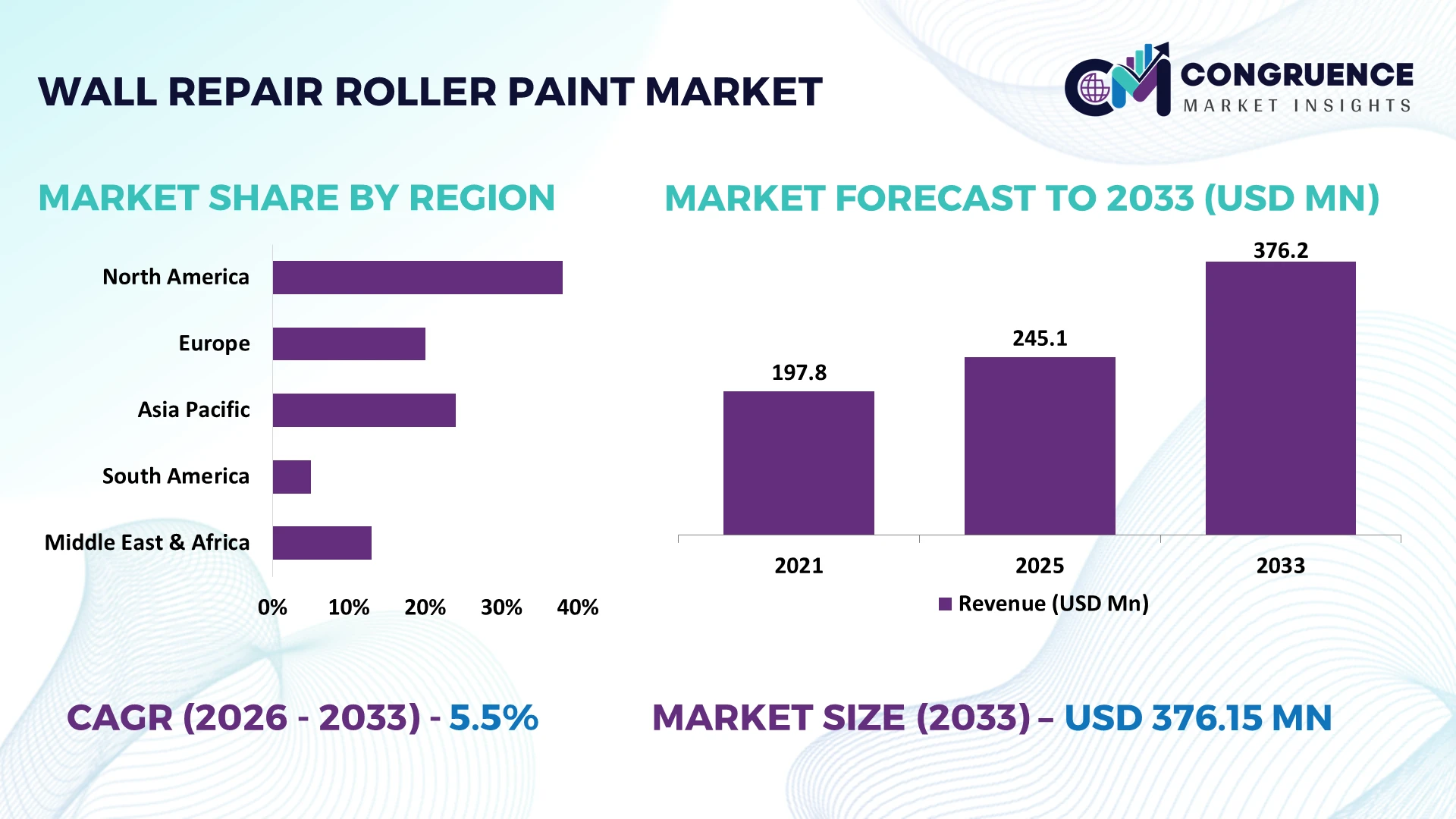
The Global Wall Repair Roller Paint Market was valued at USD 245.1 Million in 2025 and is anticipated to reach a value of USD 376.15 Million by 2033 expanding at a CAGR of 5.5% between 2026 and 2033. Growth is driven by rising residential repainting activity, demand for integrated crack-filling and coating products, water-based low-VOC formulations, and labor-saving roller application systems.
China represents a major manufacturing and consumption center for wall repair roller paint, supported by extensive residential housing infrastructure, established coatings production, and large-scale renovation activity. The country produces approximately 30% of global paint and coatings output, providing substantial capacity for acrylic emulsions, fillers, and specialty wall coatings. Its urbanization rate exceeded 67% in 2024, sustaining opportunities for apartment maintenance and interior refurbishment. Compared with India, where housing expansion supports new construction demand, China's mature urban housing stock creates stronger opportunities for recurring wall restoration and maintenance products.
Strategic implication: Manufacturers combining crack-bridging formulations, simplified roller application, and established renovation distribution channels are positioned to capture higher-value residential maintenance demand.
Key Highlights of the Global Wall Repair Roller Paint Market
-
Market Size & Growth: USD 245.1 million in 2025, reaching USD 376.15 million by 2033 at 5.5% CAGR, supported by integrated wall repair coatings.
-
Top Growth Drivers: China's 67% urbanization, approximately 30% global coatings production contribution, and increasing residential renovation intensity underpin demand.
-
Short-Term Forecast: By 2028, integrated repair coatings targeting 10–15% shorter application cycles will strengthen contractor productivity and DIY convenience.
-
Emerging Technologies: Three innovations—elastomeric acrylic binders, microfiber roller applicators, and fast-drying polymer fillers—improve repair consistency and application control.
-
Regional Leaders: Asia-Pacific leads manufacturing scale, Europe prioritizes low-emission coatings, and North America emphasizes DIY renovation; verified regional USD allocations remain unavailable.
-
Consumer/End-User Trends: Single-step repair systems combine 2 functions, surface defect filling and decorative finishing, reducing separate product handling during minor repairs.
-
Pilot/Case Example: In 2025, commercial acrylic crack-bridging systems offered approximately 0.5 mm crack accommodation under specified testing conditions, supporting renovation applications.
-
Competitive Landscape: AkzoNobel, PPG, Sherwin-Williams, Nippon Paint, and Asian Paints compete in adjacent repair coatings; verified segment-specific leadership shares remain unavailable.
-
Regulatory & ESG Impact: The EU's 30 g/L VOC limit for certain interior matt coatings encourages water-based, low-emission repair paint development.
-
Investment & Funding: Coatings manufacturers are expanding water-based formulation capabilities; verified wall repair roller paint-specific investment totals remain unavailable.
-
Innovation & Future Outlook: Two-in-one repair coatings, refillable roller systems, and rapid-curing polymers support differentiated renovation products through 2033.
The Wall Repair Roller Paint Market serves residential renovation, rental property maintenance, commercial refurbishment, and DIY surface restoration. Product innovation increasingly combines acrylic fillers, flexible binders, and integrated roller applicators to simplify treatment of hairline cracks, minor dents, and uneven interior surfaces. Water-based coatings meeting VOC limits of 30 g/L for applicable interior matt paint categories support low-emission renovation specifications. China's established coatings manufacturing network strengthens material sourcing, while European product development emphasizes indoor air quality and application convenience. Competitive positioning increasingly depends on repair coverage, drying performance, surface compatibility, and distribution accessibility, establishing the foundation for strategic market evaluation.
What Is the Strategic Relevance and Future Pathways of the Wall Repair Roller Paint Market?
Wall repair roller paint is becoming strategically important as coatings manufacturers target recurring property maintenance expenditure rather than relying exclusively on conventional decorative repainting cycles. The transition toward integrated repair and finishing products is changing formulation priorities, packaging formats, and retail distribution strategies. China's urbanization rate exceeding 67% creates an extensive installed housing base requiring periodic surface restoration. Meanwhile, European VOC regulations encourage manufacturers to develop water-based acrylic systems that combine crack filling, adhesion, and decorative coverage within simplified application workflows.
Integrated roller repair systems eliminate separate handling stages associated with conventional filler application and subsequent painting. For minor cosmetic defects, manufacturers can target 10–15% shorter application cycles through optimized viscosity, faster drying, and controlled roller deposition. Europe emphasizes low-emission formulations, while India offers opportunities for affordable renovation products distributed through neighborhood paint retailers. During 2026–2028, product differentiation will increasingly depend on measurable coverage, drying consistency, and compatibility with existing painted surfaces.
Apartment turnover maintenance illustrates the commercial opportunity: contractors must repair localized wall defects before repainting occupied or vacant properties. AkzoNobel, Asian Paints, and Nippon Paint are positioned to leverage established coatings distribution and formulation capabilities. Competitive advantage will depend on repeatable repair performance, accessible product formats, and lower labor requirements across routine refurbishment projects.
Wall Repair Roller Paint Market Dynamics
DRIVER:
Residential Refurbishment and Integrated Surface Repair
Recurring residential refurbishment is strengthening demand for roller-applied wall repair coatings that combine minor defect correction with decorative finishing. China's urbanization rate exceeded 67% in 2024, creating an extensive installed housing base requiring maintenance. Water-based acrylic formulations can be engineered to accommodate approximately 0.3–0.5 mm hairline cracks under specified conditions, improving suitability for routine interior restoration. Integrated application systems targeting 10–15% shorter repair cycles reduce separate filler handling and repaint preparation. China's transition toward renovation-led housing expenditure strengthens opportunities for compact repair products. Manufacturers are expanding acrylic binder development, refining roller-compatible viscosity, and strengthening retail distribution. The operational advantage lies in reducing contractor handling time while maintaining consistent surface appearance across repeated maintenance jobs.
RESTRAINT:
Polymer Input Costs and Formulation Constraints
Wall repair roller paint production remains sensitive to acrylic emulsion pricing, titanium dioxide procurement, and specialty additive availability. Titanium dioxide commonly represents approximately 10–25% of selected white architectural coating formulations by weight, depending on opacity requirements and product design. Mineral fillers can account for 20–40% of high-build repair formulations, creating transportation and storage cost exposure. China remains an important source of titanium dioxide and associated coating raw materials, increasing procurement concentration for international manufacturers. Reformulating products to reduce expensive pigments can weaken hiding power or alter application viscosity. Producers are responding through regional mineral sourcing, optimized pigment-volume concentration, and longer-term supplier agreements. Maintaining consistent repair coverage while controlling raw material expenditure remains essential for protecting margins in price-sensitive distribution channels.
OPPORTUNITY:
Fast-Curing Formulations and Compact Repair Systems
Advanced polymer dispersions and multifunctional additives create opportunities for compact wall repair products that reduce maintenance disruption. Water-based acrylic systems designed for touch-dry performance within 30–60 minutes support faster refurbishment workflows under suitable environmental conditions. Manufacturers can target 10–15% shorter application cycles by integrating filling and coating functions into roller-compatible formulations. In India, urban apartment maintenance and rental property refurbishment provide opportunities for smaller packaging formats and localized retail distribution. Low-VOC product development also supports European renovation requirements, including the 30 g/L limit applicable to certain interior matt coatings. Manufacturers are investing in rapid-curing binder research, refillable applicator designs, and contractor-oriented product demonstrations. The strategic opportunity lies in monetizing convenience through repeat-use maintenance products rather than conventional paint volume alone.
CHALLENGE:
Substrate Variability and Consistent Repair Performance
Commercial scaling requires reliable performance across plaster, gypsum board, cement render, and previously painted surfaces. Substrate moisture variations exceeding 5% can affect adhesion and drying behavior, depending on measurement method and material specification. Repair coatings designed for approximately 0.3–0.5 mm hairline cracks must also maintain flexibility after repeated temperature and humidity exposure. In India's coastal cities, high ambient humidity complicates drying consistency, while alkaline cementitious substrates create additional formulation requirements. Roller texture, deposited film thickness, and operator technique introduce further application variability. Manufacturers must develop substrate-specific primers, standardized application guidance, and accelerated weathering protocols. Long-term competitiveness depends on minimizing visible repair patches, preventing premature cracking, and ensuring repeatable results across diverse refurbishment environments.
Wall Repair Roller Paint Market Latest Trends
-
High-Build Texture Matching Gains Importance: Renovation contractors increasingly specify roller coatings capable of reproducing existing wall finishes without extensive surface preparation. Nap lengths of 9–18 mm support different texture profiles, while controlled coating thickness reduces visible patch boundaries. Manufacturers are refining rheology modifiers and mineral filler distributions to improve application consistency. The commercial advantage lies in minimizing full-wall repainting when localized cosmetic restoration achieves acceptable visual uniformity.
-
Moisture-Resistant Coatings Target Problem Areas: Property maintenance teams are prioritizing specialized coatings for kitchens, bathrooms, and moisture-exposed interior surfaces. Products designed for relative humidity conditions exceeding 70% require dependable film formation and moisture resistance. Suppliers are incorporating hydrophobic polymers and antimicrobial preservation systems into differentiated repair portfolios. European product developers are emphasizing compatibility with ventilation-sensitive spaces, reducing recurring maintenance requirements when underlying moisture sources are addressed.
-
Digital Color Matching Improves Repair Accuracy: Paint retailers and professional decorators are integrating handheld spectrophotometers with computerized tinting systems to improve localized restoration. Digital color evaluation commonly uses ΔE measurements, with values below 2 representing a practical matching objective for selected applications. Manufacturers are connecting tinting databases with repair coating formulations and retail equipment. Improved matching reduces unnecessary repainting area and strengthens repeat purchasing through established distribution networks.
-
Small-Pack Maintenance Products Expand Distribution: Retailers are increasing emphasis on compact repair kits suited to minor household defects and rental property turnover. Packaging formats between 250 mL and 1 L reduce leftover material compared with conventional larger paint containers. Suppliers are adapting roller applicators, resealable packaging, and product instructions for intermittent use. This shift supports convenience-led purchasing while helping distributors serve smaller repair jobs without requiring full-size decorative coating inventories.
Segmentation Analysis
By Type
Interior Wall Repair Paint Maintains Product Leadership
Interior Wall Repair Paint accounted for an estimated 36.8% of global wall repair roller paint demand in 2025, supported by recurring residential refurbishment, apartment turnover maintenance, and compatibility with conventional interior wall substrates. Water-based acrylic formulations dominate product development because they provide practical application characteristics, controlled odor, and compatibility with existing decorative coatings. Textured Repair Paint addresses surface irregularities and finish replication, while Crack-Covering Paint incorporates flexible polymer binders for minor substrate movement. Certain elastomeric formulations accommodate approximately 0.3–0.5 mm hairline cracks under specified testing conditions. Manufacturers are refining pigment dispersion, application viscosity, and roller-compatible film formation to strengthen repair consistency.
Waterproof Repair Paint represents the fastest-growing type, reflecting increasing demand for localized moisture-resistant restoration in bathrooms, kitchens, and exterior-facing interior walls. Mold-Resistant Repair Paint targets surfaces exposed to persistent humidity, while Exterior Wall Repair Paint emphasizes weather resistance and substrate adhesion. Water-based formulations designed to meet applicable 30 g/L VOC limits support low-emission interior renovation requirements. Manufacturers are developing hydrophobic acrylic systems, differentiated primer compatibility, and specialized application guidance. Investment priorities increasingly favor formulations that address specific substrate conditions rather than broad decorative coverage alone.
- The European Coatings Association's 2025 regulatory priorities emphasized chemical compliance, sustainable formulations, and product stewardship. These considerations reinforce demand for water-based repair coatings with documented application performance, appropriate preservative systems, and compliance with applicable interior coating requirements.
By Application
Crack Repair Leads Routine Surface Restoration
Crack and Surface Defect Repair represented an estimated 39.4% of global wall repair roller paint applications in 2025, supported by routine treatment of hairline cracks, minor dents, and localized plaster imperfections. Residential renovation contractors frequently prioritize products that reduce separate filling and finishing operations while maintaining visual compatibility with existing coatings. Interior Wall Restoration remains another substantial application, particularly in rental properties, hospitality interiors, and frequently refurbished commercial spaces. Roller-compatible repair formulations targeting approximately 0.3–0.5 mm cosmetic cracks provide practical alternatives to conventional multistep restoration for suitable substrates. Manufacturers are developing high-build acrylic coatings and controlled texture formulations to improve repair coverage.
Dampness and Water Damage Repair represents the fastest-growing application as property owners address localized moisture-related deterioration. Mold and Mildew Prevention requires coatings with appropriate resistance properties, while Exterior Wall Restoration emphasizes weather exposure and surface flexibility. Relative humidity exceeding 70% increases the importance of moisture management and suitable coating selection. Suppliers are strengthening moisture-resistant product portfolios, substrate preparation guidance, and contractor training. Commercial demand increasingly favors application-specific repair systems that minimize repeat maintenance while preserving coating adhesion and surface appearance.
- The United States Environmental Protection Agency's 2025 mold guidance continued emphasizing moisture control as the foundation of effective remediation. Its recommendation to dry water-damaged materials within 24–48 hours reinforces the importance of addressing underlying moisture before applying restorative coatings.
By End-User
Residential Property Owners Dominate Repair Consumption
Residential Property Owners accounted for an estimated 43.2% of global wall repair roller paint demand in 2025, supported by household maintenance, minor cosmetic restoration, and do-it-yourself refurbishment. Compact repair products appeal to homeowners seeking localized surface correction without extensive contractor involvement. Painting and Decorating Contractors represent an established professional customer group requiring consistent texture matching, predictable coverage, and reliable drying performance. Packaging between 250 mL and 1 L supports smaller household maintenance tasks, while larger formats remain relevant for repeated professional applications. Manufacturers are expanding consumer-oriented applicator designs, instructional packaging, and retail distribution partnerships to improve product accessibility.
Facility Maintenance Providers represent the fastest-growing end-user group, reflecting recurring repair requirements across managed buildings, institutional properties, and service-intensive facilities. Commercial Property Managers prioritize standardized maintenance products that simplify procurement, while Construction and Renovation Companies emphasize substrate compatibility and application productivity. Integrated roller repair systems targeting 10–15% shorter application cycles provide a practical productivity objective for suitable cosmetic repairs. Suppliers are developing contractor-oriented product ranges, maintenance kits, and consistent replacement applicator formats. Competitive positioning increasingly depends on repeat-use convenience, predictable results, and dependable distribution across professional maintenance channels.
- The Joint Center for Housing Studies of Harvard University continued tracking substantial homeowner improvement and repair activity in its 2025 remodeling analysis. This established renovation expenditure base supports opportunities for compact wall restoration products and recurring household maintenance applications.
Region-Wise Market Insights
Asia-Pacific accounted for the largest market share at an estimated 38.5% in 2025 however, Asia-Pacific is expected to register the fastest growth, expanding at a CAGR of 6.8% between 2026 and 2033.

North America Wall Repair Roller Paint Market
DIY Renovation and Professional Maintenance Product Integration
North America represented an estimated 28.5% of global wall repair roller paint demand in 2025, supported by established home improvement distribution networks, residential refurbishment activity, and professional property maintenance services. The United States dominates regional consumption, while Canada contributes through renovation and rental housing maintenance. Manufacturers are expanding roller-compatible acrylic repair coatings, high-build textured finishes, and compact restoration kits through hardware retailers and professional paint distributors. The region's large installed housing base supports recurring treatment of drywall imperfections, hairline cracks, and localized surface damage. Sherwin-Williams, PPG, and Behr compete through product accessibility, application convenience, and established contractor relationships. The United States maintains more than 140 million housing units, providing a substantial foundation for recurring wall maintenance demand. Competitive differentiation increasingly depends on texture compatibility, consistent color matching, and reduced application preparation.
United States Market Outlook: The United States benefits from extensive DIY retail infrastructure, established architectural coatings manufacturing, and specialized drywall repair product distribution. Sherwin-Williams and PPG maintain broad contractor-facing distribution capabilities, supporting access to repair coatings and application accessories. Digital color matching and computerized tinting improve localized surface restoration. The country's substantial rental housing inventory creates recurring opportunities for apartment turnover maintenance, minor drywall repair, and standardized refurbishment products.
Europe Wall Repair Roller Paint Market
Low-Emission Formulations and Renovation Efficiency
Europe accounted for an estimated 25.2% of global wall repair roller paint demand in 2025, supported by established renovation markets, stringent coating chemical requirements, and demand for application-efficient restoration products. Germany, the United Kingdom, France, and Italy represent important consumption centers, with manufacturers emphasizing water-based acrylic formulations, controlled odor, and surface finish compatibility. European Union VOC regulations establish a 30 g/L limit for certain interior matt coatings, encouraging development of low-emission repair formulations. Manufacturers increasingly integrate mineral fillers, flexible polymer binders, and specialized rheology modifiers to improve defect coverage and roller application consistency. AkzoNobel, DAW, and other regional coatings producers compete through professional decorator channels and renovation-focused product portfolios. The strategic shift favors formulations that satisfy chemical compliance requirements while reducing visible patch boundaries and unnecessary repainting.
Germany Market Outlook: Germany maintains a sophisticated architectural coatings manufacturing industry supported by advanced polymer chemistry, technical application standards, and professional decorator networks. DAW and other domestic manufacturers supply specialized interior coatings and surface preparation products. The country's renovation sector increasingly prioritizes low-emission formulations and compatibility with existing plaster substrates. Professional applicators benefit from standardized coating specifications, specialized primers, and precise texture matching across residential and commercial refurbishment projects.
Asia-Pacific Wall Repair Roller Paint Market
Manufacturing Scale and Urban Housing Refurbishment
Asia-Pacific leads global wall repair roller paint demand, supported by concentrated coatings manufacturing, extensive urban housing inventories, and expanding renovation distribution networks. China represents the largest regional production center, while India contributes through residential construction, repainting activity, and organized decorative coatings retail expansion. Japan and South Korea emphasize compact repair formats, controlled application characteristics, and high-quality interior finishes. China's urbanization rate exceeded 67% in 2024, creating an extensive installed housing base requiring recurring surface maintenance. Regional manufacturers increasingly develop water-based acrylic repair products, flexible crack-covering formulations, and integrated roller applicators. India's established dealer networks support distribution beyond major metropolitan centers. Manufacturers are strengthening local polymer sourcing, expanding specialized repair portfolios, and adapting packaging to household purchasing preferences. Competitive positioning depends on affordable formulation performance, dependable availability, and compatibility with common wall substrates.
China Market Outlook: China benefits from extensive architectural coatings production capacity, established chemical manufacturing clusters, and large-scale residential refurbishment requirements. Domestic manufacturers including SKSHU and Carpoly supply decorative and protective coatings through established distribution networks. The country's substantial apartment inventory supports localized plaster restoration and interior repainting. Advanced acrylic emulsion production, automated pigment dispersion, and integrated packaging capabilities strengthen manufacturing efficiency and product customization.
South America Wall Repair Roller Paint Market
Residential Maintenance and Localized Coatings Production
South America represented approximately 4.8% of global wall repair roller paint demand in 2025, with Brazil accounting for the largest regional consumption concentration. Urban residential maintenance, commercial refurbishment, and decorative coatings distribution support demand for minor surface restoration products. Brazil maintains an established architectural paint manufacturing industry, enabling local sourcing of conventional coating formulations and application accessories. Manufacturers increasingly target textured repair coatings, crack-covering products, and moisture-resistant finishes suited to regional construction materials. Suvinil, Coral, and other established paint brands influence consumer purchasing through retail visibility and professional applicator relationships. Product affordability remains important, particularly where renovation projects prioritize localized repairs over complete surface replacement. Manufacturers are adapting packaging formats, strengthening domestic distribution, and developing application guidance for masonry and plaster surfaces to improve commercial accessibility.
Brazil Market Outlook: Brazil benefits from established architectural coatings production, extensive urban housing infrastructure, and strong decorative paint retail networks. The country's urban population exceeds 85%, concentrating refurbishment activity in metropolitan residential and commercial properties. Domestic manufacturing capabilities support acrylic emulsions, mineral-filled coatings, and specialized surface restoration products. Suppliers increasingly emphasize moisture resistance, texture compatibility, and affordable application systems suited to common masonry construction methods.
Middle East & Africa Wall Repair Roller Paint Market
Construction Refurbishment and Climate-Resistant Surface Protection
The Middle East & Africa accounted for approximately 3.0% of global wall repair roller paint demand in 2025, supported by commercial property maintenance, residential refurbishment, and hospitality infrastructure development. Saudi Arabia and the United Arab Emirates represent important premium coatings markets, while South Africa contributes through established architectural paint manufacturing and renovation activity. High temperatures, ultraviolet exposure, and localized moisture conditions create demand for flexible repair coatings and durable exterior surface restoration. Manufacturers are expanding acrylic elastomeric formulations, textured coatings, and moisture-resistant repair systems through professional contractor networks. Saudi Arabia's Vision 2030 development programs support extensive construction and property maintenance activity. Regional suppliers increasingly collaborate with international coatings manufacturers and local distributors to improve product availability, application training, and performance under demanding environmental conditions.
Saudi Arabia Market Outlook: Saudi Arabia benefits from large-scale construction investment, hospitality development, and expanding residential infrastructure. Riyadh and Jeddah represent important markets for professional wall finishing and refurbishment products. Summer temperatures frequently exceed 40°C, increasing the importance of appropriate coating application conditions and substrate preparation. Manufacturers are developing flexible acrylic repair systems, specialized primers, and protective finishes suited to thermal exposure and masonry surfaces.
Market Competition Landscape
The wall repair roller paint market features competition between Sherwin-Williams, PPG, AkzoNobel, Nippon Paint, and Asian Paints, alongside specialized regional coating suppliers. The five leading groups collectively represent an estimated 35–40% of global segment demand, reflecting fragmented distribution and localized product preferences. Sherwin-Williams and PPG compete through professional contractor networks, while AkzoNobel emphasizes formulation technology and renovation-focused product portfolios. Nippon Paint and Asian Paints leverage extensive Asian distribution and localized application expertise. Water-based repair formulations meeting applicable 30 g/L VOC limits strengthen regulatory positioning, while integrated products targeting 10–15% shorter application cycles support productivity differentiation. Manufacturers are expanding acrylic binder development, compact repair packaging, and digital color matching capabilities. Raw material procurement, substrate compatibility, and consistent texture reproduction remain important competitive barriers. Market leadership requires reliable repair coverage, efficient application, affordable consumables, and established access to professional and household renovation channels.
Companies Profiled in the Wall Repair Roller Paint Market Report
-
The Sherwin-Williams Company
-
PPG Industries, Inc.
-
AkzoNobel N.V.
-
Nippon Paint Holdings Co., Ltd.
-
Asian Paints Limited
-
Kansai Paint Co., Ltd.
-
Jotun A/S
-
DAW SE
-
Hempel A/S
-
SKSHU Paint Co., Ltd.
-
Carpoly Chemical Group Co., Ltd.
-
RPM International Inc.
-
Berger Paints India Limited
-
KCC Corporation
Technology Insights for the Wall Repair Roller Paint Market
Waterborne acrylic emulsions, elastomeric binders, and rheology modifiers underpin modern wall repair roller paints. High-build formulations combine mineral fillers with flexible polymers to conceal surface imperfections while maintaining adhesion. Selected crack-bridging coatings accommodate openings approaching 0.5 mm under specified testing conditions. Roller-compatible viscosity controls splashing, sagging, and deposited film thickness. Compared with conventional separate filling and painting, integrated repair coatings targeting 10–15% shorter application cycles offer contractors measurable productivity advantages, provided defects remain cosmetic and substrates require no structural remediation.
Emerging technologies include self-crosslinking acrylic dispersions, hydrophobic polymer networks, and microencapsulated functional additives. Waterborne formulations meeting applicable 30 g/L VOC limits support low-emission interior applications. Digital spectrophotometers and automated tinting equipment improve localized color matching, with ΔE values below 2 serving as practical targets for selected finishes. Adoption is established in professional paint retail channels, although integrated roller repair products remain specialized offerings. Manufacturers benefit from differentiated formulations, improved consistency, and stronger contractor relationships.
Between 2026 and 2028, automated pigment dispersion, refillable applicators, and moisture-resistant polymer systems will shape product development. Packaging between 250 mL and 1 L supports targeted maintenance applications. Established suppliers gain distribution advantages, while specialists compete through surface compatibility, reliable texture reproduction, and simplified application workflows.
Recent Developments in the Global Wall Repair Roller Paint Market
-
August 2025: Nippon Paint introduced Aqua Proof 7 in 1 in Sri Lanka, combining waterproofing, hairline crack coverage, and antifungal protection. The upgraded coating addresses monsoon-related wall deterioration, expanding the company's multifunctional exterior maintenance portfolio. Source: lankabusinessnews.com
-
February 2026: Jotun launched Jotashield Eterna in India, introducing self-cleaning exterior wall protection with a 12-year warranty. Advanced binders and weather-resistant pigments address dirt accumulation and fading, strengthening premium renovation specifications and reducing repainting frequency. Source: architectandinteriorsindia.com
-
April 2026: Sherwin-Williams introduced Emerald Symmetry Interior Acrylic, featuring a zero-VOC formulation incorporating plant-based technology. The launch strengthens premium interior maintenance and repainting options, combining enhanced hiding performance with reduced coating emissions for renovation projects. Source: prnewswire.com
-
April 2026: Nippon Paint launched Perfect Top Si Heat-Shielding Option in Japan, combining roller-friendly application with an expected 15-year service life. Its heat-reflective silicone formulation expands exterior refurbishment capabilities, addressing surface temperatures and durability requirements. Source: linkedin.com
Scope of the Wall Repair Roller Paint Market Report
The Wall Repair Roller Paint Market Report examines product innovation, manufacturing capabilities, application requirements, and competitive positioning between 2026 and 2033. Type segmentation covers Textured Repair Paint, Crack-Covering Paint, Waterproof Repair Paint, Mold-Resistant Repair Paint, Interior Wall Repair Paint, and Exterior Wall Repair Paint. Application analysis includes Crack and Surface Defect Repair, Dampness and Water Damage Repair, Mold and Mildew Prevention, Interior Wall Restoration, and Exterior Wall Restoration. End-user coverage evaluates Residential Property Owners, Painting and Decorating Contractors, Commercial Property Managers, Construction and Renovation Companies, and Facility Maintenance Providers.
Regional assessment spans North America, Europe, Asia-Pacific, South America, and Middle East & Africa. The report evaluates 14 competitive participants, acrylic polymer technologies, application efficiency, moisture resistance, and specialized repair packaging. Strategic insights support product investment, distribution expansion, formulation development, supplier selection, and competitive differentiation across residential and professional maintenance channels.
Wall Repair Roller Paint Market Report Summary
| Report Attribute/Metric | Report Details |
|---|
Market Revenue in 2025 | USD 245.1 Million |
Market Revenue in 2033 | USD 376.15 Million |
CAGR (2026 - 2033) | 5.5% |
Base Year | 2025 |
Forecast Period | 2026 - 2033 |
Historic Period | 2021 - 2025 |
Segments Covered | By TypeMold-Resistant Repair Paint Interior Wall Repair Paint Exterior Wall Repair Paint
By ApplicationCrack and Surface Defect Repair Dampness and Water Damage Repair Mold and Mildew Prevention Interior Wall Restoration Exterior Wall Restoration
By End-UserResidential Property Owners Painting and Decorating Contractors Commercial Property Managers Construction and Renovation Companies Facility Maintenance Providers
|
Key Report Deliverable | Revenue Forecast, Growth Trends, Market Dynamics, Segmental Overview, Regional and Country-wise Analysis, Competition Landscape |
Region Covered | North America, Europe, Asia-Pacific, South America, Middle East, Africa |
Key Players Analyzed | The Sherwin-Williams Company, PPG Industries, Inc., AkzoNobel N.V., Nippon Paint Holdings Co., Ltd., Asian Paints Limited, Kansai Paint Co., Ltd., Jotun A/S, DAW SE, Hempel A/S, SKSHU Paint Co., Ltd., Carpoly Chemical Group Co., Ltd., RPM International Inc., Berger Paints India Limited, KCC Corporation |
Customization & Pricing | Available on Request (10% Customization is Free) |