
Reports
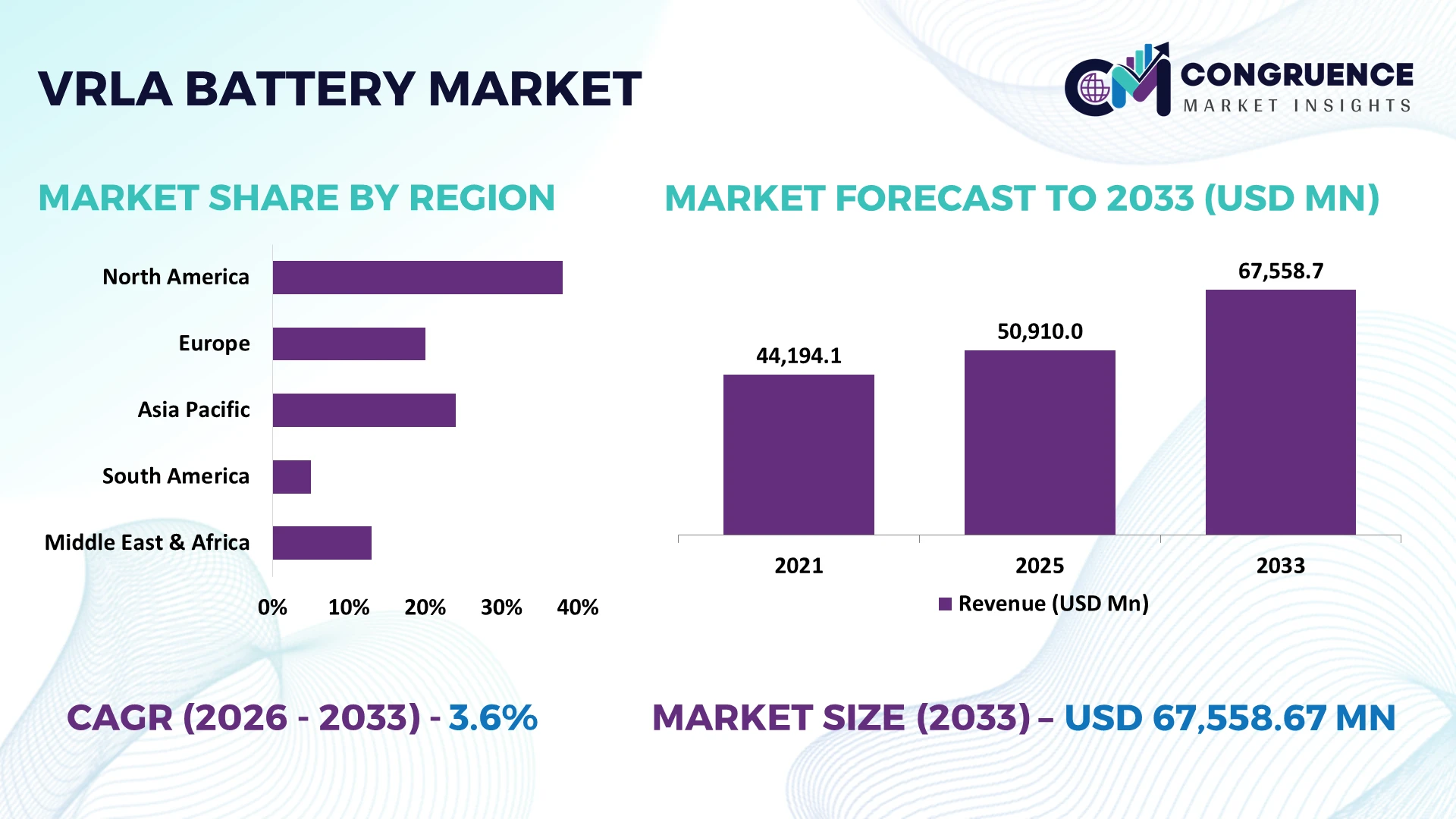
The Global VRLA Battery Market was valued at USD 50910 Million in 2025 and is anticipated to reach a value of USD 67558.67 Million by 2033 expanding at a CAGR of 3.6% between 2026 and 2033. Expansion of telecom infrastructure, grid-scale backup systems, data centers, industrial UPS installations, and renewable energy storage continues to strengthen long-term demand for advanced VRLA battery solutions with improved cycle life and maintenance-free performance.
China remains the dominant country, accounting for approximately 42% of global manufacturing capacity, supported by large-scale telecom, renewable energy, rail, and industrial backup applications alongside continued investments exceeding USD 8 billion in battery manufacturing upgrades. Compared with India, where industrial battery deployment is expanding rapidly through infrastructure and digitalization projects, China maintains higher production efficiency and broader export capability. Ongoing supply-chain diversification following global trade realignments further reinforces regional manufacturing competitiveness.
Manufacturers strengthening localized production, advanced lead-acid technologies, and resilient supply chains are positioned to secure long-term competitive advantage across high-growth industrial applications.
Market Size & Growth: USD 50910 Million in 2025, projected to reach USD 67558.67 Million by 2033 at a CAGR of 3.6%, supported by expanding telecom infrastructure and industrial backup power demand.
Top Growth Drivers: Telecom backup installations contribute over 28% of demand, data center expansion exceeds 18% growth, and renewable energy storage integration rises by 16%.
Short-Term Forecast: By 2028, manufacturing automation reduces production costs by approximately 9% while battery reliability improves by nearly 12%.
Emerging Technologies: AI-enabled battery monitoring, advanced AGM designs, and smart predictive maintenance improve operational efficiency by more than 15%.
Regional Leaders: Asia Pacific exceeds USD 31 billion, North America approaches USD 14 billion, and Europe surpasses USD 12 billion, driven by localized manufacturing and resilient supply chains.
Consumer/End-User Trends: More than 55% of industrial UPS and telecom operators prioritize maintenance-free VRLA systems for critical infrastructure.
Pilot/Case Example: In 2026, an industrial energy backup deployment improved system availability by 18% through intelligent battery management integration.
Competitive Landscape: Top manufacturers collectively account for approximately 46% market share, led by EnerSys, East Penn Manufacturing, Exide Technologies, GS Yuasa, and C&D Technologies.
Regulatory & ESG Impact: Battery recycling initiatives recover over 95% of lead materials, strengthening circular manufacturing and environmental compliance across major markets.
Investment & Funding: More than USD 3 billion supports manufacturing expansion, automation, and strategic regional partnerships amid global supply-chain diversification.
Innovation & Future Outlook: High-performance separators, carbon-enhanced electrodes, and digital battery diagnostics accelerate next-generation industrial energy storage strategies.
Maintenance-free power backup requirements across telecom networks, data centers, utilities, healthcare, and transportation continue to strengthen demand for advanced VRLA battery solutions. Manufacturers are introducing intelligent battery monitoring and longer-life AGM technologies, improving operational efficiency by nearly 15%. Increasing localization of battery manufacturing and recycling initiatives, supported by evolving industrial compliance requirements, is reinforcing supply-chain resilience and setting the foundation for the strategic market assessment that follows.
The VRLA Battery Market has become strategically important as industries prioritize resilient backup power, localized manufacturing, and infrastructure modernization across telecom, utilities, transportation, and digital facilities. Supply-chain restructuring since recent global trade realignments has accelerated domestic battery production and procurement diversification, reducing dependence on single-country sourcing. Industrial operators increasingly value maintenance-free energy storage capable of supporting uninterrupted operations, creating stronger competitive differentiation for manufacturers with integrated production, recycling, and distribution capabilities.
Advanced AGM-based VRLA batteries now deliver approximately 18% longer service life and reduce maintenance requirements by nearly 25% compared with conventional flooded lead-acid systems, lowering lifecycle operating costs for critical installations. China continues to lead large-scale production and manufacturing efficiency, while India is expanding deployment through telecom network upgrades and industrial automation projects. During the next two to three years, digital battery monitoring adoption is expected to exceed 40% of new industrial backup installations, improving predictive maintenance and operational continuity.
A recent utility-scale substation modernization project integrating intelligent VRLA battery management reduced maintenance interventions by nearly 20% while improving system availability. Manufacturers are expanding localized production, strengthening recycling partnerships, and investing in smart battery diagnostics to improve supply resilience. Companies combining operational reliability, digital monitoring capabilities, and circular manufacturing practices will strengthen competitive positioning across increasingly performance-driven industrial markets.
Rapid expansion of telecom towers, hyperscale data centers, industrial automation, and grid infrastructure continues to strengthen demand for high-reliability VRLA battery systems. More than 60% of telecom backup installations still rely on lead-acid technologies because of proven reliability and established service networks, while advanced AGM configurations improve operational efficiency by approximately 15%. India is accelerating digital infrastructure deployment, and China continues investing in battery manufacturing modernization to support domestic and export demand. These structural shifts encourage manufacturers to expand automated production lines, improve recycling capabilities, and establish long-term supply agreements. Companies integrating intelligent battery monitoring with maintenance-free designs are securing stronger positions in mission-critical industrial applications through improved asset reliability and reduced service requirements.
Lead price fluctuations, stricter environmental regulations, and uneven recycling infrastructure continue to limit operational flexibility for battery manufacturers. Raw material costs can represent more than 45% of total production expenses, while compliance investments have increased operating expenditure by approximately 10% for several manufacturers. China’s environmental enforcement and evolving battery recycling standards require additional processing investments, affecting production planning and export competitiveness. Companies are responding by diversifying supplier networks, increasing localized sourcing, expanding closed-loop recycling operations, and negotiating long-term procurement contracts. Businesses that improve material recovery efficiency and stabilize procurement strategies achieve stronger cost predictability and greater resilience against commodity market disruptions.
Growing integration of intelligent battery management platforms with industrial energy infrastructure is creating new value beyond traditional backup applications. Digital monitoring solutions reduce unexpected battery failures by nearly 30%, while predictive maintenance lowers inspection requirements by approximately 20%. Japan and India are expanding investments in resilient power infrastructure, creating demand for advanced VRLA systems supporting renewable energy backup and critical industrial operations. Manufacturers are increasing R&D spending on carbon-enhanced lead technologies, intelligent diagnostics, and recyclable battery components while forming partnerships with automation providers. A less obvious opportunity lies in lifecycle management services, allowing suppliers to generate recurring service revenue alongside hardware deployment and recycling programs.
The primary long-term challenge extends beyond manufacturing capacity to integrating connected battery systems across complex industrial environments. More than 35% of legacy facilities continue operating without centralized battery health management, increasing maintenance complexity and reducing operational visibility. Industrial operators also face shortages of specialized technicians capable of managing advanced monitoring platforms and predictive maintenance software. Manufacturers must standardize communication protocols, strengthen cybersecurity for connected battery management systems, and invest in workforce training to ensure consistent deployment quality. Companies building integrated digital service ecosystems, technical support capabilities, and interoperable battery management solutions will establish stronger operational resilience and maintain competitive advantage as industrial infrastructure becomes increasingly connected.
Smart Battery Intelligence Expansion Industrial operators are integrating AI-enabled battery monitoring into backup power systems, with connected battery management adoption exceeding 38% of new installations and predictive diagnostics reducing maintenance visits by nearly 22%. Digital infrastructure upgrades in India and Japan are accelerating deployment, while manufacturers are expanding software partnerships and embedded monitoring capabilities to improve uptime and reduce lifecycle servicing costs.
Localized Manufacturing Acceleration Supply-chain diversification continues reshaping production networks as localized battery sourcing has increased by approximately 20% and automated manufacturing lines improve output efficiency by nearly 14%. China remains the largest production hub while India strengthens domestic manufacturing through industrial expansion initiatives. Companies are restructuring procurement strategies, expanding regional production capacity, and securing long-term supplier agreements to improve delivery reliability.
Advanced AGM Product Evolution Premium AGM battery adoption has grown by roughly 18% across critical infrastructure applications due to improved durability, lower maintenance, and faster installation. Enhanced separator materials increase service life by nearly 15%, supporting operational continuity in telecom and industrial facilities. Manufacturers are prioritizing premium product portfolios, automation investments, and engineering collaborations to strengthen performance differentiation in competitive industrial markets.
Circular Recycling Integration Closed-loop battery recycling has become an operational priority, with lead recovery rates consistently exceeding 95% while recycled material usage has increased by approximately 17% across manufacturing operations. Tightening environmental compliance requirements are encouraging producers to integrate recycling partnerships and reverse logistics programs, reducing raw material dependence and improving long-term production stability alongside sustainability objectives.
AGM batteries account for approximately 44% of the VRLA Battery Market, supported by strong deployment across UPS systems, telecom infrastructure, and industrial backup applications. Their maintenance-free operation, vibration resistance, and rapid recharge capability make them the preferred solution for mission-critical environments. High Rate batteries remain strategically important for applications requiring rapid power delivery, particularly in data centers and emergency backup systems. Manufacturers continue investing in separator technology, automated production, and enhanced battery management compatibility to improve operational reliability and product differentiation.
Gel batteries represent the fastest-growing type as demand increases for renewable energy storage and remote industrial installations requiring deeper discharge capability and improved thermal stability. Deep Cycle batteries continue serving off-grid energy systems and industrial mobility applications where repeated discharge performance is essential. Gel battery deployments have increased by nearly 16%, while advanced AGM products improve operational lifespan by approximately 18%. Companies are expanding specialized product portfolios and forming technology partnerships to address evolving industrial performance requirements while balancing cost efficiency with application-specific reliability.
UPS Systems represent the leading application, accounting for approximately 36% of total demand because uninterrupted power availability remains essential across industrial facilities, healthcare institutions, financial services, and digital infrastructure. Battery replacement cycles and expanding edge computing deployments continue supporting consistent demand. Telecommunications is the fastest-growing application, driven by continued 5G infrastructure expansion and remote network deployments. Telecom backup installations have increased by nearly 17%, while intelligent battery monitoring reduces unexpected failures by approximately 20%. Manufacturers are scaling production and integrating digital monitoring capabilities to improve operational continuity.
Renewable Energy applications continue expanding as hybrid storage solutions become more common for distributed energy systems. Automotive demand remains stable through auxiliary power functions, while Emergency Lighting continues requiring reliable maintenance-free battery solutions for commercial buildings and public infrastructure. Companies are increasing production flexibility, strengthening partnerships with telecom operators, and developing application-specific battery configurations to improve deployment efficiency across multiple industrial sectors.
Telecom remains the largest end-user, representing approximately 34% of market demand as uninterrupted network availability requires dependable backup power across base stations, switching facilities, and communication infrastructure. Continuous network modernization and rural connectivity programs maintain large replacement cycles and new installations. Data Centers are the fastest-growing end-user segment, with deployment increasing by approximately 19% as hyperscale facilities require highly reliable backup systems supporting uninterrupted digital operations. Companies are introducing customized battery configurations and intelligent monitoring platforms tailored for mission-critical environments.
Utilities continue investing in substation backup modernization, while Industrial users increasingly adopt VRLA systems to support automation and manufacturing continuity. Automotive applications remain focused on auxiliary power and commercial fleet requirements. Smart battery management integration improves maintenance efficiency by nearly 18%, encouraging suppliers to strengthen enterprise partnerships, expand localized technical support, and develop sector-specific product portfolios. Competitive positioning increasingly depends on customized solutions that align with operational reliability and infrastructure resilience requirements.
Asia-Pacific accounted for the largest market share at 46.8% in 2025 however, Middle East & Africa is expected to register the fastest growth, expanding at a 4.8% between 2026 and 2033.
Critical Infrastructure Reliability Driving Premium Battery Deployment
North America maintains a strong position through widespread deployment across hyperscale data centers, utilities, telecom infrastructure, healthcare facilities, and industrial automation. The region contributes approximately 24% of global demand, supported by replacement-driven procurement and increasing digital infrastructure resilience investments. More than 60% of large enterprise backup installations continue utilizing maintenance-free VRLA technology because of established operational reliability and mature service networks. Utilities are modernizing substations with intelligent battery monitoring platforms, while manufacturers expand localized recycling and production capabilities to improve supply-chain security. Enterprise customers increasingly prioritize lifecycle performance, predictive maintenance compatibility, and regulatory compliance, encouraging suppliers to strengthen technology partnerships and integrated service offerings.
United States Market Outlook: The United States leads regional demand through large-scale data center expansion, utility modernization, and nationwide telecom network upgrades. More than 40% of regional industrial battery deployments support digital infrastructure and mission-critical facilities. Domestic manufacturers continue investing in automation, battery diagnostics, and recycling capabilities, strengthening operational resilience while improving product availability for enterprise customers requiring uninterrupted backup power.
Sustainability Standards Reshaping Industrial Energy Storage
Europe represents approximately 21% of global market activity, supported by industrial modernization, advanced recycling infrastructure, and stringent environmental compliance. Manufacturers increasingly integrate recycled lead into production, while utility operators modernize backup systems for substations and transportation infrastructure. More than 70% of industrial battery recycling capacity operates within regulated recovery frameworks, improving raw material availability and reducing procurement risks. Companies are strengthening regional manufacturing partnerships and expanding premium AGM product portfolios to support industrial automation, healthcare, and renewable integration. Operational efficiency and circular manufacturing increasingly define supplier competitiveness across the region.
Germany Market Outlook: Germany remains the regional technology leader through advanced manufacturing capabilities, industrial automation, and engineering expertise. Approximately 30% of Europe's industrial backup battery demand is linked to German manufacturing, energy, and automotive facilities. Companies continue investing in automated production processes and sustainable recycling systems while strengthening partnerships supporting resilient industrial power infrastructure.
Manufacturing Scale and Infrastructure Expansion
Asia-Pacific dominates the market through unmatched production capacity, expanding industrial infrastructure, and extensive telecom deployment. The region accounts for nearly 47% of global consumption while producing more than half of worldwide VRLA battery output. China, India, Japan, and South Korea continue investing in battery manufacturing automation, improving production efficiency by approximately 15%. Expanding digital infrastructure, transportation modernization, and utility upgrades sustain consistent demand across industrial applications. Manufacturers are strengthening export capabilities, expanding localized production facilities, and integrating intelligent quality-control systems to improve operational performance and supply reliability.
China Market Outlook: China remains the largest manufacturing hub with approximately 42% of global production capacity supported by integrated supply chains, large-scale industrial demand, and advanced manufacturing ecosystems. Domestic producers continue expanding automated production, premium AGM technologies, and recycling operations while strengthening export competitiveness through higher production efficiency and diversified international distribution networks.
Telecom and Utility Modernization Supporting Demand
South America continues expanding VRLA battery deployment through telecommunications, mining operations, renewable integration, and utility modernization initiatives. The region contributes approximately 5% of global demand while infrastructure investment steadily improves industrial backup requirements. Telecom operators continue upgrading network resilience, and mining facilities increasingly deploy maintenance-free battery systems to reduce operational downtime. Infrastructure limitations and import dependency remain operational constraints; however, manufacturers are strengthening distributor partnerships and localized service capabilities. Companies increasingly focus on application-specific solutions that improve reliability in remote industrial environments.
Brazil Market Outlook: Brazil leads regional demand through extensive telecom infrastructure, mining operations, and expanding industrial facilities. More than 45% of South American VRLA battery deployments occur within Brazil, supported by utility modernization and commercial infrastructure investment. Manufacturers continue expanding local distribution networks and technical support capabilities to improve service responsiveness and enterprise customer retention.
Infrastructure Investment Accelerating Backup Power Deployment
The Middle East & Africa is experiencing strong operational momentum through digital infrastructure expansion, utility modernization, transportation projects, and smart city development. The region accounts for approximately 3% of global demand but records the strongest deployment momentum driven by industrial diversification and critical infrastructure investment. Telecom operators continue expanding remote connectivity, while utilities deploy advanced backup systems supporting grid stability. Strategic partnerships, localized warehousing, and regional technical service networks are improving equipment availability and reducing delivery timelines. Companies increasingly prioritize resilient power infrastructure capable of supporting uninterrupted industrial operations.
Saudi Arabia Market Outlook: Saudi Arabia leads regional investment through large-scale infrastructure modernization, industrial diversification, and smart city initiatives. More than 35% of regional enterprise battery installations support utilities, telecom networks, and industrial facilities. Manufacturers are expanding regional partnerships, localized inventory management, and technical service operations to support national infrastructure transformation and long-term operational reliability.
The VRLA Battery Market is led by EnerSys, GS Yuasa, East Penn Manufacturing, Exide Technologies, and C&D Technologies, while regional manufacturers compete aggressively on localized supply and pricing. The top five players collectively control approximately 46% of market share, competing through manufacturing efficiency, product reliability, digital battery management, and distribution reach rather than price alone. Premium manufacturers emphasize advanced AGM technologies delivering nearly 18% longer service life, while cost-focused suppliers reduce production expenses by approximately 10% through automation and localized sourcing. Competition increasingly centers on vertical integration, recycling capability, customized industrial solutions, and strategic partnerships with telecom operators, utilities, and data center developers. Manufacturers are expanding regional production facilities to reduce logistics risk and strengthen supply resilience. The primary entry barrier remains integrated manufacturing, recycling infrastructure, and certification capability. Sustainable competitiveness depends on combining product performance, resilient supply chains, intelligent battery monitoring, and responsive enterprise support.
EnerSys
GS Yuasa Corporation
East Penn Manufacturing Co.
Exide Technologies
C&D Technologies
Clarios
Leoch International Technology Limited
CSB Battery Co., Ltd.
FIAMM Energy Technology S.p.A.
Vision Group
Narada Power Source Co., Ltd.
Hoppecke Batterien GmbH & Co. KG
Amara Raja Energy & Mobility Limited
Chaowei Power Holdings Limited
Advanced absorbed glass mat (AGM), gel electrolyte optimization, and Thin Plate Pure Lead (TPPL) technologies remain the core innovations shaping the VRLA Battery Market. AGM batteries now represent more than 44% of industrial deployments because they improve recharge efficiency by approximately 15% and extend operational life by nearly 18% compared with conventional flooded lead-acid batteries. Manufacturers are increasingly integrating intelligent battery management systems with industrial UPS, telecom infrastructure, and utility backup networks, reducing unplanned maintenance by around 20% while improving asset utilization across mission-critical facilities.
Emerging technologies between 2026 and 2028 include AI-enabled battery diagnostics, digital twin-based lifecycle management, carbon-enhanced lead electrodes, and automated manufacturing inspection. Connected battery monitoring has reached nearly 40% of new enterprise installations, enabling predictive maintenance and reducing field service costs by approximately 12%. Automated quality inspection using machine vision improves manufacturing consistency while minimizing production defects, allowing premium manufacturers to strengthen competitive differentiation through higher reliability and faster product validation.
Disruptive innovation is shifting from standalone battery products toward intelligent energy storage ecosystems integrating cloud analytics, predictive maintenance, and circular recycling operations. Compared with legacy monitoring practices, digital battery management improves fault detection accuracy by nearly 30% while reducing maintenance response times by approximately 25%. Companies investing early in connected diagnostics, automated production, and advanced recycling infrastructure will secure stronger enterprise partnerships, improve operational resilience, and establish competitive leadership as industrial infrastructure becomes increasingly digitized through 2028.
May 2026 EnerSys launched the AlphaCell™ 4.0HP+ TPPL battery for outdoor communications networks, engineered to improve replacement interval stability in edge deployments. The platform enhances electrochemical stability for demanding environments, strengthening telecom infrastructure reliability. Source: (EnerSys Investor Relations)
March 2026 EnerSys announced cumulative sales exceeding 4 million Hawker® ARMASAFE™ Plus 6TAGM AGM batteries worldwide, demonstrating long-term deployment across industrial and defense applications. The milestone reinforces the company's leadership in premium maintenance-free AGM battery technology. Source: (EnerSys)
March 2026 GS Yuasa introduced its first Yuasa YBX9625 AGM commercial vehicle battery, expanding its heavy-duty portfolio with maintenance-free AGM technology for commercial fleets. The product strengthens endurance and rapid recharge performance for high electrical-load vehicles. Source: (GS Yuasa)
May 2025 GS Yuasa renewed its ECO.R Revolution automotive battery series, improving long-life durability and high starting performance while unifying product branding. The upgraded range supports modern stop-start vehicles through enhanced charging capability and product standardization.
The report provides comprehensive analysis of the global VRLA Battery Market across AGM, Gel, Deep Cycle, and High Rate battery technologies, evaluating their performance, deployment characteristics, and evolving industrial relevance. It examines key applications including UPS Systems, Telecommunications, Automotive, Renewable Energy, and Emergency Lighting while assessing demand across Telecom, Data Centers, Utilities, Automotive, and Industrial end-users. Regional assessment covers North America, Europe, Asia-Pacific, South America, and the Middle East & Africa, supported by country-level operational insights and competitive benchmarking.
The study evaluates technology adoption trends, manufacturing developments, battery management innovations, recycling strategies, and supply-chain transformation influencing market direction between 2026 and 2033. It profiles more than 10 major industry participants, highlights deployment patterns across critical infrastructure, and assesses shifting investment priorities, product positioning, enterprise partnerships, and operational strategies. The report supports market entry planning, expansion decisions, competitive assessment, portfolio optimization, and long-term business strategy through data-driven analysis of evolving industrial demand and technology adoption.
| Report Attribute/Metric | Report Details |
|---|---|
Market Revenue in 2025 | USD 50910 Million |
Market Revenue in 2033 | USD 67558.67 Million |
CAGR (2026 - 2033) | 3.6% |
Base Year | 2025 |
Forecast Period | 2026 - 2033 |
Historic Period | 2021 - 2025 |
Segments Covered | By Type
By Application
By End-User
|
Key Report Deliverable | Revenue Forecast, Growth Trends, Market Dynamics, Segmental Overview, Regional and Country-wise Analysis, Competition Landscape |
Region Covered | North America, Europe, Asia-Pacific, South America, Middle East, Africa |
Key Players Analyzed | EnerSys, GS Yuasa Corporation, East Penn Manufacturing Co., Exide Technologies, C&D Technologies, Clarios, Leoch International Technology Limited, CSB Battery Co., Ltd., FIAMM Energy Technology S.p.A., Vision Group, Narada Power Source Co., Ltd., Hoppecke Batterien GmbH & Co. KG, Amara Raja Energy & Mobility Limited, Chaowei Power Holdings Limited |
Customization & Pricing | Available on Request (10% Customization is Free) |




