
Reports
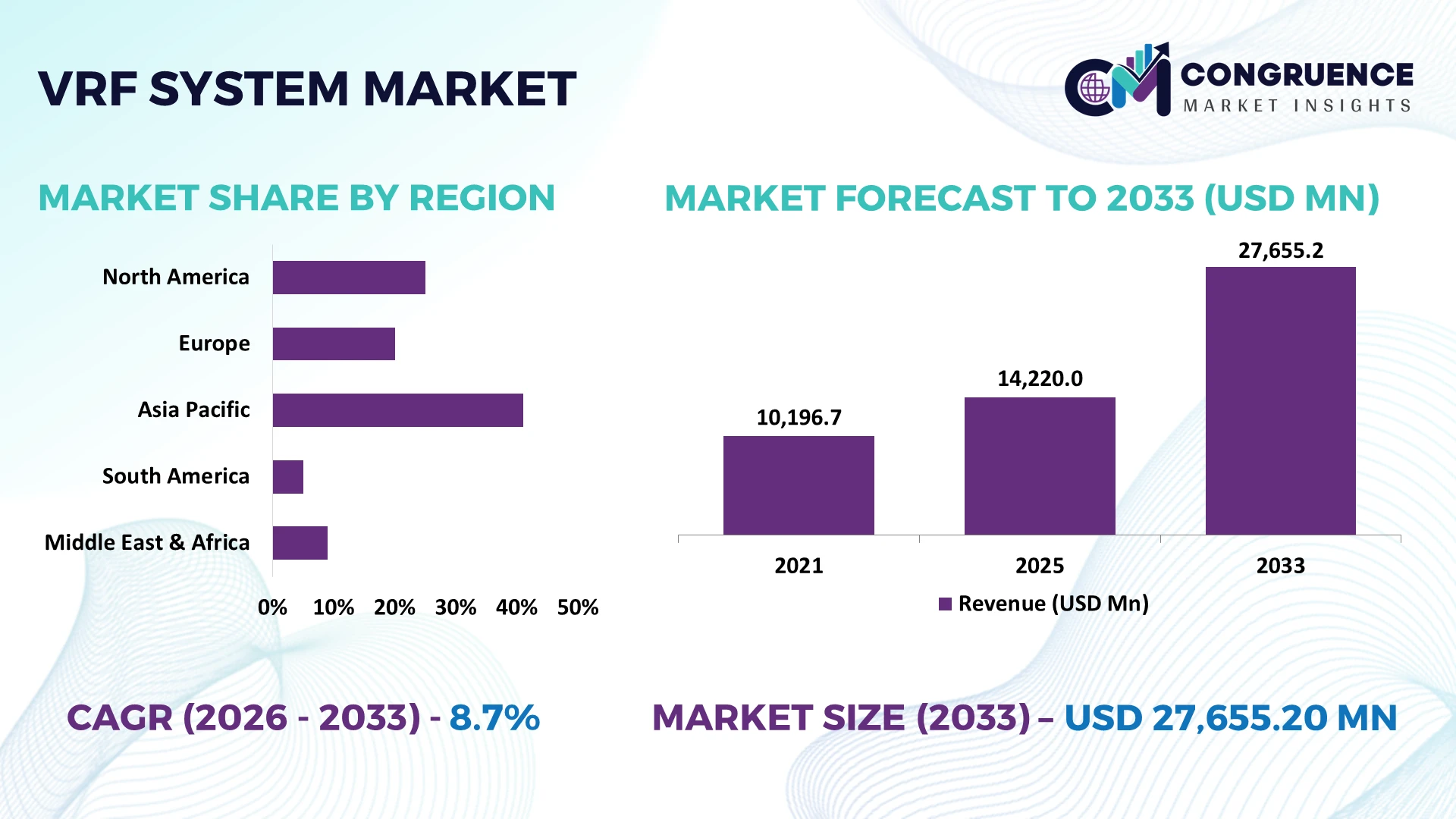
The Global VRF System Market was valued at USD 14220 Million in 2025 and is anticipated to reach a value of USD 27655.2 Million by 2033 expanding at a CAGR of 8.67% between 2026 and 2033. Building electrification, inverter-compressor penetration, tighter HVAC efficiency standards, and replacement of centralized chillers with individually controlled heat-pump and heat-recovery systems are accelerating VRF installations.
China remains the dominant VRF system market, accounting for approximately 40% of global demand, supported by extensive domestic HVAC manufacturing capacity and installations across offices, hotels, hospitals, retail complexes, and multifamily buildings. Inverter-driven systems can deliver 20–30% energy savings against conventional fixed-speed HVAC under variable-load conditions. Japan maintains substantially higher mature-building penetration, while India is expanding from a lower installed base as commercial construction and cooling loads rise. China’s property-sector restructuring is redirecting supplier emphasis toward retrofit, public infrastructure, industrial, and energy-efficient replacement projects.
Strategically, manufacturers should prioritize high-efficiency heat-pump VRF, retrofit-compatible controls, local compressor supply, and intelligent building integration as efficiency regulation and electrification reshape HVAC procurement.
Market Size & Growth: USD 14.22 billion in 2025 advances to USD 27.66 billion by 2033 at 8.67% CAGR, driven by inverter HVAC replacement and building electrification.
Top Growth Drivers: Building electrification contributes 35%, efficiency-led replacement 33%, and commercial construction 32% to incremental demand momentum.
Short-Term Forecast: By 2027, advanced inverter controls can reduce part-load HVAC electricity consumption by approximately 20–30% versus conventional fixed-speed equipment.
Emerging Technologies: AI-enabled controls, heat-recovery VRF, and low-GWP refrigerants are strengthening system efficiency, with premium inverter platforms targeting seasonal efficiency improvements above 15%.
Regional Leaders: Asia-Pacific approaches USD 15.2 billion by 2033, North America USD 6.1 billion, and Europe USD 4.8 billion as electrification and retrofit deployment accelerate.
Consumer/End-User Trends: Commercial buildings represent approximately 55% of VRF deployment, reflecting demand for independent zoning, simultaneous heating-cooling, and lower mechanical-room requirements.
Pilot/Case Example: A 2025 VRF retrofit configuration combining heat recovery and intelligent controls demonstrated approximately 25% lower HVAC energy consumption versus conventional configurations.
Competitive Landscape: Daikin holds approximately 18% global share, competing with Mitsubishi Electric, Midea, LG Electronics, and Panasonic across efficiency, controls, refrigerants, and installation ecosystems.
Regulatory & ESG Impact: EU F-gas rules target a 95% reduction in HFC availability by 2030 versus 2015, accelerating low-GWP VRF redesign and refrigerant transition.
Investment & Funding: More than USD 1 billion in announced HVAC manufacturing and technology investments is strengthening heat-pump, compressor, controls, and localized supply capacity globally.
Innovation & Future Outlook: Next-generation R32/R290 architectures, predictive controls, and heat recovery target 20%+ operational efficiency gains as HVAC procurement shifts toward lower-carbon electrified buildings.
VRF system demand is strengthening across offices, hotels, hospitals, educational facilities, retail buildings, and multifamily developments where zoning flexibility and part-load efficiency materially influence operating costs. Advanced inverter compressors, heat-recovery architectures, intelligent refrigerant control, and building-management integration are improving equipment responsiveness; optimized VRF installations can reduce HVAC electricity use by approximately 20–30% compared with conventional fixed-speed systems. Low-GWP refrigerant adoption is also accelerating as Europe tightens F-gas requirements, forcing manufacturers to redesign equipment and installer practices. This convergence of electrification, refrigerant transition, and connected controls establishes the operational foundation for the strategic market discussion ahead.
VRF systems are becoming strategically important as building owners prioritize electrified heating and cooling, granular zoning, and lower lifecycle energy consumption. Regulatory restructuring is accelerating this transition: Europe’s revised F-gas framework progressively restricts high-GWP refrigerants, forcing manufacturers to redesign compressors, controls, heat exchangers, and installation practices. Simultaneously, commercial retrofit activity is shifting HVAC investment toward modular systems that avoid extensive ductwork and centralized plant replacement.
Inverter-driven VRF can reduce HVAC electricity consumption by roughly 20–30% versus conventional fixed-speed systems under variable loads, while heat-recovery configurations simultaneously serve heating and cooling zones. China provides manufacturing scale and extensive commercial deployment; Japan leads mature heat-pump engineering, while India offers stronger whitespace through offices, hotels, hospitals, and mixed-use construction. Through 2028, low-GWP refrigerants, intelligent controls, and heat-recovery architectures will capture a larger proportion of premium specifications.
A hotel retrofit illustrates the operational advantage: VRF enables floor-by-floor installation while occupied areas remain functional, reducing disruption compared with centralized HVAC replacement. Manufacturers are expanding localized production, installer training, refrigerant-transition R&D, and building-controls partnerships. Competitive advantage will increasingly depend on combining seasonal efficiency, regulatory-ready refrigerants, digital optimization, and dependable service networks rather than equipment pricing alone.
Electrification of commercial heating and cooling is the strongest structural driver for VRF deployment. Buildings account for roughly 30% of global final energy consumption, while space heating and cooling represent approximately 35% of building energy use; inverter-based VRF can lower HVAC electricity consumption by 20–30% against fixed-speed configurations under variable loads. In Japan, mature heat-pump adoption demonstrates the operational viability of refrigerant-based zoned systems, while India’s expanding offices, hotels, hospitals, and mixed-use developments are widening the addressable installed base. Tightening building-energy codes are shifting specifications toward high seasonal efficiency and intelligent controls. Daikin, Mitsubishi Electric, LG, and other manufacturers are investing in inverter compressors, heat recovery, localized production, and installer networks. The strategic advantage lies in controlling both equipment efficiency and commissioning quality.
Refrigerant regulation is creating immediate redesign, certification, and installation costs across the VRF supply chain. Europe’s revised F-gas regime targets approximately 95% lower HFC availability by 2030 versus the 2015 baseline, while R32 carries a GWP near 675 compared with roughly 2,088 for R410A. Transitioning toward lower-GWP alternatives therefore requires redesigned components, leak-management procedures, technician certification, and application-specific safety controls. In countries with fragmented HVAC contractor networks, these requirements increase commissioning costs and constrain scalable deployment. Manufacturers are mitigating exposure through R32 platform expansion, alternative-refrigerant R&D, technician training, and localized component sourcing. A key operational constraint is increasingly installer readiness rather than compressor availability: technically compliant equipment cannot scale efficiently without technicians qualified to handle new refrigerant architectures and associated safety requirements.
Commercial-building retrofits create a high-value opportunity because VRF combines zoning, electrification, and phased installation without requiring complete centralized plant reconstruction. Heat-recovery configurations can redistribute thermal energy between simultaneously cooling and heating zones, while inverter operation can deliver approximately 20–30% electricity savings over fixed-speed HVAC in variable-load applications. Buildings contribute around 30% of global final energy consumption, making existing stock strategically more important than new construction alone. India’s hotels, hospitals, premium offices, and educational facilities provide particularly attractive retrofit environments where occupancy patterns vary significantly by zone. Through 2028, AI-assisted controls, occupancy sensing, predictive maintenance, and low-GWP refrigerants will strengthen retrofit economics. Manufacturers are integrating VRF with building-management platforms and expanding retrofit-focused dealer ecosystems. The non-obvious opportunity is monetizing controls and lifecycle services alongside equipment replacement.
Achieving rated efficiency consistently across thousands of site-specific installations remains a critical execution challenge. VRF performance depends on refrigerant piping design, charge accuracy, branch configuration, controls integration, commissioning, and maintenance; field errors can materially erode the 20–30% energy advantage expected from inverter operation. Meanwhile, refrigerant transition requires technicians to manage A2L-classified alternatives such as R32, whose GWP is approximately 68% lower than R410A but introduces different safety and handling requirements. India’s rapidly expanding commercial construction pipeline intensifies pressure on qualified HVAC designers and commissioning technicians, while increasingly connected controls add software-integration requirements. Manufacturers must expand certification programs, digital commissioning tools, leak detection, remote diagnostics, and contractor partnerships. Long-term competitiveness therefore depends on controlling installation quality: superior hardware delivers limited differentiation when field execution prevents systems from achieving designed seasonal performance.
Low-GWP Platforms Reshape Product Portfolios: Manufacturers are accelerating R32-based VRF transitions as its GWP of approximately 675 is nearly 68% below R410A’s 2,088. Europe’s HFC phase-down targets a 95% reduction by 2030 versus 2015 levels. Suppliers are redesigning refrigerant circuits, leak controls, and installation protocols, while expanding technician certification. The shift increases near-term engineering complexity but protects product eligibility under tightening HVAC regulation.
Connected Controls Deepen Energy Optimization: VRF systems are increasingly integrated with building-management platforms, occupancy sensors, and cloud-based diagnostics. Advanced inverter control can deliver 20–30% lower HVAC electricity consumption than fixed-speed operation, while predictive maintenance can reduce unplanned service interventions by approximately 15–25%. Japanese and U.S. commercial operators are adopting centralized dashboards across multi-site portfolios. Manufacturers are expanding API connectivity and remote diagnostics to convert equipment sales into recurring lifecycle services.
Modular Design Accelerates Phased Deployment: Modular outdoor units are gaining traction in hotels, offices, and mixed-use properties because capacity can be expanded without replacing complete HVAC plants. Phased installation can reduce occupied-building disruption by 30–50%, while compact equipment footprints release valuable mechanical space. Indian developers increasingly specify modular configurations for projects delivered in stages. Suppliers are broadening combinable outdoor-unit ranges and simplifying piping architectures to improve contractor productivity.
Heat Recovery Gains Operational Priority: Simultaneous heating and cooling is becoming increasingly valuable in hospitals, hotels, and mixed-use buildings with contrasting zone loads. Heat-recovery VRF can reclaim otherwise rejected thermal energy and improve operating efficiency by roughly 15–25% under favorable diversified loads. Companies are refining three-pipe controls, branch selectors, and intelligent refrigerant distribution. A non-obvious advantage is reduced peak plant dependency, strengthening retrofit economics where electrical capacity is constrained.
VRF Heat Pump Systems lead the type segment with an estimated 45% share, supported by simpler refrigerant architecture, lower installation complexity, and suitability for buildings requiring predominantly one operating mode at a time. Their established contractor ecosystem and scalable outdoor-unit combinations sustain demand across commercial and residential projects. Two-Pipe Systems reinforce this cost-sensitive position because fewer refrigerant lines reduce installation material and labor requirements. Modular VRF Systems are gaining relevance where developers require phased capacity additions and flexible building configurations.
VRF Heat Recovery Systems represent the fastest-growing type as hotels, hospitals, and mixed-use buildings prioritize simultaneous heating and cooling. Properly configured heat recovery can improve operating efficiency by approximately 15–25% under diversified loads. Three-Pipe Systems support this transition by enabling independent zone operation, although additional piping and branch-control hardware increase installation complexity. Manufacturers are consequently directing engineering investment toward heat-recovery controls, modular outdoor units, low-GWP refrigerants, and simplified commissioning, shifting premium product competition toward lifecycle efficiency rather than initial equipment cost.
Commercial Buildings lead VRF applications with an estimated 46% share because offices and mixed-use properties combine variable occupancy, multiple thermal zones, extended operating hours, and strong requirements for individual temperature control. Inverter-based VRF can reduce HVAC electricity consumption by approximately 20–30% compared with fixed-speed systems under variable loads, strengthening lifecycle economics for large commercial properties. Hospitality remains an established application because room-level control aligns capacity with occupancy, while Retail Spaces benefit from compact equipment and flexible zoning across differently loaded sales areas.
Healthcare Facilities represent the fastest-growing application as hospitals and outpatient facilities require precise zone control, redundancy, and simultaneous heating and cooling. Heat-recovery configurations can improve operating efficiency by approximately 15–25% under suitable diversified loads. Residential Buildings increasingly adopt smaller-capacity VRF systems in premium multifamily developments, particularly in dense Asian cities. Manufacturers are responding with expanded capacity ranges, quieter indoor units, advanced filtration, centralized controls, and application-specific heat-recovery solutions, concentrating product development on environments where zoning delivers measurable operating savings.
Property Developers represent the leading end-user group with an estimated 32% share because HVAC selection is frequently determined during design and construction, allowing developers to influence equipment scale, zoning architecture, refrigerant selection, and lifecycle specifications across entire projects. Building Owners increasingly evaluate VRF against operating expenditure, with inverter configurations capable of delivering approximately 20–30% electricity savings versus fixed-speed alternatives under variable-load conditions. HVAC Contractors remain pivotal because piping design, refrigerant charging, commissioning, and controls integration directly determine delivered efficiency.
Facility Management Companies represent the fastest-growing end-user segment as connected VRF installations shift procurement toward remote diagnostics, predictive maintenance, and portfolio-wide energy optimization. Digital maintenance workflows can reduce unplanned service interventions by approximately 15–25%. Commercial Enterprises increasingly influence specifications through corporate energy targets and workplace modernization. Manufacturers are responding with developer design support, contractor certification, extended maintenance agreements, connected-control platforms, and facility-management partnerships. Competitive positioning is therefore moving beyond equipment supply toward lifecycle performance assurance and stronger installer ecosystems.
Asia-Pacific accounted for the largest market share at 48% in 2025 however, Middle East & Africa is expected to register the fastest growth, expanding at a CAGR of 10.2% between 2026 and 2033.

Heat-Pump Electrification Reshapes HVAC Specifications
North America represented approximately 22% of global VRF system demand in 2025, led by U.S. commercial retrofits, heat-pump electrification, and tighter building-performance requirements. VRF is gaining specification share in offices, hotels, multifamily properties, education facilities, and healthcare buildings where individualized zoning reduces unnecessary conditioning. Inverter-driven configurations can lower HVAC electricity consumption by approximately 20–30% versus conventional fixed-speed equipment under variable loads. U.S. refrigerant regulation is simultaneously accelerating migration from R410A toward lower-GWP alternatives, requiring redesigned outdoor units, controls, leak detection, and contractor training. Manufacturers are expanding domestic distribution, engineering support, and A2L-refrigerant training while integrating VRF with building-management systems. The operational shift favors suppliers capable of combining heat-pump performance with commissioning expertise and lifecycle service rather than competing solely on equipment efficiency ratings.
United States Market Outlook: The United States remains North America’s most strategically significant VRF market, supported by extensive commercial building stock and accelerating heat-pump adoption. Federal refrigerant-transition requirements are moving new HVAC equipment toward alternatives with substantially lower climate impact; R32 has approximately 68% lower GWP than R410A. Manufacturers are therefore prioritizing compliant product platforms, installer certification, connected controls, and retrofit-oriented distribution networks.
Refrigerant Regulation Accelerates Portfolio Redesign
Europe accounted for approximately 18% of global VRF system demand in 2025, with Germany, the United Kingdom, France, Italy, and Spain supporting installations across commercial, hospitality, healthcare, and mixed-use properties. The revised EU F-gas framework is fundamentally changing equipment development by tightening HFC availability and introducing application-specific restrictions that favor lower-GWP refrigerants. The HFC quota pathway targets approximately 95% lower availability by 2030 relative to the 2015 baseline, making refrigerant architecture a procurement issue rather than only an environmental specification. Heat-recovery VRF is gaining relevance in buildings requiring simultaneous heating and cooling, while intelligent controls support energy-performance compliance. Manufacturers are redesigning product families, expanding R32 and alternative-refrigerant engineering, training installers, and strengthening building-controls integration. Regulatory readiness and qualified installation capacity increasingly determine commercial competitiveness.
Germany Market Outlook: Germany combines demanding building-efficiency requirements with a large installed base of offices, hotels, healthcare facilities, and commercial properties requiring heating-system modernization. Buildings account for roughly one-third of national energy consumption, making HVAC efficiency strategically significant. VRF suppliers are targeting renovation projects with reversible heat-pump systems, digital controls, heat recovery, and refrigerant platforms aligned with progressively stricter European environmental requirements.
Manufacturing Scale Reinforces Deployment Leadership
Asia-Pacific held approximately 48% of global VRF system demand in 2025, reflecting concentrated HVAC manufacturing, dense urban construction, and established inverter-air-conditioning adoption across China, Japan, India, South Korea, and Southeast Asia. China provides exceptional compressor, heat-exchanger, electronics, and finished-system manufacturing scale, while Japan remains a technology center for inverter compressors, heat recovery, and sophisticated refrigerant controls. India is expanding installations across offices, hotels, hospitals, retail complexes, and premium residential projects as cooling requirements intensify. Inverter-based VRF can deliver approximately 20–30% lower electricity consumption than fixed-speed HVAC under variable loads, strengthening lifecycle economics where cooling operates for extended periods. Manufacturers are localizing production, widening dealer networks, developing modular outdoor units, and integrating remote monitoring. Scale increasingly allows Asian suppliers to compete simultaneously on technology, procurement cost, and delivery flexibility.
China Market Outlook: China represents the region’s largest VRF manufacturing and consumption base, accounting for an estimated 40% of worldwide demand. Its integrated compressor, electronics, motor, and heat-exchanger supply chain supports rapid product iteration and competitive manufacturing economics. Property-sector restructuring is redirecting suppliers toward public infrastructure, commercial refurbishment, industrial buildings, and replacement demand while connected controls and high-efficiency inverter platforms gain specification importance.
Commercial Retrofits Drive Concentrated Adoption
South America accounted for approximately 5% of global VRF system demand in 2025, with Brazil dominating deployment and Chile, Colombia, and Argentina providing smaller commercial opportunities. VRF adoption is concentrated in hotels, corporate offices, hospitals, retail developments, and premium residential projects where zoning and limited plant-room requirements provide tangible advantages. Brazil’s warm climate and extensive urban commercial stock support long cooling hours, strengthening the economics of inverter compressors capable of reducing variable-load electricity consumption by approximately 20–30%. However, imported components, currency volatility, uneven technician availability, and financing costs can raise installed-system expenditure outside major cities. Manufacturers are strengthening distributor inventories, contractor certification, local technical support, and modular product availability. Market access consequently depends heavily on installation capability and spare-parts availability rather than equipment specifications alone.
Brazil Market Outlook: Brazil provides the region’s strongest VRF opportunity through São Paulo, Rio de Janeiro, Brasília, and other major commercial centers. Commercial buildings account for a meaningful portion of national electricity consumption, making cooling efficiency a procurement priority. Suppliers increasingly combine inverter systems with centralized controllers, remote diagnostics, and trained contractor networks to reduce commissioning risk across geographically dispersed installations.
Mega-Projects Intensify Efficient Cooling Demand
Middle East & Africa represented approximately 7% of global VRF system demand in 2025, with the UAE, Saudi Arabia, South Africa, and Qatar concentrating higher-value installations. Extreme cooling loads and large hospitality, residential, healthcare, retail, and mixed-use developments make part-load efficiency increasingly important. Saudi Arabia’s Vision 2030 construction pipeline and UAE building-modernization programs are encouraging specification of intelligent HVAC, while VRF zoning allows unoccupied areas to operate at reduced capacity. Properly engineered inverter systems can lower HVAC electricity consumption by approximately 20–30% compared with fixed-speed alternatives under variable conditions. Suppliers are expanding engineering partnerships, local service networks, controls integration, and heat-resistant equipment configurations. Africa remains constrained by uneven electricity reliability and technical-service coverage, making resilient controls, maintenance capability, and localized support decisive for sustained deployment.
Saudi Arabia Market Outlook: Saudi Arabia offers a strategically important deployment environment because giga-projects, hospitality expansion, commercial construction, and urban modernization create substantial cooling requirements. Air conditioning can represent more than half of building electricity demand during peak periods, strengthening the case for variable-capacity systems. Manufacturers are aligning VRF portfolios with smart-building controls, high-ambient operation, modular installation, and locally supported maintenance networks.
Daikin, Mitsubishi Electric, Midea, LG Electronics, and Panasonic compete for VRF leadership through inverter technology, heat recovery, controls integration, refrigerant transition, and contractor reach, while Chinese manufacturers intensify price and manufacturing-scale pressure on Japanese incumbents. The top five players collectively hold approximately 55% of global demand. Premium suppliers differentiate through seasonal efficiency improvements approaching 15–25%, while optimized inverter systems deliver 20–30% electricity savings versus fixed-speed HVAC. Lower-GWP platforms reduce refrigerant climate impact by about 68% when R32 replaces R410A. Competition increasingly centers on R&D, localized manufacturing, distributor expansion, installer certification, smart-building partnerships, and vertically integrated compressor production. The current shift toward low-GWP refrigerants and connected lifecycle services is reducing dependence on hardware-only differentiation. Certification requirements, compressor engineering, refrigerant expertise, distribution density, and commissioning capability remain significant entry barriers. Winning requires regulatory-ready technology, reliable installation ecosystems, competitive lifecycle economics, and digital controls that sustain designed efficiency throughout system operation.
Daikin Industries, Ltd.
Mitsubishi Electric Corporation
Midea Group
LG Electronics Inc.
Panasonic Holdings Corporation
Samsung Electronics Co., Ltd.
Carrier Global Corporation
Johnson Controls International plc
Fujitsu General Limited
Haier Smart Home Co., Ltd.
Gree Electric Appliances, Inc.
Lennox International Inc.
Bosch Home Comfort Group
Hisense Group
Current VRF technology centers on inverter compressors, heat-recovery architectures, R32 refrigerant, electronic expansion valves, and connected building controls. Variable-speed compression can reduce HVAC electricity consumption by 20–30% versus fixed-speed systems, while R32 cuts refrigerant GWP about 68% versus R410A. Deployment is established across offices, hotels, hospitals, and mixed-use buildings, giving manufacturers with strong installer networks measurable lifecycle-cost and commissioning advantages.
Emerging platforms combine AI optimization, occupancy sensing, cloud diagnostics, predictive maintenance, and refrigerant-leak detection. Predictive controls can reduce avoidable energy consumption by roughly 10–20%, while remote diagnostics can cut service interventions by 15–25%. Compared with legacy fixed-speed HVAC, intelligent inverter VRF delivers approximately 25% better operating efficiency under variable loads. Integration with building-management systems increasingly converts standalone cooling equipment into continuously optimized energy assets.
Disruptive development is shifting toward natural refrigerants, advanced heat exchangers, digital twins, and autonomous controls. CO2-based VRF brings refrigerant GWP down to 1, while next-generation microchannel heat exchangers can reduce refrigerant charge by more than 10%. During 2026–2028, low-GWP platforms and AI-enabled commissioning will move deeper into commercial specifications. Japanese technology leaders benefit from compressor expertise, while scaled Chinese manufacturers gain through cost-efficient production; acting now protects regulatory compliance, installer readiness, and premium-building specifications globally today.
October 2024 – Panasonic launched its R32 ECOi EX MZ1 VRF series at Chillventa, with the 10HP unit reducing footprint 43% and supporting 64 indoor units. The compact architecture lowers installation-space requirements for commercial multi-unit projects globally. Source: aircon.panasonic.eu
January 2025 – Daikin announced its first European CO2 VRV system using R-744 with GWP 1, scheduled for April availability. The natural-refrigerant platform targets supermarkets and retail buildings requiring decarbonized heating and cooling under tightening F-gas regulation. Source: daikin.eu
March 2026 – Midea launched the V9 R32 VRF platform with a 310-degree G-type heat exchanger delivering 15% outdoor-unit energy efficiency. Integrated leak sensing and shut-off technology strengthen compliant deployment in hospitals, malls, and other mission-critical buildings. Source: prnewswire.com
July 2026 – GE Appliances expanded HVAC with its R32 VRF platform, offering MRV-7 modules from 6–20 tons and combinations reaching 36 tons. Heat-pump and heat-recovery configurations broaden specification flexibility for North American retrofit and commercial projects. Source: achrnews.com
The VRF System Market Report evaluates five system types: VRF Heat Pump Systems, VRF Heat Recovery Systems, Two-Pipe Systems, Three-Pipe Systems, and Modular VRF Systems. Application coverage spans Residential Buildings, Commercial Buildings, Hospitality, Healthcare Facilities, and Retail Spaces, while end-user analysis examines Property Developers, Building Owners, HVAC Contractors, Facility Management Companies, and Commercial Enterprises. Asia-Pacific represents approximately 48% of 2025 market activity, establishing the primary deployment and manufacturing benchmark.
Regional assessment covers North America, Europe, Asia-Pacific, South America, and Middle East & Africa, alongside country-level shifts in refrigerant regulation, electrification, commercial construction, and retrofit activity. Technology coverage includes inverter compressors, R32 and natural refrigerants, heat recovery, AI controls, leak detection, predictive maintenance, and building-management integration. The report supports 2026–2033 investment planning by identifying specification shifts, installer requirements, competitive positioning, localization priorities, partnership opportunities, and emerging low-GWP niches.
| Report Attribute/Metric | Report Details |
|---|---|
Market Revenue in 2025 | USD 14220 Million |
Market Revenue in 2033 | USD 27655.2 Million |
CAGR (2026 - 2033) | 8.67% |
Base Year | 2025 |
Forecast Period | 2026 - 2033 |
Historic Period | 2021 - 2025 |
Segments Covered | By Type
By Application
By End-User
|
Key Report Deliverable | Revenue Forecast, Growth Trends, Market Dynamics, Segmental Overview, Regional and Country-wise Analysis, Competition Landscape |
Region Covered | North America, Europe, Asia-Pacific, South America, Middle East, Africa |
Key Players Analyzed | Daikin Industries, Ltd., Mitsubishi Electric Corporation, Midea Group, LG Electronics Inc., Panasonic Holdings Corporation, Samsung Electronics Co., Ltd., Carrier Global Corporation, Johnson Controls International plc, Fujitsu General Limited, Haier Smart Home Co., Ltd., Gree Electric Appliances, Inc., Lennox International Inc., Bosch Home Comfort Group, Hisense Group |
Customization & Pricing | Available on Request (10% Customization is Free) |




