
Reports
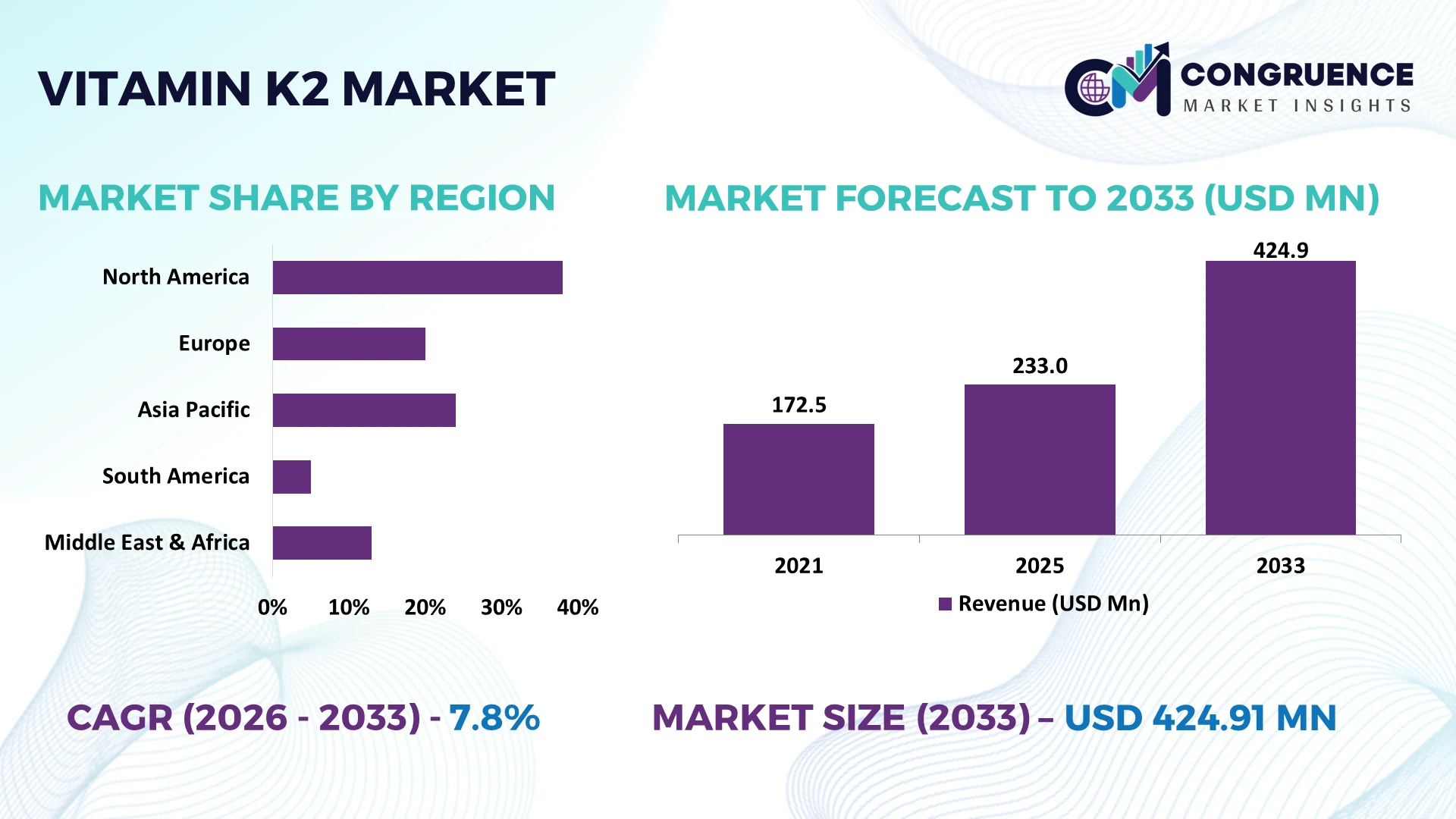
The Global Vitamin K2 Market was valued at USD 233 Million in 2025 and is anticipated to reach a value of USD 424.91 Million by 2033 expanding at a CAGR of 7.8% between 2026 and 2033. Growth is being driven by expanding clinical nutrition applications, wider fortification of functional foods, higher dietary supplement penetration, and precision fermentation technologies improving Vitamin K2 production efficiency.
Japan remains the dominant country, accounting for approximately 34% of global Vitamin K2 production capacity, supported by advanced fermentation expertise, established nutraceutical manufacturing, and continuous investment in functional health products. Production efficiency has improved by nearly 18% through automated fermentation systems, while China is rapidly expanding manufacturing capacity through cost-competitive facilities and integrated ingredient supply chains. Ongoing Indo-Pacific supply chain diversification following regional trade realignments in 2026 continues strengthening production resilience.
For industry participants, securing regional manufacturing partnerships and technology-driven production capabilities will remain the defining competitive strategy for long-term market expansion.
Market Size & Growth: USD 233 Million in 2025 is projected to reach USD 424.91 Million by 2033 at a CAGR of 7.8%, supported by advanced fermentation technology and expanding functional nutrition manufacturing.
Top Growth Drivers: Clinical nutrition demand contributes approximately 28%, functional food fortification 24%, and aging population supplementation 22% of market expansion momentum.
Short-Term Forecast: By 2028, production costs decline by nearly 12% as process automation and fermentation optimization improve manufacturing efficiency.
Emerging Technologies: AI-assisted fermentation monitoring, precision microbial strains, and continuous bioprocessing increase production yields by approximately 15% while improving quality consistency.
Regional Leaders: Asia-Pacific exceeds USD 185 Million with strong nutraceutical adoption, Europe approaches USD 108 Million through preventive healthcare expansion, and North America surpasses USD 82 Million with premium supplement innovation.
Consumer/End-User Trends: More than 46% of premium bone-health supplement launches now integrate Vitamin K2 with Vitamin D3 formulations for enhanced product positioning.
Pilot/Case Example: In 2026, an automated fermentation modernization project improved batch productivity by approximately 17% while reducing quality deviations across commercial production.
Competitive Landscape: Leading manufacturers collectively control nearly 48% of the global market, with Gnosis by Lesaffre, Kappa Bioscience, NattoPharma, Balchem Corporation, and Seebio Biotech maintaining strong competitive positions.
Regulatory & ESG Impact: Sustainable fermentation initiatives reduce processing emissions by approximately 14%, while stricter ingredient traceability strengthens international product compliance.
Investment & Funding: More than USD 240 Million supports manufacturing expansion, strategic partnerships, and regional capacity development amid global supply chain diversification.
Innovation & Future Outlook: High-purity MK-7 formulations, precision fermentation, and personalized nutrition platforms accelerate next-generation product differentiation and long-term strategic competitiveness.
Growing demand for preventive healthcare, functional nutrition, and premium dietary supplements continues reshaping the Vitamin K2 Market. Advanced microbial fermentation, higher-purity MK-7 formulations, and integrated quality monitoring improve manufacturing consistency by approximately 16%. Regional production diversification and stricter ingredient traceability across international supply chains strengthen operational resilience, positioning manufacturers for broader application expansion and setting the stage for deeper strategic market evaluation.
The Vitamin K2 Market has become strategically important as preventive healthcare, functional nutrition, and pharmaceutical innovation reshape global ingredient competition. Manufacturers are prioritizing supply-chain restructuring through localized fermentation capacity and vertically integrated raw material sourcing to reduce procurement risks and improve production continuity. Regulatory emphasis on ingredient traceability and standardized quality testing is further encouraging investment in advanced manufacturing platforms, creating stronger competitive differentiation for producers with validated production systems.
Precision microbial fermentation now delivers approximately 16% higher production efficiency and reduces batch variability by nearly 14% compared with conventional fermentation processes, lowering operational waste while improving consistency. Japan continues leading in process innovation and premium MK-7 production, whereas China is scaling cost-efficient manufacturing with larger industrial fermentation facilities and expanding export capabilities. Over the next two to three years, automated production monitoring is expected to exceed 55% deployment across newly commissioned facilities, improving quality assurance and production flexibility.
A leading nutraceutical manufacturer recently expanded automated fermentation capacity while establishing regional ingredient partnerships to shorten procurement cycles and strengthen inventory resilience. Companies are increasingly directing investments toward premium formulations, localized manufacturing, and strategic collaborations with functional food producers. Organizations that combine technology leadership with resilient sourcing networks will secure stronger competitive positioning and sustain long-term operational advantages.
Growing integration of Vitamin K2 into bone health, cardiovascular nutrition, and premium dietary supplements remains the market's strongest structural growth driver. Approximately 46% of newly introduced premium bone-health formulations now combine Vitamin K2 with complementary nutrients, while automated fermentation improves production efficiency by nearly 15% and reduces quality deviations by around 12%. Japan continues strengthening industrial fermentation capabilities through advanced bioprocess technologies, encouraging manufacturers to expand high-purity MK-7 production. In response, companies are investing in dedicated fermentation facilities, entering long-term ingredient supply agreements, and forming partnerships with functional food manufacturers. The strategic advantage increasingly belongs to producers capable of delivering pharmaceutical-grade consistency alongside scalable manufacturing efficiency.
Dependence on specialized microbial cultures and fermentation inputs continues limiting manufacturing flexibility. Raw material procurement costs fluctuate by approximately 10–15%, while compliance testing and ingredient validation increase production expenses by nearly 8% for export-oriented manufacturers. China remains a critical production hub, making global supply chains vulnerable to logistics disruptions and changing trade conditions. These structural constraints directly affect production scheduling, inventory management, and pricing competitiveness, particularly for smaller manufacturers. Companies are mitigating risk by localizing selected raw material sourcing, expanding regional production footprints, negotiating long-term procurement contracts, and investing in process standardization to improve manufacturing consistency while reducing exposure to external supply volatility.
Emerging opportunities extend beyond dietary supplements into clinical nutrition, personalized wellness, and premium functional foods supported by digital manufacturing technologies. AI-assisted fermentation monitoring increases process efficiency by approximately 13%, while continuous production systems reduce operational downtime by nearly 11%. South Korea is expanding biotechnology investments focused on precision fermentation and advanced nutraceutical ingredients, creating new commercialization pathways. Companies are strengthening R&D collaborations, expanding high-purity MK-7 portfolios, and integrating digital quality management platforms across production facilities. A non-obvious competitive opportunity lies in supplying standardized pharmaceutical-grade Vitamin K2 ingredients for specialized medical nutrition, where quality assurance and traceability provide stronger differentiation than production scale alone.
Maintaining consistent high-purity Vitamin K2 production while meeting evolving international quality standards remains a significant execution challenge. Validation requirements increase manufacturing timelines by approximately 18%, while maintaining pharmaceutical-grade consistency across large production batches raises operational complexity by nearly 14%. Germany and Japan continue applying rigorous quality expectations for imported nutraceutical ingredients, requiring manufacturers to strengthen documentation, testing, and process validation. These pressures affect production scalability, regulatory readiness, and long-term competitiveness. Companies must accelerate investment in automated quality control, digital batch traceability, advanced fermentation optimization, and cross-border technical partnerships to ensure reliable large-scale deployment while sustaining premium product positioning in increasingly regulated global markets.
Precision Fermentation Scaling Advanced microbial fermentation is replacing conventional batch production, improving yield by approximately 16% while reducing process waste by nearly 13%. Automation deployment has crossed 50% in newly upgraded facilities, particularly in Japan, where manufacturers are integrating real-time quality monitoring. Companies are expanding fermentation capacity, modernizing production lines, and strengthening upstream process control to improve supply reliability amid tighter ingredient quality requirements.
Premium MK-7 Portfolio Expansion Manufacturers are shifting toward high-purity MK-7 formulations as premium health products gain wider acceptance. More than 48% of new product launches now emphasize clinically positioned MK-7 ingredients, while standardized formulations reduce quality variation by around 12%. Increasing regulatory scrutiny on ingredient traceability is encouraging producers to establish strategic partnerships with certified raw material suppliers and implement digital batch documentation to accelerate market access.
Localized Manufacturing Networks Supply-chain diversification continues reshaping production strategies, with localized sourcing reducing procurement lead times by approximately 18% and lowering logistics disruptions by nearly 14%. China and India are strengthening domestic ingredient ecosystems through integrated manufacturing investments. Companies are restructuring supplier portfolios, establishing regional processing hubs, and increasing inventory flexibility to improve operational resilience against geopolitical trade adjustments and transportation bottlenecks.
Digital Quality Management Adoption Artificial intelligence-enabled quality inspection and predictive manufacturing analytics are becoming standard operational tools, reducing production deviations by nearly 15% while shortening product release cycles by approximately 10%. Enterprise-wide digital manufacturing platforms also improve regulatory documentation efficiency. Leading producers are investing in cloud-based manufacturing execution systems, workforce digitalization, and cross-functional data integration, creating a non-obvious advantage through faster compliance readiness rather than production volume alone.
MK-7 leads the Vitamin K2 Market with an estimated 56% share, supported by superior bioavailability, longer biological activity, and broad integration into premium nutraceutical formulations. Manufacturers increasingly prioritize MK-7 because standardized fermentation enables consistent quality and scalable commercial production. Natural Vitamin K2 continues gaining preference as clean-label demand expands, while Synthetic variants maintain relevance in cost-sensitive formulations requiring predictable supply. Companies are expanding dedicated MK-7 manufacturing, investing in advanced purification technologies, and developing premium ingredient portfolios to strengthen competitive differentiation.
MK-4 represents the fastest-growing type for targeted pharmaceutical and therapeutic applications, supported by increasing clinical utilization and specialized formulations. Adoption has increased by approximately 17% across prescription-focused product development, while Natural Vitamin K2 usage has expanded by nearly 15% within premium dietary supplements. Producers are strengthening partnerships with biotechnology firms, expanding fermentation capacity, and optimizing formulation technologies. Investment priorities continue shifting toward high-purity, clinically validated ingredients capable of supporting premium pricing and long-term customer retention.
Bone Health remains the leading application, representing approximately 42% of overall demand due to increasing preventive healthcare programs and expanding use in premium nutritional formulations. Broad clinical acceptance, physician recommendations, and combination products with complementary nutrients continue strengthening demand concentration. Dietary Supplements maintain a mature position through established consumer adoption, while Cardiovascular Health applications continue expanding as manufacturers diversify clinically supported wellness portfolios. Companies are scaling production, improving formulation stability, and strengthening distribution partnerships across pharmacy and specialty nutrition channels.
Functional Foods & Beverages represent the fastest-growing application as food manufacturers integrate Vitamin K2 into fortified dairy products, nutritional beverages, and wellness-focused foods. Product launches in this category have increased by approximately 19%, while automated fortification systems improve manufacturing efficiency by nearly 12%. Infant Nutrition remains a specialized but strategically important segment emphasizing premium formulations and strict quality assurance. Manufacturers continue investing in application-specific ingredient development and production flexibility to address evolving consumer health preferences.
Nutraceutical Companies account for approximately 49% of Vitamin K2 purchasing activity, supported by extensive product portfolios, high formulation volumes, and established distribution infrastructure. Their operational scale enables faster commercialization of premium health supplements and sustained procurement of high-purity ingredients. Food & Beverage Manufacturers continue increasing purchases through fortified product expansion, while Healthcare Providers influence prescription-oriented nutritional recommendations. Companies are strengthening customer-specific formulations, long-term supply agreements, and technical support programs to reinforce relationships with high-volume buyers.
Pharmaceutical Companies represent the fastest-growing end-user group as clinical nutrition applications and standardized ingredient requirements expand. Procurement volumes have increased by approximately 16%, while demand for pharmaceutical-grade MK-7 continues strengthening quality-focused manufacturing. Food & Beverage Manufacturers are expanding ingredient integration by nearly 14% through automated fortification systems. Producers are responding with customized formulations, differentiated pricing strategies, regional partnerships, and integrated regulatory support, positioning themselves to capture higher-value contracts across specialized healthcare and nutrition ecosystems.
Asia-Pacific accounted for the largest market share at 41.8% in 2025 however, North America is expected to register the fastest growth, expanding at a CAGR of 8.3% between 2026 and 2033.
Advanced Nutraceutical Manufacturing and Clinical Integration
North America continues strengthening its position through advanced nutraceutical manufacturing, premium dietary supplement innovation, and expanding clinical nutrition adoption. The region represents approximately 27% of global Vitamin K2 consumption, supported by strong contract manufacturing capabilities and increasing deployment of automated quality control systems. More than 58% of premium bone-health formulations now incorporate Vitamin K2 alongside complementary micronutrients. Manufacturers are investing in digital production monitoring and vertically integrated ingredient sourcing to improve regulatory compliance and production efficiency. Strategic collaborations between ingredient suppliers and healthcare-focused brands are shortening product development cycles by nearly 14%, while enterprise investments in formulation research continue improving product differentiation. Companies are prioritizing pharmaceutical-grade quality systems to strengthen competitive positioning across premium nutrition and healthcare applications.
United States Market Outlook: The United States leads regional demand through its extensive dietary supplement industry, mature healthcare infrastructure, and high consumer adoption of preventive nutrition. More than 62% of regional Vitamin K2 product launches originate from U.S.-based manufacturers, supported by automated production facilities and advanced formulation expertise. Companies continue expanding domestic manufacturing capacity, investing in ingredient traceability technologies, and strengthening partnerships with specialty nutrition brands to improve operational resilience and accelerate commercialization.
Quality Standards Drive Premium Ingredient Development
Europe maintains a strong market position through rigorous ingredient quality standards, advanced fermentation technologies, and growing demand for clinically supported nutritional products. The region contributes approximately 24% of global market activity, with pharmaceutical-grade production and premium functional food applications remaining strategic priorities. More than 54% of manufacturers have expanded digital quality documentation and process validation systems to strengthen regulatory compliance. Sustainability initiatives are encouraging energy-efficient fermentation technologies while supporting cleaner manufacturing practices. Companies are increasing investments in specialized ingredient production, collaborative research, and standardized manufacturing systems to strengthen export competitiveness and long-term operational efficiency.
Germany Market Outlook: Germany remains the region's industrial leader due to its advanced nutraceutical manufacturing ecosystem, strong regulatory infrastructure, and emphasis on clinically validated ingredients. Approximately 45% of regional high-purity ingredient production is associated with German manufacturing operations and technology partnerships. Producers continue investing in process automation, laboratory modernization, and precision quality management systems to strengthen pharmaceutical and premium nutrition supply chains.
Manufacturing Scale and Export Leadership
Asia-Pacific dominates the global Vitamin K2 Market through extensive fermentation infrastructure, integrated manufacturing ecosystems, and strong export capabilities. The region accounts for approximately 41.8% of global market activity, supported by cost-efficient production and continuous investment in industrial biotechnology. Automated fermentation deployment has expanded by nearly 18% across major production facilities, improving manufacturing consistency and operational efficiency. Integrated supply chains enable rapid scaling while reducing procurement complexity for international customers. Manufacturers continue strengthening export networks, expanding production capacity, and implementing digital manufacturing technologies to maintain leadership in premium Vitamin K2 ingredient supply.
Japan Market Outlook: Japan remains the most strategically important country owing to its long-established fermentation expertise, premium MK-7 production capabilities, and advanced biotechnology infrastructure. Nearly 34% of global Vitamin K2 production capacity is concentrated within Japanese manufacturing facilities. Companies continue investing in precision fermentation, automated quality assurance, and high-value ingredient innovation, reinforcing the country's leadership in premium-grade Vitamin K2 manufacturing and international technology partnerships.
Functional Nutrition Adoption Accelerates
South America is experiencing stronger market activity through expanding dietary supplement consumption, localized food fortification initiatives, and growing investment in preventive healthcare products. The region contributes approximately 5.8% of global demand, supported by increasing production partnerships and wider distribution of functional nutrition products. Manufacturing modernization has improved packaging and processing efficiency by nearly 11%, although dependence on imported specialty ingredients continues influencing procurement costs. Companies are strengthening regional distribution agreements, improving inventory planning, and expanding partnerships with nutritional product manufacturers to enhance market accessibility while balancing infrastructure constraints.
Brazil Market Outlook: Brazil represents the largest national market in South America through its expanding nutraceutical manufacturing base and growing consumer preference for functional health products. More than 48% of regional supplement production is concentrated within Brazil, supported by established food processing infrastructure and increasing enterprise investment in value-added nutrition products. Domestic manufacturers continue improving formulation capabilities while strengthening regional supply partnerships.
Healthcare Modernization Supports Market Expansion
The Middle East & Africa market is advancing through healthcare modernization programs, expanding nutritional awareness, and increasing investment in premium wellness products. The region accounts for approximately 4.4% of global market activity, with demand supported by imported high-quality ingredients and growing pharmaceutical distribution networks. Healthcare infrastructure investments have increased specialized nutrition product availability by nearly 15%, while enterprise partnerships continue improving regional supply continuity. Companies are expanding localized packaging operations, strengthening distributor networks, and improving regulatory compliance capabilities to enhance long-term market penetration and operational efficiency.
Saudi Arabia Market Outlook: Saudi Arabia leads regional development through healthcare investment programs, expanding pharmaceutical distribution, and rising demand for preventive nutrition products. Approximately 38% of regional premium nutritional product imports are directed toward the Saudi market, supported by modern healthcare infrastructure and strong private-sector investment. Companies are establishing regional distribution partnerships, enhancing logistics capabilities, and expanding premium supplement portfolios to strengthen market presence.
The Vitamin K2 Market is led by Gnosis by Lesaffre, Kappa Bioscience, Balchem Corporation, NattoPharma, and Seebio Biotech, competing against regional fermentation specialists and cost-focused ingredient manufacturers. The top five players collectively control approximately 49% of the market, creating competition between technology-driven premium suppliers and high-volume manufacturing companies. Premium producers compete through high-purity MK-7 formulations, advanced fermentation, and validated quality systems, while regional manufacturers emphasize pricing and production scale. Precision fermentation improves production efficiency by nearly 16%, and digital quality management reduces batch deviations by around 15%, making operational excellence a decisive advantage. Companies are expanding production facilities, forming long-term supply partnerships, investing in proprietary fermentation strains, and integrating upstream manufacturing to secure raw material availability. Competition is shifting toward technology ownership and supply-chain control rather than price alone. High regulatory compliance costs and pharmaceutical-grade validation remain significant entry barriers. Winning requires scalable premium production, consistent quality, resilient sourcing, and continuous formulation innovation.
Gnosis by Lesaffre
Kappa Bioscience
Balchem Corporation
NattoPharma
Seebio Biotech
Kyowa Hakko Bio
GeneFerm Biotechnology
Menadiona SL
Jilin Aodong Pharmaceutical Group
Zhejiang Medicine Co., Ltd.
Xi'an Healthful Biotechnology Co., Ltd.
Shanghai Freemen LLC
Nutraceutical Corporation
DSM Nutritional Products
Precision microbial fermentation remains the core production technology for Vitamin K2, enabling higher-purity MK-7 manufacturing with approximately 16% better production efficiency and 13% lower process waste than conventional fermentation. Around 58% of commercial manufacturers now deploy automated fermentation monitoring to improve batch consistency and traceability. Integrated digital quality management platforms shorten validation cycles by nearly 10%, allowing producers to strengthen regulatory compliance while improving production throughput and inventory planning.
Emerging technologies between 2026 and 2028 include AI-assisted fermentation optimization, continuous bioprocessing, and digital twin-based manufacturing control. AI-driven process optimization improves fermentation yield by approximately 12%, while continuous production systems reduce downtime by nearly 14%. Adoption of advanced inline spectroscopy has exceeded 35% among premium ingredient manufacturers, enabling real-time quality verification and reducing product variability. Companies integrating these technologies achieve stronger manufacturing flexibility and faster response to customer-specific formulation requirements.
Disruptive innovation is shifting competition toward precision fermentation ecosystems, synthetic biology, and automated purification technologies. Compared with legacy batch processing, next-generation integrated production platforms improve operational productivity by approximately 18% while reducing quality deviations by nearly 15%. Premium manufacturers with proprietary fermentation expertise benefit most through superior product consistency and pharmaceutical-grade positioning. Companies investing in intelligent manufacturing, process automation, and integrated supply-chain analytics between 2026 and 2028 will strengthen competitive resilience and accelerate commercialization of high-value Vitamin K2 formulations.
March 2025 Gnosis by Lesaffre announced Food Standards Australia New Zealand (FSANZ) approval for Vitamin K2 in Foods for Special Medical Purposes, expanding regulated application opportunities and supporting new clinical nutrition formulations. Business impact: broader commercial deployment in regulated nutrition products. Source: https://gnosisbylesaffre.com/blog/
March 2024 Gnosis by Lesaffre and SunWay Biotech launched MenaQ7 Metabolic, combining Vitamin K2 with Ankascin 568-R and supported by more than 130 scientific studies. Business impact: expanded clinically differentiated cardiovascular and bone-health ingredient portfolio.
May 2024 Kappa Bioscience introduced seven new private-label K2VITAL Vitamin K2 products through its ExperienceCard platform and expanded its portfolio to more than 20 launch-ready solutions. Business impact: accelerated commercialization and broader customer customization.
July 2025 Gnosis by Lesaffre highlighted additional clinical validation for its plant-based precision-fermented MenaQ7 MK-7 ingredient, reinforcing its bone and cardiovascular positioning. Business impact: strengthened science-backed product differentiation in premium nutrition markets.
The report provides comprehensive coverage of the global Vitamin K2 Market across MK-7, MK-4, Natural, and Synthetic product categories while evaluating demand across Bone Health, Cardiovascular Health, Dietary Supplements, Functional Foods & Beverages, and Infant Nutrition. It further assesses procurement trends among Nutraceutical Companies, Pharmaceutical Companies, Food & Beverage Manufacturers, and Healthcare Providers. The study examines more than 10 leading industry participants alongside evolving production technologies, precision fermentation, automation, and digital quality management trends influencing operational competitiveness.
Regional assessment spans North America, Europe, Asia-Pacific, South America, and the Middle East & Africa, highlighting deployment patterns, manufacturing concentration, supply-chain developments, and enterprise expansion strategies. The report incorporates segment share comparisons, adoption indicators, competitive benchmarking, technology evolution, and strategic investment priorities to support business expansion, portfolio optimization, partnership planning, and competitive positioning. It also evaluates emerging premium formulations, localized manufacturing initiatives, and next-generation production technologies expected to shape strategic market direction between 2026 and 2033.
| Report Attribute/Metric | Report Details |
|---|---|
Market Revenue in 2025 | USD 233 Million |
Market Revenue in 2033 | USD 424.91 Million |
CAGR (2026 - 2033) | 7.8% |
Base Year | 2025 |
Forecast Period | 2026 - 2033 |
Historic Period | 2021 - 2025 |
Segments Covered | By Type
By Application
By End-User
|
Key Report Deliverable | Revenue Forecast, Growth Trends, Market Dynamics, Segmental Overview, Regional and Country-wise Analysis, Competition Landscape |
Region Covered | North America, Europe, Asia-Pacific, South America, Middle East, Africa |
Key Players Analyzed | Gnosis by Lesaffre, Kappa Bioscience, Balchem Corporation, NattoPharma, Seebio Biotech, Kyowa Hakko Bio, GeneFerm Biotechnology, Menadiona SL, Jilin Aodong Pharmaceutical Group, Zhejiang Medicine Co., Ltd., Xi'an Healthful Biotechnology Co., Ltd., Shanghai Freemen LLC, Nutraceutical Corporation, DSM Nutritional Products |
Customization & Pricing | Available on Request (10% Customization is Free) |




