
Reports
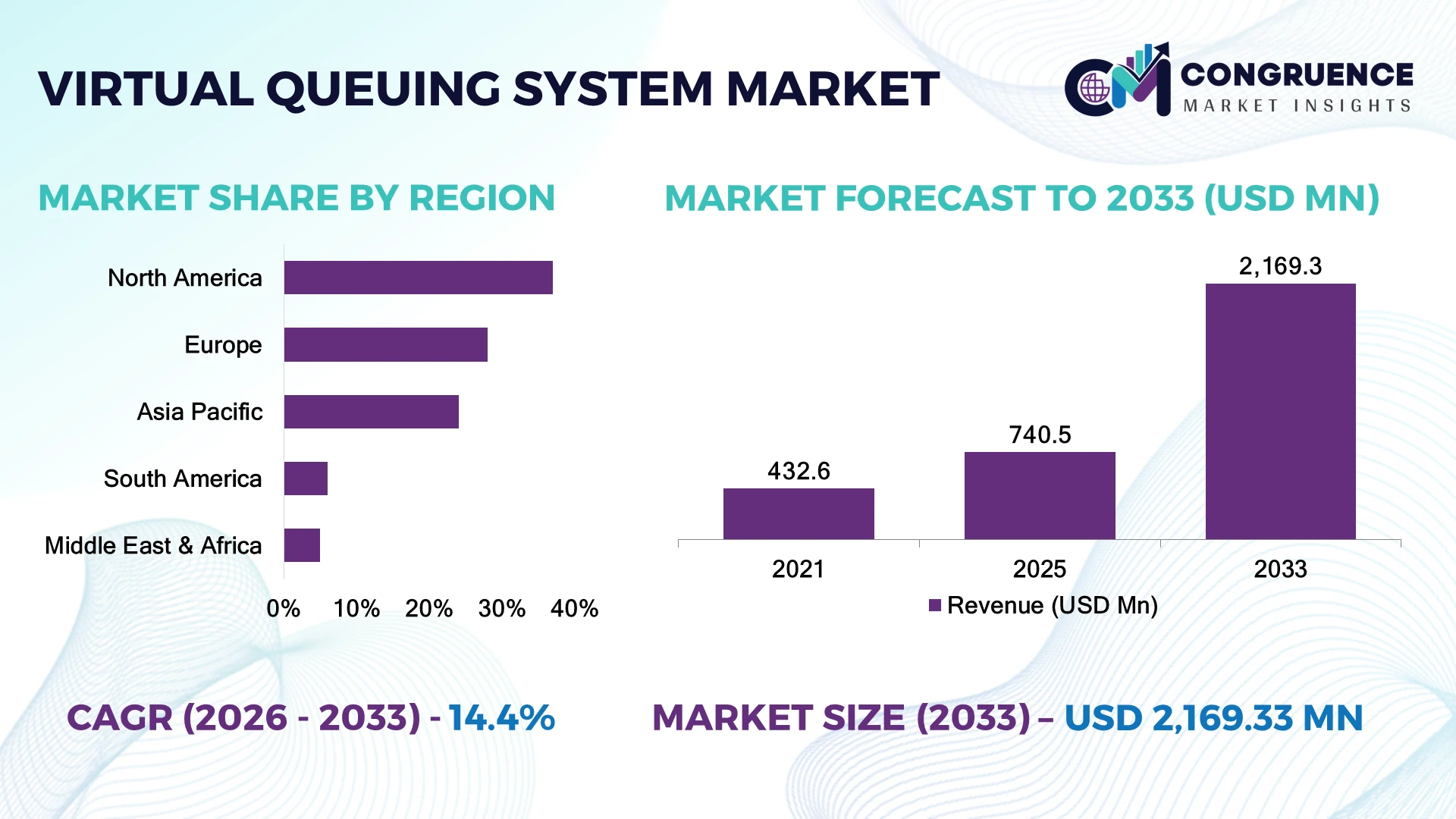
The Global Virtual Queuing System Market was valued at USD 740.0 Million in 2025 and is anticipated to reach a value of USD 2,169.3 Million by 2033 expanding at a CAGR of 14.38% between 2026 and 2033. Growth is being driven by rapid deployment of AI-enabled customer flow management platforms across airports, hospitals, retail chains, and government service centers to reduce physical congestion and improve service efficiency.
The United States dominates the market with an estimated 34% share, supported by large-scale digital transformation investments across healthcare, aviation, and public administration. More than 65% of major U.S. airports have adopted advanced queue management technologies, compared with approximately 42% in the United Kingdom. Federal modernization programs, smart infrastructure spending, and post-pandemic service optimization initiatives continue accelerating adoption. High-volume industries process millions of customer interactions annually through digital appointment and virtual waitlist systems, strengthening the country’s leadership position.
Organizations prioritizing customer experience modernization and operational efficiency are increasingly treating virtual queuing platforms as strategic digital infrastructure rather than standalone service tools.
Market Size & Growth: USD 740.0 Million in 2025, projected to reach USD 2,169.3 Million by 2033, supported by AI-powered customer flow optimization and a 14.38% CAGR.
Top Growth Drivers: Digital service adoption (+48%), self-service technology deployment (+41%), and smart facility modernization (+37%) are accelerating market expansion.
Short-Term Forecast: By 2028, average customer wait times are expected to decline by 30%, while service efficiency improves by 25%.
Emerging Technologies: AI-driven queue prediction, cloud-native platforms, and mobile appointment automation are reshaping advanced queue management.
Regional Leaders: North America (~USD 760 Million), Europe (~USD 520 Million), and Asia-Pacific (~USD 610 Million by 2033) lead through smart infrastructure adoption.
Consumer/End-User Trends: More than 70% of customers prefer digital waitlist notifications over physical queues in high-traffic environments.
Pilot/Case Example: A 2024 airport deployment reduced passenger waiting time by 35% and improved processing throughput by 22%.
Competitive Landscape: Top vendors collectively control nearly 40% of market activity, led by Qmatic, Wavetec, Lavi Industries, Q-nomy, and Advantech.
Regulatory & ESG Impact: Digital queue systems reduce paper ticket usage by over 80% and support public-service modernization initiatives.
Investment & Funding: More than USD 500 Million has been directed toward smart facility and customer experience technologies through partnerships and expansion programs.
Innovation & Future Outlook: Predictive analytics, omnichannel engagement, and AI-based demand forecasting are defining next-generation competitive strategies.
Virtual Queuing System solutions are increasingly deployed across healthcare facilities, transportation hubs, retail networks, and government service centers where customer throughput and experience directly affect operational performance. AI-enabled scheduling engines, mobile notifications, and predictive demand analytics are improving service utilization rates by over 25% in selected deployments. Growing smart-city initiatives and public-service digitization programs are also expanding adoption, creating a strong foundation for broader strategic transformation across customer-facing industries.
Virtual queuing systems have become strategically important because customer experience, operational efficiency, and service accessibility increasingly influence competitive differentiation. Organizations across healthcare, airports, financial institutions, and public agencies are replacing traditional waiting models with digital engagement platforms that support appointment management, demand forecasting, and customer flow optimization. Infrastructure modernization initiatives and large-scale digital service transformation programs are accelerating deployment across both public and private sectors.
Compared with conventional physical queue management, advanced virtual queuing platforms can reduce perceived wait times by 30–40% while improving staff utilization by nearly 20%. The United States leads in enterprise-scale deployment across healthcare and aviation, whereas countries such as India are witnessing rapid adoption through digital public-service initiatives and smart-city projects. Mobile-first platforms and cloud-based architectures are enabling faster implementation and lower administrative overhead.
A practical example is airport passenger management, where digital waitlist systems streamline security screening and boarding operations. Vendors are expanding AI capabilities, strengthening integration partnerships, and investing in predictive analytics ecosystems. Over the next two to three years, adoption is expected to intensify across high-volume service environments, making virtual queuing a critical tool for operational resilience, customer retention, and long-term competitive positioning.
The strongest market driver is the enterprise-wide shift toward digital customer engagement and service optimization. More than 70% of consumers now prefer mobile-based service interactions, while organizations deploying virtual queuing solutions report customer satisfaction improvements exceeding 25%. Healthcare providers have reduced patient congestion by nearly 30% through appointment-linked virtual waiting systems. Following post-pandemic service modernization efforts, governments and large enterprises have prioritized contactless service delivery and real-time queue visibility. This shift directly improves resource allocation, reduces facility bottlenecks, and increases service throughput. In response, technology providers are expanding cloud-native platforms, forming integration partnerships, and investing in AI-powered forecasting tools. The strategic advantage extends beyond customer convenience, enabling organizations to convert queue management into a measurable operational performance asset.
Legacy infrastructure remains a significant barrier to deployment, particularly across public-sector facilities and fragmented service networks. Approximately 45% of organizations still operate outdated scheduling or customer management systems that require extensive customization for virtual queue integration. Deployment costs can increase by 20–30% when multiple legacy databases and communication platforms must be connected. In countries with uneven digital infrastructure, unreliable connectivity creates additional operational limitations. These constraints affect implementation timelines, scalability, and return on investment. Companies are responding by developing modular architectures, API-driven integration frameworks, and cloud migration strategies to reduce deployment complexity. A key operational insight is that interoperability challenges often represent a larger adoption barrier than software procurement costs, particularly for multi-site organizations managing diverse technology environments.
Artificial intelligence is creating significant opportunities by transforming virtual queuing from a scheduling tool into an intelligent service orchestration platform. AI-based demand forecasting has improved queue prediction accuracy by more than 35% in selected deployments, while automated appointment allocation can increase resource utilization by nearly 20%. India, Indonesia, and other rapidly digitizing economies are expanding smart government services and digital healthcare programs, creating substantial untapped demand. Emerging technologies such as conversational AI, real-time occupancy analytics, and digital identity integration are enhancing platform capabilities. Companies are investing in R&D partnerships, cloud ecosystems, and industry-specific solutions to capture these opportunities. A particularly valuable opportunity lies in integrating virtual queuing with broader customer experience platforms, enabling end-to-end service journey management rather than isolated queue control.
As virtual queuing platforms handle increasing volumes of customer data and real-time interactions, cybersecurity and scalability have become critical long-term challenges. Studies indicate that over 60% of enterprises identify data privacy and system security as major concerns during digital service deployments. Large healthcare networks and transportation hubs processing thousands of daily interactions require highly resilient architectures capable of maintaining consistent performance under peak demand. Integration with mobile applications, payment systems, and customer databases further increases operational complexity. Companies must invest in advanced encryption, zero-trust security frameworks, and scalable cloud infrastructure to maintain reliability. A strategic challenge is balancing seamless user experience with strict compliance requirements, particularly in highly regulated sectors where service disruptions or data breaches can directly affect competitiveness and stakeholder trust.
AI-Based Queue Prediction Expansion – Enterprises are increasingly deploying predictive analytics engines that improve queue forecasting accuracy by 30–40% and reduce service bottlenecks by nearly 25%. Healthcare networks and airports are integrating AI with appointment systems to dynamically allocate staff and service capacity. Labor shortages and customer experience mandates are accelerating adoption. Vendors are responding through automation-focused product upgrades, machine-learning partnerships, and predictive workflow orchestration that improves throughput without increasing physical infrastructure.
Mobile-First Service Delivery Models – Mobile enrollment and notification platforms now account for more than 60% of virtual queue interactions in digitally mature service environments. Customer no-show rates have declined by approximately 18%, while digital check-in usage has increased by over 35%. Banks, hospitals, and government agencies are redesigning service journeys around smartphone-based engagement. Companies are scaling app ecosystems, integrating loyalty and identity verification tools, and expanding omnichannel communication capabilities to streamline customer flow management.
Cloud-Native Platform Consolidation – Cloud deployments represent over 55% of new implementations as organizations prioritize centralized management and faster rollout cycles. Deployment timelines have shortened by nearly 30%, while software maintenance workloads have fallen by roughly 20%. Multi-site enterprises are consolidating fragmented queue systems into unified operational platforms. Providers are expanding SaaS portfolios, strengthening API ecosystems, and developing enterprise-grade integration frameworks to improve interoperability across customer-facing operations.
Real-Time Operational Intelligence Adoption – Organizations are embedding live analytics dashboards that increase resource utilization by 15–20% and improve service visibility across distributed locations. Retail chains and transportation hubs increasingly monitor queue performance through real-time operational metrics rather than periodic reporting. A notable shift is the use of queue intelligence for workforce planning instead of customer management alone. Vendors are investing in analytics partnerships, automation tools, and operational command-center capabilities to support data-driven service optimization.
Mobile-Based Virtual Queuing Systems hold the largest share at approximately 46% of the market due to their scalability, customer convenience, and seamless integration with mobile applications, SMS alerts, and digital service ecosystems. Organizations favor mobile-based platforms because they eliminate physical crowding while enabling remote queue participation and real-time notifications. Adoption is particularly strong across healthcare, banking, and public-service environments where customer mobility and appointment visibility directly influence service efficiency. More than 60% of newly deployed virtual queue solutions now include mobile engagement capabilities as a core feature. Web-Based Virtual Queuing Systems represent the fastest-growing segment as enterprises increasingly prioritize browser-accessible customer interactions without requiring dedicated applications. Kiosk-Based Systems maintain strategic relevance in airports, retail locations, and government offices where on-site customer onboarding remains essential. Nearly 35% of enterprises now operate hybrid deployments combining mobile, web, and kiosk interfaces. Vendors are investing in unified customer experience platforms, expanding cloud integration capabilities, and developing AI-enabled scheduling tools to strengthen competitive differentiation and support evolving service delivery models.
Customer Service Management accounts for approximately 42% of market demand and remains the leading application segment due to its broad deployment across retail, banking, healthcare, and public administration environments. Organizations rely on virtual queuing to optimize customer routing, reduce congestion, and improve service transparency. The segment benefits from direct operational impact, including wait-time reductions exceeding 25% in high-volume service centers. Enterprises continue integrating queue systems with CRM and customer engagement platforms to enhance service personalization and workflow visibility. Appointment Scheduling is the fastest-growing application as healthcare providers, government agencies, and financial institutions shift toward structured service delivery models. Retail Queue Management is also gaining traction through omnichannel retail strategies and in-store customer experience initiatives. More than 50% of enterprise deployments now combine queue management with appointment orchestration capabilities. Companies are expanding automation, integrating predictive scheduling technologies, and scaling cloud-based service coordination platforms. Demand is increasingly shifting toward solutions that combine customer engagement, operational planning, and resource optimization within a unified workflow environment.
Healthcare represents the largest end-user segment with an estimated 28% market share, driven by high patient volumes, appointment-intensive workflows, and the need for operational efficiency. Hospitals, clinics, and diagnostic centers increasingly utilize virtual queuing systems to streamline patient flow, reduce overcrowding, and improve service coordination. Patient wait-time reductions of 20–30% have become common in digitally enabled healthcare environments. The sector’s reliance on scheduled interactions and regulatory compliance further strengthens demand for advanced queue orchestration technologies. Airports and Transportation Hubs constitute the fastest-growing end-user segment as operators modernize passenger processing and congestion management systems. Retail, Banking and Financial Services, Government Offices, and Education continue expanding adoption through customer experience and service modernization initiatives. More than 45% of large organizations across these sectors have accelerated investments in digital customer flow management over the past two years. Vendors are responding with industry-specific solutions, strategic partnerships, and customized deployment models that address operational requirements unique to each vertical while strengthening long-term customer retention.
North America accounted for the largest market share at 37% in 2025 however, Asia-Pacific is expected to register the fastest growth, expanding at a CAGR of 16.2% between 2026 and 2033.
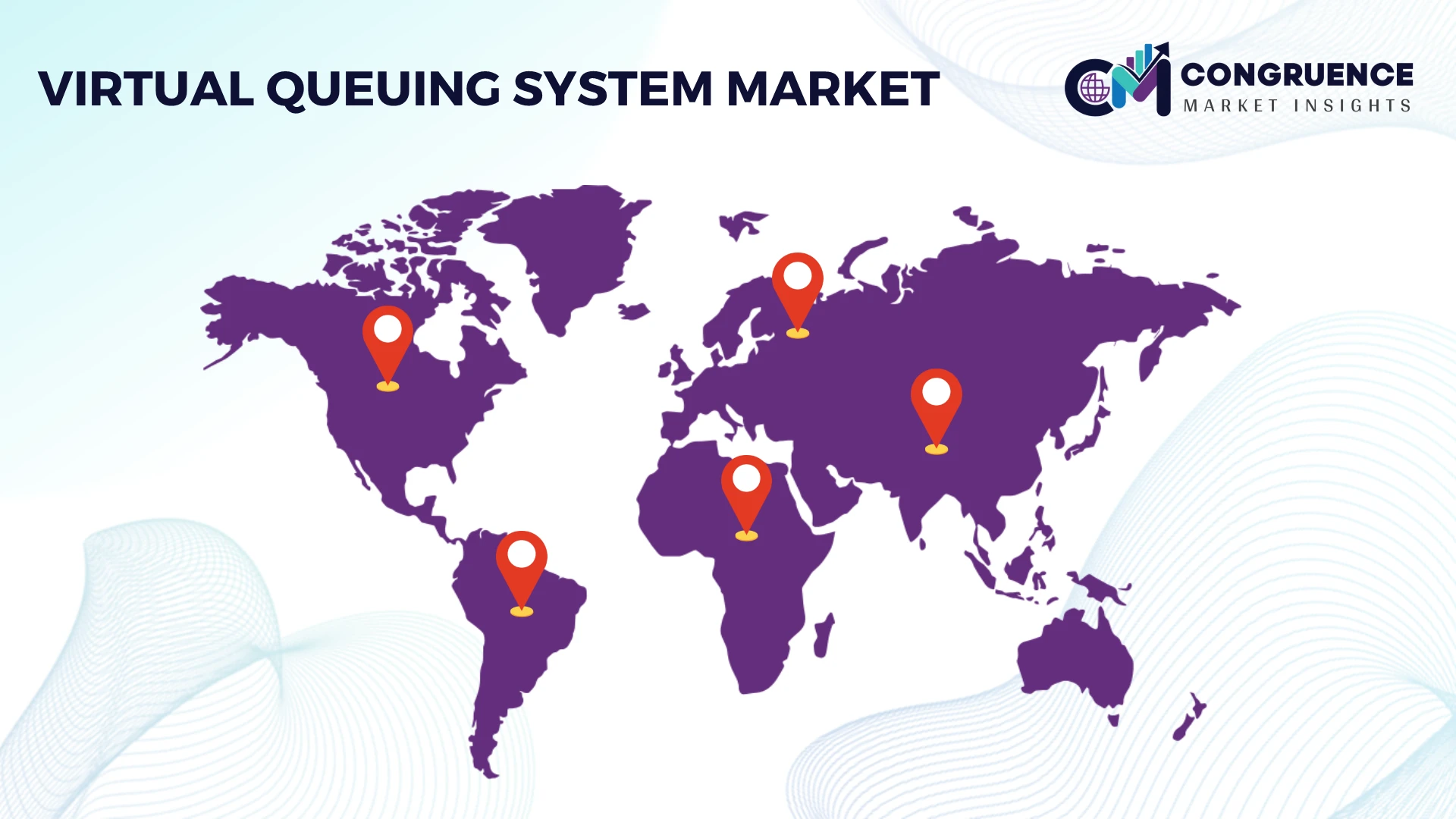
North America maintains its leadership position through extensive deployment across healthcare systems, airports, government agencies, financial institutions, and large retail networks. The region accounts for approximately 37% of global demand, supported by mature digital infrastructure and high penetration of cloud-based service management platforms. Organizations increasingly integrate virtual queuing with customer relationship management, appointment scheduling, and workforce optimization systems to improve operational visibility. More than 65% of large-scale deployments now incorporate mobile-first engagement capabilities. Airports, hospitals, and public-service centers continue replacing traditional waiting models with predictive queue orchestration tools. Strategic partnerships between software providers and enterprise technology vendors are accelerating deployment across multi-site operations. The region’s strong focus on service efficiency, customer retention, and digital transformation continues to reinforce its market leadership.
United States Market Outlook: The United States remains the largest contributor due to extensive adoption across healthcare, aviation, retail, and government services. Major healthcare networks increasingly deploy integrated patient-flow management systems, while airports continue investing in digital passenger processing technologies. More than 70% of large enterprises pursuing customer experience modernization initiatives have incorporated some form of digital queue management. Strong cloud infrastructure, advanced software ecosystems, and ongoing public-sector modernization programs position the country as a primary innovation hub for next-generation virtual queuing solutions.
Europe represents approximately 28% of global market activity, supported by strong adoption across healthcare providers, transportation networks, municipal services, and financial institutions. Governments are increasingly prioritizing digital public-service delivery, creating sustained demand for queue optimization technologies. The region benefits from widespread cloud adoption and advanced digital identity frameworks that support integrated customer engagement models. More than 50% of new public-service modernization projects now include digital appointment and queue management capabilities. Sustainability initiatives are also encouraging paperless customer interaction systems across public and private sectors. Enterprises continue investing in workflow automation, real-time service analytics, and omnichannel customer communication platforms to improve operational responsiveness and service quality.
Germany Market Outlook: Germany holds a strategically important position due to its advanced enterprise technology ecosystem and extensive public-sector digitalization initiatives. Large healthcare providers, municipal administrations, and transportation operators increasingly deploy integrated queue management platforms to optimize service delivery. Digital government programs and smart infrastructure investments continue strengthening adoption. Nearly 40% of major public-service modernization projects incorporate customer flow management technologies, reflecting the country’s emphasis on operational efficiency, automation, and structured digital transformation.
Asia-Pacific accounts for approximately 24% of global market activity and represents the most dynamic deployment environment due to rapid digitalization, expanding urban populations, and large-scale public-service modernization programs. Governments and enterprises are investing heavily in digital customer engagement infrastructure across healthcare, transportation, banking, and municipal services. Mobile-first service delivery models dominate new implementations, with digital check-in and appointment systems becoming standard across high-volume facilities. More than 60% of recent deployments in key economies are cloud-enabled. Smart-city development programs and increasing smartphone penetration continue creating favorable conditions for market expansion. Vendors are scaling regional operations, forming technology alliances, and localizing platforms to address diverse operational requirements.
China Market Outlook: China leads the regional market through extensive smart-city initiatives, advanced digital infrastructure, and large-scale deployment across public administration, healthcare, and transportation sectors. High urban population density creates strong demand for efficient service orchestration technologies. Digital government programs continue expanding implementation across municipal service centers and public facilities. More than half of newly modernized public-service environments now utilize digital appointment and queue coordination systems, strengthening the country’s position as a major deployment and innovation center.
South America accounts for approximately 6% of global market activity, with adoption accelerating across healthcare institutions, financial services, retail chains, and government offices. Organizations increasingly deploy virtual queuing systems to address service inefficiencies and improve customer accessibility without significant physical infrastructure expansion. Digital banking growth and public-service modernization programs are creating new deployment opportunities. Approximately 35% of large service organizations have expanded digital appointment management capabilities over the past two years. While infrastructure disparities and uneven technology investment remain challenges, cloud-based deployment models are improving accessibility and reducing implementation complexity. Vendors are prioritizing localized partnerships and scalable subscription-based solutions to strengthen regional market penetration.
Brazil Market Outlook: Brazil represents the largest market within the region due to its sizeable banking sector, extensive healthcare network, and growing digital transformation initiatives. Financial institutions are among the most active adopters of virtual queuing technologies as they seek to improve branch efficiency and customer engagement. Public-service digitization programs are also increasing deployment opportunities. Large enterprises continue investing in customer experience technologies, with digital service management becoming an important component of operational modernization strategies across multiple sectors.
The Middle East & Africa region accounts for approximately 5% of global market activity and is increasingly shaped by government-led modernization initiatives, smart-city investments, and digital public-service programs. Healthcare facilities, airports, government agencies, and financial institutions are leading adoption as organizations seek to improve service efficiency and customer accessibility. Several major infrastructure programs now incorporate digital customer management capabilities as part of broader transformation strategies. More than 40% of newly developed smart-service facilities in key Gulf economies include virtual queuing functionality. Investment in cloud infrastructure and digital government platforms continues supporting market development. Technology providers are expanding regional partnerships and establishing localized service capabilities to address growing enterprise demand.
Saudi Arabia Market Outlook: Saudi Arabia serves as the region’s most influential market due to large-scale digital transformation programs, smart-city development projects, and sustained investment in public-service modernization. Government agencies, healthcare providers, and transportation operators continue adopting advanced customer flow management technologies to improve service quality and operational efficiency. National digitalization initiatives have accelerated deployment across public-facing institutions. The country’s strong infrastructure investment pipeline and commitment to technology-enabled service delivery position it as a leading market for future virtual queuing system implementation.
The competitive landscape is led by Qmatic, Q-nomy, Wavetec, Lavi Industries, and Advantech, which collectively account for approximately 42% of market activity. Global platform providers compete directly with regional queue-management specialists, while cloud-native innovators challenge established enterprise workflow vendors. Competition centers on AI-enabled scheduling, mobile engagement, deployment speed, interoperability, and vertical-specific customization rather than price alone. Organizations adopting predictive queue orchestration report wait-time reductions exceeding 30%, while integrated mobile solutions improve customer engagement by more than 25%. Leading vendors are expanding through healthcare and government-sector partnerships, cloud platform enhancements, and omnichannel service capabilities. The market is shifting toward customer journey orchestration, where queue management is embedded within broader digital-service ecosystems. Consolidation pressure is increasing as enterprises favor unified platforms over standalone queue solutions. A major entry barrier is enterprise integration complexity, particularly across legacy infrastructure environments. Winning requires scalable cloud architecture, industry-specific functionality, strong integration capabilities, measurable operational outcomes, and trusted enterprise deployment expertise.
Q-nomy
Wavetec
Lavi Industries
Advantech
Skiplino
WaitWell
Aurionpro
AKIS Technologies
XIPHIAS Software Technologies
QLess
Tensator
SEDCO
Qminder
Current technology development is centered on AI-driven queue orchestration, cloud-native deployment, and mobile-first customer engagement. AI-enabled forecasting engines improve queue prediction accuracy by 30–40%, while real-time resource allocation increases service utilization by approximately 20%. More than 60% of newly deployed enterprise solutions now incorporate predictive analytics capabilities. Organizations benefit through reduced congestion, improved staff productivity, and stronger customer retention. Healthcare providers, airports, and financial institutions are among the largest adopters because operational efficiency directly affects service quality and throughput.
Emerging technologies include conversational AI, digital identity integration, and advanced workflow automation. Compared with traditional first-come-first-served queue systems, intelligent virtual queuing platforms reduce perceived waiting times by more than 35% and lower administrative workloads by nearly 25%. Adoption is accelerating as enterprises connect queue management with customer relationship management, appointment scheduling, and workforce optimization platforms. Technology leaders with strong cloud ecosystems gain a competitive advantage through deeper integration and data visibility.
Disruptive innovation is shifting toward autonomous service orchestration powered by machine learning and real-time behavioral analytics. Between 2026 and 2028, adoption of intelligent queue automation is expected to exceed 70% among large customer-facing enterprises. Companies acting early can improve operational responsiveness, optimize staffing decisions, and create differentiated service experiences that are increasingly difficult for legacy providers to replicate.
April 2025 – Q-nomy launched Q-Flow Online Booking Journey 2.0 and Virtual Lobby 4.0, introducing fully integrated omnichannel appointment management with enhanced security, customization, and mobile functionality. The release delivered a unified customer journey across in-person, phone, and video interactions, strengthening enterprise deployment scalability and customer engagement efficiency. Source: qnomy.com
June 2026 – Q-nomy introduced AgentFlow and QLM, expanding its platform with AI-powered customer journey orchestration capabilities. The launch strengthened automation across service workflows and accelerated intelligent decision-making for customer interactions, supporting next-generation queue management deployments and enterprise service optimization initiatives. Source: qnomy.com News
January 2025 – Q-nomy and Amdocs expanded their long-standing partnership to advance customer engagement solutions across financial services, retail, and digital channels. The collaboration broadened enterprise integration capabilities and reinforced scalable omnichannel service management strategies for high-volume customer environments. Source: Q-nomy Partnership Update
March 2025 – Advantech and QNX expanded collaboration around integrated embedded platforms supporting healthcare, industrial automation, robotics, and transportation applications. The initiative streamlined deployment workflows and reduced development complexity through pre-integrated hardware-software environments, improving implementation efficiency for mission-critical digital service infrastructures. Source: Collaboration Announcement
This report provides comprehensive analysis of the Virtual Queuing System Market across major technology categories, applications, deployment environments, and end-user industries. Coverage includes mobile-based, web-based, and kiosk-enabled solutions alongside customer service management, appointment scheduling, retail queue optimization, and public-service applications. The study evaluates adoption patterns across healthcare, transportation, banking, government, education, and retail sectors. Regional assessment spans North America, Europe, Asia-Pacific, South America, and the Middle East & Africa, highlighting deployment concentration, technology maturity, and enterprise adoption dynamics.
The report examines AI-driven queue orchestration, cloud-native platforms, predictive analytics, mobile engagement technologies, and workflow automation trends shaping industry evolution. More than 60% of recent enterprise deployments incorporate cloud-enabled architectures, while mobile-first engagement continues expanding across customer-facing industries. Strategic insights support investment evaluation, market entry planning, partnership development, competitive benchmarking, product positioning, and expansion strategy. The analysis also identifies emerging deployment opportunities, operational transformation priorities, and technology-driven competitive advantages expected to influence market direction between 2026 and 2033.
| Report Attribute / Metric | Details |
|---|---|
| Market Revenue (2025) | USD 740.0 Million |
| Market Revenue (2033) | USD 2,169.3 Million |
| CAGR (2026–2033) | 14.38% |
| Base Year | 2025 |
| Forecast Period | 2026–2033 |
| Historic Period | 2021–2025 |
| Segments Covered |
By Type
By Application
By End-User
|
| Key Deliverables | Revenue Forecast; Market Trends; Growth Drivers & Restraints; Technology Insights; Segmentation Analysis; Regional Insights; Competitive Landscape; Regulatory & ESG Overview; Recent Developments |
| Regions Covered | North America; Europe; Asia-Pacific; South America; Middle East & Africa |
| Companies Profiled | Qmatic; Q-nomy; Wavetec; Lavi Industries; Advantech; Skiplino; WaitWell; Aurionpro; AKIS Technologies; XIPHIAS Software Technologies; QLess; Tensator; SEDCO; Qminder |
| Customization & Pricing | Available on Request (10% Customization Free) |




