
Reports
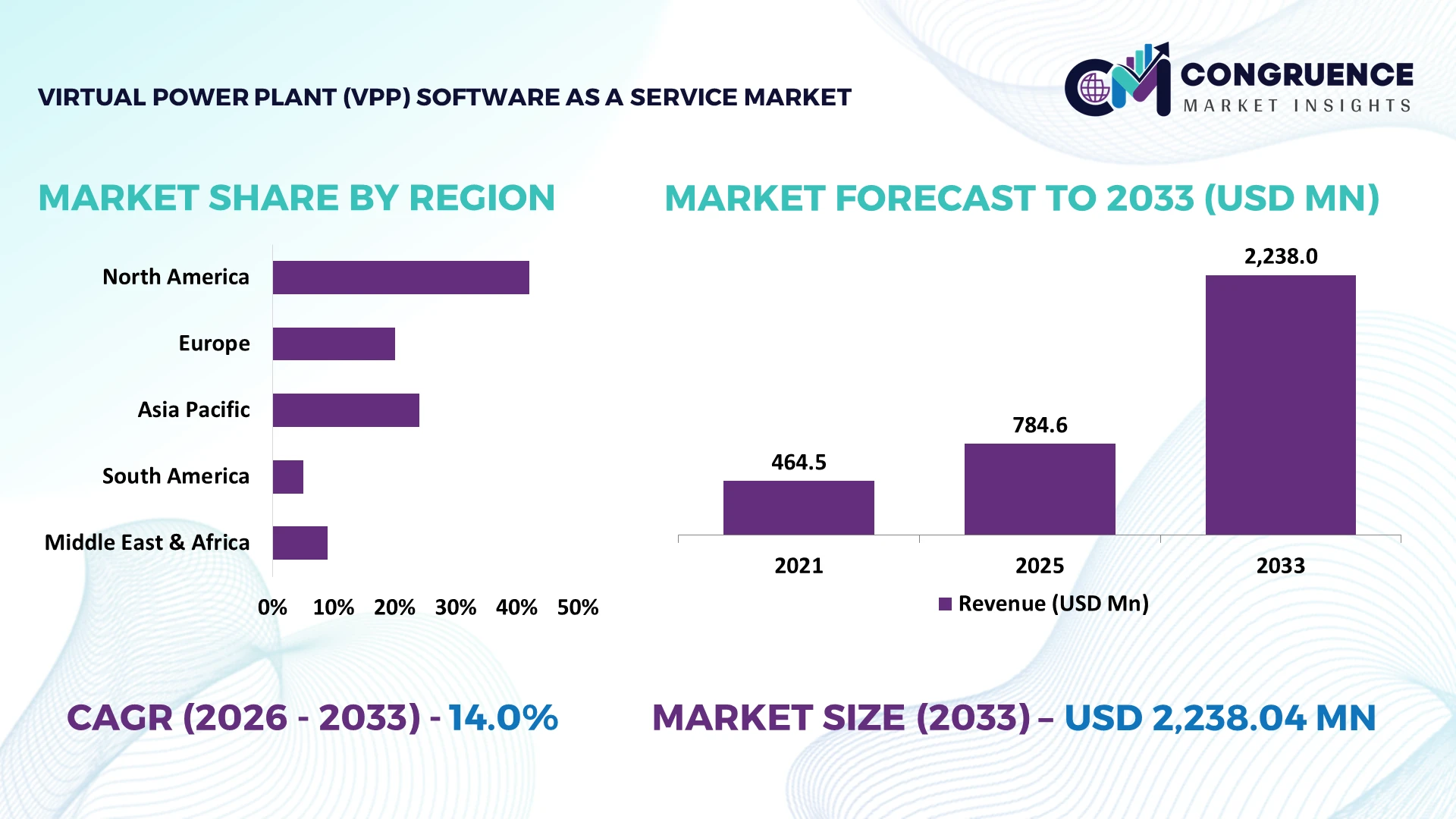
The Global Virtual Power Plant (VPP) Software as a Service Market was valued at USD 784.56 Million in 2025 and is anticipated to reach a value of USD 2238.04 Million by 2033 expanding at a CAGR of 14% between 2026 and 2033. Growth is driven by rapid distributed-energy-resource aggregation, battery and EV orchestration, wholesale-market participation, grid congestion management, and utility migration toward cloud-based real-time flexibility platforms.
The United States commands an estimated 35–40% of global VPP SaaS demand, supported by 33 GW of North American VPP capacity and expanding aggregation of batteries, thermostats, EV chargers, solar, and commercial loads. U.S. programs targeting 80–160 GW by 2030 could serve 10–20% of peak load. Australia operates at smaller scale but has deeper residential battery aggregation experience. FERC Order 2222 implementation and intensifying U.S. electricity-demand pressure are accelerating software requirements for dispatch, telemetry, enrollment, and settlement automation.
VPP SaaS vendors that combine multi-asset interoperability, market bidding, predictive dispatch, and scalable customer enrollment will capture the strongest utility and aggregator opportunities.
Market Size & Growth: USD 784.56 million in 2025 reaches USD 2,238.04 million by 2033 at 14% CAGR, driven by DER aggregation and automated grid flexibility.
Top Growth Drivers: DER proliferation contributes approximately 35%, grid-flexibility requirements 30%, and wholesale-market participation 20% to incremental VPP SaaS demand.
Short-Term Forecast: By 2028, automated forecasting and dispatch workflows can reduce manual flexibility-management requirements by approximately 20–30%.
Emerging Technologies: AI forecasting, edge orchestration, and vehicle-to-grid integration are targeting 15–25% improvements in distributed-resource dispatch efficiency.
Regional Leaders: North America approaches USD 850 million, Europe USD 650 million, and Asia-Pacific USD 560 million by 2033 as aggregation scales.
Consumer/End-User Trends: North American VPP capacity reached 33 GW, confirming expanding utility and household participation in flexible-load programs.
Pilot/Case Example: In July 2025, California VPPs delivered over 535 MW, including nearly 500 MW supplied by Tesla Powerwall households.
Competitive Landscape: AutoGrid/Schneider Electric holds an estimated 10–12% position alongside Tesla, EnergyHub, Enel X, and Kraken Technologies.
Regulatory & ESG Impact: FERC Order 2222 enables DER aggregations as small as 100 kW to access organized wholesale electricity markets.
Investment & Funding: U.S. VPP deployment at 80–160 GW could avoid approximately USD 10 billion in annual grid costs by 2030.
Innovation & Future Outlook: Advanced VPP orchestration targets 10–20% of U.S. peak demand through automated batteries, EVs, buildings, and flexible industrial loads.
Virtual Power Plant Software as a Service is moving from demand-response administration toward continuous orchestration of batteries, rooftop solar, EV chargers, thermostats, buildings, and flexible industrial loads. North American VPP capacity has already reached 33 GW, establishing commercial scale for cloud-based forecasting, dispatch, telemetry, enrollment, and settlement. AI optimization and multi-asset APIs are improving real-time resource coordination, while FERC Order 2222 implementation is opening wholesale-market participation to aggregated DERs. The emerging priority is therefore software capable of converting millions of decentralized devices into dependable, dispatchable grid capacity.
VPP SaaS is becoming strategic grid infrastructure as utilities shift from centralized generation planning toward software-coordinated distributed flexibility. North America already operates roughly 33 GW of VPP capacity, while FERC Order 2222 is restructuring market access by allowing aggregated DERs to participate in organized wholesale markets. This regulatory transition elevates forecasting, telemetry, dispatch, enrollment, and settlement software from supporting tools to commercial infrastructure.
Cloud-native VPP platforms coordinate batteries, EV chargers, thermostats, solar, and flexible loads within seconds, versus legacy demand-response systems relying on scheduled curtailment and fragmented device control. Automated orchestration can improve dispatch utilization by 15–25%. The United States leads commercial aggregation scale; Australia has deeper residential battery orchestration, while Germany increasingly emphasizes flexibility around renewable generation. Through 2028, EV charging and behind-the-meter storage will materially expand controllable portfolios.
A practical deployment can aggregate 50,000 household batteries, forecast available capacity, dispatch them during peak conditions, and calculate participant settlements automatically. Vendors are expanding utility partnerships, device integrations, AI forecasting, and market-bidding capabilities. Competitive advantage will belong to platforms converting heterogeneous DER fleets into predictable, verifiable grid capacity.
Rapid DER deployment is turning millions of customer-owned assets into dispatchable grid resources. North American VPP capacity has reached approximately 33 GW, while deployment pathways indicate aggregated resources can eventually address 10–20% of U.S. peak demand. Battery storage installations and managed EV charging are expanding the controllable asset pool, while FERC Order 2222 lowers organized-market barriers for aggregations as small as 100 kW. Utilities consequently require software that forecasts availability, coordinates devices, verifies performance, and automates settlements. Vendors are expanding integrations with battery manufacturers, EV charging platforms, thermostats, and utility systems. The strategic shift is significant: utilities can procure flexibility from existing customer assets instead of relying exclusively on new peak-generation infrastructure.
VPP economics remain constrained by fragmented device protocols, telemetry quality, interconnection rules, and market-specific participation requirements. A single aggregation can span five or more asset categories with different response times, APIs, warranty conditions, and control permissions. Integration and customer-acquisition activities can consume 20–30% of early deployment effort, while incomplete telemetry can reduce dispatchable portfolio availability by 10–15%. California provides strong DER density, yet utilities, aggregators, manufacturers, and market operators still operate distinct enrollment and verification processes. Providers are reducing integration costs through standardized APIs, hardware-agnostic orchestration, pre-certified device libraries, and long-term OEM partnerships. The key constraint is therefore not resource availability but the cost of converting heterogeneous assets into consistently measurable grid services.
EVs create a substantial new flexibility pool because vehicles remain parked for long periods while charging demand can be shifted without disrupting mobility. Managed charging can move 20–40% of participating charging load away from grid peaks, while bidirectional vehicle-to-grid systems add export capability. California, with more than 2 million cumulative zero-emission vehicle sales, provides an increasingly dense software-addressable fleet. Through 2028, ISO 15118 adoption, bidirectional charging, AI forecasting, and dynamic tariffs will expand automated vehicle participation. VPP providers are building partnerships with automakers, charging-network operators, utilities, and home-energy platforms. The non-obvious opportunity is aggregated charging avoidance: monetizable grid value begins before widespread V2G because software can shift consumption without requiring battery export.
Scaling from thousands to millions of distributed devices creates latency, cybersecurity, forecasting, and availability-management challenges that conventional demand-response architecture was not designed to handle. VPP platforms increasingly require sub-minute telemetry for selected services while maintaining availability across fleets where 10–20% of devices can be temporarily offline, charging, disconnected, or customer-constrained. Australia’s expanding household battery ecosystem demonstrates the operational complexity of coordinating different inverter standards, network limits, and retailer programs. Cybersecurity pressure rises simultaneously as cloud platforms gain remote control over physical energy assets. Vendors must invest in edge computing, encrypted APIs, automated failover, device-level authentication, and probabilistic forecasting. Long-term competitiveness depends on delivering contracted capacity reliably despite constantly changing asset availability and network conditions.
Wholesale Participation Moves Into Production: FERC Order 2222 implementation is moving aggregated DER portfolios beyond utility programs toward organized electricity markets. Minimum aggregation thresholds can reach 100 kW, while portfolios combine thousands of endpoints. Vendors are automating qualification, telemetry validation, bidding, and settlement, reducing manual market-operation workflows by roughly 20–30% and making smaller distributed assets commercially manageable.
Forecasting Becomes Dispatch Critical: VPP operators are replacing static availability assumptions with AI forecasts incorporating weather, consumption, battery state-of-charge, and behavioral signals. Forecasting automation can improve usable flexibility estimates by 10–20% while reducing dispatch shortfalls by approximately 15%. Platforms are expanding machine-learning pipelines and real-time telemetry because inaccurate availability increasingly translates directly into imbalance costs and performance penalties.
Dynamic Tariffs Reshape Customer Control: Time-varying electricity pricing is linking household behavior directly with VPP dispatch economics. Automated thermostats, batteries, and smart appliances can shift 10–30% of flexible household consumption away from expensive periods. Utilities and software providers are integrating tariff engines, customer consent, and device scheduling, transforming retail pricing from a billing mechanism into an operational flexibility signal.
Capacity Payments Strengthen Retention Economics: Aggregators are redesigning participation around recurring customer incentives instead of event-only rewards. Programs coordinating residential batteries increasingly commit several kilowatts per household across hundreds or thousands of participants. Automated enrollment and performance tracking reduce administrative handling by 15–25%. The non-obvious shift is toward retention analytics: software providers now optimize participant persistence alongside megawatt availability.
Demand Response represents approximately 30–35% of VPP SaaS deployment demand, supported by mature utility programs, established load-control infrastructure, and relatively low integration requirements. Thermostats, commercial HVAC, water heaters, and controllable industrial loads provide scalable flexibility without requiring electricity export. Distributed Generation remains strategically important where rooftop solar and dispatchable generation require coordinated forecasting. Battery Storage provides higher response precision, with modern systems capable of transitioning from standby to dispatch within seconds, strengthening participation in higher-value grid services.
Mixed-Asset VPP is the fastest-growing type because aggregators increasingly combine consumption, generation, and storage rather than operating technology-specific fleets. Mixed portfolios can diversify resource availability and improve dispatch reliability by approximately 15–25% compared with dependence on a single asset category. Hybrid VPP configurations similarly combine centralized and distributed flexibility where utilities require portfolio-level control. Providers are prioritizing hardware-agnostic APIs, cross-device optimization, automated enrollment, and OEM partnerships as investment shifts from single-resource control toward portfolio orchestration.
Grid Balancing accounts for approximately 30–35% of VPP SaaS application demand because utilities and aggregators require continuous alignment between variable electricity supply and consumption. Demand Management remains a mature application, particularly for thermostats, commercial loads, and managed devices, while Peak Shaving targets expensive system peaks through scheduled flexibility. Frequency Regulation requires faster telemetry and response, making batteries and automated controls particularly valuable where second-to-second adjustments command operational premiums.
Renewable Integration is the fastest-growing application as solar and wind increase short-duration balancing requirements. Forecasting combined with flexible storage and demand can reduce renewable-related imbalance exposure by approximately 10–20%, while automated dispatch can shorten response workflows from minutes to seconds. Energy Trading is also strengthening as aggregated portfolios gain access to organized markets and dynamic tariffs. Vendors are responding with AI forecasting, market-bidding engines, automated settlements, and ISO/RTO integrations, shifting investment toward platforms capable of optimizing the same distributed asset across multiple applications.
Utilities account for approximately 35–40% of VPP SaaS demand because they manage system reliability, peak capacity, distribution constraints, and customer flexibility programs at scale. Their portfolios can aggregate tens of thousands of endpoints across residential and commercial service territories. Energy Retailers use VPP platforms to optimize customer portfolios against wholesale prices, while Renewable Operators increasingly combine generation forecasts with batteries and controllable demand. Industrial Facilities and Commercial Buildings contribute high-value flexibility through HVAC, refrigeration, storage, and production scheduling.
Aggregators are the fastest-growing end-user group as regulatory reforms expand third-party participation and DER portfolios become commercially large enough for independent optimization. Automated enrollment and dispatch can reduce portfolio-management effort by approximately 20–30%, strengthening aggregator economics at scale. Providers are targeting utilities with enterprise integrations while offering aggregators API-first platforms, performance-based pricing, device ecosystems, and automated market interfaces. Competitive demand is consequently shifting toward software capable of serving both regulated grid operations and merchant flexibility portfolios.
North America accounted for the largest market share at 38% in 2025 however, Asia-Pacific is expected to register the fastest growth, expanding at a CAGR of 16.2% between 2026 and 2033.
Wholesale Access Accelerates DER Orchestration
North America accounted for approximately 38% of global VPP SaaS demand in 2025, supported by large distributed battery fleets, smart thermostats, rooftop solar, managed EV charging, and mature electricity markets. Existing VPP capacity is measured in tens of gigawatts, establishing commercial scale for automated forecasting, dispatch, telemetry, and settlement platforms. FERC Order 2222 is restructuring participation by enabling aggregated DERs to enter organized wholesale markets, while California and Texas provide dense pools of controllable customer assets. Utilities increasingly deploy cloud orchestration as an alternative to relying exclusively on peaking generation and distribution upgrades. Software providers are expanding ISO/RTO integrations, OEM partnerships, device libraries, and automated enrollment capabilities, shifting competition toward multi-market monetization of the same flexible asset portfolio.
United States Market Outlook: The United States combines large organized electricity markets with rapidly expanding battery, EV, thermostat, and rooftop-solar fleets. Aggregations can qualify for wholesale participation at thresholds as low as 100 kW under market implementations shaped by Order 2222. California provides particularly strong software economics because high DER density enables aggregators to assemble substantial dispatchable capacity within concentrated distribution territories.
Flexibility Markets Reshape Renewable Operations
Europe represents approximately 27% of global VPP SaaS demand, driven by high renewable penetration, cross-border electricity trading, dynamic tariffs, distributed solar, batteries, heat pumps, and increasingly flexible industrial consumption. Germany, the United Kingdom, the Netherlands, and Nordic markets provide particularly favorable environments for software-coordinated flexibility. Renewables generate more than 40% of EU electricity, increasing intraday balancing and congestion-management requirements. Smart-meter deployment and market reforms are enabling more granular customer participation, while negative electricity prices strengthen incentives to shift charging and storage behavior. Providers are integrating day-ahead and intraday trading, imbalance optimization, battery dispatch, forecasting, and flexibility-market interfaces. Competition increasingly centers on converting distributed assets into simultaneously tradable energy, balancing, and congestion-management products rather than operating isolated demand-response programs.
Germany Market Outlook: Germany combines more than 100 GW of installed solar capacity with expanding batteries, heat pumps, EVs, and dynamic electricity tariffs. High renewable output periodically produces negative wholesale prices, creating direct economic value for automated charging and storage optimization. VPP platforms capable of coordinating household and commercial flexibility across trading intervals gain a strong operational advantage.
Distributed Storage Creates Aggregation Scale
Asia-Pacific represents approximately 25% of global VPP SaaS demand, supported by Australia’s residential battery ecosystem, Japan’s distributed-energy programs, and expanding Chinese storage and EV infrastructure. Australia provides one of the world’s most mature household VPP environments because rooftop solar penetration exceeds 30% of homes, creating concentrated pools of batteries and controllable generation. Japan emphasizes resilience, distributed storage, and utility aggregation, while China offers exceptional device scale across EVs, solar, and battery systems. Market structures remain heterogeneous, requiring country-specific dispatch, settlement, and compliance configurations. Providers are therefore expanding localized utility partnerships, inverter integrations, forecasting engines, and customer-enrollment platforms. The strategic shift is from demonstration projects toward commercially managed portfolios capable of delivering peak management, balancing, and network-support services.
Australia Market Outlook: Australia combines more than 4 million rooftop-solar installations with rapidly expanding household batteries, giving VPP operators unusually dense residential resource pools. South Australia has been an important aggregation hub, demonstrating coordinated battery dispatch across thousands of households. Dynamic tariffs and distributed-energy integration continue strengthening the commercial case for automated portfolio management.
Distributed Solar Opens Flexibility Pathways
South America accounts for approximately 5% of global VPP SaaS demand, with Brazil and Chile providing the strongest foundations for distributed-energy aggregation. Brazil has surpassed 40 GW of distributed solar capacity, creating a substantial software-addressable generation base, while Chile combines utility-scale renewables with rapidly expanding battery storage. Current VPP deployment remains constrained by market rules, smart-meter penetration, and limited mechanisms for monetizing aggregated flexibility. Commercial and industrial customers therefore represent an important early pathway because larger controllable loads can be aggregated with fewer endpoints. Providers are targeting solar-plus-storage portfolios, commercial demand management, forecasting, and energy optimization rather than replicating residential models immediately. Progress in smart metering and market liberalization will determine how quickly these distributed assets transition from passive generation into actively orchestrated flexibility.
Brazil Market Outlook: Brazil provides the region’s largest distributed-energy base, with millions of distributed-generation connections spread across residential, commercial, and industrial consumers. Solar-heavy portfolios create an opportunity for VPP platforms to combine generation forecasting with batteries and controllable commercial loads. Software providers that integrate local tariff structures and utility interfaces can establish early aggregation advantages.
Smart Grids Enable Flexible Resource Coordination
Middle East & Africa represents approximately 5% of global VPP SaaS demand, with the UAE, Saudi Arabia, Israel, and South Africa providing distinct adoption pathways. Gulf markets combine utility-scale renewable investment with smart-meter infrastructure, EV deployment, and digitally managed buildings, while South Africa’s reliability challenges encourage behind-the-meter solar and battery installations. Saudi Arabia has deployed more than 10 million smart meters, establishing a digital foundation for increasingly granular demand management. UAE smart-city programs provide additional opportunities around commercial buildings and EV charging. Providers are initially targeting large controllable portfolios rather than fragmented residential aggregation, integrating building-management systems, batteries, solar, and utility interfaces. The operational opportunity lies in coordinating customer assets to reduce peak requirements while improving utilization of rapidly expanding renewable infrastructure.
United Arab Emirates Market Outlook: The UAE combines advanced metering, smart-building infrastructure, expanding solar generation, and growing EV charging networks within geographically concentrated electricity systems. Dubai and Abu Dhabi provide attractive environments for commercial VPP deployment because large buildings and campuses offer controllable HVAC, charging, solar, and storage loads that can be centrally optimized.
The Virtual Power Plant SaaS market pits Schneider Electric, Tesla, EnergyHub, Enel X, and Kraken Technologies against specialist aggregation platforms and utility software providers. The top five account for approximately 40–45% of commercial platform activity, reflecting fragmented asset ownership and country-specific electricity markets. Tesla competes through vertically integrated batteries and vehicle ecosystems; EnergyHub emphasizes device aggregation, while Schneider Electric targets utility-scale orchestration and enterprise integration. Hardware-agnostic platforms can expand addressable device coverage by 20–30%, while automated forecasting and dispatch reduce portfolio-management effort by approximately 20–25%. Players are securing utility partnerships, integrating OEM APIs, expanding market-bidding functionality, and automating customer enrollment and settlements. Competition is shifting from single-asset demand response toward mixed-asset, multi-market optimization. Complex ISO integrations, telemetry requirements, cybersecurity, and device certification create significant entry barriers. Winning requires broad asset interoperability, reliable dispatch performance, automated market participation, scalable enrollment, and proven utility-grade cybersecurity across heterogeneous distributed-energy portfolios.
Schneider Electric
Tesla
EnergyHub
Kraken Technologies
Enel X
Next Kraftwerke
Sonnen
Flexitricity
Piclo
Limejump
Sympower
Voltus
Virtual Peaker
Renew Home
Current VPP SaaS technology combines cloud-native DERMS, device APIs, automated enrollment, telemetry, forecasting, and market dispatch across batteries, thermostats, EV chargers, solar, and flexible loads. Cross-DER orchestration can improve portfolio utilization by 15–25%, while automated settlement reduces administrative processing by roughly 20%. Multi-asset deployments are expanding as utilities replace separate demand-response applications with unified control layers.
Emerging platforms apply AI forecasting, edge computing, digital twins, and probabilistic optimization to predict asset availability and respond to grid conditions. AI-driven dispatch can reduce forecast error by 10–20%, improving capacity confidence and imbalance management. Compared with legacy event-based demand response, real-time VPP orchestration can improve flexible-resource utilization by approximately 25%. Utilities, aggregators, and energy retailers with broad device ecosystems benefit most because software can monetize identical assets across multiple grid services.
From 2026–2028, agentic optimization, vehicle-to-grid control, dynamic tariffs, and autonomous market bidding will become disruptive capabilities. Platforms coordinating millions of endpoints will increasingly make sub-minute decisions across distribution constraints and wholesale prices, targeting 15–20% higher dispatch efficiency. Open APIs and edge intelligence will reduce vendor lock-in while strengthening resilience. Companies investing now in interoperable asset models, cybersecurity, and automated market interfaces gain a durable advantage as VPP software becomes operational grid infrastructure.
November 2024 EnergyHub demonstrated dynamic load shaping with three U.S. utilities across 2 GW of flexible capacity, coordinating thermostats and batteries more precisely than conventional events. The tests strengthened VPP schedulability and utility confidence in software-controlled distributed resources. Source: canarymedia.com
January 2025 U.S. Department of Energy reported North American VPP capacity reached 33 GW and outlined 80–160 GW deployment potential by 2030. The update strengthened the commercial case for scalable aggregation software addressing peak demand and infrastructure constraints. Source: energy.gov
September 2025 Wood Mackenzie reported North American VPP deployments increased 33%, while capacity rose 13.7% to 37.5 GW. The divergence showed utilities adding programs faster than capacity, intensifying demand for scalable enrollment, interoperability, and asset optimization software platforms. Source: utilitydive.com
May 2026 Kraken and enercity partnered to develop a VPP integrating decentralized generation, grid-scale batteries, controllable loads, electricity, and heat. Automated onboarding, real-time optimization, and market access expand monetization pathways while strengthening Germany’s software-enabled grid flexibility infrastructure operations. Source: kraken.tech
The Virtual Power Plant (VPP) Software as a Service Market Report evaluates Demand Response, Distributed Generation, Battery Storage, Hybrid VPP, and Mixed-Asset VPP platforms across Grid Balancing, Demand Management, Energy Trading, Frequency Regulation, Renewable Integration, and Peak Shaving. Coverage spans Utilities, Energy Retailers, Aggregators, Commercial Buildings, Industrial Facilities, and Renewable Operators, with Demand Response representing approximately 30–35% of deployment demand.
Regional analysis covers North America, Europe, Asia-Pacific, South America, and Middle East & Africa, assessing regulatory access, DER density, electricity-market structures, and deployment maturity. Technology coverage includes AI forecasting, cloud DERMS, edge orchestration, digital twins, automated bidding, V2G, dynamic tariffs, and cross-DER optimization. The 2026–2033 framework supports investment planning, geographic expansion, partnership selection, competitive positioning, platform development, and strategic participation in emerging distributed-flexibility markets.
| Report Attribute/Metric | Report Details |
|---|---|
Market Revenue in 2025 | USD 784.56 Million |
Market Revenue in 2033 | USD 2238.04 Million |
CAGR (2026 - 2033) | 14% |
Base Year | 2025 |
Forecast Period | 2026 - 2033 |
Historic Period | 2021 - 2025 |
Segments Covered | By Type
By Application
By End-User
s |
Key Report Deliverable | Revenue Forecast, Growth Trends, Market Dynamics, Segmental Overview, Regional and Country-wise Analysis, Competition Landscape |
Region Covered | North America, Europe, Asia-Pacific, South America, Middle East, Africa |
Key Players Analyzed | Schneider Electric, Tesla, EnergyHub, Kraken Technologies, Enel X, Next Kraftwerke, Sonnen, Flexitricity, Piclo, Limejump, Sympower, Voltus, Virtual Peaker, Renew Home |
Customization & Pricing | Available on Request (10% Customization is Free) |




