
Reports
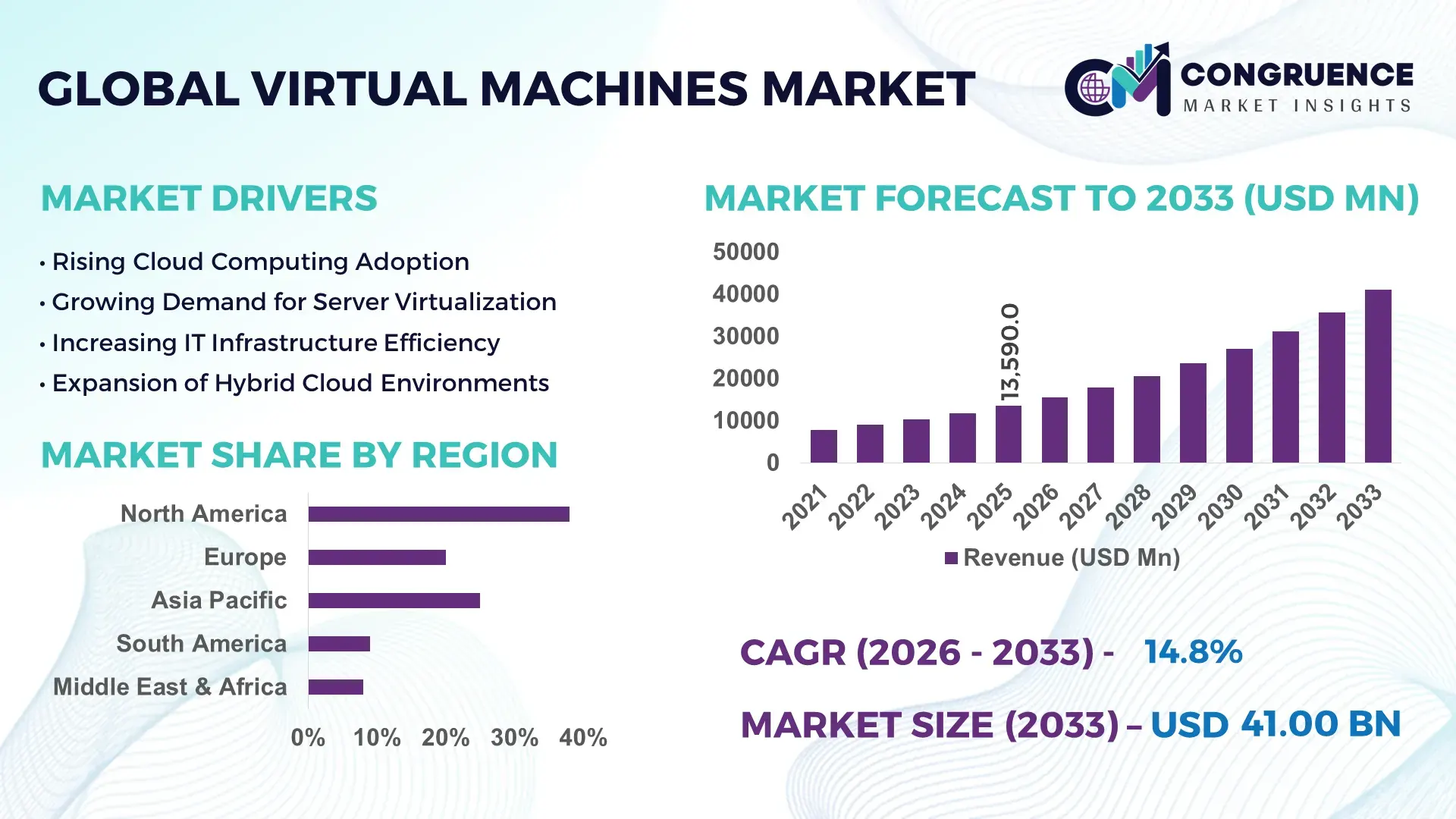
The Global Virtual Machines Market was valued at USD 13590 Million in 2025 and is anticipated to reach a value of USD 40997.23 Million by 2033 expanding at a CAGR of 14.8% between 2026 and 2033. Enterprise migration toward hybrid cloud infrastructure, AI-ready virtualized workloads, and rising demand for secure multi-tenant computing environments are accelerating deployment across banking, telecom, manufacturing, and government data centers.
The United States dominates the global virtual machines market with nearly 34% infrastructure concentration, supported by hyperscale cloud investments exceeding USD 48 billion in 2026 and virtualization penetration above 72% across enterprise workloads. China follows with rapid sovereign cloud expansion and over 28% annual growth in virtual desktop deployments amid tightening cybersecurity mandates and semiconductor localization policies linked to ongoing US-China technology restrictions. Germany leads European industrial virtualization adoption, with automotive and Industry 4.0 facilities improving server utilization rates by nearly 40% through advanced VM orchestration platforms.
Vendors prioritizing AI-integrated virtualization, energy-efficient workload balancing, and sovereign cloud compliance frameworks are positioned to capture high-value enterprise modernization contracts through 2033.
Market Size & Growth: USD 13.59 billion in 2025 to USD 40.99 billion by 2033 at 14.8% CAGR, driven by hybrid cloud and AI workload virtualization.
Top Growth Drivers: Hybrid cloud adoption up 41%, enterprise VDI deployments up 36%, and AI-enabled workload automation improving utilization by 29%.
Short-Term Forecast: By 2027, enterprise VM orchestration reduces infrastructure costs by 22% and increases server efficiency by 31%.
Emerging Technologies: AI-driven hypervisors, container-VM integration, and edge virtualization improve workload allocation speeds by 35%.
Regional Leaders: North America exceeds USD 15 billion with hyperscale expansion, Asia-Pacific crosses USD 11 billion through sovereign cloud growth, and Europe surpasses USD 8 billion via industrial virtualization adoption.
Consumer/End-User Trends: Over 68% of enterprises prioritize multi-cloud VM environments to improve resilience and regulatory compliance.
Pilot/Case Example: In 2026, a global telecom virtualization upgrade reduced downtime by 37% and lowered power consumption by 18%.
Competitive Landscape: Leading providers control nearly 52% market share, with strong competition among cloud infrastructure and enterprise virtualization vendors.
Regulatory & ESG Impact: Energy-efficient VM scheduling cuts data center power consumption by 16% under tightening European sustainability regulations.
Investment & Funding: Global virtualization and cloud infrastructure investments exceed USD 60 billion, supported by AI-driven expansion and regional data sovereignty initiatives.
Innovation & Future Outlook: Advanced autonomous VM management and edge-native virtualization platforms are reshaping high-performance enterprise computing strategies.
Virtual machines remain central to enterprise digital infrastructure as organizations expand hybrid cloud environments, AI processing workloads, and remote desktop ecosystems. Nearly 64% of large enterprises increased virtualization budgets in 2026 to improve workload portability and cybersecurity resilience. Edge virtualization, GPU-enabled VM instances, and low-latency orchestration platforms are gaining traction, particularly amid stricter regional data localization policies and growing pressure to optimize global data center energy consumption, setting the stage for deeper strategic transformation.
Virtual machines have become strategically critical as enterprises restructure digital infrastructure around AI computing, sovereign cloud frameworks, and multi-environment workload portability. Large organizations are reducing dependence on single-cloud architectures after repeated supply-chain and geopolitical disruptions affecting semiconductor access and cross-border data transfers. In 2026, more than 61% of enterprise IT modernization programs include virtualization-layer optimization to improve cybersecurity isolation, workload resilience, and infrastructure utilization across banking, healthcare, telecom, and manufacturing operations.
AI-enabled VM orchestration platforms now deliver nearly 32% faster workload balancing compared to legacy hypervisor-based management systems while lowering idle server consumption by approximately 18%. The United States leads in hyperscale virtualization density and GPU-enabled VM deployments, whereas India and Southeast Asia are expanding cost-efficient virtual desktop infrastructure for digital public services and enterprise outsourcing ecosystems. Over the next two years, edge-native virtualization adoption is expected to exceed 40% across industrial automation and low-latency telecom environments as companies prioritize distributed computing architectures.
A 2026 financial services deployment in Singapore reduced disaster recovery response times by 36% through automated VM failover integration across hybrid cloud environments. Vendors are increasing investments in sovereign cloud partnerships, AI-integrated orchestration tools, and energy-efficient virtualization clusters to strengthen enterprise retention and long-term infrastructure relevance. Organizations with scalable virtualization ecosystems and compliance-ready deployment models will secure stronger operational control, lower infrastructure risk, and superior competitive positioning.
Rapid enterprise migration toward hybrid cloud and AI-enabled infrastructure environments is accelerating virtual machine deployment across critical industries. More than 68% of global enterprises now operate multi-cloud architectures, while virtualization-based workload consolidation improves server utilization efficiency by nearly 35%. In the United States, financial institutions and healthcare networks are expanding VM orchestration to meet stricter cybersecurity and data recovery requirements following rising ransomware incidents and evolving digital compliance frameworks. Semiconductor supply stabilization in Taiwan and South Korea has also improved enterprise server procurement cycles, enabling faster infrastructure modernization. In response, technology providers are expanding GPU-enabled VM offerings, acquiring cloud optimization firms, and forming infrastructure partnerships to improve workload portability. Companies integrating automation-led VM management are reducing operational downtime and improving compute scalability without proportional increases in physical data center footprints.
Complex interoperability requirements across multi-vendor cloud environments continue to constrain scalable virtual machine deployment. Nearly 44% of enterprises report integration inefficiencies between legacy on-premise systems and containerized cloud-native infrastructure, while licensing and migration costs increase virtualization operating expenses by approximately 19%. Germany and Japan face additional deployment friction due to strict enterprise data governance standards and fragmented industrial IT architectures. Vendor lock-in pressures are intensifying as proprietary hypervisor ecosystems limit workload mobility and increase long-term infrastructure dependency. Organizations are responding through localized cloud procurement strategies, open-source virtualization adoption, and multi-platform orchestration investments to reduce migration exposure. Companies unable to simplify licensing structures and cross-platform compatibility risk slower enterprise onboarding cycles and weaker retention in high-value industrial and financial sectors.
Edge computing expansion and AI-intensive enterprise applications are creating high-value opportunities for advanced virtual machine platforms. More than 47% of telecom and manufacturing operators are prioritizing edge virtualization to support low-latency analytics, autonomous operations, and distributed computing environments. In India, digital infrastructure investments tied to smart manufacturing and public cloud expansion are accelerating enterprise VM adoption across industrial corridors. AI-driven resource scheduling platforms improve compute allocation efficiency by nearly 28%, while lightweight virtualization frameworks reduce deployment time by approximately 22% compared to traditional architectures. Companies are investing in edge-ready VM clusters, strategic telecom alliances, and AI-integrated orchestration engines to capture emerging industrial demand. A non-obvious growth area is energy-aware virtualization management, where enterprises optimize workload distribution to reduce cooling pressure and improve sustainability compliance across large-scale data center operations.
Long-term scalability of virtual machine ecosystems is increasingly challenged by cybersecurity complexity, infrastructure fragmentation, and virtualization talent shortages. Nearly 39% of enterprise breaches in 2026 involve misconfigured virtual environments, while security patch management cycles across distributed VM infrastructures increase administrative overhead by over 21%. The United Kingdom and Canada face growing pressure to secure sovereign digital infrastructure as cross-border data regulations tighten and hybrid cloud environments become more decentralized. Rapid expansion of AI-enabled workloads is also intensifying compute density pressures within existing data center environments, creating operational strain on cooling and network optimization systems. Companies must strengthen zero-trust virtualization frameworks, invest in automated compliance monitoring, and expand specialized infrastructure engineering capabilities. Organizations failing to standardize VM governance and cybersecurity automation risk inconsistent deployment performance, higher downtime exposure, and reduced competitiveness in enterprise infrastructure markets.
AI-Orchestrated Workload Optimization Enterprise IT teams are increasingly deploying AI-enabled VM orchestration to automate resource balancing and reduce idle compute waste. In 2026, automated workload scheduling improved server utilization by nearly 33% while lowering infrastructure power consumption by 17% across large-scale cloud environments. United States banking and telecom operators are restructuring virtualization stacks around predictive scaling models, while providers are expanding partnerships with AI infrastructure vendors to accelerate high-density compute deployment and reduce manual workload intervention.
Edge Virtualization Expansion Accelerates Manufacturing and telecom operators are rapidly integrating lightweight virtual machines into edge computing environments to support low-latency analytics and industrial automation. More than 42% of industrial facilities in Germany and South Korea now deploy edge-based VM clusters, reducing application response times by approximately 28%. Rising semiconductor supply normalization and 5G infrastructure rollouts are accelerating deployment cycles, prompting companies to expand localized micro data centers and automate distributed VM management across remote operational sites.
Sovereign Cloud Adoption Intensifies Tightening data localization mandates in India, France, and the Middle East are increasing enterprise demand for sovereign cloud-compatible virtual machine platforms. Nearly 48% of regulated enterprises now prioritize region-specific VM deployment frameworks to maintain compliance and cybersecurity control. Providers are responding through localized infrastructure partnerships, in-country hosting expansion, and compliance-driven virtualization architecture redesigns to strengthen enterprise retention and reduce cross-border data dependency risks.
GPU-Enabled Virtual Machines Rise AI training workloads and high-performance enterprise applications are driving rapid adoption of GPU-accelerated virtual machines. In 2026, GPU-backed VM deployments increased by nearly 39% across healthcare imaging, financial modeling, and engineering simulation workloads. Japan and Singapore are scaling high-density virtualization clusters to support AI compute demand while reducing physical server expansion pressure. Companies are optimizing virtualization software for accelerated graphics processing and forming hardware alliances to secure long-term compute availability amid rising enterprise AI infrastructure competition.
Server virtual machines continue to dominate the market due to their scalability, centralized workload management, and high infrastructure utilization efficiency. Large enterprises improve hardware utilization rates by nearly 40% through server virtualization consolidation, particularly across financial services, telecom, and hyperscale cloud environments. System virtual machines maintain strong relevance in legacy enterprise application support and secure sandboxing operations, while desktop virtual machines are gaining traction in hybrid workforce environments where secure remote access and centralized endpoint control remain operational priorities. Providers are expanding orchestration capabilities and integrating AI-driven resource optimization into server-focused virtualization platforms to improve workload balancing and reduce infrastructure overhead.
Cloud virtual machines represent the fastest-growing segment as enterprises accelerate multi-cloud deployment strategies and edge-native application scaling. In 2026, more than 58% of enterprises expanded cloud-based VM deployments to improve infrastructure flexibility and disaster resilience. Process virtual machines are also gaining relevance in application portability and cross-platform software execution, particularly within development ecosystems. Companies are prioritizing cloud-native VM architectures, GPU-enabled environments, and lightweight virtualization frameworks through infrastructure partnerships and regional cloud expansion strategies to support evolving enterprise computing demands.
Cloud computing remains the leading application segment due to rapid enterprise migration toward hybrid infrastructure and scalable digital operations. More than 66% of enterprises now depend on virtual machine-based cloud environments for workload portability, centralized infrastructure management, and secure multi-environment deployment. Server virtualization continues to support mission-critical enterprise applications by reducing physical hardware dependency and improving compute efficiency by approximately 34%. Disaster recovery deployments are also strengthening as organizations prioritize business continuity and automated failover capabilities following rising ransomware incidents and stricter operational resilience requirements across financial and government sectors.
Desktop virtualization is emerging as the fastest-growing application area, particularly in India and Southeast Asia, where enterprises are expanding secure remote workforce infrastructure and centralized endpoint management systems. Application testing environments are increasingly shifting toward lightweight VM orchestration to reduce software validation cycles by nearly 27% and improve deployment consistency. Companies are responding through AI-integrated automation, expansion of cloud-native virtualization ecosystems, and strategic partnerships with cybersecurity providers to strengthen operational agility and reduce infrastructure complexity across distributed enterprise networks.
IT and telecom remain the dominant end-user segment due to high infrastructure intensity, large-scale cloud operations, and continuous network virtualization requirements. Telecom operators improved infrastructure utilization efficiency by approximately 36% through advanced VM orchestration and software-defined network integration. The BFSI sector also represents a major adoption base as banks prioritize secure transaction processing, disaster recovery frameworks, and sovereign cloud compliance. Government agencies in the United Kingdom and Singapore are increasing virtualization investments to modernize digital public infrastructure and strengthen cybersecurity resilience amid tightening national data governance policies.
Healthcare is emerging as the fastest-growing end-user segment, driven by AI-assisted diagnostics, telemedicine expansion, and secure patient data management requirements. In 2026, healthcare VM deployments increased by nearly 31% as hospitals expanded virtualized imaging, analytics, and electronic medical record systems. Retail enterprises are accelerating desktop virtualization to support distributed workforce management and real-time inventory analytics, while educational institutions are scaling virtual labs and remote learning platforms. Vendors are responding with sector-specific virtualization bundles, cybersecurity partnerships, and subscription-based infrastructure models tailored to operational compliance and cost optimization priorities.
North America accounted for the largest market share at 38.4% in 2025 however, Asia-Pacific is expected to register the fastest growth, expanding at a CAGR of 16.2% between 2026 and 2033.
AI-Centric Hybrid Infrastructure Dominance
North America leads the virtual machines market through hyperscale cloud infrastructure concentration, AI-ready data center expansion, and enterprise-grade virtualization maturity. The region contributes more than 38% of global virtualization deployments, supported by high adoption across telecom, BFSI, healthcare, and government sectors. In 2026, enterprise VM density across major US cloud facilities improved by nearly 34% through AI-driven orchestration and automated workload balancing systems. Rising cybersecurity compliance requirements and increasing AI compute demand are accelerating sovereign cloud-compatible VM deployment. Companies are expanding GPU-enabled virtualization clusters, edge-integrated VM environments, and zero-trust infrastructure frameworks to improve workload resilience, operational scalability, and distributed computing efficiency across mission-critical enterprise operations.
United States Market Outlook: The United States remains the dominant contributor due to large-scale cloud infrastructure, advanced semiconductor access, and enterprise AI deployment intensity. More than 72% of enterprise workloads now operate within hybrid or virtualized environments, particularly across financial services, healthcare, and telecom networks. Federal cybersecurity modernization programs and increasing enterprise demand for AI-ready computing are accelerating sovereign cloud investments and GPU-backed VM expansion across major data center corridors including Texas, Virginia, and California.
Sovereign Cloud and Industrial Virtualization Expansion
Europe is strengthening its virtualization ecosystem through sovereign cloud initiatives, industrial automation modernization, and sustainability-focused data center optimization. The region represents nearly 24% of global enterprise virtualization deployment activity, with Germany, France, and the Netherlands leading adoption across manufacturing, automotive, and financial infrastructure. In 2026, industrial VM orchestration improved production system utilization efficiency by approximately 29% across advanced manufacturing facilities. Tightening EU digital sovereignty regulations and carbon-efficiency mandates are accelerating localized virtualization deployment and energy-aware workload management. Enterprises are investing in regional cloud infrastructure partnerships, AI-integrated VM platforms, and compliance-driven orchestration systems to reduce operational risk and improve infrastructure flexibility across regulated sectors.
Germany Market Outlook: Germany leads the European market through strong Industry 4.0 integration, industrial automation intensity, and advanced enterprise cloud modernization programs. Nearly 63% of large manufacturers now utilize virtualized industrial workloads to improve production monitoring, predictive maintenance, and distributed computing efficiency. German enterprises are prioritizing localized VM deployment frameworks and low-energy virtualization infrastructure to comply with tightening digital sovereignty and sustainability requirements while supporting automotive, engineering, and industrial analytics operations.
Massive Digital Infrastructure Scaling Momentum
Asia-Pacific is emerging as the fastest-expanding virtual machines market due to rapid digital infrastructure investment, hyperscale cloud expansion, and rising enterprise automation demand. The region contributes nearly 31% of global virtualization deployment activity, led by China, India, Japan, and South Korea. In 2026, enterprise cloud virtualization adoption increased by more than 41% across major industrial and telecom sectors as organizations accelerated AI integration and distributed computing modernization. Expanding 5G infrastructure, smart manufacturing programs, and government-backed digital transformation initiatives are strengthening demand for edge-native VM ecosystems. Companies are scaling localized cloud facilities, AI-optimized virtualization platforms, and lightweight orchestration systems to support cost-efficient enterprise modernization and low-latency application delivery.
China Market Outlook: China remains the largest operational market within Asia-Pacific due to sovereign cloud expansion, domestic semiconductor investment, and aggressive enterprise digital transformation initiatives. More than 68% of large enterprises are deploying localized virtual machine frameworks to comply with tightening cybersecurity and data localization regulations. Major telecom and cloud providers are expanding AI-ready virtualization clusters and edge computing ecosystems to support manufacturing automation, digital public services, and large-scale industrial analytics deployment across key economic zones.
Enterprise Cloud Modernization Gains Pace
South America is witnessing accelerating virtual machine adoption through enterprise cloud modernization, telecom digitization, and financial sector infrastructure upgrades. Brazil and Chile account for the highest deployment concentration as enterprises expand hybrid cloud operations and centralized virtualization management systems. In 2026, virtualization-driven infrastructure consolidation reduced enterprise hardware operating costs by nearly 21% across regional banking and telecom environments. However, uneven data center capacity and network infrastructure limitations continue to affect deployment consistency outside major urban technology hubs. Companies are responding through regional cloud partnerships, localized hosting expansion, and subscription-based virtualization deployment models to improve infrastructure accessibility and operational scalability.
Brazil Market Outlook: Brazil dominates the South American market through strong banking digitization, expanding cloud infrastructure, and rising enterprise cybersecurity investments. Nearly 58% of large enterprises now operate virtualized workloads across hybrid cloud environments to improve operational continuity and digital service delivery. Telecom operators and financial institutions are expanding localized VM deployment frameworks and AI-assisted infrastructure monitoring systems to strengthen transaction resilience and support growing digital payment ecosystems across metropolitan business centers.
Digital Sovereignty and Smart Infrastructure Investments
The Middle East & Africa market is expanding through sovereign digital infrastructure programs, hyperscale data center construction, and government-led smart city modernization initiatives. The Gulf countries account for the majority of enterprise virtualization deployment activity, supported by large-scale investments in cloud infrastructure and AI-enabled computing environments. In 2026, virtualization adoption across public sector and telecom operations improved infrastructure efficiency by approximately 26% through centralized workload management and automated resource allocation systems. Rising demand for localized data processing and cybersecurity compliance is accelerating deployment of sovereign cloud-compatible VM environments. Providers are increasing regional infrastructure partnerships and edge-ready virtualization deployments to support low-latency enterprise operations and digital public services expansion.
United Arab Emirates Market Outlook: The United Arab Emirates leads regional virtualization deployment through aggressive smart infrastructure investment, advanced cloud adoption, and government-backed AI modernization initiatives. More than 61% of enterprise digital transformation projects now integrate hybrid virtualization frameworks to support secure data processing and scalable cloud operations. UAE-based operators are expanding localized data center infrastructure, AI-enabled orchestration systems, and sovereign cloud ecosystems to strengthen regional digital competitiveness and support financial, logistics, and public sector modernization programs.
The virtual machines market is dominated by competition between global cloud infrastructure leaders, enterprise virtualization specialists, and AI-focused infrastructure providers including VMware, Microsoft, Amazon Web Services, Oracle, Citrix, and Red Hat. The top five players collectively control nearly 58% of enterprise virtualization deployments through integrated cloud ecosystems, hypervisor technologies, and hybrid infrastructure platforms. Competition increasingly centers on AI-enabled orchestration, workload portability, cybersecurity integration, and infrastructure efficiency, with automated VM management reducing operational overhead by approximately 27% and improving workload utilization by nearly 33%. Major providers are expanding sovereign cloud partnerships, GPU-backed virtualization environments, and edge-ready deployment frameworks to strengthen enterprise retention. Regional cloud operators are competing aggressively on localized compliance infrastructure and pricing flexibility. Rising AI compute demand and tightening data governance standards are accelerating platform consolidation and increasing switching complexity. Winning requires scalable multi-cloud compatibility, advanced automation capabilities, low-latency infrastructure, and strong enterprise cybersecurity integration.
VMware
Microsoft
Amazon Web Services
Oracle
Citrix Systems
Red Hat
IBM
Nutanix
Huawei Cloud
Alibaba Cloud
Google Cloud
Parallels
Sangfor Technologies
Proxmox Server Solutions
AI-driven orchestration, confidential computing, and GPU-accelerated virtualization are reshaping enterprise virtual machine infrastructure. In 2026, nearly 69% of large enterprises deployed AI-assisted workload balancing platforms that improved compute utilization efficiency by approximately 31% while reducing manual infrastructure intervention by 24%. Confidential virtual machines integrated with hardware-level isolation frameworks are gaining rapid adoption across banking and healthcare due to rising cybersecurity regulations and sovereign cloud requirements. Compared to legacy hypervisor environments, AI-integrated virtualization stacks reduce workload migration delays by nearly 28%, strengthening operational continuity across hybrid cloud ecosystems.
Edge-native virtualization and lightweight VM frameworks are emerging as critical technologies for telecom, industrial automation, and distributed AI processing. More than 43% of telecom operators in Japan and South Korea are deploying edge-based VM clusters to support low-latency analytics and 5G applications. Container-integrated virtual machines now improve application deployment consistency by nearly 26% over traditional isolated virtualization systems. Enterprises are responding through strategic partnerships with cloud infrastructure vendors and accelerated deployment of AI-enabled orchestration platforms to improve scalability and infrastructure responsiveness.
Between 2026 and 2028, GPU-enabled confidential virtual machines and autonomous VM management systems will become major competitive differentiators. Organizations adopting advanced virtualization automation are expected to lower infrastructure operating costs by approximately 22% while improving workload deployment speed by 34%, creating measurable operational advantages in AI-intensive enterprise environments.
May 2026 – VMware released Workstation and Fusion 26H1 with a full 64-bit architectural transition and expanded automation capabilities for enterprise virtualization workflows. The upgrade improved VM management visibility and modern hardware compatibility, strengthening enterprise deployment efficiency and infrastructure scalability across hybrid computing environments. Source: blogs.vmware.com
March 2026 – Microsoft Azure expanded confidential virtual machine availability with Intel TDX-based DCe and ECe v6 instances supporting full VM encryption without application modification. The deployment strengthened enterprise-grade security isolation and accelerated confidential computing adoption for regulated industries managing sensitive operational workloads. Source: learn.microsoft.com
October 2025 – Microsoft Azure accelerated confidential VM deployment automation through ARM template integration supporting AMD SEV-SNP and Intel TDX architectures. The development simplified secure VM provisioning workflows and improved enterprise deployment flexibility, helping organizations strengthen workload isolation and compliance-driven cloud modernization strategies.
February 2024 – Microsoft Azure strengthened confidential computing infrastructure by expanding GPU-enabled confidential virtual machines integrated with NVIDIA H100 Tensor Core acceleration. The enhancement improved AI workload protection and high-performance computing scalability, enabling enterprises to deploy sensitive machine learning environments with stronger data-in-use security controls. Source: azure.microsoft.com
The Virtual Machines Market report provides comprehensive analysis across system, process, desktop, server, and cloud virtual machine segments, covering deployment evolution, infrastructure modernization trends, and enterprise virtualization strategies between 2026 and 2033. The study evaluates operational adoption across server virtualization, disaster recovery, cloud computing, application testing, and desktop virtualization environments while assessing deployment intensity across IT and telecom, BFSI, healthcare, government, retail, and education sectors. More than 65% of enterprise infrastructure transformation programs now integrate virtualization-driven workload optimization and hybrid cloud management frameworks.
The report delivers region-wise assessment across North America, Europe, Asia-Pacific, South America, and the Middle East & Africa, highlighting enterprise deployment concentration, sovereign cloud expansion, AI-enabled virtualization adoption, and edge computing integration trends. It further analyzes competitive positioning, enterprise infrastructure investment priorities, GPU-enabled virtualization growth, and confidential computing deployment patterns. Strategic insights support expansion planning, infrastructure optimization, cloud partnership evaluation, cybersecurity readiness, and long-term enterprise virtualization modernization initiatives.
| Report Attribute/Metric | Report Details |
|---|---|
|
Market Revenue in 2025 |
USD 13590 Million |
|
Market Revenue in 2033 |
USD 40997.23 Million |
|
CAGR (2026 - 2033) |
14.8% |
|
Base Year |
2025 |
|
Forecast Period |
2026 - 2033 |
|
Historic Period |
2021 - 2025 |
|
Segments Covered |
By Type
By Application
By End-User
|
|
Key Report Deliverable |
Revenue Forecast, Growth Trends, Market Dynamics, Segmental Overview, Regional and Country-wise Analysis, Competition Landscape |
|
Region Covered |
North America, Europe, Asia-Pacific, South America, Middle East, Africa |
|
Key Players Analyzed |
VMware, Microsoft, Amazon Web Services, Oracle, Citrix Systems, Red Hat, IBM, Nutanix, Huawei Cloud, Alibaba Cloud, Google Cloud, Parallels, Sangfor Technologies, Proxmox Server Solutions |
|
Customization & Pricing |
Available on Request (10% Customization is Free) |




