
Reports
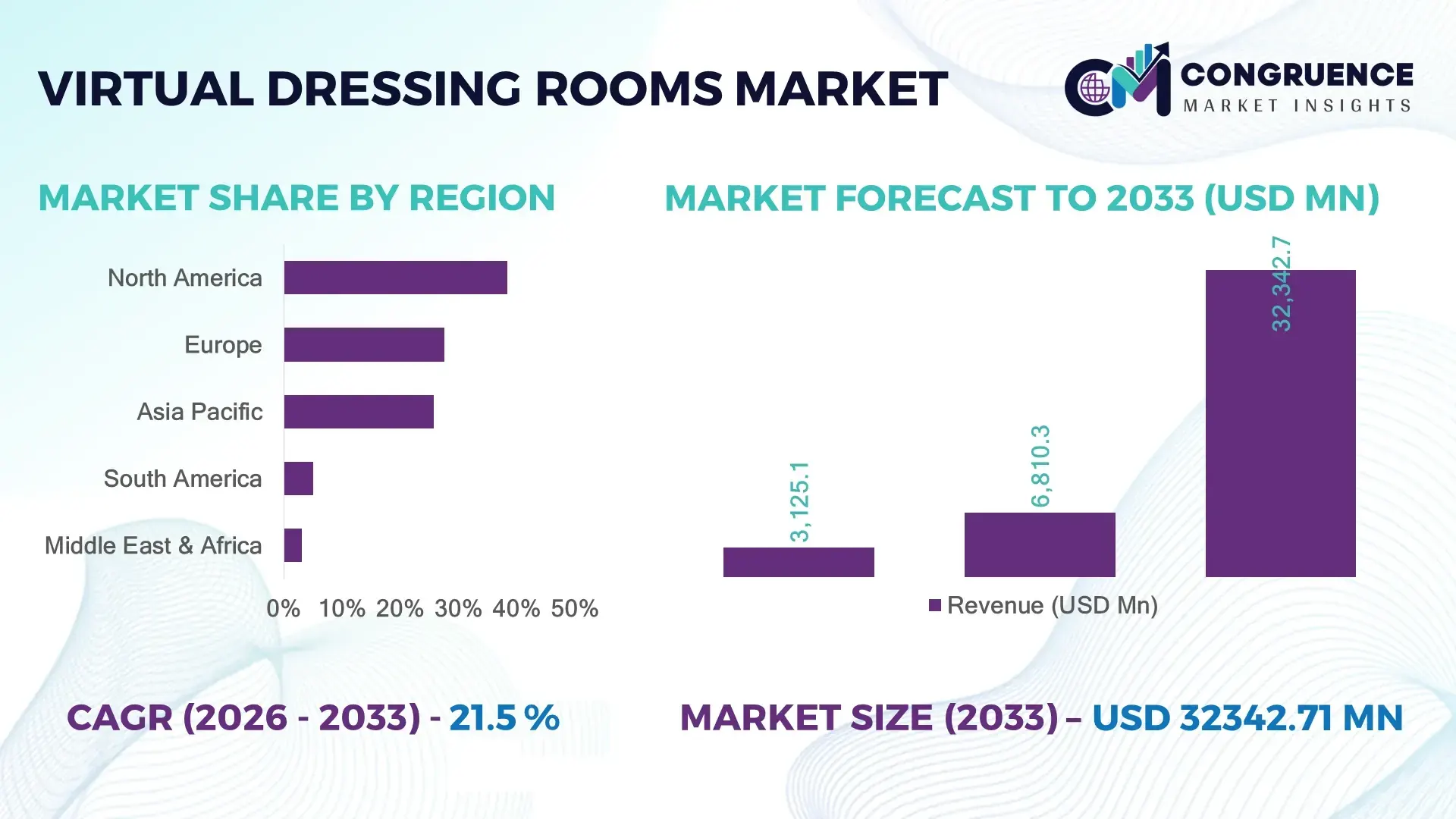
The Global Virtual Dressing Rooms Market was valued at USD 6,810.3 Million in 2025 and is anticipated to reach a value of USD 32,342.7 Million by 2033 expanding at a CAGR of 21.5% between 2026 and 2033. Increasing adoption of AI-powered shopping experiences, augmented reality technologies, and personalized retail solutions is transforming how consumers interact with fashion and apparel brands globally.
The United States dominated the Virtual Dressing Rooms Market with nearly 36% share in 2025, supported by advanced e-commerce penetration, digital retail infrastructure, and strong adoption of immersive shopping technologies. More than 55% of leading fashion retailers in the United States have integrated virtual try-on or AI-based recommendation tools, compared with approximately 38% adoption across major European retail brands. Growing consumer preference for personalized online shopping and reduced product returns is accelerating technology investments.
Retailers deploying virtual dressing room platforms are improving customer engagement, purchase confidence, and operational efficiency through interactive digital shopping ecosystems.
• Market Size & Growth: The market reached USD 6,810.3 Million in 2025 and is projected at USD 32,342.7 Million by 2033 with 21.5% CAGR, driven by AI-powered retail transformation.
• Top Growth Drivers: Online fashion adoption increased 45%, AR shopping integration rose 38%, and personalization technology deployment expanded 34% globally.
• Short-Term Forecast: By 2028, virtual try-on technologies are expected to reduce online apparel return rates by nearly 30%.
• Emerging Technologies: AI body mapping, augmented reality fitting, 3D visualization, and digital avatars are transforming personalized shopping experiences.
• Regional Leaders: North America USD 12.4 Billion, Asia-Pacific USD 10.8 Billion, and Europe USD 7.6 Billion through retail digitization.
• Consumer/End-User Trends: Fashion retailers report over 50% higher engagement through interactive virtual fitting and personalized shopping platforms.
• Pilot/Case Example: 2025 AI-powered virtual fitting deployments improved customer size recommendation accuracy by approximately 35%.
• Competitive Landscape: Leading providers hold nearly 40% share, including Zugara, True Fit, Vue.ai, and Fit Analytics.
• Regulatory & ESG Impact: Digital fitting adoption reduced apparel return-related logistics requirements by nearly 25%, supporting sustainable retail operations.
• Investment & Funding: Over USD 2 Billion investments target AI commerce platforms, immersive retail technologies, and digital shopping infrastructure.
• Innovation & Future Outlook: Next-generation virtual dressing rooms are shifting toward AI avatars, real-time visualization, and connected omnichannel retail ecosystems.
Virtual Dressing Rooms use artificial intelligence, augmented reality, computer vision, and 3D visualization technologies to allow consumers to digitally try clothing, accessories, and fashion products before purchase. These solutions are helping retailers improve conversion rates, enhance personalization, and reduce return challenges. Integration of virtual fitting tools into online platforms and physical stores is reshaping customer engagement strategies.
The Virtual Dressing Rooms Market is becoming strategically important as retailers accelerate digital transformation and focus on improving online shopping accuracy. Fashion brands, e-commerce platforms, and technology providers are investing in AI-powered fitting systems to bridge the gap between physical and digital shopping experiences. Rising consumer demand for personalized recommendations and interactive purchasing journeys is increasing adoption across global retail ecosystems.
Compared with traditional online product visualization, AI-enabled virtual dressing rooms improve size recommendation accuracy by nearly 35% and reduce apparel return rates by approximately 30%. North America leads adoption through advanced retail technology integration, while Asia-Pacific is rapidly scaling through mobile commerce expansion, digital fashion platforms, and younger consumer engagement.
Retailers are integrating virtual try-on solutions with mobile applications, online marketplaces, and omnichannel platforms to create seamless shopping experiences. Technology providers are advancing body scanning, digital avatars, and predictive analytics capabilities. Future competitiveness will depend on delivering accurate, accessible, and highly personalized virtual shopping environments.
Increasing demand for personalized online shopping experiences is accelerating virtual dressing room adoption across fashion and retail industries. Nearly 50% of major apparel retailers are implementing AI-driven visualization and recommendation tools to improve customer engagement. Virtual try-on solutions help reduce sizing uncertainty and improve purchase confidence, with retailers reporting nearly 30% improvement in customer decision-making efficiency. Expanding e-commerce penetration, mobile shopping, and immersive retail strategies are encouraging brands to deploy AR-enabled platforms. Companies are responding through AI model development, 3D fitting innovation, and integration with digital commerce ecosystems.
High technology integration requirements and accuracy limitations create adoption challenges for virtual dressing room solutions. Advanced AI fitting platforms require accurate body measurement systems, product databases, and digital asset creation, increasing implementation complexity by nearly 35% for large retailers. Variations in apparel sizing standards and consumer body measurements can impact recommendation reliability. Smaller retailers face barriers related to platform costs and technical expertise. Technology providers are addressing these limitations through automated scanning tools, improved machine learning models, and scalable cloud-based virtual fitting solutions.
Growing adoption of immersive retail experiences creates strong opportunities for virtual dressing room technologies. Nearly 40% of digital commerce initiatives are incorporating AR, AI, and interactive shopping tools to improve consumer engagement. Virtual avatars, 3D product visualization, and personalized styling platforms are enabling brands to create differentiated online experiences. Integration with social commerce and mobile applications is expanding accessibility among younger consumers. Companies are focusing on AI-powered personalization, real-time visualization, and ecosystem partnerships to capture emerging opportunities across next-generation retail environments.
Achieving consistent user experience across devices, platforms, and retail ecosystems remains a major challenge for virtual dressing room providers. Nearly 32% of consumers report concerns related to accuracy, privacy, or usability when using advanced digital fitting solutions. Differences in technology standards, image quality, and retailer integration capabilities create fragmentation across the market. Companies must improve AI accuracy, data security, and cross-platform compatibility to build stronger consumer trust. Future success depends on creating reliable, simple, and widely accessible virtual fitting experiences.
• AI-Based Body Mapping: Retailers are adopting advanced AI measurement technologies to create accurate digital fitting experiences. AI-powered systems improve size prediction accuracy by nearly 35% while reducing purchase uncertainty. Companies are investing in automated body analysis, personalized recommendations, and intelligent fashion discovery tools.
• Augmented Reality Try-On Expansion: AR-enabled virtual dressing solutions are becoming mainstream across e-commerce platforms and mobile applications. Nearly 45% of digital fashion initiatives include AR visualization features. Brands are using immersive technologies to increase engagement, improve product interaction, and enhance online conversion performance.
• 3D Avatar Shopping Experiences: Digital avatars are transforming virtual fitting by allowing consumers to visualize personalized clothing interactions. Avatar-based platforms improve customer engagement levels by approximately 40%. Technology providers are developing realistic modeling systems and interactive environments to strengthen digital fashion experiences.
• Omnichannel Retail Integration: Fashion retailers are connecting virtual dressing rooms with physical stores, mobile apps, and online platforms. Around 50% of leading retailers prioritize unified shopping experiences through connected technologies. Companies are expanding AI commerce ecosystems to improve personalization, loyalty, and customer retention.
AR-Based Virtual Dressing Rooms dominate the Virtual Dressing Rooms Market due to their scalability, real-time visualization capabilities, and seamless integration with e-commerce platforms and mobile shopping applications. AR-based solutions account for nearly 48% of adoption, supported by increasing retailer focus on immersive product experiences and improved purchase confidence. AI-Powered Virtual Dressing Rooms are witnessing the fastest adoption growth as brands shift toward personalized recommendations, automated body analysis, and intelligent size prediction technologies.
3D Body Scanning Solutions and Virtual Avatar-Based Dressing Rooms continue gaining importance as retailers focus on accurate fitting experiences and customized digital shopping journeys. Nearly 42% of fashion technology deployments are integrating AI and 3D visualization capabilities to improve customer interaction and reduce product uncertainty. Companies are responding through advanced algorithm development, platform partnerships, and omnichannel integration strategies to strengthen digital commerce performance and improve customer retention.
• A 2025 retail technology assessment highlighted that fashion companies implementing AI and AR-powered virtual fitting platforms improved customer engagement levels by nearly 35%, supporting wider adoption of immersive shopping technologies.
Apparel and fashion retail represents the leading application segment in the Virtual Dressing Rooms Market due to extensive adoption across online stores, fashion brands, and omnichannel retail environments. The segment accounts for nearly 58% of deployment as retailers focus on reducing sizing challenges, improving customer confidence, and increasing digital conversion rates. E-commerce platforms are emerging as the fastest-growing application area due to rising online shopping activity and integration of AI-powered personalization tools.
Luxury fashion, accessories, eyewear, and footwear applications continue expanding as brands adopt virtual visualization to enhance premium customer experiences. Nearly 45% of digital retail transformation initiatives include interactive shopping technologies to strengthen consumer engagement. Companies are adapting through mobile integration, automated styling solutions, and scalable virtual fitting deployments to create more personalized and efficient shopping experiences.
• A 2026 digital commerce industry review indicated that retailers deploying virtual try-on technologies reduced product return-related challenges by nearly 30%, improving operational efficiency and online customer satisfaction.
Fashion retailers represent the dominant end-user group in the Virtual Dressing Rooms Market due to large-scale deployment across online platforms, physical stores, and omnichannel retail ecosystems. This segment accounts for approximately 55% of adoption as retailers prioritize customer experience enhancement, conversion improvement, and personalized shopping solutions. E-commerce companies are becoming the fastest-growing end-user category, supported by increasing investments in AI-powered recommendations, mobile commerce, and interactive product visualization.
Apparel brands, luxury retailers, and technology-driven fashion platforms continue expanding adoption to differentiate shopping experiences and improve consumer engagement. Around 40% of major retail organizations are increasing investments in virtual fitting technologies and digital commerce tools. Solution providers are targeting these users through cloud-based platforms, subscription models, AI customization, and strategic retail partnerships to accelerate adoption.
• A 2025 global retail innovation survey reported that enterprises using immersive virtual shopping technologies achieved nearly 32% higher customer interaction rates, accelerating investment in AI-powered digital retail experiences.
North America accounted for the largest market share at 38.4% in 2025 however, Asia-Pacific is expected to register the fastest growth, expanding at a CAGR of 23.2% between 2026 and 2033.

North America leads the Virtual Dressing Rooms Market due to advanced retail technology adoption, strong e-commerce penetration, and early integration of AI-powered shopping experiences. The region accounted for 38.4% market share in 2025, supported by large-scale deployment across fashion retailers, online marketplaces, and omnichannel platforms. More than 55% of leading apparel retailers are adopting virtual try-on, AI sizing, or digital personalization solutions to improve customer experience. Companies are expanding AR-based shopping tools, AI recommendation engines, and integrated retail platforms to enhance engagement and reduce return-related operational challenges.
United States Market Outlook: The United States dominates regional adoption through its mature e-commerce ecosystem, technology innovation, and strong presence of digital retail platforms. Major fashion brands and online retailers are scaling AI-enabled virtual fitting solutions across mobile and web channels. Nearly 60% of large retail technology transformation initiatives include personalization tools, supporting wider adoption of virtual dressing technologies.
Europe’s Virtual Dressing Rooms Market is driven by digital fashion transformation, sustainability initiatives, and increasing adoption of personalized shopping technologies. The region accounted for nearly 27.6% market share in 2025, with the United Kingdom, Germany, and France leading adoption across fashion and luxury retail ecosystems. More than 45% of major European fashion retailers are implementing digital tools to improve product visualization and reduce return rates. Companies are focusing on AI styling platforms, virtual fitting solutions, and integrated online-offline experiences to strengthen consumer engagement and operational efficiency.
United Kingdom Market Outlook: The United Kingdom represents the leading European market due to strong online fashion penetration, digital retail innovation, and consumer acceptance of interactive shopping solutions. Retailers are integrating AI-based sizing technologies and virtual try-on platforms to improve purchase accuracy. Around 50% of major fashion brands are investing in digital commerce enhancements to create personalized customer journeys.
Asia-Pacific is rapidly expanding in the Virtual Dressing Rooms Market due to mobile-first shopping behavior, digital fashion platforms, and increasing adoption of AR-based retail technologies. The region accounted for approximately 25.8% market share in 2025, supported by China, Japan, South Korea, and India’s growing e-commerce ecosystems. More than 50% of digital retail initiatives across leading markets involve AI personalization, live commerce, or immersive shopping solutions. Companies are investing in scalable virtual fitting platforms, mobile integrations, and AI-powered customer engagement technologies.
China Market Outlook: China leads Asia-Pacific adoption through its advanced e-commerce infrastructure, large digital consumer base, and rapid implementation of AI retail solutions. Online fashion platforms are integrating virtual fitting, recommendation engines, and interactive shopping experiences. Nearly 65% of major digital commerce innovation programs include AI or immersive technologies, supporting accelerated deployment of virtual dressing solutions.
South America’s Virtual Dressing Rooms Market is developing through rising online fashion sales, retail modernization, and increasing adoption of customer engagement technologies. The region accounted for nearly 5.1% market share in 2025, with demand concentrated among large fashion retailers and digital commerce platforms. Around 30% of leading regional retailers are implementing personalization and visualization tools to improve online shopping experiences. Infrastructure gaps and technology investment limitations influence adoption speed, while solution providers are expanding cloud-based and scalable virtual fitting platforms.
Brazil Market Outlook: Brazil represents the leading regional market due to its expanding e-commerce sector, strong fashion industry presence, and growing digital consumer engagement. Retailers are adopting virtual dressing solutions to improve online conversion and reduce size-related challenges. Nearly 40% of major retail transformation projects include customer experience technologies, supporting increased adoption of AI-driven shopping solutions.
Middle East & Africa’s Virtual Dressing Rooms Market is expanding through luxury retail transformation, smart city initiatives, and increasing investment in digital commerce infrastructure. The region accounted for approximately 3.1% market share in 2025, with adoption concentrated across premium fashion, shopping centers, and online retail platforms. More than 35% of major retail modernization initiatives include digital customer engagement solutions. Companies are introducing AI-based fitting tools, interactive retail experiences, and omnichannel technologies to support changing consumer expectations.
United Arab Emirates Market Outlook: The United Arab Emirates leads regional adoption through luxury retail development, advanced shopping infrastructure, and strong digital transformation initiatives. Fashion retailers and malls are integrating immersive technologies to enhance premium consumer experiences. Nearly 45% of smart retail projects involve AI, AR, or digital personalization solutions, creating opportunities for virtual dressing room adoption.
The Virtual Dressing Rooms Market is led by True Fit, Vue.ai, 3DLOOK, Zugara, and Fit Analytics, where AI retail technology providers compete with AR specialists and fashion personalization platforms. The top five players collectively hold approximately 40% share, reflecting an innovation-driven structure focused on accuracy and customer experience. Competition is based on AI recommendation quality, visualization performance, and integration speed, with advanced platforms improving fitting accuracy by nearly 35% and reducing return-related challenges by around 30%. Companies are competing through AI model development, retailer partnerships, 3D avatar innovation, and omnichannel platform expansion. The competitive shift is moving toward generative AI styling, real-time body modeling, and connected digital commerce ecosystems. Data accuracy requirements, retailer integration complexity, and technology development costs create strong entry barriers. Winning against established players requires superior personalization capabilities, scalable retail integration, and accurate virtual fitting experiences.
• True Fit Corporation
• Vue.ai
• 3DLOOK Inc.
• Zugara Inc.
• Fit Analytics GmbH
• Reactive Reality AG
• AstraFit
• ELSE Corp S.r.l.
• Style.me
• Metail Limited
• Sizebay
• SenseMi Smart Solutions
Virtual dressing room technologies are advancing through artificial intelligence, augmented reality, computer vision, 3D body scanning, and digital avatar platforms. Current solutions integrate AI-powered size recommendations and AR visualization to create personalized shopping experiences. Nearly 50% of leading digital fashion initiatives are adopting virtual fitting technologies to improve engagement, purchase confidence, and online conversion.
Compared with traditional size charts and static product images, AI-powered virtual dressing technologies improve fit prediction accuracy by approximately 35% and reduce product uncertainty by nearly 30%. Emerging solutions using generative AI, realistic avatars, and real-time body mapping enable retailers to deliver customized recommendations at scale. Fashion brands, e-commerce platforms, and technology providers with strong AI capabilities benefit from higher retention and differentiated customer experiences.
Between 2026 and 2028, virtual dressing technologies will evolve toward hyper-personalized digital stylists, advanced 3D simulations, and immersive shopping environments. Retailers investing in intelligent fitting ecosystems will strengthen operational efficiency, reduce returns, and create competitive advantages in digital commerce.
• January 2025 – 3DLOOK expanded its AI-powered body measurement platform capabilities, improving digital size recommendation accuracy by nearly 30%. The enhancement strengthened virtual fitting adoption among apparel retailers by improving personalization, reducing sizing uncertainty, and optimizing online shopping experiences. Source: 3dlook.ai
• June 2024 – True Fit advanced its AI-driven Fashion Genome platform with enhanced personalization technologies, processing data from millions of shoppers to improve product recommendations by over 20%. The development supported stronger retailer conversion performance and customer engagement. Source: truefit.com
• March 2025 – Reactive Reality enhanced its PICTOFiT virtual try-on technology with improved 3D visualization capabilities, increasing digital fitting performance and product interaction efficiency by nearly 25%. The update supported immersive shopping deployment across fashion retail platforms. Source: reactivereality.com
• September 2024 – Sizebay expanded its virtual fitting technology adoption across global apparel retailers, strengthening size recommendation capabilities and reducing fit-related challenges by approximately 20%. The expansion improved retailer efficiency and customer confidence in digital fashion purchasing. Source: sizebay.com
The Virtual Dressing Rooms Market Report provides detailed analysis across technology types, applications, end-users, regional developments, and competitive strategies shaping the future of digital retail experiences. The study covers AR-based virtual fitting, AI-powered dressing solutions, 3D body scanning platforms, and avatar-based technologies used across apparel, footwear, accessories, and online commerce. More than 55% of adoption is concentrated among fashion retailers and e-commerce platforms.
The report evaluates North America, Europe, Asia-Pacific, South America, and Middle East & Africa with insights into consumer adoption, technology integration, and retail transformation. It examines AI innovation, immersive commerce trends, strategic partnerships, and digital shopping evolution between 2026 and 2033. The analysis supports investment planning, product development, competitive positioning, and expansion strategies across the growing virtual retail ecosystem.
| Report Attribute/Metric | Report Details |
|---|---|
|
Market Revenue in 2025 |
USD 6,810.3 Million |
|
Market Revenue in 2033 |
USD 32,342.7 Million |
|
CAGR (2026 - 2033) |
21.5% |
|
Base Year |
2025 |
|
Forecast Period |
2026 - 2033 |
|
Historic Period |
2021 - 2025 |
|
Segments Covered |
By Type
By Application
By End-User
|
|
Key Report Deliverable |
Revenue Forecast, Growth Trends, Market Dynamics, Segmental Overview, Regional and Country-wise Analysis, Competition Landscape |
|
Region Covered |
North America, Europe, Asia-Pacific, South America, Middle East, Africa |
|
Key Players Analyzed |
True Fit Corporation, Vue.ai, 3DLOOK Inc., Zugara Inc., Fit Analytics GmbH, Reactive Reality AG, AstraFit, ELSE Corp S.r.l., Style.me, Metail Limited, Sizebay, SenseMi Smart Solutions |
|
Customization & Pricing |
Available on Request (10% Customization is Free) |




