
Reports
The Global Virtual and Online Fitness Market was valued at USD 12513.63 Million in 2025 and is anticipated to reach a value of USD 166512.8 Million by 2033 expanding at a CAGR of 38.2% between 2026 and 2033. AI-driven workout personalization, enterprise wellness subscriptions, connected fitness devices, and integrated digital health ecosystems are accelerating platform monetization and long-term user retention across global fitness providers.
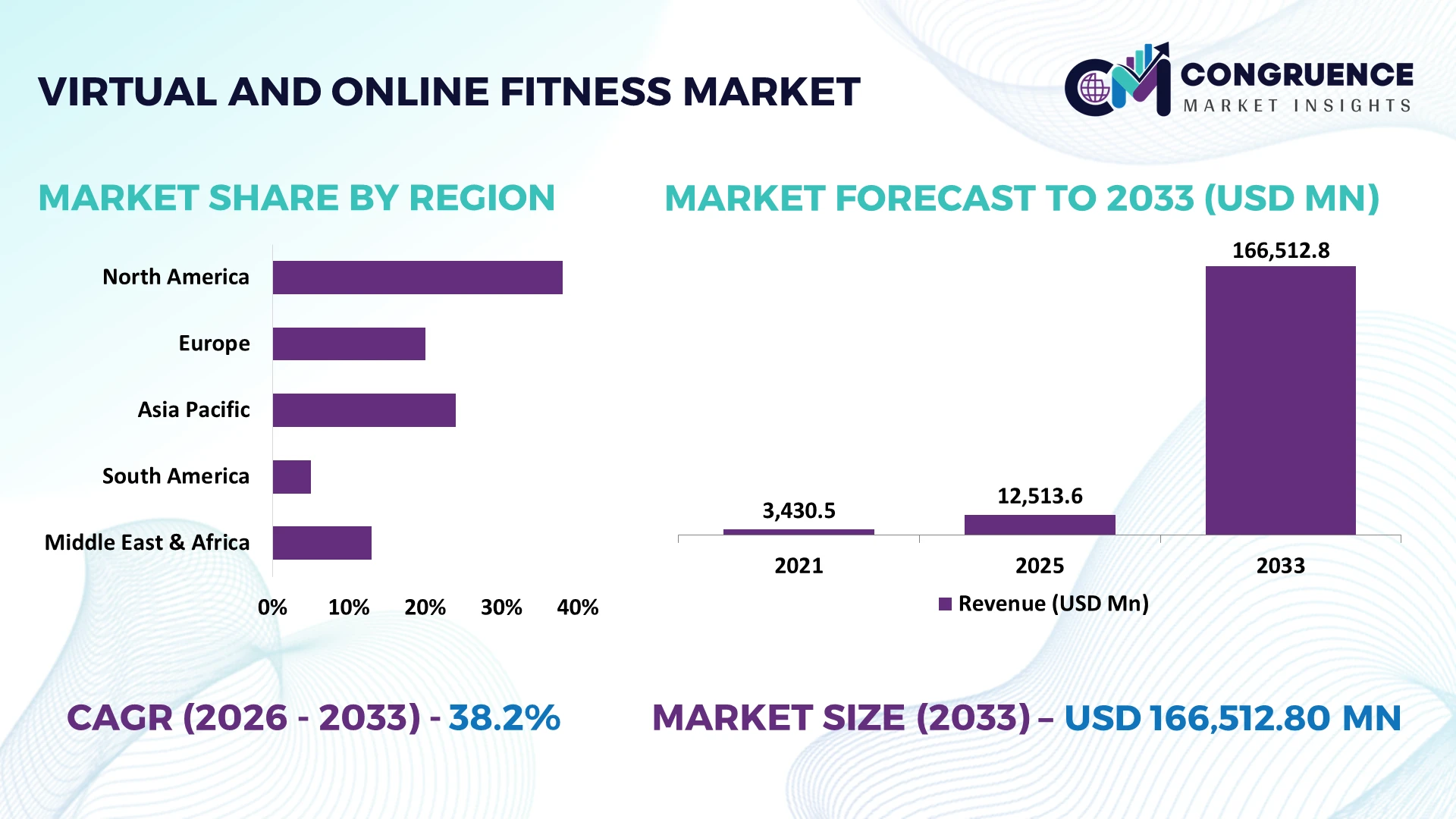
The United States accounts for nearly 40% of global virtual and online fitness platform adoption, supported by widespread wearable penetration exceeding 55% among fitness users, expanding employer-sponsored wellness programs, and sustained investment in digital health technologies. China follows with approximately 24% market participation, benefiting from mobile-first fitness ecosystems and AI-enabled coaching applications, while North American platform engagement remains around 1.8× higher. Continued digital healthcare expansion and post-pandemic preventive wellness strategies in 2026 reinforce cross-border platform adoption and premium subscription growth.
Organizations prioritizing AI-enabled coaching, interoperable wearable ecosystems, and scalable subscription models are positioned to secure stronger customer lifetime value and sustainable competitive differentiation.
• Market Size & Growth: The market expands from USD 12,513.63 million in 2025 to USD 166,512.8 million by 2033 at a CAGR of 38.2%, driven by AI-powered coaching, connected wearables, and enterprise wellness subscriptions.
• Top Growth Drivers: AI-based personalized training improves user retention by approximately 32%, corporate wellness adoption contributes nearly 28% of new enterprise users, and wearable ecosystem integration increases engagement by around 26%.
• Short-Term Forecast: By 2028, customer acquisition costs decline by nearly 18%, subscriber retention improves by 24%, and digital coaching efficiency increases by approximately 30%.
• Emerging Technologies: Generative AI trainers, computer vision-based posture correction, and biometric analytics are deployed across more than 58% of premium fitness platforms.
• Regional Leaders: North America leads with approximately USD 62 billion, Asia-Pacific exceeds USD 54 billion, and Europe approaches USD 31 billion by 2033, supported by hybrid fitness adoption and expanding digital healthcare infrastructure.
• Consumer Trends: Nearly 64% of subscribers prefer on-demand fitness sessions, while connected wearable users complete approximately 29% more weekly workouts than conventional app users.
• Pilot Example: During 2026, a multinational corporate wellness deployment covering over 120,000 employees reduced absenteeism by 14% while increasing employee wellness participation by 33%.
• Competitive Landscape: The leading platform controls roughly 17% of the global market, with competition driven by Apple Fitness+, Peloton, Nike Training Club, Fitbit Premium, and Les Mills+ through AI-enhanced content ecosystems.
• Regulatory & ESG Impact: Enhanced digital health compliance frameworks improve consumer trust by approximately 23%, while cloud optimization initiatives reduce platform energy consumption by nearly 12%.
• Investment & Funding: More than USD 9.5 billion in global investments supports AI innovation, wearable partnerships, platform acquisitions, and expansion across Asia-Pacific and the Middle East.
• Innovation & Future Outlook: Digital therapeutics, insurance-linked wellness programs, and predictive health analytics are increasing customer lifetime value by approximately 31%, reshaping long-term platform competitiveness.
The Virtual and Online Fitness Market continues to expand across personalized fitness coaching, digital rehabilitation, corporate wellness, and connected home exercise solutions. AI-powered movement analysis, real-time biometric feedback, and adaptive training algorithms are now integrated into leading platforms, improving workout completion rates by nearly 28%. In 2026, stronger digital health compliance requirements and deeper wearable interoperability are accelerating platform standardization, creating a seamless transition toward broader strategic market opportunities.
The Virtual and Online Fitness Market has evolved into a strategic pillar of the digital health economy as organizations prioritize scalable wellness services, personalized engagement, and recurring subscription ecosystems. Competition increasingly centers on AI-enabled coaching, connected wearable integration, and enterprise wellness platforms rather than content libraries alone. In 2026, stricter digital health governance and accelerated cloud infrastructure modernization are encouraging vendors to strengthen cybersecurity, interoperability, and data management capabilities, creating higher barriers to entry while supporting premium service differentiation.
Modern AI-powered fitness platforms deliver approximately 35% faster workout personalization and reduce manual coaching requirements by nearly 30% compared with conventional video-based applications. The United States leads in enterprise wellness deployment through employer-sponsored health programs, while South Korea demonstrates faster adoption of AI-enabled fitness applications supported by advanced mobile infrastructure and high wearable penetration. Over the next two to three years, connected device synchronization is expected to exceed 70% among premium platforms, improving user engagement and retention across subscription ecosystems.
Leading providers are expanding partnerships with wearable manufacturers, insurers, healthcare organizations, and corporate employers to create integrated preventive wellness ecosystems. For example, enterprise fitness deployments combining biometric monitoring with personalized coaching are improving employee participation by approximately 28% while reducing program administration time. Companies that prioritize ecosystem interoperability, predictive analytics, and scalable AI services will strengthen competitive positioning and establish durable operational advantages across the evolving digital fitness landscape.
Corporate wellness transformation and AI-enabled personalized coaching have become the primary structural drivers of market expansion. More than 61% of large enterprises now incorporate digital wellness initiatives into employee benefit strategies, while AI-powered workout recommendations improve user retention by nearly 32% and connected wearable integration increases engagement by approximately 27%. In 2026, expanding digital health compliance frameworks have accelerated investment in secure cloud-based fitness ecosystems across the United States. Companies are responding by acquiring AI capabilities, expanding subscription offerings, and partnering with healthcare providers and wearable manufacturers. The strongest competitive advantage increasingly comes from integrating preventive health analytics with personalized fitness experiences, creating higher customer lifetime value and stronger enterprise retention.
Fragmented device ecosystems and evolving privacy regulations continue to limit seamless platform scalability. Nearly 42% of fitness providers report interoperability challenges across wearable brands, while compliance-related technology investments increase operating costs by approximately 18%. Cross-border data governance requirements in Europe and varying healthcare privacy standards complicate unified platform deployment and delay product launches. These structural constraints directly affect customer experience, platform consistency, and expansion efficiency. Companies are mitigating operational risk through standardized APIs, localized cloud infrastructure, long-term technology partnerships, and enhanced cybersecurity investments. Vendors capable of delivering secure multi-device interoperability gain stronger enterprise credibility and reduce customer churn despite increasing regulatory complexity.
The strongest opportunity lies in combining virtual fitness with preventive healthcare, insurance incentives, and predictive wellness analytics. AI-enabled health recommendations improve personalized engagement by approximately 34%, while wearable-generated health data increases coaching accuracy by nearly 29%. Japan is accelerating digital preventive healthcare initiatives that encourage broader integration between fitness platforms and medical monitoring technologies. Companies are increasing investment in AI research, expanding healthcare partnerships, and developing interoperable wellness ecosystems supporting continuous health management rather than standalone exercise programs. This strategic convergence creates new subscription models, strengthens long-term customer retention, and opens high-value enterprise and insurer partnerships beyond traditional consumer fitness services.
Long-term competitiveness depends on maintaining secure, high-performance digital infrastructure while supporting millions of concurrent users across connected devices. Approximately 37% of providers identify cybersecurity investment as a top operational priority, and nearly 26% report increasing infrastructure complexity from expanding wearable ecosystems and AI workloads. Large-scale live fitness events, real-time biometric processing, and cross-platform synchronization continue to place significant pressure on cloud performance and latency management. Companies are investing in edge computing, zero-trust security frameworks, AI-based threat detection, and resilient cloud architecture to improve deployment consistency. Organizations that successfully combine platform resilience with seamless user experience will establish sustainable competitive differentiation as digital fitness ecosystems continue to mature.
• AI Coaching Becomes Standard AI-powered coaching is becoming a default capability across premium fitness platforms, with nearly 62% of leading applications integrating real-time movement analysis and adaptive workout planning. Personalized recommendations improve workout completion by approximately 31%, while automated coaching reduces trainer intervention by 28%. Growing enterprise demand and stronger digital health governance in the United States are encouraging companies to expand AI partnerships, automate content generation, and deploy continuous learning algorithms that improve platform efficiency and user retention.
• Wearable Ecosystem Integration Accelerates Connected fitness ecosystems continue to mature as more than 58% of active subscribers synchronize wearable devices with digital fitness platforms. Real-time biometric integration increases engagement by around 27% and reduces workout abandonment by approximately 19%. Device manufacturers are strengthening interoperability through standardized APIs and cloud connectivity, allowing fitness providers to expand ecosystem partnerships and improve cross-platform experiences while reducing customer acquisition costs through higher long-term retention.
• Enterprise Wellness Platforms Expand Employer-sponsored digital wellness programs are reshaping commercial demand, with approximately 46% of multinational organizations increasing investment in virtual fitness benefits during 2026. Automated wellness reporting shortens administrative workloads by nearly 25%, while employee participation improves by approximately 30%. Tight labor markets and rising healthcare expenditure are encouraging companies to integrate virtual fitness with insurance incentives, strengthening long-term workforce productivity and organizational health outcomes through scalable digital deployment.
• Hybrid Fitness Models Strengthen Fitness providers are increasingly combining physical facilities with digital subscriptions, creating hybrid service ecosystems that improve customer retention by approximately 24% and increase recurring membership utilization by nearly 22%. In the United Kingdom, fitness operators are expanding omnichannel service delivery to improve operational flexibility while responding to changing consumer behavior. Companies are restructuring membership models, strengthening digital infrastructure, and introducing bundled wellness services that generate stronger engagement beyond conventional gym attendance.
On-Demand fitness remains the leading segment, accounting for approximately 39% of total market deployment because of its scalability, lower content delivery costs, and flexible user accessibility across multiple devices. Consumers increasingly prefer self-paced exercise supported by personalized recommendations and synchronized wearable data, resulting in nearly 35% higher weekly usage than scheduled virtual sessions. Live Streaming continues to retain strong relevance for instructor-led engagement and community interaction, particularly within premium subscription platforms where live participation improves member retention by approximately 22%.
AI-Powered fitness represents the fastest-growing segment as intelligent coaching engines, predictive analytics, and computer vision enhance workout personalization and reduce manual coaching requirements by nearly 30%. Connected Fitness also continues expanding through deeper integration between smart equipment, biometric sensors, and cloud-based performance tracking, increasing active engagement by approximately 27%. Companies are prioritizing AI investments, strategic hardware partnerships, and interoperable software ecosystems while shifting product development toward integrated digital fitness experiences capable of supporting long-term customer retention and differentiated service delivery.
Strength Training represents the largest application segment with an estimated 34% market share, supported by increasing demand for personalized resistance programs, connected equipment, and AI-generated workout progression. Digital coaching improves exercise consistency by approximately 29%, while wearable integration increases performance tracking accuracy by nearly 26%. Cardio Training continues to maintain significant adoption through interactive classes and connected treadmill or cycling ecosystems, remaining an important component of subscription-based fitness platforms.
Wellness Coaching is emerging as the fastest-growing application as employers and healthcare organizations increasingly combine behavioral coaching, nutrition guidance, and preventive health management within unified digital platforms. Weight Management solutions benefit from AI-driven monitoring and biometric tracking, while Yoga & Meditation continue expanding through stress management and mental wellness integration. Companies are enhancing applications through automated coaching, personalized wellness journeys, and healthcare partnerships, strengthening engagement across multiple lifestyle-focused fitness categories.
Individual Consumers remain the largest end-user segment, representing approximately 52% of market demand due to widespread smartphone usage, connected wearables, and flexible subscription models. Personalized digital coaching increases subscriber engagement by approximately 30%, while AI-based recommendations improve workout adherence by nearly 28%. Fitness Centers continue integrating hybrid memberships that combine physical facilities with digital access, improving member retention and expanding recurring subscription opportunities.
Corporate Wellness Programs are the fastest-growing end-user segment as organizations strengthen employee health initiatives and reduce healthcare-related operating costs through digital fitness solutions. Healthcare Providers increasingly incorporate virtual fitness into rehabilitation and preventive care, while Educational Institutions adopt online wellness platforms to improve student participation and physical activity. Companies are developing enterprise-specific platforms, flexible pricing models, and strategic partnerships with insurers and employers to strengthen long-term customer acquisition and ecosystem expansion.
North America accounted for the largest market share at 38.9% in 2025 however, Asia-Pacific is expected to register the fastest growth, expanding at a CAGR of 41.7% between 2026 and 2033.

Strong Enterprise Wellness and AI Platform Leadership
North America remains the most mature Virtual and Online Fitness Market, supported by advanced digital health infrastructure, high wearable penetration, and widespread enterprise wellness adoption. The region contributes nearly 39% of global platform deployment, with over 60% of premium fitness applications integrating AI-driven coaching and biometric tracking. Corporate wellness contracts continue to expand across healthcare, insurance, and technology sectors, strengthening recurring subscription models. During 2026, multiple fitness technology providers increased partnerships with wearable manufacturers to improve interoperability and real-time health monitoring, reducing customer churn by approximately 18%. Companies are prioritizing cloud-native platforms, predictive analytics, and personalized coaching ecosystems to strengthen long-term engagement while improving operational efficiency across commercial and consumer fitness networks.
United States Market Outlook: The United States leads regional deployment through advanced digital infrastructure, employer-sponsored wellness programs, and widespread connected device adoption. More than 55% of active digital fitness users regularly synchronize wearable devices with online platforms, supporting higher engagement and personalized coaching accuracy. Healthcare organizations, insurers, and technology firms continue expanding integrated wellness partnerships, enabling AI-powered preventive health services and strengthening enterprise subscription ecosystems across both commercial and consumer segments.
Digital Health Regulation Accelerates Platform Modernization
Europe continues strengthening its position through standardized digital health regulations, expanding cloud infrastructure, and growing consumer acceptance of hybrid fitness models. The region accounts for approximately 26% of global market activity, supported by increasing investment in AI-enabled wellness applications and secure health data management. More than 48% of premium platforms now provide integrated wearable connectivity alongside personalized digital coaching. Enhanced privacy compliance requirements have encouraged companies to modernize cybersecurity architecture while improving consumer confidence. Strategic partnerships between fitness providers, insurers, and healthcare organizations continue expanding preventive wellness offerings, allowing operators to improve service differentiation while maintaining regulatory compliance across multiple European markets.
Germany Market Outlook: Germany remains the region's largest strategic market due to its advanced healthcare ecosystem, strong enterprise wellness investments, and high digital health adoption. Approximately 46% of medium and large enterprises have expanded digital employee wellness initiatives, supporting broader deployment of virtual fitness platforms. Companies continue investing in AI-supported rehabilitation, connected wellness services, and secure health technology infrastructure to improve long-term preventive healthcare delivery.
Mobile-First Scale Drives Digital Expansion
Asia-Pacific represents the fastest-expanding regional market as mobile connectivity, affordable smartphones, and digital payment ecosystems accelerate fitness platform deployment. The region contributes nearly 31% of global adoption, with mobile-based fitness engagement exceeding 65% in several major economies. AI-enabled coaching, multilingual content, and localized subscription models continue improving user acquisition while reducing operational costs. During 2026, several leading providers expanded cloud infrastructure and localized digital content partnerships to improve customer retention and platform responsiveness. Companies increasingly focus on scalable mobile ecosystems, localized AI training, and wearable integration to capture rapidly expanding urban digital wellness demand.
China Market Outlook: China leads regional deployment through its extensive digital ecosystem, advanced mobile infrastructure, and large connected fitness user base. More than 70% of online fitness participation occurs through smartphone-based applications integrated with digital payment platforms and AI-powered recommendations. Domestic technology companies continue strengthening cloud infrastructure, smart wearable integration, and personalized digital coaching to enhance user retention and ecosystem competitiveness.
Subscription Models Expand Consumer Access
South America is steadily strengthening its digital fitness ecosystem through rising smartphone penetration, expanding internet accessibility, and growing awareness of preventive health. The region represents approximately 8% of global market activity, with subscription-based digital fitness adoption increasing by nearly 24% during the past year. Infrastructure limitations remain uneven across several countries, yet cloud-based deployment reduces technology investment requirements for service providers. Companies are expanding localized content libraries, regional payment solutions, and strategic telecommunications partnerships to improve customer accessibility while lowering user acquisition costs across emerging urban markets.
Brazil Market Outlook: Brazil dominates the regional market through its large digital consumer base, rapidly expanding wellness economy, and strong social engagement with fitness applications. Nearly half of premium digital fitness subscriptions originate from metropolitan areas where broadband connectivity and smartphone usage continue improving. Companies are investing in Portuguese-language AI coaching, local instructor partnerships, and hybrid fitness memberships to strengthen subscriber retention and competitive positioning.
Digital Wellness Investment Gains Momentum
The Middle East & Africa market is advancing through expanding digital infrastructure, government-supported healthcare modernization, and increasing investment in connected wellness technologies. The region contributes approximately 6% of global market deployment while enterprise wellness adoption continues strengthening across major urban economies. During 2026, investment in cloud infrastructure and digital healthcare platforms accelerated deployment of AI-supported fitness applications, improving service accessibility and operational scalability. Companies are expanding strategic partnerships with healthcare providers and telecommunications operators while introducing localized subscription models suited to rapidly digitizing consumer markets.
United Arab Emirates Market Outlook: The United Arab Emirates leads regional innovation through advanced digital infrastructure, smart city initiatives, and proactive healthcare digitization strategies. Connected fitness adoption continues rising across corporate wellness and premium consumer segments, supported by high smartphone penetration and government-backed digital transformation programs. Technology providers are expanding AI-enabled wellness ecosystems, multilingual fitness platforms, and enterprise partnerships to strengthen long-term digital health engagement.
The competitive landscape is led by Apple Fitness+, Peloton, Fitbit Premium, Nike Training Club, and Les Mills+, competing against regional digital fitness platforms, specialized AI coaching providers, and connected equipment innovators. The top five participants collectively control approximately 46% of the market through technology leadership, ecosystem integration, and premium subscription models. Competition centers on AI personalization, wearable interoperability, and user retention, with personalized coaching improving engagement by nearly 30% and integrated ecosystems reducing customer acquisition costs by approximately 18%. Companies compete through healthcare partnerships, enterprise wellness contracts, platform acquisitions, and continuous AI innovation rather than pricing alone. Market dynamics increasingly favor vertically integrated ecosystems combining software, connected devices, and predictive wellness analytics. The principal entry barrier is the substantial investment required for scalable cloud infrastructure, cybersecurity, AI development, and regulatory compliance. Sustainable competitive success depends on delivering seamless connected experiences, superior personalization, trusted data security, and long-term ecosystem partnerships that maximize customer lifetime value.
Apple Fitness+
Peloton Interactive
Nike Training Club
Fitbit Premium
Les Mills+
Technogym
EGYM
iFIT Health & Fitness
Zwift
Freeletics
Centr
Wellhub (formerly Gympass)
Strava
Aaptiv
Artificial intelligence, wearable connectivity, and cloud-native content delivery define the current technology landscape of the Virtual and Online Fitness Market. More than 60% of premium fitness platforms now integrate AI-powered workout recommendations, while real-time biometric synchronization improves exercise adherence by approximately 28% and reduces manual coaching effort by nearly 30%. Connected fitness equipment and smartwatch ecosystems enable continuous performance tracking, allowing providers to deliver highly personalized programs that strengthen subscriber retention and operational efficiency.
Emerging technologies between 2026 and 2028 include computer vision for movement correction, generative AI coaching assistants, digital twin fitness analytics, and predictive health algorithms integrated with healthcare platforms. Compared with traditional video-only fitness applications, AI-enabled coaching improves personalization accuracy by approximately 35% and shortens workout planning time by nearly 40%. Nearly 58% of enterprise wellness platforms are deploying interoperable wearable ecosystems, while edge computing enhances real-time feedback with lower processing latency, creating stronger user engagement and scalable digital wellness operations.
Disruptive innovation is shifting competition toward intelligent wellness ecosystems rather than standalone fitness applications. Technology leaders combining AI, connected hardware, preventive healthcare integration, and cloud analytics benefit from higher engagement, stronger subscription retention, and lower operating costs than content-focused providers. During 2026–2028, companies investing in multimodal AI, interoperable digital health infrastructure, and predictive wellness platforms are expected to secure the strongest competitive advantage as enterprise healthcare partnerships and personalized digital fitness become core market differentiators.
January 2025 Apple introduced new Apple Fitness+ programming, including progressive strength training, breath meditation, and a Strava collaboration, expanding personalized wellness experiences across Apple devices. The update added multiple new workout categories, strengthening ecosystem engagement and subscriber retention.
October 2025 Peloton launched Peloton IQ and the Cross Training Series, introducing AI-powered coaching, computer vision, and upgraded connected equipment. More than 2 million members actively used strength training on the platform, reinforcing Peloton's transition toward an integrated digital wellness ecosystem. Source: Peloton Interactive, Inc.
March 2026 Peloton expanded into commercial fitness facilities through its Connected Fitness Series for heavy-use locations, accelerating enterprise deployment. The initiative strengthened business-to-business expansion while supporting broader equipment utilization across gyms, hotels, and wellness centers.
May 2026 Peloton reported that average workout time per Connected Fitness Subscription increased by 7% year over year following deployment of Peloton IQ personalization and commercial product expansion. The improvement demonstrated stronger user engagement and validated AI-driven coaching investments. Source: Peloton Interactive, Inc.
The report delivers a comprehensive assessment of the Virtual and Online Fitness Market by evaluating market dynamics, competitive positioning, technology evolution, and strategic deployment trends across the global digital fitness ecosystem. It analyzes four major product types, five application segments, and five end-user categories while providing detailed regional coverage across North America, Europe, Asia-Pacific, South America, and the Middle East & Africa. The study also evaluates AI-powered coaching, connected fitness platforms, wearable integration, cloud infrastructure, and computer vision technologies shaping next-generation digital wellness services.
The analysis supports business strategy through detailed assessment of deployment patterns, enterprise adoption, competitive benchmarking, and emerging investment priorities between 2026 and 2033. More than 60% platform-level AI adoption, increasing enterprise wellness implementation, expanding wearable interoperability, and evolving hybrid fitness models are examined alongside leading company strategies. The report provides actionable intelligence for investment planning, geographic expansion, product development, partnership evaluation, competitive positioning, and long-term decision-making across both established and emerging virtual fitness segments.
| Report Attribute/Metric | Report Details |
|---|---|
Market Revenue in 2025 | USD 12513.63 Million |
Market Revenue in 2033 | USD 166512.8 Million |
CAGR (2026 - 2033) | 38.2% |
Base Year | 2025 |
Forecast Period | 2026 - 2033 |
Historic Period | 2021 - 2025 |
Segments Covered | By Type
By Application
By End-User
|
Key Report Deliverable | Revenue Forecast, Growth Trends, Market Dynamics, Segmental Overview, Regional and Country-wise Analysis, Competition Landscape |
Region Covered | North America, Europe, Asia-Pacific, South America, Middle East, Africa |
Key Players Analyzed | Apple Fitness+, Peloton Interactive, Nike Training Club, Fitbit Premium, Les Mills+, Technogym, EGYM, iFIT Health & Fitness, Zwift, Freeletics, Centr, Wellhub (formerly Gympass), Strava, Aaptiv |
Customization & Pricing | Available on Request (10% Customization is Free) |




