
Reports
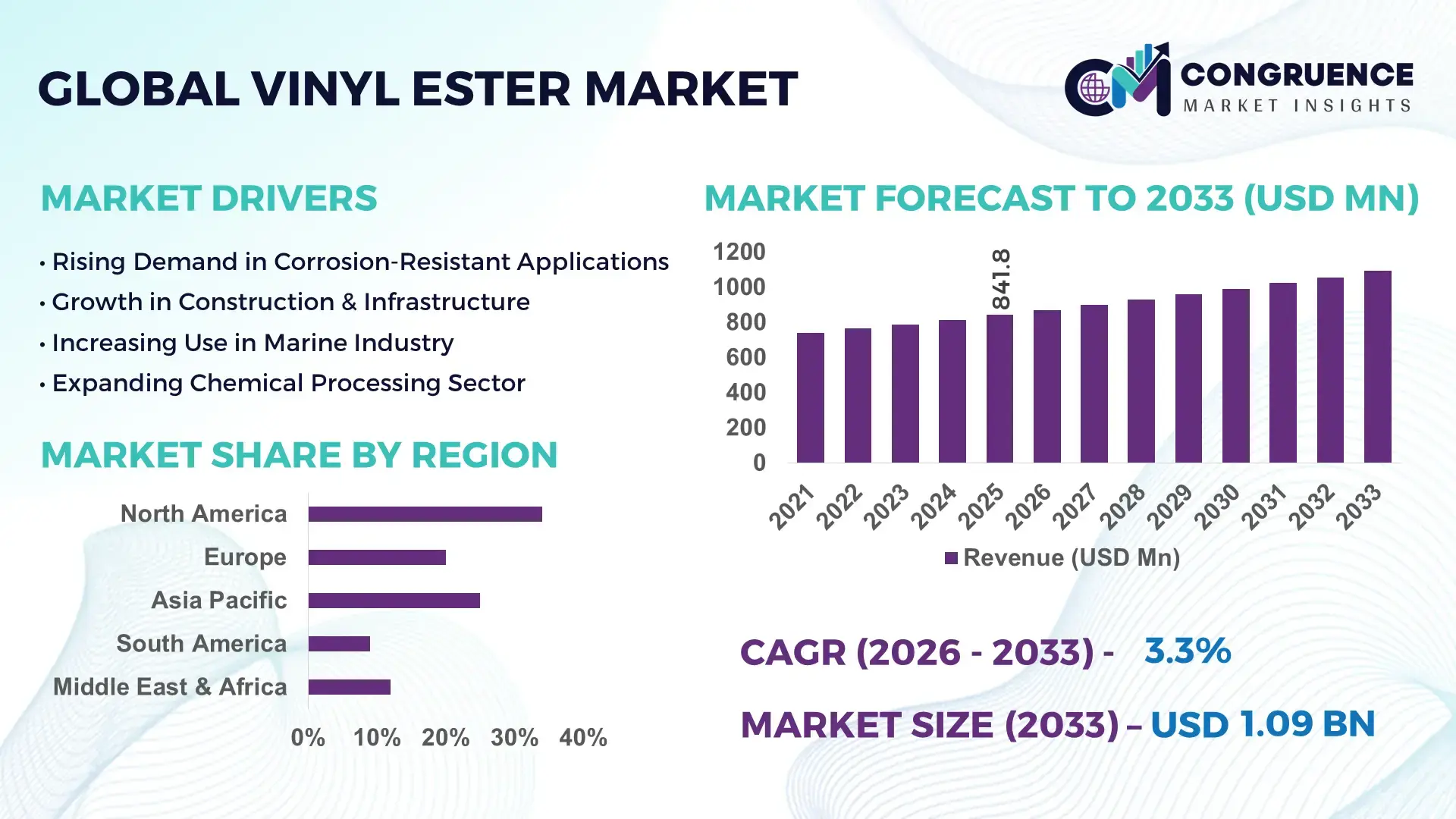
The Global Vinyl Ester Market was valued at USD 841.82 Million in 2025 and is anticipated to reach a value of USD 1091.5 Million by 2033 expanding at a CAGR of 3.3% between 2026 and 2033. The market is primarily driven by increasing demand for corrosion-resistant materials across marine, chemical processing, and infrastructure sectors.
The United States continues to demonstrate strong industrial capabilities in the vinyl ester market, supported by an annual production capacity exceeding 250 kilotons of advanced composite resins. Investments in high-performance polymer manufacturing facilities have crossed USD 500 million in the past five years, particularly in regions such as Texas and Louisiana. Vinyl ester resins are widely utilized in chemical storage tanks, wind turbine blades, and wastewater treatment systems, with over 40% of domestic composite applications linked to infrastructure and environmental engineering. Technological advancements, including improved resin curing efficiency and enhanced thermal resistance up to 180°C, are contributing to broader industrial adoption. Additionally, the country’s robust supply chain network and integration of automated manufacturing processes have enabled a 15–20% increase in production efficiency across major facilities.
Market Size & Growth: Valued at USD 841.82 Million in 2025, projected to reach USD 1091.5 Million by 2033 at a CAGR of 3.3%, driven by rising demand for corrosion-resistant composite materials.
Top Growth Drivers: 35% increase in infrastructure corrosion protection demand, 28% rise in marine composite adoption, 22% improvement in industrial chemical resistance efficiency.
Short-Term Forecast: By 2028, advanced resin formulations are expected to improve durability performance by 18% and reduce maintenance costs by 12%.
Emerging Technologies: Adoption of low-styrene emission resins, nano-enhanced vinyl ester composites, and automated resin infusion processes.
Regional Leaders: North America projected at USD 410 Million by 2033 with infrastructure focus; Asia-Pacific at USD 360 Million with industrial expansion; Europe at USD 290 Million with sustainability-driven adoption.
Consumer/End-User Trends: Increased usage in construction, marine, and wind energy sectors, with over 45% demand coming from infrastructure reinforcement applications.
Pilot or Case Example: In 2024, a European chemical plant improved equipment lifespan by 25% using advanced vinyl ester linings, reducing maintenance downtime by 15%.
Competitive Landscape: Market leader holds approximately 18% share, followed by major players such as Ashland, Swancor, Polynt-Reichhold, Interplastic Corporation, and Sino Polymer.
Regulatory & ESG Impact: Environmental policies promoting low VOC emissions have driven adoption of eco-friendly resin systems, with 20% reduction targets in emissions by 2030.
Investment & Funding Patterns: Over USD 300 million invested globally in composite material R&D and production expansion over recent years.
Innovation & Future Outlook: Integration of recyclable thermoset technologies and hybrid composite systems is expected to redefine long-term market competitiveness.
The vinyl ester market continues to expand across diverse industry sectors, with construction contributing nearly 35% of total demand due to increasing infrastructure rehabilitation projects. Marine applications account for approximately 20%, driven by the need for durable and lightweight materials. Technological innovations such as high-performance bisphenol-A-based resins and epoxy-modified vinyl esters are improving chemical resistance by up to 30%. Regulatory frameworks emphasizing reduced environmental impact are accelerating the shift toward low-emission resin formulations. Asia-Pacific remains a high-growth consumption hub, supported by rapid industrialization and rising demand for corrosion-resistant equipment. Emerging trends such as renewable energy infrastructure and advanced composite manufacturing are expected to further strengthen market growth.
The vinyl ester market holds strong strategic relevance within advanced materials and specialty chemicals industries, particularly due to its superior corrosion resistance, mechanical strength, and durability in harsh environments. These characteristics position vinyl ester resins as a critical material in infrastructure modernization, offshore energy projects, and chemical processing industries. Recent advancements in nano-modified vinyl ester resins deliver nearly 25% improvement in tensile strength compared to traditional polyester resins, enabling higher performance standards in demanding applications. Similarly, low-styrene emission technologies reduce volatile organic compound output by approximately 30% compared to conventional formulations, aligning with global environmental compliance goals.
From a regional perspective, Asia-Pacific dominates in production volume due to large-scale industrial manufacturing hubs, while Europe leads in sustainable adoption with over 40% of enterprises integrating eco-friendly resin technologies into their operations. By 2028, automation-driven resin infusion technologies are expected to improve production efficiency by 20% while reducing material wastage by nearly 15%. Companies are increasingly committing to ESG metrics, including a 25% reduction in emissions and enhanced recyclability of composite materials by 2030.
A practical example can be observed in 2024, when a major manufacturer in Germany achieved a 22% increase in operational efficiency by implementing AI-assisted curing systems in vinyl ester production. These systems optimize curing cycles, reducing energy consumption and improving product consistency. The vinyl ester market is steadily evolving as a pillar of industrial resilience, regulatory compliance, and sustainable growth, supported by continuous innovation and strategic investments.
The growing need for corrosion-resistant infrastructure is a significant driver of the vinyl ester market, particularly in industries exposed to harsh environmental conditions such as chemical processing, marine construction, and wastewater treatment. Vinyl ester resins provide superior resistance to acids, alkalis, and solvents, extending the lifespan of equipment and structures by up to 30–40% compared to conventional materials. In wastewater management systems, over 60% of newly installed storage tanks and pipelines now incorporate advanced composite linings, many of which rely on vinyl ester formulations. The global push for infrastructure modernization, especially in aging industrial economies, has led to increased replacement of metal components with composite materials. Additionally, the expansion of desalination plants and offshore platforms has further accelerated demand, as these environments require materials capable of withstanding high salinity and chemical exposure. The ability of vinyl ester resins to maintain structural integrity under such conditions makes them a preferred solution for long-term infrastructure projects.
Volatility in raw material prices poses a significant restraint for the vinyl ester market, as key inputs such as epoxy resins and methacrylic acid are derived from petrochemical sources subject to fluctuating crude oil prices. Price variations of up to 20% in these raw materials have been observed during periods of supply chain disruption, directly impacting production costs for manufacturers. Additionally, global logistics challenges, including transportation delays and port congestion, further exacerbate cost instability. Small and medium-sized manufacturers are particularly vulnerable, as they often lack long-term procurement contracts to mitigate price risks. The dependence on fossil-based feedstocks also exposes the market to regulatory pressures aimed at reducing carbon emissions. As governments impose stricter environmental standards, compliance costs for production facilities increase, adding further financial strain. These factors collectively create uncertainty in pricing strategies and can limit the adoption of vinyl ester resins in cost-sensitive applications.
The rapid expansion of renewable energy infrastructure presents substantial opportunities for the vinyl ester market, particularly in wind energy and solar power installations. Vinyl ester resins are widely used in the manufacturing of wind turbine blades due to their high strength-to-weight ratio and resistance to environmental degradation. With global wind energy capacity installations exceeding 100 gigawatts annually, demand for durable composite materials has increased significantly. Vinyl ester resins contribute to extending turbine blade lifespan by up to 25%, reducing maintenance costs and improving energy output efficiency. In solar energy systems, these resins are utilized in protective coatings and structural components that require long-term exposure to UV radiation and extreme weather conditions. Furthermore, government incentives promoting clean energy projects are encouraging manufacturers to invest in advanced composite technologies. The integration of recyclable and bio-based resin formulations also opens new avenues for sustainable product development within the renewable energy sector.
Stringent environmental regulations and sustainability requirements present notable challenges for the vinyl ester market, particularly concerning emissions and waste management. Traditional vinyl ester resins often contain styrene, a volatile organic compound that contributes to air pollution and poses health risks. Regulatory agencies across North America and Europe have implemented strict limits on VOC emissions, requiring manufacturers to invest in low-styrene or styrene-free alternatives. Transitioning to these eco-friendly formulations can increase production costs by approximately 15–25%, creating barriers for widespread adoption. Additionally, the thermoset nature of vinyl ester resins makes recycling difficult, leading to concerns over end-of-life waste management. Industries are under pressure to develop recyclable composite materials, yet technological solutions remain in early stages of commercialization. Compliance with environmental standards also necessitates upgrades in manufacturing processes and equipment, further increasing operational complexity. These challenges require continuous innovation and investment to balance performance requirements with sustainability goals.
• Increasing Adoption of Low-Styrene and Styrene-Free Resin Systems: Regulatory pressure and environmental compliance targets have accelerated the shift toward low-styrene vinyl ester formulations, with over 48% of manufacturers transitioning to reduced-emission resins by 2025. These advanced formulations cut volatile organic compound emissions by nearly 30–35%, while improving workplace safety metrics by 20%. In Europe, more than 60% of composite manufacturers have adopted low-emission resin technologies to comply with stringent air quality standards, significantly influencing production practices and material selection.
• Expansion of Wind Energy Infrastructure Driving Composite Demand: The rapid growth of renewable energy has significantly boosted demand for vinyl ester resins in wind turbine blade manufacturing, accounting for approximately 26% of total composite resin consumption in this segment. Global wind installations surpassed 110 GW annually, with turbine blade lengths increasing by 15–20%, necessitating stronger and more fatigue-resistant materials. Vinyl ester resins enhance blade durability by up to 25%, reducing maintenance intervals and improving operational efficiency across large-scale wind farms.
• Integration of Automation and Advanced Manufacturing Techniques: Automation in resin infusion and curing processes has increased production efficiency by 18–22%, while reducing material waste by nearly 12%. Automated filament winding and vacuum-assisted resin transfer molding technologies are now used in over 50% of large-scale composite manufacturing facilities. These systems improve consistency and reduce defect rates by approximately 15%, enabling manufacturers to meet high-volume industrial demand with improved quality control and reduced labor dependency.
• Growth in Chemical Storage and Industrial Tank Applications: Demand for vinyl ester resins in chemical storage tanks and pipelines has grown by over 30% in the past five years, driven by the need for superior corrosion resistance in aggressive industrial environments. Approximately 65% of newly installed industrial tanks in chemical processing plants now utilize vinyl ester linings due to their ability to withstand temperatures exceeding 120°C and prolonged chemical exposure. This trend is particularly prominent in Asia-Pacific, where industrial expansion has led to a 20% increase in demand for corrosion-resistant infrastructure materials.
The vinyl ester market segmentation reflects a structured distribution across product types, industrial applications, and end-user industries, each contributing distinctively to overall demand patterns. By type, bisphenol-A-based vinyl ester resins dominate due to their high chemical resistance and mechanical strength, while novolac-based variants are gaining traction for high-temperature applications. In terms of applications, construction and infrastructure account for a significant portion of demand, followed by marine and chemical processing sectors, where durability and corrosion resistance are critical. End-user industries include oil and gas, energy, water treatment, and transportation, each demonstrating varying adoption rates based on environmental exposure and performance requirements. Approximately 40% of total demand originates from infrastructure-related applications, highlighting the importance of long-term durability and lifecycle cost efficiency. Regional variations also influence segmentation, with Asia-Pacific showing higher consumption in industrial manufacturing, while North America emphasizes advanced composites and environmental compliance solutions.
The vinyl ester market by type is primarily segmented into bisphenol-A epoxy vinyl ester, novolac epoxy vinyl ester, and other specialized resin formulations. Bisphenol-A vinyl ester resins lead the segment, accounting for approximately 52% of total adoption due to their balanced performance in terms of corrosion resistance, mechanical strength, and cost-effectiveness. These resins are widely used in marine structures, chemical tanks, and pipelines where moderate chemical exposure is prevalent. In comparison, novolac epoxy vinyl ester resins hold around 28% share, offering superior resistance to high temperatures and aggressive chemicals, making them suitable for demanding industrial environments such as flue gas desulfurization systems.
The fastest-growing segment is novolac-based vinyl ester resins, expanding at an estimated CAGR of 5.1%, driven by increasing demand in high-temperature and chemically aggressive applications. Industries such as power generation and petrochemicals are adopting these resins due to their ability to withstand temperatures above 150°C and resist strong acids. Other specialized vinyl ester resins, including brominated and elastomer-modified variants, collectively contribute nearly 20% of the market, catering to niche applications requiring flame retardancy or enhanced flexibility.
In terms of application, the vinyl ester market is segmented into pipes and tanks, marine structures, wind energy components, building and construction, and others. Pipes and tanks represent the leading application segment, accounting for approximately 38% of total demand due to the extensive use of vinyl ester resins in chemical storage and wastewater management systems. These applications benefit from the material’s ability to resist chemical degradation and maintain structural integrity under prolonged exposure to corrosive substances.
Marine applications account for nearly 24% of the market, driven by increasing demand for lightweight, durable materials in boat hulls and offshore structures. Wind energy is the fastest-growing application segment, expanding at an estimated CAGR of 6.2%, supported by rising global installations of wind turbines and the need for longer, more durable blades. Vinyl ester resins enhance fatigue resistance and structural strength, making them ideal for renewable energy infrastructure. Other applications, including construction and transportation, collectively contribute around 38% of the market, with increasing adoption in bridge components and automotive parts.
The vinyl ester market by end-user is segmented into construction and infrastructure, oil and gas, marine, energy and power, and water treatment industries. Construction and infrastructure lead the segment, contributing approximately 35% of total demand due to the growing need for durable, corrosion-resistant materials in bridges, tunnels, and industrial facilities. Oil and gas account for nearly 22% of the market, utilizing vinyl ester resins in pipelines, storage tanks, and offshore platforms where exposure to harsh chemicals and environmental conditions is significant.
The fastest-growing end-user segment is energy and power, particularly renewable energy, expanding at an estimated CAGR of 6.5%. This growth is driven by increased deployment of wind turbines and solar infrastructure requiring high-performance composite materials. Marine and water treatment sectors together represent around 28% of the market, supported by rising investments in desalination plants and wastewater management systems. Adoption rates in these sectors have increased by approximately 18% over the past three years due to stricter environmental regulations.
Region North America accounted for the largest market share at 34% in 2025 however, Asia-Pacific is expected to register the fastest growth, expanding at a CAGR of 4.6% between 2026 and 2033.

North America’s dominance is supported by advanced composite manufacturing infrastructure and strong demand from construction and chemical processing sectors, with over 45% of regional consumption linked to corrosion-resistant industrial applications. Europe follows with approximately 27% market share, driven by sustainability-focused regulations and high adoption of low-emission resin systems across Germany, France, and the UK. Asia-Pacific holds nearly 29% share, with China and India contributing over 60% of regional demand due to rapid industrialization and infrastructure expansion. The Middle East & Africa region accounts for around 6%, primarily supported by oil and gas sector investments, while South America contributes close to 4%, driven by energy and water treatment projects. Regional production capacity has increased by over 18% globally in the past five years, with Asia-Pacific leading expansion in manufacturing facilities and North America focusing on technological innovation and high-performance resin development.
How are advanced composite innovations shaping industrial material demand?
North America holds approximately 34% of the global vinyl ester market, supported by strong industrial demand and technological leadership in composite materials. Key industries driving demand include construction, wastewater treatment, and oil and gas, which collectively contribute over 60% of regional consumption. Regulatory frameworks focused on environmental protection have accelerated the adoption of low-VOC and styrene-reduced resin systems, with nearly 55% of manufacturers transitioning to eco-compliant formulations. Technological advancements such as automated resin transfer molding and AI-driven curing processes have improved production efficiency by 20% and reduced defects by 15%. A notable regional player, Ashland, has expanded its advanced resin portfolio with high-performance corrosion-resistant solutions, improving product durability by up to 25%. Consumer behavior in this region reflects high enterprise adoption in infrastructure and industrial sectors, where over 50% of projects prioritize long-term lifecycle cost savings and durability over initial material costs.
Why is sustainability-driven material innovation transforming industrial composites?
Europe accounts for approximately 27% of the vinyl ester market, with key contributions from Germany, the UK, and France, which together represent over 65% of regional demand. Strict environmental regulations and sustainability initiatives have led to widespread adoption of low-emission and recyclable resin technologies, with over 60% of manufacturers integrating eco-friendly production processes. Regulatory bodies enforcing VOC emission limits have driven a 30% reduction in styrene-based formulations across the region. Emerging technologies such as nano-enhanced resins and automated composite manufacturing are improving product performance by nearly 20%. Companies like Polynt-Reichhold are investing in advanced resin development, focusing on high-temperature and chemical-resistant formulations. Consumer behavior in Europe is influenced by regulatory pressure, with industries prioritizing compliance and sustainability, leading to increased demand for transparent, environmentally responsible material solutions.
What factors are accelerating industrial material adoption across manufacturing hubs?
Asia-Pacific represents nearly 29% of the global vinyl ester market and ranks as the fastest-growing region in terms of consumption and production expansion. China, India, and Japan collectively account for over 70% of regional demand, driven by rapid industrialization and infrastructure development. Manufacturing output in the region has increased by more than 25% over the past five years, with significant investments in chemical processing and construction sectors. Infrastructure projects, including water treatment plants and transportation networks, contribute over 40% of regional demand. Technological advancements such as automated composite fabrication and cost-efficient resin production methods are improving efficiency by 18%. A leading regional manufacturer, Swancor, has introduced advanced eco-friendly vinyl ester resins that reduce emissions by 20% while maintaining high performance. Consumer behavior reflects strong growth in industrial and infrastructure applications, with increasing adoption of cost-effective, durable materials across emerging economies.
How are energy and infrastructure investments influencing material demand patterns?
South America holds approximately 4% of the global vinyl ester market, with Brazil and Argentina being the primary contributors, accounting for over 65% of regional consumption. The market is driven by infrastructure development and energy sector investments, particularly in water treatment and oil refining applications. Government initiatives promoting industrial modernization have increased demand for corrosion-resistant materials by nearly 15% over the past three years. Trade policies supporting local manufacturing have encouraged the establishment of composite production facilities, improving regional supply chains. A regional producer has expanded its vinyl ester resin production capacity by 10%, targeting growing demand in chemical storage applications. Consumer behavior in this region is closely tied to infrastructure and energy projects, where approximately 70% of demand is linked to public sector investments and industrial expansion.
Why is industrial diversification boosting demand for high-performance composites?
The Middle East & Africa region accounts for around 6% of the global vinyl ester market, with demand primarily driven by oil and gas, construction, and desalination sectors. Countries such as the UAE and South Africa contribute over 55% of regional consumption, supported by large-scale infrastructure and energy projects. The adoption of advanced composite materials has increased by approximately 20% in the past five years, particularly in pipeline and storage tank applications. Technological modernization efforts, including automated manufacturing and high-performance resin systems, are improving efficiency by 15%. Trade partnerships and government initiatives promoting industrial diversification have further supported market growth. A regional manufacturer has introduced high-durability vinyl ester coatings capable of extending equipment lifespan by 30%. Consumer behavior reflects strong demand from industrial sectors, with increasing focus on long-term durability and resistance to extreme environmental conditions.
United States Vinyl Ester Market – 28% share: Strong production capacity exceeding 250 kilotons and high demand from infrastructure and chemical processing industries.
China Vinyl Ester Market – 24% share: Rapid industrial expansion and large-scale infrastructure projects driving high consumption of corrosion-resistant materials.
The vinyl ester market exhibits a moderately fragmented competitive landscape, with over 40 active global and regional manufacturers competing across various application segments. The top five companies collectively account for approximately 55% of the total market share, indicating a balanced mix of consolidation and regional competition. Leading players are focusing on product innovation, strategic partnerships, and capacity expansion to strengthen their market positions. Over the past three years, more than 20 new product launches have been recorded, particularly in low-styrene and high-performance resin formulations designed to meet evolving environmental regulations.
Strategic collaborations between resin manufacturers and composite fabricators have increased by nearly 18%, enabling the development of customized solutions for specific industrial applications. Mergers and acquisitions activity has also intensified, with at least 8 notable transactions completed in recent years to enhance geographic reach and technological capabilities. Investment in research and development has risen by approximately 15%, focusing on advanced composite technologies such as nano-enhanced resins and recyclable thermoset systems.
Innovation trends are centered on improving material durability, reducing emissions, and enhancing production efficiency. Companies are leveraging automation and digital manufacturing tools to reduce production costs by up to 12% while improving product consistency. The competitive environment is expected to remain dynamic, driven by technological advancements and increasing demand for sustainable, high-performance materials.
Ashland
Swancor Holding Co., Ltd.
Polynt-Reichhold Group
Interplastic Corporation
Sino Polymer Co., Ltd.
Allnex
AOC Resins
Showa Denko Materials Co., Ltd.
Scott Bader Company Ltd.
Reichhold LLC
Technological advancements in the vinyl ester market are centered on enhancing performance characteristics, improving environmental compliance, and optimizing manufacturing efficiency. One of the most significant developments is the introduction of low-styrene and styrene-free resin systems, which reduce volatile organic compound emissions by up to 35% while maintaining comparable mechanical strength and chemical resistance. These formulations are increasingly adopted in regions with strict environmental regulations, with over 50% of new resin production lines integrating emission-reduction technologies.
Another key innovation is the use of nano-enhanced vinyl ester resins, where nanoparticles such as silica and graphene are incorporated to improve tensile strength by 20–25% and increase thermal stability beyond 180°C. These materials are particularly valuable in high-performance applications such as wind turbine blades and chemical processing equipment. Additionally, advancements in automated manufacturing processes, including vacuum-assisted resin transfer molding (VARTM) and filament winding, have improved production efficiency by approximately 18% while reducing material waste by 10–12%.
Digitalization is also playing a transformative role, with AI-driven curing systems optimizing temperature and pressure conditions, resulting in up to 15% reduction in energy consumption and improved product consistency. Hybrid composite technologies combining vinyl ester with carbon or glass fibers are gaining traction, offering enhanced durability and lightweight properties for transportation and infrastructure projects. Furthermore, research into recyclable thermoset composites is progressing, with pilot programs demonstrating up to 25% material recovery rates. These technological trends collectively position vinyl ester resins as a critical material solution for high-performance, sustainable industrial applications.
• In March 2025, Ashland expanded its corrosion-resistant resin portfolio by introducing new Derakane™ epoxy vinyl ester resins designed for high-temperature industrial applications. These resins offer improved chemical resistance and enhanced durability, enabling up to 20% longer service life in aggressive processing environments. Source: www.ashland.com
• In September 2024, Polynt-Reichhold Group announced capacity expansion initiatives across its European facilities to increase production of specialty vinyl ester resins. The expansion aims to improve supply reliability and reduce lead times by approximately 15% for customers in construction and chemical processing sectors. Source: www.polynt.com
• In May 2025, Allnex introduced advanced low-styrene vinyl ester formulations targeting reduced emissions and improved workplace safety. These new products reduce VOC emissions by nearly 30% while maintaining high mechanical performance, supporting regulatory compliance across Europe and North America. Source: www.allnex.com
• In November 2024, Swancor Holding Co., Ltd. launched eco-friendly vinyl ester resins designed for wind energy applications, offering enhanced fatigue resistance and up to 25% improved lifespan for turbine blades. The development aligns with increasing demand for sustainable composite materials in renewable energy projects. Source: www.swancor.com
The vinyl ester market report provides a comprehensive analysis of the global industry, covering key segments, technological advancements, and regional dynamics influencing demand patterns. The scope includes detailed segmentation by resin type, including bisphenol-A, novolac, and specialty modified vinyl ester resins, which collectively address diverse industrial requirements ranging from standard corrosion resistance to high-temperature performance exceeding 150°C. Application coverage spans critical sectors such as pipes and tanks, marine structures, wind energy components, and construction materials, with infrastructure-related applications contributing approximately 40% of total demand.
Geographically, the report evaluates five major regions, including North America, Europe, Asia-Pacific, South America, and the Middle East & Africa, each analyzed based on consumption patterns, production capabilities, and industrial growth trends. Asia-Pacific is highlighted for its rapid industrial expansion and increasing manufacturing output, while North America and Europe are examined for their technological leadership and regulatory-driven adoption of sustainable resin systems.
The report also incorporates analysis of emerging technologies such as nano-enhanced composites, automated manufacturing processes, and recyclable thermoset materials, which are reshaping production efficiency and environmental impact. Additionally, it explores end-user industries including oil and gas, water treatment, energy, and transportation, which together account for over 70% of total market consumption. The scope further extends to competitive landscape evaluation, supply chain analysis, and innovation trends, providing decision-makers with a structured and data-driven understanding of current and future market developments.
| Report Attribute/Metric | Report Details |
|---|---|
|
Market Revenue in 2025 |
USD V2025 Million |
|
Market Revenue in 2033 |
USD V2033 Million |
|
CAGR (2026 - 2033) |
3.3% |
|
Base Year |
2025 |
|
Forecast Period |
2026 - 2033 |
|
Historic Period |
2021 - 2025 |
|
Segments Covered |
By Types
By Application
By End User
|
|
Key Report Deliverable |
Revenue Forecast, Growth Trends, Market Dynamics, Segmental Overview, Regional and Country-wise Analysis, Competition Landscape |
|
Region Covered |
North America, Europe, Asia-Pacific, South America, Middle East, Africa |
|
Key Players Analyzed |
Ashland, Swancor Holding Co., Ltd., Polynt-Reichhold Group, Interplastic Corporation, Sino Polymer Co., Ltd., Allnex, AOC Resins, Showa Denko Materials Co., Ltd., Scott Bader Company Ltd., Reichhold LLC |
|
Customization & Pricing |
Available on Request (10% Customization is Free) |




