
Reports
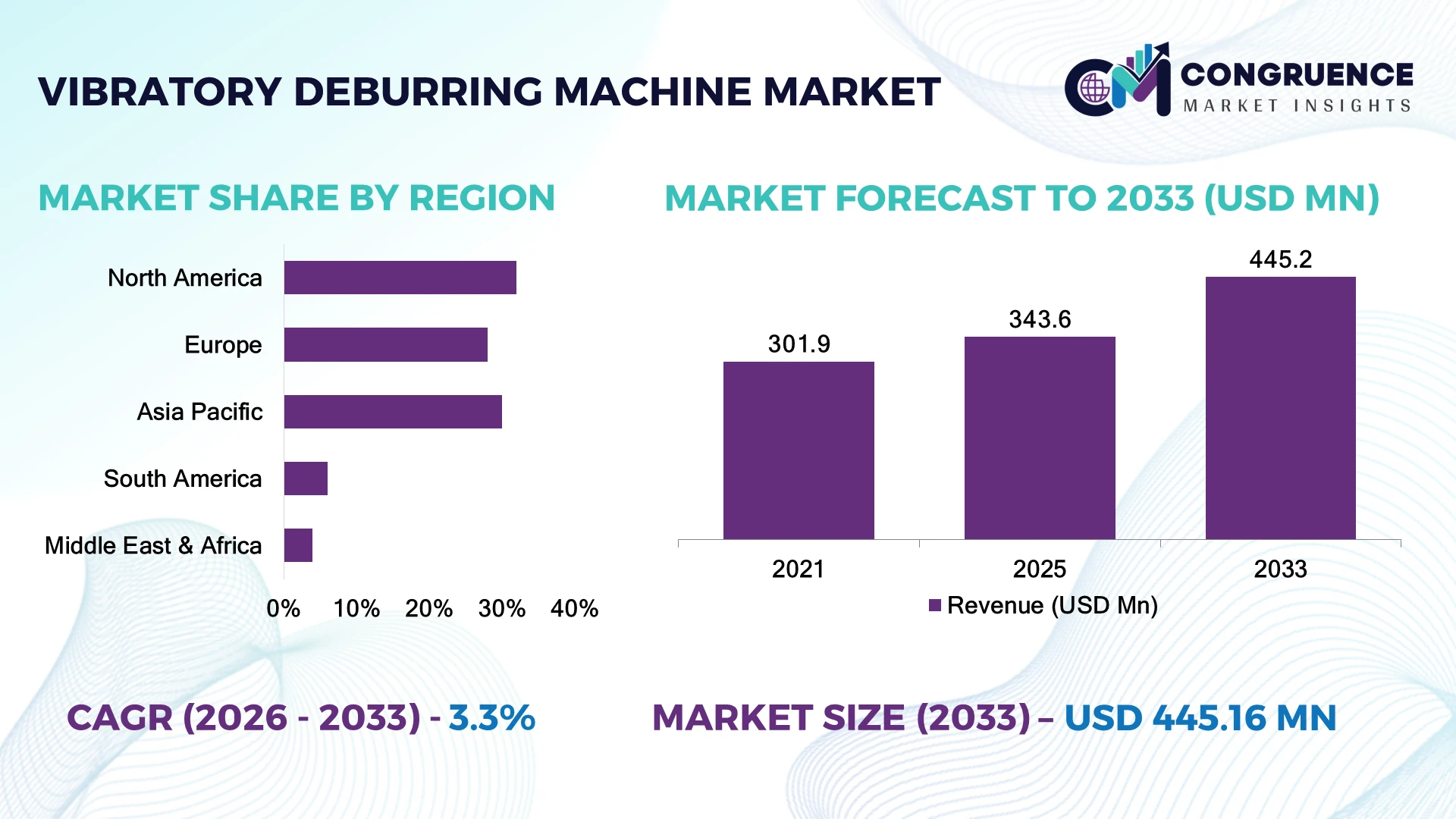
The Global Vibratory Deburring Machine Market was valued at USD 343.6 Million in 2025 and is anticipated to reach a value of USD 445.2 Million by 2033 expanding at a CAGR of 3.29% between 2026 and 2033. Growth is driven by rising automation in precision manufacturing, increasing adoption of CNC-integrated finishing systems, and demand for consistent surface treatment in automotive, aerospace, and medical component production.
The United States dominates the market with nearly 28% share, supported by aerospace machining hubs, automotive supply chains, and investments in automated finishing technologies exceeding USD 500 million annually across advanced manufacturing programs. Germany follows with strong adoption in automotive engineering, where over 60% of premium machining facilities utilize automated surface finishing solutions. Compared with China’s expanding manufacturing base, U.S. and German producers emphasize high-precision, low-defect production aligned with Industry 4.0 initiatives accelerated after global supply-chain restructuring.
Strategic implication Manufacturers investing in intelligent vibratory finishing platforms and localized service networks will gain stronger positioning in precision-driven industrial ecosystems.
Market Size & Growth: Valued at USD 343.6 Million in 2025 and reaching USD 445.2 Million by 2033 at 3.29% CAGR, driven by automated precision finishing adoption.
Top Growth Drivers: Automation adoption (35%), aerospace component production growth (18%), and electric vehicle manufacturing expansion (25%) accelerate market demand.
Short-Term Forecast: By 2028, automated deburring systems are expected to improve finishing consistency by 20% and reduce manual labor requirements by 15%.
Emerging Technologies: AI-assisted process monitoring, robotic loading systems, and advanced abrasive media are transforming high-precision finishing operations.
Regional Leaders: North America targets USD 125 Million+ market value through aerospace automation; Europe exceeds USD 110 Million with Industry 4.0 adoption; Asia-Pacific approaches USD 150 Million through automotive expansion.
Consumer/End-User Trends: Over 45% of automotive suppliers are shifting toward automated surface finishing to improve throughput and quality control.
Pilot/Case Example: In 2024, automotive machining facilities using automated vibratory systems reported up to 30% reduction in finishing cycle time.
Competitive Landscape: Leading manufacturers include approximately 20%+ combined share holders such as Rosler, Walther Trowal, Mass Finishing, Inovatec Machinery, and Hammond Roto-Finish.
Regulatory & ESG Impact: Energy-efficient finishing equipment reduces operational waste by around 15%, supporting sustainable manufacturing targets in Europe and North America.
Investment & Funding: More than USD 1 billion is being directed toward smart manufacturing upgrades globally, increasing partnerships between machine builders and automation providers.
Innovation & Future Outlook: Next-generation systems integrating sensors, analytics, and predictive maintenance are reshaping competitive strategies across global manufacturing markets.
The Vibratory Deburring Machine Market is becoming increasingly important for manufacturers seeking higher precision, lower defect rates, and scalable finishing operations. Demand is shifting from conventional batch processing toward automated, digitally monitored systems as supply chains diversify after disruptions such as geopolitical tensions affecting Asian manufacturing routes. Advanced machines using sensor-based controls deliver up to 25% higher process consistency compared with legacy manual finishing methods. Japan and Germany lead in high-precision deployment, while India and China are expanding adoption through automotive and industrial modernization programs. Over the next 2–3 years, manufacturers are prioritizing robotic integration, localized production, and service partnerships to strengthen operational resilience. Companies implementing automated vibratory finishing solutions in aerospace component facilities have achieved improved surface uniformity and reduced rework rates. Strategic investments in connected equipment and customized finishing technologies will define competitive advantage in precision manufacturing.
The Vibratory Deburring Machine Market is becoming strategically important as manufacturers worldwide prioritize precision engineering, automation, and production efficiency. Automotive electrification, aerospace component complexity, and reshoring initiatives are increasing demand for reliable surface finishing systems capable of maintaining consistent quality at higher production volumes.
A major market shift is the transition from standalone machines to digitally connected finishing cells. Modern automated vibratory systems achieve approximately 20–30% higher operational efficiency than conventional manual deburring processes while reducing operator dependency. The United States focuses on aerospace and defense manufacturing modernization, while Germany emphasizes smart factory integration, and China expands deployment through large-scale automotive and electronics production.
Companies are strengthening competitive positions through partnerships with automation providers, investments in robotic material handling, and development of energy-efficient equipment. For example, automotive suppliers integrating automated vibratory finishing lines have reduced processing bottlenecks and improved production consistency. Over the next few years, adoption of sensor-enabled systems and predictive maintenance platforms will accelerate as manufacturers seek lower downtime and improved manufacturing intelligence.
Strategic conclusion: Companies that combine precision finishing expertise with automation capabilities will secure stronger long-term relevance in advanced manufacturing ecosystems.
Rising automation across automotive, aerospace, and medical component industries is the primary growth driver for vibratory deburring machines. Over 40% of manufacturers are increasing investment in automated finishing equipment to reduce manual variability, while robotic integration improves production consistency by nearly 25%. The expansion of electric vehicle manufacturing in China, Germany, and the U.S. is increasing demand for high-quality component finishing. Industry 4.0 adoption is pushing companies toward connected vibratory systems with real-time monitoring capabilities. Machine manufacturers are responding through smart equipment launches, automation partnerships, and localized service centers to support precision manufacturing requirements.
High initial equipment costs and dependency on specialized components limit adoption among small and medium manufacturers. Advanced vibratory systems with automation features can require 20–35% higher investment compared with traditional machines. Supply-chain disruptions affecting electronic controllers and precision components continue to pressure delivery timelines, particularly across European manufacturing hubs. Smaller suppliers often delay upgrades due to capital constraints and maintenance requirements. Companies are reducing exposure through supplier diversification, regional sourcing strategies, and long-term component agreements. Manufacturers expanding local production capabilities are improving equipment availability while reducing dependency on volatile international supply networks.
Digital transformation creates significant opportunities through AI-enabled monitoring, automated loading systems, and customized finishing solutions. Smart manufacturing adoption is increasing, with more than 30% of industrial facilities evaluating connected equipment for quality optimization. Emerging applications in electric vehicle parts, lightweight aerospace structures, and medical devices are creating new demand areas. India’s expanding automotive manufacturing ecosystem and Southeast Asia’s industrial investments provide additional opportunities for equipment suppliers. Companies are investing in R&D, software integration, and strategic partnerships to deliver intelligent finishing platforms. The strongest opportunity lies in combining vibratory processing with predictive analytics to reduce waste and maximize machine utilization.
Complex integration requirements remain a challenge as manufacturers transition toward automated vibratory finishing environments. Nearly 30% of industrial facilities report difficulties in adopting advanced automation due to workforce skill shortages and system compatibility issues. Cybersecurity requirements for connected manufacturing equipment are also increasing as factories deploy networked systems. Companies face pressure to maintain consistent output while upgrading legacy production environments. Japan and Germany are addressing these issues through workforce training and smart factory initiatives, while developing markets require stronger technical support networks. Equipment providers must invest in training programs, modular designs, and cybersecurity-focused solutions to ensure sustainable deployment and long-term competitiveness.
Smart Automation Integration: Manufacturers are accelerating adoption of sensor-enabled vibratory deburring systems, with approximately 35% of advanced machining facilities integrating automated monitoring and 20% improving process consistency through digital controls. Automotive suppliers in Germany and Japan are replacing manual inspection workflows with connected finishing cells to reduce defects and improve throughput. Companies are responding through robotic loading partnerships, AI-based process monitoring, and modular machine upgrades.
Energy-Efficient Finishing Systems: Rising energy costs and sustainability targets are driving demand for optimized vibratory machines, with newer systems delivering around 15–25% lower energy consumption and reducing abrasive waste by nearly 20%. European manufacturers are prioritizing low-maintenance equipment following stricter industrial efficiency regulations. Machine producers are redesigning motors, circulation systems, and media-handling technologies to improve lifecycle performance.
Customized Surface Treatment Growth: Aerospace, medical, and electric vehicle component producers are shifting toward application-specific finishing solutions, increasing customized machine deployments by nearly 30% in precision manufacturing environments. The growth of lightweight materials and complex geometries is creating demand for specialized media and programmable cycles. Companies are expanding engineering services and forming application-development partnerships to support niche production requirements.
Supply Chain Localization Shift: Global manufacturing disruptions have encouraged localized equipment sourcing, with around 25% of industrial buyers increasing preference for regional suppliers and service networks. India and Southeast Asian manufacturers are expanding domestic machining capabilities to reduce dependency on imported finishing systems. Equipment providers are establishing local support centers, component partnerships, and faster maintenance networks to strengthen supply resilience.
Automated vibratory deburring machines represent the leading type segment, accounting for approximately 45% of the market due to higher consistency, reduced labor dependency, and integration with modern production lines. These systems are widely adopted by automotive and aerospace manufacturers requiring repeatable surface finishing across high-volume operations. Manual and semi-automated systems continue to maintain relevance among small manufacturers because of lower upfront costs and flexible deployment requirements, representing nearly 35% combined adoption. However, investment priorities are shifting toward intelligent machines with programmable controls and automated material handling. The fastest-growing segment is advanced automated vibratory systems, supported by Industry 4.0 adoption and demand for real-time process control. Adoption of connected finishing equipment is increasing by more than 25% among precision manufacturers seeking improved quality tracking. Companies are expanding product portfolios with sensor-based monitoring, energy-efficient designs, and customized automation solutions to capture higher-value industrial applications.
Automotive component finishing is the leading application segment, contributing nearly 50% market share due to large-scale demand from engine parts, transmission components, and electric vehicle manufacturing. Vehicle manufacturers require consistent deburring quality to improve component reliability and reduce assembly issues. Aerospace and medical device applications are emerging rapidly, with adoption increasing by approximately 25% as manufacturers require tighter surface specifications and contamination control. General industrial applications remain important, particularly among metal fabrication and machinery producers seeking cost-effective finishing processes. Aerospace applications are expanding faster than traditional segments because of increasing aircraft component complexity and lightweight material usage. Companies are responding through specialized media development, automated batch processing, and integration with CNC production environments. The shift toward electric vehicle production is creating new finishing requirements for battery housings and precision-machined components.
Automotive manufacturers represent the dominant end-user segment with approximately 52% market share, driven by high-volume production, strict component quality requirements, and increasing electric vehicle manufacturing. Large automotive plants in China, Germany, and the United States are adopting automated vibratory systems to improve throughput and reduce manual finishing operations. Aerospace and medical device manufacturers are among the fastest-growing users, with adoption rising nearly 30% due to complex component designs and regulatory quality requirements. Small and medium industrial manufacturers continue adopting compact vibratory machines for flexible production needs, while large enterprises prioritize integrated systems connected to broader factory automation platforms. Companies are targeting different buyer groups through customized equipment configurations, financing models, and service-based partnerships. Future demand is shifting toward manufacturers requiring higher automation levels, traceability, and reduced operational variability.
North America accounted for the largest market share at 32% in 2025 however, Asia-Pacific is expected to register the fastest growth, expanding at a CAGR of 4.1% between 2026 and 2033.

North America holds a leading position in the vibratory deburring machine market due to strong aerospace, automotive, medical device, and defense manufacturing ecosystems. The region contributes nearly 32% of global demand, supported by high adoption of automated finishing systems across advanced production facilities in the United States and Canada. Automotive suppliers are increasingly integrating vibratory machines with robotic handling and CNC production lines to improve component consistency. More than 40% of large manufacturers in the region are adopting smart manufacturing solutions to optimize workflow efficiency. Companies are strengthening regional service networks, automation partnerships, and customized finishing solutions to support rising demand for precision component processing.
United States Market Outlook: The United States remains the primary contributor within North America due to its aerospace and automotive manufacturing scale. The country accounts for nearly 75% of regional demand, supported by advanced machining clusters across Michigan, California, and Texas. Over 50% of major aerospace suppliers are increasing automation investments to improve production accuracy and reduce manual finishing requirements.
Europe maintains a strong position in the vibratory deburring machine market due to its advanced automotive engineering base, industrial automation capabilities, and strict manufacturing quality standards. The region represents approximately 28% of global adoption, with Germany, Italy, and France serving as key deployment centers. European manufacturers are increasingly replacing conventional finishing processes with digitally monitored systems to improve efficiency and reduce production waste. Nearly 35% of industrial facilities are implementing connected manufacturing technologies as part of smart factory modernization programs. Companies are focusing on energy-efficient machines, automated process control, and partnerships with industrial technology providers to meet sustainability and productivity objectives.
Germany Market Outlook: Germany leads the European market through its automotive manufacturing strength and Industry 4.0 leadership. The country contributes nearly 40% of European demand, supported by extensive machining operations and premium component production. More than 60% of large automotive suppliers use automated finishing technologies to maintain precision standards across high-volume manufacturing environments.
Asia-Pacific is the fastest-expanding market for vibratory deburring machines due to large-scale automotive production, electronics manufacturing, and industrial infrastructure development. The region accounts for approximately 30% of global demand, with China, Japan, South Korea, and India driving adoption. Increasing electric vehicle production and export-oriented manufacturing are accelerating demand for automated surface finishing solutions. China’s manufacturing sector represents a significant deployment base, while India is expanding adoption through automotive localization and industrial modernization programs. More than 45% of manufacturers in major industrial hubs are upgrading production equipment with automation capabilities. Companies are increasing local partnerships, production capacity, and after-sales support networks to capture emerging opportunities.
China Market Outlook: China dominates the Asia-Pacific market due to its extensive automotive, machinery, and electronics manufacturing ecosystem. The country contributes over 55% of regional demand and continues expanding automated machining capacity across industrial clusters. More than 30% of manufacturers are adopting smart production technologies to improve quality control and operational efficiency.
South America represents an emerging market for vibratory deburring machines, supported by automotive production, metal fabrication, mining equipment manufacturing, and industrial modernization initiatives. Brazil accounts for the majority of regional demand due to its automotive manufacturing base and established industrial infrastructure. The region contributes nearly 6% of global adoption, with demand concentrated among large manufacturing facilities seeking improved finishing consistency. Limited automation penetration and equipment import dependency remain challenges for smaller manufacturers. However, investments in industrial upgrades are encouraging adoption of automated finishing systems. Companies are expanding through distributor partnerships, localized maintenance services, and cost-effective machine configurations to address regional manufacturing requirements.
Brazil Market Outlook: Brazil leads South America through its automotive and industrial manufacturing capacity. The country represents nearly 65% of regional demand, supported by vehicle production centers and metal processing industries. More than 20% of large manufacturers are increasing automation adoption to improve production efficiency and reduce dependency on manual finishing operations.
The Middle East & Africa market is developing through industrial diversification, infrastructure investment, and expansion of manufacturing capabilities. Demand is concentrated in countries investing in aerospace, automotive assembly, metal fabrication, and energy-related equipment production. The region contributes approximately 4% of global market adoption, with the United Arab Emirates, Saudi Arabia, and South Africa representing key markets. Industrial transformation programs and manufacturing localization strategies are encouraging adoption of advanced finishing equipment. More than 25% of new industrial facilities in major economic zones are incorporating automation technologies. Companies are building regional partnerships and service capabilities to support equipment deployment and long-term operational requirements.
United Arab Emirates Market Outlook: The United Arab Emirates is emerging as a strategic market due to investments in aerospace, advanced manufacturing, and industrial diversification projects. The country accounts for a significant share of regional adoption, supported by manufacturing zones and technology-focused industrial initiatives. More than 15% of advanced manufacturing facilities are integrating automated production solutions to improve precision and efficiency.
The Vibratory Deburring Machine Market features competition between global finishing technology leaders such as Rosler, Walther Trowal, and Mass Finishing against regional manufacturers offering cost-focused solutions. The top five players collectively hold approximately 45% share, creating a moderately consolidated structure. Global OEMs compete through automation, precision control, and customized systems, while regional suppliers compete on pricing and faster delivery. Technology differentiation drives competition, with smart monitoring improving process efficiency by 20% and automated handling reducing labor requirements by nearly 25%. Companies are expanding service networks, forming automation partnerships, and developing application-specific solutions for automotive, aerospace, and medical industries. The competitive landscape is shifting toward connected equipment, energy-efficient designs, and localized supply chains. High engineering expertise, application knowledge, and after-sales support remain key entry barriers. Winning players must combine advanced automation, customization capability, and reliable global support infrastructure.
Walther Trowal
Mass Finishing Inc.
Inovatec Machinery
Hammond Roto-Finish
Bel Air Finishing Supply Corporation
Kemet International
Otec Präzisionsfinish GmbH
Almco
Giant Finishing Systems
ActOn Finishing Limited
Tipton Corp.
The Vibratory Deburring Machine Market is shifting from conventional batch finishing systems toward intelligent automated platforms integrating sensors, programmable controls, and data monitoring. Smart vibratory machines improve process consistency by approximately 20% and reduce manual inspection requirements by nearly 15%. Around 35% of advanced manufacturing facilities are adopting connected finishing technologies to improve traceability and workflow control.
Robotic integration is becoming a key differentiator, replacing traditional loading and unloading processes with automated handling solutions. Compared with older manual operations, robotic vibratory finishing cells deliver nearly 25% higher operational efficiency and reduce cycle variability by approximately 20%. Automotive and aerospace manufacturers benefit most through improved quality control and reduced production interruptions.
Between 2026 and 2028, AI-based process optimization, predictive maintenance, and energy-efficient motor technologies will influence competitive positioning. Companies investing in digital finishing ecosystems will gain advantages through lower downtime, faster customization, and improved resource utilization. Manufacturers combining automation hardware with software analytics are positioned to capture premium industrial applications.
July 2025 Rösler Group deployed a new interlinked mass finishing system for HARTING Technology Group in Vietnam, enhancing automated surface finishing for industrial connectors. The solution improves safety and quality control through integrated processing workflows. The project strengthens Rösler’s position in automated finishing applications across Asia. Source: www.rosler.com
February 2025 Walther Trowal introduced sustainability-focused mass finishing developments addressing microplastic concerns in finishing processes. The company highlighted process improvements through optimized media management and recycling approaches, helping manufacturers reduce environmental impact while maintaining finishing performance. The innovation supports sustainable manufacturing requirements. Source: www.blog.walther-trowal.com
September 2025 OTEC Präzisionsfinish advanced aerospace finishing solutions with automated vibratory and finishing technologies designed for Class-A components. The systems integrate production data management and intelligent media control, improving process stability and reducing scrap risks for critical aerospace manufacturing operations. Source: www.otec.de
August 2024 Walther Trowal expanded its Mexico operations by increasing warehouse capacity to approximately 1,000 m² and adding sales resources. The expansion improves regional customer support and strengthens supply-chain responsiveness for industrial finishing equipment users in North America.
The Vibratory Deburring Machine Market Report covers detailed analysis across machine types, applications, end-users, regional markets, technology trends, and competitive developments. The study evaluates automated and conventional systems, with application coverage spanning automotive components, aerospace parts, medical devices, electronics, and industrial manufacturing. Regional assessment includes North America, Europe, Asia-Pacific, South America, and Middle East & Africa, highlighting deployment patterns and industrial adoption trends.
The report provides strategic insights into automation integration, digital manufacturing adoption, supplier positioning, and emerging application opportunities. It evaluates more than 10 major industry participants and analyzes market shifts influencing investment decisions between 2026 and 2033. The coverage supports business planning through segment analysis, technology evaluation, competitive benchmarking, expansion opportunities, and future positioning strategies across global precision manufacturing ecosystems.
| Report Attribute / Metric | Details |
|---|---|
| Market Revenue (2025) | USD 343.6 Million |
| Market Revenue (2033) | USD 445.2 Million |
| CAGR (2026–2033) | 3.29% |
| Base Year | 2025 |
| Forecast Period | 2026–2033 |
| Historic Period | 2021–2025 |
| Segments Covered |
By Type
By Application
By End-User
|
| Key Deliverables | Revenue Forecast; Market Trends; Growth Drivers & Restraints; Technology Insights; Segmentation Analysis; Regional Insights; Competitive Landscape; Regulatory & ESG Overview; Recent Developments |
| Regions Covered | North America; Europe; Asia-Pacific; South America; Middle East & Africa |
| Companies Profiled | Rosler; Walther Trowal; Mass Finishing Inc.; Inovatec Machinery; Hammond Roto-Finish; Bel Air Finishing Supply Corporation; Kemet International; Otec Präzisionsfinish GmbH; Almco; Giant Finishing Systems; ActOn Finishing Limited; Tipton Corp. |
| Customization & Pricing | Available on Request (10% Customization Free) |




