
Reports
The Global Vibration Sensors Market was valued at USD 987.11 Million in 2025 and is anticipated to reach a value of USD 1645.9 Million by 2033 expanding at a CAGR of 6.6% between 2026 and 2033. Growth is being driven by predictive maintenance deployment across manufacturing, expanding industrial automation, rising condition monitoring requirements in energy infrastructure, and stricter equipment reliability standards in aerospace, automotive, and process industries.
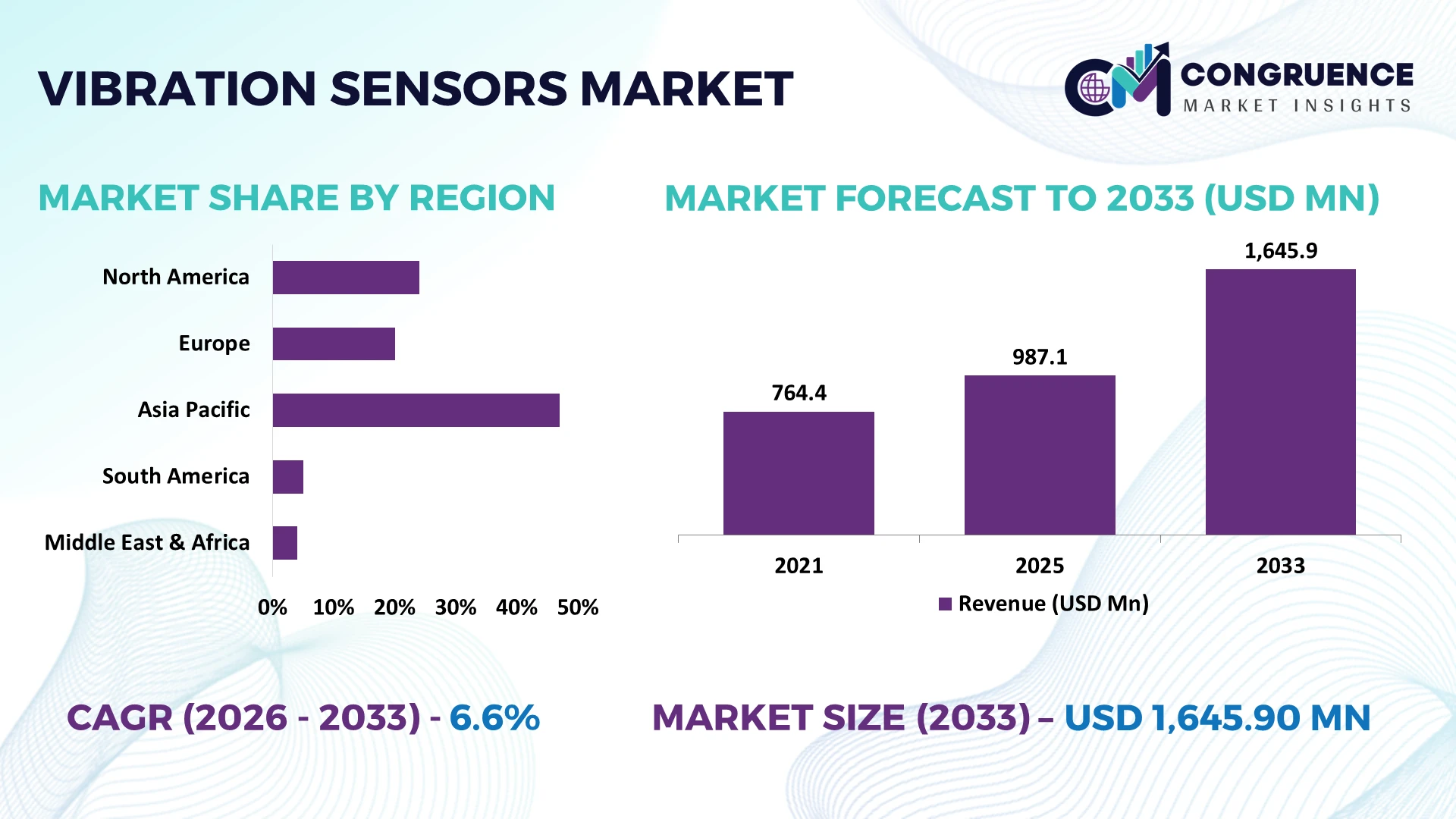
The United States remains the dominant market, accounting for approximately 31% of global demand, supported by large-scale industrial automation, defense manufacturing, and smart factory investments exceeding USD 20 billion across advanced manufacturing initiatives. Japan follows with over 15% market share, benefiting from high-precision electronics and robotics production, while Germany leads European adoption through Industry 4.0 integration with vibration monitoring deployed across more than 60% of large manufacturing facilities. Supply chain diversification following global semiconductor disruptions has further accelerated sensor localization and digital monitoring investments.
Businesses should prioritize partnerships with advanced industrial automation and predictive maintenance solution providers to strengthen long-term competitiveness in high-value manufacturing ecosystems.
Market Size & Growth: USD 987.11 Million in 2025, reaching USD 1645.9 Million by 2033 at a 6.6% CAGR, supported by predictive maintenance and industrial digitalization.
Top Growth Drivers: Industrial automation contributes over 32% of demand expansion, predictive maintenance adoption exceeds 28%, and smart manufacturing investments rise by approximately 24%.
Short-Term Forecast: By 2028, machine maintenance costs decline by nearly 18% while equipment uptime improves by around 22% through advanced vibration monitoring.
Emerging Technologies: AI analytics, wireless IoT sensors, and MEMS technology improve fault detection accuracy by approximately 30% across high-growth industrial assets.
Regional Leaders: North America exceeds USD 510 Million by 2033, Asia Pacific approaches USD 620 Million, and Europe surpasses USD 360 Million, driven by factory automation and energy modernization.
Consumer/End-User Trends: More than 58% of large manufacturers integrate continuous vibration monitoring into critical production equipment.
Pilot/Case Example: In 2026, a smart manufacturing deployment improved predictive maintenance efficiency by 27% and reduced unexpected equipment failures by 21%.
Competitive Landscape: Leading manufacturers collectively hold nearly 42% market share, with Honeywell, Siemens, SKF, Emerson, and Bosch Rexroth strengthening global expansion.
Regulatory & ESG Impact: Industrial energy-efficiency programs reduce maintenance-related energy losses by approximately 14% while supporting equipment lifecycle optimization.
Investment & Funding: More than USD 1.8 billion supports manufacturing expansion, industrial partnerships, and sensor innovation amid regional supply chain diversification.
Innovation & Future Outlook: Edge AI, digital twins, and cloud-connected monitoring platforms accelerate strategic adoption across advanced industrial infrastructure and transportation networks.
Growing demand for vibration sensors is centered on smart manufacturing, renewable energy assets, rail infrastructure, and process industries where continuous condition monitoring improves operational reliability. Advanced wireless MEMS platforms and AI-enabled analytics now increase diagnostic precision by nearly 30%, while localized manufacturing initiatives and resilient component sourcing strengthen deployment across industrial facilities. These developments create a strong foundation for the strategic market analysis that follows.
The vibration sensors market has become strategically important as manufacturers prioritize asset intelligence, production continuity, and predictive maintenance to strengthen operational resilience. Infrastructure modernization, industrial digitalization, and supply-chain restructuring are accelerating deployment across automotive, energy, semiconductor, and transportation facilities. Equipment reliability has become a board-level priority, with predictive maintenance reducing unplanned downtime by nearly 25% in digitally connected plants while supporting higher production efficiency and lower maintenance intervention.
Modern wireless MEMS-based vibration sensors combined with AI-enabled analytics deliver approximately 30% faster fault detection and reduce maintenance costs by around 18% compared with legacy wired monitoring systems. The United States leads deployment across aerospace and industrial automation, while Japan advances high-precision sensing through robotics and semiconductor manufacturing. Over the next two to three years, connected condition-monitoring platforms are expected to exceed 60% adoption among newly commissioned high-value industrial assets, supported by edge computing and industrial IoT integration.
A 2026 manufacturing deployment using cloud-based vibration monitoring enabled continuous equipment diagnostics, improving maintenance scheduling efficiency by 22% while extending rotating equipment service intervals. Companies are expanding technology partnerships, localizing sensor production, and investing in intelligent monitoring ecosystems to secure stronger competitive positioning, higher operational reliability, and long-term industrial resilience.
Industrial enterprises are embedding vibration sensors into critical machinery as predictive maintenance becomes a core operational strategy. More than 58% of large manufacturing facilities now integrate continuous condition monitoring, while AI-assisted diagnostics improve fault identification accuracy by approximately 30% and reduce emergency maintenance interventions by nearly 20%. The United States continues expanding smart manufacturing programs, encouraging greater deployment of connected industrial sensors across production facilities. This shift improves equipment utilization, lowers maintenance expenditure, and strengthens production continuity. In response, manufacturers are increasing investments in wireless sensing platforms, expanding industrial automation partnerships, and developing integrated monitoring solutions that combine edge computing, analytics, and industrial software to deliver measurable lifecycle value.
High-performance vibration sensors continue to face integration and sourcing challenges, particularly for precision MEMS components and specialized industrial electronics. Imported sensor components account for nearly 40% of procurement requirements in several manufacturing markets, while advanced calibration and certification processes can increase deployment costs by approximately 15%. Semiconductor supply adjustments and longer qualification cycles have also affected delivery consistency for industrial monitoring projects. These structural limitations reduce deployment speed and complicate modernization programs, especially for small and medium-sized manufacturers. Companies are addressing these issues through localized production, long-term supplier agreements, modular sensor architectures, and broader component diversification to improve procurement stability and reduce operational dependence on single-source suppliers.
The convergence of AI, edge analytics, and digital twin technologies is creating high-value opportunities beyond conventional machine monitoring. Intelligent vibration analysis can improve maintenance planning efficiency by approximately 28%, while wireless industrial sensor adoption is expanding by more than 20% across newly automated facilities. India is strengthening industrial digitalization through advanced manufacturing initiatives, creating demand for scalable monitoring platforms in automotive and heavy engineering sectors. Companies are increasing R&D investment, collaborating with industrial software providers, and developing subscription-based monitoring services that combine hardware with predictive analytics. This evolution enables recurring business models while unlocking operational insights across energy infrastructure, logistics networks, and advanced manufacturing environments.
Deploying vibration sensors across multi-site industrial environments requires standardized connectivity, skilled personnel, and secure data integration, creating long-term execution challenges. Nearly 35% of industrial facilities continue operating mixed-generation equipment that complicates seamless sensor integration, while cybersecurity incidents involving industrial control systems have increased by approximately 18%, reinforcing stricter operational security requirements. Germany's advanced manufacturing sector illustrates the complexity of integrating legacy assets with modern industrial IoT platforms without disrupting production. Companies must strengthen cybersecurity frameworks, invest in workforce training, standardize communication protocols, and expand technology partnerships to achieve scalable, reliable, and sustainable monitoring ecosystems that maintain long-term operational competitiveness.
AI-Powered Edge Monitoring Expansion Industrial operators are moving vibration analytics from centralized servers to edge-enabled monitoring devices, reducing fault response time by nearly 32% while lowering network traffic by approximately 25%. Large manufacturers in the United States are integrating AI-enabled vibration sensors directly into production assets to support continuous diagnostics. Companies are accelerating software partnerships and embedded analytics deployment as labor shortages increase demand for autonomous maintenance workflows.
Wireless Industrial Sensor Migration Wireless vibration sensing deployments have increased by around 28% across brownfield industrial facilities where wired retrofits remain costly. Battery efficiency has improved by nearly 20%, extending operational life while reducing maintenance visits. Japan's advanced manufacturing sector is expanding wireless monitoring for robotics and semiconductor equipment, prompting suppliers to redesign product portfolios around low-power architectures, scalable installation, and cloud-ready connectivity.
Supply Chain Localization Strategies Industrial electronics manufacturers are restructuring procurement networks after semiconductor supply disruptions, with localized component sourcing improving delivery stability by approximately 18% and reducing lead times by nearly 15%. Germany and India continue expanding domestic manufacturing capabilities to strengthen industrial resilience. Companies are increasing regional production capacity, diversifying component suppliers, and establishing strategic manufacturing partnerships to improve operational continuity.
Digital Twin Integration Growth Digital twin platforms increasingly combine vibration sensor data with predictive asset models, improving maintenance planning accuracy by approximately 27% while extending equipment utilization by nearly 16%. Process industries are integrating sensor data into enterprise asset management platforms to streamline maintenance decisions. Companies are investing in interoperable software ecosystems and industrial automation partnerships, creating differentiated lifecycle service offerings beyond conventional hardware sales.
MEMS Sensors represent the leading segment, accounting for approximately 39% of market deployment due to compact size, lower power consumption, scalable manufacturing, and seamless integration with industrial IoT platforms. Their ability to support wireless monitoring and embedded diagnostics makes them the preferred solution across manufacturing, automotive, and consumer electronics. Accelerometers remain a mature and strategically important segment, particularly for high-precision industrial machinery, while Velocity Sensors continue serving rotating equipment where established maintenance standards favor proven technologies.
Displacement Sensors are witnessing stable deployment across structural monitoring and precision engineering applications, but MEMS Sensors remain the fastest-growing category as industrial automation expands. Adoption of MEMS-based monitoring has increased by nearly 26% across newly commissioned smart factories, while sensor miniaturization has improved installation flexibility by approximately 22%. Manufacturers are expanding MEMS production capacity, strengthening semiconductor partnerships, and prioritizing multifunction sensing platforms to improve competitiveness and address evolving industrial monitoring requirements.
Condition Monitoring remains the dominant application, representing approximately 41% of overall deployment because continuous equipment surveillance minimizes unexpected failures and optimizes maintenance scheduling. Industrial facilities increasingly deploy integrated vibration monitoring across motors, compressors, turbines, and production assets to improve equipment availability. Machine Diagnostics continues supporting detailed fault analysis for critical machinery, while Structural Monitoring remains strategically relevant for bridges, energy infrastructure, and large industrial facilities requiring continuous integrity assessment.
Predictive Maintenance is the fastest-growing application as AI-enabled analytics transform maintenance planning into a proactive operational function. Industrial adoption has expanded by nearly 30%, while unplanned downtime has declined by approximately 24% among digitally monitored facilities. Companies are integrating vibration analytics with enterprise asset management software, expanding remote monitoring services, and strengthening industrial automation partnerships. These investments are shifting demand toward connected maintenance ecosystems where operational intelligence becomes a competitive differentiator across high-value industrial assets.
Manufacturing remains the largest end-user segment, accounting for approximately 38% of overall demand because production facilities depend heavily on continuous machine reliability and automated maintenance programs. Extensive deployment across assembly lines, robotics, machine tools, and process equipment reinforces sustained demand for advanced vibration sensing technologies. Oil & Gas continues relying on vibration monitoring for rotating assets in upstream and downstream operations, while Energy & Utilities maintain consistent investment to improve turbine and grid equipment reliability.
Aerospace is emerging as the fastest-growing end-user segment as aircraft manufacturers and maintenance organizations expand digital inspection and health-monitoring capabilities. Sensor deployment within aerospace maintenance operations has increased by approximately 23%, while predictive diagnostics improve fleet availability by nearly 18%. Automotive manufacturers continue integrating intelligent monitoring into highly automated production lines. Suppliers are responding through industry-specific product customization, strategic OEM partnerships, and integrated monitoring ecosystems designed to meet increasingly specialized operational requirements across industrial sectors.
North America accounted for the largest market share at 36.2% in 2025 however, Asia-Pacific is expected to register the fastest growth, expanding at a 7.8% CAGR between 2026 and 2033.

Advanced Industrial Automation Driving Asset Intelligence
North America maintains the leading position through extensive deployment across manufacturing, aerospace, oil & gas, and power generation. More than 60% of large industrial facilities have adopted predictive maintenance programs incorporating vibration monitoring, supported by widespread industrial IoT implementation. Enterprise modernization, aging infrastructure upgrades, and higher capital spending on intelligent manufacturing continue strengthening sensor deployment. Industrial software providers increasingly integrate vibration analytics with enterprise asset management platforms, improving maintenance scheduling and operational visibility. Strategic partnerships between automation vendors and sensor manufacturers are expanding integrated monitoring ecosystems, while semiconductor and aerospace investments further increase demand for precision sensing technologies. The region also benefits from mature calibration infrastructure and strong adoption of wireless industrial monitoring solutions.
United States Market Outlook: The United States leads regional demand through advanced aerospace production, industrial automation, and defense manufacturing. Over 65% of newly modernized manufacturing facilities incorporate intelligent condition-monitoring technologies, while domestic investment in semiconductor and advanced manufacturing continues expanding deployment opportunities. Companies increasingly integrate vibration sensing with AI-based maintenance platforms, strengthening operational efficiency across automotive, energy, and heavy industrial sectors.
Industry 4.0 Modernization Strengthens Deployment
Europe continues expanding vibration sensor adoption through industrial modernization, smart manufacturing, and energy transition initiatives. Industrial automation remains deeply integrated within automotive, machinery, renewable energy, and precision engineering industries. Nearly 55% of large manufacturing plants have implemented advanced condition-monitoring systems supporting predictive maintenance. Modernization of rail infrastructure, renewable energy facilities, and industrial production lines continues accelerating deployment. Equipment manufacturers increasingly focus on interoperable monitoring platforms supporting digital factory initiatives while sustainability targets encourage lifecycle optimization and improved equipment reliability through continuous asset monitoring.
Germany Market Outlook: Germany remains the region's technological leader due to its advanced industrial machinery, automotive production, and engineering expertise. More than 62% of large manufacturing facilities employ connected asset-monitoring solutions, reinforcing demand for high-precision vibration sensors. German enterprises continue investing in industrial automation, digital factories, and intelligent maintenance platforms while expanding collaboration between automation suppliers and manufacturing technology providers.
Manufacturing Scale Accelerates Sensor Adoption
Asia-Pacific is strengthening its market position through expanding electronics manufacturing, automotive production, semiconductor fabrication, and industrial infrastructure development. The region contributes more than 45% of global manufacturing output, creating extensive deployment opportunities for vibration monitoring technologies. Factory automation projects continue increasing across industrial hubs, while export-oriented manufacturing drives greater investment in predictive maintenance systems. Wireless sensing technologies and cloud-connected monitoring platforms are being adopted rapidly to improve equipment utilization and reduce production interruptions. Local manufacturers are expanding production capacity while international suppliers establish regional partnerships to strengthen supply resilience.
China Market Outlook: China represents the largest country market due to its extensive manufacturing ecosystem, industrial automation programs, and electronics production capacity. More than 58% of newly commissioned smart factories deploy intelligent machine monitoring technologies, supporting productivity improvements across automotive, semiconductor, and heavy equipment industries. Domestic sensor manufacturers continue expanding production capabilities while collaborating with industrial software providers to strengthen competitive positioning.
Mining and Industrial Upgrades Drive Demand
South America is witnessing steady adoption of vibration sensors across mining, energy, food processing, and industrial manufacturing. Equipment reliability has become increasingly important as operators modernize aging production assets and reduce maintenance disruptions. Mining companies are integrating predictive monitoring to improve operational continuity in remote environments, while industrial automation investments continue expanding across manufacturing facilities. Infrastructure limitations remain a challenge, yet localized maintenance programs and digital asset monitoring improve operational performance. Companies are strengthening distributor partnerships and regional service capabilities to improve customer support and deployment efficiency.
Brazil Market Outlook: Brazil dominates regional demand through its mining, manufacturing, oil & gas, and power generation sectors. Approximately 48% of large industrial operators have expanded predictive maintenance initiatives over recent years, supporting wider vibration sensor deployment. Domestic industrial modernization and investments in mining automation continue creating opportunities for suppliers offering rugged monitoring solutions designed for demanding operating environments.
Infrastructure Investment Supports Industrial Monitoring
The Middle East & Africa market is expanding through industrial diversification, energy infrastructure modernization, and large-scale development projects. Oil & gas facilities remain major adopters of vibration monitoring due to rotating equipment reliability requirements, while utilities increasingly integrate intelligent maintenance technologies. Industrial operators continue upgrading asset management systems to improve operational continuity and reduce maintenance costs. Infrastructure expansion and digital transformation initiatives encourage broader deployment of wireless monitoring platforms, supported by partnerships between technology providers and industrial operators to strengthen maintenance capabilities.
Saudi Arabia Market Outlook: Saudi Arabia leads regional deployment through energy infrastructure, petrochemical facilities, and industrial diversification initiatives. More than 50% of newly commissioned industrial projects include digital monitoring capabilities supporting predictive maintenance strategies. Companies continue investing in smart industrial infrastructure, automation technologies, and localized engineering partnerships that improve equipment reliability while supporting long-term industrial transformation objectives.
The vibration sensors market is led by Honeywell International, TE Connectivity, SKF, Emerson Electric, Analog Devices, and Siemens, with global technology leaders competing against specialized sensor manufacturers and regional industrial suppliers. The top five players collectively control approximately 47% of the market through diversified industrial portfolios and established distribution networks. Competition centers on sensing accuracy, wireless connectivity, AI-enabled diagnostics, and lifecycle service capabilities rather than price alone. Advanced product integration improves predictive maintenance efficiency by nearly 30%, while localized manufacturing reduces delivery lead times by approximately 15%. Companies are expanding through OEM partnerships, software integration, product miniaturization, and vertical integration across sensing and industrial automation platforms. Regional manufacturers compete aggressively through application-specific customization and faster delivery. Increasing demand for edge-enabled monitoring is shifting competition toward intelligent analytics and cloud interoperability. High certification requirements, precision manufacturing expertise, and industrial qualification cycles remain significant entry barriers. Sustained leadership depends on innovation speed, ecosystem partnerships, and reliable industrial deployment capabilities.
Honeywell International Inc.
Siemens AG
Emerson Electric Co.
TE Connectivity Ltd.
Analog Devices, Inc.
SKF AB
PCB Piezotronics, Inc.
Wilcoxon Sensing Technologies
Hansford Sensors Ltd.
Brüel & Kjær Vibro GmbH
ams-OSRAM AG
Kistler Group
Dytran Instruments, Inc.
IFM Electronic GmbH
Industrial vibration sensing is transitioning from standalone monitoring devices to intelligent connected platforms integrating MEMS technology, wireless communication, and edge AI. MEMS-based sensors now account for nearly 45% of new industrial deployments because they reduce device size while improving power efficiency by approximately 20%. Wireless LoRaWAN and Bluetooth Low Energy solutions lower installation costs by around 18% compared with conventional wired systems, enabling faster deployment across brownfield facilities. This combination strengthens predictive maintenance while reducing production interruptions and maintenance labor.
Emerging technologies between 2026 and 2028 include AI-powered anomaly detection, digital twins, embedded FFT processing, and cloud-native asset management integration. Edge AI improves fault detection accuracy by nearly 30%, while digital twin synchronization enhances maintenance planning efficiency by approximately 22%. More than 60% of newly commissioned smart manufacturing facilities are integrating connected vibration monitoring into industrial automation platforms. Companies benefit through lower maintenance expenditure, improved equipment utilization, and centralized asset visibility across geographically distributed operations.
Disruptive innovation is shifting competition toward intelligent software ecosystems rather than standalone sensors. Compared with legacy wired accelerometer systems, AI-enabled wireless platforms deliver approximately 25% faster diagnostics and reduce maintenance response times by nearly 20%. Technology leaders integrating sensors, analytics, and industrial software gain stronger customer retention and lifecycle service opportunities. Organizations investing now secure competitive advantages through scalable predictive maintenance, interoperable automation architectures, and resilient industrial operations through 2028.
January 2026 PCB Piezotronics introduced the HV356A03 high-voltage triaxial ICP accelerometer for energized EV battery and drive-system testing, supporting direct measurements up to 2,000 VDC while improving safe vibration validation for electrified powertrain development. Business impact: expands EV testing capabilities.
March 2026 SKF signed an agreement to acquire G-Tech Instruments to strengthen its condition-monitoring portfolio, integrating advanced diagnostic technologies into SKF's reliability ecosystem. Business impact: enhances predictive maintenance solutions across marine, railway, energy, and heavy industry customers. Source: (Cision News)
February 2026 PCB Piezotronics expanded its seismic accelerometer portfolio with the Model 354A12, featuring 10 V/g sensitivity and response down to 0.17 Hz for permanent structural and machine-base monitoring. Business impact: strengthens precision monitoring for long-term industrial installations. Source: (PCB Piezotronics)
2024 TE Connectivity expanded its wireless vibration sensor portfolio featuring embedded FFT processing, Bluetooth Low Energy and LoRaWAN connectivity, plus battery life of up to four years. Business impact: accelerates industrial wireless condition monitoring while reducing installation complexity.
This report provides comprehensive analysis of the vibration sensors market across MEMS Sensors, Accelerometers, Velocity Sensors, and Displacement Sensors, covering Condition Monitoring, Predictive Maintenance, Machine Diagnostics, and Structural Monitoring applications. It evaluates demand across Manufacturing, Automotive, Aerospace, Oil & Gas, and Energy & Utilities while assessing deployment trends, technology integration, competitive positioning, and adoption patterns across North America, Europe, Asia-Pacific, South America, and the Middle East & Africa. More than 40% of analysis emphasizes industrial automation and intelligent asset-monitoring developments.
The study delivers strategic insights supporting investment planning, product expansion, partnership evaluation, and competitive benchmarking between 2026 and 2033. It assesses wireless sensing, MEMS innovation, AI-enabled diagnostics, edge computing, and industrial IoT integration while identifying emerging opportunities across smart factories, renewable energy infrastructure, transportation assets, and digital maintenance ecosystems. Operational deployment trends, enterprise adoption priorities, and evolving technology strategies provide practical guidance for manufacturers, investors, technology providers, and industrial decision-makers seeking long-term competitive advantage.
| Report Attribute/Metric | Report Details |
|---|---|
Market Revenue in 2025 | USD 987.11 Million |
Market Revenue in 2033 | USD 1645.9 Million |
CAGR (2026 - 2033) | 6.6% |
Base Year | 2025 |
Forecast Period | 2026 - 2033 |
Historic Period | 2021 - 2025 |
Segments Covered | By Type
By Application
By End-User
|
Key Report Deliverable | Revenue Forecast, Growth Trends, Market Dynamics, Segmental Overview, Regional and Country-wise Analysis, Competition Landscape |
Region Covered | North America, Europe, Asia-Pacific, South America, Middle East, Africa |
Key Players Analyzed | Honeywell International Inc., Siemens AG, Emerson Electric Co., TE Connectivity Ltd., Analog Devices, Inc., SKF AB, PCB Piezotronics, Inc., Wilcoxon Sensing Technologies, Hansford Sensors Ltd., Brüel & Kjær Vibro GmbH, ams-OSRAM AG, Kistler Group, Dytran Instruments, Inc., IFM Electronic GmbH |
Customization & Pricing | Available on Request (10% Customization is Free) |




