
Reports
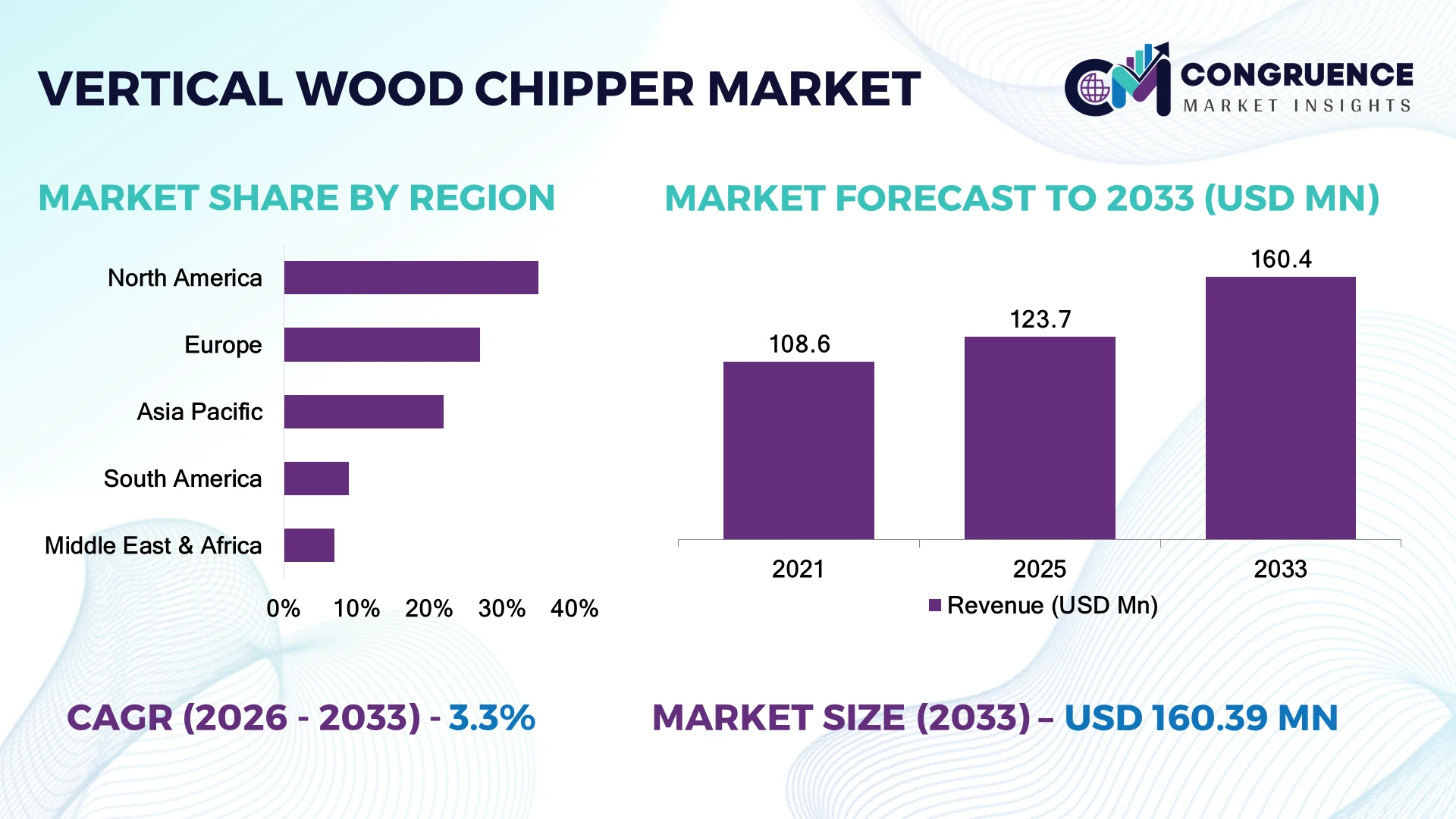
The Global Vertical Wood Chipper Market was valued at USD 123.7 Million in 2025 and is anticipated to reach a value of USD 160.4 Million by 2033 expanding at a CAGR of 3.3% between 2026 and 2033. Growth is being driven by municipal biomass recovery, storm-debris processing, forestry residue utilization, and demand for compact high-throughput chipping equipment.
The United States remains the dominant country, supported by extensive forestry operations, municipal vegetation-management programs, and biomass utilization. U.S. operators account for an estimated 30%+ of global vertical-chipper demand, while Germany and Canada maintain strong professional deployments. Automated feed systems and hydraulic control are improving throughput by approximately 15–20%, strengthening adoption among contractors and municipal fleets. The U.S. market remains more equipment-intensive than Germany because of its larger forestry and land-management base.
The strategic priority is shifting toward higher-throughput, mobile, fuel-efficient machines that improve biomass recovery economics while reducing handling time.
Market Size & Growth: USD 123.7 million in 2025 to USD 160.4 million by 2033 at 3.3% CAGR, driven by biomass recovery and forestry residue processing.
Top Growth Drivers: Municipal vegetation management 32%, forestry residue utilization 27%, and biomass applications 21% underpin demand.
Short-Term Forecast: By 2028, automated feeding and hydraulic optimization are positioned to improve processing efficiency by 12–18%.
Emerging Technologies: Smart feed control, hydraulic automation, remote diagnostics, and wear-resistant cutting systems are reducing downtime by 10–15%.
Regional Leaders: North America leads with approximately 35% adoption, Europe emphasizes low-emission equipment, while Asia-Pacific expands contractor-led mechanized forestry operations.
Consumer/End-User Trends: Professional contractors represent more than 40% of equipment usage, increasingly favoring mobile, high-capacity configurations.
Pilot/Case Example: 2025 municipal biomass programs using integrated chipping and collection workflows achieved approximately 15% lower material-handling time.
Competitive Landscape: Leading manufacturers compete through throughput, durability, mobility, service coverage, and feed-system engineering, with established brands retaining approximately 35% combined positioning.
Regulatory & ESG Impact: Biomass diversion and open-burning restrictions are increasing the value of chipping solutions, supporting approximately 10% higher utilization in regulated waste-management applications.
Investment & Funding: Equipment investment is increasingly directed toward hydraulic automation, fuel efficiency, and fleet modernization, with replacement programs representing roughly 20% of procurement activity.
Innovation & Future Outlook: Next-generation vertical wood chippers will integrate predictive maintenance, telematics, automated feed adjustment, and modular cutting systems to strengthen fleet productivity through 2028.
The Vertical Wood Chipper Market is increasingly concentrated in forestry contractors, municipal vegetation-management fleets, biomass processors, and landscaping operators requiring rapid conversion of branches, logs, and storm debris into usable chips. Equipment upgrades emphasizing automated feeding and hydraulic optimization can improve throughput by 15–20%. In 2026, tighter biomass utilization practices and restrictions on uncontrolled vegetation burning are reinforcing the commercial case for mobile chipping systems, creating a stronger transition toward productive, data-enabled equipment fleets.
Vertical wood chippers are becoming strategically relevant because operators increasingly need to convert bulky woody residues into transportable biomass at the point of collection. The shift reduces secondary handling and improves truck utilization, particularly for municipal contractors and forestry-service providers. In 2026, equipment purchasing is increasingly tied to biomass diversion, storm-response readiness, and lower labor intensity rather than simple replacement cycles.
Hydraulic feed systems and automated load control provide a measurable advantage over mechanically controlled legacy configurations, with optimized systems improving processing productivity by roughly 15–20% while reducing operator intervention. North American fleets prioritize high-capacity mobile units for forestry and storm debris, whereas European buyers place greater emphasis on compact dimensions, emissions performance, and workplace efficiency. Asian operators increasingly favor versatile equipment that can serve both forestry and landscaping applications.
Over the next 2–3 years, telematics, remote diagnostics, predictive wear monitoring, and automated feed adjustment will increasingly become differentiators. A contractor processing storm-damaged timber can use mobile chipping directly at collection sites, reducing material movement and handling steps. Manufacturers are therefore prioritizing hydraulic upgrades, modular cutting assemblies, dealer partnerships, and fleet-service programs. Competitive advantage will increasingly depend on throughput per labor hour, mobility, uptime, and lifecycle operating cost rather than machine capacity alone.
Municipal vegetation management and forestry residue recovery are strengthening demand for vertical wood chippers as operators prioritize on-site processing over secondary material handling. In the U.S., contractor-led vegetation management represents an estimated 35% of professional equipment utilization, while automated hydraulic feeding can improve processing throughput by 15–20% and reduce manual intervention by approximately 20%. Restrictions on open burning and stronger biomass diversion practices are reinforcing this shift in 2026. Manufacturers are responding with higher-capacity feed systems, mobile configurations, and telematics-enabled fleet management. The non-obvious advantage is improved truck utilization: converting bulky branches at collection points reduces haulage volume before transportation, improving operating economics. Equipment suppliers are therefore prioritizing hydraulic automation and productivity-focused product upgrades.
Vertical wood chippers remain exposed to elevated equipment, cutting-system, and maintenance costs, particularly for heavy-duty hydraulic configurations. Cutting components and wear parts can represent roughly 10–15% of annual operating expenditure, while fuel and service requirements can increase total operating costs by 8–12% for intensive fleets. In the U.S., specialized replacement parts can also create downtime when dealer inventories are limited. Smaller contractors consequently face weaker utilization economics than large forestry fleets. Manufacturers are reducing this pressure through modular wear components, localized parts inventories, longer-life cutting systems, and service contracts. A key operational constraint is that lower upfront pricing can become uneconomic when blade replacement intervals shorten; suppliers increasingly compete on lifecycle cost rather than machine purchase price.
Connected vertical wood chippers create an underdeveloped opportunity to optimize machine utilization, maintenance scheduling, and biomass throughput. Telematics can reduce unplanned downtime by an estimated 10–15%, while automated feed adjustment can improve processing consistency by 8–12% across variable material sizes. U.S. and Canadian contractors are increasingly suited to these systems because dispersed forestry and storm-response operations make centralized fleet visibility commercially valuable. Manufacturers are integrating remote diagnostics, engine monitoring, load sensing, and predictive wear alerts into premium equipment platforms. The strategic opportunity extends beyond machine sales: suppliers can build recurring service relationships around fleet analytics, maintenance planning, and parts forecasting. By 2028, connected equipment ecosystems should increasingly differentiate manufacturers competing for professional fleet replacement programs.
Advanced vertical wood chippers increasingly combine hydraulic automation, electronic controls, telematics, and safety interlocks, creating execution complexity for operators and service technicians. Training requirements can rise by approximately 15–20% when fleets transition from conventional mechanical controls to electronically managed feed systems, while inexperienced operation can reduce effective throughput by 10% or more. In rural U.S. and Canadian forestry operations, technician availability remains a practical constraint for sophisticated equipment deployment. Manufacturers must therefore simplify interfaces, strengthen remote diagnostics, and expand dealer training programs. The long-term challenge is not machine capability but consistent utilization: sophisticated systems deliver limited value when operators cannot interpret load data, manage feed rates, or perform preventive maintenance correctly. Competitive sustainability will depend on equipment design, workforce development, and service infrastructure.
Hydraulic Feeding Gets Smarter Automated feed-rate control is becoming more prevalent in professional machines, improving throughput by 12–18% and reducing operator intervention by roughly 15%. Variable-diameter material is driving adoption because machines can adjust feeding pressure without repeated manual correction. Manufacturers are upgrading hydraulic controls and load-sensing systems to stabilize output and reduce unnecessary engine loading.
Telematics Enters Fleet Management Connected equipment deployment is expanding among larger contractors, with approximately 20–25% of premium professional fleets incorporating some form of machine monitoring. Remote engine diagnostics can reduce service-related downtime by 10–15%. In 2026, suppliers are linking utilization data with maintenance alerts, creating more predictable service schedules and improving fleet replacement decisions.
Wear Systems Shift to Longevity Rising replacement-part costs are pushing manufacturers toward hardened knives, modular cutting assemblies, and redesigned rotor components. Advanced wear configurations can extend component service intervals by approximately 15–20% compared with conventional assemblies. Operators increasingly evaluate machines on lifecycle productivity rather than purchase price, encouraging suppliers to develop standardized replacement systems and faster field-service procedures.
Storm Response Drives Mobility Severe-weather cleanup is increasing demand for mobile chipping workflows that process woody debris directly at collection locations. Integrated operations can reduce secondary material handling by roughly 15% and improve transport efficiency by 10–12%. Municipal contractors are consequently prioritizing compact transport configurations, rapid setup, and higher feed capacity, while manufacturers are adapting machines for faster deployment across dispersed cleanup sites.
Drum-type vertical wood chippers are estimated to hold the leading position at approximately 38% market share, supported by continuous feeding, high processing capacity, and suitability for mixed woody residues. Disc-type machines account for around 32%, retaining strong demand where operators prioritize established cutting performance, simpler maintenance, and reliable chip production. Screw-type and other specialized configurations represent the remaining 30%, serving applications requiring controlled particle sizing, compact equipment design, or specialized feed handling. Drum systems therefore remain the preferred investment for high-utilization forestry and biomass operations, while disc machines continue to benefit from established contractor familiarity. Manufacturers are strengthening both platforms through hydraulic feed optimization, hardened cutting components, and modular maintenance systems, targeting 10–15% improvements in processing productivity and longer service intervals.
The fastest-growing segment is screw-type equipment, with adoption estimated to expand approximately 8–10% faster than mature configurations as biomass processors seek greater consistency in downstream material handling. This shift is moving investment toward specialized feed control and automated adjustment, while mature drum and disc platforms remain strategically important for large-volume operations.
The U.S. Energy Information Administration reported that wood and wood waste supplied about 2% of total U.S. energy consumption in 2025, while industry accounted for approximately 68% of U.S. wood and wood-waste fuel consumption, reinforcing the industrial importance of processed woody biomass.
Forestry residue processing represents the leading application, with an estimated 36% market share, driven by requirements to process branches, treetops, thinning residues, and low-grade timber close to harvesting sites. Biomass fuel preparation follows at approximately 28%, supported by the need for consistent feedstock dimensions and efficient residue conversion. Landscaping and tree-care operations account for roughly 21%, while municipal vegetation management and specialized applications comprise the balance. Forestry users prioritize throughput and mobility, whereas biomass processors place greater emphasis on chip consistency and continuous feeding. Manufacturers are responding with higher-capacity hydraulic systems, interchangeable knives, and mobile configurations that can reduce secondary material handling by approximately 10–15%. This application split is pushing suppliers toward purpose-built configurations rather than standardized machines.
Biomass fuel preparation is the fastest-growing application, with adoption estimated to advance 9–11% faster than mature landscaping uses as wood residues increasingly become commercially useful feedstocks. Landscaping remains equipment-intensive but more fragmented, while municipal operations emphasize rapid deployment for vegetation clearance and storm debris. The strategic implication is clear: manufacturers are increasingly optimizing discharge systems, feed control, and chip-size consistency according to downstream material requirements.
The U.S. Environmental Protection Agency identifies forest thinnings, logging residues, tree-harvesting residuals, urban tree trimmings, disaster debris, and clean land-clearing wood among recognized forms of clean cellulosic biomass, strengthening the relevance of chipping for managed biomass recovery.
Forestry contractors represent the dominant end-user group at approximately 40% market share because their operations involve high machine utilization, dispersed job sites, and recurring processing of harvesting residues. Biomass processors account for nearly 25%, requiring consistent chip characteristics and dependable feed performance, while landscaping and tree-care contractors represent approximately 20% and emphasize mobility, compactness, and rapid deployment. Municipal authorities and other users form the remaining demand base. Forestry contractors therefore generate stronger replacement and aftermarket potential than lower-utilization users, encouraging manufacturers to offer financing, preventive-maintenance programs, modular cutting systems, and dealer-supported service packages. Approximately 15–20% productivity improvement from optimized hydraulic feeding is becoming an important purchasing criterion for fleet operators evaluating equipment on operating output rather than acquisition price.
Biomass processors constitute the fastest-growing end-user segment, with adoption estimated to increase 10–12% as processed woody residues gain greater value in industrial energy and material applications. Forestry contractors remain the most equipment-intensive buyers, but biomass operators increasingly favor automated feed control and consistent chip output. Landscaping users prioritize versatility, whereas municipal buyers emphasize rapid mobilization. Suppliers are consequently segmenting product portfolios, positioning higher-automation systems for intensive fleets while retaining simpler configurations for cost-sensitive operations.
U.S. Energy Information Administration data show that industrial users consumed approximately 68% of U.S. wood and wood-waste energy in 2025, with wood products and paper manufacturers identified as major industrial users, highlighting the importance of industrial biomass processing demand.
North America accounted for the largest market share at 35% in 2025 however, Asia-Pacific is expected to register the fastest growth, expanding at a CAGR of 4.0% between 2026 and 2033.

High-Throughput Forestry and Municipal Fleet Modernization
North America maintains the leading position in the Vertical Wood Chipper Market, supported by extensive forestry activity, municipal vegetation management, landscaping services, and storm-debris processing. The region represents approximately 35% of global demand, with the United States accounting for the majority of regional deployments. Professional contractors increasingly favor mobile, hydraulic-feed equipment capable of processing mixed woody residues at collection sites. Automated feed controls are improving operational throughput by approximately 15–20%, while telematics adoption is strengthening preventive-maintenance planning across larger fleets. Canada contributes additional demand through forestry and land-clearing operations. In 2026, equipment procurement is increasingly tied to biomass recovery and fleet productivity rather than basic replacement. Manufacturers are responding with higher-capacity configurations, improved cutting assemblies, financing programs, and expanded dealer-service coverage.
United States Market Outlook: The United States represents the most strategically significant national market because of its large forestry base, extensive landscaping industry, municipal vegetation-management programs, and commercial biomass utilization. Professional contractors increasingly deploy mobile chippers for storm cleanup and land-clearing operations, where direct processing can reduce secondary material handling by approximately 15%. Strong dealer networks and established equipment-financing channels further support fleet modernization. Manufacturers are prioritizing hydraulic automation, remote diagnostics, and higher-capacity feeding systems to improve utilization across geographically dispersed operations.
Low-Emission Equipment Reshapes Professional Fleet Selection
Europe represents approximately 27% of global Vertical Wood Chipper Market demand, with Germany, France, the United Kingdom, and the Nordic countries forming important equipment clusters. Procurement is increasingly influenced by emissions performance, operator safety, noise control, and efficient biomass handling. Compact machines with advanced hydraulic systems are gaining preference where contractors operate within urban or environmentally regulated areas. Equipment upgrades incorporating fuel-efficient engines and automated feeding can reduce operating requirements by approximately 10–15%. Manufacturers are strengthening European portfolios through quieter configurations, modular cutting systems, and dealer partnerships. The strategic shift is toward lifecycle efficiency and regulatory compatibility rather than maximum engine output, particularly for contractors serving municipalities and densely populated areas.
Germany Market Outlook: Germany is strategically important because of its advanced forestry machinery ecosystem, organized municipal services, and established wood-processing infrastructure. Demand is concentrated among forestry contractors, landscaping companies, and biomass-handling operators seeking compact but high-performance equipment. Automated feed control and durable cutting assemblies are becoming more relevant as operators seek approximately 10% higher productivity without proportionally increasing labor requirements. Germany's emphasis on emissions management and workplace safety also favors manufacturers offering efficient engines, enclosed safety systems, and lower-noise equipment.
Manufacturing Scale Accelerates Mechanized Chipping Adoption
Asia-Pacific is emerging as the fastest-expanding market, supported by forestry mechanization, plantation management, landscaping expansion, and growing biomass utilization. China, Japan, India, Australia, and Southeast Asian markets present different demand structures, ranging from industrial forestry to small contractor operations. The region accounts for approximately 22% of global demand, while equipment adoption in developing markets remains comparatively under-mechanized. Manufacturers are increasingly introducing compact hydraulic models that can improve processing productivity by 12–18% compared with labor-intensive residue handling. China provides a significant manufacturing and supply-chain base, while Australia emphasizes high-capacity forestry equipment. Suppliers are expanding local distribution, adapting machines to regional feedstock characteristics, and introducing lower-maintenance configurations to address fragmented service infrastructure.
China Market Outlook: China represents the most strategically significant Asia-Pacific market because of its manufacturing capacity, expanding landscaping activity, forestry modernization, and strong machinery supply chain. Domestic equipment production enables competitive component sourcing and shorter delivery cycles, while automated hydraulic systems are gaining traction among professional operators. Machinery manufacturers are increasingly integrating electronic controls and modular cutting systems, targeting productivity improvements of approximately 12–15%. China's combination of manufacturing scale and growing mechanization creates opportunities for suppliers able to balance advanced functionality with cost-sensitive configurations.
Forestry Expansion Drives Mobile Processing Demand
South America represents an important emerging demand center, with Brazil accounting for the majority of regional equipment activity because of its large commercial forestry and plantation industry. Regional demand is estimated at approximately 9% of the global market, concentrated around forestry operations, land clearing, biomass processing, and agricultural residue management. Brazil's eucalyptus and pine plantations generate substantial woody residues requiring efficient on-site processing. Mobile vertical chippers can reduce material transportation requirements by approximately 10–15%, improving operational economics for dispersed forestry sites. However, uneven dealer coverage and financing availability constrain adoption outside major forestry corridors. Manufacturers are responding through localized distribution partnerships, simplified maintenance designs, and equipment configurations suited to high-volume plantation operations.
Brazil Market Outlook: Brazil is the region's strongest national market because of its extensive planted-forest base, pulp and paper industry, biomass utilization, and large-scale forestry operations. Commercial forestry companies increasingly emphasize mechanized residue management to improve plantation productivity and resource utilization. High-volume operators favor robust hydraulic feeding and durable cutting systems capable of continuous operation. Equipment configurations that improve processing efficiency by approximately 15% are particularly relevant for large forestry sites. Manufacturers are strengthening local service capabilities and adapting machines for tropical operating conditions to improve uptime and aftermarket retention.
Landscaping Investment Expands Specialized Equipment Demand
Middle East & Africa accounts for a smaller share of global Vertical Wood Chipper demand, estimated at approximately 7%, but deployment is becoming more specialized around landscaping, municipal vegetation management, agricultural land clearing, and selected forestry applications. Saudi Arabia and the United Arab Emirates are important demand centers because of large-scale landscaping, urban greening, and infrastructure-development programs. Mobile chippers can reduce vegetation-handling volume by approximately 10–15%, improving logistics for contractors managing dispersed sites. Limited forestry activity in much of the Middle East shifts demand toward landscaping and municipal applications, while African markets remain more closely linked to forestry and agricultural residues. Manufacturers are responding with compact machines, simplified service requirements, and distributor-led market development.
Saudi Arabia Market Outlook: Saudi Arabia represents a strategically significant Middle Eastern market because of sustained urban landscaping, public-space development, and large infrastructure programs requiring vegetation management. Contractors increasingly require mobile equipment capable of processing branches and pruning residues close to work sites, reducing collection and transportation requirements. Equipment utilization is concentrated among professional landscaping and municipal-service providers rather than forestry operators. Manufacturers are positioning compact hydraulic machines with simplified maintenance and rapid deployment capabilities, while distributor networks are becoming critical for parts availability and technical support.
The Vertical Wood Chipper Market pits Morbark, Vermeer, Bandit, and Peterson against regional equipment builders and cost-focused Asian suppliers. Global leaders compete through throughput, dealer coverage, durability, and automation, while regional players emphasize price, customization, and faster delivery. The top five players collectively hold an estimated 55% market share, indicating moderate concentration. Competition increasingly centers on lifecycle economics: automated feeding can improve productivity 12–18%, hydraulic optimization can reduce operator intervention 10–15%, and modular wear systems can lower maintenance downtime 8–12%. Morbark and Vermeer are strengthening technology-led portfolios, while Bandit emphasizes high-capacity tracked and drum configurations. Regional manufacturers compete through localized sourcing and simplified designs. The competitive shift is moving from engine power toward productivity per labor hour, uptime, mobility, and service responsiveness. Entry barriers remain high because dealer networks, engineering expertise, safety compliance, and replacement-part availability require substantial investment. Winning requires throughput, reliable service, application-specific customization, and competitive lifecycle cost.
Morbark
Vermeer Corporation
Bandit Industries
Peterson Pacific Corp.
Terex Corporation
GreenMech
Timberwolf
Pezzolato
J.P. Carlton
ECHO
Linddana
Jensen
China Foma
Weifang Fred Machinery
Hydraulic automation is becoming the most commercially relevant technology, with automated feed control improving throughput by 12–18% and reducing operator intervention by 10–15%. Smart load sensing adjusts feed pressure to material density, improving fuel utilization by roughly 5–8%. Adoption is strongest in professional forestry and municipal fleets, where higher utilization converts automation into measurable labor and uptime benefits. Manufacturers are integrating electronic controls with remote diagnostics to strengthen service responsiveness.
Telematics and predictive maintenance are moving from premium features toward practical fleet tools. Machine monitoring can identify engine loading, operating hours, fault conditions, and maintenance intervals, potentially reducing unplanned downtime by 8–12%. Compared with manual inspection schedules, condition-based maintenance can improve maintenance planning efficiency by approximately 15%. Large contractors and rental fleets benefit most because dispersed machines require centralized visibility and faster service coordination.
Next-generation systems will combine AI-assisted feed optimization, automated knife-condition monitoring, electric drivetrains for selected urban applications, and cloud-based fleet analytics. By 2028, connected equipment adoption could reach roughly 30% of premium professional deployments, shifting competition toward data-enabled productivity. Manufacturers investing now in sensor architecture, interoperable controls, and remote-service ecosystems will gain stronger aftermarket relationships, while cost-focused suppliers risk competing primarily on hardware price and residual-value management.
August 2025 Bandit Industries produced its 100,000th machine, a 12XC hand-fed chipper, marking major manufacturing scale and reinforcing its global production footprint across more than 56 countries. The milestone strengthens supply capability and brand reach for professional wood-processing equipment. Source: banditchippers.com
November 2025 Timberwolf acquired GreenMech’s brand and intellectual property, including European support entities, consolidating complementary wood-chipper capabilities. GreenMech had operated since 1993, while the transaction added established engineering and sales infrastructure. The move strengthens European forestry and tree-care positioning through expanded technical coverage. Source: greenmech.co.uk
May 2025 GreenMech expanded its EVO 205 series with tracked configurations targeting difficult terrain and higher-throughput arboricultural work. The EVO 205D uses a 50-hp Stage V engine and processes up to 25 cubic metres per hour. The upgrade strengthens productivity and mobility for demanding professional applications. Source: greenmech.co.uk
December 2025 Plymouth Utilities allocated capital for a replacement wood chipper following competitive quotations, selecting a Brush Bandit Intimidator 15XP for $69,619.20. The procurement demonstrates continued municipal fleet renewal and confirms active competition among Bandit, Morbark, and Vermeer for public-sector equipment contracts. Source: plymouthgov.com
The Vertical Wood Chipper Market Report evaluates equipment demand across drum, disc, screw, and specialized chipper configurations, with application coverage spanning forestry residue processing, biomass fuel preparation, landscaping and tree care, municipal vegetation management, and related uses. End-user analysis covers forestry contractors, biomass processors, landscaping contractors, municipalities, and other professional operators. The study assesses purchasing criteria including throughput, mobility, feed-system performance, maintenance requirements, fuel efficiency, automation, and lifecycle operating economics.
Regional coverage includes North America, Europe, Asia-Pacific, South America, and Middle East & Africa, with country-level assessment of manufacturing activity, forestry infrastructure, biomass utilization, equipment adoption, and distribution networks. Technology analysis examines hydraulic automation, telematics, predictive maintenance, advanced cutting systems, and emerging connected equipment. The report supports investment planning, geographic expansion, product positioning, fleet modernization, competitive benchmarking, and strategic decision-making through 2026–2033.
| Report Attribute/Metric | Report Details |
|---|---|
|
Market Revenue in 2025 |
USD 123.7 Million |
|
Market Revenue in 2033 |
USD 160.4 Million |
|
CAGR (2026 - 2033) |
3.3% |
|
Base Year |
2025 |
|
Forecast Period |
2026 - 2033 |
|
Historic Period |
2021 - 2025 |
|
Segments Covered |
By Type
By Application
By End-User
|
|
Key Report Deliverable |
Revenue Forecast, Growth Trends, Market Dynamics, Segmental Overview, Regional and Country-wise Analysis, Competition Landscape |
|
Region Covered |
North America, Europe, Asia-Pacific, South America, Middle East, Africa |
|
Key Players Analyzed |
Morbark, Vermeer Corporation, Bandit Industries, Peterson Pacific Corp., Terex Corporation, GreenMech, Timberwolf, Pezzolato, J.P. Carlton, ECHO, Linddana, Jensen, China Foma, Weifang Fred Machinery |
|
Customization & Pricing |
Available on Request (10% Customization is Free) |




