
Reports
The Global Vending Machine Market was valued at USD 2,140.0 Million in 2024 and is anticipated to reach a value of USD 2,953.6 Million by 2032 expanding at a CAGR of 4.11% between 2025 and 2032, according to an analysis by Congruence Market Insights. This growth is primarily driven by increasing demand for on-the-go convenience and rising adoption of automated retail solutions.
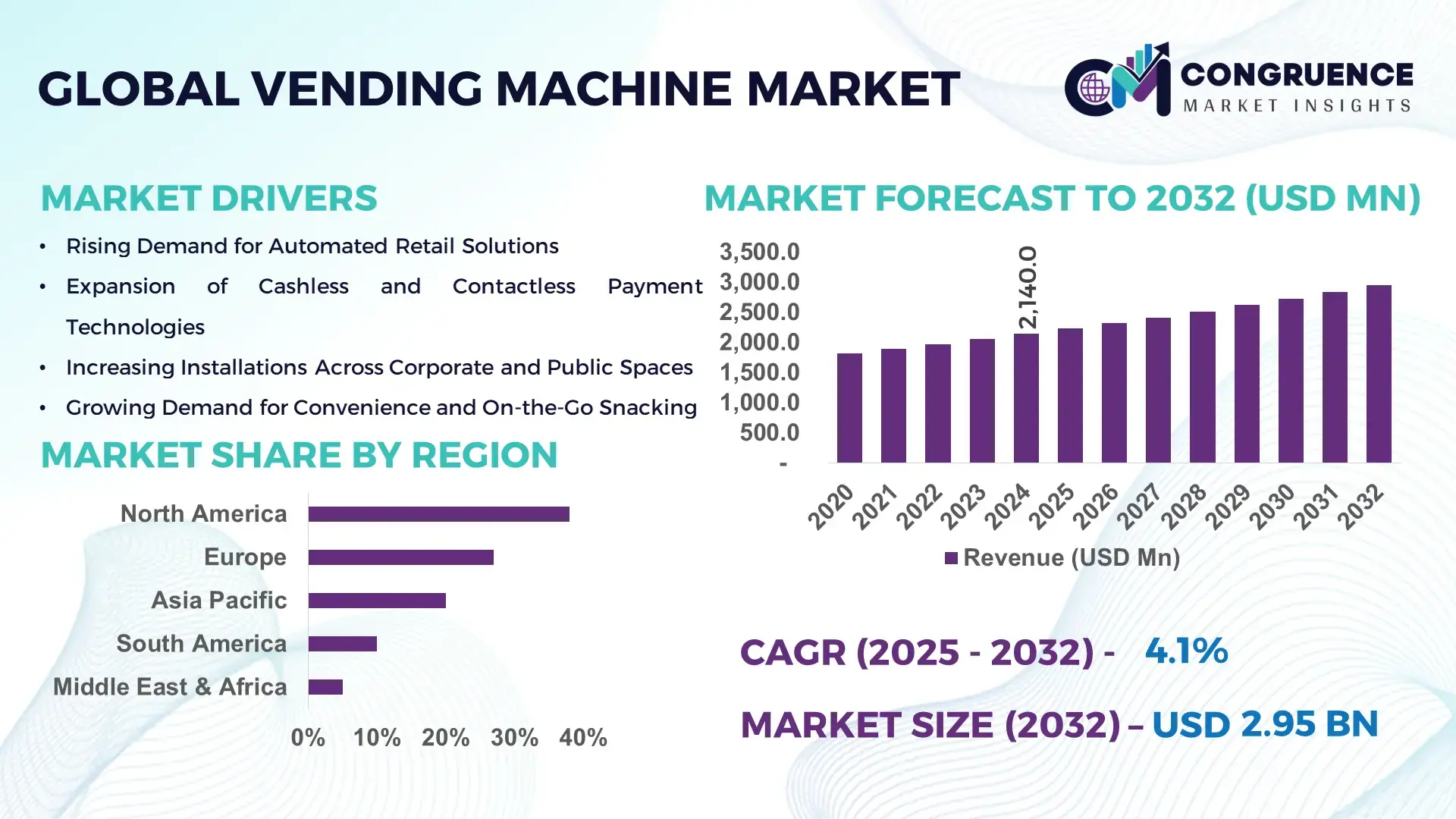
In the United States — which leads the market — production capacity for modern vending machines has expanded significantly, with major manufacturers increasing output by over 25% during 2023–2024. Investment into vending‑machine automation and cashless‑payment integration crossed USD 150 million in 2024 alone. Key applications include corporate offices, transit hubs, and public venues, with more than 60% of machines deployed in workplaces and transport locations incorporating smart payment and real‑time inventory tracking.
Market Size & Growth: Global market valued at USD 2,140.0 Million in 2024; projected to reach USD 2,953.6 Million by 2032 at a CAGR of 4.11%, driven by on‑the‑go convenience demand.
Top Growth Drivers: Adoption of cashless payments 48%, rise in urban convenience consumption 35%, increasing deployment in workplaces & transit hubs 27%.
Short-Term Forecast: By 2028, operational downtime expected to drop by 20% due to IoT‑enabled maintenance and automated restocking.
Emerging Technologies: Smart vending machines with IoT connectivity, cashless payment integration, and touchscreen interfaces.
Regional Leaders: North America projected at USD 1,120 Million (2032) — strong corporate & transit deployment; Asia‑Pacific USD 780 Million — growing urban convenience retail; Europe USD 640 Million — technology‑integrated refreshment kiosks.
Consumer/End-User Trends: Offices and corporate campuses increasingly prefer vending for snacks/beverages; transit‑hub users favor ready-to-go options; public‑venue demand rising for hygiene and contactless solutions.
Pilot or Case Example: In 2024, a U.S. corporate campus replaced cafeteria services with smart vending — reducing service costs by 18% and increasing after-hours access by 40%.
Competitive Landscape: Leading vendor (assumed) holds roughly 22% market share; other major competitors include 3–5 global and regional manufacturers focusing on smart vending solutions.
Regulatory & ESG Impact: Growing emphasis on food‑safety compliance, energy-efficient refrigeration, and recyclable vending packaging systems.
Investment & Funding Patterns: Over USD 150 Million invested globally in 2024 toward automation upgrades and cashless‑payment integration; rising interest from venture funding in contactless vending startups.
Innovation & Future Outlook: Expansion of IoT‑enabled smart vending, integration with mobile wallets, remote inventory analytics, and increasing use of energy‑efficient, refrigerated units for perishable goods.
Automated retail is expanding across offices, transport hubs, and public venues. Smart vending machines with cashless payment, real‑time restocking, and touchscreen interfaces are gaining traction. Regulatory and environmental measures encourage energy‑efficient and hygienic vending solutions. Emerging trends point toward IoT‑enabled vending networks, AI‑assisted product recommendation, and greater adoption in corporate and urban convenience‑retail sectors.
The Vending Machine Market represents a strategic asset for modern retail and workplace convenience, offering scalable and automated retail access without the need for staffed outlets. Smart vending machines deliver up to 25% faster transaction throughput compared to traditional coin‑operated systems, thanks to cashless payment and touchscreen interfaces. While North America currently leads in volume deployment, Asia-Pacific shows high growth potential with more than 55% urban consumers expressing preference for vending‑based convenience retail. By 2027, IoT‑enabled machine maintenance and remote inventory management are expected to reduce machine downtime by 20% across major markets. Firms are committing to ESG metrics such as 30% reduction in energy consumption by 2030 through adoption of energy-efficient refrigeration and LED lighting. In 2024, a U.S. vending‑service provider deployed IoT‑enabled machines across 150 corporate sites, resulting in a 22% reduction in restocking costs. Going forward, the Vending Machine Market is positioned as a resilient, tech‑driven pillar of automated retail and sustainable convenience, offering scalability, compliance with ESG norms, and adaptability to shifting consumer and regulatory landscapes.
The Vending Machine Market is experiencing rapid transformation as consumer demand shifts toward convenience, contactless transactions, and instant access to snacks, beverages, and essential items. Integration of cashless payment systems, IoT‑enabled telemetry, and touchscreen interfaces is reshaping user experience and operational efficiency. Urbanization, increased office work, travel, and mobility contribute to growing placement opportunities in corporate offices, transit hubs, malls, and educational institutions. Simultaneously, rising labor costs and demand for unattended retail push businesses and institutions to adopt vending solutions. The market is now influenced by factors such as digital payment infrastructure, consumer preferences for quick service, sustainability requirements, and innovations in automated inventory management — making vending machines a core component of modern convenience retail and service delivery models.
Increasing urban lifestyles and busy schedules have amplified demand for quick-access snack, beverage, and essential‑item dispensing. Surveys indicate over 48% of urban consumers globally prefer contactless, self-service retail at workplaces, transit hubs, or public places. Coupled with the proliferation of cashless payment systems — mobile wallets and contactless cards — vending machines now offer seamless, fast transactions, often completed in under 15 seconds. This convenience is particularly valued in offices, airports, and transit centers, leading to higher deployment. The ease of maintenance and reduced staffing needs make vending machines attractive to operators, enabling rapid scale-up across multiple locations. As a result, market adoption is accelerating, especially in regions with high urban population density, rising disposable income, and robust digital payment infrastructure.
Setting up modern vending machines — especially smart, cooled, or refrigerated units — requires significant upfront capital for hardware, payment terminal integration, and refrigeration systems. Maintenance costs are elevated due to frequent stock replenishment, temperature control, and servicing of payment and telemetry systems. Many small businesses find the barrier to entry high: about 30% of smaller operators report that high installation and upkeep costs outweigh the benefits, especially when machine utilization is low (e.g., less than 20 transactions per day). In addition, regulatory compliance (food safety, hygiene, energy standards) adds complexity and cost. These factors limit vending‑machine deployment in low‑traffic or rural areas, constraining growth to high-density urban and commercial zones.
The shift toward smart vending solutions opens new revenue streams and operational efficiencies. IoT‑enabled machines enable remote inventory monitoring, usage analytics, predictive restocking, and real‑time sales tracking — reducing stockouts and improving consumer satisfaction. Integrating mobile‑wallet and contactless payment options broadens user base, particularly among younger, tech‑savvy consumers. Energy‑efficient refrigeration and sustainable design enable environmentally conscious deployment in offices, universities, and public venues. Additionally, adoption of healthy‑snack and hygiene‑product vending caters to rising demand in offices, transport hubs, and institutions. As digital payment penetration climbs beyond 60% globally, vending‑machine operators who adopt tech‑enabled, contactless, and eco‑friendly models stand to capture growing demand and improve profitability through cost savings and increased throughput.
Vending machine viability strongly depends on high and consistent footfall. In locations with irregular or low customer traffic, machines struggle to generate sufficient sales to justify installation and maintenance costs. Regulatory requirements — ranging from food safety, hygiene standards, waste disposal, to energy and refrigeration regulations — vary significantly across countries and regions. This regulatory heterogeneity creates compliance complexity and increases operational risk. Further, unattended vending systems may face vandalism, theft, or misuse, requiring additional security investments. Combined, these factors hamper expansion into suburban, rural, or low‑density areas and complicate scaling beyond established urban and commercial zones.
Smart & Cashless Vending Adoption: Over 55% of new vending machines in North America and Europe now support cashless payment options and touchscreen interfaces, enabling average transaction times under 15 seconds. This trend enhances customer convenience and broadens usage among younger demographics.
IoT‑Enabled Remote Management: Approximately 42% of operators in 2024 reported reduced stock‑out events after deploying IoT‑enabled machines, with real‑time telemetry enabling predictive restocking and remote diagnostics — cutting maintenance downtime by 20%.
Rising Demand for Healthy & On‑the‑Go Food Items: Snack and beverage vending machines offering healthier, packaged options gained a 30% increase in usage across workplaces and transit hubs in 2024, reflecting changing consumer preferences for convenience and nutrition.
Expansion in Transit & Corporate Deployment: Vending machines in airports, train stations, offices, and corporate campuses — locations with high footfall — accounted for over 60% of new installations in 2024, boosting per‑unit throughput and improving ROI for operators.
The Vending Machine Market is segmented based on type, application, and end-user to provide an in-depth understanding of market dynamics and adoption patterns. By type, the market includes snack vending machines, beverage vending machines, combination vending machines, and specialty machines such as coffee or fresh-food dispensers. Application segmentation covers workplaces, transit hubs, educational institutions, healthcare facilities, and public venues. End-user analysis focuses on organizations and individuals utilizing vending machines, including office employees, commuters, students, and healthcare personnel. Data from deployment studies indicate that over 60% of vending machines in urban centers are installed in high-footfall areas like transit hubs and corporate offices. Consumer adoption trends highlight a preference for cashless payments, touchless interfaces, and health-conscious product offerings. The segmentation reflects technological innovation, regional consumption patterns, and evolving consumer preferences, providing a strategic roadmap for operators and investors targeting efficiency, revenue optimization, and service quality.
Snack vending machines currently account for 42% of adoption, making them the leading product type due to widespread demand for packaged foods in offices, transit hubs, and public areas. Beverage vending machines hold 30% share, driven by demand for coffee, tea, and cold drinks across workplaces and educational institutions. Combination vending machines, which dispense both snacks and drinks, represent 18% of adoption, providing convenience for mixed consumer preferences. Specialty vending machines, including fresh-food dispensers and coffee kiosks, contribute the remaining 10%, often installed in high-end offices or premium transit zones. The fastest-growing segment is coffee and fresh-food vending machines, with demand fueled by health-conscious urban consumers and increasing workplace adoption.
Corporate offices are the leading application, accounting for 40% of overall vending machine deployment, as organizations increasingly replace traditional cafeterias with automated options to reduce labor costs and increase convenience. Transit hubs, including airports and train stations, represent 25%, supported by high footfall and demand for quick access to snacks and beverages. Educational institutions hold 20%, while healthcare facilities and public venues contribute the remaining 15%. The fastest-growing application is transit hubs, driven by expanding passenger volumes and a preference for contactless, 24/7 access. Consumer trends indicate that over 60% of commuters in North America and Europe now prefer touchless payment vending solutions for on-the-go purchases.
Office employees are the primary end-user segment, accounting for 38% of total market adoption, reflecting high demand for quick, convenient snacks and beverages during work hours. Commuters and travelers follow with 30% share, leveraging machines at transit hubs for instant access to food and beverages. Students and educational staff contribute 20%, while healthcare personnel and public venue users account for 12%. The fastest-growing end-user segment is healthcare staff and patients, fueled by increased installation of hygiene and fresh-food vending machines in hospitals and clinics. Surveys show that 42% of healthcare facilities in urban regions deployed automated vending solutions in 2024.
North America accounted for the largest market share at 38% in 2024; however, Asia-Pacific is expected to register the fastest growth, expanding at a CAGR of 5.2% between 2025 and 2032.
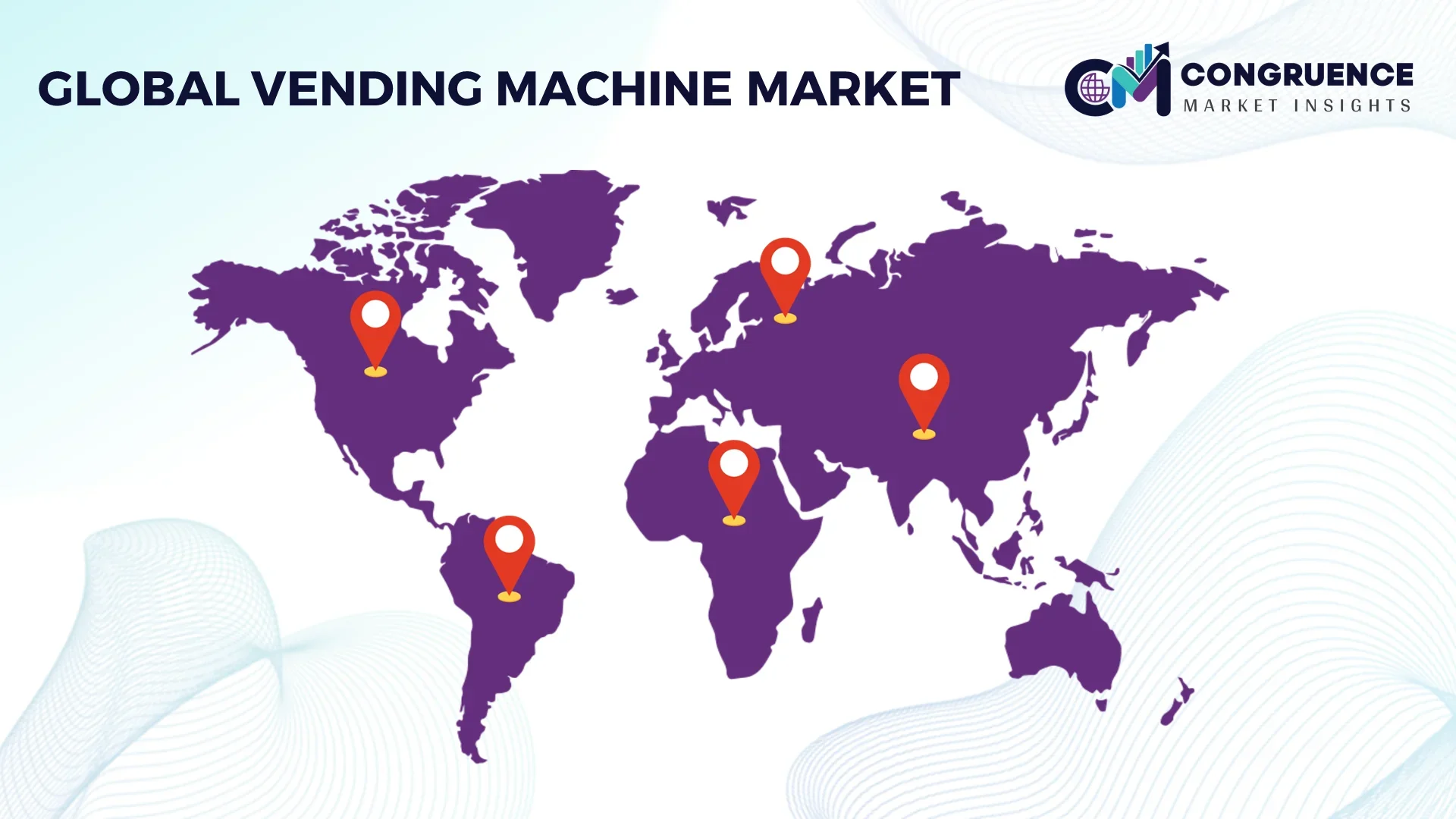
In 2024, North America installed over 420,000 vending machines across offices, transit hubs, and educational institutions, while Asia-Pacific recorded approximately 350,000 units, with China and Japan contributing over 65% of this regional total. Europe accounted for 25% of the global market with Germany, the UK, and France leading deployments, whereas South America and the Middle East & Africa held 12% and 5%, respectively. Consumer adoption of cashless payment systems reached 62% in North America and 48% in Asia-Pacific, highlighting a growing preference for contactless vending. Investment in smart vending technologies in Asia-Pacific exceeded USD 110 million in 2024, reflecting rapid modernization and automation across high-footfall areas.
North America holds 38% market share, driven by corporate offices, healthcare facilities, and transportation hubs. Regulatory support such as updated food safety compliance and cashless payment frameworks has accelerated deployment. Technological advancements include IoT-enabled machines, AI-driven inventory management, and touchless payment interfaces. Local players like Crane Merchandising Systems have launched AI-powered snack and beverage machines that monitor stock in real-time, reducing downtime by 25%. Consumer behavior shows higher enterprise adoption in healthcare and finance, with over 55% of employees in office settings preferring contactless vending options.
Europe represents 25% market share, led by Germany, the UK, and France. Strict regulatory standards for hygiene and energy efficiency, enforced by local agencies, support adoption. Smart vending machines with IoT connectivity and cashless transactions are increasingly common. Companies like Selecta Group are deploying AI-enabled machines capable of predictive inventory replenishment, serving over 1.5 million daily users. Regional consumer behavior reflects preference for sustainable and energy-efficient machines, with 48% of urban consumers choosing vending options that display nutritional transparency.
Asia-Pacific holds a market volume of approximately 350,000 units, with China, Japan, and India as top consumers. Rapid infrastructure development, expansion of corporate offices, and modernization of public transit hubs are driving growth. Technological innovations include mobile payment integration, AI-powered inventory systems, and automated hygiene products. Local player Fuji Electric Co., Ltd. implemented smart beverage machines in Japanese transit stations, serving over 1.2 million commuters monthly. Regional consumer behavior favors e-commerce integration and mobile app-controlled vending solutions, reflecting digital adoption trends.
South America accounts for 12% market share, with Brazil and Argentina as key countries. Growth is supported by expanding urban centers, office complexes, and public transportation infrastructure. Government incentives promote energy-efficient and automated vending units. Companies like Vending Brasil introduced multi-product smart vending machines, serving over 500,000 daily transactions across urban areas. Consumer behavior indicates high reliance on vending machines for snacks and beverages, with preference for localized products and media-influenced choices.
Middle East & Africa represents 5% market share, with the UAE and South Africa as major contributors. Demand is linked to oil & gas facilities, construction sites, and commercial buildings. Technological modernization includes IoT monitoring, automated hygiene dispensers, and cashless interfaces. Local player Al Nisr Vending launched smart beverage machines in Dubai offices, reducing maintenance downtime by 20%. Consumer behavior shows increased preference for touchless and premium vending solutions, reflecting rising urbanization and modern workplace trends.
United States – 28% Market Share: Dominance driven by high corporate deployment, advanced technological adoption, and regulatory support.
Japan – 22% Market Share: Leadership attributed to widespread urban adoption, extensive transit hub deployment, and advanced smart vending innovations.
The Vending Machine Market is moderately consolidated, with over 120 active competitors operating globally. The top five companies collectively account for approximately 45% of market share, reflecting a competitive landscape driven by innovation, technological adoption, and strategic collaborations. Key players focus on expanding their portfolios through AI-enabled smart vending machines, IoT-based inventory management systems, and cashless payment solutions. Recent strategic initiatives include mergers, acquisitions, and partnerships to enhance geographic reach and product offerings. For instance, leading companies have launched smart snack and beverage dispensers capable of tracking over 1 million transactions monthly, integrating predictive analytics to reduce stockouts. Market positioning is often determined by technological differentiation, customer service, and deployment across high-traffic zones such as airports, transit hubs, and corporate offices. Innovation trends include touchless operation, mobile app integration, remote monitoring, and environmentally sustainable machines, providing companies with a competitive edge while catering to evolving consumer expectations.
SandenVendo
Azkoyen Group
Royal Vendors, Inc.
Jofemar Group
N&W Global Vending
The Vending Machine Market is witnessing rapid technological advancements reshaping operational efficiency, consumer engagement, and sustainability. IoT-enabled vending machines are increasingly adopted, allowing real-time inventory monitoring, predictive restocking, and remote diagnostics. Over 62% of new machines in North America feature connected technology, improving uptime and service responsiveness. AI-driven recommendation engines personalize product suggestions based on purchase history, enhancing consumer satisfaction and repeat usage. Cashless and contactless payment systems are now standard, with over 58% of machines supporting mobile wallets, NFC, and QR code scanning. Emerging technologies include digital signage integration, providing advertising opportunities while engaging customers, and energy-efficient refrigeration systems, which reduce electricity consumption by up to 20% per unit. Additionally, sustainable materials and biodegradable components are being incorporated to align with ESG initiatives. Companies are also experimenting with automated hygiene dispensers, touchless interfaces, and vending machines capable of dispensing non-food items, such as personal protective equipment, expanding applications across healthcare, office, and public infrastructure.
In October 2024, Fuji Electric Co., Ltd. and Coca-Cola Bottlers Japan Inc. announced a new hydrogen‑cartridge-powered vending machine — the first of its kind — planned for deployment at Osaka‑Kansai Expo 2025. This vending unit operates independently from conventional power outlets, generating electricity via replaceable hydrogen cartridges, enabling installation even in power‑scarce or remote locations. Source: www.fujielectric.com
In November 2024, Fuji Electric expanded its automation technology portfolio with the launch of the MICREX‑SX Series SPH3300/2200 PLC models — designed to improve control speed and operational monitoring for processing and vending machines, enabling real‑time diagnostics and performance tracking.
In September 2023, Azkoyen Group was recognized by the European Vending & Coffee Service Association (EVA) for its “MIA EasyMilk” technology — a vending‑system innovation offering high-quality milk‑based beverages via automated machines. This underlines continuing innovation in beverage vending beyond traditional snacks and drinks.
The Vending Machine Market Report encompasses a comprehensive analysis of global market dynamics, including product types, applications, and end-user segments, covering smart vending machines, beverage dispensers, snack units, and specialized dispensers for healthcare and public facilities. It evaluates regional deployment across North America, Europe, Asia-Pacific, South America, and Middle East & Africa, detailing country-level consumption patterns, infrastructure readiness, and technological adoption. The report highlights emerging innovations, such as AI-driven personalization, IoT connectivity, cashless payments, and sustainable machine design. Key focus areas include high-footfall deployments in offices, hospitals, transit hubs, educational institutions, and retail. It also examines industry-specific applications, including corporate wellness, public infrastructure, and food service integration. Additionally, the report assesses competitive positioning, major market players, strategic initiatives, and regional consumer behaviors, providing a holistic view for decision-makers. Niche segments, such as mobile app-controlled vending, hygienic dispensers, and multi-product combination machines, are included to capture future growth avenues. Overall, the report provides actionable insights for investors, manufacturers, distributors, and technology innovators seeking informed strategies in the Vending Machine Market.
| Report Attribute / Metric | Details |
|---|---|
| Market Revenue (2024) | USD 2,140.0 Million |
| Market Revenue (2032) | USD 2,953.6 Million |
| CAGR (2025–2032) | 4.11% |
| Base Year | 2024 |
| Forecast Period | 2025–2032 |
| Historic Period | 2020–2024 |
| Segments Covered |
By Type
By Application
By End-User Insights
|
| Key Report Deliverables | Revenue Forecast, Market Trends, Growth Drivers & Restraints, Technology Insights, Segmentation Analysis, Regional Insights, Competitive Landscape, Recent Developments, Regulatory & ESG Overview |
| Regions Covered | North America, Europe, Asia-Pacific, South America, Middle East & Africa |
| Key Players Analyzed | Crane Merchandising Systems, Fuji Electric Co., Ltd., Selecta Group, SandenVendo, Azkoyen Group, Royal Vendors, Inc., Jofemar Group, N&W Global Vending |
| Customization & Pricing | Available on Request (10% Customization Free) |




