
Reports
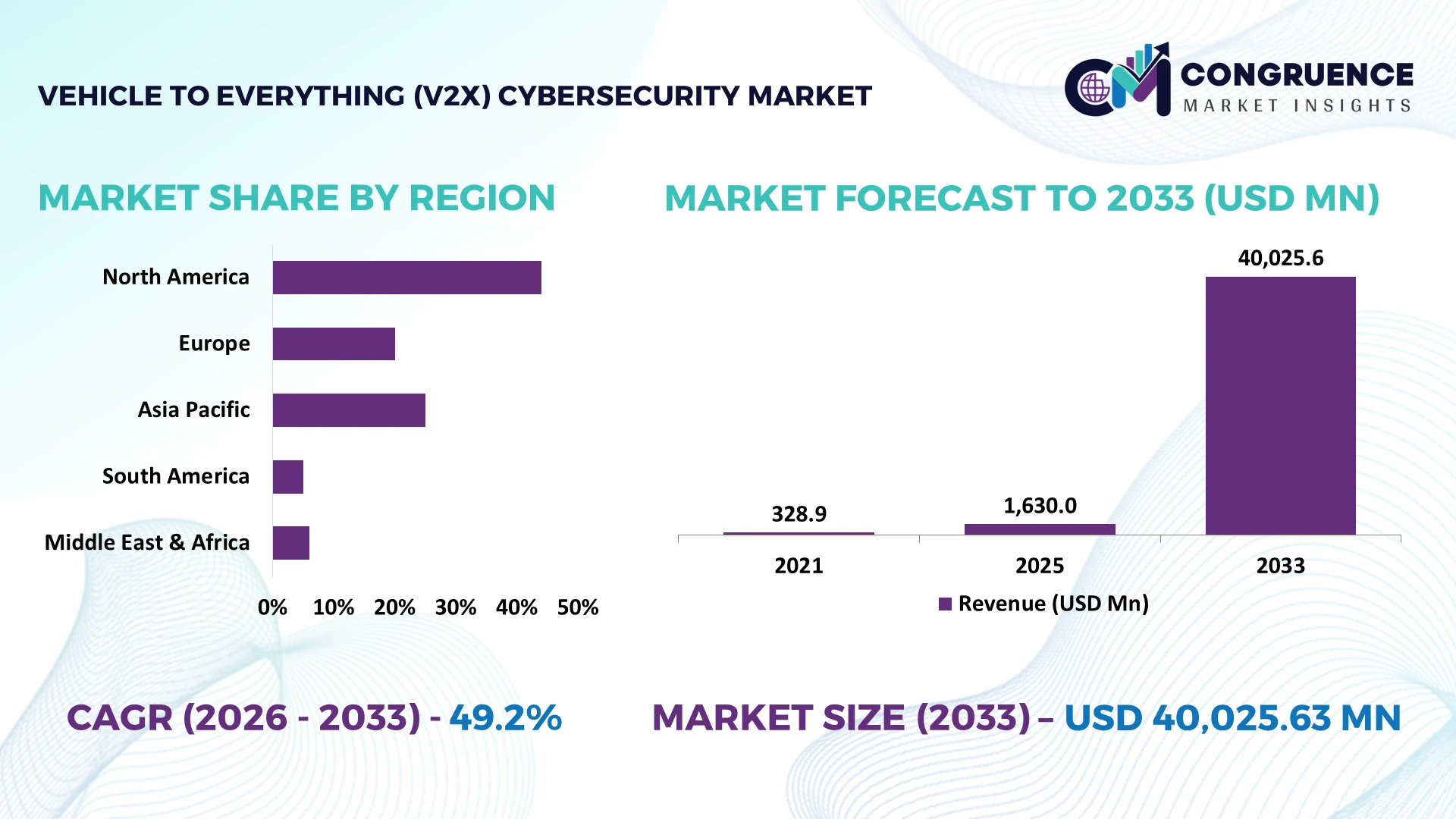
The Global Vehicle-to-Everything (V2X) Cybersecurity Market was valued at USD 1630 Million in 2025 and is anticipated to reach a value of USD 40025.63 Million by 2033 expanding at a CAGR of 49.2% between 2026 and 2033. Growth is driven by C-V2X deployment, connected vehicle authentication requirements, UNECE cybersecurity regulations, and expanding protection of vehicle-to-infrastructure communication networks.
China represents a leading deployment center for V2X cybersecurity infrastructure, supported by large-scale connected vehicle manufacturing, roadside connectivity investments, and government-backed intelligent transportation programs. The country produced approximately 31.3 million vehicles in 2024, compared with roughly 10.6 million in the United States, providing substantial scale for connected vehicle security integration. China's intelligent connected vehicle pilot programs span 20 designated cities and city clusters, accelerating demand for secure C-V2X communication, certificate management, and roadside authentication infrastructure across automotive and telecommunications ecosystems.
Automakers and cybersecurity suppliers should prioritize scalable public key infrastructure, secure V2X chipsets, and interoperable authentication platforms to strengthen positioning in connected mobility networks.
Market Size & Growth: USD 1,630 million in 2025, reaching USD 40,025.63 million by 2033 at 49.2% CAGR, driven by secure C-V2X integration.
Top Growth Drivers: Three priorities dominate: 100% lifecycle cybersecurity management for regulated vehicle types, expanding 5G connectivity, and authenticated roadside communication.
Short-Term Forecast: By 2028, advanced V2X security platforms will prioritize 100% certificate validation for authenticated safety messages, strengthening network trust and interoperability.
Emerging Technologies: Three technologies—AI-based intrusion detection, hardware security modules, and post-quantum cryptography—are reshaping connected vehicle protection architectures.
Regional Leaders: Asia-Pacific, Europe, and North America lead deployment, with China's 20 intelligent connected vehicle pilot cities and clusters supporting infrastructure security integration.
Consumer/End-User Trends: Automotive OEMs increasingly integrate cybersecurity across 3 communication environments: vehicle-to-vehicle, vehicle-to-infrastructure, and vehicle-to-network.
Pilot/Case Example: China's 2024 vehicle-road-cloud integration initiative selected 20 cities and clusters, expanding coordinated connected mobility infrastructure development.
Competitive Landscape: Qualcomm, NXP Semiconductors, Thales, BlackBerry QNX, and Elektrobit compete across 3 security layers: chipsets, embedded software, and certificate infrastructure.
Regulatory & ESG Impact: UNECE R155 and R156 establish 2 complementary requirements covering cybersecurity management and software update governance for applicable vehicle approvals.
Investment & Funding: The European Union's approximately EUR 1.5 billion Connecting Europe Facility digital program for 2021–2027 supports connectivity infrastructure relevant to secure mobility ecosystems.
Innovation & Future Outlook: Post-quantum cryptography standardization introduced 3 initial NIST algorithms in 2024, strengthening long-term automotive authentication planning.
The Vehicle-to-Everything (V2X) Cybersecurity Market is increasingly shaped by secure cooperative driving, authenticated roadside infrastructure, and automotive software lifecycle protection. Hardware security modules, security credential management systems, and AI-driven intrusion detection are becoming integral to connected mobility architectures. China's vehicle-road-cloud integration initiative covers 20 designated cities and clusters, demonstrating the infrastructure scale required for coordinated V2X deployment. European UNECE cybersecurity compliance requirements are encouraging automakers to integrate certificate provisioning and security monitoring into vehicle development workflows. These developments position interoperable authentication, low-latency threat detection, and scalable credential management as central priorities for future investment and competitive differentiation.
V2X cybersecurity is becoming a strategic requirement for automotive manufacturers, telecommunications operators, and intelligent transportation infrastructure providers as connected vehicles exchange safety-critical information. China's vehicle-road-cloud integration initiative covers 20 cities and city clusters, creating deployment opportunities for authentication platforms, secure roadside units, and credential management services. Meanwhile, UNECE R155 requires cybersecurity management systems for applicable vehicle approvals, shifting security investment from isolated electronic control units toward continuous vehicle lifecycle protection.
Modern V2X security architectures combine hardware-backed cryptography, digital certificates, and automated credential verification. Unlike legacy vehicle networks that rely heavily on perimeter isolation, authenticated V2X systems verify individual messages and participating devices. Dedicated hardware accelerators reduce cryptographic processing overhead compared with software-only implementations, although performance varies by chipset and signature algorithm. China's infrastructure-led deployment contrasts with Germany's regulation-driven automotive cybersecurity integration and the United States' emphasis on interoperable transportation communication standards.
Between 2026 and 2028, suppliers will prioritize certificate lifecycle automation, security credential management systems, and real-time misbehavior detection. A practical deployment involves roadside units validating signed vehicle safety messages before using their contents in traffic applications. Qualcomm, NXP Semiconductors, and Thales are positioned across secure connectivity, embedded cryptography, and identity management. Competitive advantage will depend on interoperability, low-latency verification, and scalable security operations.
Automotive cybersecurity regulation is accelerating security integration across V2X-enabled vehicle platforms. UNECE R155 establishes cybersecurity management requirements for applicable vehicle approvals, while R156 addresses software update management. Together, these frameworks shift procurement toward continuous risk assessment, authenticated communications, and secure lifecycle maintenance. China's vehicle-road-cloud program spans 20 cities and clusters, expanding the infrastructure requiring trusted communication. Vehicle manufacturers must protect 100% of safety-critical message processing paths within their approved security architectures, although deployment coverage varies. NXP Semiconductors and Thales are strengthening hardware security and credential management capabilities, while automotive software suppliers integrate security monitoring into vehicle platforms. The operational advantage comes from reusing certified security components across multiple vehicle models rather than rebuilding authentication systems for each program.
V2X cybersecurity deployment faces structural constraints from incompatible communication ecosystems, uneven roadside infrastructure, and substantial certification requirements. China emphasizes cellular V2X, while the United States has transitioned spectrum policy toward C-V2X within the 5.9 GHz transportation band. The Federal Communications Commission allocated 30 MHz of the band for intelligent transportation services, narrowing available spectrum compared with the original 75 MHz allocation. This represents a 60% reduction in dedicated bandwidth allocation. Automotive suppliers must accommodate different regional radio configurations, security profiles, and certification processes, increasing engineering expenditure. Qualcomm and NXP Semiconductors address these constraints through adaptable connectivity platforms, while infrastructure operators prioritize interoperable roadside equipment. Standardized certificate interfaces and modular security architectures reduce integration duplication across regional deployments.
Automated security credential management creates opportunities beyond conventional vehicle hardware protection. V2X networks require frequent certificate changes to support authentication while limiting persistent vehicle tracking. NIST finalized three initial post-quantum cryptography standards in 2024, creating a technology pathway for future-resistant digital signatures and key establishment. China's connected mobility infrastructure initiative encompasses 20 deployment areas, offering environments for credential provisioning and distributed trust management. Between 2026 and 2028, cybersecurity suppliers can develop cryptographic agility, automated certificate renewal, and cloud-assisted misbehavior analysis. Thales and semiconductor security providers are positioned to expand hardware-backed identity solutions and integration partnerships. A strategic opportunity lies in supplying reusable credential infrastructure to vehicle manufacturers and roadside operators, reducing duplicated security administration across interconnected transportation systems.
Maintaining dependable security under dense V2X message traffic presents a long-term engineering challenge. Cooperative awareness applications can broadcast safety messages at frequencies approaching 10 Hz, requiring repeated signature verification as surrounding vehicle density increases. At 100 nearby transmitters, a receiver could encounter approximately 1,000 messages per second before filtering, creating substantial cryptographic and processing workloads. Attackers can exploit compromised credentials, false position messages, and delayed certificate revocation to undermine transportation safety. Germany's connected vehicle engineering ecosystem increasingly requires cybersecurity validation throughout software development and operational maintenance. NXP Semiconductors, Qualcomm, and automotive cybersecurity specialists must optimize hardware acceleration, prioritize safety-critical verification, and strengthen misbehavior detection. Sustainable deployment depends on maintaining bounded processing latency while preserving authentication integrity and reliable incident response.
Hardware Security Moves Into Vehicle Chipsets: Automotive semiconductor suppliers are integrating cryptographic accelerators and secure key storage directly into connected vehicle processors. Dedicated security hardware separates private keys from application software, supporting authenticated communications across multiple electronic control units. NXP Semiconductors and Qualcomm are expanding security capabilities within automotive connectivity platforms. This integration reduces reliance on separate security components and strengthens protection against unauthorized firmware access and credential extraction.
Roadside Infrastructure Adopts Security Monitoring: Transportation operators are extending cybersecurity monitoring beyond vehicles to roadside units and traffic management systems. China's intelligent connected vehicle initiative covers 20 cities and city clusters, creating coordinated environments for vehicle-road-cloud security deployment. Infrastructure suppliers are integrating device authentication, encrypted management connections, and remote diagnostics. Centralized monitoring improves incident visibility while reducing dependence on individual roadside maintenance interventions.
Misbehavior Detection Becomes Operational Priority: Connected vehicle security platforms increasingly distinguish valid digital signatures from trustworthy message content. Cooperative safety applications can transmit messages at approximately 10 Hz, creating continuous streams requiring plausibility assessment. Automotive cybersecurity developers are combining trajectory validation, location consistency checks, and anomaly detection to identify compromised but authenticated transmitters. This approach strengthens safety assurance beyond conventional cryptographic verification and supports faster investigation of suspicious communications.
Software Update Governance Reshapes Procurement: UNECE R155 and R156 are influencing automotive cybersecurity purchasing through two complementary compliance frameworks covering security management and software updates. Manufacturers are integrating vulnerability tracking, secure boot verification, and update authorization into supplier qualification processes. BlackBerry QNX, Elektrobit, and embedded security specialists are strengthening lifecycle security integration. Procurement increasingly evaluates long-term maintenance capability alongside initial hardware performance and development costs.
V2V Security represents a foundational segment of the Vehicle-to-Everything (V2X) Cybersecurity Market because direct vehicle communication requires authenticated safety messages, certificate verification, and protection against message manipulation. Cooperative awareness applications can broadcast messages at approximately 10 Hz, making efficient cryptographic processing essential for dense traffic environments. Automotive semiconductor suppliers including NXP Semiconductors and Qualcomm integrate hardware security capabilities into connectivity platforms, reducing the need for separate authentication components. V2I Security extends protection to roadside units, traffic controllers, and transportation infrastructure, where secure device provisioning and trusted message exchange are operational requirements.
V2N Security is gaining strategic importance as cellular connectivity connects vehicles with cloud services, security monitoring platforms, and remote management infrastructure. V2P Security addresses communications involving pedestrians and vulnerable road users, requiring privacy-conscious authentication and reliable message handling. China's intelligent connected vehicle initiative encompasses 20 cities and city clusters, illustrating infrastructure deployment opportunities. Suppliers are prioritizing interoperable credential management, secure connectivity modules, and integration partnerships to address different communication environments without duplicating security architecture.
Secure Communication represents a core application within the Vehicle-to-Everything (V2X) Cybersecurity Market because authenticated message exchange is essential for cooperative driving, roadside connectivity, and safety-critical transportation services. Public key infrastructure, digital signatures, and hardware-protected credentials establish message authenticity while limiting unauthorized participation. Cooperative awareness messages can operate at frequencies approaching 10 Hz, creating substantial verification workloads in dense traffic environments. NXP Semiconductors, Thales, and automotive software developers compete through cryptographic acceleration, secure credential storage, and interoperable communication stacks. Identity and Authentication provides the underlying trust infrastructure for vehicle and roadside device verification.
Threat Detection is becoming increasingly important as connected mobility systems require continuous monitoring for anomalous behavior and manipulated safety information. Intrusion Prevention addresses unauthorized access, malicious software execution, and attacks against vehicle communication interfaces. At 100 surrounding transmitters operating at 10 Hz, a receiver could encounter approximately 1,000 messages per second before filtering. Suppliers are integrating behavioral analytics, secure gateways, and automated security monitoring to improve detection effectiveness without disrupting time-sensitive communications.
Automotive OEMs represent the central procurement group for Vehicle-to-Everything (V2X) Cybersecurity solutions because they coordinate vehicle architecture, cybersecurity validation, software maintenance, and supplier compliance. UNECE R155 and R156 establish two complementary regulatory frameworks influencing cybersecurity and software update management for applicable vehicle approvals. Manufacturers increasingly specify secure processors, cryptographic interfaces, certificate management capabilities, and cybersecurity monitoring requirements during vehicle platform development. Qualcomm, NXP Semiconductors, and Thales compete for integration opportunities through embedded security technologies and trusted connectivity solutions. Tier-1 Suppliers support implementation by incorporating protected communication modules, secure gateways, and software security components into automotive systems.
Road Infrastructure Operators represent an important deployment segment as intelligent transportation programs expand roadside connectivity and cooperative traffic management. Telecom Operators contribute cellular network infrastructure, connectivity management, and security services supporting V2N communication. China's vehicle-road-cloud initiative covers 20 cities and city clusters, creating coordinated procurement requirements across public infrastructure and automotive ecosystems. Suppliers are developing modular security architectures and partnership models that distribute authentication responsibilities between vehicle manufacturers, network operators, and transportation authorities.
Asia-Pacific accounted for the largest market share in 2025 however, Asia-Pacific is expected to register the fastest growth between 2026 and 2033, supported by China's large-scale C-V2X infrastructure deployment and expanding connected vehicle security integration.
C-V2X Spectrum Modernization and Automotive Security Integration
North America's V2X cybersecurity market is shaped by connected vehicle development, transportation communication standards, and automotive semiconductor innovation. The United States leads regional activity through automotive engineering, intelligent transportation projects, and security technology development. The Federal Communications Commission's restructuring of the 5.9 GHz transportation spectrum established a 30 MHz allocation for intelligent transportation services, supporting C-V2X deployment. Qualcomm and automotive semiconductor suppliers are integrating cryptographic processing, secure boot, and hardware-backed authentication into connected vehicle platforms. Canada's transportation research ecosystem contributes connected corridor testing and cooperative vehicle communication development. Regional deployment emphasizes interoperable security credentials, roadside device authentication, and software lifecycle protection. The transition from isolated vehicle electronics toward cooperative transportation networks increases procurement requirements for certificate management and threat monitoring. Suppliers are prioritizing reusable security platforms that support automotive manufacturers and infrastructure operators across different deployment environments.
United States Market Outlook: The United States combines advanced automotive software development, semiconductor security expertise, and intelligent transportation infrastructure investment. Michigan, California, and Texas support connected mobility research and automotive technology integration. The Department of Transportation's national V2X deployment strategy, released in 2024, establishes milestones extending through 2036. Qualcomm, automotive suppliers, and transportation technology developers are advancing secure C-V2X communication, certificate provisioning, and roadside interoperability. Federal spectrum policy provides a defined foundation for infrastructure investment and deployment planning.
Cybersecurity Regulation Reshapes Connected Vehicle Procurement
Europe's V2X cybersecurity market is strongly influenced by automotive cybersecurity regulation, established vehicle manufacturing networks, and cooperative intelligent transportation infrastructure. Germany, France, Sweden, and the Netherlands support connected vehicle development through automotive engineering, digital mobility programs, and roadside communication initiatives. UNECE Regulations R155 and R156 establish cybersecurity management and software update requirements for applicable vehicle approvals, strengthening demand for secure vehicle architecture and lifecycle protection. The European Union's Cooperative Intelligent Transport Systems initiatives support interoperable communication between vehicles and transportation infrastructure. NXP Semiconductors, Thales, and automotive software developers contribute embedded security, identity management, and secure communication technologies. Regional suppliers increasingly integrate security validation into vehicle development workflows rather than treating cybersecurity as a separate postproduction activity. This approach supports regulatory compliance, standardized supplier qualification, and coordinated software maintenance across automotive production networks.
Germany Market Outlook: Germany benefits from major automotive manufacturers, established automotive electronics suppliers, and advanced cybersecurity engineering capabilities. Volkswagen Group, BMW, and Mercedes-Benz maintain extensive connected vehicle development programs requiring secure software integration. Germany's automotive sector produced approximately 4.1 million passenger cars in 2024, supporting substantial embedded security engineering activity. Automotive suppliers are strengthening secure gateway integration, cybersecurity testing, and software update management capabilities. The country's regulatory environment and engineering infrastructure support demand for validated V2X authentication and secure connected mobility technologies.
Large-Scale Connected Mobility Deployment and Security Infrastructure Expansion
Asia-Pacific represents a leading deployment center for V2X cybersecurity, supported by extensive vehicle manufacturing, telecommunications infrastructure, and government-backed intelligent transportation initiatives. China dominates regional deployment activity through cellular V2X development, roadside infrastructure investment, and coordinated vehicle-road-cloud integration programs. Japan and South Korea contribute advanced automotive electronics, secure communication research, and intelligent transportation technologies. China's 2024 vehicle-road-cloud initiative selected 20 cities and city clusters for coordinated infrastructure development, creating demand for trusted roadside units, security credential management, and connected vehicle authentication. Qualcomm, NXP Semiconductors, and domestic technology suppliers compete across automotive connectivity hardware and embedded security platforms. Regional manufacturers are increasingly integrating security functions into vehicle communication modules and transportation infrastructure equipment. The resulting procurement shift favors interoperable cryptographic architectures, localized certification capabilities, and partnerships between automotive manufacturers, telecommunications operators, and infrastructure providers.
China Market Outlook: China combines substantial automotive production capacity, extensive 5G infrastructure, and government-supported intelligent connected vehicle development. The country manufactured approximately 31.3 million vehicles in 2024, providing a significant industrial foundation for connected vehicle technology integration. Beijing, Shanghai, Wuhan, and other major urban centers support intelligent transportation testing and roadside communication deployment. Domestic automotive manufacturers and telecommunications equipment providers are developing secure C-V2X modules, certificate management infrastructure, and vehicle-cloud security integration. China's coordinated industrial policy strengthens demand for localized cybersecurity platforms and scalable connected mobility authentication systems.
Connected Transportation Modernization and Automotive Network Security
South America's V2X cybersecurity market is developing through automotive digitalization, expanding mobile connectivity, and intelligent transportation infrastructure modernization. Brazil represents the principal regional opportunity, supported by established vehicle manufacturing, telecommunications investment, and urban mobility technology programs. Argentina and Chile contribute connected transportation initiatives and road infrastructure modernization activities. Brazil produced approximately 2.5 million vehicles in 2024, providing an industrial base for automotive connectivity integration. Expanding 5G coverage supports connected mobility applications, although dedicated V2X roadside infrastructure remains less developed than in China and major European automotive markets. Cybersecurity suppliers are targeting secure vehicle communication modules, embedded authentication, and transportation network monitoring. Partnerships between telecommunications operators, automotive manufacturers, and infrastructure technology providers are important for reducing deployment fragmentation. Regional adoption depends on coordinated infrastructure investment and interoperable technical specifications.
Brazil Market Outlook: Brazil benefits from a substantial automotive manufacturing sector, expanding telecommunications infrastructure, and established technology integration capabilities. São Paulo and other industrial centers support automotive electronics development and connected mobility initiatives. Brazil's telecommunications regulator, Anatel, continues overseeing 5G deployment obligations, strengthening the connectivity foundation for future transportation applications. Automotive manufacturers and telecommunications providers are evaluating secure communication technologies, vehicle connectivity platforms, and infrastructure integration. Commercial opportunities concentrate on embedded cybersecurity, connected fleet management, and authentication systems compatible with evolving intelligent transportation networks.
Smart Mobility Investment and Secure Transportation Infrastructure Development
The Middle East & Africa V2X cybersecurity market is influenced by smart city investment, transportation digitalization, and telecommunications infrastructure modernization. The United Arab Emirates and Saudi Arabia represent important deployment environments through connected mobility initiatives, autonomous transportation programs, and advanced digital infrastructure investment. Dubai's autonomous transportation strategy targets 25% of transportation journeys becoming smart and driverless by 2030, reinforcing requirements for secure communication and infrastructure authentication. Saudi Arabia's Vision 2030 initiatives support intelligent transportation development and digital infrastructure expansion. South Africa contributes automotive manufacturing capabilities and connected fleet technology applications. Regional security requirements increasingly emphasize protected roadside communications, identity verification, and centralized infrastructure monitoring. Technology suppliers are pursuing partnerships with telecommunications operators, mobility developers, and government transportation agencies. Successful deployment requires coordinated cybersecurity governance across transportation assets and connected vehicle systems.
United Arab Emirates Market Outlook: The United Arab Emirates benefits from smart city infrastructure, advanced telecommunications networks, and government-backed autonomous mobility initiatives. Dubai and Abu Dhabi support connected transportation development, intelligent traffic management, and vehicle automation testing. Dubai's Roads and Transport Authority has established a target for 25% autonomous transportation journeys by 2030. Transportation authorities and technology partners are prioritizing secure digital infrastructure, reliable connectivity, and authenticated communication between vehicles and roadside systems. These initiatives strengthen opportunities for V2X security integration, transportation cybersecurity monitoring, and trusted mobility platform development.
Qualcomm and NXP Semiconductors compete in secure V2X chipsets, while Thales and Giesecke+Devrient target credential infrastructure; Vector Informatik and Elektrobit compete in automotive software integration. The market spans semiconductor, identity management, and embedded security layers, preventing a defensible combined top-five market-share estimate without comparable segment revenues. Competition centers on cryptographic latency, interoperability, certification, and integration costs. Hardware-backed authentication can reduce software processing overhead, although verified percentage improvements depend on chipset architecture. China's C-V2X deployments and Europe's cybersecurity regulations are accelerating supplier partnerships, secure module development, and localized integration. Qualcomm emphasizes connected vehicle platforms; NXP integrates cryptographic accelerators; Thales strengthens digital identity capabilities. The competitive shift favors lifecycle security platforms over standalone protection components. Entry barriers include automotive qualification, certificate infrastructure interoperability, and long-term vulnerability management. Suppliers win through validated security performance, reliable manufacturing, scalable credential provisioning, and integration across vehicle and roadside networks without compromising safety-critical communication latency requirements.
Qualcomm Incorporated
NXP Semiconductors N.V.
Thales Group
Giesecke+Devrient GmbH
Infineon Technologies AG
Elektrobit Automotive GmbH
Vector Informatik GmbH
ETAS GmbH
HARMAN International
VicOne Corporation
Karamba Security Ltd.
Autocrypt Co., Ltd.
Argus Cyber Security Ltd.
Current V2X cybersecurity architectures combine hardware security modules, public key infrastructure, digital signatures, and secure communication protocols. Automotive processors from Qualcomm and NXP support hardware accelerated cryptography, protecting private keys during vehicle communication. Cooperative safety applications can transmit messages at 10 Hz, requiring continuous authentication without excessive processing delays. Compared with legacy software-only verification, dedicated cryptographic hardware reduces processor utilization, although percentage improvements depend on implementation. Suppliers integrating security directly into connectivity chipsets gain advantages in component consolidation and automotive qualification.
Emerging technologies include AI-based misbehavior detection, automated certificate management, and privacy-preserving authentication. Machine learning evaluates vehicle trajectories, message consistency, and abnormal communication patterns to identify compromised transmitters whose signatures remain valid. China's connected mobility program spans 20 cities and clusters, providing deployment environments for coordinated security infrastructure. Thales and specialized cybersecurity developers are advancing credential provisioning and monitoring capabilities. Integration with roadside units enables centralized incident analysis while preserving local safety decisions.
Between 2026 and 2028, post-quantum cryptography, secure edge computing, and software-defined security architectures will influence procurement. NIST standardized three initial post-quantum algorithms in 2024, establishing migration foundations. Suppliers must optimize signature verification, cryptographic agility, and update governance to maintain interoperability across evolving vehicle networks.
June 2025: Qualcomm completed its acquisition of Autotalks, combining DSRC and C-V2X capabilities within Snapdragon Digital Chassis. Support for two communication standards expands automotive integration options and consolidates security-sensitive V2X connectivity development across global vehicle platforms. Source: qualcomm.com
May 2025: NXP Semiconductors unveiled OrangeBox 2.0, integrating AI, post-quantum cryptography, and software-defined networking into its automotive connectivity controller. The second-generation platform strengthens protection across wireless vehicle interfaces and simplifies security integration for manufacturers developing software-defined vehicle architectures. Source: nxp.com
March 2025: AUTOCRYPT launched an India-compliant cloud-native V2X security credential system, extending coverage to five major geographic standards environments. Deliveries to Indian automakers expand certificate-management availability and support localized authentication infrastructure for connected vehicles entering India's developing intelligent transportation ecosystem. Source: autocrypt.io
October 2024: NIST validated NXP Semiconductors' i.MX8 DXL V2X cryptographic module at FIPS 140-2 Security Level 3. Independent validation establishes a documented hardware security assurance benchmark for automotive suppliers evaluating trusted cryptographic components and secure vehicle communication architectures. Source: nist.gov
The Vehicle-to-Everything (V2X) Cybersecurity Market Report evaluates connected mobility security, deployment infrastructure, technology development, and competitive positioning between 2026 and 2033. Type segmentation covers V2V Security, V2I Security, V2P Security, and V2N Security. Application analysis includes Threat Detection, Secure Communication, Intrusion Prevention, and Identity and Authentication. End-user coverage examines Automotive OEMs, Tier-1 Suppliers, Telecom Operators, and Road Infrastructure Operators. Regional analysis encompasses North America, Europe, Asia-Pacific, South America, and the Middle East & Africa.
Technology assessment addresses hardware security modules, cryptographic authentication, security credential management, AI-based threat detection, and post-quantum cryptography. China's 20 designated vehicle-road-cloud pilot cities and clusters provide a deployment benchmark. Competitive analysis examines interoperability, regulatory compliance, supplier partnerships, and security integration costs, supporting investment planning, infrastructure expansion, procurement strategy, and long-term market positioning.
| Report Attribute/Metric | Report Details |
|---|---|
Market Revenue in 2025 | USD 1630 Million |
Market Revenue in 2033 | USD 40025.63 Million |
CAGR (2026 - 2033) | 49.2% |
Base Year | 2025 |
Forecast Period | 2026 - 2033 |
Historic Period | 2021 - 2025 |
Segments Covered | By Type
By Application
By End-User
|
Key Report Deliverable | Revenue Forecast, Growth Trends, Market Dynamics, Segmental Overview, Regional and Country-wise Analysis, Competition Landscape |
Region Covered | North America, Europe, Asia-Pacific, South America, Middle East, Africa |
Key Players Analyzed | Qualcomm Incorporated, NXP Semiconductors N.V., Thales Group, Giesecke+Devrient GmbH, Infineon Technologies AG, Elektrobit Automotive GmbH, Vector Informatik GmbH, ETAS GmbH, HARMAN International, VicOne Corporation, Karamba Security Ltd., Autocrypt Co., Ltd., Argus Cyber Security Ltd. |
Customization & Pricing | Available on Request (10% Customization is Free) |




