
Reports
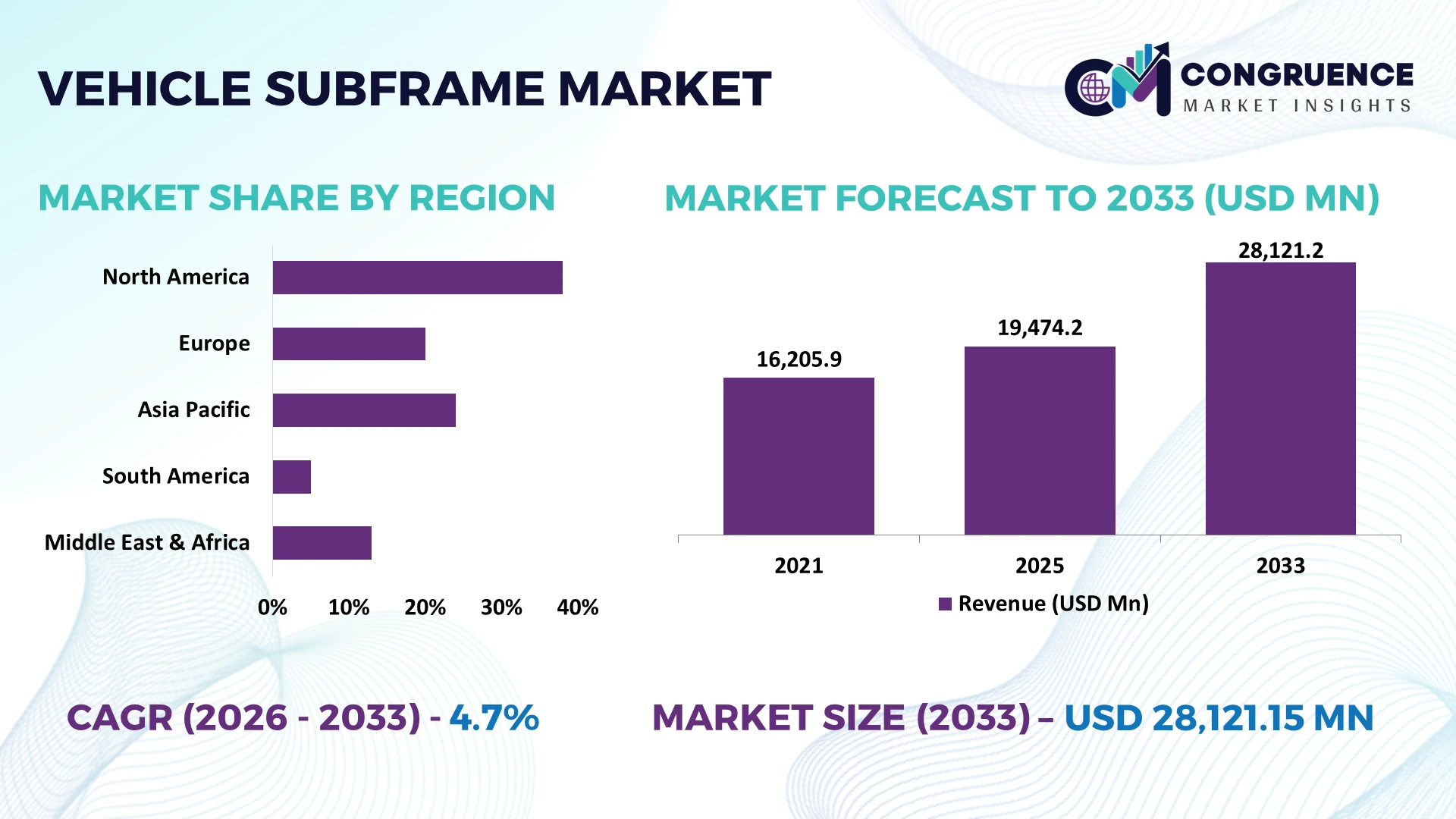
The Global Vehicle Subframe Market was valued at USD 19474.2 Million in 2025 and is anticipated to reach a value of USD 28121.15 Million by 2033 expanding at a CAGR of 4.7% between 2026 and 2033. Growth is being driven by rising electric vehicle platform production, lightweight aluminum subframe integration, and automated chassis manufacturing that improves structural efficiency while reducing vehicle weight.
China remains the dominant manufacturing hub, accounting for approximately 34% of global vehicle production while expanding advanced automotive component investments across EV supply chains in 2026. Compared with Germany, where premium vehicle engineering accelerates aluminum subframe adoption above 55% in new EV platforms, China's large-scale manufacturing ecosystem enables faster capacity expansion. Ongoing global supply-chain diversification and tariff-driven sourcing adjustments continue influencing procurement and localization strategies.
For manufacturers and suppliers, expanding localized production with lightweight, high-strength subframe technologies remains the strongest competitive strategy for securing long-term OEM contracts.
Market Size & Growth: USD 19474.2 Million (2025) to USD 28121.15 Million (2033) at 4.7% CAGR, supported by lightweight vehicle architecture and expanding EV platform production.
Top Growth Drivers: Aluminum subframe adoption +21%, EV chassis demand +19%, robotic welding utilization +17%, strengthening manufacturing productivity.
Short-Term Forecast: By 2028, automated production reduces manufacturing costs by nearly 12% while improving assembly efficiency by approximately 15%.
Emerging Technologies: AI-enabled quality inspection, high-strength steel forming, and advanced aluminum casting improve defect detection by around 20%.
Regional Leaders: Asia Pacific approaches USD 12300 Million, Europe exceeds USD 7100 Million, North America reaches USD 5600 Million, driven by EV localization and regional supply-chain expansion.
Consumer/End-User Trends: More than 48% of new electric vehicle platforms incorporate lightweight subframe designs to improve driving range and structural performance.
Pilot/Case Example: In 2026, automated chassis manufacturing programs achieved approximately 18% shorter production cycles through digital inspection and robotic assembly.
Competitive Landscape: Top manufacturers collectively hold nearly 42% market share, led by Magna International, Benteler, Gestamp, Hyundai Mobis, and Martinrea International.
Regulatory & ESG Impact: Lightweight material adoption lowers component mass by about 14%, supporting stricter vehicle emission and sustainability requirements across global markets.
Investment & Funding: More than USD 2.8 Billion supports manufacturing expansion, automation upgrades, and regional partnerships amid supply-chain diversification.
Innovation & Future Outlook: Multi-material subframes, digital manufacturing, and modular EV chassis platforms strengthen long-term OEM competitiveness and production flexibility.
Vehicle Subframe Market demand is strengthening across electric passenger vehicles, premium SUVs, and commercial vehicle platforms as manufacturers prioritize lightweight structural systems and crash performance. Advanced aluminum casting and hybrid material joining technologies improve component durability, while lightweight designs reduce structural weight by nearly 15%. Regional manufacturing localization and resilient supplier networks continue reshaping procurement strategies, setting the foundation for the strategic market assessment.
The Vehicle Subframe Market is becoming strategically important as automakers accelerate platform standardization, lightweight engineering, and localized component sourcing to strengthen production resilience and reduce manufacturing complexity. Supply-chain restructuring following global trade realignments is encouraging OEMs to shift procurement toward regional manufacturing hubs while increasing investment in high-strength aluminum and multi-material vehicle architectures that improve structural performance and assembly flexibility.
Advanced robotic welding and digital inspection systems now deliver nearly 18% higher production efficiency than conventional manual welding while reducing quality deviations by approximately 22%. China leads high-volume manufacturing through integrated EV supply chains, whereas Germany focuses on precision-engineered lightweight subframes for premium vehicle platforms with aluminum deployment exceeding 55% in new electric models. Over the next two to three years, digital quality monitoring is expected to exceed 60% adoption across large automotive component facilities, improving traceability and reducing production downtime.
A practical example is the deployment of automated laser-welding cells that shorten production cycles while ensuring consistent dimensional accuracy across modular vehicle platforms. Manufacturers are expanding partnerships with material suppliers, investing in localized stamping and casting facilities, and integrating digital manufacturing technologies to strengthen OEM relationships. Companies securing scalable, lightweight, and digitally enabled production capabilities will achieve stronger competitive positioning as vehicle platforms continue evolving.
The transition toward lightweight vehicle platforms is reshaping procurement priorities across the automotive industry. Aluminum and high-strength steel subframes reduce structural weight by approximately 15%, while robotic manufacturing improves production efficiency by nearly 18% and lowers defect rates by around 20%. China continues expanding EV manufacturing capacity, encouraging suppliers to establish localized production facilities and integrated component ecosystems. This structural shift enables faster model launches, lower logistics exposure, and improved supply continuity. In response, manufacturers are investing in advanced casting technologies, automated welding lines, and strategic partnerships with OEMs to deliver modular subframe solutions that support multiple vehicle platforms, strengthening operational efficiency and long-term contract competitiveness.
Fluctuating prices of aluminum, specialty steel, and energy-intensive processing continue challenging production planning and margin stability. Raw material costs account for nearly 45% of total subframe manufacturing expenses, while logistics disruptions have increased component lead times by approximately 16% for several global suppliers. Japan and other import-dependent manufacturing locations remain particularly exposed to supply concentration risks for specialty metals. These conditions reduce production flexibility and complicate long-term procurement strategies. Companies are mitigating exposure through supplier diversification, localized sourcing agreements, multi-year material contracts, and increased adoption of recyclable alloys that stabilize input costs while improving operational resilience across manufacturing networks.
The integration of digital manufacturing with advanced material engineering is creating new competitive opportunities. AI-enabled production monitoring improves process consistency by nearly 20%, while simulation-driven product development shortens prototype validation cycles by approximately 25%. India is emerging as an attractive manufacturing destination through expanding automotive production capacity and supportive industrial modernization initiatives. Companies are increasing investments in hybrid aluminum-steel subframe designs, digital twins, and collaborative engineering partnerships to improve production scalability. An emerging opportunity lies in developing modular subframes compatible with multiple electric vehicle platforms, enabling lower development costs, faster vehicle launches, and stronger supply-chain flexibility for global automotive manufacturers.
The primary long-term challenge is scaling intelligent manufacturing while maintaining consistent quality across geographically distributed production facilities. Integrating digital inspection, robotics, and real-time manufacturing analytics requires workforce upskilling, with advanced production specialists representing less than 35% of personnel in many component plants. Complex software integration can extend production commissioning by approximately 20%, delaying operational optimization. Germany and Mexico illustrate differing readiness levels, with automation maturity varying significantly across supplier networks. To maintain competitiveness, manufacturers must invest in workforce development, interoperable production systems, standardized quality platforms, and collaborative technology partnerships that ensure consistent execution, rapid scalability, and long-term manufacturing resilience.
Advanced Multi-Material Integration Lightweight engineering is accelerating as aluminum and high-strength steel combinations increase by nearly 24% across newly launched vehicle platforms, reducing structural weight by approximately 15%. Tightened vehicle efficiency regulations in Germany are encouraging manufacturers to redesign chassis architectures, while suppliers expand hybrid forming technologies and collaborative material-development partnerships to improve production flexibility.
Factory Automation Expands Rapidly Digital welding, AI-assisted inspection, and robotic assembly are now deployed across more than 60% of large automotive component facilities, improving dimensional accuracy by around 20% and reducing rework by nearly 18%. Labor shortages in Japan are accelerating smart factory investments, prompting companies to automate quality control and standardize production workflows across multiple manufacturing locations.
Regional Supply Networks Reshape Vehicle manufacturers are reducing long-distance sourcing by increasing localized procurement by approximately 22% and shortening component lead times by nearly 16%. Trade policy adjustments and supply-chain resilience initiatives are driving new supplier partnerships in Mexico and India. A less visible shift is the rise of dual-source procurement strategies that improve production continuity without significantly increasing inventory costs.
Platform Standardization Gains Momentum Modular vehicle platforms now support nearly 40% of new passenger vehicle programs, allowing common subframe architectures across multiple models and reducing engineering validation time by about 25%. Automotive suppliers are restructuring product portfolios, expanding flexible manufacturing capacity, and investing in configurable tooling systems that accelerate product launches while lowering operational complexity.
Steel Subframes remain the leading segment with an estimated market share of approximately 49%, supported by proven durability, lower manufacturing costs, and broad compatibility across passenger and commercial vehicle platforms. Their mature supply ecosystem and efficient large-scale stamping processes continue making steel the preferred choice for high-volume production. Front Subframes also represent a significant share because they integrate suspension, steering, and powertrain components, making them operationally critical for structural stability and crash performance.
Aluminum Subframes are the fastest-growing segment as OEMs prioritize lightweight vehicle architectures to improve energy efficiency and driving range. Aluminum integration has increased by nearly 23% across new EV-focused platforms, while Rear Subframes are gaining importance through modular chassis development for electric vehicles. Manufacturers are expanding high-pressure casting capacity, investing in mixed-material joining technologies, and strengthening partnerships with lightweight material specialists. Investment priorities are steadily shifting toward scalable aluminum production while maintaining steel platforms for cost-sensitive vehicle programs.
Passenger Cars account for approximately 56% of total demand, supported by high production volumes, platform standardization, and increasing integration of lightweight chassis systems. Automakers continue optimizing structural performance while reducing assembly complexity, with digital manufacturing improving production efficiency by nearly 18%. Commercial Vehicles maintain stable demand because heavy-duty applications require reinforced subframes capable of supporting higher payloads and extended operating cycles.
Electric Vehicles represent the fastest-growing application as battery integration requires redesigned subframe structures with improved rigidity and crash performance. Lightweight subframe adoption within EV platforms has increased by approximately 26%, while Performance Vehicles continue driving innovation in aluminum and hybrid-material designs for enhanced handling characteristics. Manufacturers are expanding automated production lines, integrating simulation-led engineering, and scaling modular platform development to meet evolving OEM requirements while improving manufacturing flexibility.
Automotive OEMs represent the largest end-user group with an estimated market share of around 58%, reflecting their direct influence over vehicle platform design, supplier qualification, and production planning. Their large-scale purchasing programs encourage standardized subframe architectures and long-term sourcing agreements. Vehicle Manufacturers continue strengthening vertical integration strategies, improving manufacturing coordination while increasing digital production monitoring by nearly 20% across advanced assembly facilities.
Aftermarket Suppliers are the fastest-growing end-user segment as vehicle fleets age and replacement demand expands for collision repair and performance upgrades. Demand for certified replacement components has increased by approximately 15%, encouraging suppliers to broaden product portfolios and improve distribution networks. Companies are responding through customized product offerings, regional warehouse expansion, strategic distributor partnerships, and digital inventory management systems. Competitive positioning increasingly depends on balancing OEM-quality standards with responsive aftermarket availability and localized customer support.
Asia-Pacific accounted for the largest market share at 46.8% in 2025 however, South America is expected to register the fastest growth, expanding at a 5.8% CAGR between 2026 and 2033.

Advanced Manufacturing and EV Platform Localization
North America accounts for approximately 24% of global Vehicle Subframe Market demand, supported by integrated automotive production networks, advanced chassis engineering, and increasing localization of critical component manufacturing. Vehicle manufacturers continue expanding automated stamping, robotic welding, and digital inspection systems, with automation implemented across nearly 65% of large component facilities. Cross-border production between the United States, Canada, and Mexico strengthens supply-chain resilience while reducing logistics complexity. Recent investment in lightweight aluminum casting and modular vehicle platform development has shortened production lead times by approximately 14%. Suppliers are also strengthening partnerships with OEMs to improve synchronized manufacturing schedules, ensuring stable component availability while supporting next-generation passenger vehicles and electric mobility programs.
United States Market Outlook: The United States remains the regional manufacturing and innovation leader due to its extensive automotive production ecosystem and strong investment in lightweight vehicle technologies. More than 60% of newly upgraded automotive component facilities have integrated AI-assisted quality inspection and automated welding systems. Manufacturers continue investing in localized production, advanced casting capacity, and collaborative engineering programs that improve product consistency while supporting domestic sourcing strategies.
Lightweight Engineering Shapes Competitive Advantage
Europe represents approximately 22% of global demand, driven by premium automotive manufacturing, advanced material innovation, and stringent vehicle efficiency standards. Germany, France, and Italy continue expanding lightweight structural component deployment through high-strength steel and aluminum integration. Nearly 58% of premium electric vehicle platforms in the region now utilize aluminum-intensive subframe designs, improving structural efficiency and vehicle dynamics. Manufacturers are modernizing production facilities with digital quality management systems while strengthening long-term supplier partnerships for sustainable manufacturing. Continuous investment in recyclable materials and precision forming technologies is improving manufacturing efficiency and reducing production waste across automotive supply chains.
Germany Market Outlook: Germany remains Europe's technology leader through its concentration of premium automotive manufacturers and advanced engineering capabilities. Automated chassis production has expanded across major manufacturing facilities, while lightweight material utilization continues increasing across premium vehicle platforms. Close collaboration between OEMs and component suppliers strengthens innovation, accelerates product validation, and supports scalable production for domestic and export-oriented vehicle manufacturing.
Manufacturing Scale Drives Global Leadership
Asia-Pacific contributes nearly 47% of global Vehicle Subframe Market activity through unmatched automotive production capacity, integrated supplier ecosystems, and expanding electric vehicle manufacturing. China, Japan, South Korea, and India continue increasing investment in advanced stamping, aluminum casting, and automated assembly technologies. More than 70% of regional tier-one suppliers now operate digitally integrated manufacturing systems supporting high-volume vehicle production. Export-oriented manufacturing and localized sourcing strategies continue strengthening operational efficiency while reducing procurement risks. Companies are expanding manufacturing capacity, improving production flexibility, and establishing regional engineering centers to accelerate development of modular vehicle platforms.
China Market Outlook: China maintains the strongest competitive position through extensive vehicle production, mature supplier networks, and rapid electric vehicle platform expansion. Approximately 34% of global vehicle manufacturing originates from China, creating significant demand for advanced subframe systems. Manufacturers continue investing in intelligent factories, lightweight component production, and vertically integrated supply chains to improve manufacturing efficiency and strengthen export competitiveness.
Industrial Localization Supports Market Expansion
South America is strengthening its position through expanding automotive assembly operations, increasing localization of component production, and improved supplier integration. Brazil and Argentina remain the primary automotive manufacturing centers, accounting for the majority of regional vehicle assembly. Local sourcing initiatives have increased component procurement by nearly 18%, improving supply reliability while reducing import dependency. Manufacturers continue upgrading production facilities with automated fabrication equipment and standardized quality systems. Although logistics infrastructure remains uneven across several markets, industrial modernization and strategic supplier partnerships are improving production consistency and supporting broader deployment of lightweight vehicle components.
Brazil Market Outlook: Brazil leads regional automotive manufacturing through its established production base, supplier ecosystem, and expanding industrial investment. Vehicle manufacturers continue modernizing production facilities while increasing domestic sourcing of structural components. Automation adoption has expanded across key automotive plants, enabling improved production efficiency and supporting stronger integration between OEMs and regional component suppliers.
Industrial Diversification Encourages Manufacturing Investment
The Middle East & Africa market is progressing through industrial diversification programs, expanding automotive assembly operations, and infrastructure modernization. Regional demand is increasingly supported by localized vehicle production initiatives and strategic industrial investments. Manufacturing facilities adopting automated fabrication technologies have improved operational productivity by approximately 15%, while logistics infrastructure upgrades continue enhancing supply-chain efficiency. International automotive suppliers are establishing partnerships with regional manufacturers to strengthen component availability and reduce import dependence. Industrial development policies are encouraging greater localization of automotive components while supporting long-term manufacturing capability across selected markets.
Saudi Arabia Market Outlook: Saudi Arabia is emerging as the region's strategic automotive manufacturing hub through industrial diversification and advanced manufacturing investments. New vehicle production initiatives are encouraging international component suppliers to establish regional operations and engineering partnerships. Continued infrastructure expansion, industrial incentives, and localized manufacturing strategies are strengthening domestic production capability while positioning the country as a future supplier for neighboring automotive markets.
The Vehicle Subframe Market is led by Magna International, Gestamp, Benteler, Martinrea International, and Hyundai Mobis, competing directly against regional chassis manufacturers and specialized metal-forming suppliers. Global leaders challenge regional players through integrated manufacturing, while OEM-aligned suppliers compete with independent component producers on platform compatibility and delivery reliability. The top five companies collectively control approximately 44% of market activity. Competition centers on lightweight engineering, manufacturing efficiency, and supply-chain responsiveness, with automated production reducing manufacturing costs by nearly 12% and AI-enabled inspection improving quality consistency by around 20%. Companies are strengthening positions through regional expansion, long-term OEM partnerships, vertical integration, and investments in aluminum casting and multi-material forming technologies. The competitive landscape is shifting toward digital manufacturing and localized sourcing as procurement resilience becomes equally important as production scale. High tooling investment requirements, engineering certification, and OEM qualification processes remain significant entry barriers. Sustainable competitive advantage depends on combining advanced manufacturing, localized supply capability, rapid product development, and consistent quality execution.
Magna International Inc.
Gestamp Automoción S.A.
Benteler International AG
Martinrea International Inc.
Hyundai Mobis Co., Ltd.
Tower International
Futaba Industrial Co., Ltd.
Yorozu Corporation
Aisin Corporation
CIE Automotive S.A.
KLT Auto Components Ltd.
Shiloh Industries Inc.
Dongfeng Motor Parts and Components Group Co., Ltd.
Minth Group Limited
Vehicle subframe manufacturing is rapidly transitioning toward multi-material engineering, robotic welding, and AI-enabled quality inspection. More than 62% of large automotive component plants now deploy automated welding cells, improving production efficiency by approximately 18% while reducing defect rates by nearly 20%. High-strength steel remains the dominant material, but aluminum integration continues accelerating as OEMs seek lighter chassis structures without compromising crash performance. These technologies improve dimensional accuracy, shorten production cycles, and strengthen supplier competitiveness through standardized manufacturing across global vehicle platforms.
Emerging technologies include digital twins, high-pressure aluminum casting, laser welding, and AI-driven process analytics integrated with smart factory platforms. Digital simulation reduces prototype validation time by nearly 25%, while advanced casting decreases material waste by approximately 15%. Compared with conventional stamped steel assemblies, hybrid aluminum structures achieve around 14% lower structural weight and improve energy efficiency. Adoption of digital manufacturing has exceeded 55% among leading tier-one suppliers, enabling faster product customization, predictive maintenance, and synchronized production planning with automotive OEMs.
Between 2026 and 2028, disruptive manufacturing will center on modular subframe architectures, collaborative robotics, and automated inline metrology. Suppliers investing in intelligent production systems are expected to reduce operating costs by approximately 12% while improving throughput by nearly 16%. Global leaders with vertically integrated manufacturing and advanced lightweight engineering capabilities will outperform cost-focused manufacturers through faster platform launches, localized production, and stronger OEM partnerships, making immediate technology investment a decisive competitive requirement.
March 2026 Hyundai Mobis commissioned its dedicated Hungary chassis-module plant supplying Mercedes-Benz electric and hybrid vehicles. The 50,000-square-meter Just-in-Sequence facility strengthens localized production and improves delivery responsiveness for European OEM programs. Source: Hyundai Mobis
May 2026 Hyundai Mobis introduced a 160-kW Power Electric system delivering approximately 16% higher specific power and nearly 20% lower volume than previous designs, strengthening integrated electrified chassis competitiveness and expanding its global OEM supply portfolio. Source: Hyundai Motor Group
January 2024 Gestamp expanded manufacturing capacity with a new Mexico facility dedicated to automotive subframe production, strengthening North American supply capability and improving regional delivery flexibility for lightweight structural components.
October 2024 Magna International expanded electric vehicle subframe manufacturing capabilities across North America through advanced aluminum-processing investments, strengthening lightweight platform production and supporting faster OEM electrification programs.
This report delivers a comprehensive assessment of the Vehicle Subframe Market across technology evolution, manufacturing strategies, competitive positioning, and operational trends between 2026 and 2033. It evaluates Front Subframe, Rear Subframe, Steel Subframe, and Aluminum Subframe segments alongside Passenger Cars, Commercial Vehicles, Electric Vehicles, and Performance Vehicles, covering Automotive OEMs, Aftermarket Suppliers, and Vehicle Manufacturers. The analysis spans more than 10 major industry participants and evaluates deployment trends, lightweight material adoption, digital manufacturing integration, and regional production dynamics.
The report provides detailed coverage of North America, Europe, Asia-Pacific, South America, and the Middle East & Africa, highlighting manufacturing concentration, localization strategies, and emerging investment priorities. It examines advanced technologies including AI-enabled quality inspection, robotic welding, digital twins, multi-material engineering, and high-pressure aluminum casting, where automated manufacturing adoption exceeds 60% among leading suppliers. Strategic insights support investment planning, capacity expansion, supplier selection, competitive benchmarking, product positioning, and long-term business decisions across evolving global automotive supply chains.
| Report Attribute/Metric | Report Details |
|---|---|
Market Revenue in 2025 | USD 19474.2 Million |
Market Revenue in 2033 | USD 28121.15 Million |
CAGR (2026 - 2033) | 4.7% |
Base Year | 2025 |
Forecast Period | 2026 - 2033 |
Historic Period | 2021 - 2025 |
Segments Covered | By Type
By Application
By End-User
|
Key Report Deliverable | Revenue Forecast, Growth Trends, Market Dynamics, Segmental Overview, Regional and Country-wise Analysis, Competition Landscape |
Region Covered | North America, Europe, Asia-Pacific, South America, Middle East, Africa |
Key Players Analyzed | Magna International Inc., Gestamp Automoción S.A., Benteler International AG, Martinrea International Inc., Hyundai Mobis Co., Ltd., Tower International, Futaba Industrial Co., Ltd., Yorozu Corporation, Aisin Corporation, CIE Automotive S.A., KLT Auto Components Ltd., Shiloh Industries Inc., Dongfeng Motor Parts and Components Group Co., Ltd., Minth Group Limited |
Customization & Pricing | Available on Request (10% Customization is Free) |




